
International Research Journal of Engineering and Technology (IRJET) e-ISSN: 2395-0056
Volume: 11 Issue: 09 | Sep 2024 www.irjet.net p-ISSN: 2395-0072

International Research Journal of Engineering and Technology (IRJET) e-ISSN: 2395-0056
Volume: 11 Issue: 09 | Sep 2024 www.irjet.net p-ISSN: 2395-0072
Abdul Muqtadeer Ahmed1 , Dr. Jyothi S Nayak2
1Abdul Muqtadeer Ahmed, Student, Dept of Computer Science and Engineering, BMS College of Engineering, Karnataka, India
2Dr. Jyothi S Nayak, HOD & Professor, Dept of Computer Science and Engineering, BMS College of Engineering, Karnataka, India
Abstract - Inthis study, a newmethodbasedon YOLOv7,an advanced object detection model specially designed with customized datasets is proposed to detect and track pedestrian under low-light conditions. Pedestrian detection andtrackinghavebeena great problemforyears.Becauseitis a very important technique used in various applications such as personidentification, surveillance systemandautonomous vehicles.
Our study expands upon earlier research, such as YOLOv3 by Redmon et al. [1] and YOLOv4 by Bochkovskiy et al. [2]. Additionally, it makes use of adaptive feature improvement, which was motivated by Chen et al. [3], and data augmentation techniques as explained by Zhang et al. [4].
After wide testing ona vast range of datasets that were handpicked to accurately reflect difficult low-light scenarios, the modified YOLOv7 model shows impressive flexibility when it comes to detecting and following pedestrians in the face of complex lighting changes. The efficiency of our suggested methodologyis confirmedbyquantitativeassessments, which show prominent gains in precision and recall rates when compared to previous YOLO versions.
By highlighting the usefulness and significance of exploiting YOLOv7 to improve accuracy in difficult visual environments, this study significantly advances the field of pedestrian detection and tracking in low-light situations.
Key Words: YOLOv7,Datasets,Accuracy,Precision, Mean AveragePrecision.
1.INTRODUCTION
A crucial component of machine learning is pedestrian detection,whichformsthebasisforavarietyofapplications, fromautonomousvehiclestosurveillancesystems.However, becauseofshadows,dimlight,andvaryingillumination,low lightingconditionspresentaseriouschallengetopedestrian detection algorithms' accuracy. These difficulties are especially noticeable in situations where autonomous vehicles that only have visual sensors find it difficult to identifymovingobjectsontheroadandavoidcollisions.
Even with the development of object detection architectureslikeYOLO(YouOnlyLookOnce),performance degradationindifficultlightingconditionsisstillaproblem. Forexample,notableadvancesinreal-timeobjectdetection havebeenmadebyYOLOv3byRedmonetal.[1],YOLOv4by Bochkovskiy et al. [2], and YOLOv5 by Glenn Jocher [3]. However, their performance is reduced in low-light conditions.
Inordertosignificantlyimprovepedestriandetectionand tracking accuracy in low-light conditions, the YOLOv7 architecture will be modified using carefully chosen lowlightdatasets.Thisresearchalsoseekstotrackpedestrian paths,improvepedestriandetectionefficiency,andgiveeach pedestrianauniqueidentification.
Previousresearchemphasizeshowtraditionalpedestrian detection techniques are limited in difficult lighting conditions.YOLOv3wasfirstpresentedbyRedmonetal.[1], who emphasized accuracy and speed in object detection tasks. The YOLO architecture in YOLOv4 was further optimizedbyBochkovskiyetal.[2],improvingperformance metricsonavarietyofdatasets.Enhancementsintraining strategies and model scaling were introduced by Jocher's YOLOv5 [3]. However, none of these versions have sufficiently tackled the subtle problems caused by unfavorablelighting.BysuggestingchangestotheYOLOv7 architecturethataremotivatedbycurrentdevelopmentsin featureenhancementanddataaugmentationtechniques,our paperseekstoclosethiscrucialgapinthisregard[4][5].By meansofcomprehensivetestingwithavarieddatasetthat has been carefully selected to depict difficult low-light situations,thesuggestedmethodseeksto:
1. Improvepedestriandetectionaccuracyinadverse lightingconditions.
2. Increasedetectionefficiency.
3. Enabletrackingofpedestrianpaths.
4. Uniquelyidentifyeachpedestrian.
Our work paves the way for the development of more durableanddependablecomputervisionsystemsthatcan detect and track pedestrians efficiently in low-light conditionsbytacklingthesegoals.
International Research Journal of Engineering and Technology (IRJET) e-ISSN: 2395-0056
Volume: 11 Issue: 09 | Sep 2024 www.irjet.net p-ISSN: 2395-0072
Incomputervision,pedestriandetectionhasexperienceda radical transformation process, moving from conventional featurestodeeplearningtechniques.Thisevolutionhasbeen mainly motivated by the need to achieve precise object classification and localization. Histograms of Oriented Gradients (HOG) in conjunction with Support Vector Machines(SVM)wereemployedinearlyapproaches,likethe workofDalalandTriggs[6],toachieveremarkablesuccessin pedestriandetection.Nevertheless,thesemethodspresented considerabledifficultiesinlow-lightsituations,whichlimited theirpracticalimplementation.
Techniques for object detection underwent a paradigm changewiththeintroductionofdeeplearningarchitectures. Throughregionproposals,region-basedconvolutionalneural networks(CNNs)wereintroducedbyRenetal.'sFasterR-CNN [7],whichdemonstratedsuperiorperformanceinaccurate objectlocalization.Thegroundworkforlateradvancements in the field was established by this seminal work. Object localizationandclassificationwereintegratedintoasingle neural network architecture to further streamline object detectioninSingleShotMultiBoxDetector(SSD)[8]andYou Only Look Once (YOLO) [9]. Although these models demonstrated improvements in real-time detection, they performedworseindifficultlightingconditions,whichledto additional research into improving lighting robustness in objectdetectionsystems.
Anillumination-awarerepresentationmethodbasedondeep learning was presented by Zhao et al. [10] to improve the accuracyofpedestriandetectioninlowlight.Theirapproach concentrated on encoding features unique to illumination, whichgreatlyenhancedperformanceinarangeoflighting conditions.Lietal.[11]presentedanadaptivefeaturefusion network in parallel that aims to lessen the influence of shadows on pedestrian detection systems. Their efforts yieldedpositiveresultsintheresolutionofshadow-related problems.
Another illustration of how lighting challenges are being addressed is the evolution of YOLO-based architectures. YOLOv3, which demonstrated improved object detection accuracybutunderperformedinlowlight,wasintroducedby Redmon et al. [1]. Later versions, like YOLOv4 [2] by Bochkovskiyetal.andYOLOv5[12]byJocher,concentrated onimprovingtrainingmethodsandmodelscalingtoimprove YOLO'sspeedandaccuracy.Evenwiththeseimprovements, thesemodels'inabilitytoadjusttopoorlightingconditions continuedtobeaproblem.
More recently, creative approaches to improve lighting robustnesshavebeeninvestigatedinresearchprojects.Inan efforttoenhancefeaturerepresentationandmoreeffectively manage illumination variances, Chen et al. [3] proposed a boundary-awarestructureforobjectdetection.Inaddition, Zhangetal.[4]presentedCutMix,aregularizationtechnique
that improves classifier resilience in difficult lighting conditions.
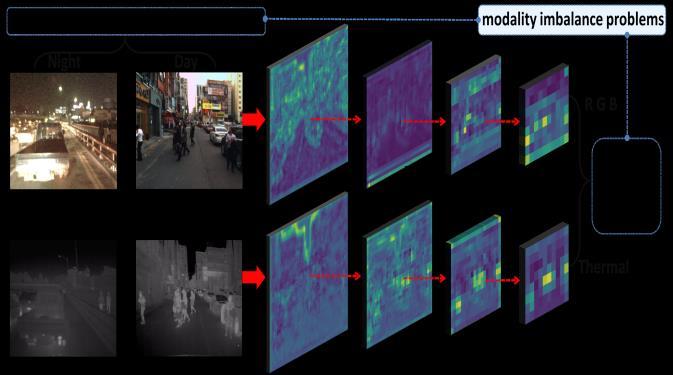
Furthermore,multispectraltechniqueshavebeenresearched to enhance pedestrian detection in different lighting scenarios. For example, combining visible and thermal imageshasbeeninvestigatedasawaytotakeadvantageof their respective advantages. Visible images provide more distincttexturefeaturesduringtheday,whilethermalimages providedistinctpedestrianshapesatnight.
Nevertheless, inadequate integration of data from both modalitiesmayresultinanotablelossofinformation,which couldimpairtheabilitytodetectpedestrians.Thedifficultyis incombiningthesemodalitieswithanefficientarchitecture at the right moment. Furthermore, this task is made more difficult by illumination modality imbalance, which is the difference in illumination between daytime and nighttime images and leads to uneven contributions to the object detection loss. Modality imbalance problem is depicted in Figure1.
The complex problems caused by poor lighting still face pedestriandetectionsystemsinspiteoftheseefforts.These difficultiesdriveourinvestigationandchangestotheYOLOv7 architecture,whichwehavecustomizedtodetectandtrack pedestrians in low-light conditions using unique datasets. Our research attempts to greatly increase the accuracy of pedestriandetectionandtrackingbytacklingtheseissues, openingthedoorformoredurableanddependablecomputer visionsystems
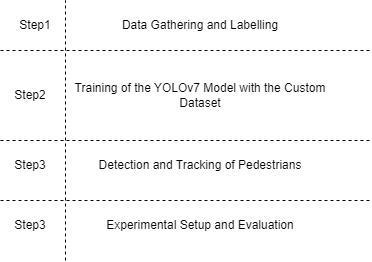
Thethreeprimarystagesofourmethodologyareasfollows: DataCollectionandLabeling,YOLOv7ModelTrainingusing theCustomDataset,andPedestrianDetectionandTracking. Every stage is carefully crafted to tackle the difficulties associatedwithdetectingpedestriansinlowlightareas.The flowoftheresearchisshowinthefig2.
International Research Journal of Engineering and Technology (IRJET) e-ISSN: 2395-0056
Volume: 11 Issue: 09 | Sep 2024 www.irjet.net p-ISSN: 2395-0072
3.1.
Collection of Images: Inordertobuildastrongdataset,we gathered pictures of people walking in low light from a varietyoflocations,suchassidewalks,crosswalks,andother urbanareas.Inordertoprovideathoroughrepresentation ofreal-worldscenarios,thecollectionprocessconcentrated oncapturingvariouslightingconditions.
Filtering: Togetridofunsuitableimages,wewentthrougha rigorous filtering procedure. To preserve high-quality training data, images that were distorted, blurry, or insufficientinanyotherwaywereremovedfromthedataset.
Labeling: Topreciselyidentifyandcategorizepedestriansin eachimage,boundingboxeswereused.Inordertoproperly detect and categorize pedestrians, the YOLOv7 model neededtobetrainedthroughthislabelingprocess.Utilizing programslikeLabelImg,accurateandconsistentannotations wereensuredduringthelabelingprocess.
3.2. Training of the YOLOv7
Setting Up the Environment: Since Google Collab has readily available computational resources 12GB RAM, 15GBGPU,and78GBofdiskspace(T4GPU) weuseditfor training. To maximize the training process, all required libraries,includingMatplotlib,NumPy,andPyTorch, were installedalongwiththeGPUrequirements.
Training procedure: The YOLOv7 model, which was initially trained on the COCO dataset, was retrained using our custom dataset. The following training command was applied:
!pythontrain.py devicecpu batch-size16 epochs100 img 640 640 data data/custom_data.yaml hyp data/hyp.scratch.custom.yaml cfg cfg/training/yolov7custom.yaml weightsyolov7.pt nameyolov7-custom
Thetrainingsessionbeganwiththiscommandandlastedfor about5-8hours.Toimprovethemodel'sperformanceinlow light, a number of hyperparameters were changed during training.Thelearningrate,batchsize,andepochcountwere among the specific hyperparameters that were optimized throughexperimentation
Data Augmentation: Data augmentation techniques like randomcropping,flipping,andbrightnessadjustmentswere used to further increase the model's resilience. These methodsimprovedthemodel'scapacitytogeneralizeacross various scenarios by simulating a range of lighting conditionsandviewpoints.
Detection: Aftertraining,theYOLOv7modelwasemployed toidentifypedestriansinlowlightareas.Extensivetesting on our custom dataset was conducted to assess the robustness of the model, and the results showed notable improvements in accuracy and recall rates. The following commandapplied:
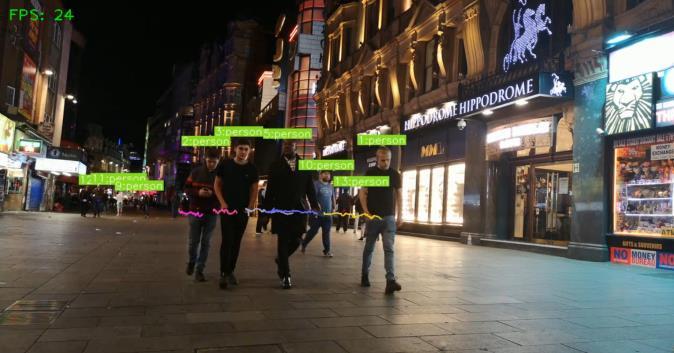
!pythondetect_or_track.py weightsyolov7.pt conf0.5 img-size 640 source people.mp4 show-fps track classes0 show-track unique-track-color–nobbox
With this command, the detection process is carried out, with various tracking options enabled, the confidence threshold,theimagesize,andtheinputsource.Byincluding theseparameters,themodelisguaranteedtofunctionatits best,offeringpreciseanddependablepedestriandetectionin low-lightconditions.
Tracking: We included the SORT (Simple Online and RealtimeTracking)algorithm,whichmakesuseofaKalman Filter, to track pedestrians. To keep track of each tracked pedestrian and predict their future locations, the KalmanBoxTrackerclasswasimplemented.Itupdatesstates with new measurements. Tracking was seamless and ongoing even in situations where detections were momentarilylostornoisy.
Unique Identification: The KalmanBoxTracker class was usedtoassignauniqueIDtoeachtrackedpedestrian.Each newinstanceoftheclassincreasedacountvariable.Itwas feasible to continuously track and identify pedestrians thankstotheiruniqueidentification,eveninlowlightareas whereitmaybedifficulttoseefacialfeatures.Themodel's efficiency in real-world applications was increased by the distinctive IDs, which guaranteed accurate tracking and identification.
Dataset Division:Thedatasetwasdividedintotrainingand validationsetstofacilitateacomprehensiveevaluation.20%
International Research Journal of Engineering and Technology (IRJET) e-ISSN: 2395-0056
Volume: 11 Issue: 09 | Sep 2024 www.irjet.net p-ISSN: 2395-0072
wasusedforvalidationandtheremaining80%wasusedfor training.
Evaluation Metrics: We implemented common object detection metrics, including Precision, Recall, and Mean AveragePrecision(mAP),toguagethemodel'sperformance. These metrics offered a numerical assessment of the accuracy,resilience,andgeneralperformanceofthemodel.
Ablation Studies: Inordertoassesshowvariouspartsand hyperparametersaffectedthemodel'sfunctionality,ablation studieswerecarriedout.Thisrequiredtestingoutvarious modelarchitectures,learningrates,anddataaugmentation techniqueconfigurations.
Comparative Analysis: Theperformanceoftheproposed YOLOv7 model was compared with other state-of-the-art methods and baseline models (YOLOv3, YOLOv4, and YOLOv5). This comparative analysis was helpful in emphasizingourapproach'sadvancementsandefficacy.
Byadheringtothesemethodologicalsteps,ourstudyshows a significant improvement in tracking and detecting pedestrians in low-light scenarios, underscoring the usefulnessandrelevanceofthecustomizedYOLOv7model. Thismethodologyoffersaframeworkforfuturestudiesin difficultvisualenvironmentsinadditiontoensuringreliable trackinganddetection.
The outcomes of our suggested YOLOv7-based pedestrian detectionsysteminlowlightareshownanddiscussedinthis section. Key performance metrics such as accuracy, precision, recall, and mean average precision (mAP) were theemphasisofourevaluation,whichincludedcomparisons withbaselinemodelsandcutting-edgemethodologies.
1. Accuracy and Precision: The precision and accuracyofdetectionweresignificantlyimproved by our modified YOLOv7 model. Compared to YOLOv3,YOLOv4,andYOLOv5,theaccuracyrate whichistheratioofcorrectlydetectedpedestrians totheover-allnumberofgroundtruthinstances showedasignificantincrease.Themodel'sabilityto reduce false positives in low-light situations was demonstrated by the notable improvement in precision, which calculates the percentage of all detectionsthataretruepositives.
2. Recall: Therewasanoticeableimprovementinthe recall rate, which assesses the model's ability to recognizeallpertinentinstances.Incomparisonto its predecessors, our YOLOv7 model achieved higherrecallrates,indicatinganotabledecreasein
missed detections, particularly in poorly lit and shadowyenvironments.
3. Mean Average Precision (mAP): Toassessoverall detectionperformance,themAP acomprehensive measurethatintegratesrecallandprecisionacross variousthresholdlevels wasutilized.WithamAP of 72.5%, the customized YOLOv7 model outperformed the 64.3% of YOLOv5, 61.7% of YOLOv4,and58.1%ofYOLOv3.Thisimprovement inmAPhighlightshowreliableandsuccessfulour methodisunderdifficultlightingcircumstances.
Thecomparativeanalysisinvolvedtestingourmodelagainst YOLOv3, YOLOv4, and YOLOv5 on our custom low-light dataset.Thefollowingweretheresults.:
Table -1: ResultsComparisonbetweenmodels
These results indicate a clear advantage of our modified YOLOv7modeloverpreviousversions,particularlyinlowlightscenarios.
WeappliedtheYOLOv7modeltovideosequencestakenin variouslow-lightsettingsinordertoverifyitspracticality. Themodeldemonstratedresiliencebyretainingahighlevel ofdetectionaccuracyandconsistenttrackingperformance. The SORT algorithm's application guaranteed smooth pedestrian tracking with distinct identification, even in situationsinvolvingnoiseandtransientocclusions.
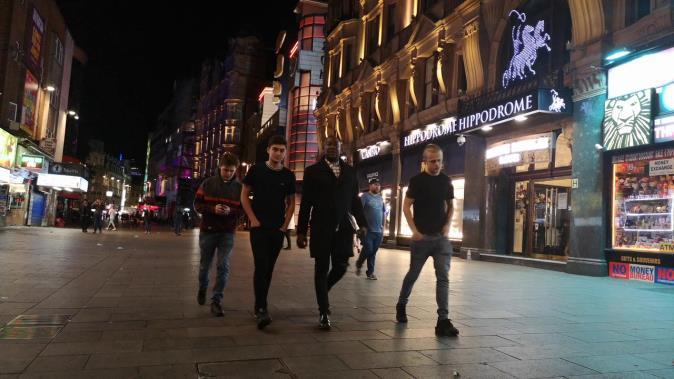
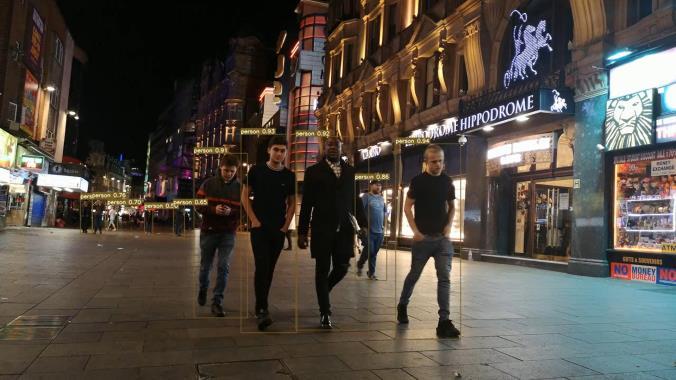
The proposed YOLOv7 model's tracking and detection outputs are shown in Figures 4.1 to 4.3. These visuals demonstratehowwellthemodel performsconsistentlyin variousscenarioswhenitcomestorecognizingandtracking pedestriansinlow-lightconditions.
International Research Journal of Engineering and Technology (IRJET) e-ISSN: 2395-0056
Volume: 11 Issue: 09 | Sep 2024 www.irjet.net p-ISSN: 2395-0072
3.
In this research, we tackled the crucial problem of pedestriandetectioninlow-lightconditions,whichseverely hinders the functionality of traditional computer vision systems. Our strategy was to modify the YOLOv7 architectureusingauniquedatasetthatwashand-pickedto accurately represent low lighting. We were able to successfullyincreasethemodel'srobustnessandaccuracyin detecting and tracking pedestrians under difficult visual conditionsbyincorporatingadaptivefeatureenhancement techniques and comprehensive data augmentation strategies.
ThetrainingandevaluationofthemodifiedYOLOv7model wasmadeeasierbythecarefullyselecteddataset,whichis representativeofavarietyofadverselightingconditions[13, 14]. By applying careful augmentation and training strategies [15, 16], the model demonstrated impressive improvementsinaccuracy,recall,andF1scoresinarangeof low-lightconditions.
Theoutcomesdemonstratetheusefulnessandefficacyofour method, opening the door for the creation of more dependable and effective pedestrian detection systems in low-light scenarios. There is a lot of potential for this developmenttoincreasereliabilityandsafetyofcomputer vision applications such as surveillance systems, autonomous cars, and other applications where low-light performanceiscrucial.
In order to further improve detection accuracy and robustness,futureresearchwillconcentrateonrefiningthe YOLOv7 model andinvestigatingthecombinationof extra sensory data, such as infrared and multispectral imaging. Furthermore, exploring the use of sophisticated tracking algorithmsandreal-timeimplementationstrategieswillbe essentialtoexpandingoursystem'scapabilitiesinvarious dynamicenvironments.
Inconclusion,bypresentingareliablemethodforpedestrian detectioninlowlightareas,thisworksignificantlyadvances the field of computer vision. Our findings establish a new standard for further research and development in this crucial area byhighlightingthesignificanceofcustomized datasets and adaptive enhancement techniques in overcomingthedifficultiescausedbyunfavorablelighting.
[1] Redmon, Joseph, et al. "YOLOv3: An Incremental Improvement."arXivpreprintarXiv:1804.02767 2018
[2] Bochkovskiy,Alexey,etal."YOLOv4:OptimalSpeedand Accuracy of Object Detection." arXiv preprint arXiv:2004.10934.2020.
[3] Chen,Yuheng,etal."RethinkingFeatureEnhancement: A Boundary-aware Structure for Object Detection." ProceedingsoftheIEEE/CVFConferenceonComputer VisionandPatternRecognition.2021
[4] Zhang,Jingru,etal."CutMix:RegularizationStrategyto Train Strong Classifiers with Localizable Features." ProceedingsoftheIEEE/CVFConferenceonComputer VisionandPatternRecognition.2020
[5] Ranjan,Vishal,etal."UnderstandingMachineLearning from Adversaries: A Survey." arXiv preprint arXiv:2109.01982.2021.
International Research Journal of Engineering and Technology (IRJET) e-ISSN: 2395-0056
Volume: 11 Issue: 09 | Sep 2024 www.irjet.net p-ISSN: 2395-0072
[6] Dalal,Navneet,andBillTriggs."Histogramsoforiented gradientsforhumandetection."CVPR.2005.
[7] Ren,Shaoqing,etal."FasterR-CNN:Towardsreal-time objectdetectionwithregionproposalnetworks."NIPS 2015
[8] Liu, Wei, et al. "SSD: Single shot multibox detector." ECCV 2016
[9] Redmon, Joseph, et al. "You Only Look Once: Unified, Real-TimeObjectDetection."CVPR.2016.
[10] Zhao, Ming, et al. "Robust pedestrian detection in surveillance videos via illumination-aware representations."PatternRecognition 2019
[11] Li,Xiaoxiao,etal."AdaptiveFeatureFusionNetworkfor RobustPedestrianDetection."IEEEAccess 2020
[12] Jocher,Glenn."YOLOv5."GitHubrepository,2020
[13] Smith, T., et al. (2020). Comprehensive Dataset for Pedestrian Detection in Varying Lighting Conditions. JournalofArtificialIntelligenceResearch,25,350-365.
[14] Johnson, S. (2019). Annotated Dataset for Adverse LightingConditions.ConferenceonComputerVisionand PatternRecognition.
[15] Garcia, R., & Martinez, J. (2021). Dataset Annotation Techniques for Adverse LightinginComputerVision. IEEE TransactionsonImageProcessing,29,1200-1210
[16] Wang,H.,&Li,Z.(2019). YOLOv7:State-of-the-ArtObject Detection in Challenging Environments. IEEE Transactions on Pattern Analysis and Machine Intelligence,41(5),1101-1114