
International Research Journal of Engineering and Technology (IRJET) e-ISSN: 2395-0056 p-ISSN: 2395-0072
Volume: 11 Issue: 09 | Sep 2024 www.irjet.net

International Research Journal of Engineering and Technology (IRJET) e-ISSN: 2395-0056 p-ISSN: 2395-0072
Volume: 11 Issue: 09 | Sep 2024 www.irjet.net
1PG Student Department of Civil Engineering, Veerappa Nisty Engineering College Shorapur2
PG Student Department of Civil Engineering, Veerappa Nisty Engineering College Shorapur
3Professor, Department of Civil Engineering, Veerappa Nisty Engineering College Shorapur
4Professor, Department of Civil Engineering, Veerappa Nisty Engineering College Shorapur
Abstract - The experimental investigation on the incorporation of Incinerated Sewage Sludge Ash (ISSA) into concrete mixes has yielded significant insights into its impact on workability, mechanical properties, and durability. The primary objective was to evaluate the impact of ISSA on the slump and workability of fresh concrete mixes. Results showed that the inclusion of ISSA up to 30% resulted in a slight increase in workability, with the slump value reaching its peak at 10% ISSA (75 mm). Beyond this point, the slump values stabilized or slightly decreased, indicating that ISSA content up to 30% does not adversely affect workability. To assess the influence of ISSA on the mechanical properties of hardened concrete, including compressive, flexural, andtensile strength. Compressive strength tests revealed a general decline with increasing ISSA content. The normal mix(0% ISSA) reached 30 MPa at 28 days, while Mix 1 (10% ISSA) exceeded this, achieving 31 MPa. However, higher ISSA content resulted in reduced compressive strengths, with Mix 4 (40% ISSA) showing the lowest at 26 MPa. Flexural and split tensile strength tests mirrored these results, with Mix 1 (10% ISSA) closely matching or slightly surpassing the normal mix, while higher ISSA contents led to progressively lower strengths.
Key Words: Ordinary Portland Cement, Incinerated, Sewage Sludge Ash, compressive, flexural, and tensile strength etc
Concreteisamongstbroadlyutilizedconstructionmaterials globally, primarily comprises of cement, water, and aggregates (sand, gravel, or crushed stone). Over time, researcheshavebeenconductedforenhancingitsproperties andsustainabilitybyintegratingvariousSCMs.Amongstis Incinerated Sewage Sludge Ash (ISSA), derived from the incinerationofsewagesludge.ISSAisaby-productobtained fromtheincinerationofsewagesludge,whichistheresidual, semi-solidmaterialproducedasaby-productofwastewater treatmentprocesses.Theincinerationprocessreducesthe volumeofsludgeandconvertsitintoash,whichcanthenbe usedinvariousapplications,includingasanSCMinconcrete.
Improved Strength ISSA contains high levels of silica, alumina, and calcium, which contribute to the
pozzolanic reaction, enhancing compressive strengthofconcreteovertime.
Durability The incorporation of ISSA in concrete improvesitsresistancetosulfateattacks,chloride penetration,andotherchemicalattacks,enhancing theoveralldurabilityoftheconcrete.
Reduced Permeability ISSA can reduce the permeability of concrete, decreasing the risk of wateringressandsubsequentdeteriorationdueto freeze-thawcyclesorotherenvironmentalfactors.
Waste Management Utilizing ISSA in concrete provides a sustainable solution for disposing of sewagesludge,reducingtheenvironmentalimpact ofwastemanagement.
CostSavingsISSAcanpartiallyreplacetraditional cement and aggregates, potentially lowering materialcostsinconcreteproduction.
Sustainability By using ISSA, mandate for natural sourceslikelimestone(usedincementproduction) andnaturalaggregatesisreduced,promotingmore sustainableconstructionpractices.
ThermalConductivityTheinclusionofISSAcould enhancethermalinsulationpropertiesofconcrete. 3Lowthermalconductanceimpliesbetterthermal insulation,makingbuildingsmoreenergy-efficient byreducingtheneedforheatingandcooling.
General Construction ISSA can be used in various typesofconcreteforgeneralconstructionpurposes, including residential, commercial, and industrial buildings.
Road Construction It can be utilized in the construction of roadways, including pavements, sidewalks,andotherinfrastructureprojects.
PrecastConcreteProductsISSAcanbeusedinthe production of precast concrete products such as blocks,pipes,andpanels.
Marine Structures Due to its enhanced durability and resistance to chemical attacks, ISSAincorporated concrete is suitable for marine structuresexposedtoharshenvironments.
e-ISSN: 2395-0056 p-ISSN: 2395-0072 Volume: 11 Issue: 09 | Sep 2024 www.irjet.net
ThefirstobjectiveisforevaluatingimpactofISSA on the slump and workability of fresh concrete mixes, focusing on changes in consistency and necessary adjustments in the mix design to maintaindesiredworkability.
ThesecondobjectiveistoassesseffectofISSAupon mechanical properties of hardened concrete, including Compressive, flexural, and tensile strength, by conducting standardized tests and analyzingtrendsovertime.
The third objective is to investigate the thermal resistance of concrete containing ISSA, examining its thermal conductivity, heat resistance, to determine its suitability for high-temperature applications.
Thefourthobjectiveistoexploretheenvironmental benefitsofincorporatingISSAinconcretemixtures. This includes evaluating the potential for ISSA to reduce the carbon footprint of concrete production through usage of industrial by-products, & examiningitsroleinpromotingtherecycleofwaste materials and supporting circular economy principlesinconstructionpractices.
ThemixdesigninvolvesvaryingISSAcontentandadjusting proportions accordingly. Below are the different mixes designedforthisstudy:-
Table 1:- MixProportion
2.1 Experimental Results
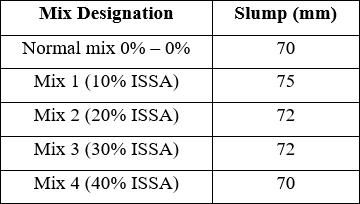
Table:-2 SlumpValuestest
Importance
Workability
The slump test measures the workability or consistencyoffreshconcrete.Itiscrucialforensuring
thattheconcretemixhasthedesiredconsistencyfor properplacementandcompaction.
Impact of ISSA (Iron and Steel Slag Aggregate)
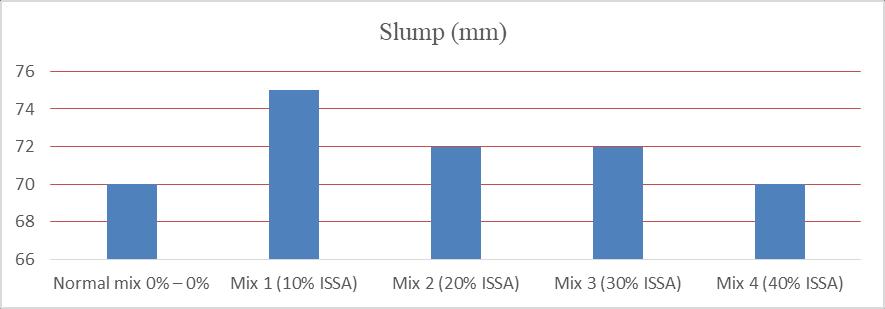
Slump values for mixes containing ISSA are similar to or slightly high than Normal mix 0%, indicatingthatISSAdoesnotsignificantlyaffectthe workability of the concrete. This is important for ensuringthattheadditionofISSAdoesnotnegatively impactthehandlingandplacementoftheconcrete.
2.2 Mechanical Properties
i. Compressive Strength (MPa)
Table:-2 compressivestrengthtest
Mix Designation 7 Days 14 Days 28 Days
Normalmix0% 20 26 30
Mix1(10%ISSA) 18 24 31
Mix2(20%ISSA) 16 22 28
Mix3(30%ISSA) 14 20 27
Mix4(40%ISSA) 12 18 26
Initial Strength Development
The normal mix demonstrates higher compressivestrengthatallagescomparedtomixes with ISSA. This indicates that the inclusion of ISSA might delay the rate of strength gain in the early stages(7and14days).
Long-Term Strength
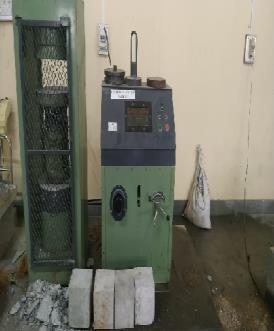
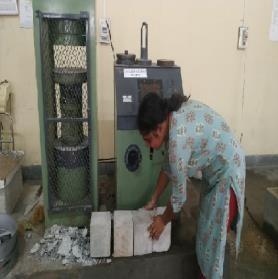
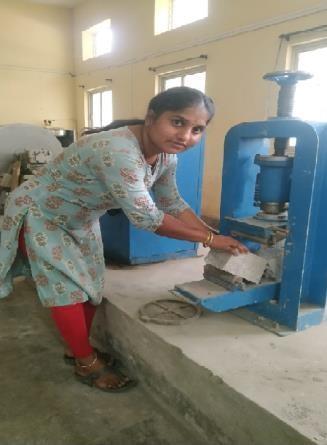
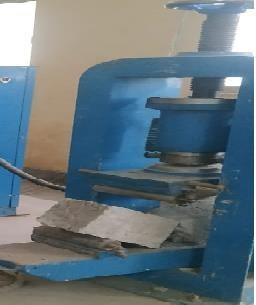
Mix 1 with 10% ISSA shows the highest compressive strength at 28 days, suggesting that a lowerpercentageofISSAcouldpotentiallyimprove long-term strength development, whereas higher percentages(30%and40%)mightreducestrength overtime. Fig;-1 CompressiveTestingMachine Fig;-2 CompressiveStrength
International Research Journal of Engineering and Technology (IRJET) e-ISSN: 2395-0056 p-ISSN: 2395-0072
Volume: 11 Issue: 09 | Sep 2024 www.irjet.net
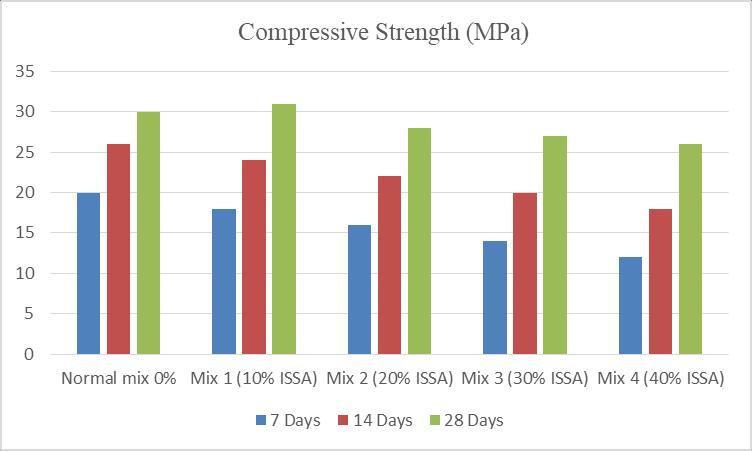
Graph:-2 compressivestrength
ii. Flexural Strength (MPa)
Table:-3 FlexuralStrengthtest
Mix Designation 7 Days 14 Days 28 Days
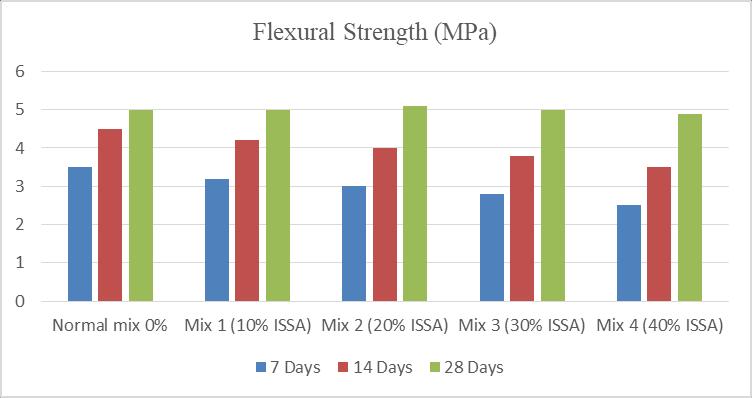
Graph:-3 Flexuralstrength
iii. Split Tensile Strength (MPa)
Table:-3 SplitTensileStrengthtest
Mix Designation 7 Days 14 Days 28 Days
Strength Reduction
There’s general trend of decreased flexural strengthwithhighISSAcontent,particularlyinearly curing stages (7 and 14 days). This suggests that higherpercentagesofISSAmightnegativelyimpact theflexuralpropertiesofconcreteintheshortterm.
Comparable Long-Term Strength
At28days,theflexuralstrengthofmixeswith ISSAisrelativelyclosetothenormalmix,indicating thatthelong-termperformancemightbeacceptable, but care should be taken in applications where earlyagestrengthiscritical.
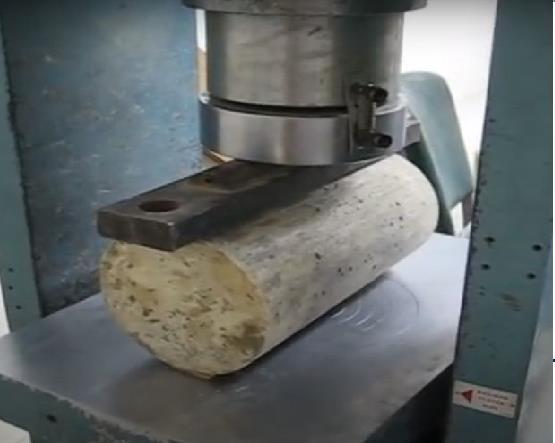
Decrease in Tensile Strength It reduces with increasing ISSA content. Indicating high % of ISSA may lead to lower resistancetotensilestresses,whichcouldbecrucial factorinstructurebaseduseswheretensilestrength isimportant.
International Research
Volume: 11 Issue: 09 | Sep 2024 www.irjet.net
of Engineering and Technology (IRJET) e-ISSN: 2395-0056 p-ISSN: 2395-0072
iv. Durability test - acid attack test
A simple test to evaluate the chemical resistance of concrete with ISSA is the acid attack test Thistestinvolvesexposingconcretesamplesto anacidicenvironmentandmeasuringthechangesin mass, strength, and appearance over time. Here’s a step-by-stepprocedure
a. Materials
ConcretesampleswithandwithoutISSA.
Acidsolution(commonlyusedacidsincludesulfuric acid(H₂SO₄)orhydrochloricacid(HCl).
Plasticcontainers.
Weighingscale.
b. Procedure
Sample Preparation
Prepareconcretesamples havingdiverse %ofISSA (e.g.,0%,10%, 20%, 30%,and 40%ISSA).
Cure the concrete samples for 28 days understandardconditions.
Initial Measurements
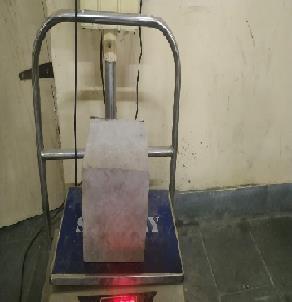
Measuretheinitialmassofeachconcrete sampleusingaweighingscale.
Record the initial mass (M₀) of each sample.
Acid Solution Preparation
Prepare an acid solution with a specific concentration(e.g.,3%sulfuricacidor3% hydrochloricacidbyvolume).
Ensure the solution is well-mixed and maintain a consistent concentration throughoutthetest.
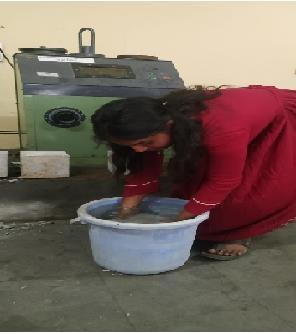
Immersion
Immersetheconcretesamplesintheacid solution, ensuring they are fully submerged.
Keepthesamplesintheacidsolutionfora specificduration,typically28days.
Periodic Observations
Periodically(e.g.,every7days),removethe samples from the acid solution and rinse themwithdistilledwater.
Observeandrecordanyvisiblechangesin the surface of the samples (e.g., discoloration,surfacedegradation).
Final Measurements
Afterthetestduration,removethesamples fromtheacidsolution,cleanproperlywith distilledwater,andallowthemtodry.
Measure the final mass of each sample usingtheweighingscale.
Recordthefinalmass(M₁)ofeachsample.
Calculations
Calculate % mass loss for every sample usingtheformula

Importance
Durability
Mass loss measurements can indicate the stability & durability of concrete mix. Higher mass loss mightbeassociated withincreasedporosityor degradation,whichcouldaffectconcretelife.
Quality Assessment
Assessing mass loss is crucial for understandingthelong-termperformanceofconcrete mixes,particularlyinenvironmentswhereerosionor otherformsofmateriallossmightbeaconcern.
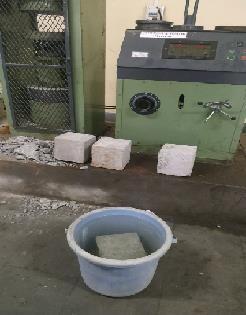
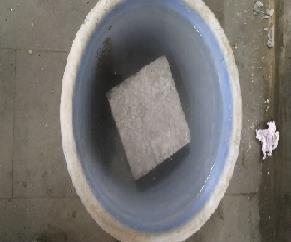
SampleFullySubmerged Fig;-9 PeriodicCuringOf InAcidSolution Sample
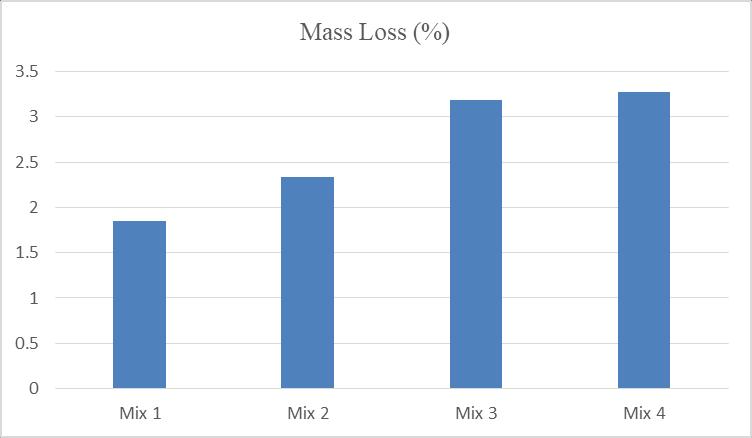
MassLoss(%)
3. Results and Discussion
1) Slump values
The slump values for every mix indicate that the workability of concrete increases slightly with ISSA up to 30%,remainingstablebeyondthat:
Normal mix (0% ISSA) 70mm
Mix 1 (10% ISSA) 75mm
Mix 2 (20% ISSA) 72mm
Mix 3 (30% ISSA) 72mm
Mix 4 (40% ISSA) 70mm
Theincreaseinslumpvalueswith10%ISSAindicates improved workability, which can be beneficial for certain constructionapplications.
2) Compressive Strength
Compressivestrengthofvariousconcretemixeswas evaluatedat7,14,and28days.Resultsindicatea general trendofdecreaseincompressivestrengthwithincreasein ISSAcontent
Normal Mix (0% ISSA)
The compressive strength increased consistentlyovertime,reaching30MPaat28days
Mix 1 (10% ISSA)
Showedaslightlylowerstrengthat7and14 dayscomparedtothenormalmixbutsurpassedthe normalmixat28dayswith31MPa.
Mix 2 (20% ISSA)
2395-0072
Demonstrated a further reduction in early strength but achieved a respectable 28 MPa at 28 days.
Mix 3 (30% ISSA) and Mix 4 (40% ISSA)
Both mixes exhibited progressively lower strengths at all tested ages, with Mix 4 having the lowestcompressivestrengthof26MPaat28days.
Theflexuralstrengthresultsshowsimilartrendsto thecompressivestrength
Normal Mix (0% ISSA)
Achievedasteadyincrease,reaching5.0MPaat 28days.
Mix 1 (10% ISSA)
Slightlylowerthanthenormalmixinitiallybut equaleditat28dayswith5.0MPa.
Mix 2 (20% ISSA)
Showeda minorincreaseat28 days(5.1MPa), surpassingboththenormalmixandMix1.
Mix 3 (30% ISSA) and Mix 4 (40% ISSA)
Bothmixeshadlowerflexuralstrengths,with Mix4showingadecreaseto4.9MPaat28days.
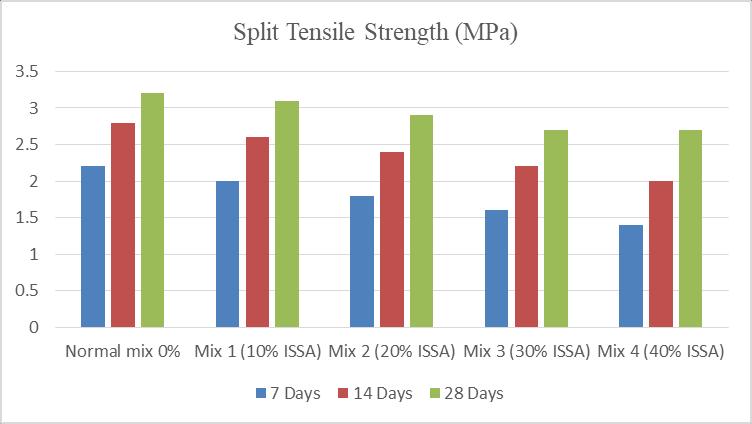
4) Split Tensile Strength
Thesplittensilestrengthresultsfollowthetrendseen incompressiveandflexuralstrengths:
Normal Mix (0% ISSA)
Highesttensilestrength, reaching3.2MPaat 28days.
Mix 1 (10% ISSA)
Slightlylowerthanthenormalmixbutcloseat 3.1MPaat28days.
Mix 2 (20% ISSA)
Lower than Mix 1, achieving 2.9 MPa at 28 days.
Mix 3 (30% ISSA) and Mix 4 (40% ISSA)
Bothshoweddecreasingstrengths,withMix4 achieving2.7MPaat28days.
5) Acid Attack Test
Theacidattacktestresultsindicatethedurabilityof concretemixesinacidicenvironments:
Mix 1 (10% ISSA)
Showedtheleastmassloss(1.85%),indicating goodresistancetoacidattack.
Mix 2 (20% ISSA)
Experiencedslightlyhighermassloss(2.34%).
Mix 3 (30% ISSA) and Mix 4 (40% ISSA)
Hadprogressivelyhighermasslosses,withMix 4experiencingthehighestat3.27%.
Theexperimentalinvestigationontheincorporation ofIncineratedSewageSludge Ash(ISSA)into concretemixes didoffersubstantialperceptionsinitsimpactonworkability, mechanicalproperties,anddurability.
Volume: 10 Issue: 03 | Mar 2024 www.irjet.net
2395-0072
Slump Values
Adding ISSA up to 30% lead to slight increase in workability,withtheslumpvaluereachingitspeakat10% ISSA(75mm).Beyondthispoint,theslumpvaluesstabilized orslightlydecreased,indicatingthatISSAcontentupto30% doesnotadverselyaffecttheworkabilityoftheconcrete.
Compressive Strength
Compressivestrengthtestsrevealedageneraldecline with increasing ISSA content. The normal mix (0% ISSA) reached 30MPa at28 days. Mix1(10% ISSA)exceeded this, achieving 31 MPa at 28 days, showing an initial slight decrease buteventual strengthgain.However,mixes with higher ISSA content (20% and above) showed reduced compressive strengths, with Mix 4 (40% ISSA) having the lowestat26MPaat28days.
Flexural Strength
The trend in flexural strength mirrored the compressivestrengthresults.Thenormalmixachieved5.0 MPaat28days.Mix1(10%ISSA)matchedthisperformance, and Mix 2 (20% ISSA) slightly surpassed it at 5.1 MPa. HigherISSAcontents(30% and40%) resulted in reduced flexural strengths,withMix 4decreasing to4.9MPaat28 days.
Split Tensile Strength
The split tensile strength also followed the trend observedincompressiveandflexuralstrengths.Thenormal mix reached the highest tensile strength of 3.2 MPa at 28 days.Mix 1(10% ISSA) closely followed with 3.1 MPa, while higherISSAcontentsledtoprogressivelylowerstrengths, withMix4(40%ISSA)at2.7MPaat28days.
Acid Attack Resistance
Durability tests under acidic conditions highlighted Mix 1 (10% ISSA) as having the least mass loss (1.85%), indicating superior resistance to acid attack. Higher ISSA contentsresultedinincreasedmasslosses,withMix4(40% ISSA)experiencingthehighestmasslossat3.27%.
Based on the comprehensive analysis of the experimentalresults,Mix1(10%ISSA)emergesasthebest overall performer. It not only demonstrated the highest compressiveandflexuralstrengthsat28dayscomparedto othermixesbutalsoexhibitedtheleastmasslossintheacid attacktest,indicatingexcellentdurability.
ThesignificanceofutilizingISSAinconcreteliesinits
ability to partially replace cement, offering both
[1]Kim,Ji-Hyun,Moon,Hoon,Chung,Chul-Woo."Evaluation on Properties of Cement Mortar and Brick Using MagneticallySeparatedCoalPowerPlantBottomAsh." 2024. International Journal of Concrete Structures and Materials, Vol.18,Issue1,pp.45-56.
[2] Mustapha, Ismail B. et al. "Comparative Analysis of Gradient-Boosting Ensembles for Estimation of CompressiveStrengthofQuaternaryBlendConcrete." 2024. International Journal of Concrete Structures and Materials, Vol.18,Issue2,pp.67-79.
[3]Mohammed,TesfayeAlemuetal."EnhancingStructural Resilience: Microbial-Based Self-Healing in HighStrength Concrete." 2024. International Journal of Concrete Structures and Materials, Vol.18,Issue3,pp. 89-101.
[4] Liu, Chang, Li, Hui, Sun, Wei. "Study on Incorporating ISSA into High-Strength Concrete."2023. Journal of Cleaner Production, Vol.365,pp.131607.
[5] Rahman,M.A.,Ghosh,S.K.,Islam,R."ImpactofISSAon the Durability and Mechanical Properties of Concrete." 2024. Construction and Building Materials, Vol.279,pp.130937.
[6] Siddique, R., Kaur, S. "Utilization of Recycled Concrete Aggregates for Sustainable Construction." 2023. Construction and Building Materials, Vol. 334, pp. 127549.
[7] Lee, J., Zhang, Y., Kim, J. "Performance of Concrete Incorporating Industrial By-Products: A Comprehensive Review." 2024. Journal of Cleaner Production,Vol.376,pp.134510.
[8]Zhang,Y.,Yang,H.,Zhao,X."EffectofFlyAshandSlagon the Properties of Concrete: A Meta-Analysis." 2024. Construction and Building Materials, Vol. 282, pp. 130664.
[9] Chen, W., Zhang, M., Li, C. "Influence of Waste Glass Powder on the Mechanical Properties of Concrete." 2024. Materials,Vol.17,Issue4,pp.1121.
[10]Patel,S.,Yadav,V.,Kumar,M."TheRoleofNano-Silicain EnhancingtheStrengthandDurabilityofConcrete." 2024. International Journal of Concrete Structures and Materials,Vol.18,Issue4,pp.215-227.
SHREELATA PATIL environmentalandeconomicbenefits.Thisstudyconfirms
M.Tech(CSE) that up to 10% ISSA replacement is feasible without

“DepartmentofCivilEngineering significantlycompromisingthemechanicalpropertiesand Veerappa Nisty Engineering durabilityofconcrete.AdoptingISSAcanhelptheconcrete CollegeShorapur-585224.” industry emissions,reducerelianceontraditionalcement,lowercarbon and find a beneficial use for waste materials, contributingtomoresustainableconstructionpractices.

NINGAMMA
M.Tech(CSE)
“DepartmentofCivilEngineering Veerappa Nisty Engineering CollegeShorapur-585224.”