
International Research Journal of Engineering and Technology (IRJET) e-ISSN: 2395-0056
Volume: 11 Issue: 09 | Sep 2024 www.irjet.net p-ISSN: 2395-0072

International Research Journal of Engineering and Technology (IRJET) e-ISSN: 2395-0056
Volume: 11 Issue: 09 | Sep 2024 www.irjet.net p-ISSN: 2395-0072
1HOD, Dept. of Civil Engineering MGMCET, Kamothe Navi-Mumbai.
2Assistant Professor, Dept of Civil Engineering MGMCET, Kamothe Navi-Mumbai.
3PG Student, Dept of Civil Engineering MGMCET, Kamothe Navi-Mumbai.
Abstract – Reinforcing steel, used in reinforced concrete worldwide, is expensive. As a result, there is a proposal to use bamboo as a reinforcement in concrete, in the form of culms or strips. Bamboo is a highly renewable and versatile resource, characterized by high strength and low weight, and is easily accessible using simple tools. Numerous studies are being conducted on the productivity and usage of bamboo as a reinforcement. This research paper specifically focuses on the performance of bamboo as a structural reinforcement for fivestory buildings under earthquake conditions. The necessary inputs for this research were obtained from experiments and used in the ETABS software to analyze earthquake cases.
Key Words: Earthquake, Bamboo, Reinforcement, ETABS, Experiments.
Generally, reinforcing steel is used as a rebar materialforconstruction.However,duetorisingconcerns aboutenergyandtheenvironment,searchesaregoingonfor non-polluting materials that need less energy. Finding a substitute using all types of waste or fiber is being developed.Inthisera,thechoicesofpeoplearecategorized on price and quality, but due to lack of awareness and knowledge aboutavailable materials,forces peopleto use industrializedmaterials.Whilemanufacturing1kgofsteel produces 1.85 tons of carbon dioxide, almost 8 percent of globalcarbondioxideemission,whileBambooemitsonly80 timeslesscarbondioxide.Steelcarbonfootprintsare2.2-2.8 kgCO2/kgand0.25kgCO2/kgforBamboo.Talkingaboutits mechanical properties, the tensile strength of Bamboo is quite high, and its specific weight is comparatively higher thanthatofsteel,makingitanattractivesubstituteforsteel. ForBamboo,thetensilestrength-to-specificweightratiois sixtimesgreaterthanthatofsteel.[1].
Generally, it is a common practice that an underreinforcedconcretesectionispreferredforadesigninwhich reinforcing materials yield first that of concrete material which helps to inform the occupants that the building is goingtohavefailuresoon.Bambooisalsoabrittletypeof reinforcingmaterialandfailureisnotacceptable,eitheran over-reinforced design is prescribed by which limited
ductility is achieved through concrete crushing [2], orthe limitofworkingstressneedstobekeptlowerthanthatof ultimatestrengthsuchthatreinforcedsectionprovidesclear information before it goes to failure.The average tensile modulusofGuduaAngustifoliatypebambooisontheorder of20GPA[3],thusthemodularratioEsteel/EBamboo=10.
Bambooismostcomparedwithwoodenproducts because of its similar chemical structure. However, the physical structure of Bamboo is not the same as other wooden members. Wooden products have anisotropic properties,andtheycontaingrainsthatareorientedinthe samedirectionthroughoutthecompletestructure. Onthe exterioredgeofeverynode,branchesformdifferenttypesof leaf structures that look like grass. Bamboo has parallel fibers that are reinforced along the axial direction of the Culm.
Bamboobehavesthesameaswoodandchangesits dimensionwhenitlosesorgainsmoisturecontent.Bamboo iscategorizedintohygroscopictypematerial.Themoisture content usually changes with having change in the correspondinghumidityandtemperatureofthesurrounding atmosphere[4].
BBendingisthemostimportantparameterasitis directly related to the material’s initial and ultimate strength. The bending property of any member is mostly dependent upon its cross size. Because of this ability, Bamboocanbetreatedasasubstituteforreinforcedsteelin theconstructionofbuildings[4]
2.4
TheenormouselasticityofBamboomaterialmakes itaverygoodbuildingmaterialforearthquake-proneareas. Also, Bamboo has very low weight. This helps for smooth transportandworkseasily,thustheuseofcranesandother bigmachinesbecomesunnecessary[4].
International Research Journal of Engineering and Technology (IRJET) e-ISSN: 2395-0056
Volume: 11 Issue: 09 | Sep 2024 www.irjet.net p-ISSN: 2395-0072
The fire resistance of Bamboo is very good. The contentofSilicateacidpresentinsideithelpstobecomea goodfireresistivematerial.IftheBambooisfilledupwith water,itcanstandatemperatureof400°Cwhilethewater cooksinside[4].
3.1 Experiment programmed
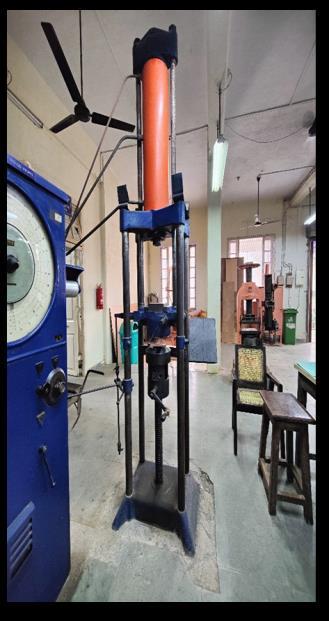
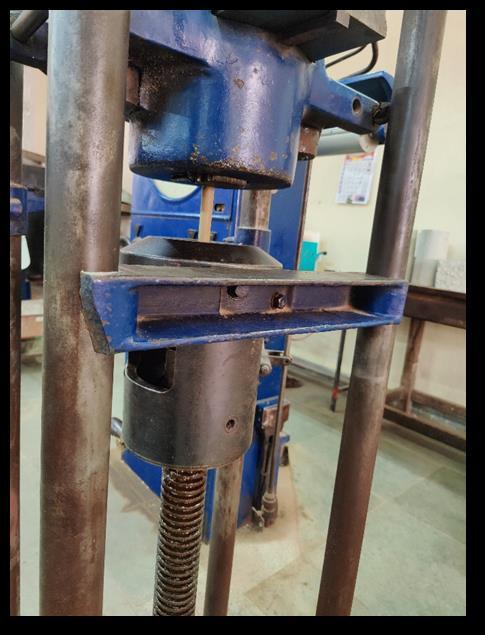
Theexperimentationhasbeencarriedouttoknow the tensile properties of Bamboo reinforcement. In this experiment, an elongation test was performed using code reference IS 6874:2008. For conducting this experiment, somepreliminarytreatmentswereperformedonBamboo surfaceslikesampling,chipping,andsmootheningofedges, etc.


3.1.1 Experimental methodology
ThreeBamboosamplesofdifferentdiameters i.e., 15mm, 18mm, and 24mm were used for finding yielding property using UTM (Universal Testing Machine). The selection of diameters was nominal just like using bar diameterforG+5storiedbuilding.
Table -1: TensilestrengthasperBamboodiameter
3.2 Software analysis
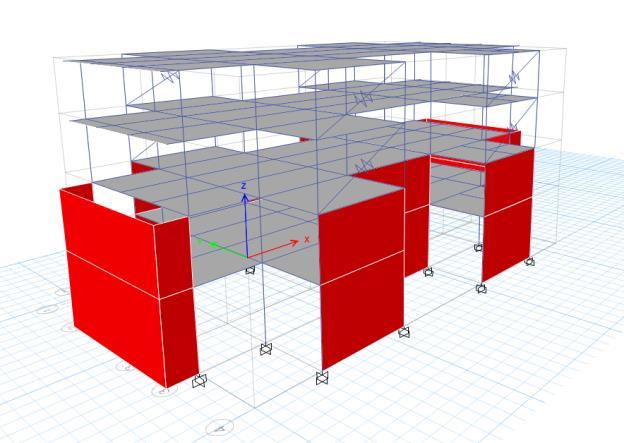
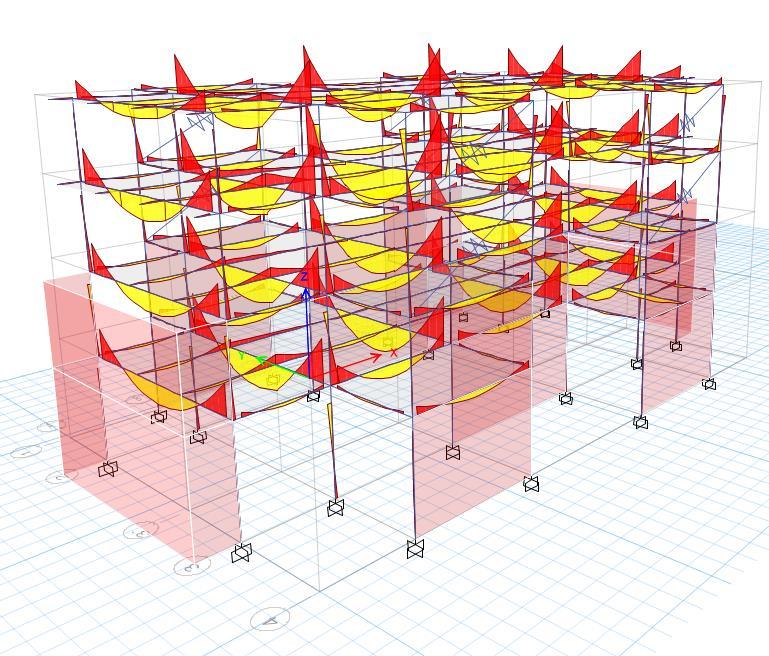
Software analysis was carried out using ETABS v 21.0software.A5-storybuildingwasmodeledinitwith2 basementfloors,1commercialfloor,and1residentialfloor respectively.Thetopmostfloorisassumedasarooflevel.
Nominalthicknesseswereassumedfortheslabas perconventionalIndianbuildingswhichis225mm.keeping theperspective,floorheightkeptat3.2meters.Aparapetof height1.0meterswasconsideredontherooflevel.Loadings wereassumedasperIS875:1987.
Table -2: Assumedarealoadings
3.2.1 Sectional assumptions
Slabs : 225mm
Beams : 250mmx550mmto 450mmx750mm
Columns : 500mmx1000mmto 750mmx950mm
Shearwalls : 400mm
Concretegrade : M50
International Research Journal of Engineering and Technology (IRJET) e-ISSN: 2395-0056
Volume: 11 Issue: 09 | Sep 2024 www.irjet.net p-ISSN: 2395-0072
3.2.2 Earthquake assumptions
Seismiczone :IV
Zonefactor,Z :0.24
Importancefactor,I :1
Soiltype :II
Responsereductionfactor,R :5
3.2.3 Load patterns and load cases assumptions
Table-3: Assumedloadpatternsandcases
Sr.no Load Type Codereferred
1 DL Dead -
2 LL Live -
3 SDL SuperDead -
4 ELX Seismic IS1893.2016
5 ELX+E Seismic IS1893.2016
6 ELX-E Seismic IS1893.2016
7 ELY Seismic IS1893.2016
8 ELY+E Seismic IS1893.2016
9 ELY-E Seismic IS1893.2016
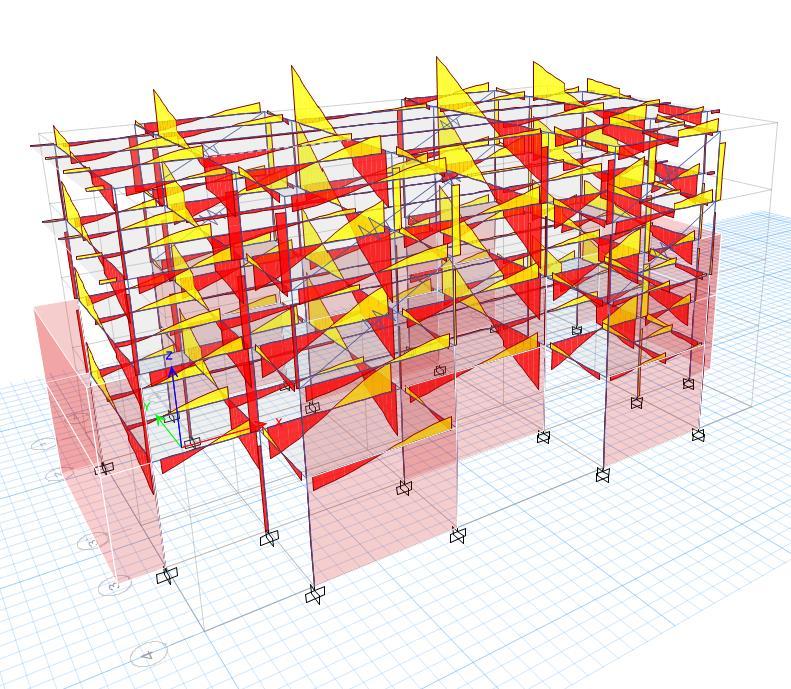
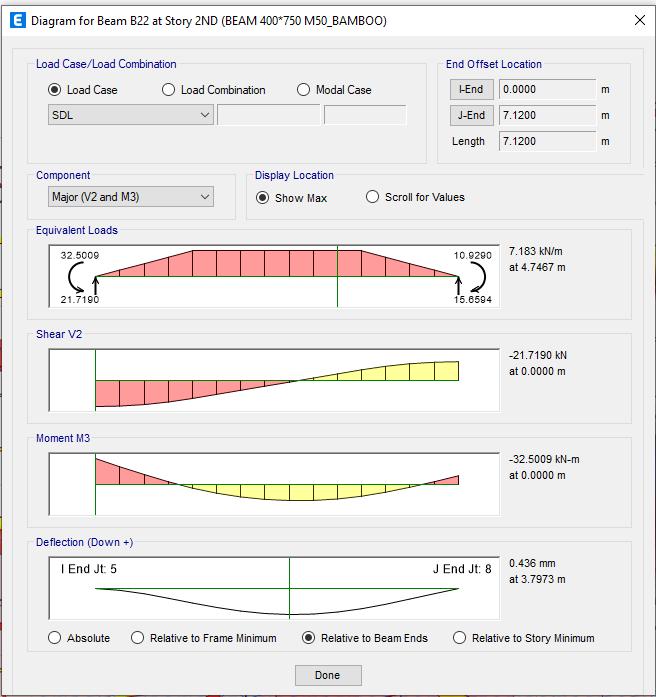
3.2.4 Analysis outputs
2024, IRJET | Impact Factor value: 8.315 | ISO 9001:2008 Certified Journal | Page82
Volume: 11 Issue: 09 | Sep 2024 www.irjet.net
4.1 Story Response
Table-4: StoryResponses
The study suggests that with proper design, detailing, and placement of dampers, bamboo-reinforced concretestructurescanmeetthenecessarysafetystandards forseismiczones.However,italsohighlightstheimportance of further research and real-world testing to optimize the designparametersandtoaddressanylong-termdurability concernsrelatedtobambooreinforcement.Also,Bamboo's rapid growth rate and low cost, coupled with the energyabsorbingcapabilitiesofdampers,provideacost-effective solution for earthquake-resistant structures. This combination not only reduces construction costs but also alignswithgreenbuildingpractices,contributingtolower carbonemissionsandreducedenvironmentalimpact.
b2 -8
4.2 Overturning moments
Table-5: Overturningmoments
4.3 Story drift
Table-6: Storydrift
[1] K. Ghavami, R. Hombeek. Mechanical properties and water-repellent treatment of bamboo. In: Latin AmericanSymposiumRationalOrganizationofBuilding AppliedtoLow-CostHousing.1.1981.49–55.
[2] AmericanConcreteInstitute(ACI)ACI440.1R-15guide for the design and construction of structural concrete reinforced with fibre-reinforced polymer (FRP) Bars. American Concrete Institute (ACI), Farmington Hills. 2015.
[3] CorrealJF.Bamboodesignandconstruction.In:Harries K,SharmaB(eds)Chapter14innonconventionaland vernacular construction materials: characterization, properties and applications. Woodhead (Elsevier) Publishing Series in Civil and Structural Engineering 2016;No.58.
[4] Shaw, A., (2012) “Characterization of engineered Bambooforbuildings”
[5] IS6874:2008“MethodoftestsforBamboo”.
[6] IS875:1987“Codeofpracticefordesignloads(other thanearthquake)forbuildingsandstructures”.
[7] IS1893:2016“CriteriaforEarthquakeresistantdesign ofstructures”.