
International Research Journal of Engineering and Technology (IRJET) e-ISSN: 2395-0056
Volume: 11 Issue: 09 | Sep 2024 www.irjet.net p-ISSN: 2395-0072

International Research Journal of Engineering and Technology (IRJET) e-ISSN: 2395-0056
Volume: 11 Issue: 09 | Sep 2024 www.irjet.net p-ISSN: 2395-0072
Elkhider B. E. Mohamed1,2 , Mohamed A. M. Elsawi 3 , Mazin A. B. Mahmoud3, Lina K. M. Abdelmahmoud3
1Assistant Professor, Department of Civil Engineering, University of Science and Technology, Omdurman, Sudan 2Assistant Professor, Department of Civil Engineering, Elnasr University, Omdurman, Sudan 3 Student, Department of Civil Engineering, University of Science and Technology, Omdurman, Sudan
Abstract - As a result of the construction industry's large expenditure, effective construction cost had become necessary. In order to estimate the expenses of building materials in Khartoum State, it is necessary to evaluate and determine whether ANNs is a viable instrument. The aim of this study is to evaluate the accuracy of artificial neural networks (ANNs) to calculate selected building materials prices in construction projects in Khartoum to decide ANNs ought to be used in the building sector. Four representative building projects across Khartoum State were selected, and the selected building materials expenses of those projects were then calculated. This information was gathered, loaded into MATLAB, and ANNs was created using the descriptive attributes as inputs and the corresponding building materials costs as the target output. The neural network then adjusted itself to try and predict the cost of the materials using the inputs that were provided. The cost created by the artificial neural network was compared to the actual cost after that. When the Neural Network outputs were compared to the real cost, it was discovered that there were absolute errors of 13.6%, 0, 2×10⁻⁶ %, and 10-9 % for each project., the maximum absolute inaccuracy stated is 1.73%, and the mean absolute percentage error is 0.44%. The authors advocate using an Artificial Neural Network to estimate building costs and urge its development with a wider scope and larger sample size.
Key Words: ANN, Costs, Building Materials, MATLAB, Khartoum.
Dueto of theconstruction industry'ssignificant spending, effective building cost management and/or quantity surveyingbecameessentialissue.Thisoccurstoensurethat a building project's resources are used to their maximum potential. Increasing cost performance is the fundamental objective of management for any building project, consequentlythecostcomponenttypicallytakespriority[2]
Aconstructionproject'sperformancehasahighcorrelation withthecapabilitytoefficientlyestimatespending,manage costs, and complete on time. [3][4] Mentioned that, to estimatematerialcosts,aquantitysurveyorsmustemploy the greatest tools available. Due to the irregular nature of
Sudanesemarketpricing,oneofthechallengesencountered by this research is that cost assessment in Sudan is often done through internal cost analysis. A procurement issue involving thoroughly documented preceding work to researchandevaluatethepre-andpost-executioncostsof constructionprojectsispresent.
Prices of materials may alter over the period of the construction project due to Sudan's irregular changes in hardcurrencyexchangeratesandthebank'slackoffunds. The accuracy of the estimate by the project's completion datemaybeaffectedbythesepricechanges.
ThisstudyseekstoexamineanddeterminewhetheranANN isa useful toolfor evaluatingbuildingprojectexpenses in Khartoum State, Sudan. A further goal of the study is to decidewhetherartificialneuralnetworksdeservetobeused inthebuildingsector.
Numerous studies have been conducted on the issue of estimatingconstructioncostsusingdeeplearningtechniques. [3]Attemptedtoforecastthepriceofcommunicationtowers inIraqusingamathematicalmodelbasedonamultifactor linearregressiontechnique.Inthisstudy,theauthorargued thattheMultifactorLinearRegressionTechnique(MLR),a powerful mathematical tool for demonstrating the engineeringinteractionbetweendependentandindependent variables,constitutedthemosteffectiveforecastingmodel. The study concluded that (MLR) outperforms more traditional methods for predicting the costs of communicationtowerconstructions,whicharelessspecific and prone to ambiguity. 90.1% accuracy was achieved in termsofcostestimation[5].
According to [3], deep machine learning algorithms can provide high levels of accuracy and a decent level of confidence when used in prospective tower construction projects. Nevertheless, this project would accomplish its objectives through the usage of artificial neural networks (ANN).Thestudyincludeddatafromavarietyofconstruction companies [6]. The study hypothesized that the variables investigated wouldhave a significantimpacton theANN's overallperformance.
International Research Journal of Engineering and Technology (IRJET) e-ISSN: 2395-0056
Volume: 11 Issue: 09 | Sep 2024 www.irjet.net p-ISSN: 2395-0072
Inanadditionalanalysis,501projectdatasetsfrom2005to 2015 were collected [7]. The overall costs for twenty-five construction-related activities were collected. For the purposesofthisstudy,ithasbeendeterminedthatusingtwo hiddennodesandthesigmoidactivationfunctionforhidden andoutputlayersresultedinthelowestpossibletestingand trainingerrorsaswellasthemaximumcorrelationinthecost estimationmodel.Thecorrelationresultshadanaccuracyof 94.91%,aprecisionof100%,andamarginoferrorof5.18%.
Theperformancewasratedasextremelygoodforpredicting buildingcosts[7]
Thisstudyincludesagreaternumberofinputs.Increasing theamountoftrainingandinputsoftenleadstoimproved accuracy.However,themajorityoftheseinputsaretypically unavailableearlyinthelifecycleofprojects.Althoughthese algorithmsarehighlyaccurate,theirusabilitydegrades.
As an illustration investigate [8], which used only eight inputs or features to predict building costs. These parameters were chosen after careful analysis of the experimental data. The analysis conclusions revealed that theeightselectedfactorswere"predominantcostdrivers." Asaresult,theywerechosentodesignandtrainthenetwork study.Otherdifferencesincludeusingasamplesizeofthirty sites,providingconstructioncostpersquaremeterrather than total construction cost, and focusing exclusively on multistoryresidentialcomplexes.Thestudyacknowledged thesignificanceof moreinputs andfoundthat integrating moreinputsmayimproveperformance.Despitethisfault, theformedneuralnetworkachievedanaverageaccuracyof 93%oversixsamples.
Thestudydiscoveredthatthenumberofexamplesisstrongly correlated with the neural network's performance in forecasting building expenses, resulting in a reduction in prediction error. "The necessity for specific project data, uncertainty about project development, changes in some design parameters, etc." have been highlighted as key disadvantagesoftraditionalcostestimates.
[8][9] Used 91 surveys to identify the input variables. However, only 19 datasets were utilized for the ANN's training and validation. This study focuses entirely on residential apartment buildings, but it also examines the neighborhoodanditsconcerns.Itarguesthatlatelytherehas notbeenmucheffortputintodeployingneuralnetworksin poorcountrieswhereconstructionisunderthreatowingto fluctuationsindirectcosts.Inordertoaccuratelyanticipate building expenses, relevant strategies were sought in this study.Othereconomicissueswerebrieflydiscussedinthe study, with a focus on the way the economy influences constructiongrowthandcapabilities.
DespitethechallengesofinflatingpricestomatchtheANN andthedataset'smodestsize,theproducedmodelregularly produced a Mean Absolute Percentage Error (MAPE) less
thanthepermitted10%.Thisstudydiscoveredthatevenif theANNmodelhadnotbeenthoroughlytested,academics and practitioners might still profit from it. The study also noted that the model may be enhanced by upgrading the weight matrix with more data from completed projects. It alsorealizedthatadditionalinputvariablesarenecessaryto improvethepredictionoftheneuralnetwork[9]
This research set out to obtain a minimum of four sample projectsthathavebeenplannedandbuiltinSudaninsideits capitalstateofKhartouminordertobeginanevaluationof constructionprojectsinKhartoum,Sudan.Onceobtained,the writersconductedanexactquantitysurveyontheexample projects. The four projects were multi-story residential buildings made of reinforced cement concrete. To avoid having results that varied greatly and made our analysis uncertain,wechoseonestyleofconstructioninonesector. Additionally, it helped the research become more focused. Thebelowflowchartillustratetheresearchprocess:
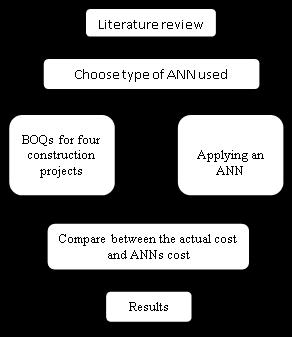
Chart -1: Researchflowchartprocess
3.1 Creating bill of quantities (BOQ)
BOQ was created in Excel, and the total overall construction costs of the projects were estimated upon projectconclusion.Allmaterial,labor,andequipmentcosts related with the projects are included in the total overall construction costs. The outcomes are shown in the table below:
International Research Journal of Engineering and Technology (IRJET) e-ISSN: 2395-0056
Volume: 11 Issue: 09 | Sep 2024 www.irjet.net p-ISSN: 2395-0072
Table -1: TotalConstructionCosts
Project TotalConstructionCost(SDGs)
G+1 61,645,361.00
G+2A 68,958,809.00
G+2B 53,254,006.00
G+3 96,555,559.00
Becauseofitsfamiliarityandreputationinthecreationof Neural Networks, MATLAB was chosen for the usage of generatinganANN.
Thedescriptionsthatwereusedtodeterminetheinputs the estimated total overall construction costs that determinedthetargetoutputsoftheneuralnetworkforeach multi-storybuilding,namelyGround+1floor(G+1),thefirst Ground+ 2floors building(G+2A),thesecondGround+2 floors building (G+2B), and the final building Ground + 3 floors(G+3)
Aspreviouslystatedinthischapter,whenusingdatain this manner, MATLAB does not function as intended. As a result,itwasmodifiedinordertobecompatible,asshownin thetablebelow:
Table -2: G+3QuantitativeInputs
Table - 3: TargetOutputs Project
G+2A
G+2B
G+3 96,555,559.00
Aftercompilingthenecessarydata,itwasimportedinto MATLAB'sworkspace.TheNeuralNetwork/DataManager, also known as the Neural Network Tool, which can be accessedbytyping"nntool"intothecommandwindow,may then simply import them. Next, select Import. The prompt will thenallocatethevariablesintothechosendestination withintheneuralnetworkdatamanagerafteryouassignthe InputvariableyouaddedtotheworkspacetotheInputData destinationandclickImport,aswellastheTarget Outputs variable you selected to the Target Data destination and clickedImport.
Theoutputsforthequantitativeneuralnetworkthatwas createdareshowninthefollowingTable:
Table - 4: QuantitativeNeuralNetworkOutputs
Project TotalConstructionCost(SDGs)
G+1 53,254,229.74
G+2A 68,958,809.00
G+2B 53,254,016.97
G+3 96,555,558,99
The maximum error was found to be 13.6% in the quantitativeassessment.Themeanabsolutepercentageerror for the quantitative neural network is 3.4%. These percentagesmeetthestudy'sgoalsandshowthatANNmay beausefultoolforcostestimationofresidentialconstruction projects,particularlyintheearlystagesoftheproject
This is owing to the Neural Network outperformed previousbackgroundresearch,whichfoundthattheerrorin estimating building project expenses in the early phases variedfrom-30%to+50%and-25%to+50%,respectively.
ThesevaluesgivenbytheANNarecomparedtotheactual estimatedtotalconstructioncostinthefollowingtable:
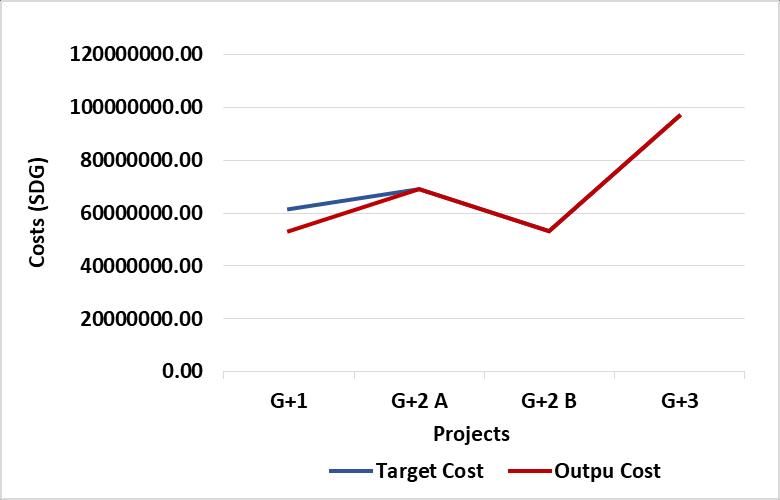
Fig -1:ComparisonbetweenQuantitativeTarget& OutputCost
International Research Journal of Engineering and Technology (IRJET) e-ISSN: 2395-0056
Volume: 11 Issue: 09 | Sep 2024 www.irjet.net p-ISSN: 2395-0072
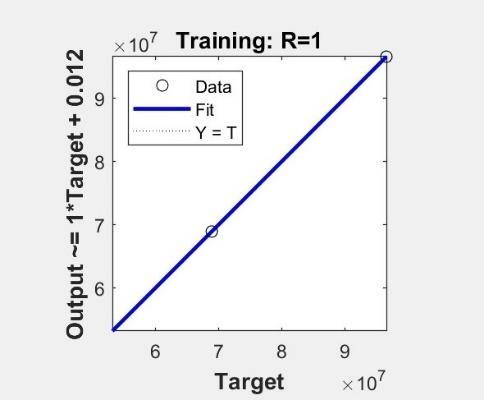
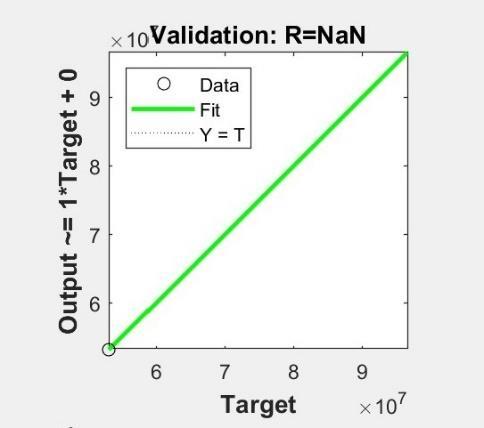
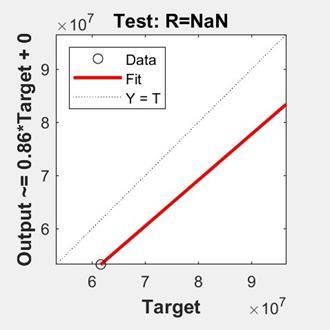
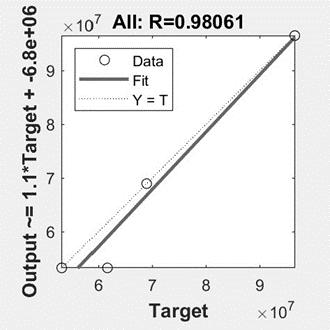
Theseresultswereobtainedaftersevenattemptstotrainthe neural network. Because our study only included four exampleprojects,onlyonecouldbevalidatedandanother examined.Asaresult,Rhasnovalueintheirrespectiveplots, asseeninFigures3and5.R=NaN(Notanumber).Iftheplot containedalloftheprojects,aregressionrelationshipmight be established. There is a very strong linear regression betweentheprojectsinthequantitativeassessment,withan R-value of 0.98061. This substantial correlation in quantitativeassessmentcanbeattributedtothetuningofthe weights in biases in neural network training, which was accomplished using random weight initialization and supervisedtraining.
The regressions of the iterations used are shown in the followingfigures:
5. CONCLUSIONS
TheresearchstudydemonstratedthattheNeuralNetwork exhibited absolute error rates of 13.6 %, 0, 2×10⁻⁶ %, and 10-9%whencomparedtoactualcostsindifferentprojects. Prior research has found that the maximum absolute inaccuracyis1.73%,whiletheaverageabsolutepercentage erroris0.44%.ThisindicatesthattheaccuracyoftheANNs created for the sample of construction projects costs is relativelyhighanddeemedacceptable.Theauthorsurgefor thecreationofalargerartificialneuralnetwork.
[1] AACEI,2021.CostEngineeringTerminology.s.l.:AACE International.
[2] Abd,A.M.,Jasim,N.A.&Naseef,F.S.,2019.FinalCostof Iraqi Construction Project Using Artificial Neural Network.IndianJournalofScienceandTechnology.
International Research Journal of Engineering and Technology (IRJET) e-ISSN: 2395-0056
Volume: 11 Issue: 09 | Sep 2024 www.irjet.net p-ISSN: 2395-0072
[3] Al-Zwainy, F. M. & Hadhal, N. T., 2016. Building a Mathematical Model for Predicting the Cost of the Communication Towers Projects Using Multifactor LinearRegressionTechnique.InternationalJournalof ConstructionEngineeringandManagement,pp.25-29.
[4] Barbosa, F. et al., 2017. Reinventing construction through a productivity revolution, s.l.: McKinsey & Company2017.
[5] Elbeltagi,E.,n.d.Chapter4CostofConstructionLabor andEquipment.In:CostEstimating.s.l.:s.n.,pp.64-96.
[6] Gündayen,H.M.&Dogan,S.Z.,2004.Aneuralnetwork approach for early cost estimation of Structural systems of buildings. International Journal of Project Management,pp.595-602.
[7] Haykin, S., 2009. Neural Networks and Learning Machines.NewJersey:PearsonEducationInc.
[8] Luu,V.T.&Kim,S.-Y.,2009.NeuralNetworkModelfor ConstructionCostPredictionofApartmentProjectsin Vietnam.KoreanJournalofConstructionEngineering andManagement.
[9] Lu,W.,Lai,C.C.&Tse,T.,2019.BIMandBigDatafor ConstructionCostManagement.NewYork:Routledge.