
International Research Journal of Engineering and Technology (IRJET) e-ISSN: 2395-0056
Volume: 11 Issue: 09 | Sep 2024 www.irjet.net p-ISSN: 2395-0072

International Research Journal of Engineering and Technology (IRJET) e-ISSN: 2395-0056
Volume: 11 Issue: 09 | Sep 2024 www.irjet.net p-ISSN: 2395-0072
Arushi Ahuja1
1Student, Kunskapsskolan Gurgaon, Haryana, India
Abstract - A muon is another entity categorized as a lepton among the many elementary particles. Like an electron, a muon consists of a charge of -1e and a spin of ½, but with greater mass. Muons exist as mere by-products of cosmic ray collisions with the particles in the Earth's atmosphere. Over ten thousand cosmic muons reach every square meter of the Earth's surface each minute. Experimental findings about cosmic muons indirectly provide us with information about the properties of cosmic rays. The purpose of this project is to propose an innovative and unique method of detecting cosmic muons. This method utilizes the emission of Cherenkov radiation as an indicator for detecting cosmic muons. Cherenkov radiation's emission occurs when a charged particle travels through a dielectric medium at a speed faster than that of light in a vacuum. The emission of a characteristic blue light can identify it. The experimental setup proposed in this project consists of photodiodes in a light-proof container filled with water to detect these blue light pulses. Since cosmic muons will travel faster than light in water, they will emit blue light pulses, confirming their detection. In order to make the inquiry automated, the light pulses are counted via an Arduino circuit. Furthermore, a predictive machine learning model is developed to predict the number of pulses detected (~120 in one hour).
Key Words: MachineLearning,CosmicMuon,Arduino
1.INTRODUCTION
Like an electron, a muon consists of a charge of -1e and a spinof½,butwithgreatermass(~207times).Sinceitisa lepton,itdoesnotcontainanyotherparticles.Hence,itisa fundamentalparticle.Ithasameanlifetimeof2.2μs,much longer than other elementary particles. Due to being an elementary particle, its decay is only mediated by weak interactionforcesandisslow.
Moreover, a muon decay almost always produces at least three particles (electrons and two types of neutrinos). In an electromagnetic field, muons accelerate slower than electrons due to greater mass, providing them the required energy to penetrate materials far more profoundly than an electron. Due to this inherent property, a cosmic muon can penetrate the atmosphere, reachEarth'slandsurface,andevenintodeepmines.
Cosmic muons exist as mere by-products of cosmic ray collisions with the particles in the Earth's atmosphere. Over ten thousand cosmic muons reach every square meter of the Earth's surface each minute. Experimental findings about cosmic muons indirectly provide us with informationaboutthepropertiesofcosmicrays.
Muonshavebeenthesubjectofintensescientificresearch for their unique properties and practical applications. Theyhavebeeninstrumentalinexperimentaltestsoftime dilation, enabling nuclear fusion at room temperatures, and creating alternate (muonic) versions of atoms. In a recent breakthrough,cosmic muonradiographyhasaided archaeologists in navigating corridors inside the Great Pyramid of Giza, showcasing the diverse applications of muonsinscientificresearch.
Cherenkov radiation is emitted when electrically charged particles travel at a speed faster than that of light in a transparent medium like water. These charged particles excite the water molecules in their path, which causes photonsto bereleasedand emit blueorvioletlight. Since the particles are moving faster than the speed of sound, they create a "shockwave" of visible light. An analogy to explain this phenomenon would be the sonic boom generated by a supersonic aircraft. Just as the sound wavesgeneratedbyanaircraftareslowerthantheaircraft itself, creating a sonic boom, the photons emitted by the charged particles in Cherenkov radiation are slower than theparticles,creatingasimilarshockwaveoflight.
The discovery of Cherenkov radiation in 1958 by the esteemedscientistPavelCherenkovwasapivotalmoment in the field of physics. During an experiment, his keen observations led him to observe a bluish light around a radioactivepreparation. Theseobservations,coupledwith his understanding of the anisotropy of the radiation, led himtoconcludethatthebluishglowwasnotafluorescent phenomenon, but a new and significant discovery in the worldofphysics.
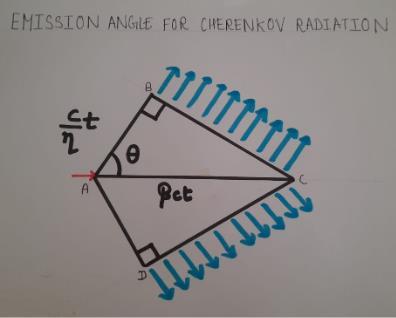
In the given figure (Fig 1.1), the charged particle (red arrow) travels with speed Vp through the medium. The
International Research Journal of Engineering and Technology (IRJET) e-ISSN: 2395-0056
Volume: 11 Issue: 09 | Sep 2024 www.irjet.net p-ISSN: 2395-0072
ratio between the speed of light and that of the particle couldbedefinedas��.
Thus,
�� (eq.1)
Additionally, the emitted light waves travel at a speed of ,where��istherefractiveindexofthemedium = c��
(eq. 2)
Vertex A represents the particle's position at an arbitrary point in time (t), assuming t=0. Now, at some other point in time (t=T), the distance traveled by the particle is (AC) = = ��ct
(From eq. 1)
Onthecontrary,thewavesemittedbythatparticletravel thedistance (AB).
= t = �� t
(From eq. 2)
FromtheFigure1.1,theemissionangle��isequalto: Cos
There are two fundamental methods to produce a muon. The first method involves cosmic ray collisions, a natural source of muon production. The second method uses a particle accelerator, where an H+ ion is accelerated to collide with the target particle (e.g. Lithium nuclei). This collision leads to a pion decay, which produces various pion variations. It's important to note that a pion is produced80%ofthetime,whileananti-pionisproduced only 20 % of the time. When a pion is contained in a vacuum, it spontaneously decays (after 26 nanoseconds) intoamuonandaneutrino.
Muonsbondwithatomslikehydrogenandcarbonexactly like electrons do; however, they are not bound by Pauli’s exclusionprinciple.Inotherwords,theycancombinewith anatom’sorbital valence even though theyare filled with and already filled with electrons. Once an electron occupies an atom’s orbital, it interacts (later combines) with the protons inside it. This process transforms the muon into a neutron and releases energy from a host particlecalledaneutrino.
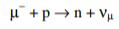
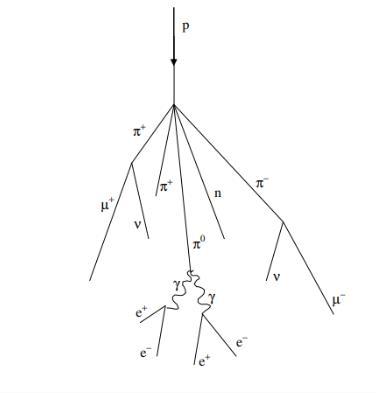
Figure 1.2:Cosmicraycascadeinducedbyacosmicray protonstrikinganairmoleculenucleuspresentinthe atmosphere.
Depending on whether or not the muon has combined witha proton,a muon’saveragelifetimeinsidea material candiffer.Bycomparison,negativelychargedmuonshave a shorter lifetime than positively charged muons since theytendtocombinewiththetargetatom’sprotondueto electrostatic attraction. At the same time, the positively charged muon tends to push away the target atom’s proton due to electrostatic repulsion. Furthermore, the probability of a muon combining with the target atom’s proton depends on the atomicnumber ofthat element.In other words, the more protons are available, the more chancesamuoncombineswiththeproton.
International Research Journal of Engineering and Technology (IRJET) e-ISSN: 2395-0056
Volume: 11 Issue: 09 | Sep 2024 www.irjet.net p-ISSN: 2395-0072
Inthegraphbelow(Fig1.3),thex-axisrepresentsthetime intervalwhenthemuonpenetratesthetargetmaterialand when it decays, respectively. In contrast, the y-axis represents the number of muons. Approximately 1000 muons were initially available in the medium; however, the number started to fall dramatically within a few microseconds. However, the difference to note comes when comparing the slopes of the positively charged muonsversusthenegativelychargedmuons
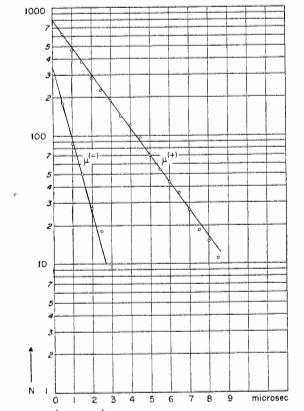
Figure 1.3 : Disintegration curves for positive and negative muons in aluminum. The ordinates at t = 0 can be used to determine the relative numbers of negative and positive muons that have undergone spontaneous decay. The slopes can be used to determine the decay time of each charge species. (From Rossi, p168.)
The line representing positive muons, assume as A, starts atay-interceptrepresentingapproximatelyeighthundred muons. On the other hand, the line representing negative muons,assumeasB,hasay-interceptrepresentingalmost three hundred muons, and that number starts to decline, too.Overall,itisevidentthattheslopeoflineAislessthan that of B. In other words, the negative muons disappear faster than the positive ones. Negative muons can do this because of their advantageous electrostatic attraction towards an atom’s protons, which later results in the formationofaneutron.
As discussed previously, any particle that travels at a speed faster than that of light will emit Cherenkov radiation. These muons will polarize the molecules in the medium and cause them to emit photons in the form of Cherenkov radiation. In this project, we use this property
of Cherenkov radiation to detect cosmic muons. Since cosmic muons pass through almost any substance, they will emit Cherenkov radiation if we isolate them to travel faster than light. In this experiment, water is used the mediumtoobserveandmeasurecosmicmuons. Sincethe refractiveindexofwatermakeslighttravelataspeedless than3x10^8m/s.Despitethespeedofmuonsbeingless than the speed of light, it still is more than the speed of lightinwater.
Ourexperimentalsetupinvolvesalight-prooftinboxfilled with tap water, serving as the detection medium. Inside this container, a photodiode is strategically positioned to detect Cherenkov radiation each time a cosmic muon passesthroughthebox.Thesephotonsarethenconverted into electrical signals and counted by the 555 IC Timer, which plays a crucial role in automating the process of counting each blue light pulse, representing the emitted Cherenkovradiation.
The tin container was sealed to light passing through it usingM-Seal,M-Sealisamulti-purposesealantthatcanbe used to fill and seal gaps, cracks, and holes in almost any surface. It has various industry applications including sealing joints in PVC pipesand fixing water leaks.Asmall holewasdrilledinthecornerofthecontainertoplacethe photodiode through it. The photodiode was placed on the sideofthecontaineratasufficientdepthtosubmergeand orienttowardsthewatersurface.Thephotodiode'sanode was connected to the Arduino UNO's analogue input pin via a jumper wire. Its cathode was to the GND pin of the microcontroller. The LED's anode was connected to a digital pin on the board via a resistor (220 ohms) and anotherjumperwire.Similarly,itscathodewasconnected to a GND pin.The VCC pin of the 555 Timer IC was connectedtoa5VpinontheArduinousingajumperwire. The GND pin of the 555 Timer IC was connected to the GNDpinontheArduino.TheOUTpinofthe555TimerIC was connected to a digital pin on the Arduino using a jumper wire. The battery's anode was connected to the VCC pin on the breadboard. The battery's cathode was connected to the GND pin of the breadboard. On a laptop, Arduino IDE was installed and a program was written to count the number of times the photodiode detects a light pulse , i.e detects a cosmic muon, consequently blinking the LED.The program was uploaded into Arduino UNO.With this modified setup, one can detect cosmic muons using Cherenkov radiation without an amplifier. Detailed records were taken of the number of muons detectedperminuteandhouratdifferenttimesoftheday. The tin container in different environments (e.g., ambient light), and materials to observe the fluctuations in the numberofmuonsdetectedbythesetup.
International Research Journal of Engineering and Technology (IRJET) e-ISSN: 2395-0056
Volume: 11 Issue: 09 | Sep 2024 www.irjet.net p-ISSN: 2395-0072
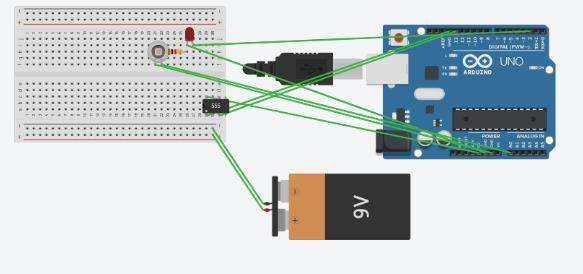
Figure 2.1:Simulationoftheproposedsetupon Tinkercad(9VBattery,ArduinoUno,Photodiode,555IC Timer,LED,220OhmResistor,JumperWires)
Thepurposeofthisexperimentwastoevaluatetheimpact of external light sources on the accuracy of our readings. Thereadingsweretakenintwodifferentsets(Figure6):
Reading Set 1 consisted of readings taken at noon undersunlight.
ReadingSet2consistedofreadingstakenatnightina darkroom(9pm).
Each reading set consists of two cases: Case 1 (readings taken every 5 seconds) and Case 2 (readingstakeneveryminute).
Eachcaseconsistsof60readingstaken.
To make plotting the graph automated and minimise errors, the readingswere noted downinExcel,saved asa .csv file, and later plotted on the graph using a Python LibrarycalledMatplotlib
3. OBSERVATIONS
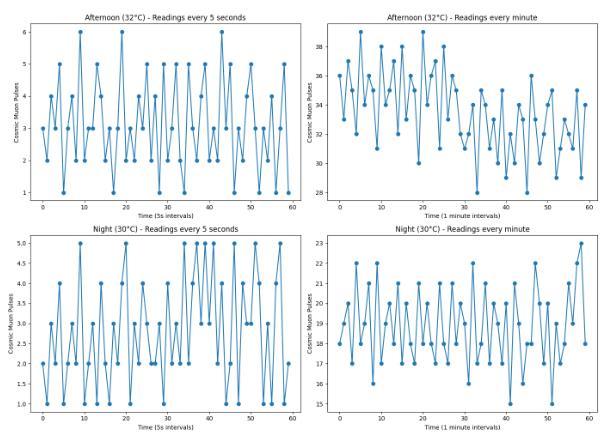
3.1:MatplotlibgraphofcosmicpulsesVstime interval
In Figure 3.1, the y-axis denotes the number of cosmic muonpulsesdetected.Ontheotherhand,thetimeinterval isgiven by the x-axis. This graphhelps us understand the significance of the light from external sources (e.g., sunlight) that influence our readings. Despite the photodiode being placed in a light-proof container, the sunlight in the afternoon (12 pm) did influence the readings taken, as observed by the stark contrast in the number of cosmic pulses detected at night (9 pm). This indicates that our Arduino setup had misinterpreted nearby light signals as cosmic pulses. Thus, for this setup toaccuratelydetectcosmic muon pulses,it needsto be in asystemwithoutexternalformsoflight.
In order to develop a machine learning model to predict thenumberofcosmicmuonsdetectedbythesetupaftera specific time interval, we would need to bifurcate the readings collected by the experiment into training data andtestingdata.
Thus,thirty readings weretakenfrom eachcase to create them into training data. Training Data is a data set for which our model has both x-axis and y-axis values. After writing the Python script using libraries such as Numpy andPanda,themodelcreatedisprovidedwiththetesting dataset(30otherreadingsforeachcase).
The following thirty readings act as the x-axis values for the model for which the y-values are missing. The model wecreatedwillpredictwhatthosethirtyreadingswillbe. Bycomparingthey-axisvaluesintheobservationtableto those predicted by our model, we can calculate the accuracy of the machine learning model. Usually, a machine learning model utilising data on this small scale uses Linear Regression. However, to increase the model, we have utilised the Random Forest Regressor algorithm. Throughout the different figures (Figure 3.2- Figure 3.5), theaverageaccuracythatwehavereceivedis97.98%.
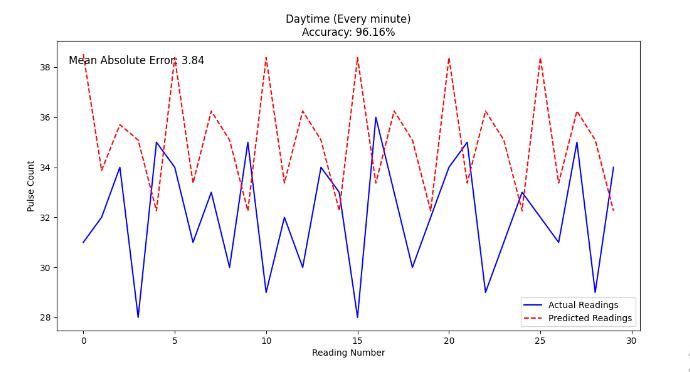
3.2:PredictivemodelforDaytimeReadings (perminute)
International Research Journal of Engineering and Technology (IRJET) e-ISSN: 2395-0056
Volume: 11 Issue: 09 | Sep 2024 www.irjet.net p-ISSN: 2395-0072
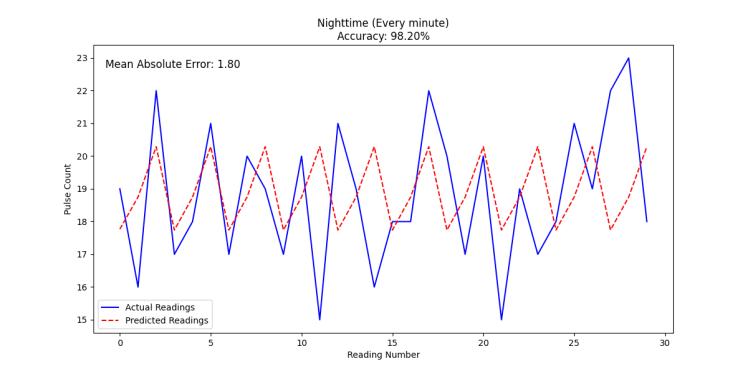
3.3:PredictivemodelforNighttimeReadings (perminute)
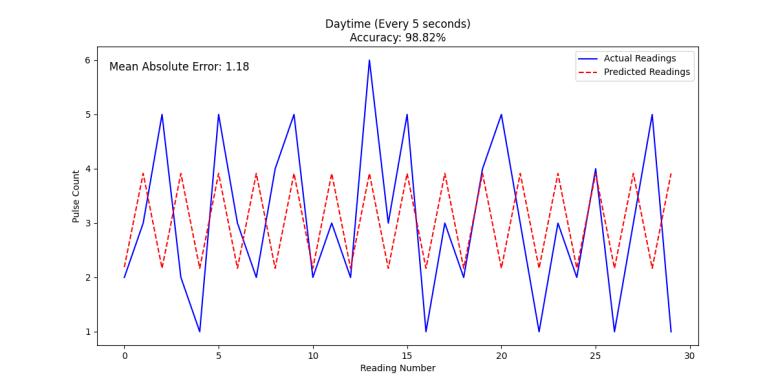
3.4:PredictivemodelforDaytimeReadings (everyfiveseconds)
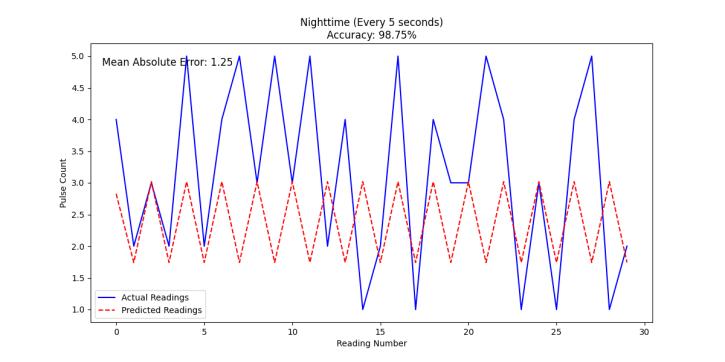
Figure 3.5:PredictivemodelforNight-TimeReadings (everyfiveseconds)
4. CONCLUSIONS
Thefutureapplicationsofthisparticularsetuprangefrom being an educational tool to being a portable device for radiation monitoring. This novel approach to detect cosmic muons could potentially be showcased in educational institutions to explain the key concepts of radiation detection and particles. It provides students witha hands-on approach towards learning scientific concepts. Constructing this setup also involves a student
2024, IRJET | Impact Factor value: 8.315 |
understanding principles of electrical engineering, computer programming and experimental physics. A modified version of this setup consisting of temperature sensors,geigercounter,oscilloscopeandaphotomultiplier tube could also be used for radiation and environmental monitoring.Itcould provideuseful insightsabout present atmosphericconditionsandvariationsincosmicradiation levels.
[1] Coan, T.E., and J. Ye. “Muon Physics,” n.d. https://web.njit.edu/~sirenko/Phys450/MU.pdf.
[2] Hunt, Charles. “Studies in Cosmic Ray Muons,” n.d. https://physics.okstate.edu/people/facultydirectory/93-pages/540-benton-rpl-studies-incosmic-ray-muons.
[3] Tanaka, Hiroyuki. “Muometric Positioning System (μPS) with Cosmic Muons as a New Underwater and Underground Positioning Technique.” Scientific Reports, November 3, 2020. https://doi.org/10.1038/s41598-020-75843-7.K.