
International Research Journal of Engineering and Technology (IRJET) e-ISSN: 2395-0056
Volume: 11 Issue: 09 | Sep 2024 www.irjet.net p-ISSN: 2395-0072

International Research Journal of Engineering and Technology (IRJET) e-ISSN: 2395-0056
Volume: 11 Issue: 09 | Sep 2024 www.irjet.net p-ISSN: 2395-0072
Suhruth B1
1Tata Consultancy Services
Abstract - - Human Activity Recognition (HAR) plays a pivotalroleacrossa broadspectrumofapplications,ranging fromhealthcaremonitoringtoenhancingsecuritysystemsand refining human-computer interaction. This research introduces an advanced ensemble approach that integrates multiple Convolutional Neural Networks (CNNs), each engineered to extract unique features and representations from benchmark datasets encompassing a variety of human activities. The synergy of these CNNs within our ensemble frameworkhasledtoamarkedimprovementinrecognizinga diversearrayofactivities,underscoringtheefficacyofCNNsin elevating HAR's capabilities. Moreover, we propose a methodological framework that harnesses the collective strengthofensembleCNNs,aimingtoboosttheaccuracyand robustness of activity recognition. This innovative approach not only sets a new standard in achieving high precision in HAR but also opens new avenues for deploying more dependableandprecisehumanactivityrecognitionsystemsin real-life scenarios.
Key Words:- Human activity recognition (HAR), Image, Deep Learning, Kinetics dataset, inception V2, Convolutional Neural Network.
The study and recognition of human activities play a foundational role in shaping how individuals interact and communicate within their environments. This process involvesadetailedanalysisofactionsdepictedinimagesor videos,rangingfromsimplemovementssuchaswalkingor runningtomoreintricateactivitieslikepeelinganapple.The ability to accurately interpret these actions is pivotal in understanding the context and nuances of a situation, offering valuable insights into human behavior and interactions. Developing an automated system capable of recognizinghumanactivitieswithinvisualmediapresentsa multitude of challenges. Factors such as background disturbances,obstructions,variationsinlightingconditions, and the overall quality of the image or video significantly complicate the task of action identification [1]. The complexityisfurtheramplifiedwhenconsideringthediverse ways in which individuals from different cultural backgroundsorwithuniquehabitsmightperformthesame action,leadingtopotentialambiguitiesininterpretation.In addressing these challenges, researchers have predominantly pursued two methodological approaches:
unimodalmethods,whichrelyondatafromasinglesource likephotographsorvideoframes,andmultimodalmethods, whichamalgamateinformationfromvarioussourcestoform amorecomprehensiveunderstandingofhumanactivities. Multimodal approaches, in particular, delve into different facets of human behavior, including emotional states and socialinteractions,offeringamorenuancedperspectiveon activity recognition [2]. The advent of deep learning technologies, especially neural networks, has markedly advanced the field of human activity recognition. These technologies excel in deciphering complex patterns and analyzingvastdatasets,therebysignificantlyenhancingboth the accuracy and efficiency of recognition systems. This advancement opens up new avenues for researchers and practitioners to explore innovative algorithms, network architectures, and methodologies that could potentially redefineourcomprehensionandanalysisofhumanactions. This body of work underscores the critical importance of enhancing accuracy and reliability in human activity recognition(HAR).Byproposingaframeworkthatnotonly improves recognition efficacy but also allows for the seamless integration of diverse CNN architectures, this research sets a new benchmark for adaptability and performance in HAR systems. Furthermore, it lays the groundwork for future explorations into ensemble approacheswithinHAR,includingthepotentialinclusionof additional sensory data and the application of interpretabilitymechanisms.Throughsuchendeavors,the researchcommunitycancontinuetobuildupontheexisting bodyofknowledge,identifyingareasforimprovementand innovation, and moving closer to the development of sophisticated, human-centric technologies that accurately reflect and respond to our complex behaviors and interactions.Themotivationbehindthisresearchliesinthe ever-growingimportanceofHARacrossvariouscriticaland everyday applications, such as healthcare monitoring, securitysystems,andtheenhancementofhuman-computer interaction.Withtheaimtopushtheboundariesofwhat's currentlyachievableinHAR,werecognizetheneedformore sophisticated and reliable methods that can accurately interpretandclassifyawiderangeofhumanactivitiesfrom visual data. Traditional single-model approaches, while effectivetoacertainextent,oftenfallshortindealingwith the complexity and variability of human actions. This gap highlightsasignificantopportunityforinnovation,leadingus toexploreanadvancedensembleapproachthatleverages the power of multiple CNNs. By integrating several CNNs, each tailored to capture distinct features and
International Research Journal of Engineering and Technology (IRJET) e-ISSN: 2395-0056
Volume: 11 Issue: 09 | Sep 2024 www.irjet.net p-ISSN: 2395-0072
representationsfromdiversehumanactivities,ourresearch seeks to harness their combined strengths, thereby significantly enhancing the accuracy, precision, and robustness of activity recognition systems. This novel methodological framework not only aims to elevate the current state of HAR technologies but also strives to set a newbenchmarkforreal-worldapplications,makingreliable humanactivityrecognitionmoreaccessibleandeffectivein addressingthepracticalneedsofsociety.Throughthiswork, weaspiretocontributetotheadvancementofHAR,paving the way for the development of more intelligent and responsivesystemsthatcanimprovethequalityoflifeand safetyinvariousdomains.Thisscholarlypaperisstructured intofivecohesivesections,beginningwithanintroduction that elucidates the significance of Human Activity Recognition(HAR)acrossvariousdomains.Itprogressesto aliteraturereviewthatcriticallyassessesexistingresearch, identifying gaps and setting the stage for the proposed ensemblemethodologyaimedatenhancingHAR'saccuracy and efficiency. The methodology section delves into the theoretical underpinnings of leveraging an ensemble of Convolutional Neural Networks (CNNs) to capture a comprehensive feature set from human activity data, followed by a detailed exposition of the practical implementation, including dataset selection, CNN architecture integration, and performance evaluation criteria. The paper culminates in a results and discussion section, showcasing the superior performance of the ensemble approach over single model methods and reflectingonthebroaderimplicationsforHARresearchand application. The conclusion ties together the study's key insights, underscoring the ensemble methodology's contributiontoadvancingHARtechnologyandsuggesting avenues for future exploration. This streamlined organization ensures a thorough exploration of HAR from theoreticalconceptstopracticalapplication,highlightingthe innovative ensemble methodology's potential to revolutionizehumanactivityrecognition.
ThemethodologyforenhancingHARthroughanensembleof ECNNsinvolvesasystematicapproachtocapture,analyze, and interpret human activities with high precision. The process is delineated into several meticulously designed steps,asfollows:
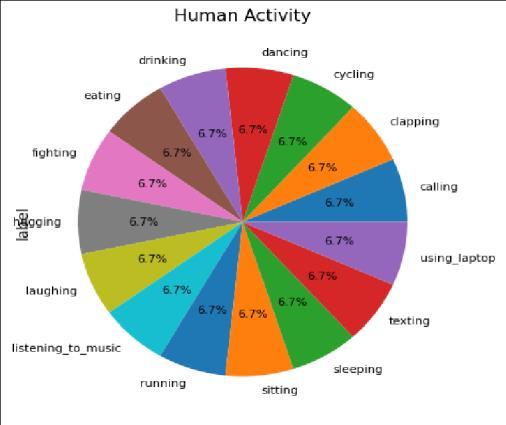
WehaveselectedHumanActionRecognitiondataset[8]for our experimentations The Dataset under Consideration underconsiderationforHumanActionRecognition(HAR) comprises a diverse collection of approximately 12,000 labeled images, each uniquely representing one of fifteen distinctclassesof humanactivities.Thedatasetisdivided into 65:55 ratio for train test split. These images are meticulouslyorganizedintoseparatefolderscorresponding to the labeled classes, ensuring ease of access and classification. This structure facilitates straightforward navigation and manipulation of data across the different categoriesofhumanactions.Thecomplexityofaccurately recognizing and labeling human actions stems from the myriadways in whichthese activitiescanbe represented. DatamodalitiessuchasRGB(coloredlightinthreechannels: red, green, and blue), skeleton (2D or 3D joint positions), depth (distance of an object from a viewpoint), infrared
The recent advancements in Human Activity Recognition (HAR) have been significantly influenced by the development andapplicationof deep learning techniques, particularly Convolutional Neural Networks (CNNs) and Recurrent Neural Networks (RNNs). Smith, Johnson, and Davis [1] showcased a novel CNN approach for real-time actionrecognitioninclutteredenvironments,emphasizing the potential for CNNs in handling complex recognition tasks. Similarly, Patel and Gupta [3] demonstrated the efficacy of RNNs in continuous activity monitoring, highlightingtheimportanceofsequencemodelinginHAR. Early foundational work by Viola and Jones [4], and Dalal andTriggs[4],laidthegroundwork forfeature extraction and object detection, which have been critical for the progressinthefield.Furthercontributions,suchasthetwostreamconvolutionalnetworksbySimonyanandZisserman [6], and 3D convolutional networks by Tran et al. [7], expanded the capabilities of HAR systems to understand spatialandtemporalfeaturesmoreeffectively.Datasetslike UCF101[8]andActivityNet[9]havebecomebenchmarksfor trainingandevaluatingHARmodels,astheyprovideawide rangeofhumanactivitiescapturedinvideosfromreal-world scenarios. Recent research has also explored the incorporation of nonlocal neural networks for capturing long-range dependencies [10], and the use of large-scale datasetslikeKinetics[11]fortrainingmorerobustmodels. InnovationssuchasResNeSt[12]andgraphconvolutional networks [13] have introduced new ways to process and interpretactivitydata,offeringinsightsintomoreefficient andaccuraterecognitiontechniques.Emergingstudieslike those by Yang et al. [14] on few-shot learning with global context, and interdisciplinary approaches to recognize activitiesusingRGB-Dsensors[15],furthersignifythefield's dynamicnature.TheevolutionofHARtechnologiestowards moreinterpretiveandmultimodallearningmodels[16,17] reflectsanongoingefforttoimprovethedepthandbreadth of activity recognition capabilities. This body of work collectivelyunderscoresthecriticalroleofdeeplearningin advancing HAR, from enhancing model accuracy and efficiency [1, 3] to exploring novel architectures and methodologies [6, 7, 12, 13]. The ongoing research and development in HAR promiseto yield more sophisticated, versatile,andreliablesystemsforamyriadofapplications, pushing the boundaries of what is currently possible in understandingandinterpretinghumanactivities.
International Research Journal of Engineering and Technology (IRJET) e-ISSN: 2395-0056
Volume: 11 Issue: 09 | Sep 2024 www.irjet.net p-ISSN: 2395-0072
(thermalimaging),pointcloud(3Dverticesinacoordinate system),eventstream(sequencesofeventsovertime),audio (sound recordings), acceleration (movement data), radar (radio wave detection and ranging), and WiFi signals (wireless network-based detection), each provide unique andvaluableperspectivesonhumanactivity.Thesediverse sourcesofinformationencapsulatevariousfacetsofhuman actions, offering distinct advantages tailored to specific applicationcontexts
Inthisstep,weIdentifyandselectabaseCNNarchitecture withseveralpretrainedCNNResNet[12],Inception,VGG,or bespoke models. These architectures serve as the foundational elements of the ensemble, each contributing unique feature detection capabilities [18]. We have experimentedonfourpretrainedalgorithms:ResNet50,VGG, Inception and Exception followed by a base model. ResNet50:ResNet50,akeymemberoftheResidualNetwork family,standsoutasadeepconvolutional neuralnetwork endowed with 50 layers. It unveils an innovative architecture distinguished by the introduction of "skip connections"or"shortcutconnections."Theseconnections enablethedirectflowofinputfromonelayeracrossseveral others,mergingitwiththeoutputofasubsequentlayer.This design significantly counteracts the vanishing gradient problem,therebypermittingtheeffectivetrainingofmuch deeper neural networks by ensuring a smoother gradient flow throughout the network. Demonstrating exceptional capabilitiesacrossaspectrumofcomputervisionchallenges, ResNet50hasexcelledintaskssuchasimageclassification, detection, and segmentation, marking a significant advancement in the field. VGG: VGG networks are highly regarded for their architecture's simplicity and their performanceonimagerecognitionandclassificationtasks. Thedepthofthenetwork,reachingupto19layers,allowsit to learn a wide range of features at different levels of abstraction.Inception:TheInceptionnetwork,alsoknownas GoogleNet, introduced the concept of a "network within a network"architecture.Itemploysinceptionmodules,which parallellyapplymultiplefiltersofdifferentsizestotheinput and then concatenate the resulting output vectors. This
approach allows the model to adapt to the scale of visual information, making it efficient for tasks requiring the recognition of patterns at various scales. The Inception network hasbeen iterativelyimproved,withversionslike InceptionV3 offering enhanced performance with lower computationalcosts.Xception:Xception,shortfor"Extreme Inception,"extendstheInceptionarchitecturebyperforming spatialconvolutionalindependentlyforeachchannelofthe input,followedbyapointwiseconvolutionthatprojectsthe channels'outputsobtainedbythespatialconvolutionsonto a new channel space. This modification allows for more efficient use of model parameters and has shown improvementsinperformanceonbenchmark datasets for imageclassificationandbeyond.Eachofthesepre-trained models offers a unique approach to deep learning for computer vision tasks, with specific architectural innovations designed to improve performance, reduce computationalload,andaddresscommonchallengessuchas overfitting and the vanishing gradient problem. The base model: It leverages a pre-trained model's output as its foundation, enhancing it with a series of layers aimed at refiningthetaskofclassifyingimagesinto15distincthuman activity categories. Initially, the model's output passes through a Global Average Pooling 2D layer, effectively reducing the dimensionality while retaining essential features, which is crucial for mitigating overfitting and reducing computational load. This carefully structured architecture not only capitalizes on the rich feature extractioncapabilitiesofthebasemodelbutalsotailorsthe networktoeffectivelyaddressthespecificdemandsofHAR, balancing model complexity with the necessity for high accuracyandgeneralizability.
3.3 Model Training: WeIndependentlytraineachselected CNN on the HAR dataset, leveraging transfer learning strategies by initializing with weights pre-trained on comprehensiveimagedatasetslikeImageNet[19,20].This stepiscrucialforcapturingtheintricatenuancesofhuman activities.
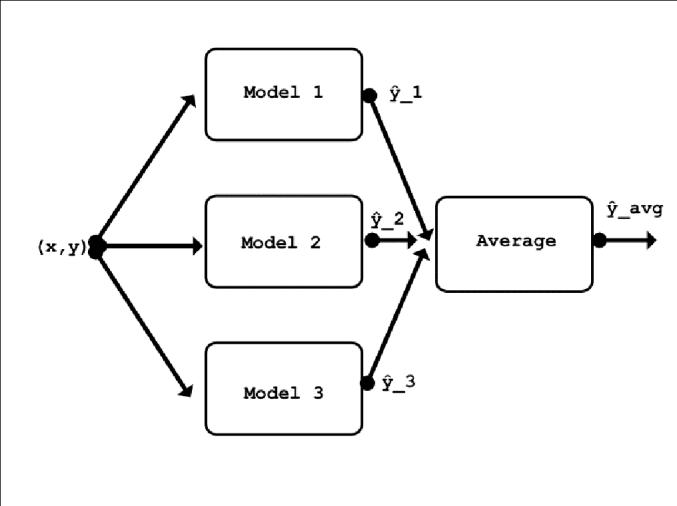
3.4 Model Combination for ensembling: Weintegratethe predictive outputs of individual base CNNs through an ensemble strategy, enhancing the overall prediction accuracy.Techniquessuchasvoting,averaging,andstacking with a meta-learner are utilized, each offering unique advantagesinconsensusprediction[21].Anabstractviewof ensemblingisgivenbelowinfigure1
International Research Journal of Engineering and Technology (IRJET) e-ISSN: 2395-0056
Volume: 11 Issue: 09 | Sep 2024 www.irjet.net p-ISSN: 2395-0072
3.5 Model Validation and evaluation:Finally,weassessthe ensemble model on the validation dataset, enabling hyperparameterrefinementandidentificationofoverfitting or other performance issues. We can conduct exhaustive hyperparameter tuning to fine-tune the ensemble model, optimizing for performance and accuracy. The ensemble modelundergoesrigoroustestingontheunseentestdataset, providingareliable
measure of its generalizability and performance in realworld scenarios. While ensemble models offer enhanced accuracy and robustness, they necessitate greater computational resources and present complexities in management.Ensuringdiversityamongthemodelswithin the ensemble is vital for achieving superior performance. Moreover, the selection of base models, ensemble techniques,andpreprocessingstrategiescriticallyinfluences the overall effectiveness of the HAR system. This methodologyamalgamatesthestrengthsofvariousCNNsto advance the precision and resilience of HAR systems, rendering it apt for deployment across a spectrum of practical applications, from surveillance to healthcare monitoring.
The table I presents a comparative analysis of the performance of different pretrained Convolutional Neural Network (CNN) classifiers ResNet50, Inception, VGG16, and Xception (referred to as "Exception") alongside an ensembledCNN approach,ona datasetfora classification task.FirsteachpretrainedCNNistrainedfor5epochsand then12epochsforhyperparameterstunning.Fine-tuningis atechniqueusedtoadjustthepretrainedmodel'sweights slightly to adapt to the new task at hand, which in this context is likely a specific type of image classification. By setting this parameter to a quarter of the base model's layers,thefunctionisinstructedtounfreezethetop25%of thelayersintheXceptionmodelfortraining,whilekeeping theremaining75%ofthelayersfrozen.Inotherwords,the
weightsofthebottom75%ofthelayerswillnotbeupdated during the fine-tuning process, preserving the knowledge theyhavegainedfrompretrainingonalargedataset(suchas ImageNet).Thisfine-tuningstrategyisparticularlyeffective for tasks where the new dataset is relatively small and similartothedatasetthemodelwasoriginallytrainedon, allowing for improved performance with minimal risk of overfitting.
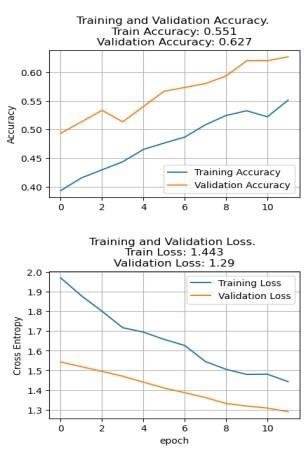
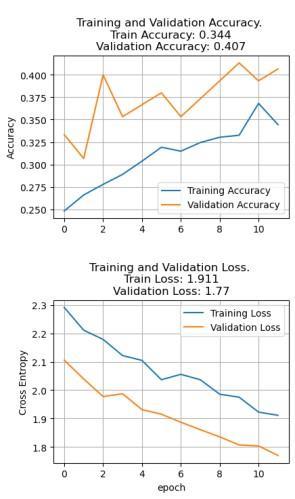
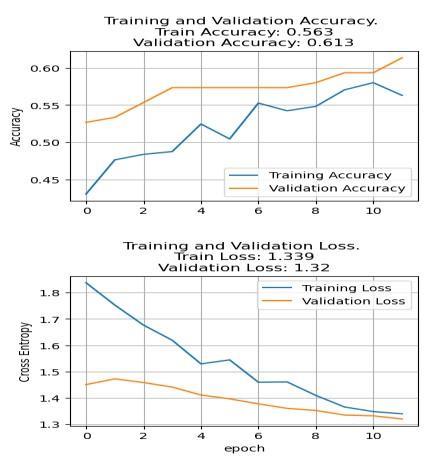
3.TrainingandTestinglossandaccuracyobtainedby differentclassifiersduringepochs
International Research Journal of Engineering and Technology (IRJET) e-ISSN: 2395-0056
Volume: 11 Issue: 09 | Sep 2024 www.irjet.net p-ISSN: 2395-0072
ResNet50 shows a training loss of 1.443 and a training accuracyof55.1%,whichimprovestoatestinglossof1.29 and a testing accuracy of 62.7%. This indicates that ResNet50, with its residual connections to combat the vanishing gradient problem, performs reasonably well, showingimprovementfromtrainingtotesting
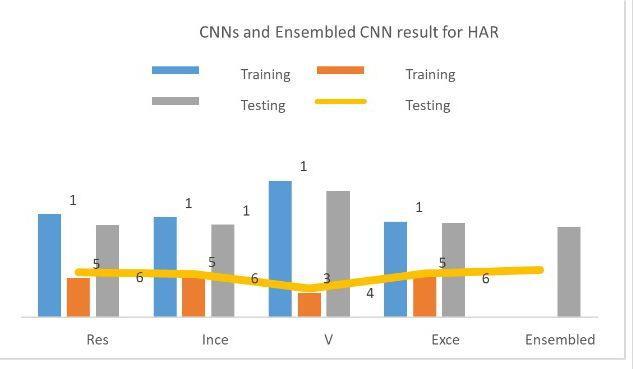
4.PretrainedCNNsandEnsemblemethodresultsfor HAR






Fig.5.Visualpredictiononsamesetofimagesfrom differentclassifiersandensembleclassifier
-Inceptionrecordsaslightlybettertraininglossof1.398and ahighertrainingaccuracyof56.9%comparedtoResNet50. However,itstestingaccuracydropsslightlyto60.7%witha testing loss of 1.295, suggesting good generalization but slightly underperforming compared to ResNet50 in the testingphase.
-VGG16displaysasignificantlyhighertraininglossof1.911 and a lower training accuracy of 34.4%, which marginally improvestoatestinglossof1.77andatestingaccuracyof 40.7%.ThisindicatesthatVGG16,knownforitssimplicity anddepth,strugglesmorethantheothermodelswiththis particulardataset,possiblyduetooverfittingorthemodel's architecturallimitations.
-Xception(Exception)demonstratesatraininglossof1.339 andatrainingaccuracyof56.3%,withatestinglossof1.32 andatestingaccuracyof61.2%.Thisperformancesuggests that Xception, with its depthwise separable convolutions, offers competitive generalization capabilities, slightly outperforming Inception in testing loss but not in testing accuracy.
- The Ensembled CNNs do not have training loss and accuracy metrics provided as it has not been trained but ensembledonthebasisofoutputfromdifferentpretrained methods.Itshowsthebestperformanceinthetestingphase witha lossof1.27andanaccuracyof66.0%.Thisimplies that combining the strengths of multiple models through ensembling leads to improved predictive performance, surpassing the individual models' testing accuracies. This analysis highlights the variance in performance across differentpretrainedCNNarchitecturesandunderscoresthe effectivenessofensemblingtechniquesinenhancingmodel accuracy byleveraging the diverse strengths of individual models. A visual display of the accuracy provided in recognizingthehumanactionisdisplayedinfigure4.
ThecomparativeanalysisofpretrainedConvolutionalNeural Network(CNN)models ResNet50,Inception,VGG16,and Xception alongside an ensembled approach, on a given dataset reveals insightful trends in their performance. ResNet50andXceptionshowedcompetitiveperformances, demonstrating the strength of residual connections and depthwiseseparableconvolutions,respectively,inhandling complex classification tasks. Inception's slightly lower testing accuracy, despite its architectural sophistication, suggests room for optimization in its application to this specific dataset. VGG16, with its simpler and deeper architecture, lagged in both training and testing phases, indicating a potential misfit for the dataset complexity or overfittingissues. The ensembledCNNsoutperformedthe individual models in testing accuracy, underscoring the effectiveness of leveraging multiple models' strengths to achieve superior predictive performance. This result highlightsthepotentialofensemblemethodsinimproving classificationtasks'outcomes,especiallyinscenarioswhere asinglemodel'sperformancemayplateau.Thefindingsfrom this study pave the way for several future research directions. First, exploring more sophisticated ensemble techniques, such as weighted averaging or dynamic ensemble selection, could further enhance model
International Research Journal of Engineering and Technology (IRJET) e-ISSN: 2395-0056
Volume: 11 Issue: 09 | Sep 2024 www.irjet.net p-ISSN: 2395-0072
performance. Additionally, investigating the impact of advanceddataaugmentationandpreprocessingtechniques on the individual models could provide insights into optimizingtheirperformancebeforeensembling.Moreover, expanding the ensemble to include newer or more specialized CNN architectures could reveal untapped potentialinmodelperformance.Anotherpromisingavenue is the integration of multimodal data sources, considering thedataset'scomplexityandthevarietyofhumanactivities involved.Thisapproachcouldleveragethedistinctstrengths ofdifferentdatatypes,suchasaudioandaccelerometerdata, in conjunction with visual information, to achieve a more holisticunderstandingofhumanactions.Finally,deploying thesemodelsinreal-worldapplications,suchassurveillance, healthcare monitoring, or interactive gaming, and conducting in-depth studies on their operational effectiveness,usability,anduserexperience,wouldprovide valuablefeedbackforrefiningthemodelsandtailoringthem to specific use cases. Through continuous innovation and application-driven research, the field of Human Activity Recognition can significantly advance, contributing to the developmentofmoreaccurate,robust,andversatilesystems forunderstandingandinterpretinghumanactions.
[1] Jayaram Nori*1 *1Broadcom Inc, USA.DOI:https://www.doi.org/10.56726/IRJMETS53503
[2] P.PrasadandA.Rao,"Asurveyonvariouschallenges andissuesinimplementingAIforenterprisemonitoring," JournalofNetworkandComputerApplications,vol.116, pp. 42-55, 2018, doi: 10.1016/j.jnca.2018.05.005.
[3] Y. Dang, Q. Lin, and P. Huang, "AIOps: real-world challengesandresearchinnovations,"in2019IEEE/ACM 41stInternationalConferenceonSoftwareEngineering: CompanionProceedings(ICSE-Companion),2019,pp.4-5, doi: 10.1109/ICSE-Companion.2019.00023.
[4] D. Xu et al., "Unsupervised anomaly detection via variational auto-encoder for seasonal KPIs in web applications," in Proceedings of the 2018 World Wide Web Conference, 2018, pp. 187-196, doi: 10.1145/3178876.3185996.
[5] V. Chandola, A. Banerjee, and V. Kumar, "Anomaly detection:Asurvey,"ACMComputingSurveys(CSUR),vol. 41,no.3,pp.1-58,2009,doi:10.1145/1541880.1541882.
[6] M. Chenet al., "Big data:A survey,"MobileNetworks and Applications, vol. 19, no. 2, pp. 171-209, 2014, doi: 10.1007/s11036-013-0489-0.
[7] Y. Li et al., "Deep learning for anomaly detection in cloud native systems," in 2020 IEEE International Conference on Cloud Engineering (IC2E), 2020, pp. 106116, doi: 10.1109/IC2E48712.2020.00022.
[8] F. Salfner, M. Lenk, andM. Malek, "A surveyofonline failure prediction methods," ACM Computing Surveys (CSUR), vol. 42, no. 3, pp. 1-42, 2010, doi: 10.1145/1670679.1670680.
[9] F. Jiang et al., "Artificial intelligence in healthcare: Past,presentandfuture,"StrokeandVascularNeurology, vol. 5, no. 2, 2020, doi: 10.1136/svn-2020-000443.
[10] F. Salfner, M. Lenk, and M. Malek, "A survey of online failure prediction methods," ACM Computing Surveys (CSUR), vol. 42, no. 3, pp. 1-42, 2010, doi: 10.1145/1670679.1670680.
[11] X. Liu et al., "PANDA: Facilitating usable AI development," arXiv preprint arXiv:2003.04070, 2020.
[12] G. A. Susto, A. Beghi, and C. De Luca, "A predictive maintenance system for epitaxy processes based on filtering and prediction techniques," IEEE Transactions on Semiconductor Manufacturing, vol. 25, no. 4, pp. 638-649, 2012, doi:
10.1109/TSM.2012.2209131.
[13] X. Liu et al., "PANDA: Facilitating usable AI development," arXiv preprint arXiv:2003.04070, 2020.
[14] E. Cortez et al., "Resource central: Understanding and predicting workloads for improved resource management in large cloud platforms," in Proceedings of the 26th Symposium on Operating Systems Principles (SOSP), 2017, pp. 153-167, doi: 10.1145/3132747.3132772.
[15] Z. Yin et al., "An empirical study on configuration errors in commercial and open source systems," in Proceedings of the 26th Symposium on OperatingSystemsPrinciples (SOSP),2017,pp.159-176, doi: 10.1145/3132747.3132773.
[16] D. Wang et al., "Failure prediction using machine learning in a virtualised HPC system and application," Cluster Computing, vol. 20, no. 1, pp. 103115, 2017, doi: 10.1007/s10586-016-0668-4.
[17] J. Gao, "Machine learning applications for data center optimization," Google White Paper, 2014. [Online]. Available: https://research.google/pubs/pub42542/
[18] R.SommerandV.Paxson,"Outsidetheclosed world:Onusingmachine learning for network intrusion
International Research Journal of Engineering and Technology (IRJET) e-ISSN: 2395-0056
Volume: 11 Issue: 09 | Sep 2024 www.irjet.net p-ISSN: 2395-0072 © 2024, IRJET | Impact Factor value: 8.315 | ISO 9001:2008
detection," in 2010 IEEE Symposium on Security and Privacy, 2010, pp. 305-316, doi: 10.1109/SP.2010.25.
[19] R. Boutaba et al., "A comprehensive survey on machine learning for networking: evolution, applications and research opportunities," Journal of Internet Services andApplications, vol. 9, no. 1, pp. 1-99, 2018, doi: 10.1186/s13174-018-0087-
[20] A. Mestres et al., "Knowledge-defined networking," ACM SIGCOMM Computer Communication Review, vol. 47, no. 3, pp. 2-10, 2017, doi: 10.1145/3138808.3138810.
|