
International Research Journal of Engineering and Technology (IRJET) e-ISSN: 2395-0056
Volume: 11 Issue: 09 | Sep 2024 www.irjet.net p-ISSN: 2395-0072

International Research Journal of Engineering and Technology (IRJET) e-ISSN: 2395-0056
Volume: 11 Issue: 09 | Sep 2024 www.irjet.net p-ISSN: 2395-0072
Rohan K1
Infosys
Abstract - Thisexploratorystudyexaminesthepotentialof blockchain technology to revolutionize supply chain management(SCM).Byleveragingacomprehensiveliterature reviewandexpertinterviews,thispaperidentifieskeybenefits of blockchain integration in SCM, including increased transparency, enhanced security, and improved traceability. The study also addresses technical challenges and implementation barriers, such as scalability issues and the need for standardization across various stakeholders. Comparative analysis of current SCM systems and potential blockchain-based solutions is conducted, highlighting significant efficiency gains and cost reductions. The findings suggest that while blockchain presents a transformative potential for SCM, strategic frameworks and collaborative efforts among industry players are crucial for successful adoption.Futureresearchdirectionsareproposed,focusingon pilot projects and real-world application case studies to further validate the technology's practical benefits and scalability in diverse supply chain contexts..
Key Words: Logistics and supply chain; Qualitative analysis,Blockchainframework
Theeconomyisbecominghyperconnected,andblockchainis enabling it. Evened-out storage areas are shaping hyperconnected experience, sharing economy, and streaming information ecologies. Industry 4.0 movements mayencouragenewinvention,internetbusiness,established errands, and supply chain strategies. Blockchain development is a simple yet effective step for the di The economy is becoming hyperconnected, and blockchain empowers it. In a hyperconnected economy, evened-out storerooms frame hyperconnected experience, sharing economy,andstreaminginformationecologies.Industry4.0 mayhelpcreatenewtacticsincreation,internetbusiness, createderrands,andsupplychains.Blockchaindevelopment isessentialanddynamicforsupplyandplannedoperations. Innovationarrangementsareexpectedtodriveglobalstore network the board market growth in the next years. Production network companies face store network disruptionsandshortcomings,customerdemandforfaster response times, determining, and inventory network synchronization[1].Distributedcomputingandinformation storage,sensorsandprogrammedidentifiableproof,stock and organization streamlining tools, sophisticated mechanics, and blockchain are some difficult key and mechanical solutions. Modern blockchain technology
leveragesdistributedrecordinnovationtoprovideauthentic dataandbuildconfidenceamongstartistsintheproduction network. Unchangeable exchanges improve accuracy, and blockchain-based services may create a smarter, more efficient store network. Blockchains, for instance, provide persistent, sealed trade records that are recorded and appendedconsecutively.Likefocaldatasetadvancements, circulatedrecordtechnologycan'tbeswitchedoff,erased,or modified. Global receipts/exchanges/times from coordinatedfactorsandproductionnetworkoperationsare stored and digitized. Blockchain technology informs store networkpartnersaboutsupplies,purchasingorders,stock levels,shippingreceiptdate,information,andsolicitations [2].Foroverthirtyyears,socialdatasetinnovationplayshad avitalimpactintheexistencesoforganizations.Inanycase, distributed computing, the administration of a lot of unstructuredinformation,andwebapplicationsdependon non social data sets utilizing an additional adaptable informationmodel.Blockchaindevelopmentinnovationisa conveyed data set framework that permits firms and associations to make and track exchanges across an organization in a close momentary way, giving them an upper hand. Blockchain advancements are anticipated to spreadinvariousenterprises.Thehugedrivingcomponents adding to the high improvement speed of the blockchain market extended subsidizing fundings and adventure for blockchain development; expansive usage of blockchain gameplansinbankingandonlinesecurity;highgatheringof blockchain deals with serious consequences regarding portion,adroitagreements,andhigh-levelcharacters;and risinggovernmentdrives[3].Therehasbeena significant increaseinthedependenceonweb basedorganizationsall acrosstheglobeasadirectresultoftheepidemiccausedby the Coronavirus. The web is being used by a variety of industries, including banking, financial services and insurance (BFSI), medical care and life sciences, manufacturing, retail, transportation, and coordinated operations, amongst others, in order to provide essential formsofassistancetopurchasingchainsandcustomers.It has come to the attention of sellers that there is an abnormally increased interest in a blockchain market [4]. The author arrived at the conclusion that, taking into account the enormous expenditures made by industry, blockchain technology has the potential to significantly modify supply chain management. The literature that is currently available on the subject of the potential uses of blockchaintechnologyinsupplychainmanagement,which touches on subjects such as the reduction of costs, the mitigationofrisksassociatedwithfinancialtransactions,and thepromotionofsustainability.Theobjectiveofthisstudyis
International Research Journal of Engineering and Technology (IRJET) e-ISSN: 2395-0056
Volume: 11 Issue: 09 | Sep 2024 www.irjet.net p-ISSN: 2395-0072
to investigate the advantages and disadvantages of blockchaintechnology(BCT)inrelationtothemanagement ofsupplychainperformance[5].Followinganexamination offourenablingidentitiesandthreelimitingidentities,they cametotheconclusionthattraceabilityshouldbeincluded intothesystemasabasicinnovationbecauseofitspotential togivedataimmutability.Afterdoingtheirstudy,theycame totherealizationthatblockchaintechnologyismostlyseen asamethodtocapitalizeonassetsthatarealreadypresent in supply chains. It has been said by Qian that BCT is beneficialtocreatingsupplychainssinceithelpstocreate trust.Blockchaintechnologyhasbeenlaudedbysomeasa possiblesolutiontotheissueofinformationasymmetryin supplychains.Thisisbecauseblockchaintechnologyhasthe abilitytoimproveknowledgesharing(KS)andinformation exchange procedures. A research investigates the use of blockchaintechnologyinthemanagementofsupplychains, aswellasthepotentialconflictsthatmayarisebetweenthe platform's transparency and security features. While attemptingtouseblockchaintechnology,GSCMcompanies face a number of obstacles [6]. As indicated by the discoveries,thecurrentendeavorstointegrateBCTintoSCM aremoreworriedaboutupgradingabilitiesatthefunctional levelthanthoseattheessentiallevel.statesthatonemethod forfurtherdevelopinginventorynetwork execution(SCP) andmix(SCI) istomaketheblockchainmoreapparent.A reference model for blockchain-based worldwide coordinatedfactorstasksispresentedinanotherexploration work.Weaccentuatethearrangementmadeforblockchain advancementsincoordinatedfactorsandstorenetworkthe executives, what partitions them into three sections: (1) following and following stages and applications; (2) item confirmation and distinguishing proof; and (3) monetary administration of the inventory network. There are many sorts of SC blockchain usefulness, including provenance, transportationandstrategies,tasks,money,consistenceand extortion,anddifferentadministrations.
Ourthree-prongedapproachtoprimaryresearchallowedus tobuildonpreviousscholarlyworkonBCinSC.Tokickoff theprocessofbuildingafoundationforfutureresearch,we spoke with two managers from platform providers and askedthemdetailedquestions.Businessexecutiveswithties touniversitiesandsubject-matterspecialistsinlogisticsand supply chain management formed the basis of the study frame from which the sample was first collected. We also reachedouttomultinationalcorporationswithHungarian branchesthatareactiveintheblockchainspaceinorderto broadenourscopeofpotentialinterviews.Onlytwoofthe fourteen businesses we contacted by phone and email agreed to take part in the interview. In 2021, business professionalsinHungarywereinterviewedin-depthusing internetsurveys.Theinterviewproceduremostlyincluded thefollowingsubjects:thefeaturesandspecificationsofBC
platforms, the pros and cons of using BC in SC, and the specificationsofBCuseingeneral[7].
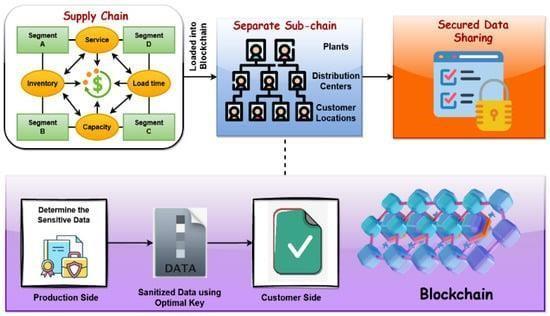
1:ProposedframeworkfordataflowinSCM(Author’s owncompilationbasedonliterartur[1],[2],4],[6])
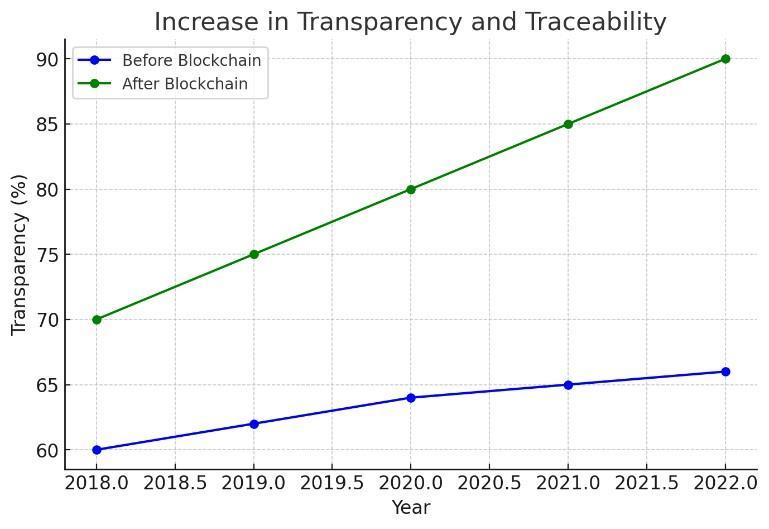
The subsequent move toward assessing the stages was to make a Specialist Subjective System (EQF) involving the meeting and optional examination information as an establishment.UtilizingaSubjectiveRelativeInvestigation (QCA) worldview in light of earlier scholastic exploration and well-qualified sentiments, we took a gander at blockchainframeworksallovertheworld.BlockchainStage, Begin Year, Information Openness, Approval, Savvy AgreementBacking,HashCapability,In-MemoryInformation Construction, Optional Capacity, Agreement Convention, ProgrammingDialects,ExchangesEachSecond(TPS),and different Charges were among the mechanical attributes distinguishedinsidethisstructureutilizingthedatafromthe auxiliary and master interviews [8-9]. Figure 1 diagram illustratestheflowofdatawithintheblockchainframework, showinghowtransactiondata isvalidated,convertedinto blocks,andapprovedforinclusionintheblockchainthrough a consensus mechanism. Here is the graph depicting the Increase in Transparency and Traceability. It illustrates a noticeableimprovementintransparencypercentagesafter implementingblockchaintechnology
Volume: 11 Issue: 09 | Sep 2024 www.irjet.net p-ISSN: 2395-0072
Figure2:Blockchainfeaturescomparisonoveryears[5],[7] The purpose of this analysis was to assess whether or whether the structural and technical qualities of the BC platforms were likely to be difficult, having equifinal or conjunctural characteristics. Thirdly, with a focus on practicality, information on the companies of blockchain platformuserswasobtainedbyusinganinterviewsheetas the foundation for a comparative analysis. The company name was followed by a list of the blockchain technology thatwasappliedinthesupplychain,alongwiththekindof blockchain technology, a broad explanation of the technology,theindustryorbusinesssector,theappliance, and the advantages of using blockchain technology. With regardtothethoroughoverviewoftheblockchainplatform. III.RESULTSOurliteraturereviewhasledustoconcentrate ontheIBM MaerskLtd.consortium'sblockchainsolution. Enterprise Management 360, which is comprised of specialists with worldwide expertise, did, however, rank IBM'ssolutionamongthetoptenblockchainplatformsfor 2020. Using worldwide precedents as a basis, our major study focused on the blockchain implementation process.. Thisiswhytheinvestigationwill focusontwoblockchain platform providers based in Budapest, Hungary: IBM Hungary Ltd. and GS1 Hungary Nonprofit Ltd [11-12]. International Business Machines (IBM) is a global information technology firm headquartered in the United States. IBM Hungary Ltd. is the Hungarian branch of IBM. Thecompanyhasemergedasa frontrunnerinthefield of artificialintelligenceandhybridcloudtechnology.InApril 2021,wespokewithamanagerfromIBMHungaryLtd.to getourfirstexpertinterview.Blockchaintechnology,namely theopenconsortiumblockchainplatformHyperledger,has been selected by IBM. This open-source blockchain technology is being developed and administered by the HyperledgerFoundation.AnIBMcommunitygrantaccounts for about 40% of the total financing for the Foundation. Second, there's the GS1 Hungary Nonprofit Company, a worldwide organization that has been working with international standards for more than 40 years. About 2 million businesses across over 20 industries and 150 countriesrelyonGS1'sstandardizedidentitysolutionsfor efficientbusinesscommunication.Thecompany'ssolutionto theproblemswithcorporatecommunicationiseDelivery,an EU-developedstandardizedmessagingsystem.Theprimary featuresthatarisethroughouttheimplementationandusage ofplatformsaredepictedinFigure2.Thesequalitieshavean impactontheflexibilityofplatforms,theirintegrationinto businessprocesses,andthefinancialconsequencesofusing them.Duetotheconsensus-basednatureofblockchain,all nodesarerequiredtokeepthesameledger.Awell-defined consensus mechanism can guarantee the safety and fault toleranceofblockchainsystems..Furthermore,suppliersand blockchainserviceprovidersshouldanalystandauditsmart contractcodeformistakeslikelostcryptographickeysand clarifysecurityproblems.Themosteffectivewaytomanage cryptographic keys is via a hardware security module.
Multifactorauthenticationandhardwaretokenscanprotect againstphishingandransomware.
Table1.Theprimaryblockchainstageclassesand specializedparticulars.(Source:Authorsowncompilation)
Blockch ain
Platfor m Data Accessib i lity Smart Contract Consen sus Protocol Hash Function
Blockch ain
Platfor musing Bitcoin
Open Data
Accessib i lity
Ripple Data Accessib i lity in group
Blockch ain
Platfor musing Corda R3
Blockch ain
Platfor musing Ethere um
Data Accessib i lity in group
Open
Stateles sSmart Contract Support
Transact i onsPer Second (TPS)
Proofof Work (Ethash ) Hash FunctionS HA-256 6 7
Stateles sSmart Contract Support XRP consen sus Hash Function SHA2-512 1600
Stateles sSmart Contract Support PBFT Hash Function SHA-256 512 1490
Stateles sSmart Contract Support
Proofof Work (Ethash ) Hash FunctionK eccak256
12 25
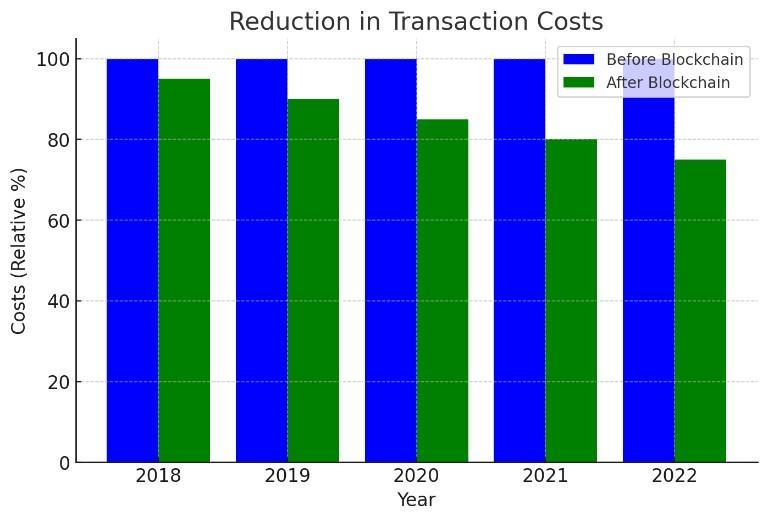
ThisabovegraphshowstheReductioninTransactionCosts over the years, demonstratinghow blockchaintechnology helpsdecreasecostsinsupplychainmanagementcompared totraditionalsystems.GPTWhenusedtothemanagementof supply chains, blockchain technology brings about more transparency, better security, and improved product traceability. All of the participants in the supply chain are abletogetaccesstothesameinformationviatheutilization of a decentralized ledger, which has the ability to reduce
International Research Journal of Engineering and Technology (IRJET) e-ISSN: 2395-0056
Volume: 11 Issue: 09 | Sep 2024 www.irjet.net p-ISSN: 2395-0072
delays, diminish costs, and lessen the likelihood of fraudulentactivity.Thistechnologyguaranteesthateachand everytransactionisdocumented,andthattheserecordsare immutable, which means that they cannot be changed withouttheagreementofallpartiesinvolved.Consequently, blockchain technology has the potential to assist in the verification of the authenticity of items by delivering a transparent and unalterable history. This is especially advantageous in sectors such as the pharmaceutical and luxurygoodsindustries,wheredemonstratingprovenanceis of utmost importance. Blockchain has the capability to execute agreements and transactions automatically when specificcircumstancesaresatisfied.Thisisaccomplishedby automatingalargenumberofoperationsviatheuseofsmart contracts.Theneedforhumaninterventionisreducedasa result, which may result in a reduction in mistakes and a speedingupofprocesses.Additionally,theuseofblockchain technology has the potential to support supply chain processes that are more ethical and sustainable. For example,itmaymonitorthecarbonimpactofitems,which helps to ensure that businesses are in compliance with environmental regulations. It also has the capability of monitoring the working conditions at manufacturing facilities, which may assist in the prevention of unethical actionssuchastheemploymentofchildrenandensurethat fairsalariesareprovided.
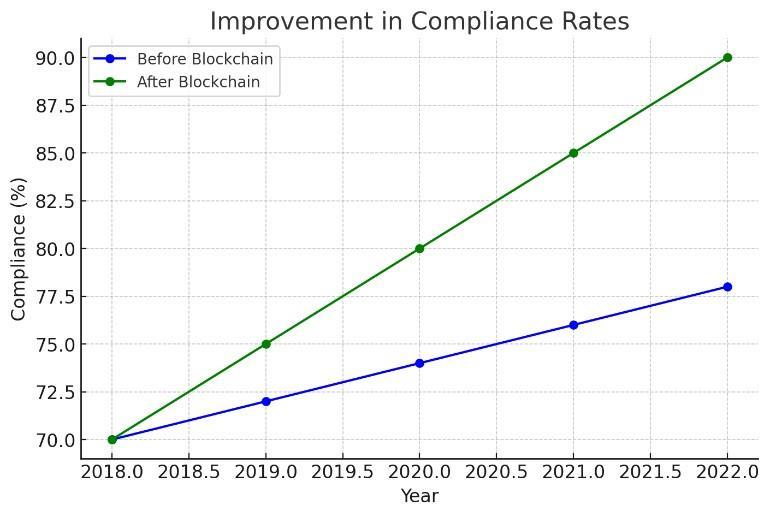
The graph above demonstrates the Improvement in ComplianceRatesoverseveralyears,showingasignificant increase in compliance with regulatory standards due to blockchain adoption in the supply chain. Blockchain also supportsbettercompliance managementandefficiencyin thesupplychain
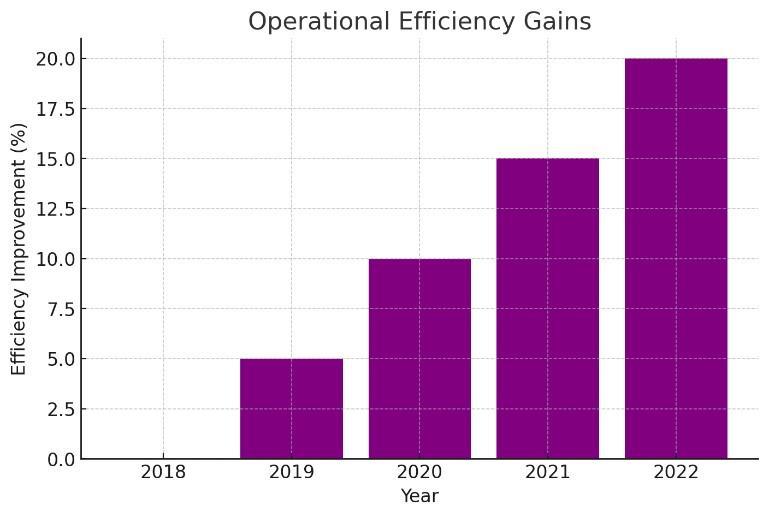
ThegraphaboveillustratestheOperationalEfficiencyGains, showingasteadyincreaseinoperationalefficiencyoverthe yearsduetotheimplementationofblockchaintechnologyin supplychainmanagement.Thisimprovementisattributed to automation and enhanced real-time data access. IV. CONCLUSION The supply chain and logistics industry has been the primary focus of this study on blockchain technology.Thefunctionof blockchain-basedplatformsin thesupplychainshouldbeexaminedfromboththetechnical developers'andtheuserindustries'andenterprises'points of view, according to secondary study. Using a paradigm grounded on expert interviews, we have explored two apparently unrelated but in fact closely linked domains. Blockchaintechnologyandthetechnologicalsolutionsthat go into it were the first strategy. In contrast, the second strategy focused on the practical uses and advantages for businesses. The existing absence of laws regarding data sharing, privacy, security, and control over blockchain transactions,togetherwithinsufficienthumanresourcesand rigid organizational structures, are some of the obstacles that have been recognized. Various angles of the research include blockchain's relative youth and the capabilities it offersthatarelackinginERPandothersupplychainsystems astheyare right now. The company's enterprise resource planning(ERP)system maybe enhancedwithmodules to provide tracking and tracing capabilities. Problems often arise when trying to integrate with existing systems and business processes. Low prevalence, high technological costs,alackofbestpracticesharing,andinsufficienthuman resource experience and competence are other limiting concerns,particularlyforSMEs.Lownetworkreadinessis another issue. Blockchain systems do not operate in isolation.Whileblockchaintechnologyitselfissimpletoset up,integratingitwithothersystemscallsforknowledgeand experience. The adaptability of blockchain technology, its effects on supply chain operations, and difficulties in deployment are other subjects that will be covered. Companies that recognise innovation in this solution and join as platform provider partners might be grouped, and lessons gained could be summarised. Additional potential
International Research Journal of Engineering and Technology (IRJET) e-ISSN: 2395-0056
Volume: 11 Issue: 09 | Sep 2024 www.irjet.net p-ISSN: 2395-0072
areasforgrowthincludemappingtheapplicationsofrivals andimprovingtheblockchain'sinteroperabilitywithcurrent ITsystemsandIndustry4.0technologies.Weexaminedthe biggestworldwideandEuropeanplatformserviceproviders usingthemethodologywebuiltviaexpertinterviews.The mostpopularplatformsinthesupplychainindustrywere Hyperledger Fabric by IBM and Ethereum. It was found throughcontrastingtheBCstagesthatthestillupintheair bytheutilizationofdifferentprogrammingdialects,andthe reasonableness of their SC not entirely settled by the elements of the stages. This outcomes in definitely fluctuating power use and handling speeds. Information availability,approval,agreementconvention,hashcapability, in-memory information structure, optional capacity, programming dialects, TPS, and exchange charges are the perspectives that characterize the utilization and improvement of BC. A well defined consensus mechanism canguarantee thesafetyandfaulttolerance of blockchain systems. The optimization of decentralization, scalability, andsecurityallatoncepresentsatrilemmatoblockchain technologies. The most popular kinds of blockchain technologyforsupplychainandlogisticsapplicationswere the subject of a fact-finding inquiry. This study's findings demonstratethatprivateandconsortiumblockchainsrule thesupplychainmanagementindustry,withsmartcontract support being readily apparent for commercial use cases. WhileEthereumemploysProofofWork,HyperledgerFabric, thedominantplatformforcorporateblockchains,provides pluggable consensus mechanisms such as Practical ByzantineFaultTolerance(PBFT),Raft,PoW,andPoS.
[1] Jayaram Nori Broadcom Inc, USA.DOI:-
https://www.doi.org/10.56726/IRJMETS53503
[2] P.PrasadandA.Rao,"Asurveyonvariouschallenges andissuesinimplementingAIforenterprisemonitoring," JournalofNetworkandComputerApplications,vol.116, pp. 42-55, 2018, doi: 10.1016/j.jnca.2018.05.005.
[3] Y. Dang, Q. Lin, and P. Huang, "AIOps: real-world challengesandresearchinnovations,"in2019IEEE/ACM 41stInternationalConferenceonSoftwareEngineering: CompanionProceedings(ICSE-Companion),2019,pp.4-5, doi: 10.1109/ICSE-Companion.2019.00023.
[4] D. Xu et al., "Unsupervised anomaly detection via variational auto-encoder for seasonal KPIs in web applications," in Proceedings of the 2018 World Wide Web Conference, 2018, pp. 187-196, doi: 10.1145/3178876.3185996.
[5] V. Chandola, A. Banerjee, and V. Kumar, "Anomaly detection:Asurvey,"ACMComputingSurveys(CSUR),vol. 41,no.3,pp.1-58,2009,doi:10.1145/1541880.1541882.
[6] M. Chenet al., "Big data:Asurvey,"MobileNetworks and Applications, vol. 19, no. 2, pp. 171-209, 2014, doi: 10.1007/s11036-013-0489-0.
[7] Y. Li et al., "Deep learning for anomaly detection in cloud native systems," in 2020 IEEE International Conference on Cloud Engineering (IC2E), 2020, pp. 106116, doi: 10.1109/IC2E48712.2020.00022.
[8] F. Salfner, M. Lenk, andM. Malek, "Asurveyofonline failure prediction methods," ACM Computing Surveys (CSUR), vol. 42, no. 3, pp. 1-42, 2010, doi: 10.1145/1670679.1670680.
[9] F. Jiang et al., "Artificial intelligence in healthcare: Past,presentandfuture,"StrokeandVascularNeurology, vol. 5, no. 2, 2020, doi: 10.1136/svn-2020-000443.
[10] F. Salfner, M. Lenk, and M. Malek, "A survey of online failure prediction methods," ACM Computing Surveys (CSUR), vol. 42, no. 3, pp. 1-42, 2010, doi: 10.1145/1670679.1670680.
[11] X. Liu et al., "PANDA: Facilitating usable AI development," arXiv preprint arXiv:2003.04070, 2020.
[12] G. A. Susto, A. Beghi, and C. De Luca, "A predictive maintenance system for epitaxy processes based on filtering and prediction techniques," IEEE Transactions on Semiconductor Manufacturing, vol. 25, no. 4, pp. 638-649, 2012, doi: 10.1109/TSM.2012.2209131.
[13] X. Liu et al., "PANDA: Facilitating usable AI development," arXiv preprint arXiv:2003.04070, 2020.
[14] E. Cortez et al., "Resource central: Understanding and predicting workloads for improved resource management in large cloud platforms," in Proceedings of the 26th Symposium on Operating Systems Principles (SOSP), 2017, pp. 153-167, doi: 10.1145/3132747.3132772.
[15] Z. Yin et al., "An empirical study on configuration errors in commercial and open source systems," in Proceedings of the 26th Symposium on OperatingSystemsPrinciples(SOSP),2017,pp.159-176, doi: 10.1145/3132747.3132773.
[16] D. Wang et al., "Failure prediction using machine learning in a virtualised HPC system and application," Cluster Computing, vol. 20, no. 1, pp. 103115, 2017, doi: 10.1007/s10586-016-0668-4.
International Research Journal of Engineering and Technology (IRJET) e-ISSN: 2395-0056
Volume: 11 Issue: 09 | Sep 2024 www.irjet.net p-ISSN: 2395-0072 © 2024, IRJET | Impact Factor value: 8.315 | ISO 9001:2008 Certified
[17] J. Gao, "Machine learning applications for data center optimization," Google White Paper, 2014. [Online]. Available: https://research.google/pubs/pub42542/
[18] R.SommerandV.Paxson,"Outsidetheclosed world:Onusingmachinelearning fornetwork intrusion detection," in 2010 IEEE Symposium on Security and Privacy, 2010, pp. 305-316, doi: 10.1109/SP.2010.25.
[19] R. Boutaba et al., "A comprehensive survey on machine learning for networking: evolution, applications and research opportunities," Journal of Internet Services andApplications, vol.9, no. 1, pp. 1-99, 2018, doi: 10.1186/s13174-018-0087-