
International Research Journal of Engineering and Technology (IRJET) e-ISSN:2395-0056
Volume: 11 Issue: 09 | Sep 2024 www.irjet.net p-ISSN:2395-0072

International Research Journal of Engineering and Technology (IRJET) e-ISSN:2395-0056
Volume: 11 Issue: 09 | Sep 2024 www.irjet.net p-ISSN:2395-0072
Pazhanibharathi K1, Pandiyan A2 , A C Mariappan3, G Peter Packiaraj4
1,2 Final Year B.E Marine Cadets, PSN CET, Tirunelveli, Tamil Nadu
3,4 Assistant Professor, Department of Marine Engineering, PSN CET, Tirunelveli, Tamil Nadu
ABSTRACT
Selective Catalytic Reduction (SCR) technology is a widely adopted method for reducing nitrogen oxides (nox) emissions from diesel engines, essential for meeting stringent environmental regulations. This paper reviews recent advancements in SCR systems, focusing on improvements in catalyst materials, urea-based reductions, and integration. System It discusses the evolution of SCR technology from its early implementations to current state of-the-artsystems,highlightingkeyinnovationssuchashigh efficiency catalysts and optimized dosing strategies. The paper also addresses challenges related to catalyst deactivation, temperature management, and integration withenginecontrolsystems.Throughexperimentaldataand real-world applications, the study demonstrates the effectivenessofmodernSCRsystemsinachievingsubstantial nox reduction and explores future directions for enhancing performanceandreliability.
Key words: ASCRT, SelectiveCatalyticAdBlue,IMO,DEF
1.INTRODUCTION
Selective Catalytic Reduction (SCR) is a system used in marine engines to reduce nitrogen oxide (NOX) emissions. Here’s a brief overview of how it works and its benefits SCRsystemsinjectareducingagent,usuallyurea(AdBlue), intotheexhaustgasesoftheengine.Thisagentreactswith noxinthepresenceofacatalysttoconvertitintoharmless nitrogen and water. SCR catalysts is a coated ceramic or metallic substrate that facilitates the chemical reaction. Urea Injection System: This system includes a tank for storing urea and a dosing unit for injecting it into the exhauststream.
Manages the operation of the urea injection and monitors the SCR system's performance. Reduced nox Emissions: SCR can lower nox emissions by up to 90%, helping ships meet stringent environmental regulations Compliance HelpsvesselscomplywithIMOTierIIIemissionstandards andotherregionalregulations.
High Combustion Temperatures: nox forms when temperatures exceed 1,500°C (2,732°F) in the combustion chamber. This is because at such high temperatures, nitrogen(N2)andoxygen(O2)intheairreacttoform nox compounds.LeanAirFuelMixture:Enginesrunningwitha lean air-fuel mixture (more air than fuel) tend to produce more nox thisis becauseleanmixturesburnhotterand at higher temperatures compared to richer mixtures. High Engine Load and RPM: Operating an engine at high loads andhighrevolutionsperminute(RPM)generallyresultsin higher combustion temperatures, which can increase nox emissions. Advanced ignition timing (igniting the fuel-air mixture earlier) can also lead to higher combustion temperatures,contributingtoincreasedNOxproduction.
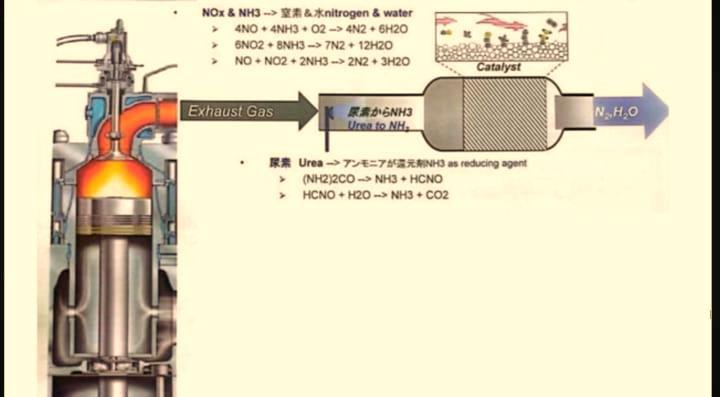
3.SELECTIVE CATALYTIC REDUCTION
Thecatalyticconvertercontainsacatalystthatreactswith NOx in the engine exhaust to convert it into nitrogen and water vapor. Nitrogen-based solutions (typically called diesel-based fluids or DEF) are used in injection system engineering prior to entry into prototyping. DEF reacts withNOxintheexhausttoformnitrogenandwatervapor.
International Research Journal of Engineering and Technology (IRJET) e-ISSN:2395-0056
Volume: 11 Issue: 09 | Sep 2024 www.irjet.net p-ISSN:2395-0072
The control system monitors the engine and exhausts conditions and adjusts the amount of DEF injected to optimize the performance of the SCR unit. The control systemalsomonitorsthecatalyticconvertertoensurethat it is functioning properly and alerts the crew when maintenance is required. SCR units are effective in reducing NOx emissions from marine diesel engines, making them an important technology for meeting emissions regulations. However, they require regular maintenance,includingrefillingtheDEFtank,replacingthe catalyticconverter,andcleaningtheinjectionsystem.
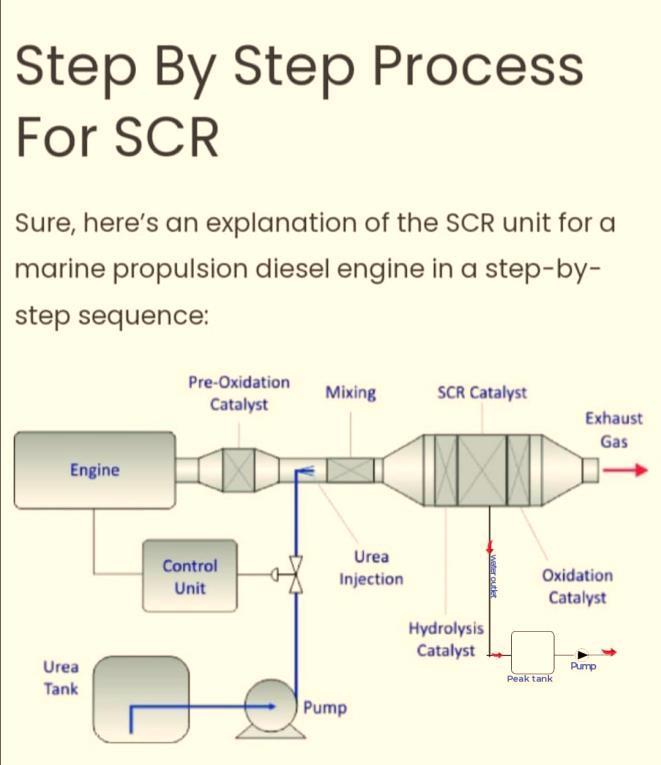
The exhaust gases produced by marine diesel engines are first directed to the SCR unit. Before entering the SCR unit, a urea-based solution (DEF) is injected into the exhaust gases. DEF reacts with nitrogen oxides (NOX) in exhaust gases to form nitrogen and water vapor. This reaction takes place in the catalytic converter present in theSCRunit.
The catalytic converter is composed of a catalyst, usually made of platinum,rhodium or palladium,whichfacilitates thechemicalreactionbetweenDEFandNOx.
Thecleanexhaustgases,whicharenowfreeofmostofthe nox,arethenreleasedthroughtheexhauststack.
The control system monitors the engine and exhaust conditions and adjusts the amount of DEF injected to optimizetheperformanceoftheSCRunit.
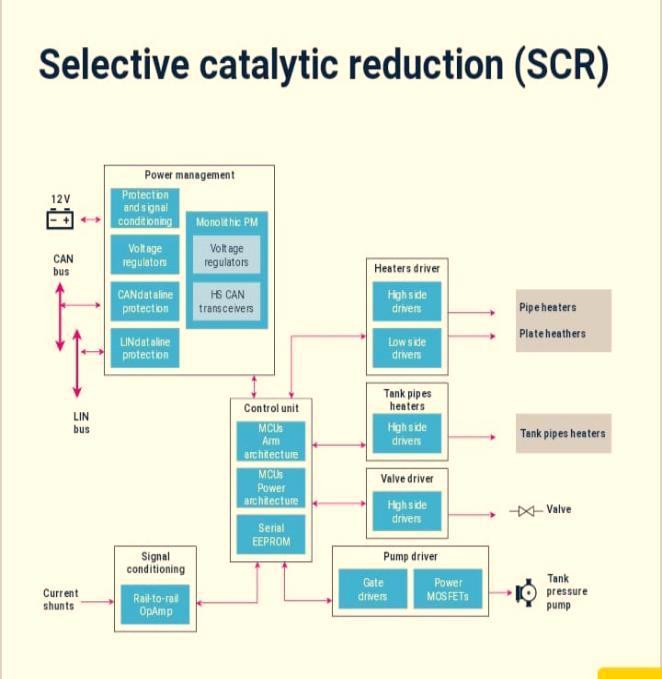
Fig.3 POWER TRANSMISSION &MANAGEMENT PROCESS
Environmental regulations: Marine diesel engines are a major source of air pollution, especially nitrogen oxide (NOx) emissions. To reduce the environmental impact of shipping and protect air quality, various international and regional regulations have been introduced that limit the number of toxic substances emitted by ships. The use of SCR systems helps ships meet these regulatory requirements
NOX waste can have significant adverse effects on human health, including respiratory failure, respiratory failure, and other respiratory diseases. Technological use of SCR helpsreducetheseproducts,improvingpublichealth.
Shipping companies that can demonstrate that they are operating in an environmentally responsible manner are more likely to be viewed favorably by customers, regulators, and other stakeholders. By using SCR systems, shipping companies can improve their environmental and increasetheirreputationandcompetitiveness.
Fuelefficiency:SCRsystemscanalsohelptoimproveafuel efficiency by optimizing the combustion process in the engine. This This can result in lower fuel consumption, lower operating costs and reduced greenhouse gas emissions
International Research Journal of Engineering and Technology (IRJET) e-ISSN:2395-0056
Volume: 11 Issue: 09 | Sep 2024 www.irjet.net p-ISSN:2395-0072
4.1
Selective Catalytic Reduction (SCR) systems in ships are used to reduce nitrogen oxide (NOx) emissions from marine engines and meet international emission regulations, such as those set by the International Maritime Organization (IMO). The SCR process works by injecting a reductant, typically ammonia or urea, into the exhaust stream, which reacts with NOx over a catalyst to formharmlessnitrogen(N2)andwatervapor(H2O).
The core component of the SCR system is the catalyst reactor,wherethechemicalreactionsoccur.Thecatalystis usually made of materials like vanadium, titanium, or zeolites. These materials facilitate the reaction between NOx and the reductant without being consumed in the process.
4.1
The reductant (often an aqueous urea solution or ammonia)isinjectedintotheexhaustgasstreambeforeit reaches the catalyst. The urea decomposes to form ammonia, which then reacts with the NOx. The injection systemispreciselycontrolledtoensureoptimalreduction.
4.1.3
SCR systems are equipped with sophisticated control systems that monitor the engine load, exhaust gas temperature, and NOx levels. The system adjusts the amount of reductant injected based on these variables to ensure efficient NOx reduction without excess ammonia slip(unreactedammoniaexitingthesystem).
To reduce the risk of ammonia slip, where unreacted ammonia escapes into the atmosphere, some systems are equipped with an additional catalyst stage to convert any residualammoniabackintonitrogenandwater.
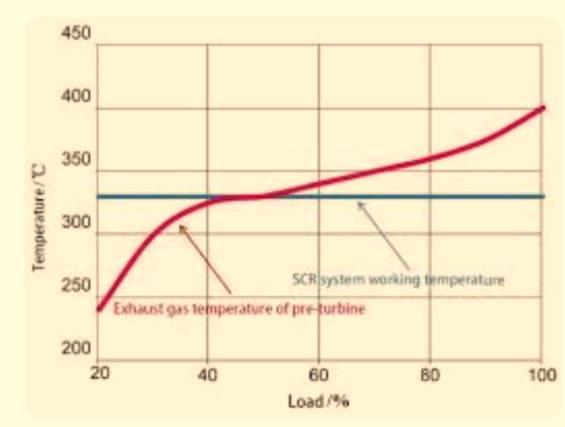
SCR systems require the exhaust gas temperature to be within a specific range (typically 300–400°C) for effective NOx reduction. Systems often include heaters or other mechanisms to maintain the necessary temperature in low-load conditions, such as during idling or slow steaming.
FortheSCR system towork efficiently,thereductantmust mix thoroughly with the exhaust gases. Mixing devices or specific exhaust designs are often used to ensure uniform distributionofammoniaorureainthegasstreambeforeit reachesthecatalyst.
The system often includes NOx sensors to continuously monitor the concentration of nitrogen oxides in the exhaust both before and after the SCR system. Thisallows for real-time adjustments and compliance with NOx emissionlimits.
4.1.8
Many SCR systems are designed to be modular, which allows for flexibility in installation. This is important for fitting SCR systems into different types of ships, where spacemaybelimited.
The catalyst materials are designed to be long-lasting, typically requiring replacement only after several thousand operating hours. Additionally, the system is designed for low maintenance, with periodic cleaning of thecatalystandinjectorsbeingtheprimaryupkeeptasks.
SCR systems are primarily used to comply with the IMO Tier III regulations, which mandate strict NOx reductions incertainEmissionControlAreas(ECAs).ByreducingNOx emissions by up to 90%, the SCR system ensures compliancewiththesestringentenvironmentalstandards.
International Research Journal of Engineering and Technology (IRJET) e-ISSN:2395-0056
Volume: 11 Issue: 09 | Sep 2024 www.irjet.net p-ISSN:2395-0072
Given the large size and weight of SCR systems, especially for large engines, the design must be optimized for minimal impact on the ship's layout and weight distribution. Some ships may need customized installationstofittheSCRsystemproperly.
4.1.12 Redundancy Features
Many systems include redundancy features to ensure continuous operation, even ifpartsofthe system fail.This might include multiple injection nozzles or catalyst segments that allow for part of the system to be serviced whiletherestremainsoperational.
4.1.13
SCRsystemsaredesignedtoworkwithenginesrunningon various marine fuels, including Heavy Fuel Oil (HFO), MarineDieselOil(MDO),andLiquefiedNaturalGas(LNG), provided the exhaust gas meets the required temperature andNOxlevels.
Byintegratingthesefeatures,SCRsystemsensuretheship meets environmental standards while maintaining operationalefficiency.
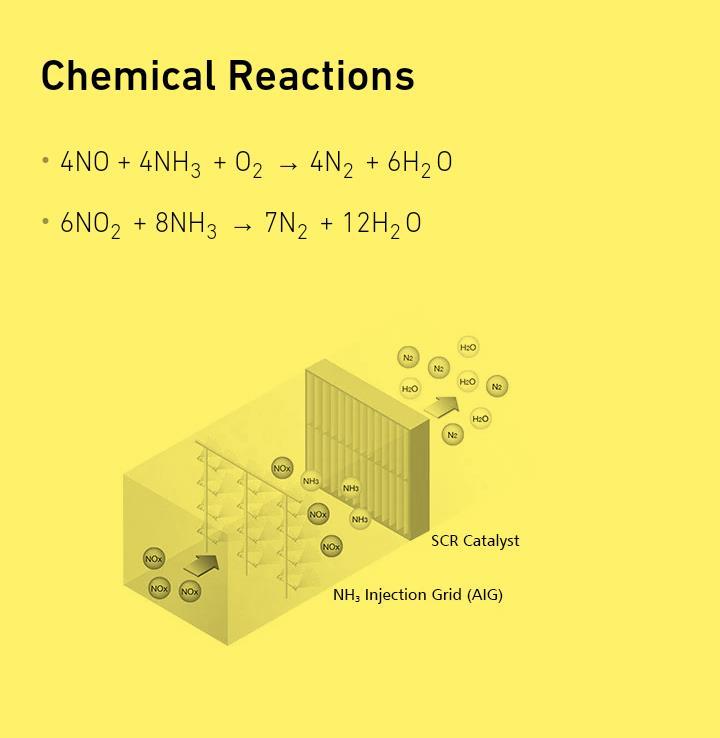
Possible NH3 emissions due to the process not being completed effectively (NH3 slip). Used catalyst Laughing gas(N2O)canbeproducedasaby-product.In"high-dust" switching,thefluegasesareladenwithNH3
Energy use for heating flue gases in "low dust configuration. Efficiency NOX:90-94% Residual emissions: Possible aerosol- forming from ammonium chloride and ammoniumsulphate
Selective catalytic reduction is used within combustion installations in the following sectors: Waste incineration; Energyplants;Metalindustry;Greenhousehorticulture.
To enhance NOx reduction, particularly in wide operating conditions(lowandhightemperatures),somesystemsuse a dual SCR configuration.A low-temperature SCR catalyst canoperateefficientlyatlowerexhausttemperatures(e.g., in csold-start conditions or city driving).A hightemperature SCR catalyst operates effectively at higher temperatures,typicallyduringhighwaydriving.
Some advanced systems combine the SCR function with a diesel particulate filter (DPF), integrating them into a single unit called SCR on Filter (SCRF).This combination reduces system complexity and saves space while providingbothNOxreductionandparticulatematter(PM) filtrationinasingleunit.
Advancedalgorithmsandmachinelearningtechniquesare beingusedtopreciselycontroltheamountofureainjected, ensuring optimal NOx reduction and minimizing urea consumption.Thesealgorithmstakeintoaccountreal-time factors like load, exhaust temperature, and NOx sensor feedback
In some advanced systems, catalysts are designed to temporarily store ammonia at lower temperatures and release it when the temperature rises, ensuring that NOx reduction can occur over a broader range of operating conditions.ThisapproachminimizesNOxemissionsduring transient driving conditions (e.g., accelerations and decelerations)
International Research Journal of Engineering and Technology (IRJET) e-ISSN:2395-0056
Volume: 11 Issue: 09 | Sep 2024 www.irjet.net p-ISSN:2395-0072
Optimizing exhaust temperature is critical for SCR efficiency. Advanced thermal management systems adjust engine parameters (e.g., injection timing, exhaust gas recirculation)orevenuseauxiliaryheaterstomaintainthe idealSCRoperatingtemperature.
Another strategy used is NOx storage reduction (NSR), where NOx is temporarily stored in a catalyst during lean conditions and then reduced during rich conditions.NSR canbecombinedwithSCRtoensureNOxreductionacross varyingconditions.
Overall, SCR is a critical component in reducing the environmental impact of diesel engines and industrial processes,contributingtocleanerairandcompliancewith regulatorystandards
REFERENCE(S)
[1]FactsheetsonAir-emissionreductiontechniques
[2]Common waste water and waste gas treatment and management systems in the chemical sector. BREF document,EuropeanIPPCBureau
[3]Elslander H., De Fre R., Geuzens P., Wevers M. (1993). Comparative evaluation of possible gas purification systemsforthecombustionofhouseholdwaste.
[4]V.Fierro,C.Mirodotos(2002)studies inthe surface andcatalysis
[5]"EmissionControlTechnologiesforDiesel Engines"by DavidL.Johnson
BIOGRAPHIES

I am pursuing B.E final year Marine Engineering cadet at PSN College of Engineering & Technology, Tirunelveli, TamilNadu



I am pursuing B.E final year Marine Engineering cadet at PSN College of Engineering & Technology, Tirunelveli, TamilNadu
Project Guide cum Assistant Professor PSNCollegeofEngineering&Technology, Tirunelveli, Tamil Nadu. Also having 15 years’ experience in Oil and Gas industries. Specialization in NDT and workedvariesGulfCountries
Project guide cum Assistant professor PSN College of engineering and technology Tirunelveli,TamilNadu.MEO Class IV Marine Engineer and worked variescountries.