
International Research Journal of Engineering and Technology (IRJET) e-ISSN: 2395-0056
Volume: 11 Issue: 09 | Sep 2024 www.irjet.net p-ISSN: 2395-0072

International Research Journal of Engineering and Technology (IRJET) e-ISSN: 2395-0056
Volume: 11 Issue: 09 | Sep 2024 www.irjet.net p-ISSN: 2395-0072
Manas Garg
MSIT, GGSIPU Delhi ***
Abstract - With the growing influence of the Internet of Things (IoT) across various sectors, Indian Railways has embraced this technology to enhance the efficiency of its operations. The integration of SCADA over WDFC demonstrates the application of IoT in critical infrastructure, allowingreal-time monitoring, control, andautomationofthe electrified freight network. The key features of WDFC’s SCADA, including its useofTCP/IPcommunicationprotocolsbasedon IEC 60870-5-104, the deployment of Remote Terminal Units (RTUs), and the advantages of real-time data acquisition and fault detection, are discussed.
Key Words: IoT, SCADA, RTU, WDFC, communication, bus, fault location. Railways
1.INTRODUCTION
The rapid adoption of the Internet of Things (IoT) has brought transformative changes to various industries, includingtransportation,whereinterconnecteddevicesand systemsfacilitatereal-timemonitoringandcontrol IoThas becomeanenablerofsmartinfrastructure,revolutionizing its operations by integrating sensors, data analytics, and communicationnetworkstoimproveefficiency,safety,and reliability. IoT devices deployed across vast railway networkscollectandtransmitdata,allowingforpredictive maintenance, enhanced fault detection, and automated decision-making. These advancements are critical for managing the complexities of modern rail networks, includingelectrification,signaling,andtrafficcontrol.
One of the most prominent examples of IoT in Indian RailwaysistheintegrationofSupervisoryControlandData Acquisition(SCADA)systemsformonitoringandcontrolling railway traction power networks. SCADA systems in IR, previouslybasedonelectromechanicaldesigns,haveevolved into sophisticated digital platforms using IoT and communication technologies. These systems enable realtime supervision of equipment across wide geographical areas,allowingforcontinuouscontrolofvitalcomponents suchassubstations,transformers,andcircuitbreakers.The transition to PC-based SCADA systems, which work on standard protocols such as SPORT (Standard Protocol for Railway Traction) and TCP/IP, ensures seamless data exchange between devices and the control center. This evolutionhasenhancedthereliabilityandsafetyofrailway operations, while also enabling remote access and automation.
AspecificandcriticalusecaseofSCADAinIndianRailways is its implementation in the Western Dedicated Freight Corridor(WDFC),a1,500-kilometer-longelectrifiedfreight corridordesignedfordouble-stackcontainermovement.The WDFC, partly financed by the Japan International CooperationAgency(JICA)atanestimatedcostof470billion INR,istheworld’sfirstelectrifiedfreightcorridorcapableof runningdouble-stackcontainerswithaheightof7.1meters. Toaccommodatethisheight,thetractioncontactlinesmust be installed at a height of 7.54 meters, which introduces significant challenges in the design and operation of the electrificationsystem.TheWDFChasadopteda2x25kVAC traction system, which requires an additional feeder wire and aerial earth wire, further complicating the overhead electrification(OHE)infrastructure.
The SCADA system implemented on the WDFC plays a critical role in managing these challenges by providing centralized control of the traction power network. The system monitors and supervises the network's various components,ensuringoperationalefficiencyandminimizing downtime. It allows operators at the Operations Control Center (OCC), located in Ahmedabad, to control multiple RemoteTerminalUnits(RTUs)deployedacrossthecorridor. These RTUs interface with various field devices such as circuit breakers, transformers, and auxiliary equipment. Usingbothdigitalandanaloginputs,theRTUsgatherdata fromIntelligentElectronicDevices(IEDs)andtransferitto the OCCforreal-timemonitoringand control.This data is then displayed through a Graphical User Interface (GUI), enabling operators to make informed decisions regarding networkperformance.
The SCADA system also enables advanced functionalities such as remote configuration of RTUs, automated fault detection,anddynamicnetworkcontrol.UsingIEC60870-5104 communication protocol over TCP/IP, the system ensuresseamless,real-timedatatransmissionbetweenthe OCCandthefieldequipment.TheintegrationofIoTwithin SCADA systems thus empowers WDFC’s electrification networktooperatemoreefficientlywhileovercomingthe logistical and technical hurdles associated with its unique requirements.
The 2x25 kV, 50 Hz system is used for high-performance traffic in worldwide railways. This type of feeding is characterizedbyadditionalauto-transformersandareturn lineatapotentialof25kV. Inthissystem,thelineissupplied
International Research Journal of Engineering and Technology (IRJET) e-ISSN: 2395-0056
Volume: 11 Issue: 09 | Sep 2024 www.irjet.net p-ISSN: 2395-0072
by a Scott Connected traction transformer without center tapping. The power is fed from the TSS at 50 kV and utilization is achieved at 25 kV by providing AutoTransformers of adequate capacity and by providing one additional conductor normally referred to as a negative feederwirebetweentheauto-transformerstationsandthe traction substations. The center point of the Auto Transformerisconnectedtotheearth/rail.Thisarrangement facilitates+25kVvoltagebetweenOHEandrailand-25kV voltagebetweenRail/earthandtheFeederWire.
Thesubstationsneedtobedesignedfortwophasesinstead ofone.Becauseofthis,twin-poleswitchgearisrequiredin theoverheadlinenetwork. Also,theprotectionofthecontact lineismorecost-effectivebecauseofthedouble-phasedesign
SCADA systems in Indian Railways (IR) have evolved alongside advancements in computing technology, transitioningfromelectromechanicalsystemstomodernPCbased systems using customized protocols like SPORT, derived from IEC 60870-5-101. This ensures efficient operationevenatslowdatatransferrates.
Theconventional25kVACtractionSCADAsystemusesslowspeed V-23, FSK modems at 600/1200 bps over OFC and copper cable mediums in half-duplex, unbalanced communication mode, with hardwiring between RTU and Control&Relaypanels.
With rapid developments in electronics, substation automation, and protection technologies, devices like numericalprotectionrelaysnowcombineprotection,control, andmonitoringfunctions.Thisenablesthetransmissionof usefuldatasuchaseventsequences,disturbancereports,and systemparameters.
SCADA’sprimaryfunctionsinclude:
QuickisolationoffaultyOHEsections
Remote monitoring/control of switching posts and transformers
AFLequipmentmonitoringandfaultreporting
HealthmonitoringofCBs,interrupters,isolators,etc.
OHEcatenaryindication
ThelatestSCADAsystemsoverWDFCuseopenarchitecture, allowingfunctionalitydistributionoveraWANandreal-time accessviaSQLandweb-basedapplications.WANprotocols likeIPenablecommunicationbetweenmasterstationsand RTUs,whichuseRS485portsandEthernetconnections.A 100Mbps Ethernet LAN, GOOSE, and object-oriented data models manage both non-critical and time-critical data transmission.
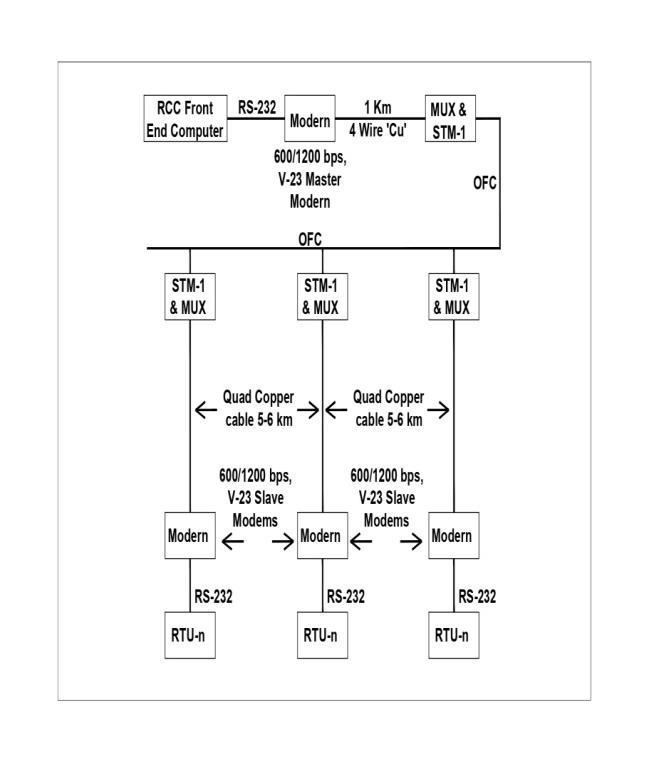
RecentadvancementsincludeoptimizedcomputersatOCC, reducedhardwiring,compactRTUs,enhancedreliability,and satellite-basedtimestamping.Keybenefitsofthesystemare:
Lesshardwiringwithnumericalrelays
CompactRTUs,savingspace
Fewer components for higher reliability and reduced maintenance
Lowercommunicationloadwith485ports
LocalHMIforparametersettings
GPSsynchronizationforuniformtimestamping
CompatibilitywithAutoFaultLocators
Integratedacquisitionofanalogparameterslikevoltage andcurrent.
ThefunctionalblockdiagramofSCADAsystemadoptedover WDFCasshowninFig.2followstwomainconceptsasgiven below:
(i) Distributed Architecture - to ensure that various componentscanassumedifferentresponsibilities.Moreover, it is easier to increase the capacity of system in future by includingmoreno.ofsimilarcomponents.
(ii)Modular Design - to make it possible to configure the wholeofthesysteminasinglecomputer,thereby,leadingto flexibilityintermsofsizingofthesystem.
International Research Journal of Engineering and Technology (IRJET) e-ISSN: 2395-0056
Volume: 11 Issue: 09 | Sep 2024 www.irjet.net p-ISSN: 2395-0072
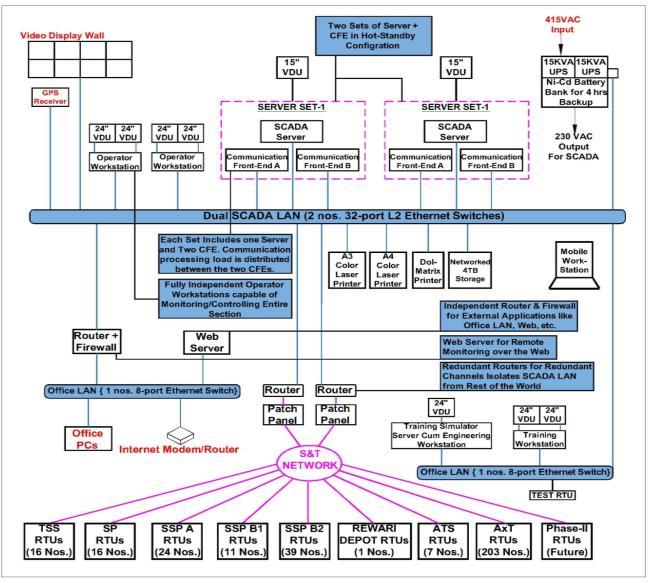
TheSACDAservers,operatorworkstationsandotherfront end devices located at OCC are used for monitoring and controloftheentiretractionnetworkoverWDFC. TheRTUs provided along the network will interact with local switchgearequipment,otherIEDsandshallactasagateway betweentheOCCandthefieldequipment.
The SCADA servers operate in hot standby mode thereby, offering dual redundancy of the SACADA server functions. Theseserversalsohosthistoriandatabase,thereby,ensuring dual redundancy of the historian too. Two sets of CommunicationFrontEnds(CFEs)havebeenconfiguredin hot-standbymode,whichwillcommunicatewiththeRTUs. Additionally,twoworkstationsgrademachineshavebeen providedforManMachineInterface(MMI)functionstothe Tractionpowercontroller.Themaincomputerinteractswith communication processor and work station computers. It collectstheformattedRTUinformationfromcommunication processorandsendstheprocessedinformationtoOperating work station (OWS) computer. The main computer also responds to the requests of the OWS computer which receivescommandsfromTPC.Thisinformationissenttothe communicationprocessor.TheSCADAserveralsoprovides thefollowingthirdpartinterfaces:
• Opendatabaseconnectivity(ODBC),SQLtoitshistorical andrealtimedatabase
• IEC60870-5-101/104fortransferofdatatootherSCADA systems
• OPCunifiedarchitecture(OPCUA)
TheseinterfacesallowexchangeofdatabetweenSCADAand third party systems. For preventing cyber attacks from external world, the SCADA LAN has been isolated through suitable firewalls placed at the point of interface with externalworld.Thesefirewallscreateanelectronicsecurity perimeter(ESP)asperIEEE1686guidelines.
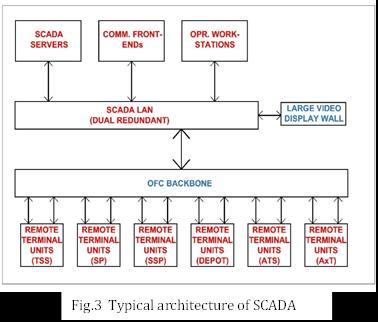
ThetypicalarchitectureofSCADAsystemisshowninFig.3.
Remote Terminal Units (RTU) areinstalledattraction control posts across the WDFC network, interfacing with electricalswitchgearviahardwireddigital/analoginputsand communicable IEDs (e.g., multifunction transducers, numerical relays). Husky RTUs are used to acquire and control signals fromfield equipmentandgather data from IEDsandotherRTUs.
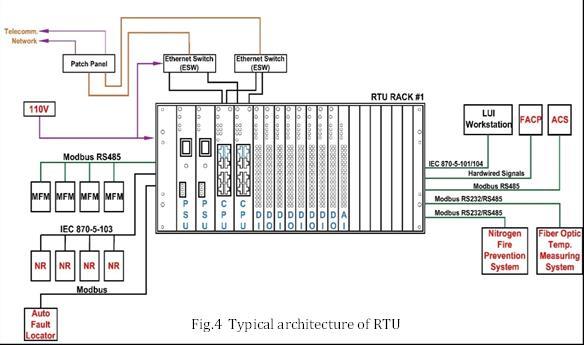
RTUssupportserialandEthernetcommunicationusing protocols like RS232, RS485, and fiber-optic Ethernet. GSM/GPRS/CDMA modems provide wireless connectivity. They can also actasa gateway,using IEC 61850 to collect data from IEDs and transfer it to master stations over protocolslikeIEC870-5.
International Research Journal of Engineering and Technology (IRJET) e-ISSN: 2395-0056
Volume: 11 Issue: 09 | Sep 2024 www.irjet.net p-ISSN: 2395-0072
Key features of Husky Studio include I/O module configuration,protocolmapping,timesynchronization,realtimemonitoring,andofflinelogicsimulation.
RTUs for TSS/SP/SSP/AT/PP are modular and rackbased, with redundant power supplies and CPUs. They support both DC and AC power, ensuring uninterrupted operation.
RTUs for Auxiliary Transformers (AxT) monitor transformerstatusatstationsandhuts,transferringdatato OCCusingfiberoptics.Thesemini-RTUsarenon-redundant, boxed, and wall-mounted, with ingress protection conformingtoIP54.
5.2.1 RTUs for Auxiliary Transformers (AxT)
Thestatusmonitoringoftheauxiliarytransformersprovided atstations,ALH(AutoLocationHuts)andTH(TelecomHuts) locationshasbeencarriedoutwiththehelpofamini-RTU. The status of each auxiliary transformer in terms of availabilityofpoweroutputfromthetransformerwouldbe captured and sent to OCC. The mini-RTU is provided in a boxedformfactor(andhencenotinterchangeablewithother typeofRTUs)andinnon-redundantfashion. Ithastwo100 Base FX Ethernet ports for interfacing with the fiber optic backbone.
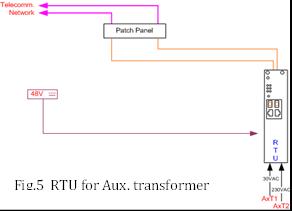
ThesecondaryoftheAxT,i.e.240VAC,hasbeenconnectedto theRTUformeasuringthevoltage.TheRTUwouldderivethe statusbasedonthemeasuredvoltageandtransferthedatato OCCusingthefiberopticbackbone.
The RTU has been housed in a wall-mounted panel and located in the respective station building or ALH/ telecom hut. Thepanelhasgotingressprotectioninconformanceto IP54.
The details of communication between OCC and other equipmentareasgivenbelow:
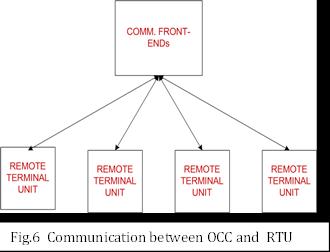
CommunicationsbetweentheRTUsandSCADAsystemtakes placeoverTCP/IP.
ThelogicaltopologyofthecommunicationbetweentheOCC andtheRTUsisstar-type,althoughthephysicaltopologymay be ring-type or daisy-chain type. Each RTU will be communicating directlyandindependentlywithOCC. The architecture,therefore,hastheadvantagethatfailuresofone or more RTUs does not affect the response times of other RTUs.
TheIEC60870-5-104communicationprotocolhasbeenused for communicating between the OCC and RTU. Therefore, data transfer is unsolicited and no explicit polling is performedbyOCC.TheRTUhasbeenconfiguredtoreport analogvaluesoncyclicbasis&statuschangesbyexceptionto OCC. However, RTU also provides exception reporting of analogdataincaseofanylimitviolations. Digitalstatusdata ishavinghigherprioritythantheanalogdata.
Alltheanalogvaluesandstatusdatahasalsobeenassigned toscangroupsforintegritycheckbyOCCatevery10minutes configurableupto60minutesRTUwise. Inaddition,RTU will report energy values to OCC on periodic basis. The periodicity is configurable from 5 minutes to 24 hours (initiallysetfor15minutes).
TheRTUatTSSlocationswillinterfacewithAFLequipment locatedatTSSonIEC60870-5-104protocolandcollectthe fault,statusinformation.Thisinformationisthentransferred byRTUtoOCCalongwithothersignals.
5.3.3
At the operations control center, a dual redundant SCADA LANhasbeenestablishedtooperateinfault-tolerantmode. This has been achieved through use of two L2 managed
International Research Journal of Engineering and Technology (IRJET) e-ISSN: 2395-0056
Volume: 11 Issue: 09 | Sep 2024 www.irjet.net p-ISSN: 2395-0072
network switches. All SCADA computersconnected to the SCADA LAN are having two Ethernet ports configured to operate in fault-tolerant mode. One port of connected to LAN1,whiletheothertoLAN2. Inthisscheme,asinglepoint offailurewillnotcausesforlossofanyfunction.
The status of both the LANs for each computer would be monitoredandrecordedintheSCADAalarm/eventlist.
ConnectivitytoanexternalLANorofficenetworkfromthe SCADA LAN has been provided through a firewall. The firewallsecurestheSCADALANandwillnotallowanytraffic exceptwebservertrafficbetweenthetwoLANs.
5.3.5
The RTU performs time stamping of hardwired inputs on individualI/Omodules.Italsopreservesthetimestampingof anyeventdonebyanotherexternal(slave)device.Thus,any time stamped event received from any slave is passed to SCADAmasterwithoutanymodifications.
TheSCADAisalsoprovidedwithanEngineeringtoolknown asIntegratedDevelopmentEnvironment(IDE)mainlyused forconfiguringtheSCADAapplicationandishavingfollowing features:
• MakesuseofsingleapplicationtoconfigureSCADAand allowsdistributingconfigurationonmultiplemachinesfrom theengineeringmachine.
• IDEisacompleteintegrateddevelopmentenvironment that allows rapidly designing and distributing SCADA projects.
• Database editing, graphics editing, topology, report editingetc.
• Export/importofdatabasepointsviaExcel.
Thus,itispossibletoconfigureSCADAdatabasethroughthis workstationwithoutinterferingwiththefunctioningofthe onlinesystem.Thechangesbecomeeffectivethroughmanual switchoverfromthestandbyservertothemainserver.
OneimportantdifferenceofSCADAsystembeingprovided overWDFCviz-a-vizIRisthecapabilityofintegrationwith Auto Fault Locators (AFLs) provided over the complete tractionnetworkforthepurposeoflocalizationoffaultsin automaticmodeforquickrestorationofhealthysection.The AFL equipment installed at TSS and other switching posts (equipped with Auto Transformers) have been interfaced withrespectiveRTUsoverIEC60870-5-1047protocol.There
are two AFL equipment at each TSS (one for the left side feedingzoneandanotherforright-sidefeedingzone).
TheintegrationofSupervisoryControlandDataAcquisition (SCADA) systems with IoT technology marks a significant advancement in the management and control of critical infrastructure,particularlyinthecaseofIndianRailways.The implementationofSCADAontheWesternDedicatedFreight Corridor(WDFC)demonstrateshowmoderndigitalsystems canaddressthecomplexchallengesposedbythe2x25kVAC tractionsystemandtheuniquerequirementsofdouble-stack container operations. By leveraging real-time data acquisition, remote monitoring, and automation, SCADA ensurestheseamlessoperationoftheWDFC’selectrification network.
The shift from traditional electromechanical systems to modern,IoT-enabledSCADAhasallowedIndianRailwaysto enhance operational efficiency, reduce maintenance costs, andimprovefaultdetectionandresponsetimes.Theuseof TCP/IP-basedcommunicationprotocols,incompliancewith IEC 60870-5-104,facilitatesreliabledatatransmissionand effective management of field equipment through Remote TerminalUnits(RTUs).Thistransitionnotonlysupportsthe growing demand for freight movement but also lays the foundationforfuturetechnologicaladvancementsinrailway infrastructure.
Inconclusion,theadoptionofSCADAsystemsacrossIndian Railways,particularlyontheWDFC,showcasesthepotential of IoT in revolutionizing railway operations. The system's ability to integrate intelligent devices, monitor network health, and respond to faults in real-time offers a robust solution for managing large-scale, unmanned power networks.Asrailwayscontinuetomodernize,SCADAsystems will play a critical role in ensuring the safe, reliable, and efficientoperationofelectrifiedcorridors.
I would like to extend my heartiest thanks to Dr. Vipin Kumar, IRSEE, for their invaluable support and guidance during the formulation of the text, verification of factual inputsandprovidingnecessaryfigures;withoutwhich,this wouldhavebeenincomplete.
[1] TrendsinProtection&SubstationAutomationSystems: IntegrationStandardization,InformationTechnologybyDe Mesmeakar Ivan, Key note address, 4th International ConferenceonPowerSystemProtection&Automation2122Nov.2007,CBIP,NewDelhi.
International Research Journal of Engineering and Technology (IRJET) e-ISSN: 2395-0056
Volume: 11 Issue: 09 | Sep 2024 www.irjet.net p-ISSN: 2395-0072
[2] IEC60870-5-103Transmissionprotocols–Companion standard for the informative interface of protection equipment.
[3] IEC60870-5-101Telecontrolequipmentandsystems–Part5-101:Transmissionprotocols-Companionstandardfor basictelecontroltasks.
[4] Research Design & Standards Organization (RDSO), Indian Railways specification No. TI/SPC/PSI/PROTCT/4050(10/2005) and TI/SPC/RCC/SCADA/1080(9/08)withAmendmentNo.1.
[5] Design of IEC 61850 based substation automation systemsaccordingtocustomerrequirements,K.P.BRAND,C. BRUNNER, W. WIMMER ABB Switzerland Ltd, Baden and Zurich,CIGRE,B5-103,2004.