
International Research Journal of Engineering and Technology (IRJET) e-ISSN: 2395-0056
Volume: 11 Issue: 09 | Sep 2024 www.irjet.net p-ISSN: 2395-0072

International Research Journal of Engineering and Technology (IRJET) e-ISSN: 2395-0056
Volume: 11 Issue: 09 | Sep 2024 www.irjet.net p-ISSN: 2395-0072
Priya Dubey1, Dipti Ranjan Tiwari2
1Master of Technology, Computer Science and Engineering, Lucknow Institute of Technology, Lucknow, India
2Assistant Professor, Department of Computer Science and Engineering, Lucknow Institute of Technology, Lucknow, India
Abstract - Heartdiseasecontinuestostandasaprominent contributor to global mortality rates, underscoring the imperativefor the creationof precise andeffectivepredictive frameworks. In recent times, deep learning methodologies have garnered considerable interest due to their capacity to scrutinize intricate and multi-dimensional datasets. This scholarly paper delves into the utilization of deep learning approaches in forecasting heart diseases, scrutinizing a spectrum of models and algorithms deployed in this sphere. The manuscript furnishes a comprehensive survey of diverse deep learning architectures, such as Convolutional Neural Networks (CNNs), Recurrent Neural Networks (RNNs), and amalgamated models, accentuating their efficacy in processing medical data and refining prognostic precision. Furthermore, the review deliberates on the hurdles and constraintsencounteredbydeeplearningmodelsintherealm of heart disease prediction, encompassing challenges associated with data integrity, model interpretability, and generalizability.Ultimately,thepaperdelineatesforthcoming avenues for research, underscoring the promise of amalgamatingdeeplearningwithothernascenttechnologies to enrich predictive capacities and contribute to tailored healthcare solutions.
Key Words: Heart Disease Prediction, Deep Learning, Convolutional Neural Networks (CNNs), Recurrent Neural Networks (RNNs), Hybrid Models, Medical Data Analysis, Predictive Models, Personalized Healthcare, Model Interpretability,DataQuality
Heart disease, a prominent cause of mortality on a global scale, boasts a rich and intricate historical background. Ancient civilizations, such as the Egyptians and Greeks, meticulouslychronicledsymptomsnowattributedtoheart disease, albeit without a comprehensive grasp of its underlying causes. It wasn't until the 17th century that WilliamHarveyelucidatedtheintricaciesofthecirculatory system, thereby laying the foundation for contemporary cardiology.Throughthepassageoftime,breakthroughsin medical science unveiled the complex mechanisms of the heartandshedlightontheprofoundinfluenceofvariables like diet, lifestyle, and genetic predispositions on cardiovascular well-being. Presently, heart disease, encompassingmaladieslikecoronaryarterydisease,heart failure, and stroke, stands as a formidable global health
crisis,claiminganestimated17.9millionlivesannuallyas reportedbytheWorldHealthOrganization.Thisburdenis notably weighty in regions characterized by limited healthcare accessibility and preventive interventions, particularly in low- and middle-income nations. The worldwide repercussions of heart disease underscore the imperativeofongoingresearchendeavors,earlydetection initiatives, and innovative therapeutic approaches geared towardsdiminishingmortalityratesandenhancingoverall qualityoflife.
1.1.Importance of early detection and prediction in reducing mortality rates.
Early detection and anticipation of cardiovascular disease are paramount in decreasing mortality rates, as they facilitatetimelyinterventionbeforetheconditionescalates toacriticalphase.Bypinpointingpredisposingfactorsand symptoms at an initial stage, healthcare providers can implementpreemptivemeasures,lifestylemodifications,and medical interventionsthatcansubstantiallydelayoreven avert the onset of severe cardiac conditions. Timely diagnosis also enables the creation of tailored treatment strategies, which can be more efficacious in managing the ailment and mitigating complications. Furthermore, prognosticmodels,especiallythosedrivenbycutting-edge technologieslikedeeplearning,canevaluateindividualrisk with remarkable precision, enabling proactive care customizedtoeachpatient.Thisproactivestancenotonly enhancessurvivalratesbutalsoenrichesthequalityoflife forpatientsbydiminishingtheprobabilityoflife-threatening incidentssuchasmyocardialinfarctionsorcerebrovascular accidents. In essence, early detection and anticipation are pivotaltacticsintheworldwidebattleagainstcardiovascular disease,offeringthepotentialtopreservemillionsoflives annually.
Heartdisease,aprevalenthealthissue,encompassesawide rangeofconditionsthatimpactthestructureandfunctionof theheart.Amongthese,coronaryarterydiseasestandsout asthemostcommonform,characterizedbythenarrowing or blockage of arteries supplying blood to the heart. This obstruction,oftencausedbythebuildupofplaque,restricts blood flow and heightens the risk of heart attacks. Additionally, heart failure, where the heart struggles to
International Research Journal of Engineering and Technology (IRJET) e-ISSN: 2395-0056
Volume: 11 Issue: 09 | Sep 2024 www.irjet.net p-ISSN: 2395-0072
pump blood efficiently, arrhythmias leading to irregular heartbeats,andvalvularheartdiseaseinvolvingfaultyheart valvesaresignificanttypesofheartconditions.
The factors contributing to heart disease are multifaceted andvaried.Geneticpredisposition,lifestylechoiceslikean unhealthy diet and lack of exercise, and environmental influencessuchasstressandpollutionallplayarole.Despite significantadvancementsinmedicalscience,heartdisease remains the primary cause of death globally, claiming millions of lives annually. Its impact extends beyond individualhealth,burdeninghealthcaresystems,economies, andfamiliesworldwide.
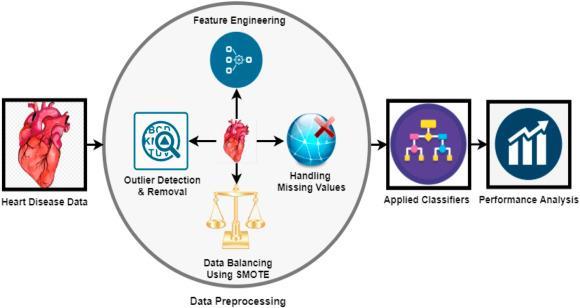
Toaddressthispervasiveissueeffectively,acomprehensive approach involving prevention, early detection, and innovative treatment strategies is crucial. By emphasizing healthylifestylehabits,raisingawarenessaboutriskfactors, and promoting regular screenings, the fight against heart diseasecanbeintensified.Throughcollectiveeffortsanda proactivemindset,thedetrimentaleffectsofheartdisease canbemitigated,ensuringahealthierfutureforgenerations tocome.
3.CURRENT DIAGNOSTIC AND PREDICTION METHODS
Currentdiagnosticandprognosticmethodologiesforcardiac ailments are varied, encompassing conventional clinical evaluationstocutting-edgetechnologicalstrategies.These methodologies are tailored to identify heart disease at different stages and forecast the probability of its manifestation,enablingtimelyinterventionandtreatment.
3.1. Clinical Assessments and Physical Examinations
3.1.1.Electrocardiogram (ECG/EKG)
Anon-invasivetestthatrecordstheelectricalactivityofthe heartovertime.Itisusedtodetectarrhythmias,ischemia,
and other heart abnormalities by analyzing the heart's rhythmandelectricalpatterns.
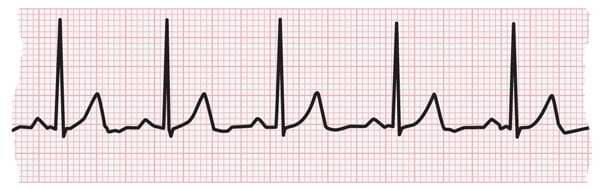
Figure-2: ECG Report
3.1.2.Blood Tests
Specificbiomarkersintheblood,suchascholesterollevels, triglycerides, and high-sensitivity C-reactive protein (hsCRP), are measured to assess the risk of heart disease. Elevatedlevelsoftroponin,aproteinreleasedduringheart muscledamage,areindicativeofaheartattack.
3.1.3.Echocardiogram
Anultrasoundoftheheartthatprovidesdetailedimagesof the heart’s structure and function. It helps in diagnosing conditions like heart valve diseases, cardiomyopathy, and heartfailure.
3.1.4.Stress Tests
These tests, including exercise stress tests and pharmacological stress tests, evaluate how the heart performs under physical exertion or stress. They help identifycoronaryarterydiseaseandassesstheseverityof knownconditions.
3.2. Imaging Techniques
3.2.1.Coronary Angiography
A procedure that uses X-ray imaging to visualize the coronaryarteries.Itinvolvesinjectingacontrastdyeintothe arteriestodetectblockagesornarrowingthatcouldleadto heartdisease.
3.2.2.Computed Tomography (CT) Scans
CTcoronaryangiography(CTCA)isanon-invasiveimaging techniquethatprovidesdetailedimagesoftheheart'sblood vessels.Itisoftenusedtoassesscoronaryarterydiseaseand calculate coronary artery calcium (CAC) scores, which predicttheriskofheartattacks.
3.2.3.Magnetic Resonance Imaging (MRI)
CardiacMRIprovideshigh-resolutionimagesoftheheart's structureandfunctionwithouttheuseofionizingradiation. It is particularly useful for diagnosing complex congenital
International Research Journal of Engineering and Technology (IRJET) e-ISSN: 2395-0056
Volume: 11 Issue: 09 | Sep 2024 www.irjet.net p-ISSN: 2395-0072
heartdisease,cardiomyopathies,andassessingmyocardial viability.
3.3. Predictive Models and Risk Assessment Tools
3.3.1.Framingham Risk Score
A widely used algorithm based on data from the FraminghamHeartStudy,whichcalculatesthe10-yearrisk of developing heart disease based on factors such as age, cholesterol levels, blood pressure, smoking status, and diabetes.
3.3.2.ASCVD Risk Calculator
DevelopedbytheAmericanCollegeofCardiology(ACC)and theAmericanHeartAssociation(AHA),thistoolestimates the 10-year and lifetime risk of atherosclerotic cardiovasculardisease(ASCVD),incorporatingfactorslike race,gender,andcholesterollevels.
3.3.3.QRISK Score
Used in the UK, the QRISK score predicts the risk of developing cardiovascular disease within 10 years by considering variables such as age, sex, ethnicity, blood pressure,cholesterollevels,andfamilyhistory.
3.4. Emerging Technologies
3.4.1.Machine Learning and AI-Based Models
Machinelearningalgorithmsandartificialintelligence(AI) are increasingly being used to predict heart disease by analyzinglargedatasets,includingelectronichealthrecords (EHRs),imagingdata,andgeneticinformation.Thesemodels can identify patterns and risk factors that may not be apparentthroughtraditionalmethods,offeringpersonalized predictions.
3.4.2.Wearable Devices
Wearable technology, such as smartwatches with ECG capabilities, can continuously monitor heart rate, rhythm, and other vital signs, providing early detection of irregularitiesandpotentialheartdisease.
3.4.3.Genomic and Biomarker Analysis
Advances in genomics have led to the identification of genetic markers associated with heart disease. Combined with biomarker analysis, these approaches offer personalized risk assessments and targeted prevention strategies.
Deeplearningtechniqueshaverevolutionizedheartdisease prediction by enabling more accurate, efficient, and
personalized assessments. These techniques leverage complex neural network architectures to analyze large volumes of data and identify patterns that traditional methods may miss. Here’s a detailed look at how deep learningisappliedinheartdiseaseprediction:
4.1. Overview of Deep Learning
4.1.1.Definition and Basic Concepts
Deeplearningisasubsetofmachinelearningthatinvolves neuralnetworkswithmanylayers(deepneuralnetworks). Thesenetworkscanautomaticallylearnandextractfeatures fromrawdata,makingthemparticularlyeffectivefortasks suchasimagerecognition,naturallanguageprocessing,and predictivemodeling.
4.2.Types of Deep Learning Models
4.2.1.Convolutional Neural Networks (CNNs)
Ideal for analyzing visual data, CNNs are used in heart diseasepredictiontoprocessmedicalimageslikeECGsand MRIscans,detectingabnormalitiesandpatternsindicativeof heartconditions.
4.2.2.Recurrent Neural Networks (RNNs)
Usefulforsequentialdata,RNNsandtheirvariants(suchas LongShort-TermMemorynetworks,LSTMs)areemployed toanalyzetime-seriesdata,suchasECGsignals,topredict arrhythmiasandotherheartconditions.
4.2.3.Autoencoders
These are used for unsupervised learning tasks, such as anomalydetectioninmedicaldata.Theycanidentifyunusual patterns in patient data that may signify emerging heart disease.
4.2.4.Feedforward Neural Networks (DNNs)
These are employed in risk prediction models that use structured data (e.g., patient demographics, laboratory results)toestimatetheprobabilityofheartdisease.
4.3.Data Used in Deep Learning Models
4.3.1.Structured Data
Includesnumericalandcategoricalinformationsuchasage, bloodpressure,cholesterollevels,andmedicalhistory.Deep learning models can integrate and analyze this data to predict heart disease risk based on complex interactions betweenvariables.
4.3.2.Unstructured Data
Comprises medical images (e.g., CT scans, MRI, echocardiograms)andtextdatafromclinicalnotes.CNNsare
International Research Journal of Engineering and Technology (IRJET) e-ISSN: 2395-0056
Volume: 11 Issue: 09 | Sep 2024 www.irjet.net p-ISSN: 2395-0072
particularly effective at processing and interpreting these types of data, extracting relevant features that inform predictivemodels.
4.3.3.Data Preprocessing
Normalization: Standardizes data ranges to improve modelperformanceandconvergence.
Augmentation: Enhances the dataset by creating variations(e.g.,rotatingorflippingimages)toimprove modelrobustness.
Feature Engineering:Involves selecting and transformingvariablestobetterrepresentthedatafor modeltraining.
4.4. Performance Metrics
4.4.1.Accuracy
Measurestheoverallcorrectnessofthemodel'spredictions.
4.4.2.Precision and Recall
Precision assesses the proportion of true positive predictions among all positive predictions, while recall evaluatestheproportionoftruepositivesamongallactual positives. Both are crucial for evaluating the model's effectivenessinidentifyingheartdisease.
4.4.3.F1-Score
The harmonic mean of precision and recall, providing a balancedmeasureofmodelperformance.
4.4.4.AUC-ROC Curve
TheAreaUndertheReceiverOperatingCharacteristicCurve quantifiesthemodel’sabilitytodistinguishbetweenpositive and negative cases, with higher values indicating better performance.
4.5. Challenges and Limitations
4.5.1.Data Quality and Quantity
Deep learning models require large and high-quality datasets for training. Limited or biased data can lead to overfittingorreducedgeneralizability.
4.5.2.Interpretability
Deep learning models are often considered "black boxes," makingitchallengingtounderstandhowdecisionsaremade. This lack of transparency can be a barrier to clinical adoption.
4.5.3.Computational Resources
Training deep learning models can be resource-intensive, requiring significant computational power and memory, whichcanbealimitationinresource-constrainedsettings.
4.5.4.Ethical and Privacy Concerns
Handling sensitive patient data raises privacy issues and requires strict adherence to ethical guidelines and regulations.
4.6. Future Directions
4.6.1.Explainable AI (XAI)
Researchis focused on developing methodstomake deep learning models more interpretable, helping clinicians understandandtrustthepredictions.
4.6.2.Transfer Learning
Utilizing pre-trained models on related tasks to improve performanceonspecificheartdiseasepredictiontaskswith limiteddata.
4.6.3.Federated Learning
Allows collaborative training of models across multiple institutionswithoutsharingsensitivedata,enhancingmodel robustnesswhileprotectingpatientprivacy.
5.APPLICATIONS OF DEEP LEARNING IN HEART DISEASE PREDICTION
Deep learning has a profound impact on heart disease prediction by offering innovative solutions that enhance diagnostic accuracy, risk assessment, and personalized treatment.Here’sadetailedexplorationofitsapplications:
5.1. Predictive Models
5.1.1.Risk Assessment Models
Deeplearningmodelsintegratetraditionalriskfactorssuch asage,sex,cholesterollevels,bloodpressure,andsmoking status with advanced data sources. These models analyze complex interactions between variables to predict the likelihood of heart disease more accurately than conventionalmethods.
5.1.2.Personalized Risk Prediction
Models like deep neural networks (DNNs) and gradient boosting machines use patient-specific data to generate personalizedriskscores.Forinstance,algorithmscantailor predictionsbasedongenetic information,lifestylefactors, andhistoricalmedicalrecords,providingindividualizedrisk assessmentsandpreventiverecommendations.
International Research Journal of Engineering and Technology (IRJET) e-ISSN: 2395-0056
Volume: 11 Issue: 09 | Sep 2024 www.irjet.net p-ISSN: 2395-0072
5.1.3.Longitudinal Monitoring
Deep learning models monitor continuous ECG data from wearable devices to detect and predict potential heart disease.Theyanalyzepatternsovertimetoidentifysubtle changesthatmayindicateemergingheartconditions.
5.2. Diagnostic Models
5.2.1.Medical Imaging Analysis
5.2.1.1.Cardiac MRI and CT Scans
CNNs are used to analyze cardiac MRI and CT images, identifying structural abnormalities, such as myocardial infarction,coronaryarterydisease,andvalvulardisorders. Thesemodelscanprovidedetailedinsightsintotheheart’s anatomyandfunction,aidinginaccuratediagnosis.
5.2.1.2.Automated Image Segmentation
Deeplearningalgorithmsperformautomatedsegmentation ofcardiacstructuresfromimagingdata,suchasidentifying theleftventricleorcoronaryarteries.Thisprocessaidsin quantifying the extent of damage or disease and planning appropriateinterventions.
5.2.2.Anomaly Detection
5.2.2.1.Unsupervised Learning
Autoencoders and other unsupervised deep learning techniquesdetectanomaliesinmedicalimagingandpatient data.Thesemodelsidentifypatternsthatdeviatefromthe norm, potentially signaling the presence of heart disease beforeclinicalsymptomsappear.
5.3. Integration with Electronic Health Records (EHRs)
5.3.1.Predictive Analytics
DeeplearningmodelsanalyzeEHRstopredicttheonsetof heart disease based on a combination of structured and unstructureddata,includingclinicalnotes,labresults,and demographicinformation.Thesemodelscanidentifyhighriskpatientsandsuggestpersonalizedtreatmentplans.
5.3.2.Natural Language Processing (NLP)
NLP techniques extract relevant information from unstructuredclinicalnotes,suchassymptomsandmedical history,toenhancepredictionmodels.Thisintegrationhelps provideacomprehensiveviewofpatienthealth,improving predictionaccuracy.
5.4. Personalized Treatment Planning
5.4.1.Treatment Response Prediction
Deep learning models predict individual responses to various treatments by analyzing patient-specific data and
historical outcomes. This approach helps in selecting the mosteffectivetreatmentplansandoptimizingtherapy.
5.4.2.Drug Discovery and Development
Models are used to identify potential drug targets and predict the efficacy of new medications for heart disease. Deep learning accelerates drug discovery by analyzing complexbiologicaldataandsimulatinginteractionsbetween drugsandtargets.
5.5.1.Wearable Devices
Wearables equipped with deep learning algorithms continuouslymonitorvitalsigns,suchasheartrateandECG, providing real-timealertsforabnormal patternsthat may indicate heart disease. These devices can notify users and healthcare providers of potential issues, enabling timely intervention.
5.5.2.Remote Monitoring Systems
Deeplearningmodelsanalyzedatafromremotemonitoring systems to track patients’ heart health remotely. These systemscandetectdeteriorationsinconditionandprovide earlywarnings,allowingforproactivemanagement.
5.6. Comparative Analysis
5.6.1.Comparison with Traditional Methods
Deep learning models are compared with traditional machine learning and statistical methods to evaluate performance improvements in heart disease prediction. Metricssuchasaccuracy,precision,recall,andAUC-ROCare usedtoassesstheeffectivenessofdeeplearningapproaches.
5.6.2.Advancements in Predictive Power
Research demonstrates that deep learning models often outperform traditional methods by capturing complex relationships and interactions in data, leading to better predictivepowerandmoreaccurateriskassessments.
5.7.Challenges and Considerations
5.7.1.Data Quality and Generalization
Theeffectivenessofdeeplearningmodelsdependsonthe quality and diversity of the data used. Models trained on diverse and high-quality datasets are more likely to generalizewellacrossdifferentpopulations.
5.7.2.Regulatory and Ethical Issues
Ensuring that deep learning models comply with medical regulationsandethicalstandardsiscrucial.Transparency,
International Research Journal of Engineering and Technology (IRJET) e-ISSN: 2395-0056
Volume: 11 Issue: 09 | Sep 2024 www.irjet.net p-ISSN: 2395-0072
interpretability,andpatient privacymustbeaddressed to gainacceptanceinclinicalpractice.
In the literature review section, we have examined the preceding research papers pertaining to the conventional predictionofheartdisease.Acomprehensivesummaryofall theaforementionedresearchpapersisdetailedbelow.
Latha & Subramanian. The proposed CANFIS model combinedtheneuralnetworkadaptivecapabilitiesandthe fuzzy logic qualitative approach which is then integrated with genetic algorithm to diagnose the presence of the disease.CANFISmodelcombinedneuralnetworkandfuzzy logicforheartdiseaseprediction.Geneticalgorithmusedto diagnosethepresenceofheartdisease.CANFISmodelwith GAshowspotentialinpredictingheartdisease.Computers complement doctors in evaluating areas highlighted by detection.
Chitra & Seenivasagam. TheresultsshowtheCNNclassifier canpredictthelikelihoodofpatientswithheartdiseaseina more efficient way. Heart disease prediction using supervised learning algorithm. Cascaded Neural Network classifierimprovespredictionefficiency.TheproposedCNN classifier can predict the likelihood of patients with heart diseasemoreefficiently.
TheSVMclassifierisalsousedforheartdiseaseprediction.
Aditya et al. Theproposedsystemwillusethemultilayered feedforwardneuralnetworkandbackpropagationneural network algorithms for the prediction of heart disease in fourstagesusingthedatasetprovidedbytheUniversityof California,Irvine[UCI]machinelearningrepository.Heart diseasepredictionsystemusingmultilayeredfeedforward and back propagation neural network. Dataset from UCI machinelearningrepository usedfor trainingandtesting. Increase in heart disease cases due to population growth. Proposed system improves accuracy and speed of disease diagnosis.
Marikani & Shyamala. This paper aims at analyzing the various data mining techniques namely Decision Trees, NaiveBayes,NeuralNetworks,RandomForestClassification andSupportVectorMachinebyusingtheClevelanddataset for Heart disease prediction to provide a quick and easy understandingofvariouspredictionmodelsindatamining. Heart disease prediction using data mining techniques. Analysis of various supervised learning algorithms for prediction. Different supervised learning algorithms were used for heart disease prediction. The accuracy of the algorithms varied depending on the attributes and tools used.
Kathleen & Julia. Clinical diagnoses of coronary heart disease were reliably and accurately derived from the
developedDNNclassificationandpredictionmodels,which can be used to aid healthcare professionals and patients throughout the world to advance both public health and global health, especially in developing countries and resource-limited areas with fewer cardiac specialists available.DNNmodelaidsheartdiseasediagnosiswithhigh accuracy. Focus on coronary heart disease diagnosis and prognosisimprovement. Developeddeeplearningmodels achievedhighdiagnosticaccuracy.Resultsexceedthoseof currentlypublishedresearch.
Poornima et al. Aneffectiveheartdiseasepredictionsystem (EHDPS)isdevelopedusingneuralnetworkforpredicting therisklevelofheartdiseaseusingmultilayerperceptron neural network with backpropagation as the training algorithm.EHDPS predicts heartdisease risk using neural networkand15parameters.Multilayerperceptronneural networkwithbackpropagationalgorithmusedfortraining. MLPNNwithBPalgorithmpredictsheartdiseasewith100% accuracy.EHDPSassistsinearlydiagnosisandplanningfor patients.
Shahid et al. ThenumberoftechniquesinArtificialNeural Network(ANN)isenlightenandtheaccuracyiscalculated andvisualizedsuchasANNgives94.7%butwithPrinciple ComponentAnalysis(PCA)accuracyrateimproveto97.7%. Heart disease prediction using Artificial Neural Network. Accuracyrateimprovedto 97.7%withPCA.ANN givesan accuracyrateof94.7%.PCAimprovestheaccuracyrateto 97.7%.
Amin et al. Theproposedmachine-learning-baseddecision support system will assist the doctors to diagnosis heart patientsefficientlyandcaneasilyidentifyandclassifypeople withheartdiseasefromhealthypeople.Machinelearningbased system for heart disease prediction using heart diseasedataset.Sevenpopularmachinelearningalgorithms and three feature selection algorithms used. Developed machine-learningsystemaccuratelypredictsheartdisease. Feature reduction impacts classifier performance in accuracyandexecutiontime.
Annisa et al. Asimulationwhichcanbeusedtodiagnosethe coronary heart disease in better performance than the traditional diagnostic methods is proposed and deeper neuralnetwork(DNN)isproposedtothemodelinthiswork. Proposed DNN model for CHD diagnosis outperforms traditional methods. Achieved 96% accuracy, 99% sensitivity,and92%specificity.AutomatedCHDdiagnosis based on chest pain type input. Angina is a common symptomofCHD.
Sowbarnica et al. The proposed approach significantly improvestheaccuracyfrom 51%to76.66%andwill help doctor to explore their data and predict heart disease accurately. Heart disease prediction using K-Nearest Neighbour classification. Proposed approach improves accuracy from 51% to 76.66%. Heart Disease Prediction
International Research Journal of Engineering and Technology (IRJET) e-ISSN: 2395-0056
Volume: 11 Issue: 09 | Sep 2024 www.irjet.net p-ISSN: 2395-0072
System using K-Nearest Neighbour Classifier provides reliable outputs. The system significantly improves heart diseasepredictionrate.
Saranya Manavalan. Itis provedthattheaccuracyofthe Fuzzy Deep belief network is superior to the Deep Belief network and that the FDBN system is one of the best classificationmodelsinefficientlypredictingcardiovascular diseaseswiththelowesterrorrateandmaximumaccuracy. HeartdiseasepredictionusingDeepBeliefNeuralNetwork withFuzzyLogic.FuzzyDeepBeliefNetworkoutperforms DeepBeliefNetworkinaccuracy.FuzzyDeepBeliefNetwork outperforms Deep Belief Network. FDBN is efficient in predictingcardiovasculardiseaseswithhighaccuracy.
Dominic et al. The model system assists clinicians in survivalratepredictionofanindividualpatientandfuture medication is planned for, and the families, relatives, and theirpatientscanplanfortreatmentpreferencesandplan fortheirbudgetconsequently.Modelpredictsheartdisease usingdataminingclassificationtechniques.Attributesused for prediction expanded to include obesity and smoking. ProposedmodelusesNaiveBayesian,decisiontree,andKNN classifiers. Decision tree has high precision and less error rate.
Irfan et al. Thestrengthoftheproposedensembleapproach suchasvotingbasedmodeliscompellinginimprovingthe prognosis accuracy of anemic classifiers and established adequate achievement in analyze risk of heart disease. MachineLearningtechniquesusedtopredictheartdisease with improved accuracy. Ensemble voting based model achieved2.1%increaseinaccuracy.Ensemblevotingmodel improves heart disease prediction accuracy by 2.1%. ML techniques and deep learning models enhance prognosis accuracysignificantly.
Yahaya et al. Thispaperinvestigatesthestateoftheartof variousclinicaldecisionsupportsystemsforheartdisease prediction, proposed by various researchers using data mining and machine learning techniques. Heart disease diagnosis and treatment are complex. Clinical decision support systems for heart disease prediction. Marginal success achieved in creating predictive models. Need for morecomplexmodelswithdiversedatasources.
Viraj et al. In this paper, the authors proposed to use convolutional neural network algorithm as a disease risk predictionalgorithmusingstructuredandperhapsevenon unstructured patient data to predict the risk of diseases. PredictheartdiseaseriskusingCNNalgorithmwith85-88% accuracy. Implement machine learning algorithms on structuredpatientdataforprediction.Convolutionalneural network algorithm predicts heart disease risk. Accuracy rangesbetween85and88%.
Singh et al. Themainobjectiveofthisresearchisdeveloping such a model Intelligent Heart Disease Prediction System
(IHDPS) with the help of three data mining modelling techniques,namely,DecisionTreespredictionmodel,Naïve BayesprobabilitytechniqueandNeuralNetwork.Develops Intelligent Heart Disease Prediction System using data mining techniques. Aids in diagnosing heart disease and makingintelligentclinicaldecisions.Thepaperproposesan IntelligentHeartDiseasePredictionSystem(IHDPS)using dataminingtechniques.TheIHDPSenablesbetterdiagnosis and assists healthcare practitioners in making intelligent clinicaldecisions.
Abhay. The main objective of this research paper is to summarize the recent research with comparative results that has been done on heart disease prediction and also makeanalyticalconclusions.Heartdiseasepredictionusing machinelearningalgorithms.NaiveBayes,DecisionTrees, and Artificial Neural Networks improve accuracy. Naive BayeswithGeneticalgorithm,DecisionTrees,andArtificial NeuralNetworksimproveheartdiseasepredictionaccuracy. Data mining and machine learning techniques are summarized.
Jakkrit & Hathairat. The results show that the Logistic Regression model is better performance than Neural Networkmodelinpredictingtheheartdiseasedetectionby using data mining techniques. Predictive model for heart disease detection using data mining techniques. Logistic RegressionmodeloutperformsNeuralNetworkmodel.
Maria et al. This paper aims to provide a solution of the dimensionalityproblembyproposinganewmixedmodelfor heartdiseasepredictionbasedontheNaiveBayesalgorithm andseveralmachinelearningtechniquesincludingSupport Vector Machine, K-Nearest Neighbors, Decision Tree, and RandomForest.HeartdiseasepredictionmodelusingNaïve Bayesalgorithmandmachinelearningtechniques. Proposed model improves performance and selects best features. Proposedmodelimprovesheartdiseasepredictionsystem performance.Naive Bayes approach outperforms Genetic AlgorithmandPrincipalComponentAnalysisapproaches.
Raniya et al. Inthisarticle ,theauthorsusedanartificial neuralnetwork(ANN)modeltoconstructadeeplearning diagnosis system for heart disease prediction, which achieved 93.44% accuracy, which is 7.5% higher than a traditionalMLmodelsupportvectormachine(SVM).ANN model achieved 93.44% accuracy for heart disease prediction. Traditional ML model SVM had 7.5% lower accuracy.
Gupta & Seth. In this paper , different machine learning classifiers and a deep learning algorithm multi-layer perceptron(MLP) were appliedontwo differentdatasets, Framingham heart study dataset and UCI heart disease datasetforpredictionofheartdisease.Machinelearningand deeplearningalgorithmswereusedtopredictheartdisease. Random forest algorithm had the highest prediction accuracyof97.13%.Randomforestalgorithmhadhighest
International Research Journal of Engineering and Technology (IRJET) e-ISSN: 2395-0056
Volume: 11 Issue: 09 | Sep 2024 www.irjet.net p-ISSN: 2395-0072
prediction accuracy of 97.13%. Multi-layer perceptron (MLP)performedwellonbothdatasets.
Jasjit et al. AmodelbasedonMachinelearningtechniques hasbeenproposedforearlyandaccuratepredictionofheart diseaseandit isfound that the resultsofproposed model givesthebetterperformanceintermsofsimulationerror, response time and accuracy in heart disease prediction. Predicting heart disease using efficient machine learning model.Utilizesfeatureoptimization,selection,andensemble learningtechniques.
Tuba. Inthispaper,amachinelearningapproachwasused forheartdiseasepredictionusingSupportVectorMachine (SVM),K-NN,RandomForestClassifier,DecisionTree,and LogisticRegression.Heartdiseasepredictionusingmachine learning models. Logistic regression and K-NN produced bestresults.LogisticregressionandK-NNmodelsproduced thebestresults.Machinelearningmodelscanoptimizeheart diseaseprediction.
Chintan et al. Inthisarticle,theauthorsproposedamethod ofk-modesclusteringwithHuangstartingthatcanimprove classificationaccuracy,whichachievedthehighestaccuracy of87.28%onareal-worlddatasetof70,000instancesfrom Kaggle. Machine learning used to predict cardiovascular diseases.Multilayerperceptronachievedhighestaccuracyof 87.28%. Multilayer perceptron with cross-validation achieved the highest accuracy of 87.28%. The proposed modelshaveAUCvaluesrangingfrom0.94to0.95.
Deng et al. Wangetal.asmentionedinthispaperproposed anindicatorvectortoindicatewhetherthevalueistrueor bepadded,whichfastsolvesthemissingvaluesandhelps expand data dimensions. And a multi-head self-attention mechanism is applied to gain whole channel information, whichisessentialforthesystemtoimproveperformance. Deeplearningsystempredictsheartfailuremortalitywith multi-head attention. Utilizes indicator vector, CNN, and focal loss function for accuracy. CNN deep learning model effectivelypredictsHFmortality.Multi-headself-attention andfocallossimproveperformance.
Yewale et al. In this paper , the authors proposed a frameworkforeffectivepredictionofheartdiseasebasedon ensembletechniques,withouttheneedoffeatureselection, incorporatingdatabalancing,outlierdetectionandremoval techniques,withresultsthatarestillatparwithcutting-edge research. Framework for heart disease prediction using ensemble techniques. Achieves superior performance in accuracyandothermetrics.Proposedapproachoutperforms existingworkinaccuracy.Nopreviousresearchfocusedon theseperformanceparameters.
Haque et al. Attention learning predicts heart failure efficientlyusingcardiovasculardata.Serumcreatinineand ejection fraction are key predictive features. Proposed
attentionlearningapproachefficientlypredictsheartfailure. OutperformsLSTMapproachinheartfailureprediction.
Latifi et al. Fast, cost-effective method for diagnosing cardiacabnormalitieswithhighaccuracy.Multi-BranchDeep Convolutional Network and LSTM-CNN for heart sound classification. High accuracy in diagnosing cardiac abnormalities using innovative neural networks. Superior results over state-of-the-art techniques in heart sound classification.
Inrecentyears,theapplicationofdeeplearningtechniques forheartdiseasepredictionhasshownsignificantpromise, offeringimprovedaccuracyandefficiencyovertraditional methods.Byleveraginglargedatasetsandcomplexmodels, deep learning algorithms can uncover patterns and relationships within medical data that were previously inaccessible.Thisreviewhashighlightedthevariousdeep learningarchitecturesemployedinheartdiseaseprediction, suchasConvolutionalNeuralNetworks(CNNs),Recurrent Neural Networks (RNNs), and hybrid models, all of which havedemonstratedvaryingdegreesofsuccess.Despitethe advancements,severalchallengesremain,includingtheneed for large, high-quality datasets, the complexity of model interpretability, and the potential for bias in predictive models. Addressing these challenges is crucial for the widespread adoption of deep learning in clinical settings. Future research should focus on enhancing model transparency,integratingmulti-modaldata,anddeveloping modelsthatcanbegeneralizedacrossdiversepopulations. While deep learning techniques offer a powerful tool for heart disease prediction, careful consideration of the underlyingchallengesandafocusonethicalimplementation areessentialtoensurethesetechnologiesbenefitpatients globally.
1. Agrahary, A. (2020). Heart disease prediction using machinelearningalgorithms.InternationalJournalof Scientific Research in Computer Science Engineering and Information Technology, 137–149. https://doi.org/10.32628/cseit206421
2. Bhatt,C.M.,Patel,P.,Ghetia,T.,&Mazzeo,P.L.(2023). Effective heart disease prediction using machine learning techniques. Algorithms, 16(2), 88. https://doi.org/10.3390/a16020088
3. Chitra, R., & Seenivasagam, D. (2013). Heart disease predictionSystemusingSupervisedLearningClassifier. BonfringInternationalJournalofSoftwareEngineering and Soft Computing, 3(1), 01–07. https://doi.org/10.9756/bijsesc.4336
International Research Journal of Engineering and Technology (IRJET) e-ISSN: 2395-0056
Volume: 11 Issue: 09 | Sep 2024 www.irjet.net p-ISSN: 2395-0072
4. Darmawahyuni,A.,Nurmaini,S.,&Firdaus,F.(2019). Coronary heart disease interpretation based on deep neural network. Computer Engineering and Applications Journal, 8(1), 1–12. https://doi.org/10.18495/comengapp.v8i1.288
5. Gupta,P.,&Seth,D.(2022).Comparativeanalysisand feature importance of machine learning and deep learning for heart disease prediction. Indonesian JournalofElectricalEngineeringandComputerScience, 29(1), 451. https://doi.org/10.11591/ijeecs.v29.i1.pp451-459
6. Haq, A. U., Li, J. P., Memon, M. H., Nazir, S., & Sun, R. (2018).Ahybridintelligentsystemframeworkforthe prediction of heart disease using machine learning algorithms. Mobile Information Systems, 2018, 1–21. https://doi.org/10.1155/2018/3860146
7. Haque,E.,Paul,M.,&Tohidi,F.(2024).PredictingHeart FailurewithAttentionLearningTechniquesUtilizing Cardiovascular Data. arXiv (Cornell University). https://doi.org/10.48550/arxiv.2407.08289
8. Javid, I., Khalaf, A., & Ghazali, R. (2020). Enhanced Accuracy of Heart Disease Prediction using Machine Learning and Recurrent Neural Networks Ensemble Majority Voting Method. International Journal of Advanced Computer Science and Applications, 11(3). https://doi.org/10.14569/ijacsa.2020.0110369
9. JournalofAdvancesinInformationTechnology.(2023). Journal of Advances in Information Technology. https://doi.org/10.12720/jait
10. Latifi, S. A., Ghassemian, H., & Imani, M. (2024). ClassificationofheartsoundsusingMulti-BranchDeep ConvolutionalNetworkandLSTM-CNN.arXiv(Cornell University). https://doi.org/10.48550/arxiv.2407.10689
11. Li,D.,Fu,J.,Zhao,J.,Qin,J.,&Zhang,L.(2023).Adeep learningsystemforheartfailuremortalityprediction. PLoS ONE, 18(2), e0276835. https://doi.org/10.1371/journal.pone.0276835
12. Makumba,D.O.,Cheruiyot, W.,& Ogada, K.(2019).A modelforcoronaryheartdiseasepredictionusingdata mining classification techniques. Asian Journal of Research in Computer Science, 1–19. https://doi.org/10.9734/ajrcos/2019/v3i430098
13. Miao, K. H., & H, J. (2018). Coronary Heart Disease DiagnosisusingDeepNeuralNetworks.International Journal of Advanced Computer Science and Applications, 9(10). https://doi.org/10.14569/ijacsa.2018.091001
14. Prediction of Heart Disease using Artificial Neural Network. (2018). VFAST Transactions on Software Engineering, 102–112. https://doi.org/10.21015/vtse.v13i3.511
15. S,S.V.,V,V.,M,V.,&Bhuvana,S.(2019).Heartdisease prediction system using K- Nearest Neighbour Classification technique. International Journal of Scientific Research in Computer Science Engineering and Information Technology, 229–236. https://doi.org/10.32628/cseit195247
16. Samagh,J. S.,& Singh,D.(2022).AMachineLearning Model for Predicting Heart Disease using Ensemble Methods.InternationalJournalofAdvancedComputer Science and Applications, 13(9). https://doi.org/10.14569/ijacsa.2022.0130965
17. Saranya, S., & Manavalan, R., PhD. (2019). ComputationalFrameworkforHeartDiseasePrediction usingDeepBeliefNeuralNetworkwithFuzzyLogic.In ArignarAnnaGovernmentArtsCollege,Departmentof Computer Science, & Department of Computer Applications&InformationTechnology,International JournalofComputerApplications(Vols.181–181,Issue 49, pp. 26–27). https://www.ijcaonline.org/archives/volume181/num ber49/saranya-2019-ijca-918675.pdf
18. Shankar, V., Kumar, V., Devagade, U., Karanth, V., & Rohitaksha,K.(2020).Heartdiseasepredictionusing CNN algorithm. SN Computer Science, 1(3). https://doi.org/10.1007/s42979-020-0097-6
19. Shinde,A.A.,NBNSinhgadSchoolofEngineering,Kale, S.N.,Samant,R.M.,Naik,A.S.,&Ghorpade,S.A.(2017). Heart Disease Prediction System using Multilayered FeedForwardNeuralNetworkandBackPropagation NeuralNetwork.InInternationalJournalofComputer Applications (Vols. 166–166, Issue No.7, pp. 32–33). https://www.ijcaonline.org/archives/volume166/num ber7/shinde-2017-ijca-914080.pdf
20. Singh, A. K., Dixit, A., & Jamshed, A. (2020). Heart Disease Risk Predictor System using Data Mining LearningTechniques:Analysis.InInternationalJournal of Computer Applications (Vols. 176–176, Issue 23). https://www.ijcaonline.org/archives/volume176/num ber23/singh-2020-ijca-920198.pdf
21. Singh,P.,Singh,S.,&Pandi-Jain,G.S.(2018).Effective heart disease prediction system using data mining techniques. International Journal of Nanomedicine, Volume 13, 121–124. https://doi.org/10.2147/ijn.s124998
22. Tuba,S.(2023).OptimizationHeartDiseasePrediction using Machine Learning Models. FIDELITY Jurnal
International Research Journal of Engineering and Technology (IRJET) e-ISSN: 2395-0056
Volume: 11 Issue: 09 | Sep 2024 www.irjet.net p-ISSN: 2395-0072
Teknik Elektro, 5(1), 53–59. https://doi.org/10.52005/fidelity.v5i1.142
23. Yahaya, L., Oye, N. D., & Garba, E. J. (2020). A comprehensive review on heart disease prediction using data mining and machine learning techniques. American Journal of Artificial Intelligence, 4(1), 20. https://doi.org/10.11648/j.ajai.20200401.12
24. Yewale,D.,Vijayaragavan,S.P.,&Bairagi,V.K.(2023). AnEffectiveHeartDiseasePredictionFrameworkbased on Ensemble Techniques in Machine Learning. International Journal of Advanced Computer Science and Applications, 14(2). https://doi.org/10.14569/ijacsa.2023.0140223
25. Yousef,M.,&Batiha,K.(2021).Heartdiseaseprediction model using naïve Bayes algorithm and machine learning techniques. International Journal of Engineering & Technology, 10(1), 46. https://doi.org/10.14419/ijet.v10i1.31310
© 2024, IRJET | Impact Factor value: 8.315 | ISO 9001:2008 Certified Journal | Page74