
International Research Journal of Engineering and Technology (IRJET) e-ISSN:2395-0056
Volume:11Issue:09|Sep2024 www.irjet.net p-ISSN:2395-0072

International Research Journal of Engineering and Technology (IRJET) e-ISSN:2395-0056
Volume:11Issue:09|Sep2024 www.irjet.net p-ISSN:2395-0072
Karanbir Singh
Senior Software Engineer, Salesforce, San Francisco, United States
Abstract - In the era of AI, Machine learning models are integral to modern software applications. From spam detectors to self-driving cars, intelligent machine learning models are making their mark. However, the process of transitioning from model development to deployment poses significantchallenges.This articleaims toexplore the model deployment process in detail and compare different deployment strategies such as Deploy as Monolithic, Deploy as Microservices, and Deploy using Amazon SageMaker. It also shed light on how Microservices and Amazon SageMaker can streamline and enhance Machine Learning Operations (MLOps). Additionally, it highlights relevant toolsandpracticesthatcomplementtheseapproaches.
Key Words: MLOps,Microservices,Monoliths,Amazon SageMaker, Kubernetes, Artificial Intelligence, Scalability,ModelDevelopmentLifecycle
Developingamachinelearningmodelisjustthebeginning of its lifecycle. To deliver value in a production environment, the model needs to be deployed efficiently, scaled to meet demand, and maintained over time. This process, commonly referred to as Machine Learning Operations (MLOps), encompasses the activities that ensure the model performs as expected when integrated intoabroaderapplicationsystem.
This article outlines the key stages of model development and explores the architectural choices for deploying models in a production environment, focusing on KubernetesandAmazonSageMaker.
The process of model development typically involves the followingsteps:
● Data Analysis: Understanding the data, cleaning it, and preparing it for training is the foundation of any machine learning model. This phase involves identifying patterns,relationships,andanomaliesinthedataset.
● Algorithm Selection:Dependingon theusecase, a suitable algorithm is chosen. This could range from
simple regression models to complex deep learning architectures.
● Training: The model is trained on the dataset to learn the underlying patterns and relationships. The goal istooptimizethemodeltogeneralizewelltonew,unseen data.
● Model Evaluation: After training, the model is evaluated to ensure it is neither underfitting (failing to capture important patterns) nor overfitting (capturing noiseinthedataasifitwereimportant).
● Efficiency Computation: The model’s efficiency is computed in terms of its performance metrics, such as accuracy, precision, recall, or F1 score, depending on the usecase.
Understanding how the model will be used in production as well as target audience is essential to guiding architecturalchoicesfordeployment
The monolithic approach involves deploying the entire system as a single, unified unit. This means that all components whether they pertain to the user interface, business logic, or machine learning models are tightly coupledanddeployedtogetherasasingleapplication.
Let’sconsider a medium-sizedcar dealership thataims to provide personalized car recommendations to its customers based on their preferences. Since the target audience is relatively small, and the system does not require handling multiple versions of the application or modelssimultaneously,amonolithicarchitecturecanbea practicalchoice.
International Research Journal of Engineering and Technology (IRJET) e-ISSN:2395-0056
Volume:11Issue:09|Sep2024 www.irjet.net p-ISSN:2395-0072
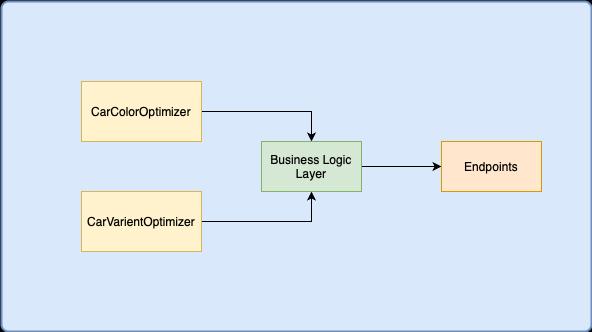
Figure1. ArchitectureoftheMonolithDeploymentforthe CarCustomizationApplication.
In this case, the machine learning model that powers the car recommendation engine is embedded directly within theapplication,alongwiththeuserinterfaceandbusiness logic. All the components are bundled together into a single deployable unit, making it easier to manage and deploy.
Pros:
● Easy to maintain: Since all components are part of the same application, maintaining the system is straightforward. Updates, bug fixes, and new features can be implemented in a unified manner, without the need to coordinatechangesacrossmultipleservices.
● Quick deployment: The entire system can be deployed at once, reducing the complexity of the deployment phase. This can be especially beneficial in environments where frequent updates or multiple versionsarenotrequired.
Cons:
● Lack of scalability: One of the key challenges of the monolithic approach is scalability. If any part of the system needs to scale to handle increased demand (e.g., the recommendation engine during a promotional event), the entireapplication must be scaledasa whole. Thiscan leadtoinefficientresourceusage.
● Difficult to update individual components: As the system grows, making updates to individual componentscanbecomemorechallenging.Forinstance,if the machine learning model needs to be retrained and updated,itmayrequireredeployingtheentireapplication, leading to potential downtime and increased deployment complexity.
Whilethemonolithicapproachmayworkwellforsmaller projects or systems with limited scalability requirements,
it can struggle as the system grows or when components needtobeindependentlyupdatedorscaled.
In the software industry, microservices architecture is a method of structuring applications as a collection of smaller,independentservicesthatcommunicatewitheach other via APIs [1]. Each service operates as a standalone component, allowing for greater flexibility in development, deployment, and scaling. This approach contrasts with monolithic architecture, where all componentsarebundledtogetheranddeployedasasingle unit.
Buildingonourpreviousexample,let’sconsiderthatacar company wants to create an application for customizing car options. However, due to concerns about data exposure, they prefer to build the system in their private cloud. In this scenario, the microservices architecture is a suitable choice, as it allows for independent scaling and management of services while maintaining control over datasecuritywithintheirprivateinfrastructure.
For instance, the car company might need to deploy differentversionsoftheapplicationforvariouscarmodels and variants, such as electric vehicles, luxury sedans, or SUVs.Eachvariantmayrequiredifferentmachinelearning models for recommendation engines, user customization, or predictive maintenance. The ability to deploy and manage these models as separate microservices ensures thatupdatesandscalingcanoccurindependently,without affectingtheentiresystem.
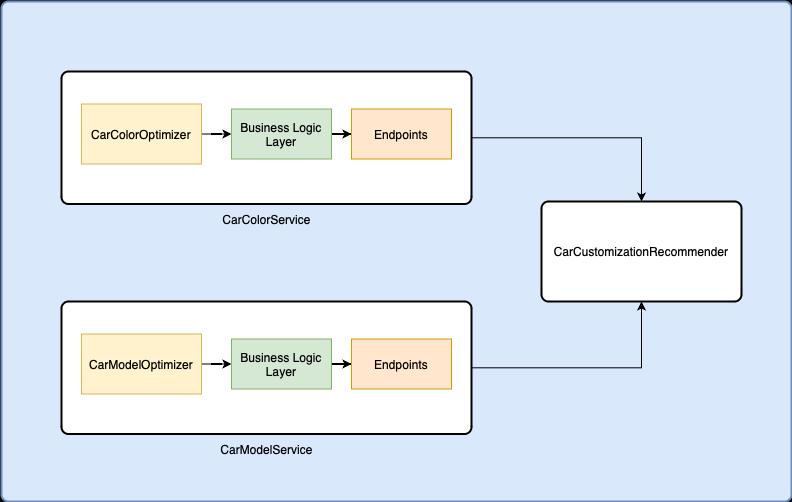
Figure2. ArchitectureoftheMicroservicesDeploymentfor theCarCustomizationApplication
Deploying the system in a private cloud adds an extra layerofsecurity,asalldataremainswithinthecompany's
International Research Journal of Engineering and Technology (IRJET) e-ISSN:2395-0056
Volume:11Issue:09|Sep2024 www.irjet.net p-ISSN:2395-0072
controlledenvironment.Thisisespeciallyimportantwhen handling sensitive customer data, proprietary algorithms, orintellectualpropertyrelatedtocardesignsandfeatures. Byusingmicroservicesinaprivatecloud,thecarcompany canbalancescalabilitywithsecurity.
Toefficientlymanagethisarchitecture,Kubernetescanbe employed to orchestrate and scale containerized microservices. Kubernetes is a powerful tool for automating the deployment, scaling, and operation of applicationcontainers.[2]Whenusedinconjunctionwith microservices in a private cloud, Kubernetes provides robust control over the system’s infrastructure while ensuringthattheapplicationremainssecureandscalable.
Pros:
● Quick Deployment:Kubernetesautomatesmuch of the deployment process, enabling rapid and consistent releasesacrosstheprivatecloudenvironment.Thisallows thecarcompanytorolloutnewfeaturesormodelupdates withoutriskingdisruptionstotheentiresystem.
● Auto-scaling: Kubernetescanautomaticallyscale individual microservices based on traffic and load. This ensures efficient resource utilization, allowing the system tohandlevaryinglevelsofdemand suchasduringanew carlaunch withoutcompromisingperformance.
● EaseofMaintenance:Kubernetesabstractsaway much of the complexity involved in maintaining containerized applications. It offers built-in tools for monitoring,logging,andservicediscovery,whichsimplify themanagementofmicroservicesovertime.
Kubernetes enables the deployment of machine learning models and microservices in a highly scalable, maintainable,andefficientmanner.Forenvironmentsthat require multiple models or services to be managed, updated, and scaled independently, Kubernetes excels. Additionally,Kubernetes offersadvanced features such as rolling updates, service discovery, and self-healing, ensuring that the application remains available and resilient,evenduringupdatesorunexpectedfailures.
By deploying microservices within a private cloud and orchestratingthemwithKubernetes,thecarcompanycan achieve a balance between scalability, security, and operational efficiency. This approach ensures that sensitive data remains protected while still benefiting fromtheflexibilityandrobustnessofmoderncloud-native technologies.
Amazon SageMaker is a fully managed service from AWS that allows data scientists and developers to build, train, and deploy machine learning models at scale. SageMaker simplifies the entire machine learning lifecycle by providing a set of tools and infrastructure that automates muchoftheprocess.[3]
KeyFeaturesofAmazonSageMaker:
● Managed Infrastructure: Amazon SageMaker abstracts away the need to manage underlying infrastructure.Itcomputesresources,handlesscaling,and ensures that the environment is configured optimally for themodel'srequirements.
● Built-in Algorithms and Frameworks: SageMaker supports a wide range of built-in algorithms andpre-configuredenvironmentsforpopularframeworks like TensorFlow, PyTorch, and Scikit-learn. This reduces thetimeneededtosetupthedevelopmentenvironment.
● Automatic Model Tuning: SageMaker provides automated hyperparameter tuning to optimize model performance. It uses machine learning to search for the best set of hyperparameters, making it easier to achieve optimalresultswithoutmanualintervention.
● One-Click Deployment: Once a model is trained, SageMaker allows for one-click deployment, where the model can be launched as an endpoint that automatically scales based on traffic. This simplifies the process of makingthemodelaccessibletoproductionapplications.
● Multi-Model Endpoints: SageMaker supports multi-model endpoints, enabling multiple models to be hosted on a single endpoint. This can reduce costs by consolidatingresourcesandsimplifyingthearchitecture.
● Monitoring and Logging: SageMaker integrates with AWS CloudWatch to monitor deployed models, providing insights into performance and operational metrics. This is crucial for maintaining models in production and ensuring they continue to perform well overtime.
Pros:
● End-to-End Management: SageMaker covers the entiremachinelearninglifecycle,fromdatapreparationto deployment, reducing the need for multiple tools and integrations.
International Research Journal of Engineering and Technology (IRJET) e-ISSN:2395-0056
● Scalability: Amazon SageMaker automatically scales the infrastructure to meet demand, ensuring that modelscanhandlevaryinglevelsoftraffic.
● Ease of Use: SageMaker’s interface and integrations with other AWS services make it userfriendly, even for teams without extensive DevOps experience.
Cons:
● Dependency on AWS Ecosystem: While SageMaker provides a seamless experience within the AWS ecosystem, it may not be the best choice for organizations using multi-cloud strategies or those seekingtoavoidvendorlock-in.
● Cost: SageMaker’s managed service can incur significant costs, particularly for large-scale deployments ormodelsthatrequireconstanttuningandmonitoring.
InadditiontoKubernetesandAmazonSageMaker,several toolsandpracticescomplementMLOpspipelines:
● Pickling a Model: Pickling is a process for serializing a Python object, such as a trained machine learning model, so it can be saved to disk and later reloaded. This technique is commonly used for model persistence, allowing models to be easily loaded and deployedinproductionenvironments.
● Jenkins: Jenkins is an open-source automation server that facilitates continuous integration and continuous delivery (CI/CD). It can be used to automate thedeploymentofmachinelearningmodelsbyintegrating with Kubernetes and other tools to streamline the build, test,anddeploymentprocesses.
● Docker: Docker containers are essential to modernMLOpspipelines.Dockerenablesthepackagingof applications, including their dependencies, into isolated containers that can be deployed consistently across different environments. Both Kubernetes and Amazon SageMaker leverage Docker containers for model deployment.
4. Conclusion
Deploying machine learning models in production requires careful consideration of the architectural approach. While monolithic systems may suffice for small projects, Kubernetes and Amazon SageMaker offer the scalability and flexibility needed for larger, more complex deployments. Kubernetes, in particular, stands out for its
ability to automate deployment and scaling, making it an ideal choice for teams with containerization expertise. Amazon SageMaker simplifies the machine learning lifecyclethroughafullymanagedservice,makingitagreat option for teams seeking to accelerate deployment with minimalinfrastructuremanagement.
The integration of complementary tools like Jenkins and Docker further enhances the efficiency and reliability of model deployment pipelines. As machine learning continuestodriveinnovation,MLOpspracticeswillplaya critical role in ensuring that models deliver consistent, real-worldvalue.
[1] Fowler, M. (2014). Microservices: A definition of this new architectural term. Retrieved from https://martinfowler.com/articles/microservices.html
[2] Kubernetes Documentation. (n.d.). Kubernetes documentation. Retrieved from https://kubernetes.io/docs/
[3] Amazon Web Services. (n.d.). Amazon SageMaker developer guide. Retrieved from https://docs.aws.amazon.com/sagemaker/
Volume:11Issue:09|Sep2024 www.irjet.net p-ISSN:2395-0072 © 2024, IRJET | Impact Factor value: 8.315 | ISO 9001:2008 Certified Journal | Page19

Karanbir Singh is an expert in MLOps with a specialization in tools like Kubernetes and Amazon SageMaker. Karanbir holds a MS in Software Engineering from San Jose State University, United States. With a strong educational background in Computer Science and Engineering, theyhavehonedtheirskillsincuttingedgeAItechniques.Currentlyworking at Salesforce, Karanbir is dedicated to making complex technical concepts accessible and practical for a wide audience. Their work reflects a deep commitment to advancing the field of artificial intelligence and empowering otherswithknowledge.