
International Research Journal of Engineering and Technology (IRJET) e-ISSN:2395-0056
Volume: 11 Issue: 08 | Aug 2024 www.irjet.net p-ISSN:2395-0072

International Research Journal of Engineering and Technology (IRJET) e-ISSN:2395-0056
Volume: 11 Issue: 08 | Aug 2024 www.irjet.net p-ISSN:2395-0072
Jesús Agüero López1* , Roxana Andrea Adame Porras2 , Marina Vlasova1 , Pedro Antonio Márquez Aguilar1 .
1Center for Research in Engineering and Applied Sciences, Morelos State Autonomous University (CIICAp-UAEMor), Av. Universidad 1001, C.P. 62209 Cuernavaca, Morelos, México.
2Faculty of Chemical Sciences and Engineering, Morelos State Autonomous University (FCQel-UAEMor), Av. Universidad 1001, C.P. 62209 Cuernavaca, Morelos, México.
Abstract
The work examines the properties of composites obtained by heat treatment at ~260-280 oC for 2 hours of PET-crushed basalt mixtures, in which both components are waste from the corresponding industries or household waste. It has been established that, depending on the ratio of components in the initial mixtures, it is possible to obtain building products with propertiesnoworsethanceramicbricks.Themaximumvalueofcompressivestrengthis18MPa,bendingstrengthis3.3MPa. Thesampleshavelowwaterabsorption(≤1.4%)andlowwear(<2mm).
Keywords: PETandbasaltminingwaste,low-temperaturesintering,strengthproperties
1. Introduction
Recyclinghouseholdplasticwasteisanimportantareainthefightagainstenvironmentalpollution.Wastefrompolyethylene terephthalate (PET) is the most large-scale. They are collected in sanitary warehouses and, due to the slow decomposition process,areextremelyharmfultotheenvironment[1].OneofthedirectionsforprocessingPETwasteistoobtainsecondary plasticbymeltingthewaste[2].SincePETmaterialshavehighhardness,andareveryresistanttowearandchemicals,aswell as shock, breakage, and fire, the synthesis of composite materials consisting of mixtures of PET and inorganic/mineral additiveshasrecentlydeveloped[3-8].Typically,PET-inorganicfillercompositeshavebeensubjecttorequirementsthatsuit differenttypesofbuildingmaterials.
The purpose of this work was to develop an energy-saving technology for the production of building materials (tiles, bricks,blocks,pavingstones)usingwastefromPETandbasalt,whichisman-madewastefromthecorrespondingminingand processing industries. Note that basalt is a volcanic rock, fine-grained, very hard, and composed mainly of feldspar and pyroxeneoraugite[9].BasaltiscommoninMexicoandiswidelyusedinconstruction.
2. Material and methods
TheworkusedcrushedhouseholdwastePETplasticmeasuring~19mmandbasaltparticlesmeasuring0.595mm.Mixtures werepreparedfromPETandbasalt,inwhichthePETcomponentwaschangedfrom90to30wt.%,andthebasaltcomponent was changed from 10 to 70 wt.%. The mixtures, placed in metal molds of various sizes, were introduced into the oven at a temperature of ~ 260-280 oC. The holding time at this temperature was 2 hours. After cooling, the samples were removed fromthemolds.
The compressive strength ofthesampleswascarriedoutaccordingtotheNMX-C-083-ONNCCE-2014standard[10]andwas calculatedusingtheformula:σ=F/A,whereσisstress inthe body,MPa(Kgf/cm2); F =internal compressionforce,kgf;Ais samplesurfacearea,cm2 .
The flexural strength of the samples was carried out according to the ASTM C1161-02c standard [11] and was calculated usingtheformula:Mr = ,whereMristheflexuralmodulusofelasticity,MPa;Cismaximumbreakingload,N;Listhelength betweenlowersupports,mm;aissamplewidth,mm;eissamplethickness,mm.
International Research Journal of Engineering and Technology (IRJET) e-ISSN:2395-0056
Volume: 11 Issue: 08 | Aug 2024 www.irjet.net
p-ISSN:2395-0072
The magnitude of the rutting deformation of the paving stones was determined according to the standard M-MMP-4-05053/21“ResidualdeformationduetoruttingwithaloadedHamburgwheel”[12]onaloadedHamburgDWTwheeledvehicle withawheelloadof705N.Theruttingdeformationwasdeterminedbymeasuringthethicknessofthedeformationpresentin thesamplesattheendofthe20,000-passcycle.
Water absorption of the samples was carried out in accordance with the standards NMX-C404-ONNCCE.2012 for bricks in walls [13] and NMX-C-314-ONNCCE-2014 for paving stones in road surfaces [14]. The amount of water absorption (W) is calculatedbytheformula:W=(P1 –Po)/P0 ‧ 100,%,where:Wisabsorptionvalue,%;Po isweightofdrysample,g;P1 isweight ofsamplesaturatedwithwater,g.
3. Results and discussions
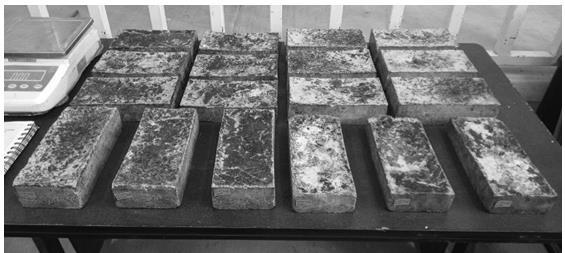
Theviewoftheobtainedsamplesintheformofbricksispresentedin Fig. 1.Theresultsof compression testsofthesamples (Fig. 2) showed that σ is in the range of 12.87-18.1 MPa. Note that according to the standard for bricks and ceramic blocks from clay, the compressive strength is in the range of 8 to 12 MPa [15]. It can be concluded that based on the compressive strength,thecomposites/bricksobtainedinthisworkaresuitableforuseinconstruction.Formasonrywithhighload-bearing loads,andforfoundationsmixtureswithahighPETcontentshouldbesintered(Fig.2, I).Toconstructdurablebuildingsof2-3 floors,youcanusebricks/blocksobtained bysintering mixturescontaining70-50 wt./%PET(Fig. 2, II). Whenconstructing one-story durable buildings, it is possible to use bricks/blocks obtained by sintering mixtures containing 40-30 wt./% PET (Fig. 2, III).
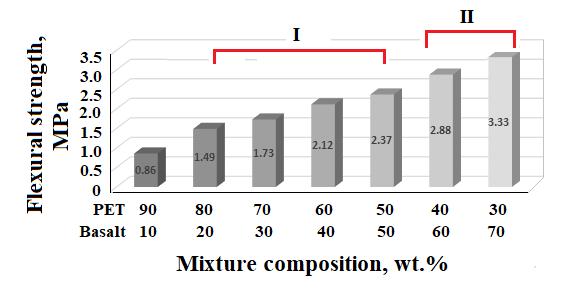
Accordingto[15], flexural strengthforbricksobtainedfromclaymustbeintherange1.4-2.8MPa,andforimprovedceramics Mr ≥ 2.8 MPa [3]. So, it is possible to conclude that bricks obtained from mixtures with 70-50 wt.% PET can be used in the construction of external and internal walls in buildings with a maximum height of two floors (Fig. 3, I). Bricks made from mixtureswith40-30wt.%PET,althoughtheyhavehighbendingstrength(Fig. 3, II),donothavegoodcompressivestrength (see Fig. 2 III).
Fromthetotalityofdataonthestrengthofbricks/blocksincompressionandbending,itcanbeconcludedthatfrommixtures of(80-50)wt.%PET-(20-50)wt.%basalt,whensinteredat280°Cfor2hours,itispossibletoobtaingoodbricksqualityfor low-riseconstruction.
The results of rutting tests (Fig. 4) indicated thatbricks/tilesproduced from PET-basaltmixtureshavehigher resistance to deformationthanthemaximumallowedbythestandard(10mm)[12] Fortheobtainedsamples,thedeformationthicknessis 1.6mm.Thismeansthattheircanbeusedaspavingstonesforsidewalks.
Water absorption for standard bricks obtained from clay consists of 6-8% [15]. For bricks obtained from mixtures of PETbasalt,(Fig. 5)waterabsorptionisespeciallylower.Thismeanstheyhavegoodwaterresistanceproperties.Suchbrickscan beused(takingintoaccounttheirstrengthproperties)forlayingafoundation, asrooftiles,fortheconstructionofswimming pools,tanks,stormsewerhatches,septictanks,channels,curbs,andgutters.
4. Conclusions
Studies have shown that after temperature treatment at 260-280 oC of PET-crushed basalt mixtures, it is possible to obtain building materials (bricks, blocks, tiles, tiles) that are not inferior in strength properties to traditional brick products made fromclay.Bychangingthecontentofcomponents,itispossibletoobtaincompositeswithdifferentstrengthsforcompression andfracture.So,bricksmadefrommixturesof(90-80)wt.%PET-(10-20)wt.%basalthasacompressivestrength(σ)~18.117.52 MPa and can be used in masonry with high load-bearing loads. Building materials obtained from mixtures of (70-50) wt.%PET-(30-50)wt.%basalthaveσ~16.26-14.74MPaandcanbeusedintheconstructionofabuildingwithamaximum of two levels. Brick products made from mixtures of composition (40-30) wt.% PET - (60-70) wt.% basalt have σ ~ 13.6212.87MPaandcanbeusedintheconstructionofone-storybuildings.Buildingmaterialsmadefrommixturesof(40-30)wt.% PET-(60-70)wt.%basaltarehighlyresistanttodeformation(1.11-1.66mm)andcanbeusedaspavingstones.Duetothefact thatsamplesfrom mixtures of(90-30) wt.% PET - (10-70)wt.% basalthavea low waterabsorption value(W~0.26-1.41)%, theycanbeusedintheconstructionofswimmingpools,tanks,stormsewerhatches,septictanks,channels,curbs,andgutters.
International Research Journal of Engineering and Technology (IRJET) e-ISSN:2395-0056
Volume: 11 Issue: 08 | Aug 2024 www.irjet.net p-ISSN:2395-0072
Taking into account the energy, water intensity, and complexity of the traditional technology for the production of brick products from clay compared to the energy-, water-saving, and easy-to-implement technology for the production of durable building bricks from waste PET basalt, one can foresee the widespread application of this technology in the building industry.
Figures captions
Fig. 1. ViewofsamplesobtainedfromvariousPET-basaltmixtureswithdimensionsof200x100x60mm.
Fig. 2. Compressive strength of samples depending on the composition of the initial PET-basalt mixtures. (I) bricks for high load-bearingloads;(II)bricksforbuildingsof2-3floors;(III)bricksforbuildingsof1floor.
Fig. 3.FlexuralstrengthofsamplesdependingonthecompositionoftheinitialPET-basaltmixtures.(I)bricksforbuildingsof 1-2floors;(II)bricksforbuildingsof1floor.
Fig. 4.Thevalueofruttingdeformationofsamples/pavingstonesobtainedfrommixturesof40wt.%PET-60wt.%basalt(1), and30wt.%PET-70wt.%basalt(2).
Fig. 5.ThevalueofwaterabsorptionofsamplesdependingonthecompositionoftheinitialmixturesofPET-basalt.
References
[1]SawsanD.A.Shubbar,AqeelS.Al-Shadeedi,Utilizationofwasteplasticbottlesasfineaggregateinconcrete,KufaJournalof Engineering,8(2)(2017)132-146.
[2]DAlighiri1,MNYasin,BRohmawati,ADrastisianti,ProcessingofrecycledwastePET(polyethyleneterephthalate)plastics bottle into for the lightweight and reinforcement bricks, Journal of Physics: Conference Series 1321 (2019) 022023. DOI:10.1088/1742-6596/1321/2/022023.
[3]M.Sulyman,J.HaponiukK.Formela, UtilizationofRecycledPolyethyleneTerephthalate(PET)inEngineeringMaterials:A Review, International Journal of Environmental Science and Development, 7 (2) (2016) 100-108. DOI: 10.7763/IJESD.2016.V7.749.
[4]CO-6481020-A2PETthermoplasticpolymerproductandproductproductionmethod.
[5]US20060009556A1HighglossPETmoldingcompositionanditemsmadefromit.
[6]AC2634793ProductionMethodofPolyesterComposites
[7]RU2725200C1ConstructionCoatingsManufacturingMethod.
[8]US20120047833A1BuildingbrickswithplasticincludedALSEWAILEM
[9] S. Raj, V. R. Kumar, B. H. B. Kumar, Nagesh R Iyer, Basalt: structural insight as a construction material. 42, (2017) 75–84 https://doi.org/10.1007/s12046-016-0573-9.
[10] National Body for Standardization and Certification of Construction and Building, NMX-C-083-ONNCCE-2014 Determination of the compressive strength of specimens, Mexican Standard, Federal Official Gazette, Benito Juárez, Mexico City,2014.
[11] ASTM C1161-02c Standard Test Method for Flexural Strength of Advanced Ceramics at Ambient Temperature, ASTM International,WestConshohocken,PA.,2008.
[12]MexicanInstituteofTransportation,M-MMP-4-05-053/21Permanentdeformationduetoruttedwithloadedwheelfrom Hamburg, Regulations for Transport Infrastructure, Ministry of Communications and Transport, Pedro Escobedo, Querétaro, (2021).
International Research Journal of Engineering and Technology (IRJET) e-ISSN:2395-0056
Volume: 11 Issue: 08 | Aug 2024 www.irjet.net p-ISSN:2395-0072
[13] National Body for Standardization and Certification of Construction and Building, NMX-C404-ONNCCE-2012 MasonryBlocks,Partitions or Bricks and Partitions for Structural Use - Specifications and Test Methods Mexican Standard, Federal OfficialGazette,BenitoJuárez,MexicoCity,2012.
[14] National Body for Standardization and Certification of Construction and Building, NMX-C-314-ONNCCE-2014 Paving stonesforuseonpavements,MexicanStandard,FederalOfficialGazette,BenitoJuárez,MexicoCity,2014.
[15] PP Budnikov, AS Berezhnoy, IA Bulavin, GP Kalliga, GV Kukolev, DN Poluboyarinov, Technology of Ceramics and Refractories,StatePublishingHouseofLiteratureonConstructionandArchitecture,Moscow,1955.
[16] Mexican Institute of Transportation, N-CMT-2-01-001/02 Bricks & Ceramic Blocks, Regulations for Transport Infrastructure,MinistryofCommunicationsandTransport,PedroEscobedo,Querétaro,2002.
1.ViewofsamplesobtainedfromvariousPET-basaltmixtureswithdimensionsof200x100x60mm.
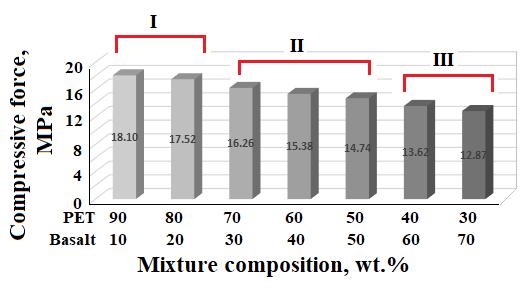
Fig. 2.CompressivestrengthofsamplesdependingonthecompositionoftheinitialPET-basaltmixtures.(I)bricksforhigh load-bearingloads;(II)bricksforbuildingsof2-3floors;(III)bricksforbuildingsof1floor.
International Research Journal of Engineering and Technology (IRJET) e-ISSN:2395-0056
Volume: 11 Issue: 08 | Aug 2024 www.irjet.net p-ISSN:2395-0072
3.FlexuralstrengthofsamplesdependingonthecompositionoftheinitialPET-basaltmixtures.(I)bricksforbuildingsof 1-2floors;(II)bricksforbuildingsof1floor
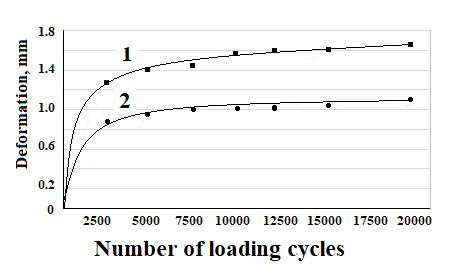
Fig. 4.Thevalueofruttingdeformationofsamples/pavingstonesobtainedfrommixturesof40wt.%PET-60wt.%basalt(1), and30wt.%PET-70wt.%basalt(2).
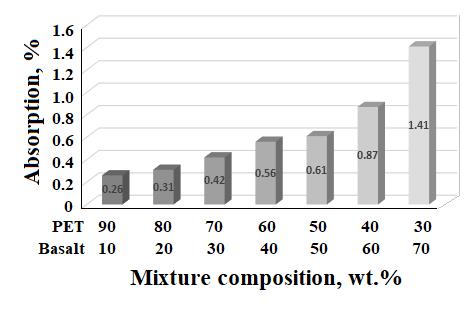
Fig. 5.ThevalueofwaterabsorptionofsamplesdependingonthecompositionoftheinitialmixturesofPET-basalt.
International Research Journal of Engineering and Technology (IRJET) e-ISSN:2395-0056
Volume: 11 Issue: 08 | Aug 2024 www.irjet.net p-ISSN:2395-0072




JesúsAgüeroLópezisaGraduatedCivilEngineerwithaMaster'sDegreeinLandRoadEngineering Graduated with studies PhD in Engineering in Materials Technology pending qualification and certificationasaprofessionalexpertinlandroutesinMexico.
Roxana Andrea Adame Porras is a Graduate Civil Engineer with a Master's Degree in EnvironmentalEngineeringandiscurrentlystudying PhDinEnvironmentalEngineeringinMexico.
MarinaVlasovacompletedherPhDattheNationalAcademyofSciencesofUkraine
Pedro Antonio Márquez Aguilar completed his Postdoctorate at the University of Bourgogne in Dijon, France and PhD at the National Institute of Optical and Electronic Astrophysics in Puebla, Mexico.