
International Research Journal of Engineering and Technology (IRJET) e-ISSN:2395-0056
Volume: 11 Issue: 08 | Aug 2024 www.irjet.net p-ISSN:2395-0072

International Research Journal of Engineering and Technology (IRJET) e-ISSN:2395-0056
Volume: 11 Issue: 08 | Aug 2024 www.irjet.net p-ISSN:2395-0072
Swapnil sonawane, Alisha Gaikwad, Sneha Thakur
Abstract- Sentiment Analysis is a process of categorizing whether the text is positive, negative, or neutral. Not only this, but it also includes emotions like happiness, sadness, anger, fear, and surprise. Sentiment analysis can be used in various fields, some well-known fields including online shopping. Sentiment analysis can solve real-time issues and is a crucial task in Natural Language Processing (NLP). We can use traditional Machine Learning algorithms, such as Support Vector Machine (SVM), Tree-based techniques, or Naïve Bayes have been widely used for sentiment analysis. The advent of deep learning (DL) techniques, like CNN, RNN, or state-of-the-art methods, changed this field to capture the more complex patterns in data. This paper presents the comparative study of sentiment analysis using ML and DL techniques. We used ML and DL algorithms against Twitter Sentiment Analysis data and compared the algorithms based on accuracy, computational efficiency, and ability to adopt complex patterns in large datasets. This paper provides insights into the trade-off between ML and DL approaches for Sentiment Analysis, further guiding researchers and practitioners in choosing the appropriate approach for their specific tasks.
Key Words: Sentiment Analysis, Machine Learning, Deep Learning, RNN, LSTM, GRU
As the whole world connects to the internet, data is everywhere, and the famous quote “Data is the new Oil” is relevant to the current world. This data includes customer feedback, reviews on the products they buy, and people’s opinions on various topics on different social media platforms.E-commercewebsiteslikeAmazon,Flipkart,and Walmart,mustanalyzethecustomer'sfeedbackandreview the product to increase the product sales. Also, the manufacturer can improve and address the customer's concerns, to enhance the customer's experience and satisfaction by analyzing the sentiment of customers' reviews and feedback. Sentiment analysis can help businesses to monitor their reputation by tracking the comments,andsocialmediareviews. Byunderstandingthe user's review, product developer can improve their products.CompanieslikeTwitter,Facebook,andInstagram can analyze people’s opinions on current trending topics
likeelections,andwarstokeeptheplatformsafeandmake sure that the platform stays neutral for all users and does notgetbiasedina specific direction.Thesecompaniesalso usedsentimentanalysistomonitorthetweetsandpoststo make sure that they are appropriate and follow all the community guidelines, and if someone goes against the guidelines, they remove their content from the platform. We can use Machine Learning and Deep Learning algorithms to classify the sentiment. However, which technique is suitable for problem statements, depends on thedatasizeandabilitytoadapttonewcontexts.
There are a few observations on which the system architectureisproposed.
2.1
In “Twitter Sentiment Analysis Using Lexical or RuleBased Approach: A Case Study” [1], Sheresh Zahoor and Rajesh Rohila use Lexical or Rule Based (unsupervised technique)forTwittersentimentanalysis.UsingtheTwitter API, they create 4 different datasets. 1. Haryana Assembly Polls 2. ML Khattar 3. The sky is pink (movie) 4. United NationsGeneralAssembly(UNGA). Thestepstheyfollowto collectthedataandanalyzethesentimentsare:
1. DataCollection
2. Datapre-processing
3. PartofSpeechtagging(POS)
4. Sentimentanalysisusinganin-builtdictionary
A. DataCollection:
TocollectdatafromTwitter,theyusetheTwitterAPI, collect the tweet, and save it in CSV format. The CSV file contains the date, text, retweet, hashtag, and followers.
B. DataPre-Processing:
Topreparedata for sentimentanalysis,theyperform various operations on data, including tokenization or Bag-of-words, N-gram Extraction, Stemming and Lemmatization,andStopWordsremoval.
International Research Journal of Engineering and Technology (IRJET) e-ISSN:2395-0056
Volume: 11 Issue: 08 | Aug 2024 www.irjet.net p-ISSN:2395-0072
C. Part-of-Speech(POS):
Process of automatically tagging each word by their grammatical feature, such as Noun, Pronoun, verb, adverb,etc.
D. ModelEvaluation:
They used TextBlob and VADER built-in libraries available in Python. TextBlob is an open-source NLTK-basedlibrary, whereasVADER (ValenceAware Dictionary and Sentiment Reasoner) is used for lexicon-based sentiment analysis. The result they concludeis:
Sentiment HaryanaAssemblyPolls
The conclusion of this case study found that the results obtained from unsupervised techniques are not accurate andsubjecttochange.
Vasily D. Derbentsev and Vitalii S. Bezkorovainyi et al. published “A Comparative Study of Deep Learning Models forSentimentAnalysisofSocialMediaTexts”[2]paper.The authorofthispaperpresentsacomparativestudyofadeep learning model for sentiment analysis of social media text. They used Deep Neural Network (DNN), Convolutional Neural Network (CNN), Long-Short Term Memory (LSTM) architecture,andLogisticRegressionclassifierasabaseline. They chose 2 datasets for their study: one is IMDB Movie Reviews,andtheotherisTwitterSentiment140.
ForFeatureExtraction,theyfollowBagofWords(BOW),Ngrams,TF-IDF,wordembedding
A. Pre-processingandwordembeddings
Forthetext-preprocessingtask,theyusedtheNLKTlibrary, andthistaskincludesremovingpunctuations,markuptags, HTML, and Tweet addresses, removing stopwords, and convertingallwordsintolowercasewords.
B. DNNmodelsdesignandhyperparametersettings
1. Usedpre-trainedGloVeembeddingsofsize100inthe firstlayer(embeddinglayer).
2. FirstmodelCNNwiththreeconvolutionallayerswith different kernel sizes and used Maxpooling layers betweenthemandthenflattenandDenselayer.
3. In the second approach, they combine the CNN+LSTM
4. Third,CNN+BiLSTM(forwardandBackwardLSTM)
5. Toobstructoverfitting,Dropoutlayersareused.
C. Evaluation:
IMDBDataset
Twitter-140dataset
TheexperimentshowedthatLR(baseline)achieved85.9% (74.23%), CNN achieved 90.09% (77.24%), CNN-LSTM reached 88.01% (78.36%), and BiLSTM-CNN attained 87.03%(82.10%).
In “Sentiment Analysis of Twitter Data: A Survey of Techniques”[3] ,thepaper’sauthors,VishalandS.Sonawane, use machine learning algorithms on a comparatively small datasetpubliclymadeavailablebyStanfordUniversity.They studied Naïve Bayes, Max Entropy, and Support Vector Machinealgorithms.Also,theycomparedtheresultwiththe various data pre-processing techniques like stopwords removal,Unigram,andTrigram.
A.DataProcessing
StopWords: Words like I, am, you, your, etc. are removed duringthedataprocessingstepbecausethesewordsdonot addmuchinformationtothetextforsentimentanalysis
Bigram: It uses a combination of two words, e.g., “Not happy”clearlyindicatingthenegativesentiment.
B.Evaluation
1. They achieve 73.56% accuracy without using StopWords removal, Unigram, and Bigram techniques.
Volume: 11 Issue: 08 | Aug 2024 www.irjet.net p-ISSN:2395-0072
Naïve
Naïve
Naïve
The paper concludes that the Support Vector Machine and Naïve Bayes algorithms give the highest accuracy, and in somecases,lexicon-basedmethodsareeffective.
Dataset
We used the Sentiment140[4] dataset for our experiment. The dataset contains 1.6 million tweets. The dataset has a target,ids,date,flag,user,andtextcolumns.
i. Target:thepolarityoftweets(0:Negative,4: Positive)
ii. Ids:idofthetweet
iii. Date:dateofthetweet
iv. Flag:query
v. User:Theuserwhotweeted
vi. Text:textofthetweet.
Thedatasethas 0.8M positive and 0.8M negative tweets.
This dataset has no column names, so we manually give names to each column for our better understanding to makethe processeasytounderstand thedata. Thecolumn names are target, ids, date, flag, user, and text. We then checkedifanycolumncontainedanynullvaluesornotand found that there were no null values present in any of the columns. The dataset has an equal number of Positive and negative Tweets i.e.,0.8M tweets in each category. For the target column, 0 represents Negative sentiment and 4 represents Positive sentiment. We replaced 4 with 1, as it givesmorecontexttothedata.Weapplythefollowingdata pre-processinganddatacleaningoperationstodata.
1. StopWords Remove: Use the NLTK library to remove all the stopwords from the data, as these words do notcontributemuchtoprediction.
2. Removal of Special characters and converting all words to a lowercase word: To remove any special characters suchas @,//,etc.from the data,weusea
regular expression library to find these characters and remove them. We convert all words into lowercasewords.
3. Stemming: In natural language processing (NLP), stemming is a text-preprocessing method. In particular, it is the act of condensing a word's inflected form into a single "stem," or basic form alsoreferredtoasa"lemma"inlinguistics.
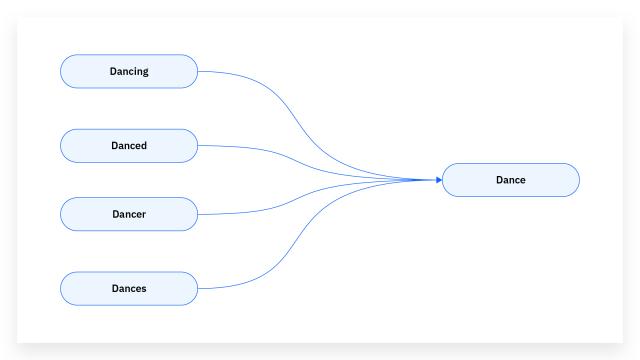
We used the PortStemmer function from the NLTK library to perform the stemming operation. Then we addthe“stemmed_text”newlycreated columntoour datasetafterperformingthestemmingstep.
(Theaboveoperationisperformedon“text”columns)
After data processing, we extract only the “target” and the newly added “stemmed_text” column for further processing. All other columns are not required for sentiment analysis. After this, the next step is to split the data into train-test splits. For this, we used scikit-learn train_test_split functions with the splitting ratio of 80:20, i.e., 80% data for training purposes and 20% data for testing purposes. To convert the text into vectors, we used theTF-IDFtechnique.
TF-IDF: Term Frequency Inverse Document Frequency (TF-IDF) is an algorithm to transfer text into a meaningful representationofnumbers(vectors)
1. TermFrequency(TF):
Tomeasurehowfrequentlyaword(term)appears intext.
TF(t,d)= countoftind numberof wordsind
2. InverseDocumentFrequency(IDF):
It measures how important a word is with entire textcorpus.
IDF=Log(TotalnoofdocumetnsincorpusD No.ofdocumentscontainigtermt)
International Research Journal of Engineering and Technology (IRJET) e-ISSN:2395-0056
Volume: 11 Issue: 08 | Aug 2024 www.irjet.net p-ISSN:2395-0072
MachineLearningAlgorithms
1. LogisticRegression
For classification issues, supervised machine learning algorithms like logistic regression are employed. It is a statistical algorithm. It is a statistical algorithm. For predictingtheoutput,itusesSigmoidfunctions,whichtake inputsandproduceprobabilityvaluesbetween0and1.
SigmoidFunction:
BasedonBaye'stheorem,theNaïveBayesalgorithmisused for classification The algorithm's presumptions are indicated by the label "Naïve." The algorithm assumes that features(columns)areindependentofeachother.
BayesTheorem:
P(y|X)=P(X|y)P(y) P(X)
Where,y=ClassLabelsandX=dependentfeatures(columns)
3. XGBOOSTCLASSIFIER
Extreme Gradient Boosting (XGBoost) is an ensemble learning method that combines predictions of multiple weak models to produce a stronger prediction (weaker → stronger). It is widely used because it can handle a large dataset and handling of missing values without requiring significant pre-processing. It is an implementation of the GradientBoostedDecisionTree.
DeepLearningArchitecture:
RNNs are used for tasks that involve sequential data, such as time series prediction, natural language processing (NLP),andspeechrecognition.
RNNs are like networks that have a memory. They process data one step at a time and remember information from previoussteps.Imagine reading a sentence word by word.
An RNN processes each word in order and keeps track of the context from previous words to understand the sentence better. This memory aspect helps RNNs make decisionsbasedonthesequenceofdata,suchaspredicting the next word in a sentence or recognizing spoken words over time. RNNs are very similar to feedforward neural networks, except is also have a connection pointing backward.
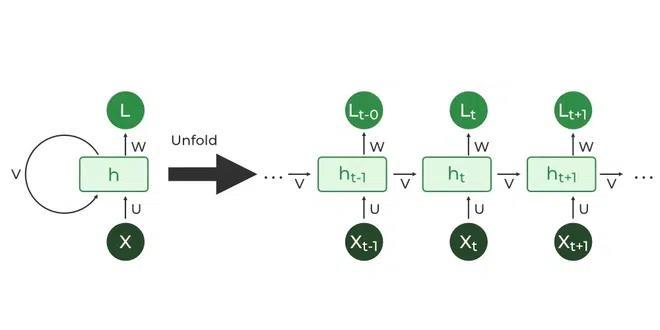
Becauseofunstablegradients,RNNsuffersfromtwomajor problems: 1) Problem of long-term dependency and (Vanishing gradient problem) 2) Stagnated Training (Explodinggradientproblem)
As sequence length increases, RNN struggles to remember theinitialtime-stepcontext,andthisissuearisesbecauseof the vanishing gradient problem, and because of the explodinggradient,thestagnatedtrainingproblemoccurs.
To tackle the Long-Term dependency problem, Sepp Hochreiter and Jurgen Schmihuber introduced the “LongShort-TermMemory(LSTM)” [5] architecture.
2.1 -
International Research Journal of Engineering and Technology (IRJET) e-ISSN:2395-0056
Volume: 11 Issue: 08 | Aug 2024 www.irjet.net p-ISSN:2395-0072
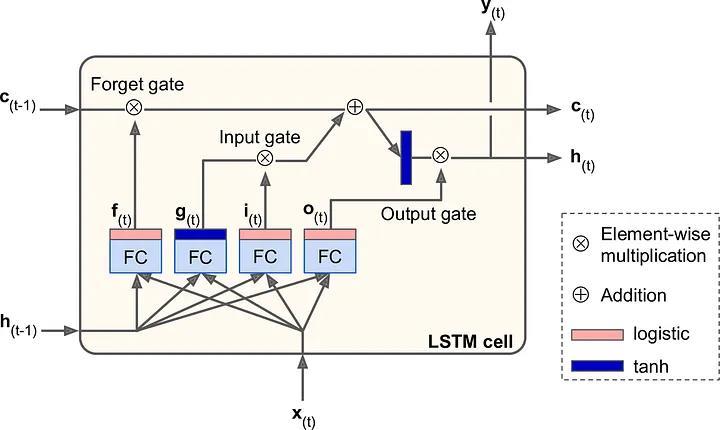
From c(t-1) to c(t) the LSTM cell decides which part has to remove(forget)andwhattoaddbasedoninput(x(t))
LSTMCellhastwostates:
1. c(t) (Cell state) → Long Term State, for remembering informationforalongerduration
2. h(t) (Hidden state) → Short Term State, for rememberinginformationforshortdurations
The key idea behind these two states is what to keep and whattodiscard.
TypeofgatesinLSTM:
1. Forgetgate(f(t)):Itdetermineswhichelementsofthe permanentstateshouldberemoved
2. Inputgate(i(t)):itcontrolswhichpartsofg(yt)should beaddedtolong-termstate.
3. Output gate(o(t)): it controls which part of the longterm state should be read and output at this time step,bothtoh(t)andy(t)
LSTMcomputations:
i(t) = σ(Wxi TX(t) + Whi Th(t 1) +bi )
f(t) = σ(Wxf TX(t) + Whf Th(t 1) +bf )
o(t) = σ(Wxo T X(t) + Who T h(t 1) +bo )
g(t) =tanh(Wxg T X(t) + Whg T h(t 1) +bg )
c(t) = σ(��(t) ⊗ c(t 1) +i(t) ⊗ g(t))
y(t) = h(t) =o(t) ⊗ tanh(c(t))
Here,
wxi, wxf, wxo, and wxg are the weight matrices of eachof the fourlayersfortheirconnectionstotheinputvectorx(t).
whi,whf ,who,andwhg aretheweightmatricesofeachofthe four layers for their connection to the previous short-term stateh(t-1).
bi,bf,bo,andbg arethebiasesforeachofthefourlayers.
To improve the performance of LSTM, the BiLSTM architecture is introduced, which captures the dependencies in both forward and backward directions of sequence.ItusestwoLSTMlayers:
1. ForwardLSTM:Itprocessedthesequencefromleft toright(StarttoEnd)direction.
2. Backward LSTM: It processes the sequence from righttoleft(endtostart)
Then, output from both LSTMs is combined, which allows the model to consider the context from both directions at eachtimestep.
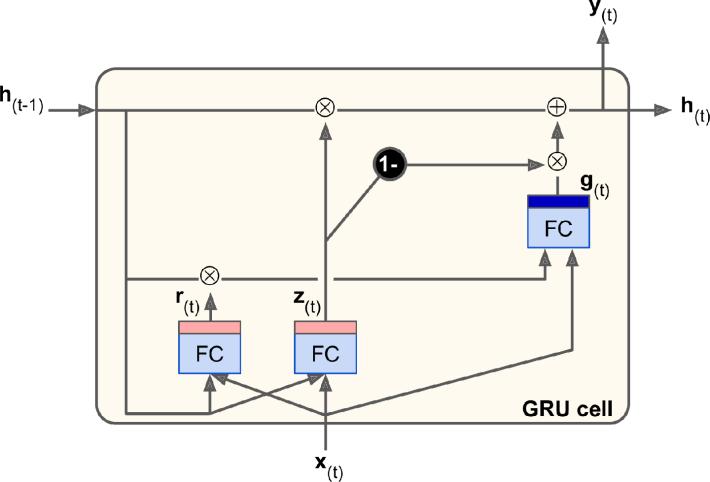
The Gated Recurrent Unit (GRU) cell was proposed by Kyunghyun Cho et al. in a 2014 paper titled “Learning Phrase Representations using RNN Encoder-Decoder for StatisticalMachineTranslation.”[6]
GRU is a reduced version of the LSTM cell, and it claims to achievesimilarresultstoLSTM.Thesimplificationsare:
1. A single vector h(t) is a combination of both state vectors
2. A single gate controller x(t) controls the forget gate andinputgate.
3. Full state vector h(t) is the output of every time step h(t)=y(t)
4. Newgatecontrollerr(t) thatcontrolswhichpartofthe previousstatewillbeshowntothelayerg(t).
GRUComputations
z(t) = σ(Wxz T X(t) + Whz T h(t 1) +bz )
r(t) =σ(Wxr TX(t) + Whr T h(t 1) +br )
g(t) =tanh(Wxg T X(t) + Whg T (���� ⊗ ��(�� 1))+bg )
h(t) =z(t) ⊗ ��(�� 1) +(1 ��(��))⊗ ��(��))
Volume: 11 Issue: 08 | Aug 2024 www.irjet.net p-ISSN:2395-0072
MachineLearningAlgorithms
We used Logistic Regression (LR) as a baseline model to comparetheaccuracyoftheothermodels.
DeepLearningAlgorithms
For each architecture, we used the Adam optimizer with a learning rate of 0.001, the sigmoid activation function for the output (last) layer, binary cross-entropy as the loss function,accuracyasthemetric,50epochs,andabatchsize of128.
FortheLSTM,BiLSTM,and GRUarchitectures,weusedthe ReLU activation function in the Dense layer and to avoid overfitting,weappliedL2regularization.
ModelSummary
Models Layers Parameters
Embedding
Simple
RNN
Dropout 0.4
Bidirectional (LSTM) 64
Dropout 0.4
Dense 64,activation='relu', kernel_regularizer=l2(0.001)
dropout 0.4
dense 1,activation=’sigmoid’
Embedding input_dim=5000, output_dim=100, input_length=50
Bidirectional (LSTM) 128,return_sequence=True kernel_regularizer=l2(0.001)
Dropout 0.4
Bidirectional (LSTM) 64
Dropout 0.4
Dense 64,activation='relu', kernel_regularizer=l2(0.001)
dropout 0.4
dense 1,activation=’sigmoid’
input_dim=5000, output_dim=100, input_length=50
simpleRNN 128,return_sequence=True
Dropout 0.5
simpleRNN 64,return_sequence=True
Dropout 0.5
simpleRNN 32
dense 1,activation=”Sigmoid”
Embedding input_dim=5000, output_dim=100, input_length=50
LSTM 128,return_sequence=True kernel_regularizer=l2(0.001)
Dropout 0.4
LSTM
BiLSTM
LSTM 64
Dropout 0.4
Dense 64,activation='relu', kernel_regularizer=l2(0.001)
dropout 0.4
dense 1,activation=’sigmoid’
Embedding input_dim=5000, output_dim=100, input_length=50
Bidirectional (LSTM) 128,return_sequence=True kernel_regularizer=l2(0.001)
In this paper, we apply both machine learning and deep learningtechniquestothesentiment140dataset.Thislarge dataset(1.6M tweets)isbestforcomparingtheMLandDL algorithms. We found that the machine learning algorithm achieved a maximum of 76.75% accuracy, whereas with only 50 epochs we crossed 77% accuracy with a simple RNNmodel withalimitednumberofparameters,and with LSTM we crossed 82% training accuracy. Hence, we can conclude that deep learning architecture outperforms machinelearningtechniques.Aswithlimitedresources,we are not able to do much experimentation. For future studies, we plan to increase the epoch size, increase the LSTMandGRUlayers,andcomparetheresults.
[1] Sheresh Zahoor, Rajesh Rohilla “Twitter Sentiment Analysis Using Lexical or Rule-Based Approach: A CaseStudy”.
International Research Journal of Engineering and Technology (IRJET) e-ISSN:2395-0056
Volume: 11 Issue: 08 | Aug 2024 www.irjet.net p-ISSN:2395-0072
[2] VasilyD.Derbentsev,VitaliiS.Bezkorovainyietal.“A comparative study of deep learning models for sentimentanalysisofsocialmediatexts.”
[3] Vishal A. Kharde, S.S. Sonawane “Sentiment Analysis ofTwitterData:ASurveyofTechniques”
[4] www.kaggle.com/datasets/kazanova/sentiment140
[5] Sepp Hochreiter and Jurgen Schmihuber “LongShort-TermMemory.”
[6] Kyunghyun Cho et al. “Learning Phrase Representations using RNN Encoder-Decoder for StatisticalMachineTranslation”
[7] MayurWankhade,AnnavarapuChandraSekharaRao & Chaitanya Kulkarni “A survey on sentiment analysismethods,applications,andchallenges”
[8] Dr. Manjula Bairam, R Lakshman Naik “A Study of Sentiment Analysis: Concepts, Techniques, and Challenges”
[9] Xing Fang & Justin Zhan “Sentiment analysis using productreviewdata”