
International Research Journal of Engineering and Technology (IRJET) e-ISSN: 2395-0056
Volume: 11 Issue: 08 | Aug 2024 www.irjet.net p-ISSN: 2395-0072
International Research Journal of Engineering and Technology (IRJET) e-ISSN: 2395-0056
Volume: 11 Issue: 08 | Aug 2024 www.irjet.net p-ISSN: 2395-0072
Swapnshri Patel 1 , Prof. Anjali Singh2 ,
1Reseacrh Scholar, Department of CSE, Aditya College of Technology and Sciences, Satna, M.P.
2Professor, Departmet of CSE, Aditya College of Technology and Sciences, Satna, M.P.
Abstract – Diabetesremainsanimportanthealthchallenge withitswidespreadpresencesteadilyincreasingaroundthe world. It can lead to other serious issues such as cardiovasculardiseases,renalfailure,andneuropathyand contribute to rising mortality rates in diabetic patients. Considering the situation, accurately predicting mortality risksindiabeticpatientsiscrucialforseveralreasonslike identifying high-risk individuals, forming proper diabetic treatment options and mitigating mortality among older patients.StudiesconductedbyWHOandCDCindicatethat riskofmortalityisveryhighindiabeticpatientsandit’shard topredicttheinsulinamountrequiredforeachpatientandit getsprogressivelyharderwhenthepatienthasadditional complications and comorbidities like HIV/Depression/AlcoholAbuseetc.Manyinfluencingfactors that could affect the diabetic complications need to be consideredandhencethereisaneedtodevelopanall-cause mortalitypredictionmodelthatcouldbeutilizedbyhealthpractitioners for devising better diabetic treatment plans, identifying sensitive individuals and controlling the mortalityrate.
OurworkmainlyfocusesonType2DiabetesMellituswhich generallyoccurswheninsulinisnoteffectivelyusedbythe bodyduetoexcessbodyweightandphysicalinactivity.The studytracksthemortalitystatusofpatientsatboththe5yearand10-yearintervals.Theworkhoweverwillnotcover thepatientswithType1Diabetesorgestationaldiabetesand usageofexternaldatasetsforthevalidationofmodelisalso notwithinthescopeofthework
Keywords: Diabetes Mellitus, Mortality, features, Machine learning,XGBoost,AUC,Accuracy
Diabetes is a non-communicable disease that affects the control of blood sugar levels in the body. Blood glucose concentration is normally controlled by insulin and glucagon,twohormonessecretedbythebeta(β)andalpha (α)cellsofthepancreas,respectively.Thenormalreleaseof thetwohormonesregulatesbloodsugarinthebodywithin the range of 70 - 180 mg/dl (4.0 - 7.8 mmol/l). Insulin lowersbloodsugar,whileglucagonincreasesbloodsugar. However, abnormality of these hormones can lead to diabetes. However, there are many types of diabetes, includingdifferenttypesofdiabetessuchastype1diabetes,
type 2 diabetes, and gestational diabetes (gdm). Type 1 diabetesismorecommoninchildren;whiletype2diabetes is more common in adults and the elderly, gdm is more common in women and is diagnosed during pregnancy. Whileinsulinsecretiondoesnotworkintype1diabetesdue tothedestructionofpancreaticbetacells,thereisadisorder ininsulinsecretionandfunctionintype2diabetes.Gdmisa glucoseintolerancefirstdiagnosedduringpregnancy;itmay bemild,butitisalsoassociatedwithhighbloodsugarand highinsulinlevelsduringpregnancy.Allofthesetypescan causea lack ofblood sugar inthe body, whichcanlead to serious diseases in the body. In other words, when blood sugar rises above normal, this condition is called hyperglycemia. On the other hand, when it decreases and fallsbelownormal,theconditioniscalledhypoglycemia[1][5].Bothconditionscanhaveanegativeimpactonaperson's health. For example, high blood sugar can cause chronic problemsandleadtokidneydisease,retinopathy,diabetes, heartattackandothertissuedamage,whilehypoglycemia canalsobeaffected.Shortterm.Itcancausekidneydisease, retinopathy, heart disease, and heart attack, and other damage can lead to diabetic coma [1], [2]. Diabetes has becomeanimportanthealthproblemintoday'sworlddueto itsprevalenceinchildrenandadults.Accordingto[6],[7], approximately 8.8% of adults worldwide had diabetes in 2015,andthisnumberwasapproximately415millionandis expectedtoreachapproximately642millionin2040.More than500,000childrenwere killedduringthisperiod.And nearly5millionpeopledied.Ontheotherhand,theglobal economic burden of diabetes was estimated to be approximately673billiondollarsin2015,andisexpectedto reach802billiondollarsin2040.Self-monitoringofblood glucose (smbg) using fingertip blood glucose meters is a diabetestreatmentmethodintroducedthreeyearsago[8], [9].Inthisway,diabeticsmeasuretheirbloodsugarlevels usingafingerglucometerontheskinoftheirfingersthreeto four times a day. The idea is to provide this: to increase insulin resistance. However, this method is laborious and laborious,andcanonlybeunderstoodifinsulinestimationis obtainedfromsmallsmbgsamples.Inotherwords,thismay causethebloodsugarinthebloodtobehigherthannormal. To overcome this problem, continuous blood glucose monitoring(cgm)hasbeenintroduced,whichcanprovide maximuminformationaboutchangesinbloodsugarwithina fewdays,allowingagoodtreatmentdecisiontobemadefor peoplewithdiabetes.Inthisway,bloodsugarconcentration
International Research Journal of Engineering and Technology (IRJET) e-ISSN: 2395-0056
Volume: 11 Issue: 08 | Aug 2024 www.irjet.net p-ISSN: 2395-0072
is constantly monitored thanks to small devices/systems that monitor the glucose level in the blood environment. These systems can be invasive, minimally invasive or noninvasive.Moreover,cgmsystemscanbedividedintotwo types:retrogradesystemsandimmediatesystems[10].The introduction and availability of new types of cgm devices/machines have brought new opportunities for diabeticstoeasilymanagetheirdiabetes.Mostcgmdevices todayoftenuseaminimallyinvasivedevicetocalculateand record the patient's current blood sugar every minute by measuringinterstitialfluid(isf).Thesesystems/deviceshave littleeffectbecausetheydamagetheskinbutnottheblood vessels. There are also non-invasive methods to measure bloodglucoseconcentration,suchasusingelectricalcurrent throughtheskinintobloodvesselsinthebody[11].
Additionally,e-healthintheformoftelemedicinenotonly allowsdoctorstoseepatientsregularlyremotely,butalsoto send cgm to the hospital's remote database to predict hypoglycemia/hyperglycemia and other complications in diabetes management. One of the challenges of diabetes management is the prevention of hypo/hyperglycemic events; this can be overcome by estimating blood sugar levelsbasedoncgm/smbgandothermethods(e.g.Exercise, diet,insulin,etc.).Therefore,itisimportanttodeveloptools forprocessingandinterpretingcgm/smbgandblood-related datatoobtainfuturebloodglucoseresults.Forthispurpose, dataminingplaysanimportantroleinthedevelopmentof diabetes diagnosis and prediction tools [12], [13]. Data mining is the process of extracting important information fromlargeamountsofdatatodiscoverpreviouslyunknown patterns, patterns, and relationships that can be used to developpredictivemodels[14].Intheliterature,different data mining-based blood sugar prediction methods and methods have been developed with various models. This technologyextracts,analyzesandinterpretsdiabetesdatato makemedicaldecisions.
Diabetes is a non-communicable disease that affects the controlofbloodsugarinthebody.Bloodsugariscontrolled primarilybyinsulinandglucagon,twohormonessecreted by the beta (β) and alpha (α) cells of the pancreas. The normalreleaseofbothhormonescontrolsbloodsugarinthe bodywithintherangeof70-180mg/dl(4.0-7.8mmol/l). Insulinlowersbloodsugar,glucagonincreasesbloodsugar. However, abnormality of these hormones can lead to diabetes. However, there are different types of diabetes, including type 1 diabetes, type 2 diabetes, and different typesofdiabetessuchasgestationaldiabetes(gdm).Type1 diabetesismorecommoninchildren;whiletype2diabetes is more common in adults and the elderly, gdm is more commoninwomenandisdiagnosedduringpregnancy.In type 1 diabetes, insulin production is impaired due to the destructionofpancreaticbetacells,butintype2diabetes, insulin secretion and action are affected. Gdm is a type of diabetesfirstdiagnosedduringpregnancy;itmaybemild,
but it is also associated with high blood sugar and insulin levels during pregnancy. All of these types can cause insufficientbloodsugarlevelsinthebody,whichcanleadto serious diseases in the body. In other words, when blood sugarishigherthannormal,itiscalledhyperglycemia.On theotherhand,whenitdecreasesandfallsbelownormal, the condition is called hypoglycemia. Both conditions can negatively affect people's health. For example, high blood sugarcanleadtolong-termproblemssuchaskidneydisease, retinopathy, diabetes, heart disease, and other tissue damage,whilelowbloodsugarcanaffectthekidneys.Short. Itcancausekidneydisease,retinopathy,heartdisease,and otherdamagecancausediabeticcoma.Diabeteshasbecome an important health problem in today's world due to its prevalenceinchildrenandadults.Accordingtothereport, approximately 8.8% of adults worldwide had diabetes in 2015,thisnumberisaround415millionandisexpectedto reach642millionin2040.Nearly5millionpeopledied.On the other hand, the global economic burden of diabetes is estimatedto beapproximately673billiondollarsin 2015 andisexpectedtoreach802billiondollarsin2040.Methods [8],[9]. Todothis,diabeticsusea fingerglucose meter to measurebloodsugarontheskinofthefingerthreetofour times a day. The idea is: increase insulin resistance. However,thismethodislaboriousandlabor-intensiveand can only be understood if insulin estimates are obtained fromsmallsmbgsamples.Inotherwords,itmaybehigher than the sugar in the blood. To overcome this problem, continuousglucosemonitoring(cgm)hasbeenintroduced, whichcanprovidethehighestdataonbloodsugarchanges overseveraldaystodeterminethebesttreatmentforpeople with diabetes. In this way, blood sugar levels can be constantlymonitoredthankstosmalldevices/systemsthat monitor blood sugar levels. These procedures can be invasive,minimallyinvasive,ornon-invasive.Additionally, cgm systems can be divided into two types: retrograde systems and current systems [10]. The introduction and availabilityofnewcgmdevices/machineshavebroughtnew opportunitiesfordiabeticstoeasilymanagetheirdiabetes. Most cgm devices today often use a minimally invasive device to calculate and record the patient's current blood sugar every minute by measuring interstitial fluid (isf). Thesemachines/toolsarelessinvasivebecausetheydamage the skin but not the blood vessels. There are also noninvasivewaystomeasurebloodglucoseconcentration,such assendingelectricitythroughtheskinintothebody'sblood vessels[11].Delivercgmstorural areasofthe hospital to predict hypo/hyperglycemia and other complications in diabetes management. One of the problems of diabetes management is the prevention of hypo/hyperglycemic states, which can be overcome by estimating blood sugar accordingtocgm/smbgandothermethods(exercise,diet, insulin,etc.).Therefore,itisimportanttodeveloptoolsto processandinterpretcgm/smbgandblood-relateddatato obtain future glycemic outcomes. For this purpose, data mining plays an important role in the development of diabetes diagnosis and prediction tools [12], [13]. Data
International Research Journal of Engineering and Technology (IRJET) e-ISSN: 2395-0056
Volume: 11 Issue: 08 | Aug 2024 www.irjet.net p-ISSN: 2395-0072
mining is the process of extracting important information fromlargeamountsofdatatodiscoverpreviouslyunknown patterns, patterns, and relationships that can be used to developpredictionmodels[14].Differentdataminingand variousmodelsbasedonbloodglucosepredictionmethods andtechniqueshavebeendevelopedintheliterature.The technologyextracts,analyzes,andinterpretsdiabetesdatato makemedicaldecisions.
Adiverseliteraturehascontributedtotheareaofdiabetes diagnosisandpredictionrangingfromthedevelopmentand performanceanalysisofnoveldataminingbasedtechniques fordiabetesdetection,prediction,andclassification,tothe surveyand reviewstudies, ascanbeseenin [15].In[16], various data mining techniques for diabetes detection are reviewed and discussed. Similarly, in [17], a systematic review of the application of data mining techniques for diabetes,aswell asthecorrespondingdata sets, methods, software, and technologies, is carried out. Based on this review,itisconcludedthatdatamininghasakeyroleand brightresearchfutureinthefieldofglycemiccontrol.Data miningisusedtoextractvaluableinformationfromdiabetes data, which ultimately helps diabetic patients in the managementoftheirglycemiccontrol.Likewise,in[18],a survey is conducted on the application of different data mining techniques, including artificial neural network (ANN),forthepredictionandclassificationofdiabetes.The survey shows that ANN outperforms the rest of the techniqueswith89%ofpredictionaccuracy.
On the other hand, in [19], the performance of four well known methods, namely J48 decision tree (DT) classifier, KNN,randomforestsalgorithm,andsupportvectormachine (SVM),isevaluatedintermsofpredictionofdiabetesusing datasampleswithandwithoutnoisefromtheUniversityof California Irvine (UCI) machine learning data repository [20].Fromthecomparativeanalysisofthesetechniques,itis observedthatJ48classifierperformsbetterinthepresence ofnoiseinthedatawith73.82%accuracy.Whereasincase of noise-free data, the KNN (k=1) and random forests outperformtherestofthetwomethodswithanaccuracyof 100%. Furthermore, in [20], with the help of data mining toolssuchasWEKA,TANAGRA,andMATLAB,acomparative studyofninedifferenttechniquesisperformedinthelightof diabetes prediction using Pima Indian diabetes dataset (PIDD) from UCI machine learning repository [20]. Accordingtotheperformanceanalysis,thebestclassifiersin WEKA, TANAGRA, and MATLAB are J48graft, NB and adaptive neuro-fuzzy inference system (ANFIS) with the corresponding accuracies of 81.33%, 100%, and 78.79%, respectively. Likewise, in [21], the comparison and performanceevaluationofvariousdataminingtechniques arepresented.
In [22], a study is conducted based on six diabetes interventionmodelsusingSVMclassificationtechnique.The
comparative analysis shows that smoking cessation is the best intervention with high accuracy. Moreover, in [23], a method based on data driven model is proposed for the glucosepredictionusingamulti-parametricsetoffree-living datasuchasfood,activity,andCGMdata.Inthismethod,the effectofdiet,physicalactivity,andmedicationontheglucose control isinvestigated.The methodincorporatesthemeal model,exercisemodel,insulinmodel,andglucoseprediction model based on support vector regression (SVR). The evaluation on data (CGM, activity insulin, etc.) from seven type1diabeticpatientsshowspromisingresultsfor15and 30minutesofpredictions.Furthermore,featureselection, extractionandclassification,anddimensionalityreduction play an important role in the prediction of risk events in glycemiccontrol.Intheliterature,abundantworkhasbeen presented on the feature extraction and classification, as shown in [24]. In [25], a hybrid prediction model is constructed.Inordertoimprovethepredictionaccuracy,the model is evaluatedusingtwo typesofdata fromthePIDD [20]: data without feature selection and data with feature selection.Basedonacomparativeanalysisfromthesetwo scenarios,itisobservedthattheoveralldetectionaccuracy improveswithfeatureselection.Similarly,in[26],amethod isproposedforthediagnosisofdiabetesbasedonbi-level dimensionalityreductionandclassificationalgorithmsusing PIDD.Thebi-leveldimensionalityreductionincludesfeature selection for removing irrelevant features and feature extraction. The diabetes data analysis with bi-level dimensionality reduction using different data mining techniquesshowsincreasedperformance.
Basedonourthoroughliteraturereview,weobservethat mostoftheexistingresearcheitherdiscussestheevaluation ofexistingdataminingbaseddiabetesdetection,prediction, andclassificationtechniques,orpresentbriefsurveysonfew ofsuchtechniques.However,tothebestofourknowledge, none of these covers a comprehensive classification and comparisonoftheexistingtechniquesandthecorresponding challenging issues in this domain. In order to provide a comprehensive classification and comparison of existing techniques using key parameters and to highlight the correspondingchallengesinthefieldofdiabetesdetection, prediction,andclassificationbasedondataminingmodels, in this work, we present a comprehensive state-of-the-art surveyonthedevelopmentofoverallsystemsfordiabetes diagnosis and prediction. Moreover, the corresponding challenges are discussed and various open issues are highlighted for future research in the field of glycemic control.
A. Classification-based techniques
Classification is a supervised learning process in which a classofobjectsisclassifiedinordertopredictanyclassesof future objects. In the literature, numerous classification baseddiabetespredictiontechniqueshavebeendeveloped
International Research Journal of Engineering and Technology (IRJET) e-ISSN: 2395-0056
Volume: 11 Issue: 08 | Aug 2024 www.irjet.net p-ISSN: 2395-0072
[27]–[30]. In [31], authors proposed a random forests classifierwiththegeneticalgorithm.Thegoaloftheclassifier istoassistinmedicaldiagnosisbyextractingtherequired informationfromthesymptomsexhibitedbyapatient.Aset ofexperimentswasdonetocomparetheproposedapproach withotherhybridclassifiersfordiabetesmellitusanditwas foundthattheapproachoutperformedotheralgorithmsin themetricsused.Ithadanaccuracyof0.923,sensitivityof 0.901,specificityof0.924,andKappaStatisticsof0.879.In terms of future work, the authors proposed research and development towards blending the algorithm with hybrid genetic algorithms, a step aimed at improving the performanceoftheapproachevenfurther.In[32],authors looked into developing a data analysis approach whereby gases and volatile organic compounds (VOCs) were measured using non-invasive samples with a field asymmetric ion mobility spectrometry (FAIMS) approach. The work affirmed that processing with a 2D wavelet transform is a preferred option than using a 1D wavelet transform.Theexperimentsweredoneina2-stepfeature selection process with the first step filtering out low variancefeatures.Thiswasthenfollowedbyastepwhere theinformationfeatureswereselectedusingafiltermethod known as the Wilcoxon rank-sum test. The first step was foundtohavelessimpactintheprocessbutthelatteradded tothequalityoftheprocessbyminimizingdimensionalityof thedataandimprovingtheAUCscores.Thefilterapproach usedinthesecondstepalsoreducedthecomputationtime andthepredictionmetricsoftheclassifier.Theauthorsalso experimentedwiththeideaofaddingprincipalcomponent analysis (PCA) in the data analysis pipeline. The goal of addingPCAwastofilterouttheeffectofunrelatedfeatures butitwasfoundtohaveanegativeeffectontheAUCscores. Theauthorsconcludedthatusinglinearcombinationsofthe featuresselectedmighthaveanegativeeffectonthesignals inwhichtheywereinterested.In[33],anonlinemethodis developedforthefuturepredictionsofinterstitial glucose concentration levels from the CGM data, where an ANN modelisusedfortheimplementationofthepredictor.The modeltakestheCGMsensorvaluesofthepast20minutesas an input and provides the prediction of the glucose concentrationasanoutputattheselectedpredictionhorizon (PH)time.Thepresentedschemeshowedbetterprediction accuracyfordifferentPHs,i.e.,15,30,and45minutes,with more accuracy, and no significant deterioration in the prediction delay compared to that of an AR model based schemein[34].Nevertheless,theproposedschemewould notbeabletodetectsuddenglucosevariationsduetomeal intake, insulin intake, and physical activity, etc., as it only depends on the CGM data. Besides, the scheme is CGM systemsdependentandisnotagenericone.In[35],anANN modelbasedglucoselevelspredictionmethodisproposed for the prevention of the hypo/hyperglycemia events in criticallyilltraumapatientsadmittedtothehospitals.Inthis method,theaimistodevelopandoptimizepatient-specific and general ANN models that could provide real-time predictionofglucoseconcentrationsincriticallyillpatients
in 75 minutes of PH. The method is evaluated with acceptableresultsintermsofprediction;yet,themethodis notimplementedinreal-time.Thefigurebelowshowsthe classificationusingdata-miningtechniques.
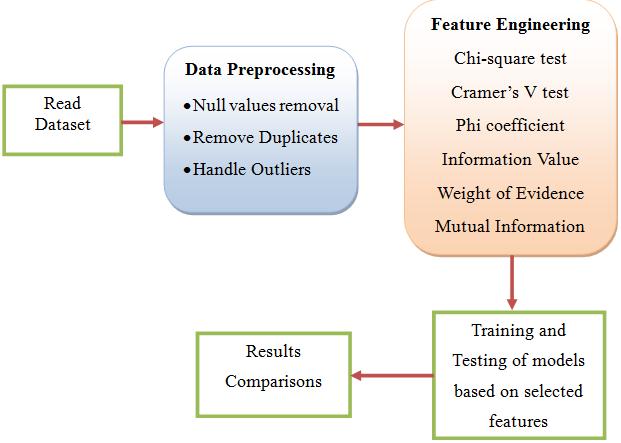
3. Proposed Work: Inthischapterthedetailsaregiven abouttheproposedidea basedonthefeatureengineering for detection of diabetic patients. The thesis is being developed in python language. All the steps of machine learning like data preprocessing, feature analysis, feature extractionandmodelbuildingisusedinthiswork.Thesteps usedfortheproposedmodelisdetailedbelowalongwiththe architecture.
3.1
Following data cleaning steps are applied:
1.NullValuesremoval.
2.Removingofduplicatevalues.
3.HandlingoutliersusingBinningmethod.
4. Removing variables with too much imbalance in 0/1 values.
3.2:
FollowingFeatureEngineeringstepsareapplied:
1. Calculate Chi-Square Values: The chi-square test was usedtodeterminethestrengthoftherelationshipbetween thepredictorvariablesandthetargetvariable[63].
2. Cramer’s Test:
TheCramer'sVtestwasused9ustogaugethestrengthof association between pairs of categorical predictors. In Cramer's V test, values range from 0 (indicating no association)to1(indicatingaperfectassociation)[64].
International Research Journal of Engineering and Technology (IRJET) e-ISSN: 2395-0056
Volume: 11 Issue: 08 | Aug 2024 www.irjet.net p-ISSN: 2395-0072
3. Phi coefficient:
ThePhicoefficientmeasuresthestrengthanddirectionof associationbetweentwobinaryvariables.Inourcase,the targetvariableismortality,andeachpredictorisa binary variable indicating the presence or absence of a specific conditionorcharacteristic[65].
4. Feature Selection – IV & WOE:
To enhance the predictive performance of the models regardingmortality,statisticalmeasuresInformationValue (IV)andWeightofEvidence (WOE)wereusedfor feature selection. Higher IV values indicate stronger predictive power. WOE, on the other hand, transforms raw features intoamoremeaningfulformbycapturingtherelationship betweeneachfeature'scategoriesandthelikelihoodofthe targetvariable.AftercalculatingIVthepredictorvariables weresplitint5categories.Allthe“notuseful”predictorsare removed.
5. Mutual Information (MI) wasthenusedtoidentifybest 20featuresbyusingtheSelectKBestmethod.Thisapproach focused on predictors with the greatest relevance to mortality,enhancingtheeffectivenessandinterpretabilityof ourpredictivemodels.
3.3 Proposed Algorithm After the EDA and the feature engineeringiscompleted,trainingandtestingwillstart.
1. Put all columns in X except the target column named “mortality”.
2.Dividethedataintotrainsetandtestsetwithsize=0.25.
3.ApplyLogisticregressionandprinttheresults.
4.ApplyRandomforestandprinttheresults.
5.ApplyRandomForestwithhyperparameterandprintthe results.
6.ApplyXGBoostClassifierandprinttheresults.
7.ApplyDecisionTreeandprinttheresult.
8.ApplyAdaBoostandprinttheresult.
9.ApplyEnsembleclassifierandprinttheresult.
10.ComparetheResults.
11.Exit.
End.
4. Result Analysis: CalculatingAUCscoreforcomparing modelperformance
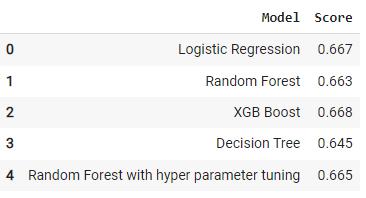
4.1:ModelsAUCScore.
Fromtheabovetable,AUCscoreishighestforXGBoost.The overall accuracy comparison of existing models and proposedmodelsareshownbelowinthetable4.1
Table4.1:ComparisonofAccuracy.(Testdataset)
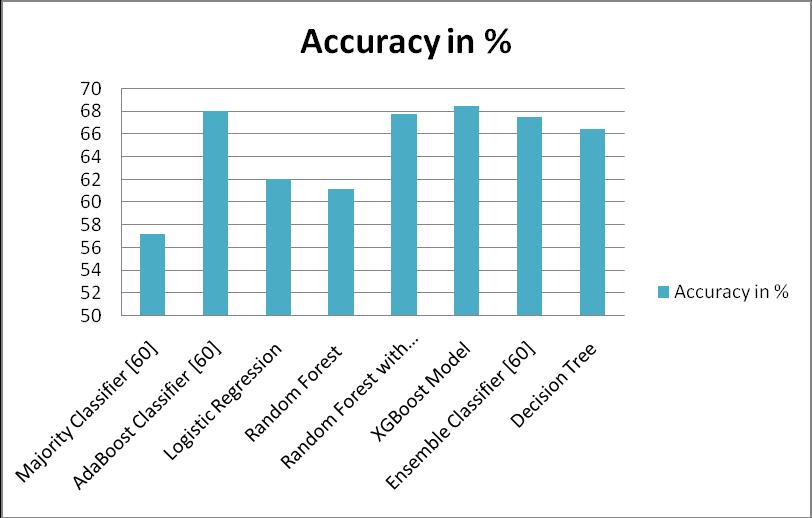
4.2:AccuracyComparison.
Fromallthemodelevaluationmetricsthatweusedonour models,weareconsistentlyseeingthatXGBoostmodelgives leastAICvalue,HighestAUCarea,besttrainingtestaccuracy curve. Confusion matrix also proved that XGBoost gives highest True positive values. From the statistics we can concludedthatallourmodelsperformeduniformlyonthe trainingandtestdatagiving68%testaccuracyconsistently
International Research Journal of Engineering and Technology (IRJET) e-ISSN: 2395-0056
Volume: 11 Issue: 08 | Aug 2024 www.irjet.net p-ISSN: 2395-0072
despitetheirunderlyingprinciple(Tree-based,Ensemble,or Linearmodel).
5. Conclusion
Byutilizingrobustdatasetsandemployingdiversemachine learning techniques such as logistic regression, decision trees, random forest, XGBoost and ensemble classifiers, researchers and healthcare professionals can develop accurateandreliablepredictivemodelsforearlydetection andintervention.
Despitethesechallenges,thepotentialbenefitsofmachine learninginType-2diabeticdetectionaresubstantial,offering the opportunity to improve patient outcomes, reduce healthcare costs, and ultimately contribute to the advancementofpersonalizedmedicine.Continuedresearch, collaboration, and innovation in this area are essential to realizingthefull potential ofmachinelearningindiabetes care.
6. References
[1] P.Dua,F.J.Doyle,andE.N.Pistikopoulos,“Model-based blood glucose control for type 1 diabetes via parametric programming,''IEEETrans.Biomed.Eng.,vol.53,no.8,pp. 1478_1491,Aug.2006.
[2] American Diabetes Association, “2. Classification and diagnosis of diabetes: Standards of medical care in diabetes_2020,'' Diabetes Care, vol. 43, no. 1, pp. S14_S31, Jan.2020.
[3] G. Sparacino, F. Zanderigo, S. Corazza, A. Maran, A. Facchinetti, and C. Cobelli, “Glucose concentration can be predictedaheadintimefromcontinuousglucosemonitoring sensortime-series,''IEEETrans.Biomed.Eng.,vol.54,no.5, pp.931_937,May2007.
[4] S.Guerra,A.Facchinetti,G.Sparacino,G.D.Nicolao,andC. Cobelli, “Enhancing the accuracy of subcutaneous glucose sensors:Areal-timedeconvolution-basedapproach,''IEEE Trans.Biomed.Eng.,vol.59,no.6,pp.1658_1669,Jun.2012.
[5] J. M. Norris, R. K. Johnson, and L. C. Stene, “Type 1 diabetes_Early life origins and changing epidemiology,'' LancetDiabetesEndocrinol.,vol.8,no.3,pp.226_238,Mar. 2020.
[6] NationalDiabetesStatisticsReport,2020.Accessed:Jan. 15, 2021. [Online]. Available: https://www.cdc.gov/diabetes/pdfs/data/statistics/nationa l-diabetes-statistics-report.pdf
[7] IDFederation. IDFDIABETESATLAS9thEdition2019 Accessed: Jan. 15, 2021. [Online]. Available: https://diabetesatlas.org/en/.
[8] L. Olansky and L. Kennedy, “Finger-stick glucose monitoring: Issues of accuracy and specificity,'' Diabetes Care,vol.33,no.4,pp.948_949,Apr.2010.
[9] J.B.Buse,D.J.Wexler,A.Tsapas,P.Rossing,G.Mingrone, C.Mathieu,D.A.D'Alessio,andM.J.Davies,“2019updateto: Managementofhyperglycemiaintype2diabetes,2018.A consensus report by the American diabetes association (ADA)andtheEuropeanassociationforthestudyofdiabetes (EASD),''Diabetologia,vol.63,no.2,pp.221_228,Feb.2020.
[10] M.Langendam,Y.M.Luijf,L.Hooft,J.H.D.Vries,A.H. Mudde,andR.J.Scholten,“Continuousglucosemonitoring systems for type 1 diabetes mellitus,'' Cochrane Database Syst. Rev., vol. 2012, no. 1, pp. 1_144, 2012, Art. No. CD008101.
[11] C. Choleau, J. C. Klein, G. Reach, B. Aussedat, V. Demaria-Pesce, G. S.Wilson, R. Gifford, and W. K.Ward, “Calibration of a subcutaneous amperometric glucose sensor:Part1.Effectofmeasurementuncertaintiesonthe determination of sensor sensitivity and background current,'' Biosensors Bioelectronics, vol. 17, no. 8, pp. 641_646,Aug.2002.
[12] D. Sisodia and D. S. Sisodia, “Prediction of diabetes usingclassificationalgorithms,''ProcediaComput.Sci.,vol. 132,pp.1578_1585,Jun.2018.
[13] H. Kaur and V. Kumar, “Predictive modelling and analyticsfordiabetesusingamachinelearningapproach,'' Appl.Comput.Inform.vol.16,pp.1_11,Jul.2020.
[14] K.Kincade,“Datamining:Diggingforhealthcaregold,'' InsuranceTechnol.,vol.23,no.2,no.2,pp.2_7,1998.
[15] I.Kavakiotis,O.Tsave,A.Salifoglou,N.Maglaveras,I. Vlahavas, and I. Chouvarda, “Machine learning and data mining methods in diabetes research,'' Comput. Struct. Biotechnology.J.,vol.15,pp.104_116,Jan.2017.
[16] D.Tomarand S.Agarwal,“A survey on data mining approachesforhealthcare,''Int.J.Bio-Sci.Bio-Technol.,vol. 5,no.5,pp.241_266,Oct.2013.
[17] M. Marinov, A. S. M. Mosa, I. Yoo, and S. A. Boren, “Data-mining technologies for diabetes: A systematic review,''J.DiabetesSci.Technol.,vol.5,no.6,pp.1549_1556, Nov.2011.
[18] M. Durairaj and K. Priya, “Breast cancer prediction usingsoftcomputingtechniques a survey,'' Int. J.Comput. Sci.Eng.,vol.6,no.8,pp.135_145,Aug.2018.
[19] J. P. Kandhasamy and S. Balamurali, “Performance analysis of classifier models to predict diabetes mellitus,'' ProcediaComput.Sci.,vol.47,pp.45_51,May2015.
International Research Journal of Engineering and Technology (IRJET) e-ISSN: 2395-0056
Volume: 11 Issue: 08 | Aug 2024 www.irjet.net p-ISSN: 2395-0072
[20] A. Tsanas and A. Xifara, “Accurate quantitative estimation of energy performance of residential buildings usingstatisticalmachinelearningtools,''EnergyBuildings, vol.49,pp.560_567,Jun.2012.
[21] L. Tapak, H. Mahjub, O. Hamidi, and J. Poorolajal, “Real-datacomparisonofdataminingmethodsinprediction ofdiabetesinIran,''HealthcareInformat.Res.,vol.19,no.3, no.3,pp.177_185,2013.
[22] A. A. Aljumah, M. K. Siddiqui, and M. G. Ahamad, “Applicationofclassificationbaseddataminingtechniquein diabetescare,''J.Appl. Sci.,vol.13,no.3,pp.416_422,Jan. 2013.
[23] E. I. Georga, D. I. Fotiadis, and V. C. Protopappas, “Glucose prediction in type 1 and type 2 diabetic patients using data driven techniques,'' in Knowledge-Oriented ApplicationsinDataMining.London,U.K.:IntechOpen,Jan. 2011,pp.277_296.
[24] D. Tomar and S. Agarwal, “Hybrid feature selection basedweightedleastsquarestwinsupportvectormachine approach for diagnosing breast cancer, hepatitis, and diabetes,'' Adv. Artif.Neural Syst.,vol.2015, pp. 1_10, Jan. 2015.
[25] D.D.A.KumarandR.Govindasamy,“Performanceand evaluation of classification data mining techniques in diabetes,''Int.J.Comput.Sci.Inf.Technol.,vol.6,no.2,pp. 1312_1319,2015.
[26] R. Sheikhpour and M. A. Sarram, “Diagnosis of diabetes using an intelligent approach based on bi-level dimensionality reduction and classification algorithms,'' IranianJ.DiabetesObesity,vol.6,no.2,pp.74_84,2014.
[27] F. Stahl, R. Johansson, and E. Renard, “Ensemble glucosepredictionininsulin-dependentdiabetes,''inDatadriven Modeling for Diabetes. Berlin, Germany: Springer, 2014,pp.37_71.
[28] X.Mo,Y.Wang,andX.Wu,“Hypoglycemiaprediction using extreme learning machine (ELM) and regularized ELM,''in Proc.25thchin.Control Decis.Conf. (CCDC),May 2013,pp.4405_4409.
[29] A. A. Al Jarullah, “Decision tree discovery for the diagnosisoftypeIIdiabetes,''in Proc.Int.Conf.Innov.Inf. Technol.,Apr.2011,pp.303_307.
[30] K. S. Eljil, G. Qadah, and M. Pasquier, “Predicting hypoglycemia in diabetic patients using data mining techniques,''inProc.9thInt.Conf.Innov. Inf.Technol.(IIT), Mar.2013,pp.130_135.
[31] N. K. Kumar, D. Vigneswari, M. V. Krishna, and G. P. Reddy,“Anoptimizedrandomforestclassifierfordiabetes mellitus,'' in Emerging Technologies in Data Mining and Information Security. Singapore: Springer, 2019, pp. 765_773.
[32] A. S. Martinez-Vernon, J. A. Covington, R. P. Arasaradnam, S. Esfahani, N. O'Connell, I. Kyrou, and R. S. Savage,``Animprovedmachinelearningpipelineforurinary volatilesdiseasedetection:Diagnosingdiabetes,''PLoSONE, vol.13,no.9,Sep.2018,Art.no.e0204425.
[33] H. Das, B. Naik, and H. Behera, “Classification of diabetes mellitus disease (DMD): A data mining (DM) approach,'' in Progress in Computing, Analytics and Networking.Singapore:Springer,2018,pp.539_549.
[34] E.V.Carrera,A.Gonzalez,andR.Carrera,“Automated detectionofdiabeticretinopathyusingSVM,''inProc.IEEE 24 Int. Conf. Electron., Electr. Eng. Comput. (INTERCON), Aug.2017,pp.1_4.