
International Research Journal of Engineering and Technology (IRJET) e-ISSN:2395-0056
Volume: 11 Issue: 08 | Aug 2024 www.irjet.net

International Research Journal of Engineering and Technology (IRJET) e-ISSN:2395-0056
Volume: 11 Issue: 08 | Aug 2024 www.irjet.net
Pavithra Moorthy1, Thyagarajen T2, Hakesh M3
p-ISSN:2395-0072
*12Formerly, Dept. of Computer Science and Engineering, Rajalakshmi Engineering College, Tamil Nadu, India
3 Student, Dept. of Computer Science and Engineering, Anand Institute of Higher Technology ,Tamil Nadu, India
Abstract - Traveling has become our daily essentials, like oxygen, water, and food. Vehicles have evolved along with human needs and desires, as well as risk and danger. It is natural for a human to doze off while driving for a long time. Driver drowsiness or fatigue is one of the main reasons behind road accidents. Continued surveillance with the required preventive measures through an efficient model will be provided in this project. This project comprises two phases. In phase one, with the help of a camera module, a computer vision model can be used to monitor and detect the fatigue state. The proposed system incorporates a digital library. The Face Landmark Detection algorithm offered by the Digital Library is an implementation of the Ensemble of Regression Trees (ERT) and HOG descriptors for object detection. The EAR (Eye Aspect Ratio) value is determined, followed by the threshold frame count to endorse the fatigue state. Detection of drowsiness or fatigue: an alert is displayed on the screen along with an alert alarm. Simultaneously, the achieved value is uploaded in real-time to Firebase (cloud database storage). In phase two, a simulated car with a Raspberry Pi as its base control unit is established to take input from the firebase. For every specified threshold value, the actions of the car are subjected to certain changes. As a preventive measure, the motor slows down the vehicle’s wheels as the fatigue threshold increases, and finally, the car is stopped. As an emergency measure, the car is integrated with a GSM and GPS module, which in turn sends an alert message and the location of the vehicle to the nearest hospital and one’s respective emergency contact.
Key Words: digitallibrary,histogramoforientedgradients, eye-aspectratio,ensembleofregressiontrees,GSM,GPS.
Theevolutionandgrowthoftheautomobileindustryinthe present period are impeccable. Increases in vehicle automationandself-sustainabilityarewitnessedeveryday. Despitealltheinnovations,theroadsafetyandlivesofthe people on board a vehicle are still intriguing. Every year, thousandsofpeoplelosetheirlivesduetoroadaccidents. Therearemanycausesofaccidents,forexample,speeding andbeingdrunk.
driving, but still, the foremost factor, especially on rural roads,isthedriver’sfatigueandmonotony.Accordingtothe datacollectedin2017fromtheWorldHealthOrganization, an approximate number of 1.25 million deaths have been
recorded worldwide, i.e., approximately for every 25 seconds,anindividualouttherewillexperiencearoadcrash.
The current evolved vehicle generation does not have the propersystemtopreventaccidentscausedbydrowsiness.A properfatiguemonitoringsystemshouldbeimplementedto prevent road crashes and save lives. A model that just detects fatigue and alerts the driver alone will not be sufficienttopreventroadcrashesfromhappening.
Ashieldsystemthatsimultaneouslysynchronizeswiththe fatigue monitoring phase to save lives and avoid road accidentsmustbeincorporated.Thesephasestogetherwill form an efficient barrier to road accidents. Continuous surveillance with the help of computer vision and implementingthechangesconcerningtheobservedchanges will enhance vehicle safety and ensure the prevention of roadcrashes.
Fatiguesurveillanceandshieldsystemslaydriverprotection and road safety as their foundation. This model aims to receivethefaciallandmarksofanindividualasinput,which isprocessedtogeneratearesultthatwillindicatethestate offatigue.Thefurtherproceedingsofthemodeldependon thatstateandexecutethe necessaryactionstoachieveits goal.Ifanindividualisobservedtobedrowsyorinattentive while driving, the drowsiness is detected through the camera,andthealertsystemwillbetriggered,mentioning thatthedriverisdrowsy.Thisresultwillbeupdatedincloud storage for later. If a condition prevails where the driver remainsdrowsyevenafterthealertalarmandtheindication message goes on, the momentum of the vehicle will be reducedstepbystepwiththehelpofthevalueattainedfrom thecloudforeverythresholdframeuntilthecarhaltsandis preventedfromcollapsing.Oncethecarishalted,acaution text and the location of the fatigued individual will be deliveredtotheirrespectiveemergencycontact
The authors of [1] propose a fundamental algorithm that detects the individual differences of a driver while a deep cascaded convolutional neural network is constructed to detect the face region and also where the eye aspect ratio concept is introduced to evaluate the drowsiness of the individual in the present frame. The use of deep cascaded CNNavoidstheproblemofpooraccuracyinartificialfeature extraction.
International Research Journal of Engineering and Technology (IRJET) e-ISSN:2395-0056
Volume: 11 Issue: 08 | Aug 2024 www.irjet.net p-ISSN:2395-0072
The facial features monitoring model incorporates three phasesforreal-timefacialmonitoringandproposesefficient facialfeaturedetectionusingViolaJones,eyetracking,and yawning detection. It illuminates the skin part, and considering the chromatic components alone helps in rejecting most of the non-facial background. The implementation of a binarylinear support vector machine classifies continuous frames into fatigue and non-fatigue states,thusmakingthesystemhighlyefficient.[2]
This paper [3] presents deep learning-based drowsiness detection for the brain-computer interface (BCI) using functional near-infrared spectroscopy (fNIRS), where the activitiesofthebrainaremeasuredwithacontinuous-wave fNIRSsystem.Deepneuralnetworks(DNN)areimplemented to classify the drowsy and alert states from the observed brainactivities.TheinclusionoftheusedCNNarchitecture attainsanaccuracyof99.3%,makingthesystemreliable,and itisalsoefficientinaccessingtheframelocationforapassive BC.
A comprehensive Drowsiness Level Detection Model CombiningMultimodalInformation[4]cansensetheentire range of stages of drowsiness. The approach behind this modelmakesuseofsittingposture-relatedindexvaluesthat canindicateweakdrowsiness.Theproposedsystemdoesnot struggletocomprehendanddifferentiatevariousdrowsiness states.
Theauthorsin[6]proposeareal-timesystemthatcandetect driver fatigue and distractions using machine vision approaches where face template matching and horizontal projection of the top-half face image are utilized to obtain hypervigilancesymptomsfromtheface.Theimplementation ofadaptivehypervigilancemonitoringmodulesforstandard inputs and a very short training phase makes this model robustandefficientlydetectsindividualswithdifferentfacial andeyelidbehaviors.
The author in [7] proposes a system named DriCare that modulates to detect the driver’s fatigue status, such as yawning, blinking, and duration of eye closure, and introduces a new face algorithm to improve tracking accuracy.Thenon-contactmethodiscost-efficientanddoes not require computer vision technology or a sophisticated camera,whichallowsthemodeltobeusedinmorecars.
TheSmallFacesAttentionfacedetector[8]proposesanew scale-invariant face detector, which iscalleda Small Faces Attention (SFA) face detector. This model is built over the first-ever multi-branch face detection architecture and adopts multi-scale training and testing to make the model robust at various scales. It provides promising detection performance on challenging detection benchmarks like WIDER FACE and FDDB data sets. Having a multi-branch detection architecture, this model pays more attention to facesonasmallscale.
Theauthorofthepaper[9]proposesanewmoduletodetect an individual’s eye closure and yawning for drowsiness analysisusinganinfraredcamera.Thismoduleincorporates four steps, namely, face detection, eye detection, and eye closureandyawningdetection.Thismethodcandetecteye closureoryawningeveninlow-lightambiance.
Thispaper[10]proposesasystemthatutilizesmathematical models like neural networks and image processing techniques to sense the environment, and it has been implemented as three major components, namely, curved roaddetection,roadsignandsignaldetection,andobstacle detection. The proposed model is well-trained, efficient in obstacleandroadsigndetection,andcanworkefficientlyin breakingdownsignsinbothsunlightandnightillumination.
The paper [11] presents a low-cost human-computer interaction device, represented by an Arduino glove, to controlanRCcar.TheArduinogloveincludesagyrosensor to identify the angle of the hand, while the fingers’ movementsareidentifiedbytheflexsensor.Itisalow-cost human-computer.
Inthispaper[12],wetacklethedevelopmentofaroboticcar withhardwarecontrol,lanedetection,mapping,localization, andpathplanningcapabilities.ITalsointroducedageneric map analysis system to increase the efficiency of certain pathsonthetrack.Itiscompletelyrobust.
The architecture diagram derives from the extraction of imageframesandprocessingthemwiththeDlibtoplotthe facial features and detect the eyes. While the EAR value is calculatedforeachframe,thevaluesandframecountsare passedtotheclouddatabase,whichinturnactsastheinput fortheRaspberryPi,whichactsasthevehicle’scontrolunit. GSMandGPSarethekeycomponentsoftherecoveryphase.
Thearchitecturediagramoftheprojectisshownbelow:
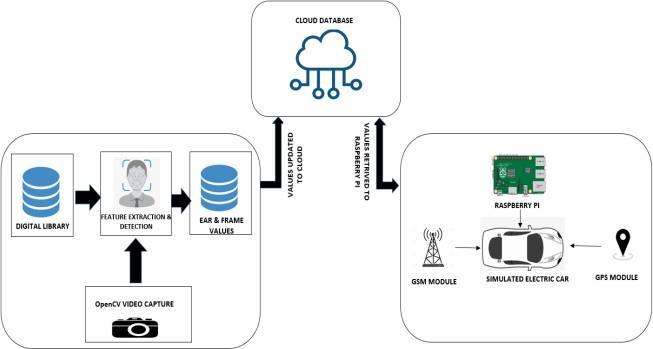
Fig -1:FatigueSurveillanceandShield
International Research Journal of Engineering and Technology (IRJET) e-ISSN:2395-0056
Volume: 11 Issue: 08 | Aug 2024 www.irjet.net p-ISSN:2395-0072
The fatigue surveillance and shield system lays driver protection and road safety as its foundation. This model extractsfaciallandmarkswiththeOpenCVofanindividual as input, where it is processed to generate a result from faciallandmarks.Whilethemodelislocatingtheeyeregion, therespectiveEARvalueiscalculated.WiththeEARvalue,if itislessthanthethresholdvalue,thenthatwillindicatethe stateoffatigue.Thefurtherproceedingsofthemodeldepend onthatstateandexecutethenecessaryactionstoachieveits goal.Ifanindividualisobservedtobedrowsyorinattentive while driving, the drowsiness is detected, and the alert system will be triggered, mentioning that the driver is drowsy.ThisEARandframecountvaluewillbeupdatedin cloudstoragelater.Ifaconditionprevailswherethedriver remainsdrowsyevenafterthealertalarmandtheindication message goes on, the momentum of the vehicle will be reducedgraduallywiththehelpoftheEARvalueattained fromthecloudforeverythresholdframeuntilthecarhalts andispreventedfromcolliding.Oncethecarishalted,using GSMandGPS,acautiontextandthelocationofthefatigued individual will be delivered totheir respective emergency contact,suspectingthatthedrivermightbeinrecoverable danger. The proposed model consists of four modules, namely image acquisition, face and eye detection, fatigue monitoring,androadcrashrecovery.Thelistedmodulesare explainedhere.
This module is used for capturing image frames of an individualwiththecameraattached.Usingcomputervision, thecameraisaccessed,andthefaceiscapturedlive.These acquiredframesarethenconvertedtoagrayscaleforfurther processing.Beingtheinitialmodule,theimageacquisition neverstopsorchanges.
Inthismodule,thebaseoffacedetection,i.e.,facialfeature extraction of the individual, is carried over. Dlib’s shape predictoristrainedwiththe300W–IBUGtrainingdataset. The 300W-bug dataset consists of 11 columns and 1786 rows.Itstandardizesmultiplealignments.databaseswith68 landmarks. The goal of 300W-IBUG is to train a shape predictorcapableoflocalizingeachfacialstructure.Withthe help of trained Dlib, it will be efficient to mark the facial feature landmarks and identify the eye region. The data pointsfortheeyeregionwillbeextracted.
This module helps in monitoring the fatigue state of an individual. HOG (Histogram of Oriented Gradients) is a featuredescriptorgenerallyusedforobjectdetection.The converted grayscale frame from the image acquisition
module is then passed to HOG, and the coordinates of the facial features are extracted from the five face landmarks definedinthedataset.TheEARisdefinedastheratioofthe vertical to the horizontal Euclidean distance of the landmarksintheeye.TheEARvaluedetermineswhetherthe eye is in an open or closed state while continuously monitoring the closure angle of the eyes. The EAR (Eye AspectRatio)fortheleftandrighteyesiscalculatedwiththe attainedcoordinates.OncetheEARvaluedropsbelowthe thresholdvalue,itisconsideredtobeinafatiguestate.
TheattainedEARvaluewillbesimultaneouslyuploadedto theclouddatabase.Fromthecloud,thevaluesaretakenas inputbytheRaspberryPicontrolunit.Basedontheinput EARvaluebeingreceived,themotorreducesthespeedor rpmofthecarforeverythresholdframevalue,andfinally, the vehicle attains the rest. Once the car is in a stopped position,withthehelpofGSMandGPSmodules,thelocation and alert message are sent to the emergency contact for recovery.Thismoduleinnovatesroadsafetybypreventing roadcrashesbyceasingthevehicle'smotion.
The fatigue surveillance and shield have been completed withthehelpofOpenCV.andtheFaceLandmarkDetection algorithm.
InFigure2,oncetheprogramisexecuted,OpenCVaccesses thecameraandstartsthecapture.Thefaceiscapturedframe byframecontinuouslywithoutanyhalts.Thus,OpenCVacts astheentrypoint.
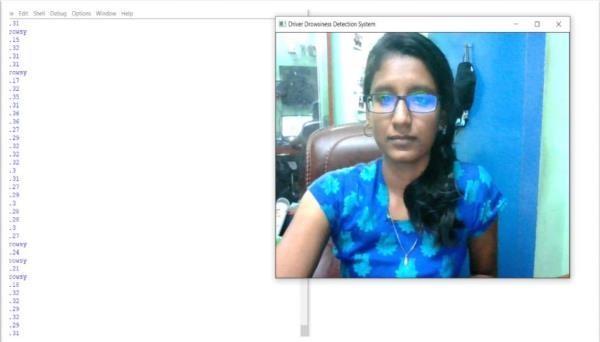
Afterthedetectionphase,withtheuseofDlibandHOGface descriptors, the facial landmarks for the eyes are marked, andtheirrespectiveEARvaluesarecalculated.Thedistance betweeneacheyecoordinateistakenasinput,andtheEAR isbasedonthatvalue.Ontheserialmonitor,theEARvalue calculatedforeachframeisprintedasoutput.Oncethevalue drops below the threshold EAR value, drowsiness will be displayed.
International Research Journal of Engineering and Technology (IRJET) e-ISSN:2395-0056
Volume: 11 Issue: 08 | Aug 2024 www.irjet.net p-ISSN:2395-0072
InFigure3,aftersuccessfuldetectionoftheeyeclosure,the EARvaluedropsbelowthethresholdvalue,andthefatigue alertmessageistriggeredontheComputerVisionwindow. Alongwiththealertmessage,analarmsoundisflashedto bring the driver back to consciousness. This process continuesrelentlesslyinaloopwithoutanyhindrance.

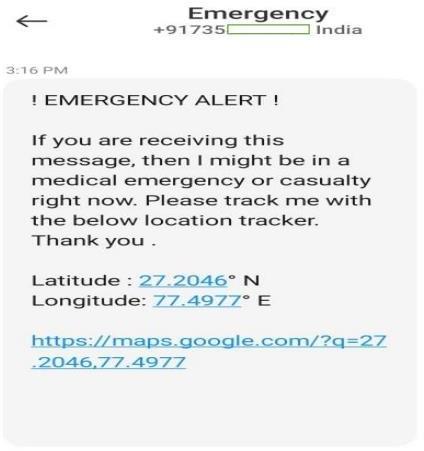
Theemergencytext,alongwiththelocationreceivedbythe emergencycontact,isdisplayed.Oncethevehiclecomestoa completerestposition,thealertmessageindicatingtheneed forhelpalongwiththelocationtotrackdowntheindividual willbedeliveredwithoutanyinterruption.
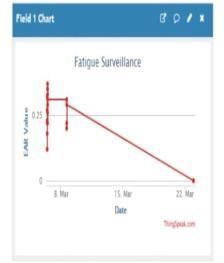
The EAR value calculated while detecting is passed to the cloudrepositoryandstored.Thedataissecuredfrombeing tamperedwith.Thegraphrepresentsthevalue’sriseandfall duringthefatiguemonitoringphase.
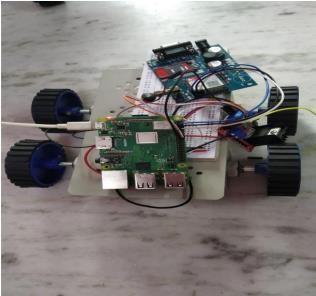
Thesimulatedcarofareal-timevehicleisinarestposition to prevent a crash once the fatigue monitor reaches the thresholdEARvalue.
The fatigue surveillance and shield system perform and providesthenecessaryroadsafetybypreventingaccidents withthesystem’senhancedcapabilityofbeingagiletothe resultforeverysinglesecond.Duringtherecoveryphase,the modeltakesoverthecontrolontheroadanddoesnotjust wind up with the detection and alert phases. Speed reduction and location sharing are the apex features that ensureZ-gradesafetyinthispracticalworld.Themodelcan befurtherenhancedbyincorporatingAIintothevehicle’s drivingmode.
When detecting drowsiness, the accident can be further prevented with a self-parking feature and a wide alarm sound for causality recognition. Different approaches for detectingdrowsinesscanbehandled,suchasbodypostures and linking smartwatches with vehicle driving mode. Wheneveranindicationofcardiacarrestarises,theshield systemcanbeactivated.
International Research Journal of Engineering and Technology (IRJET) e-ISSN:2395-0056
[1] Feng You Xiaolong li, Yunbo Gong Haiwei Wang, and HongyiL, A Real-time Driving Drowsiness Detection Algorithm With Individual Differences Consideration, IEEEACCESS.2019.2958667.
[2] Manu, B.N., Facial features monitoring for real-time drowsiness detection, International Conference on InnovationinInformationTechnology,IIT2016.
[3] M.AsidTanveer, M.Jawad Khan, M.Jahangir Qureshi, NomanNaseer, and KeumShik Hong, Enhanced Drowsiness Detection Using Deep Learning, IEE ACCESS.2019.2942838
[4] MikaSunagawa,Shin-ichiShikii,WataruNakai,Makoto Mochizuki, Koichi Kusukame, and Hiroki Kitajima, Comprehensive Drowsiness Level Detection Model Combining Multimodal Information, IEEE Sensors Journal,vol.20,no.7,April1,2020.
[5] RatebJabbar, Khalifa Al-Khalifa, Mohamed Kharbeche, WaelAlhajyaseen,MohsenJafari,andShanJiang,Realtime Driver Drowsiness Detection for Android ApplicationsUsingDeepNeuralNetworksTechniques, 9th International Conference on Ambient Systems, Networks,andTechnologies(ANT2018).
[6] Mohamad-HoseynSigari,MahmoodFathy,andMohsen Soryani, A Driver Face Monitoring System for Fatigue and Distraction Detection, International Journal of VehicularTechnology,Volume2013,ArticleID263983.
[7] Wanghuadeng,Ruoxuewu,Real-timedriverdrowsiness detectionusingfacialfeatures,ACCESS.2019.2936663.
[8] Shi Luo, Xiongfei Li, Rui Zhu, and Xiaolizhang, Small Faces Attention Face Detector, IEEE ACCESS.2019.2955757.
[9] Wisaroot Tipprasert, Theekapun Charoenpong, Chamaporn Chianrabutra, Chamaiporn Sukjamsri*, A MethodofDriver’sEyesClosureandYawningDetection for Drowsiness Analysis by Infrared Camera, InternationalSymposiumonInstrumentation,Control, ArtificialIntelligence,andRobotics(ICA-SYMP),2019.
[10] B Padmaja, P V Narasimha Rao, M Madhubala, and E KrishnaRaoPatro,ANovelDesignofAutonomousCars UsingIoTandVisualFeaturesIEEEXplorePartNumber: CFP18OZV-ART;ISBN:978-1-5386-1442-6.
[11] RuslanT.,YerdenK.,andMd.HazratAli,Developmentof an Arduino Glove-Based Autonomous Car, 21st International Conference on System Theory, Control, andComputing(ICSTCC),2017.
Volume: 11 Issue: 08 | Aug 2024 www.irjet.net p-ISSN:2395-0072 © 2024, IRJET | Impact Factor value: 8.315 | ISO 9001:2008
[12] DanielClaes-Broecker.DevelopmentofanAutonomous Rc-Car, Conference: International Conference on IntelligentRoboticsandApplications,2013.