
International Research Journal of Engineering and Technology (IRJET) e-ISSN: 2395-0056
Volume: 11 Issue: 08 | Aug 2024 www.irjet.net p-ISSN: 2395-0072

International Research Journal of Engineering and Technology (IRJET) e-ISSN: 2395-0056
Volume: 11 Issue: 08 | Aug 2024 www.irjet.net p-ISSN: 2395-0072
Joshitha
Lakshminarayana1 ,
Bhoomika
K2 ,
Keerthana
M3 , Dr.Vrunda Kusanur4
1Dept. of ECE BNM Institute of Technology Bengaluru, India,
2Dept. of ECE BNM Institute of Technology Bengaluru, India,
3Dept. of ECE BNM Institute of Technology Bengaluru, India,
4Associate Professor, Dept. of Electronics and Communication Engineering, BNM Institute of Technology, Karnataka India ***
Abstract Current urban environments require advanced surveillance systems that can identify unusual activity in densely populated regions in order to protect public safety and security. This project uses an advanced multi-model approach to detect anomalous behavior in pedestrians, in order to meet this need. The combination of ResNet50, Inception V3, and the Slow Fast model represents an allencompassing approach that utilizes deep learning to identify minor variations achieving an accuracy of 94%. By improving the effectiveness of surveillance systems in public areas, this project hopes to contribute to the general safety and security by offering an effective way of identifying and handling anomalous behavior.
Key words Anomalous behavior, Pedestrians, ResNet50, Inception V3, Slow Fast model, Deep learning, Advanced multimodelapproach,Accuracy(94%),Publicsafety.
1.INTRODUCTION
In today’s world, abnormal activity indicates threats and risks to others. An anomaly can be defined as something that deviates from what is expected, common, or normal. Becauseitisdifficulttocontinuouslymonitorpublicspaces and classify them, intelligent video surveillance is necessary. So choosing an appropriate framework for identifyingsuspiciousactivityplaysaverysignificantrole.
Abnormalactivitydetection,monitoringandidentifying abnormal conditions is a very difficult task. In today’s life, the use of security cameras is increasing due to serious crimes.Forsome the performanceisincredible,forothers itisnot.Therefore,choosinganappropriateframeworkto identifysuspiciousactivitiesplaysanimportantrole.New monitoring systems use deep learning models to identify maliciousprograms.Deeplearningisverypopularandisa typeofmachinelearning.
It is popular because it can process unnecessary information. Deep learning utilizes and utilizes deep learningneural networks.Hehasgoodcalculations.Italso provides great flexibility when it needs to handle many features. These features are taken from data and do not cause any problems. The deep learning model has many layersthroughwhichitpassesdata.Eachlayercomeswith features derived from non-standard data. This feature is transferredtothenextlayerofthenetwork.
Lowlevelfeaturesareextractedfromthefirstlayerand the following layers will provide these features. Creates a complete feature representation. It solves many problems that arise in traditional analysis. Provides better performancebydeepneuralnetworks.
Research literature has gathered the following point’s supports the use of deep learning in analysis Analyzing human experience activity by observing video is a frequently conducted research in image processing and computervisionoperatesinitsfield.
Bus stations, train stations, airports, banks, shops, homes,schools andcolleges,car parks, roads, etc. through visualmonitoring.Humanactivitiesinpublicareassuchas can be monitored. Prevent violence, theft, accidents and illegal parking, torture, fighting, theft, crime and other activitiesno.Itisverydifficulttoconstantlymonitorpublic places, so there is a need for intelligent video surveillance that can monitor human activities and distinguish them intonormalandabnormal;andcangenerateanalarm.
2.1 Inception V3:
Introduction: Inception V3 stands as a pinnacle achievement in the realm of convolutional neural networks (CNNs), a product of continuous refinement within the Inception series pioneered by Google. This state-of-the-art architecture is specifically crafted for image classification and object recognition, embodying a synthesis of innovative design principles that elevate its performanceincomparisontoitspredecessors
Architecture Overview: The evolution of Inception V3 is markedbyadeparturefromconventionalapproaches.The architecture comprises a meticulously designed ensemble of convolutional modules, each tailored for a specific purpose. These modules, including 1x1, 3x3, and 5x5 convolutions, collectively enable the network to capture features at varying scales. Furthermore, the introduction of parallel pathways, often referred to as Inception modules, allows simultaneous feature extraction at different receptive field sizes. This parallelism empowers the model to discern fine details alongside broader contextual information, contributing to its robust recognitioncapabilities.
International Research Journal of Engineering and Technology (IRJET) e-ISSN: 2395-0056
Volume: 11 Issue: 08 | Aug 2024 www.irjet.net p-ISSN: 2395-0072
Efficient Feature Extraction: At the core of Inception V3's success lies its ability to perform efficient feature extraction.Bydiversifyingconvolutionalfilters,themodel excels in capturing intricate details crucial for image understanding. The spatial hierarchies created through the amalgamation of different filters contribute to the network'scapacitytocomprehendcomplexstructuresand patterns. Notably, the incorporation of 1x1 convolutions strategically reduces the dimensionality of feature maps, striking a balance between computational efficiency and informationretention.
Methodology -: Inception V3 goes beyond conventional architectures by introducing auxiliary classifiers during training. These classifiers, located at intermediate layers, servea dual purpose. While aidinginthetrainingprocess by providing additional paths for gradient flow, they also contribute to the model's overall robustness. This innovativeapproachmitigatesissuessuchasthevanishing gradient problem, promoting better convergence during thetrainingphase.
Versatility and Transfer Learning: The versatility of Inception V3 extends to its applicability in transfer learning. Pre-trained models can be leveraged across diverse domains, offering a significant advantage in scenarios with limited labeled data. This adaptability has renderedInceptionV3apopularchoiceforawidearrayof computer vision tasks, contributing to breakthroughs in imagerecognitionandclassification.
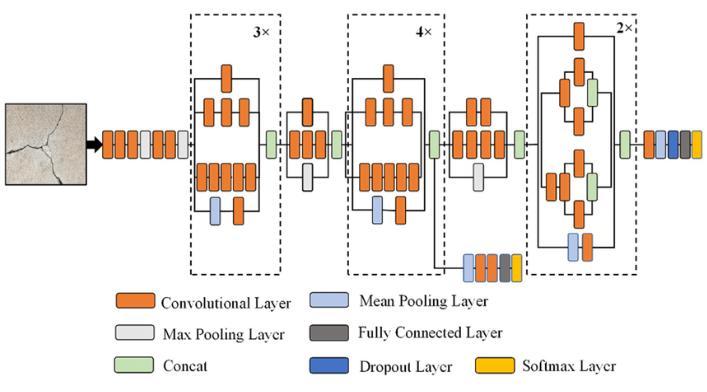
Fig. 1:ThearchitectureofInception-V3mode
2.2 Resnet-50:
Introduction: ResNet-50, a convolutional neural network (CNN) developed by Microsoft researchers, has gained acclaim for its deep learning capabilities in image recognition. It effectively tackles challenges related to training deep networks through the introduction of residualconnections.
Residual Learning and Skip Connections: ResNet's key innovation lies in residual blocks featuring skip
connections. Traditional deep networks grapple with the vanishing gradient problem, hindering training of extensively layered models. Residual blocks mitigate this by learning the residual mapping, the input output difference, and combining it with the original input throughaskipconnection,easingoptimization.
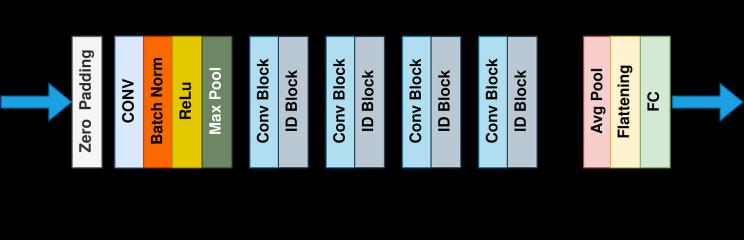
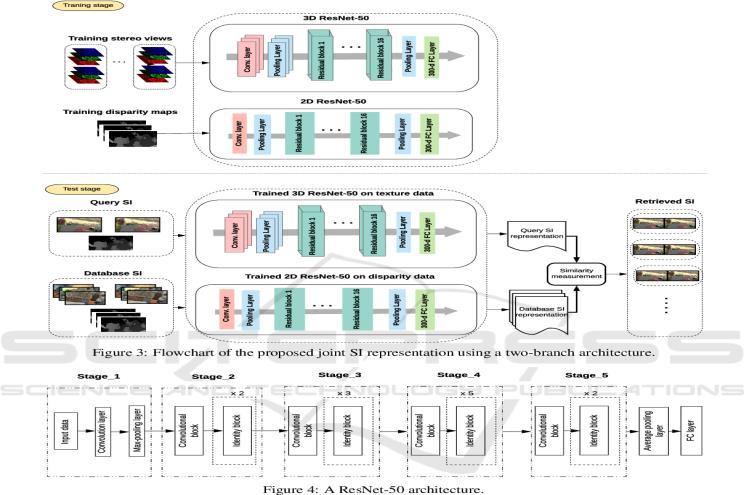
Architecture Overview: Comprising 50 layers, ResNet-50 includes convolutional layers, batch normalization, activation functions, and fully connected layers. The architecture is segmented into stages with multiple residualblocks,incorporatingglobalaveragepoolinganda fullyconnectedlayerforclassification.
Convolutional Layers: The initial layers serve as feature extractors, capturing low-level features like edges. Progressing through stages, the convolutional layers learn intricatefeatures,enablingdiscriminationbetweendiverse patterns.
ResidualBlocks:CentraltoResNet'ssuccess,eachblock contains convolutional layers, batch normalization, and ReLU activation. The skip connection facilitates learning residual features, capturing fine-grained details. Global Average Pooling: Replacing fully connected layers, global averagepoolingreducesfeaturedimensionality,enhancing interpretability and generalization to new data. PreTrainedWeightsandTransferLearning:ResNet-50isoften pre-trained on datasets like ImageNet, leveraging transfer learning for specific applications. This approach saves computationalresourcesandtime.
International Research Journal of Engineering and Technology (IRJET) e-ISSN: 2395-0056
Volume: 11 Issue: 08 | Aug 2024 www.irjet.net p-ISSN: 2395-0072
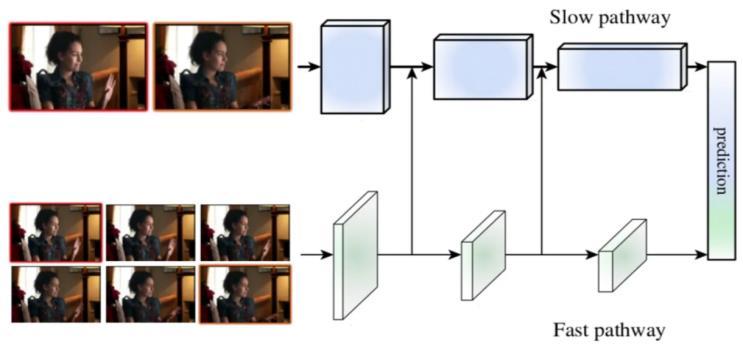
Introduction: The SlowFast model represents a breakthrough in the domain of video understanding, addressingtheinherentchallengesposedbythetemporal dimension in visual data. Introduced as a novel architecture by Facebook AI Research (FAIR), the SlowFastmodelisdesignedtocapturebothhighandlowfrequency temporal information efficiently. This innovative approach is particularly impactful in video recognition tasks, where a nuanced understanding of temporaldynamicsisessentialforaccurateanalysis.
Architecture Overview: At the heart of the SlowFast model isadual-patharchitecture,featuringtwoseparatestreams for processing video frames at different temporal resolutions. The "Slow" pathway operates at a reduced frame rate, capturing the broader context and global temporal information. Conversely, the "Fast" pathway processes frames at a higher frame rate, focusing on finer details and rapid temporal changes. This dual-stream design allows the model to balance the trade-off between capturing long-term dependencies and reacting swiftly to temporal nuances, resulting in a more comprehensive understandingofvideocontent.
Efficient Feature Extraction:TheefficiencyoftheSlowFast model is underpinned by its adept feature extraction process. The Slow pathway, with its reduced frame rate, produces high-level semantic features, capturing the overarching temporal structure. Simultaneously, the Fast pathway excels in capturing fine-grained details and subtle temporal variations. The fusion of these pathways, achieved through a carefully designed network architecture,ensuresthatthemodelsynthesizesaholistic representation that encapsulates both global and local temporalfeatures.
Methodology - Dual-Path Temporal
Convolution: A distinctivefeatureoftheSlowFastmodelistheintegration of a dual-path temporal convolution mechanism. This innovation involves separate 3D convolutions for each pathway, allowing the model to process temporal information independently in both the Slow and Fast streams. The combination of these convolutions ensures that the model can effectively capture temporal dependencies across multiple time scales. This methodology enhances the model's ability to discern complex temporal patterns, making it well-suited for a widerangeofvideoanalysistasks.
Spatial-Temporal Fusion: A key strength of the SlowFast model liesinits emphasisonspatial-temporal fusion.The model seamlessly integrates information from both the SlowandFastpathwaysthroughcarefullydesignedfusion layers. This fusion process enables the model to create a unifiedrepresentationthatleveragesthestrengthsofboth streams, resulting in a more nuanced and comprehensive
understanding of the temporal dynamics within the video data.
3.1 Introduction
The objective of this project is to create a supervised ML modelfordetectingabnormalactivities,Classifythemand notify the respected higher authorities. Fig. 5 represents thecompletemethodologyofthemodel.
Machine Learning Model for Human Suspicious Activity:
1) Data Collection and Preprocessing: The machine learningmodelisbasedonacarefullyselecteddataset.We started the process of gathering data, collecting a wide range of short videos of abnormal activities detected in public places , from several websites and apps such as kaggle , which included datasets of several classes of abnormalactivitiessuchasshoplifting,Stealing,Fighting, ExplosionandVandalism.
Before preprocessing, First the video must be converted intoseveralvideoframes.Inordertoensureamodelwith optimalperformance,avarietyofpreprocessingprocesses havebeenperformedtothe videoframesobtained.These operations consist of resizing each frames , normalizing pixel values, and standardizing image sizes. While normalization improves model convergence, standardizationguaranteesconsistency.
2) Selection and Training of Machine Learning Model:Inthe quest for architecture conducive to video classification tasks, we opted to train three Machine Learning Models: Slow-Fast,Inception-v3andResnet50.
3) Web Application Integration: The trained ML Model is integrated into the web application. A simple interface is created using HTML and CSS to facilitate the usage of ML ModelforDetectionofabnormalactivitiesinpublicplaces. The model is configured to receive video inputs through the website, enabling users to obtain binary classification outputsbyuploadingvideosontotheplatform.
International Research Journal of Engineering and Technology (IRJET) e-ISSN: 2395-0056
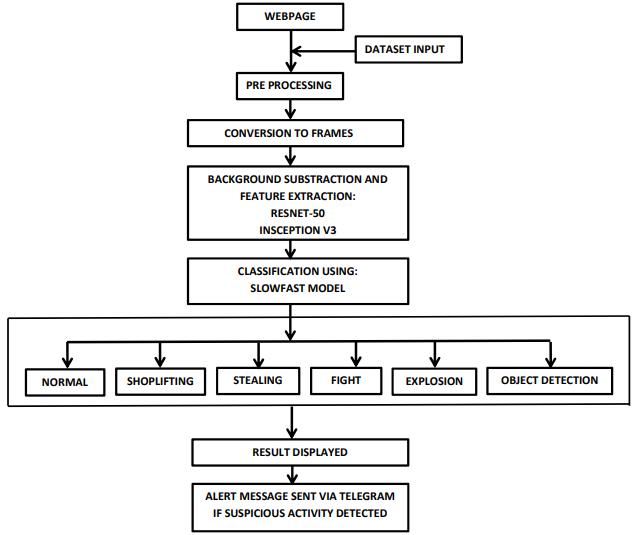
Fig. 5:Flowchartdepictingthemodel
4.RESULTS
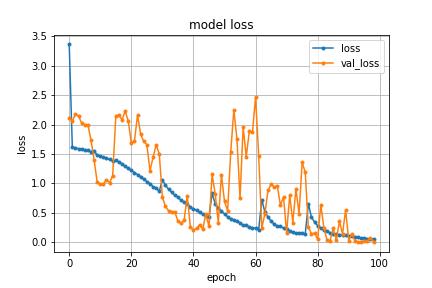
Chart -1:GraphdepictsModelLoss
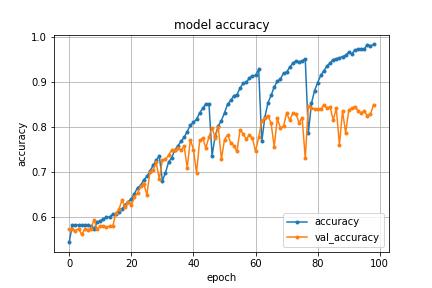
Chart-2:GraphdepictsModelaccuracy
We plot the model's training and validation accuracy and loss,asshownin Chart-1andChart -2. The epochsof the
model accuracy and loss for video classification are around 98%. The classification report of the model using the unseen test data is presented in Fig 6. The support valuesshowthenumber of videos relatedto eachclassin thetestdata.
Table 1:Accuracyandlossvaluesforfirst10epochs
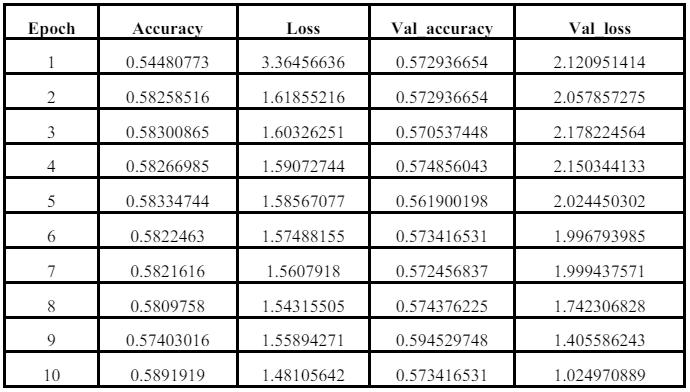
Table 2:accuracyandlossvaluesforlast10epochs
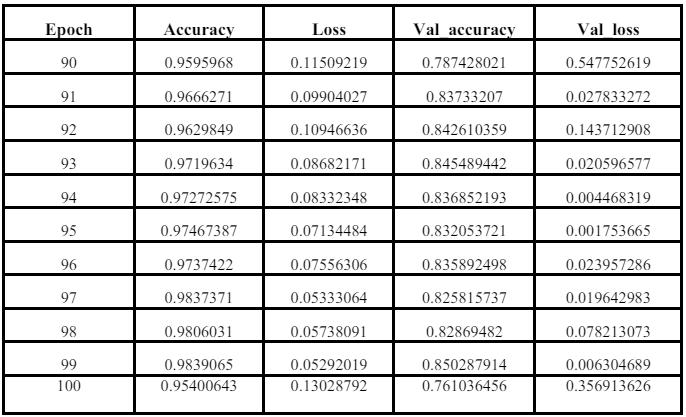
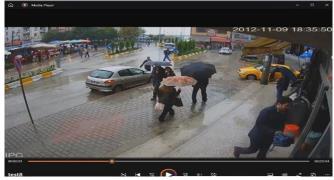
Fig. 6: Figuredepictsnormalcase
Volume: 11 Issue: 08 | Aug 2024 www.irjet.net p-ISSN: 2395-0072 © 2024, IRJET | Impact Factor value: 8.226 |
International Research Journal of Engineering and Technology (IRJET) e-ISSN: 2395-0056
Volume: 11 Issue: 08 | Aug 2024 www.irjet.net p-ISSN: 2395-0072
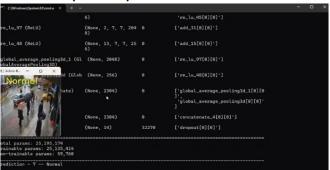
7:FiguredepictsNormalPrediction
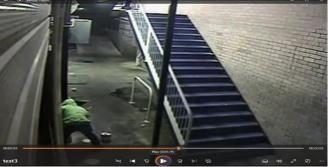
Fig. 8:FiguredepictsShopliftingCase
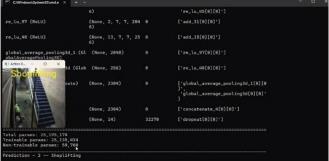
Fig. 9:FiguredepictsShopliftingPrediction
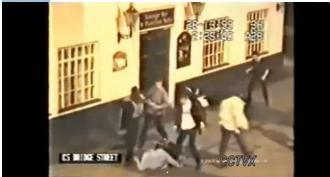
Fig. 10: FiguredepictsFightingCase
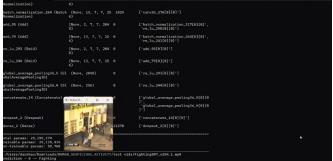
Fig. 11:FiguredepictsFIghtingPrediction
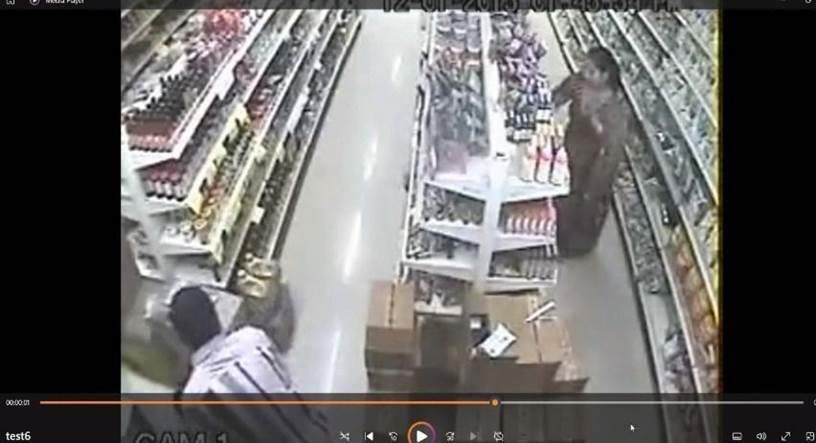
Fig. 12: FiguredepictsStealing/RobberyCase
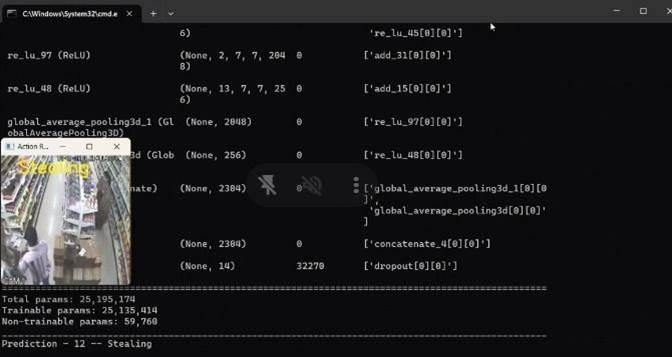
Fig. 13: FiguredepictsStealing/RobberyPrediction
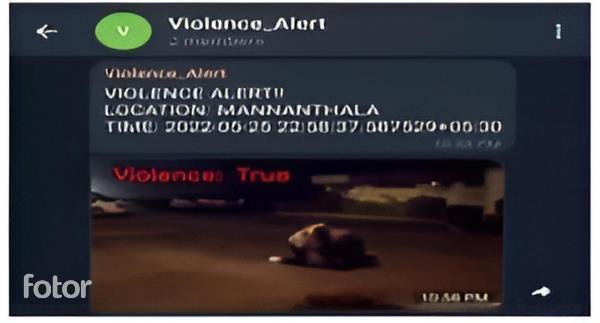
Fig. 14: AlertMessageviaTelegram
International Research Journal of Engineering and Technology (IRJET) e-ISSN: 2395-0056
Volume: 11 Issue: 08 | Aug 2024 www.irjet.net p-ISSN: 2395-0072
Machine learning-based detection of suspect human activity is a major step forward for improving security protocols in a variety of sectors. We may examine enormous volumes of data to find patterns and abnormalities that can point to potentially dangerous or illegal activity by utilizing the capabilities of machine learningalgorithms.
In this regard, machine learning's capacity for adaptationandcontinuousimprovementisoneofitsmain advantages.Bymeansofongoingexposuretolabeleddata, thesealgorithmsareabletoenhancetheircomprehension of typical behavior in contrast to potentially suspicious activities. The creation of more reliable and precise detectingsystemsismadepossiblebythisversatility.
However, the caliber and variety of the training data greatly influences how successful these machine learning models are. Potentially producing false positives ornegatives,biasesorshortagesinthetrainingdatamight result in distorted or incomplete representations of suspicious behavior. Consequently, in order to guarantee thegeneralizabilityandreliabilityofthemodel,itiscrucial tocollectdatasetsthatcoverabroadvarietyofeventsand demographics.Furthermore,therearemajormoral issues raised by the use of machine learning for suspicious behavior identification, especially with regards to privacy andindividualrights.Itisimportanttopaycloseattention to matters like data anonymization, authorization, and transparency in algorithmic decision-making in order to achieve a balance between the necessity for security and respectforindividualliberties.
[l] Abnormal Behavior Detection in Video Surveillance Using Inception-v3 Transfer Learning Approaches. Sabah AbdulazeezJeburl , Khalid A. Hussein2 , HaiderKadhimHoomod3JUNE2023.
[2] .Human Suspicious Activity Detection using Deep Learning RachanaGugale, AbhiruchiShendkar, ArishaChamadia,SwatiPatra,DeepaliAhir.June2020.
[3 ]Pedestrian Detection and Tracking using HOG and KalmanFilter"byS.S.PatilandS.S.Pawar(2016).
[4 ]Z. Kain, A. Y. Ouness, I. E. Sayad, S. Abdul-Nabi and H. Kassem, "Detecting Abnormal Events in University Areas," 2018 International Conference on Computer and Applications (ICCA), Beirut, Lebanon , 2018, pp. 260-264,doi:10.1109/COMAPP.2018.8460336.
[5]A. B. A., P. P. and V. S., "Detection of Suspicious Human Activity based on CNN-DBNN Algorithm for Video Surveillance Applications ," 2019 Innovations in
Power and Advanced Computing Technologies(iPACT), Vellore, India, 2019, pp. 1-7, doi: 10.1109/iPACT44901.2019.8960085.
[6]Anomaly Detection in Video Surveillance using SlowFast Resnet-50 Mahasweta Joshi l Computer Engineering Department CSPIT, CHARUSAT University, Changa, India Jitendra Chaudhari2 Electronics and Communication Department CSPIT, CHARUSATUniversity,Changa,India.
[7]Pedestrian Detection Using Deep Learning: A ComprehensiveSurvey"byV.SinghandR.S.Khatkar.
[8] Pedestrian Movement Detection using Video Surveillance: A Comprehensive Review" byE. K. Abagun,etal.(2019).