
International Research Journal of Engineering and Technology (IRJET) e-ISSN: 2395-0056
Volume: 11 Issue: 08 | Aug 2024 www.irjet.net p-ISSN: 2395-0072

International Research Journal of Engineering and Technology (IRJET) e-ISSN: 2395-0056
Volume: 11 Issue: 08 | Aug 2024 www.irjet.net p-ISSN: 2395-0072
Yash Jigneshkumar Panchal1
1B.E – Civil Engineering from K.K Wagh Institute of Engineering Education and Research College in Nashik, Maharashtra
Abstract - Building Information Modelling (BIM) has the potential to completely transform the planning, building, and infrastructure management process. Building information modelling (BIM) is a digital depiction of a facility's functional and physical attributes. It is a common knowledge base that provides a dependable foundation for decision-making at every stage of a facility's lifespan.
The architectural, engineering, and construction (AEC) sector has seen a significant shift in project planning, execution, and maintenance due to the advent of BIM. The AEC sector historically depended on 2D drawings and siloed data, which caused inefficiencies and misunderstandings among stakeholders. But with BIM, everyone working on a project can communicate with each other using a single, cohesivesystemof3Dmodelsandrelateddata.
Key Words: Building Information Modeling(BIM), Collaboration,Construction,Clash-Detection
1. INTRODUCTION
Historically, the architectural, engineering, and construction (AEC) sector has encountered a number of difficulties that have raised expenses, reduced project efficiency, and affected the general calibre of building projects.Amongthesedifficultiesare:
[1]DisjointedMechanisms
The AEC sector is distinguished by disjointed procedures involving several parties, including as clients, contractors, architects, engineers, and subcontractors. Since each personworksalonemostofthetime,communicationgaps andmisalignedprojectgoalsresult.Thisdisarraymaylead to project delays, overspending, and uneven results.
[2]IneffectiveInteraction
Conventional project delivery approaches frequently use 2D papers and drawings, which can cause misunderstandings and poor stakeholder communication. Inaccuracies and rework during construction may arise fromthelossorneglectofvitalprojectdataintheabsence ofacentralisedplatformforinformationsharing.
[3]MistakesinDesignandConstruction
In the AEC sector, design mistakes and construction disputes are frequent problems. Complex spatial relationships can be difficult to visualise when 2D drawings are used, which raises the possibility of design conflicts and constructability problems, which are frequently found late in the project lifecycle.
[4]OverspendingandPostponements
In the AEC sector, cost overruns and project delays are majorproblems.Theseproblemsarefrequentlycausedby imprecise cost projections, unanticipated design modifications, and ineffective project management. Anticipatingandmitigatingpossiblehazardsischallenging intheabsenceofintegrateddataandpredictiveanalytics.
[5]LifecycleManagementThatIsLimited
The design and construction phases are given precedence over the facility's long-term operation and maintenance under conventional project delivery. Because of this, facilitymanagerscouldnothavetheknowledgenecessary to control building systems efficiently, which would raise operatingexpensesanddegradebuildingperformance.
The process of creating and managing digital representations for a building or infrastructure across its lifespan is called building information modelling, or BIM. Digital representationsofa place's functional and physical attributes are created and managed as part of BIM. It is extensively utilised in the fields of architecture, engineering, and construction (AEC) to enhance decisionmaking,efficiency,andteamwork.
1. CollaborationandIntegration:
o BIM facilitates communication between many stakeholders, including owners, contractors, engineers, and architects. They might work together on a shared digital model to reduce errorsandmisunderstandings.
International Research Journal of Engineering and Technology (IRJET) e-ISSN: 2395-0056
Volume: 11 Issue: 08 | Aug 2024 www.irjet.net p-ISSN: 2395-0072
2. Datamanagementandcentralisation:
o All project-related data is kept up to date and accessible to all stakeholders by being centrally housedinadigitalmodel.Thiscentralisationhelps topreservethedata'sconsistencyandcorrectness.
3. Visualisation:
o BIM makes it possible to create 3D models that provide an architectural or infrastructure representation. Better comprehension and communication of the design purpose are facilitatedbythisvisualisation.
4. ClashDetection:
o BIM technologieshavetheabilitytoautomatically identify conflicts or clashes in the design, such as overlappingsystemsorstructuralparts.Thisearly detectionallowsfortheresolutionofissuesbefore constructionbegins.
5. LifecycleManagement:
o Building Information Modelling (BIM) encompasses all phases of a building's existence, from designand construction to maintenance and use. This all-inclusive strategy lowers operating expenses and promotes effective facility management.
6. SimulationandAnalysis:
o BIM allows for the simulation and analysis of a variety of architectural aspects, including lighting, structural integrity, and energy performance. These evaluations support both design optimisation and regulatory compliance.
7. CostEstimationandScheduling:
o Accurate estimates of construction costs and timeframesareprovidedbytheintegrationofcost estimation and project scheduling using BIM. Project planning and budget management are aidedbythisintegration.
8. Sustainability:
o By facilitating the study of energy use, material usage, and environmental effect, BIM supports sustainable design methods. The creation of ecofriendly structures is aided by this emphasis on sustainability.
All things considered, BIM is a revolutionary strategythatimprovesproductivity,accuracy,and teamworkintheAECsector,resultinginimproved projectresultsandlowercosts.
2. BIM from its inception to its current state
Building InformationModelling (BIM) has been developed gradually over several decades, changing as industry practices and technological breakthroughs have. The following provides a timeline of the significant turning pointsintheevolutionofBIM:
•1960s–1970s:InitialThoughts
• 1960s: The introduction of early computer-aided design (CAD) systems marked the beginning of the idea of employingcomputersforarchitecturaldesign.Ratherof3D modelling, the primary focus of these systems was 2D draughting.
• 1970s: To construct computerised representations of buildings, the concept of a "building description system" was established. But since the technology was still in its infancy,2Ddrawingscontinuedtobethemajorfocus.
•The1980ssawtheriseof3Dmodelling
•1980s:Amajoradvancementwasmadewiththecreation of 3D modelling software. The earliest iterations of BIM principles were the result of research and development into methods for producing 3D representations of buildings. Programs like RUCAPS (Really Universal Computer-Aided Production System) and ArchiCAD were createdduringthisperiod.
•1990s:BIMConceptsWereFormalised
• The term "Building Information Modelling" gained popularity in the 1990s. The emphasis moved from basic 3D modelling to the creation of comprehensive digital representations that contain precise information about building components in addition to geometry. These concepts started to be integrated by programs like Autodesk's Revit, which offered a framework for more comprehensivearchitecturaldesignanddocumentation.
•AdoptionandStandardisationinthe2000s
• The 2000s saw a greater uptake of BIM in the AEC (architecture, engineering, and construction) sector. Governments and other institutions began to see how effectiveitmightbeincuttingcostsandincreasingproject efficiency. The National Building Information Modelling Standard(NBIMS)intheUnitedStatesisoneexampleofa standardandguidelineforusingBIM.
• 2002saw the publicationof the "BIM Handbook" by Chuck Eastman and associates, which helped to
International Research Journal of Engineering and Technology (IRJET) e-ISSN: 2395-0056
Volume: 11 Issue: 08 | Aug 2024 www.irjet.net p-ISSN: 2395-0072
formalise BIM methodsandconceptsand providedan extensive industry reference.2010s: Industry IntegrationandGlobalAdoption.
• 2010s: Governments in several nations started requiringtheuseofBIMforpublicprojects,makingita standard procedure. The possibilities of BIM were improved by its connection with other technologies, suchasGeographicInformationSystems(GIS).
• 2011: Toaccelerate the use and advancement ofBIM practicesandtechnology,theUKgovernmentmandated that Level 2 BIM be incorporated into all public sector constructionprojectsby2016.
• 2013 saw the introduction of Industry Foundation Classes (IFC) by buildingSMART International, which gaveBIMusersaccesstoastandardiseddatamodeland improvedsoftwareplatformcompatibility.
• 2020s: Cutting-Edge Technology and Upcoming Opportunities
• 2020s: With the incorporation of cutting-edge technologies like artificial intelligence (AI), virtual reality(VR),andtheInternetofThings(IoT),BIMisstill evolving. The simulation, analysis, and facility managementcapabilitiesofBIMarebeingimprovedby thesetechnologies.
• Digital Twins: As an extension of BIM, the idea of digitaltwins,whichentailsproducingareal-timedigital duplicateofaphysicalbuilding,hascometolight.Using this method allows for continuous optimisation and dataanalysisoverthecourseofabuilding'sexistence.
• Sustainability and Smart Cities: Integrated digital platforms are used in the design and management of buildings in smart cities, and building information modelling (BIM) is a key tool in advancing these developments.CurrentStateandFutureTrends
These days, BIM is widely acknowledged as a gamechanging strategy in the AEC sector, providing advantages including increased project results, less mistakes, and greater cooperation. BIM is still being developed, but its main goals are to become more integrated with new technologies, have more applications across the whole building lifecycle, and support international standards for interoperability.
BIMisanticipatedtosignificantlytransformtheAECsector as technology develops, allowing more effective, sustainable,andintelligentconstructionpractices.
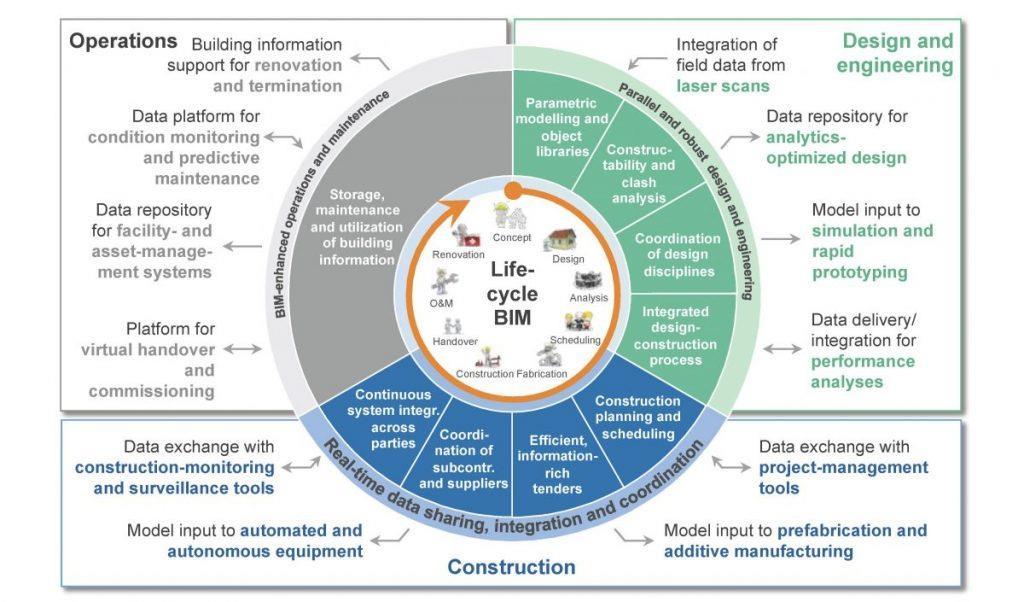
Building Information Modelling (BIM) is an allencompassing methodology that comprises several essential elements, each of which is vital to its overall efficacy. Together, these elements software tools, data management, and collaborative processes enable effective building and infrastructure design, construction, andmanagement.
1.ComputerTools
Digital building models can only be created, analysed, and managed with the help of BIM software tools. Numerous functions that assist different phases of the building lifecycleareofferedbythesetechnologies.
o DesignandModellingin3D:
One of the most widely used BIM programs is Autodesk Revit, which is utilised for structural engineering, architectural design, and MEP (mechanical, electrical, and plumbing)systems.
o ArchiCAD: An application that offers a userfriendly interface for architectural documentation anddesign.
o Tekla Structures is well-known for its adept structuralengineeringanddetailingskills.
2.ExaminingandModelling:
o Navisworks: Teams can employ clash detection and coordination to identify and resolve conflicts beforebuildingbegins.
o EcoDesigner: An instrument for sustainability evaluationandenergyanalysis.
o Dynamo: a visual programming tool that streamlines processes and develops original workflowstoadvanceBIMexpertise.
International Research Journal of Engineering and Technology (IRJET) e-ISSN: 2395-0056
Volume: 11 Issue: 08 | Aug 2024 www.irjet.net p-ISSN: 2395-0072
3.Visualisation:
o Lumion and Enscape:Toolsthat provide excellent rendering and visualisation, enabling users to engage with designs in immersive, threedimensionalenvironments.
2. Data Management
AcrucialcomponentofBIMisdatamanagement,which makes sure that information is correct, current, and availableatalltimesoverthecourseofaproject.
•Centralisedrepositoriesofdata:
o All project data, including geometry, materials, timelines,andbudgets,arehousedinBIMmodels, which act as a single source of truth. This centralisation reduces the likelihood of inconsistentdataandmisinterpretations.
•Cooperation:
o Industry Foundation Classes (IFC): An open standard that guarantees compatibility across various software tools and platforms for the interchangeofBIMdata.
o BuildingSMART: A group that creates open standards for BIM data to encourage industry cooperationanddatasharing.
• History tracking and version control:
o VersioncontrolcapabilitiesinBIMsystemsenable teams to keep track of changes and preserve a history ofadjustments. Teams are able to go back toearlieriterationsifnecessary,andresponsibility isguaranteed.
3. Collaboration Processes
The foundation of BIM iscollaboration, which makes it possible for all stakeholders to cooperate successfully andefficiently.
•IntegratedProjectDelivery(IPD):
o A methodology that prioritises early communication and cooperation amongst all parties involved in a project, such as owners, contractors, architects, and engineers. IPD promotescollaboration,whichlowersconflictand improvesprojectresults.
•CommonDataEnvironment(CDE):
o A common digital platform for managing and storingallprojectdata.CDEs,likeTrimbleConnect and Autodesk BIM 360, help team members communicate, share documents, and work togetherinrealtime.
•CoordinationandClashDetection:
BIM solutions allow for automatic coordination and clash detection, which finds conflicts between various building systems and components. By resolving problems before
construction starts, this technique helps teams avoid expensivedelaysandrework.
•WorkflowAutomation:
Teamsmayconcentrateondesignanddecision-makingby using automation solutions to improve productivity and simplify repetitive operations. Workflows may be altered to meet the unique requirements of a project, increasing productivityandloweringmistakes.
4. Applications of BIM in the AEC Industry
With its many uses that enhance productivity, teamwork, and decision-making across the project lifecycle, building information modelling, or BIM, has emerged as a crucial tool in the architectural, engineering, and construction (AEC) sector. The following are some significant uses of BIMintheAECsector:
1.VisualisationandDesign
• 3D Modelling: Using Building Information Modelling (BIM), architects and designers can produce detailed 3D modelsthatprovideacomprehensivevisualdepictionofa building. This makes it easier to explore various design optionsandmakewell-informeddecisions.
• Visualisation and Rendering: Realistic project visualisation and rendering are made possible by BIM technologies, giving stakeholders the opportunity to experience the design in a virtual setting. This helps explainthedesignobjectiveandwinoverthecustomer.
• Conceptual Design: BIM facilitates fast prototyping and iterationbyenablingarchitectstoswiftlydevelopandalter designconcepts.
2. Coordination and Collaboration
• Interdisciplinary Coordination: By offering a common digital model that incorporates all design aspects, BIM makes it easier for other disciplines to collaborate, including structural engineering, architecture, and MEP (mechanical,electrical,andplumbing)systems.
• Clash Detection: BIM solutions lower the possibility of expensivereworkandconstructiondelaysbyautomatically detectingandresolvingconflictsbetweenbuildingsystems andcomponents.
• Common Data Environment (CDE): BIM facilitates the sharing of information in real time amongst project stakeholders through a centralised data repository, which enhancescoordinationandcommunication.
• Automated Quantity Takeoff: BIM enables estimators to swiftlyandaccuratelydetermine material quantities and costs while minimising human labour and errorproneness.
• Cost calculation: BIM allows for the dynamic and comprehensivecalculationofcostsoverthecourseofa projectbyintegratingcostdataintothemodel.
International Research Journal of Engineering and Technology (IRJET) e-ISSN: 2395-0056
Volume: 11 Issue: 08 | Aug 2024 www.irjet.net p-ISSN: 2395-0072
4. Construction Planning and Management
•4DBIM(Time):Schedulingdata isincludedintoBIM, enabling the construction process to be visualised across time. This facilitates the planning and optimisation of construction-related tasks, cutting downondelaysandraisingproductivity.
• building Simulation: Before work starts, possible problems may be found and workflows can be optimised thanks to BIM's ability to simulate building processes.
•PlanningforSiteLogisticsandSafety:BIMhelpswith the planning of site logistics and safety precautions, improvingsitemanagementandloweringrisks.
5. Facility Management and Operations
• 5D BIM (Cost): By offering a thorough digital model that contains details on building components, maintenance schedules, and operational data, BIM is extendedintofacilitymanagement.
• Asset Management: BIM enables improved maintenance scheduling, facility operation efficiency, andbuildingassetmonitoringandmanagement.
• Lifecycle Management: By supporting a building's whole lifecycle, from design and construction to operation and maintenance, BIM facilitates efficient facilitymanagementandreducesoperatingcosts.
6. Sustainability and Energy Analysis
•EnergyPerformanceAnalysis:BIMtechnologiesmake energy analysis easier, enabling architects to assess a building's energy efficiency and maximise its sustainabledesign.
• Sustainable Design: By making it possible to analyse theeffectsontheenvironment,materialselections,and buildingperformance,BIM facilitatestheincorporation ofsustainabledesignprinciples.
• Green Building Certification: By offering precise data and paperwork needed for compliance, BIM helps achievegreenbuildingcertifications,includingLEED.
7. Renovation and Retrofit
• Existing Condition Modelling: BIM makes precise models of existing buildings, which makes refit and rehabilitationprojectseasier.
•DesignIterationandFeasibilityStudies:ByusingBIM, engineers and architects may evaluate various design possibilitiesanddetermineifrehabilitationprojectsare feasible, which enhances decision-making and project results.
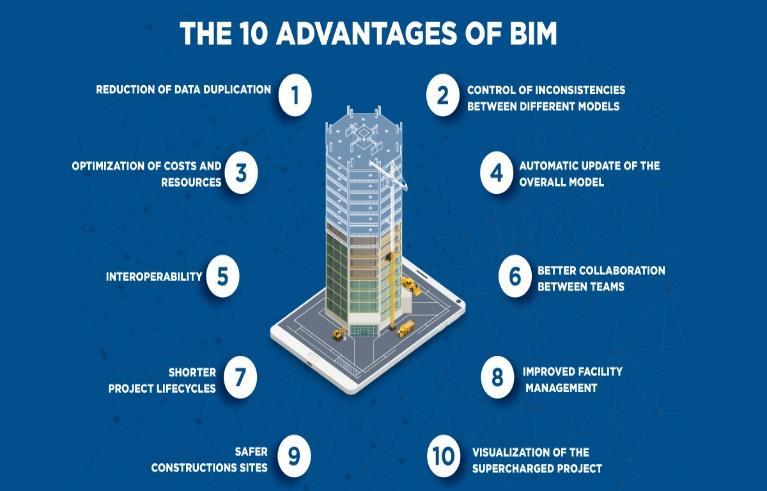
5. Challenges and Limitations of BIM
Although there are many benefits to using Building Information Modelling (BIM) in the architectural, engineering, and construction (AEC) sector, there are also certain drawbacks and difficulties. These difficulties may have an impact on how well BIM is adopted and used across projects. Some of the primary barriers and limitationsincludethefollowing:
1.Exorbitantstartingexpenses
• Software and technology Investment: In order to implementBIM,asubstantialsumofmoneymustbespent on software licensing and technology that can process complicated models. This might be a challenge for smaller companieswithmorelimitedfunding.
• Training and Skill Development: Developing new skills and training staff members throughout the BIM transition canbecostlyandtime-consuming.
2. Interoperability Issues
• Data Standards: The absence of widely recognised data standardscanimpedesmoothintegrationanddatasharing across platforms. Although standards like Industry Foundation Classes (IFC) exist, not all software fully supportsthem.
• Software Compatibility: Issues with compatibility betweenBIMsoftwaresystemscanmakeitchallengingfor stakeholders to collaborate using a variety of tools and exchangedata.
3. Change Management and Resistance
• Cultural Resistance: Organisations must change their ways of thinking in order to implement BIM. Adoption processes might be slowed down by resistance to
International Research Journal of Engineering and Technology (IRJET) e-ISSN: 2395-0056
Volume: 11 Issue: 08 | Aug 2024 www.irjet.net p-ISSN: 2395-0072
switching from conventional techniques to digital workflows.
• Organisational Restructuring: Using BIM may require adjusting organisational structures and procedures, which canbedifficulttoplanforandcarryoutsuccessfully.
• Model Complexity: BIM models may grow to be quite intricateanddata-intensive,whichmakesthemchallenging to handle and traverse. Performance problems may arise fromthiscomplexity,especiallyinthecaseofbigprojects.
• Data Management Challenges: It's critical to guarantee data confidentiality, correctness, and consistency across the BIM model. Inadequate data management can lead to miscommunicationsanderrors.
Legal and Contractual Issues
•Intellectual PropertyIssues:SharingcomprehensiveBIM models gives rise to questions regarding data ownership and intellectual property rights, which may result in legal issues.
•ContractualFrameworks:NewcontractsthathandleBIMspecific concerns like data sharing, accountability, and liability must be developed because existing contractual frameworksmightnotbeappropriateforBIMprojects.
6. Limited Expertise and Adoption
• Skilled Professionals: The absence of professionals with thenecessaryBIMexpertisemightmakeitmoredifficultto installandusethetechnologyeffectively.
• Diverse Adoption Rates: Although BIM is getting increasingly popular, different areas and industries have differentratesofadoption.BIMadoptionmaybeslowerin certainregionsorsectorsoftheeconomy.
7. Implementation and Maintenance Challenges
• Initial Setup and Transition: Putting BIM into practice may be a complicatedand resource-intensive process that hastobecarefullyplannedandcarriedout.
• Updating and Maintenance: Throughout the course of a project,itcanbedifficulttokeepBIMmodelscurrentwith the most recent data and changes, especially during the operationsandmaintenancestage.
8. Limitations in Certain Project Types
• Suitability for Small Projects: Big, complicated projects reapthegreatestbenefitsfromBIM.Theeffortand money spentonBIMmaynotbeworthitforsmallerprojects.
• Adaptability to Existing Buildings: Because it can be difficult to adequately model existing buildings, implementingBIMinrenovationorretrofitprojectscanbe tricky.
Improving the architecture, engineering, and construction (AEC) sector's adoption and application of building information modelling (BIM) necessitates a strategic strategy that takes intoaccountthemanyobstaclesandmakesuseof BIM's potential advantages. The following recommendations are for those involved in the industry:
• Extensive Training Programs: Provide and execute thorough training courses covering processes, best practices, and BIM software tools. Make that every employee,fromentry-leveltoseniormanagement,has theabilitiesneededtouseBIMefficiently.
• continual Learning: To stay up to date with the quicklychangingBIMtechnology,promoteacultureof continual learning. Give staff members the chance to participate in training sessions, conferences, and certificationcourses.
• Educational Partnerships: Work together with educationalestablishmentstoincludeBIMintocourse offerings, guaranteeing that recently graduated students entering the profession are well-versed in BIMconceptsandresources.
2.FosterCollaborationandCommunication
• Integrated Project Delivery (IPD): Encourage the application of IPD techniques, which prioritise early stakeholderinteractionandcooperation.Thisstrategy promotesteamworkandincreasestheuptakeofBIM.
• Common Data Environment (CDE): Put in place a centralisedplatformforinformationexchangerelated toprojectsso thatall partiesinvolved mayaccessthe mostrecentinformationandworktogethereasily.
• Frequent Gatherings of Stakeholders: Organise frequent get-togethers and workshops to promote candid dialogue and teamwork while addressing any issuesordifficultieswithBIMadoption.
3.EstablishClearStandardsandGuidelines
• Adopt Industry Standards: To guarantee uniformity and interoperability across projects, make use of industrystandardslikebuildingSMARTguidelinesand IndustryFoundationClasses(IFC).
International Research Journal of Engineering and Technology (IRJET) e-ISSN: 2395-0056
Volume: 11 Issue: 08 | Aug 2024 www.irjet.net p-ISSN: 2395-0072
• Establish Internal BIM Standards: Based on the requirementsofyourcompany,establishinternalBIM standardsand proceduresthataddresstopics suchas quality control, data management, and modelling techniques.
• BIM Execution Plans: To guarantee communication and agreement among all team members, create thorough BIM execution plans for every project that includeroles,duties,procedures,anddeliverables.
4.AddressLegalandContractualIssues
•CreateBIM-SpecificContracts:Collaboratewithlegal experts to create contracts that cover BIM-specific concerns including liability, data exchange, and intellectual property rights.
•ClearlyDefinedOwnershipandResponsibility:Make sure that everyone is aware of their responsibilities and tasks by clearly defining who owns what BIM data.
5.DemonstrateValueandROI
• Highlight Successful Projects: Highlight BIM efforts and case studies that effectively demonstrate the advantagesandreturnoninvestment(ROI)associated withBIMadoption.Makeuseoftheseexamplestowin overpertinentparties.
• Quantify Benefits: To support the investment and promotebroaderadoption,quantifytheadvantagesof BIM, such as cost savings, increased efficiency, and lessmistakes.
6.SupportInfrastructureandTechnology
•MakeanInvestmentinTechnology:Ensurethatyour business has the newest BIM software, robust PCs, and the hardware and software infrastructure requiredtosupportBIM.
• Cloud-Based Solutions: Take into account cloudbased BIM solutions to improve flexibility and scalability by facilitating collaboration, data sharing, andmodelaccessfromanylocation.
7.EncourageGovernmentandRegulatorySupport
• Government Mandates: Promote laws requiring the use of BIM in public sector projects in order to encourage industry-wide standardisation and acceptance.
• Incentives and Support: Press governments to provide small and medium-sized enterprises (SMEs)
that use BIM with financial aid, incentives, and other typesofsupport.
8.PromoteResearchandDevelopment
• Creative Solutions: Invest in R&D to investigate cutting-edgetechnologiesandcreativesolutions,such digital twins, artificial intelligence, and machine learning,thatexpandthepotentialofBIM.
• Collaboration with Academic Institutions: To foster innovation and create state-of-the-art BIM technologies and techniques, collaborate with academicinstitutionsandresearchorganisations.
Conclusion
Industry players may overcome adoption barriers and realise the full potential of BIM by putting these tips into practice. The AEC sector will change as a result of a strategic approach that prioritises innovation, standardisation, training, and cooperation in order to provide project outputs that are more sustainable, costeffective,andefficient.
[1] https://www.incide.it/en/the-10-advantages-of-bim/
[2] https://catenda.com/glossary/bim-buildinginformation-modeling/
[3] Building Information Modeling: Global & Indian PerspectivebyDr.Adv.HarshulSavla
[4] https://www.autodesk.com/solutions/aec/bim