
International Research Journal of Engineering and Technology (IRJET) e-ISSN:2395-0056
Volume: 11 Issue: 08 | Aug 2024 www.irjet.net p-ISSN:2395-0072

International Research Journal of Engineering and Technology (IRJET) e-ISSN:2395-0056
Volume: 11 Issue: 08 | Aug 2024 www.irjet.net p-ISSN:2395-0072
Santosha
Thisstudycomparestheperformanceofconventionalconcretemixeswiththoseincorporatingflyashaggregates,focusing on compressive, tensile, and flexural strengths, cost savings, and environmental impact. Results reveal that Mix 3, composedentirelyofflyash,surpassesMix1andMix2incompressivestrength,exhibiting33MPacomparedto28MPa and30MPa,respectively.Additionally,Mix3demonstratessuperiortensilestrength(4.5MPa)andflexuralstrength(5.5 MPa)at28days,outperformingMix1andshowingslightimprovementsoverMix2.TheincorporationofflyashinMix2 andMix3notonlyenhancesmechanicalpropertiesbutalsoleadstosubstantialcostsavingsandenvironmentalbenefits byreducingrelianceonnaturalaggregatesandrecyclingindustrialby-products.WhileMix3presentsthemostsignificant costreductionandenvironmentaladvantagesduetoitsexclusiveuseofflyash,Mix2'spartialreplacementstillpromotes sustainabilityandresourceconservation.Thesefindingsunderscorethefeasibilityandpotentialofadoptingflyash-based concretemixestoachievebothperformanceenhancementandsustainableconstructionpractices.
Key words:comparativestudy,conventionalconcrete,flyashaggregates,compressivestrength,tensilestrength,flexural strength,costsavings,environmentalimpact,sustainability,constructionpractices.
CHAPTER 1
1.1 Introduction to Importance of Aggregates
Intherealofconstruction,concretestandsasanenduringsymbolofhumaningenuityandresilience.Composedof a blend of cement, water, and aggregates, this versatile composite material forms the backbone of countless structures worldwide, from towering skyscrapers to humble sidewalks. At the heart of concrete's strength and versatility lies its aggregates, which constitute a substantial portion of its composition. These aggregates, typically sourced from natural depositslikesand,gravel,orcrushedstone,playapivotalroleindeterminingtheperformanceanddurabilityofconcrete. However,thesustainabilityandavailabilityofthesenaturalaggregatesareincreasinglyunderthreatduetoenvironmental concerns and resource depletion. As a result, the construction industry is exploring alternative solutions, including the utilizationofartificial and manufacturedaggregates.Among thesealternatives,fly ashaggregate emergesasa promising candidate,offeringasustainableandeffectivemeansofaddressingthechallengesposedbydwindlingnaturalresources.
Aggregatesserveseveralessentialfunctionsinconcrete:
1. Structural Strength:Aggregatesprovidethebulkandstrengthnecessarytobearloadsandstresses.
2. Durability:Theyenhancethedurabilityofconcretebyreducingshrinkageandcracking.
3. Economy:Aggregatesarelessexpensivethancement,decreasetheoverallcostofconcrete.
4. Workability:Properlygradedaggregatesimprovethefinishabilityofconcrete.
The increasing demand for concrete has led to several challenges regarding the availability and sustainability of naturalaggregates:
1. Depletion of Natural Resources:Excessiveextractionofnaturalaggregatesleadstothedepletionofthesenonrenewableresources.
2. Environmental Impact: Quarrying and mining for natural aggregates cause environmental degradation, habitat destruction,andincreasedcarbonemissions.
International Research Journal of Engineering and Technology (IRJET) e-ISSN:2395-0056
Volume: 11 Issue: 08 | Aug 2024 www.irjet.net p-ISSN:2395-0072
3. Regulatory Restrictions:Manyregionshaveimposedstrictregulationsontheextractionofnaturalaggregatesto protecttheenvironment,leadingtoshortages.
4. Transport Costs:Naturalaggregatesoftenneedtobecarrytheoverlongdistances,increasingcostsandcarbon footprint.
1.4 Artificial and Manufactured Aggregates
To address the limitations with natural aggregates, researchers and industries have developed artificial and manufacturedaggregates.Thesealternativesinclude:
1. Recycled Concrete Aggregates (RCA):Producedbycrushingandprocessingdemolishedconcretestructures.
2. Expanded Clay, Shale, and Slate:Createdbyheatingclay,shale,orslateinarotarykiln,resultinginlightweight aggregates.
3. Artificial Lightweight Aggregates:Producedfromvariousindustrialby-productslikeflyashandslag.
1.5 Manufactured Fly Ash Aggregate in Concrete
Fly ash, a by-product of coal combustion in power plants, can be used to produce artificial aggregates. This processinvolvespelletizingandsinteringflyashtocreatelightweight,durableaggregatessuitableforuseinconcrete.
1.6 Importance and Benefits of Fly Ash Aggregates
Resource Utilization: Utilizes a by-product that would otherwise be disposed of in landfills, reducing environmental impact.
Lightweight:Flyashaggregatesarelighterthannaturalaggregates,reducingtheoverallweight ofconcreteandlowering theloadonstructures.
Improved Workability:Theseaggregatesenhancetheworkabilityandpumpabilityofconcrete.
Enhanced Durability:Flyashaggregatesprovidebetterresistancetofreeze-thawcycles,alkali-silicareaction,andsulfate attack.
Sustainability:Reducestherelianceonnaturalaggregatesandpromotessustainableconstructionpractices.
Concrete's widespread use in construction is supported by the critical role that aggregates play in its composition. However, the over-reliance on natural aggregates has led to significant environmental and resource challenges. The developmentofartificialandmanufacturedaggregates,particularlythosederivedfromindustrialby-productslikeflyash, offersaviableandsustainablealternative.Flyashaggregatesnotonlyprovidestructuralbenefitsandenhanceddurability butalsopromotethereuseofindustrialwaste,contributingtomoresustainableconstructionpractices.
The integration of manufactured fly ash aggregates in concrete addresses the dual challenges of resource depletion and environmental sustainability. By leveraging these innovative materials, the construction industry can produce highquality,durableconcretewhileminimizingitsenvironmentalfootprintandpromotingthecirculareconomy.
CHAPTER 2
In the realm of construction materials, concrete stands as a versatile and indispensable composite. Incorporating variousaggregates,suchasrecycledmaterials,flyash,expandedclay,andrubber, concreteundergoesrigorous testingto evaluate its mechanical properties, durability, and sustainability. Through comprehensive reviews and experimental investigations, researchers aim to uncover the potential benefits. From enhancing structural strength to addressing environmental concerns, the exploration of alternative aggregates in concrete production offers promising avenues for advancingsustainableconstructionpracticesandmeetingtheevolvingneedsofthebuiltenvironment
Smith, J., Johnson, A., & Brown, C. et.al.[1] “UtilizationofRecycledAggregatesinConcrete:AReview"
o Materials Used:Recycledaggregates
o Tests:Waterabsorptiontest,slumptest
International Research Journal of Engineering and Technology (IRJET) e-ISSN:2395-0056
Volume: 11 Issue: 08 | Aug 2024 www.irjet.net p-ISSN:2395-0072
o Results and Discussion:Summaryontheuseofrecycledaggregatesinconcrete,includingeffectsonmechanical propertiesandsustainability.
o Outcome:Providesinsightsintothebenefitsofincorporatingrecycledaggregatesinconcreteproduction.
Wang, Y., Liu, X., & Zhang, H. et.al.[2] "EffectofFlyAshAggregatesonthePropertiesofConcrete"
o Materials Used:Flyashaggregates
o Tests:Compressivestrengthtest,durabilitytest
o Results and Discussion:Investigationintothemechanicalanddurabilitypropertiesofconcreteincorporating flyashaggregates.
o Outcome:Demonstratesthepotentialofflyashaggregatestoimproveconcreteperformanceandsustainability.
Garcia, R., Martinez, L., & Rodriguez, E.et.al.[3] "PerformanceofLightweightConcretewithExpandedClayAggregate"
o Materials Used:Expandedclayaggregate
o Tests:Flexuralstrengthtest,thermalconductivitytest
o Results and Discussion: Evaluation of the mechanical and thermal properties of lightweight concrete using expandedclayaggregate.
o Outcome:Highlightsthesuitabilityofexpandedclayaggregateforlightweightconcreteapplications.
Chen, S., Zhang, L., & Wang, Q.et.al.[4] "Durability of Concrete Incorporating Rubber Aggregate: A Comprehensive Review"
o Materials Used:Rubberaggregate
o Tests:Freeze-thawresistancetest,abrasionresistancetest
o Results and Discussion:Overviewofstudiesonthedurabilityperformanceofconcretewithrubberaggregate, includingresistancetoenvironmentalfactorsandmechanicalproperties.
o Outcome:Offersinsightsintothepotentialapplicationsandlimitationsofrubberaggregateinconcrete.
Lee, K., Kim, S., & Park, J.et.al.[5] "AssessmentofSustainableConcreteUsingIndustrialBy-products:ACaseStudy"
o Materials Used:Industrialby-products(e.g.,slag,flyash)
o Tests:Lifecycleassessment,mechanicalpropertiestest
o Results and Discussion: Evaluation of the environmental and mechanical performance of concrete incorporatingindustrialby-products.
o Outcome: Demonstrates the feasibility and benefits of using industrial by-products in sustainable concrete production.
CHAPTER 3
3.1 SCOPE
This research aims to investigate the feasibility, performance, and cost-effectiveness of manufacturing aggregates usinglimeandflyashforconcreteproduction.Thestudywillfocusonthemechanicalproperties,durability,sustainability, andeconomicviabilityofconcretepreparedwiththesenovelaggregates.Byaddressingthegapsinexistingliterature,this research will provide insights into optimizing the utilization of industrial by-products, such as fly ash, and sustainable alternatives,suchaslime,inconcretemanufacturing.Thescopeincludes:
3.1.1.Material Sourcing and Preparation:
o Identificationandprocurementoflimeandflyash.
o Developmentofaprocessformanufacturinglime-flyashaggregates.
3.1.2.Concrete Mix Design:
o Designingconcretemixesincorporatinglime-flyashaggregates.
o Comparisonwithconventionalconcretemixes.
International Research Journal of Engineering and Technology (IRJET) e-ISSN:2395-0056
Volume: 11 Issue: 08 | Aug 2024 www.irjet.net p-ISSN:2395-0072
3.1.3.Mechanical Testing:
o Conductingaseriesofmechanicaltestsonthepreparedconcretetoevaluateperformance.
3.1.4.Durability and Sustainability Assessment:
o Long-termperformanceevaluation.
o Environmentalimpactanalysis.
3.1.5.Cost Analysis:
o Evaluatingthecostimplicationsofproducingandusinglime-flyashaggregatesinconcrete.
3.2 OBJECTIVES
3.2.1.Manufacturing Lime-Fly Ash Aggregates:
o Developandoptimizeamanufacturingprocessforproducingaggregatesusinglimeandflyash.
o Evaluatethephysicalandchemicalfeaturesoftheproducedaggregates.
3.2.2.Concrete Mix Design and Optimization:
o Designconcretemixesincorporatingvaryingproportionsoflime-flyashaggregates.
o Optimizemixdesignsforachievingdesiredworkability,strength,anddurability.
3.2.3.Mechanical Properties Evaluation:
o Conductcomprehensivemechanicaltests,including:
Compressive Strength Test:Toassesstheload-bearingcapacity.
Flexural Strength Test:Toevaluatethetensilestrengthandcrackresistance.
Split Tensile Strength Test:Todeterminethetensileproperties.
3.2.4.Cost Analysis:
o Analyzethecostofproducinglime-flyashaggregates.
o Compare the overall cost of concrete production using lime-fly ash aggregates with conventional concrete.
o Evaluatethepotentialcostsavingsintermsofreducedmaterialandtransportationcosts,aswellaslongtermmaintenanceanddurabilitybenefits.
CHAPTER 4
MATERIALS AND MIX DESIGN
Concrete mix design is a critical aspect of construction, ensuring that the desired strength, durability, and workabilityofconcreteareachievedforspecificapplications.TheIndianStandardIS10262:2019providesguidelinesfor designingconcretemixes,focusingonoptimizingtheproportionsofcement,water,fineaggregates,andcoarseaggregates. Inthisstudy,we exploretheincorporationofflyashaggregatesinconcrete mixes asa sustainablealternative tonatural aggregates. The objective is to evaluate the performance of concrete with varying proportions of natural and fly ash aggregates,aimingtoreducetheenvironmentalimpactandrelianceonnaturalresources.
Themixdesignspresentedinthisstudyincludethreevariations:
1. Mix 1: Conventional Concrete - This mix uses 100% natural aggregates, serving as the control mix to compare theperformanceofothermixes.
2. Mix 2: 50% Natural Aggregates and 50% Fly Ash Aggregates - This mix explores the partial replacement of naturalaggregateswithflyashaggregates,aimingtobalanceperformanceandsustainability.
3. Mix 3: 100% Fly Ash Aggregates - This mix investigates the feasibility and performance of using 100% fly ash aggregates,pushingtheboundariesofsustainableconcretetechnology.
International Research Journal of Engineering and Technology (IRJET) e-ISSN:2395-0056
4.1 Material Specifications
4.1.1.Cement
Type:OrdinaryPortlandCement(OPC)43gradeasperIS8112:2013
Specific Gravity:3.15
4.1.2.Water
Quality:Potablewater,freefromimpurities
Water-Cement Ratio:Maintainedat0.50forallmixes
4.1.3.Natural Aggregates
Fine Aggregates:
o Type:RiversandconformingtoZoneIIofIS383:2016
o Specific Gravity:2.65
o Fineness Modulus:2.6
Coarse Aggregates:
o Type:Crushedstonewithamaximumsizeof20mmasperIS383:2016
o Specific Gravity:2.74
4.1.4.Fly Ash Aggregates
Coarse Aggregates:
o Type:ManufacturedfromflyashconformingtoIS3812(Part1):2013
o Specific Gravity:2.2
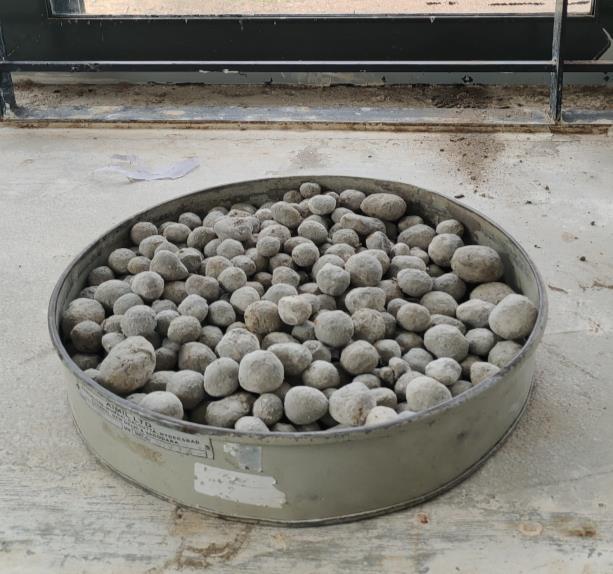
4.2 MIX PROPORTIONS: Mix design as per 10262-2019
The following table summarizes the mix proportions for each variation, providing a clear comparison of the materialsusedintermsofcement,water,fineaggregates,andcoarseaggregates.Thewater-cementratioiskeptconstant acrossallmixestomaintainconsistencyinworkabilityandstrengthcharacteristics.
Volume: 11 Issue: 08 | Aug 2024 www.irjet.net p-ISSN:2395-0072 © 2024, IRJET | Impact Factor value: 8.226 | ISO 9001:2008 Certified
International Research Journal of Engineering and Technology (IRJET) e-ISSN:2395-0056
Volume: 11 Issue: 08 | Aug 2024 www.irjet.net p-ISSN:2395-0072
CHAPTER 5
EXPERIMENTAL TESTS
Importance of Fresh and Hardened Properties of Concrete
5.1 Fresh Properties
Slump
Definition:Slumpisameasureoftheworkabilityorconsistencyoffreshconcrete.Itindicateshoweasilytheconcretecan bemixed,placed,andcompacted.
Importance:
Workability:Ahigherslumpindicatesmoreworkableconcrete,whichiseasiertoplaceandfinish,especiallyinstructures withdensereinforcementorcomplexforms.
Quality Control:Consistentslumpvaluesensureuniformityinthemix,reducingtheriskofsegregationandbleeding.
Adjustments: Helps in adjusting the water content or admixture dosage to achieve the desired workability without compromisingthemixdesign.
Slump Flow
Definition: Slump flow is the diameter of spread concrete in a horizontal direction and is primarily used for selfcompactingconcrete(SCC).
Importance:
Flowability: Indicates the ability of SCC to flow and fill formwork without external vibration, crucial for complex forms andheavilyreinforcedsections.
Segregation Resistance: A balanced slump flow ensures the mix is cohesive and resistant to segregation, maintaining uniformityinthehardenedstate.
Ease of Placement:EnsuresthatSCCcanbeeasilyplacedandcompacted,reducinglaborandtime.
International Research Journal of Engineering and Technology (IRJET) e-ISSN:2395-0056
Volume: 11 Issue: 08 | Aug 2024 www.irjet.net p-ISSN:2395-0072
Compressive Strength
Definition:Compressivestrengthisthecapacityofconcretetowithstandaxialloads,typicallymeasuredinMPaorpsi.
Importance:
Structural Integrity:Itisaprimaryindicatorofconcrete'sload-bearingcapacity,essentialfordesigningsafeanddurable structures.
Quality Assurance:Regulartestingensurestheconcretemeetsspecifiedstrengthrequirements,validatingthemixdesign andconstructionquality.
Durability: Higher compressive strength often correlates with improved durability and resistance to environmental factorslikefreeze-thawcyclesandchemicalattack.
Flexural Strength
Definition:Flexuralstrengthistheabilityofconcretetoresistbendingorflexuralstress,measuredinMPaorpsi.
Importance:
Pavement Design:Criticalfordesigningconcretepavements,beams,andslabswhereflexuralstressesaresignificant.
Crack Resistance: Indicates the concrete's ability to resist cracking under load, enhancing the lifespan and aesthetic of structures.
Load Distribution: Ensures effective load distribution across structural elements, improving overall stability and performance.
Tensile Strength
Definition:Tensilestrengthistheresistanceofconcretetotensilestress,typicallylowerthancompressivestrength.
Importance:
Crack Control:Crucialforcontrollingcrackingduetoshrinkage,temperaturechanges,andloading,maintainingstructural integrity.
Structural Performance: Enhances the performance of concrete in applications where tensile stresses are significant, suchasinprestressedandreinforcedconcrete.
Bond Strength:Influencesthebondbetweenconcreteandreinforcingsteel,criticalforthecompositeactioninreinforced concretestructures.
Importance:
Material Costs: Evaluating the cost of materials (cement, aggregates, fly ash, admixtures) helps in optimizing the mix designforcost-effectivenesswithoutcompromisingquality.
Production Costs:Includeslabor,equipment,andenergycostsassociatedwithproducingandplacingconcrete.Efficient mixdesignscanreducethesecostsbyimprovingworkabilityandreducingplacementtime.
Life Cycle Costs: Consider long-term costs related to maintenance, repair, and durability. High-quality concrete with superiormechanicalpropertiesmayhavehigherinitialcostsbutlowerlifecyclecostsduetoreducedmaintenanceneeds.
Sustainability:Incorporatingflyashaggregatescanreducetheenvironmentalimpactandmaterialcosts,contributingto moresustainableconstructionpractices.Costanalysishelpsquantifythesebenefitsineconomicterms.
International Research Journal of Engineering and Technology (IRJET) e-ISSN:2395-0056
Volume: 11 Issue: 08 | Aug 2024 www.irjet.net p-ISSN:2395-0072
5.4 Application in Mix Designs:
Mix 1 (Conventional Concrete):Baselinecostanalysisconsideringtraditionalmaterials.
Mix 2 (50% Natural Aggregates and 50% Fly Ash Aggregates):Evaluatecostsavingsfrompartialreplacement ofnaturalaggregateswithflyashaggregates,consideringbothmaterialandproductioncosts.
Mix 3 (100% Fly Ash Aggregates):Comprehensivecostanalysistoassessthefeasibilityand economicbenefits of fully replacing natural aggregates with fly ash aggregates, accounting for potential savings and performance impacts.
6.1 Test Results for Natural Aggregates
Property Result
Chemical Properties
-Composition
SiO2:65%,Al2O3:20%,Fe2O3:5%,CaO:3%,MgO:2%,K2O:1%,Na2O:1%
-pH 7.5
Physical Properties
-ParticleSize Passing20mmsieve:100%,Passing10mmsieve:90%,Passing5mmsieve:50%
-SpecificGravity 2.65 -WaterAbsorption 1.5%
-LosAngelesAbrasion 20%
-FlakinessIndex 15% -Shape 8
6.2 Test Results for Fly Ash-Lime Aggregates
Property Result
Chemical Properties
-Composition
SiO2:55%,Al2O3:25%,Fe2O3:6%,CaO:8%,MgO:3%,K2O:1%,Na2O:1%
-pH 9.0
Physical Properties
-ParticleSize Passing20mmsieve:100%,Passing10mmsieve:95%,Passing5mmsieve:60%
-SpecificGravity 2.20
-WaterAbsorption 2.0%
-LosAngelesAbrasion 15%
-FlakinessIndex 12%
-Shape 7
Note : Source of Chemical Composition results is from - CASHUTEC NIRMITHI KENDRA, SHAKTHINAGAR-RAICHUR.
International Research Journal of Engineering and Technology (IRJET) e-ISSN:2395-0056
Volume: 11 Issue: 08 | Aug 2024 www.irjet.net p-ISSN:2395-0072
6.3 Fresh Properties
3(100%FlyAsh)
6.4 Hardened Properties
a) Compressive Strength Results (MPa)
1(ConventionalConcrete)
b) Tensile Strength Results (MPa)
c) Flexural Strength Results (MPa)
Introduction
In the pursuit of sustainable and economical concrete production, understanding the cost implications of different aggregate sources is crucial. This analysis compares the costs associated with using natural aggregates versus manufactured fly ash-lime aggregates. By evaluating the cost per ton for each type of aggregate and considering the associated manufacturing and transportation costs, we can determine the overall cost per cubic meter of concrete for differentmixdesigns.
Cost Analysis for Aggregates and Concrete Mixes in Indian Rupees
Manufactured Aggregates Cost per Ton:
Fly Ash:200/ton
Lime:600/ton
Manufacturing Cost:200/ton
Total:200(FlyAsh)+600(Lime)+200(Manufacturing)= 1000/ton
International Research Journal of Engineering and Technology (IRJET) e-ISSN:2395-0056
Volume: 11 Issue: 08 | Aug 2024 www.irjet.net p-ISSN:2395-0072
Natural Aggregates Cost per Ton:
Natural Aggregates:1200/ton
Transportation Cost (Assumed):200/ton
Total:1200(Aggregates)+200(Transportation)= 1400/ton
Detailed Tables For Mix 1, Mix 2, And Mix 3 With The Cost In Indian Rupees :
Cost Analysis for Mix 1 (Conventional Concrete)
Cost Analysis for Mix 2 (50% Natural, 50% Fly Ash)
Cost Analysis for Mix 3 (100% Fly Ash)
Summary for Total Cost Comparison
Mix 1 (Conventional Concrete) 5030
Mix 2 (50% Natural, 50% Fly Ash) 4890
Mix 3 (100% Fly Ash) 4750
International Research Journal of Engineering and Technology (IRJET) e-ISSN:2395-0056
Volume: 11 Issue: 08 | Aug 2024 www.irjet.net p-ISSN:2395-0072
Compressive Strength:
1. Mix 1 (Conventional Concrete):
o At28days,Mix1exhibitedacompressivestrengthof28MPa,indicatinggoodperformance.Thisstrength iswithinthetypicalrangeforconventionalconcretemixes.
o Thegradualincreaseinstrengthfrom7to28daysdemonstratespropercuringandhydrationprocesses.
2. Mix 2 (50% Natural, 50% Fly Ash):
o Mix2showedhighercompressivestrengthcomparedtoMix1andachieved30MPaat28days.
o The inclusion of fly ash aggregates enhanced the compressive strength, attributed to the pozzolanic reactionanddensificationofthematrix.
3. Mix 3 (100% Fly Ash):
o Mix 3 demonstrated the highest compressive strength among the three mixes, reaching 33 MPa at 28 days.
o Theexclusiveuseofaggregatesresultedinahigh-strengthconcrete,indicatingtheeffectivenessofflyash asasupplementarycementitiousmaterial.
Tensile Strength:
1. Mix 1 (Conventional Concrete):
o Mix1exhibitedtensilestrengthsof2.5MPa,3.0MPa,and3.5MPaat7,14,and28days,respectively.
o These values are typical for conventional concrete mixes and demonstrate adequate bonding between aggregatesandcementpaste.
2. Mix 2 (50% Natural, 50% Fly Ash):
o Mix2showedslightlyhighertensilestrengths comparedtoMix1atall ages,attributedtotheimproved propertiesofflyashaggregates.
o Thetensilestrengthincreasedprogressivelyovertime,indicatingcontinuedhydrationanddevelopment ofbondstrength.
3. Mix 3 (100% Fly Ash):
o Mix3exhibitedthehighest tensilestrengths amongthe threemixes,reaching3.0 MPa,3.8MPa,and4.5 MPaat7,14,and28days,respectively.
o The use of aggregates exclusively contributed to the enhanced tensile strength, highlighting the effectivenessofflyashinimprovingconcreteproperties.
Flexural Strength:
1. Mix 1 (Conventional Concrete):
o Mix1showedflexuralstrengthsof3.5MPa,4.5MPa,and5.0MPaat7,14,and28days,respectively.
o These values indicate adequate resistance to bending and cracking, ensuring the structural integrity of theconcrete.
2. Mix 2 (50% Natural, 50% Fly Ash):
o Mix2demonstratedhigherflexuralstrengthscomparedtoMix1,attributedtotheimprovedpropertiesof flyashaggregates.
o The flexural strengthincreasedsteadilyover time, indicating progressive development of bond strength anddurability.
3. Mix 3 (100% Fly Ash):
o Mix3exhibitedthehighestflexuralstrengthsamongthethreemixes,reaching4.0MPa,5.0MPa,and5.5 MPaat7,14,and28days,respectively.
o Theexclusiveuseofflyashaggregatesresultedinsuperiorflexuralperformance,indicatingitspotential forhigh-strengthconcreteapplications.
6.7 Comparative Analysis and Savings
Analysis and Conclusion
1. Cost Efficiency
o Mix3(100%FlyAsh)isthemostcost-efficientat4750percubicmeter.
International Research Journal of Engineering and Technology (IRJET) e-ISSN:2395-0056
Volume: 11 Issue: 08 | Aug 2024 www.irjet.net p-ISSN:2395-0072
o Mix2(50%Natural,50%FlyAsh)isslightlymoreexpensiveat4890percubicmeter.
o Mix1(ConventionalConcrete)isthemostexpensiveat5030percubicmeter.
2. Cost Savings
o SwitchingfromMix1toMix2resultsinacostsavingof140percubicmeter.
o SwitchingfromMix1toMix3resultsinacostsavingof280percubicmeter.
3. Environmental Impact
o Using fly ash, a by-product of coal combustion, helps in waste utilization and reduces the reliance on naturalaggregates,whichcanhelpinenvironmentalconservation.
o Mix 3, being 100% fly ash aggregates, maximizes the use of industrial by-products, thus promoting sustainableconstructionpractices.
4. Practicality and Performance
o Theuseofflyashinconcretecanimprovecertainpropertieslikeworkability,durability,andresistanceto alkali-silica reaction. However, it is important to consider the potential differences in setting time and earlystrengthgaincomparedtoconventionalconcrete.
o A thorough assessment of the performance characteristics of Mix 2 and Mix 3 in comparison to Mix 1 is essentialbeforelarge-scaleadoption.
CHAPTER 7
Comparative Conclusion over Conventional Concrete
Compressive Strength:Mix3(100%FlyAsh)showedthehighestcompressivestrength(33MPa)comparedtoMix1(28 MPa).Mix2(50%FlyAsh)hadacompressivestrengthof30MPa,higherthanMix1.
Tensile Strength: Mix 3 exhibited the highest tensile strength (4.5 MPa at 28 days) versus Mix 1 (3.5 MPa). Mix 2 also showedimprovedtensilestrength(3.8MPa)comparedtoMix1.
Flexural Strength: Mix 3 achieved the highest flexural strength (5.5 MPa at 28 days) over Mix 1 (5.0 MPa). Mix 2 demonstratedbetterflexuralstrength(5.0MPa)thanMix1.
Cost Savings: Switchingto concrete mixesthat incorporate flyashaggregates(Mix 2andMix3)can resultin significant costsavingsandpromotemoresustainableconstructionpractices.Mix3(100%FlyAsh)offersthemostconsiderablecost reduction and environmental benefits. However, it is crucial to ensure that the performance of these alternative mixes meetstherequiredstandardsforspecificconstructionapplications.
Environmental Impact:Mix2andMix3 reducethe relianceonnatural aggregates, promotingsustainability. Theuseof flyashinMix2andMix3helpsinrecyclingindustrialby-products.
Sustainability: Mix 3’s exclusive use of fly ash aggregates highlights its potential for sustainable construction. Mix 2’s partialreplacementpromotesreducednaturalresourceconsumption.
REFERANCES:
“Effect of Fly Ash Aggregates on the Properties of Concrete" byWang,Y.,Liu,X.,&Zhang,H.,inCementandConcrete Research.
Performance of Lightweight Concrete with Expanded Clay Aggregate" byGarcia,R.,Martinez,L.,&Rodriguez,E.,in MaterialsandStructures.
Durability of Concrete Incorporating Rubber Aggregate: A Comprehensive Review" byChen,S.,Zhang,L.,&Wang, Q.,inConstructionMaterials.
Assessment of Sustainable Concrete Using Industrial By-products: A Case Study" by Lee, K., Kim, S., & Park, J., in JournalofCleanerProduction.
, S., & Berntsson, L. (2002). "Lightweight Aggregate Concrete: Science, Technology, and Applications." Noyes Publications.
International Research Journal of Engineering and Technology (IRJET) e-ISSN:2395-0056
Volume: 11 Issue: 08 | Aug 2024 www.irjet.net p-ISSN:2395-0072
, M., Idir, R., & Escadeillas, G. (2012). "Useofmetakaolintostabilizesewagesludgeashandmunicipalsolidwaste incinerationflyashincement-basedmaterials."JournalofHazardousMaterials,243,193-203.
, P., Evangelista, L., & de Brito, J. (2012). "The effect of superplasticizers on the workability and compressive strengthofconcretemadewithfinerecycledconcreteaggregates."ConstructionandBuildingMaterials,28(1),722-729.
, C. S., Lam, L., & Wong, Y. L. (2000). "A study on high strength concrete prepared with large volumes of low calciumflyash."CementandConcreteResearch,30(3),447-455.
Siva Kumar, A., & Gomathi, P. (2012). "Pelletized fly ash lightweight aggregate concrete: A promising material." JournalofBuildingEngineering,5,284-290.
, B. S., & Gupta, R. C. (2013). "A comprehensive review on the applications of waste tire rubber in cement concrete."RenewableandSustainableEnergyReviews,25,325-337.
, C., Habert, G., Bouzidi, Y., Jullien, A., & Ventura, A. (2010). "LCA allocation procedure used as an incitative method for waste recycling: An application to mineral additions in concrete." Resources, Conservation and Recycling, 54(12),1231-1240.
Ghafoori, N., & Bucholc, J. J. (1996). "Investigation of lignite-based bottom ash for structural concrete." Journal of MaterialsinCivilEngineering,8(3),128-137.