
International Research Journal of Engineering and Technology (IRJET) e-ISSN: 2395-0056
Volume: 11 Issue: 08 | Aug 2024 www.irjet.net p-ISSN: 2395-0072

International Research Journal of Engineering and Technology (IRJET) e-ISSN: 2395-0056
Volume: 11 Issue: 08 | Aug 2024 www.irjet.net p-ISSN: 2395-0072
Komal Kumari Roy1 , Prof. Preeti Rai2
1Reseacrh Scholar, Department of CSE, Gyan Ganga Institute of Technology and sciences, Jabalpur, M.P.
2Professor, Departmet of CSE, Gyan Ganga Institute of Technology and Sciences, Jabalpur, M.P.
Abstract –Sepsisisacomplexmedicalconditionthatcan manifest in various ways and progress through different stages.Cliniciansoftencategorizesepsisintodifferenttypes or stages based on the severity and specific clinical characteristics.Thispaperreviewresearchthathavealready done by various researchers in the field as well as introduced a novel prediction model using XGBoost for septic patient’s detection based on medical data. The researchbeganbyaddressingthechallengesofmissingdata intheavailablepatientrecords.Tocounteractthepotential negative impact of this missing information on prediction accuracy, a unique preprocessing and early prediction networkisproposed.Thismodelnotonlyidentifiedmissing data patterns to enhance prediction accuracy but also extendeditsapplicabilitytobroaderdetectiontimeframesof thesepticconditionsofpatients
Keywords: Sepsis detection, Machine learning, Random forest,Boostingensemble,earlypredictions.
Sepsis is a life-threatening medical emergency that can rapidlyleadtotissuedamage,organfailure,anddeath[1]. Sepsisisconsideredresponsibleformorethanone-thirdof thehospital deaths in theUnited Statesand the increased incidencehavebeenagrowingconcern[2].Itisoneofthe mostexpensiveconditionstotreat,representing13%ofthe totalU.S.healthcarecost.Additionally,statisticsshowthat theaveragelengthofstayinhospitalsforsepsispatientsis nearly75%longerthanthatofothermedicalconditions[3]. It has been reported that the early intervention and recognition of sepsis can significantly reduce the overall mortalityandcostburdenofsepsis.Theimportanceofearly prediction and treatment of sepsis is emphasized in the currentclinicalandobservationalstudiesthatshowalower riskofmortalityforsepsispatientswhoreceivedantibiotics andintravenousfluidsontime[4],[5].Inanotherstudy,itis reported that hourly delays in the initiation of antibiotic therapycancauseanaverageincreaseinthemortalityrate by7.6%[6].Inthecontextofsepsisdiagnosis,theSystemic Inflammatory Response Syndrome (SIRS) criteria were consideredtobecentral[7].Recently,thethirdinternational consensusdefinitionforsepsisandsepticshock(Sepsis-3) waspublished.Fordiagnosticcriterion,theSequentialOrgan Failure Assessment (SOFA) scoring system was proposed.
Furthermore, SIRS criteria have been criticized for inadequatespecificityandsensitivitysinceSIRSmayoccur in several non-infectious scenarios [8]. The SOFA score is based on the degree of dysfunction of six organ systems, such as respiratory, coagulation, hepatic, cardiovascular, renal,andneurologicalsystems[9].AccordingtotheSepsis3 guidelines, patients with a SOFA score of 2 or more are associatedwithanorganfailureconsequenttotheinfection, meaning that a higher SOFA score indicates the increased mortalityrisk.TheModifiedEarlyWarningScore(MEWS)is another scoring system used for the determination or predictionofsepsis[10].Theseupdateddefinitionsandgold standards have been adapted to facilitate the earlier identification and timely management of septic patients. However, sepsis is a dynamic condition and, hence, such criteria may not yield accurate outcomes. Consequently, earlypredictionoftheonsetofsepsisremainsachallenging problem. Therehasbeena significant surgeinusing deep neuralnetworks(DNNs)andmachinelearningforsolving multivariate, complex, and nonlinear problems. Training such networks requires a significant volume of data. Meanwhile, the intensive care unit (ICU) patients are monitoredconsistently.Thishasgeneratedanabundanceof data, which allows for training ML and DNNs for event predictionordecisionsupportincriticalcarecases[11].
RecentstudieshaveincorporatedsuchMLandDNN-based approaches using electronic health records (EHRs) for identifyingtheearlystagesofcomplexdiseases[12],[13], [14].Insepsiscases,attentionhasbeenplacedoncreating anaccurateandswiftpredictionmodelasanextensionofthe clinicaldecisionsincetheperformanceofthedeeplearning modelshasbeenfoundsignificantlyhigherthantraditional scoring systems. In [15] and [16], authors have been systematically reviewed and evaluated studies employing machinelearningforthepredictionofsepsisintheICU.Our strategyistobuildaML-basedpreprocessingblockthathas the ability to learn the underlying dependencies and correlations of the observed time series to estimate the missingvalues.
Early detection and diagnosis of sepsis can increase a patient'schancesofsurvivalandimprovelong-termhealth. In this paper [17] we use shapley additive explanations
International Research Journal of Engineering and Technology (IRJET) e-ISSN: 2395-0056
Volume: 11 Issue: 08 | Aug 2024 www.irjet.net p-ISSN: 2395-0072
(shap)analysistoinvestigatevariablesthatarefrequently associatedwiththedevelopmentofsepsisinpatientsandto examine different working models for classification. To developourpredictionmodel,weevaluatethecontribution ofdifferentfeaturestothepredictionresultintwoperiods, using data collected after the first and fifth hours of recognition.Ourfindingssuggestthatalthoughthereismuch opingmachinelearningmodels.
predict clinical outcomes. Svm and logistic regression are more effective in high-level environments. Boosting algorithmsprovidemachinelearningmodelswithmultiple capabilities to improve prediction accuracy. Boosting algorithm is one of the most commonly used types of algorithms.
missinginformationintheearlystagesofpresentation,this informationmaybeusefulforearlypredictionofsepsis.We alsofoundadiscrepancybetweendifferentfeaturesofthe entry level, which should be taken into account when devel
Study [18] evaluated the performance of a combined machinelearningmodelinpredictingsepsisusingsixpreexisting vital signs. This study validates the tool and comparesitwithexistingmethods.Theresultsshowthatthe technologycanpredictsepsisupto48hoursinadvance.This methodhashighsensitivityandspecificityandrarelyloses data. Early diagnosis is critical to improving outcomes in patients with sepsis, and delaying treatment may put the patientatrisk.Therefore,machinelearningalgorithmscan playanimportantroleinearlydetectionandpredictionof sepsis,therebyimprovingpatientoutcomes.
Many techniques have b
een used to identify sepsis before clinical outcomes are known, but machine learning techniqueshavetakentheleadamongothertechniquesand tools.Moreinformationisavailabletoobtainmoreaccurate results,andsomeresearchersusetheirowninformationthat isnotreadilypubliclyavailable.We[19]usedtwolists;seta and set b to train and test our models available on physionet.org.Weusetheentiresetaandmostofsetbto trainouralgorithm,andth
erestofsetbtotest.Weachieved the necessary training process by applying forward filling andbackfillingtothedatatofillinmissingvaluesandthen applied the extreme gradient boosting (xgb ) classifier to obtainsepsis diagnosis results
.Diagnosis ofsepsis is92% accurate. The algorithm will be used to improve patient survival and save annual costs for sepsis diagnosis and treatment.
The article [20] focuses on predicting sepsis in its early stages:machinelearningalgorithms.Sepsisisaseriousform of the body's response to an infection. When the body's response goes wrong, it can lead to tissue damage, organ failure,andevendeath.Sepsiscanbe difficulttodiagnose becauseitdevelopsquicklyandcanbeconfusedwithother diseases. Early detection of sepsis can save lives; late detection can be fatal and consume significant hospital resources. Therefore, in this study, sepsis patient identification is based on machine learning algorithms to provide better performance. This project was created in visualstudioandusespythonforaccessibility.Theaimisto usephysiologicaldatatopredictearlysepsis.Patientdatais analyzed and validated using algorithms from different models such as gradient boosting, logistic regression, support vector machines, and decision tree classifiers to
Theresearchstudyin[21]willusepreliminarydata(using decisiontrees,randomization)fromthemimic-iiidatabase tocreateapredictionmodelforthefirst15hoursofsepsis onset.Forest,Adaboost,gradientboostingtreesandvarious sensorlayers.Themodelwasvalidatedusing10-foldcrossvalidation.The roc-auc scoreis often usedto evaluatethe performance of the prediction model. In the model comparison, an additional set of predictive models was created10hoursbeforetheonsetofsepsis,usingthesame algorithmtocomparetheirperformancewiththepreviously generatedpredictivemodel.Modelcomparisonsshowedthat gradientboostedtreehadthebestroc-aucscoreforthe15hour and 10-hour prediction models before the onset of sepsis;the15-hourforecastpatternwas0.777andthe10hour forecast pattern was 0.769. Results can be further refinedusingmoredataandderivedfromaugmentedtrees algorithms.
Earlyandaccuratediagnosisofsepsisisimportantbecause delayed treatment may increase mortality. The aim of the studywastocreateaclassificationthatcouldpredictsepsis 6 hours before the diagnosis of the disease. This is done through the patient's emr, vital signs, and demographic information.Thisworkintroducesvariousinteractionsand proposesanewfillingalgorithmcalledhybridfilling.Thekey featuresthatmaketheinterpreterpredictableareexplained, makingiteasierformedicalstafftointerprettheexamples. Six models including random forest, logistic regression, optical gradient boosting technology, cloud gradient boosting, neural network, and short time were studied to classify patients. The parameters obtained are unprecedentedandusefulintermsofdurationandaccuracy ofsepsis.
This article [23] proposes a method to predict the occurrence of sepsis 6 hours in advance using various machine learning and deep learning models and suggests learningstrategiesforthesamerate.Themedicaldatamart for intensive care iii (mimic3) dataset is used to test traditional machine learning methods such as random forests(rf),XGBoost,anddeeplearningtechniquessuchas neuralnetworksandautoencoderswithXGBoost.
In[24],theauthorsproposedagoodlearningtechniqueto predict missing data in the data. Our model includes a convolutionalneuralnetwork(gan)thatusesashort-term temporal (lstm)network asa generatorand distinguishes text eventsin theclassroom.Deeplstm networksarealso used for prediction purposes. The prediction network is trainedusingganconditionalresultsandevaluatedinblind testingtoexaminetheeffectivenessoftheproposedmodel.
Volume: 11 Issue: 08 | Aug 2024 www.irjet.net p-ISSN: 2395-0072
Here,weshowthattheproposedframeworkcanidentifynot only long-term temporal but also missing patterns. We presentperformanceresultsandcomparethemwithother well-known methods. The method achieved receiver operating characteristic (auroc) of 94.49%, 93.74%, and 94.01%for4-hour,8-hour,and12-hourpredictionofsepsis, respectively.Here,itisshownthatadvancesindetectionand predictionpromisetoprovideaneffectivemeansforearly detectionofsepsisinhigh-riskpatients.
The aim of this study [25] is to develop and implement a machinelearning(ml)-basedtechnologythatcanpredictthe severity of shock and sepsis and evaluate its impact on healthcare and patients. This study is a type of integrated retrospectivealgorithmderivationandvalidationwithpreand post-intervention evaluation. For non-icu cases, algorithms are derived and used for specific times. The system used in this study was derived and implemented using electronic health records (ehrs), which are initially silentbutalertmedicalpersonneltothepredictionofsepsis. Patientsselectedtotraintheclassificationsystemmusthave an icd and updated codes for acute or septic shock. Additionally, patients must have good blood results and proof of high blood pressure (sbp) or lactate levels at the timeofcontactingthehospital.Theaccuracy,sensitivity,and specificity of the classification algorithm are 93.84%, 93.22%, and 95.25%, respectively. In terms of reporting, diagnostic criteria have made small but important contributionstoivuseandclinicaltrials.
Earlydetectionofsepsiscanbetreatedusingantibioticsand completely curable and save millions of people. In this scenario the early detection or prediction of sepsis using Machine Learning is a hot area for research.Sepsis is activatedbytheimmunesystempresentinyourbodythat works all the time in order to prevent the infection from entering. During this stage, the enormous number of syntheticsubstancesdischargedintothebloodcausesbroad irritation.Forthepatientthepracticalityofdetectingsepsis diseaseoccurrenceindevelopmentisanimportantfactorin theresult.Theprimarygoalofthisresearchistobuild,train andtestamodelusingdatathatisavailableintheformof electronicclinicalhealthdataandpredictsoutcomeofclass labelsassepsisorno-sepsisforunseenhealthrecordsusing machinelearningmodel.Thesecondarygoalistocompare theaccuracyofthevariousmodels.Theproposedsystemis developedwithXGBoostmachinelearningmodel.
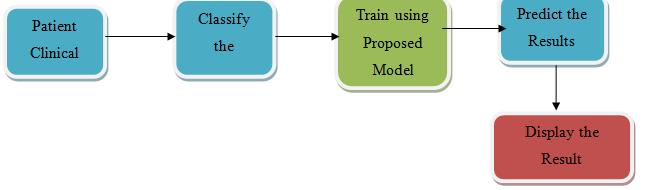
The first step is to get the data from dataset. Import the important libraries. Load the data as a Dataframe using Pandas.Thedataisstoredintheformof.CSVfiles.Thedata isbeingdownloadedfromkaggle.com.Proposedsystemuses kaggledataset.Parametersaredefinedforidentificationof sepsis. Thendatavisualizationandexploratorydataanalysis areperformedtogetclearpictureaboutvariousattributes and available data. Statistical description with values is carriedout.Followingcalculusmeasuresarecarriedout:
Nullvaluesareignoredinthesummary
Highestnumberofentriesforacolumn~36klikely toconsiderifithelpsindicatetheprediction
Lowestnumberofentriesforacolumn~1klikelyto dropbecausetherearetoomanymissingentriestotraina modelonAverage(mean),minimum(min),maximum(max) areself-explanatory
Standarddeviation(std)howdispersedthevalues arenormal(Gaussian)distributionfollows68-95-99.7rule
o 68%ofvaluesarewithin1std
o 95%ofvaluesarewithin2std
o 99.7%ofvaluesarewithin3std
1st(25%),median(50%),3rd(75%) quartilesor percentiles,forexample:
25%ofthepatientshadatemplowerthan 36.3°C
75%ofthepatientshadaresphigherthan 20.5breathsperminute
min/max
if min == 0 and max == 1, likely discrete categoricaldata
International Research Journal of Engineering and Technology (IRJET) e-ISSN: 2395-0056
Volume: 11 Issue: 08 | Aug 2024 www.irjet.net p-ISSN: 2395-0072
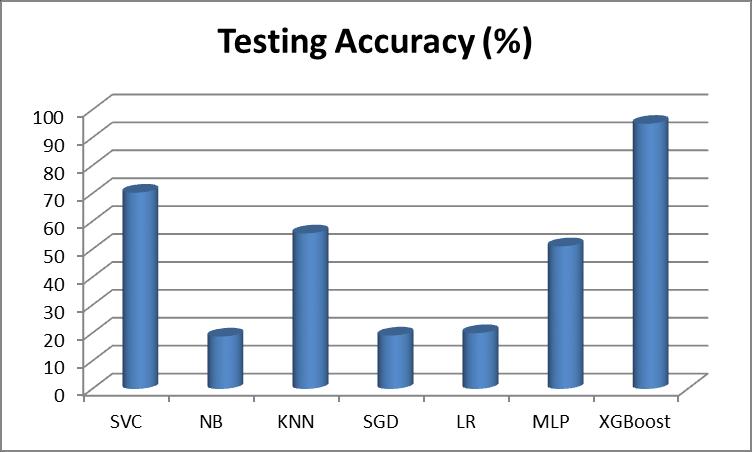
TheEvaluationsofvariousclassifieralgorithmsaccordingto accuracyaredisplayedbelow:
Table1:PerformanceEvaluation.
It is observed that proposed XGBoost classifier gives the betterresultsintermsofaccuracy.
5. Conclusion
Insummary,thisthesisintroducedanovelpredictionmodel using XGBoost for septic patients. The research began by addressing the challenge of missing data in the available patientrecords.Tocounteractthepotentialnegativeimpact ofthismissinginformationonpredictionaccuracy,aunique preprocessingandearlypredictionnetworkwasproposed. This model not only identified missing data patterns to enhance prediction accuracy but also extended its applicabilitytobroaderdetectiontimeframes.Thekeytake awayfromthisstudyistherecognitionofthecrucialroleof capturing uncertainty in time series data, particularly in medical contexts. This approach helps mitigate error propagation,ultimatelyimprovingpredictionoutcomes.
Theresultsofthisresearchdemonstratedthesuperiorityof the proposed method, which can be applied to various applicationsinvolvinginfrequentlyrecordedhealthrecords.
Notably, this study represents the latest advancement in sepsispredictionalgorithms,offeringenhancedperformance throughadversarialtrainingoverprogressivelylongertime windows. Overall, this work contributes to the field of medicalpredictionmodels,offeringavaluabletoolforsepsis predictionandunderscoringtheimportanceofaddressing missingdatainhealthcareanalytics.
[1] A.Rhodes,L.E.Evans,W.Alhazzani,M.M.Levy,M. Antonelli,R.Ferrer,A.Kumar,J.E.Sevransky,C.L.Sprung, and M. E. Nunnally, ‘‘Surviving sepsis campaign: Internationalguidelinesformanagementofsepsisandseptic shock: 2016,’’ Intensive Care Med., vol. 43, no. 3, pp. 304–377,2017.
[2] D. C. Angus, W. T. Linde-Zwirble, J. Lidicker, G. Clermont, J. Carcillo, and M. R. Pinsky, ‘‘Epidemiology of severe sepsis in the United States: Analysis of incidence, outcome,andassociatedcostsofcare,’’Crit.CareMed.,vol. 29,no.7,pp.1303–1310,Jul.2001.
[3] C.J.Paoli,M.A.Reynolds,M.Sinha,M.Gitlin,andE. Crouser, ‘‘Epidemiology and costs of sepsis in the United States An analysis based on timing of diagnosis and severitylevel,’’Crit.CareMed.,vol.46,no.12,p.1889,2018.
[4] V.X.Liu,V.Fielding-Singh,J.D.Greene,J.M.Baker,T. J.Iwashyna,J.Bhattacharya,andG.J.Escobar,‘‘Thetimingof earlyantibioticsandhospitalmortalityinsepsis,’’Amer.J. RespiratoryCrit.CareMed.,vol.196,no.7,pp.856–863,Oct. 2017.
[5] C. W. Seymour, F. Gesten, H. C. Prescott, M. E. Friedrich, T. J. Iwashyna, G. S. Phillips, S. Lemeshow, T. Osborn,K.M.Terry,andM.M.Levy,‘‘Timetotreatmentand mortalityduringmandatedemergencycareforsepsis,’’New EnglandJ.Med.,vol.376,no.23,pp.2235–2244,2017.
[6] A. Kumar, D. Roberts, K. E. Wood, B. Light, J. E. Parrillo,S.Sharma,R.Suppes,D.Feinstein,S.Zanotti,andL. Taiberg, ‘‘Duration of hypotension before initiation of effectiveantimicrobialtherapyisthecriticaldeterminantof survivalinhumansepticshock,’’Crit.CareMed.,vol.34,no. 6,pp.1589–1596,2006.
[7] M.M.Levy,M.P.Fink,J.C.Marshall,E.Abraham,D. Angus, D. Cook, J. Cohen, S. M. Opal, J.-L. Vincent, and G. Ramsay,‘‘2001SCCM/ESICM/ACCP/ATS/SISinternational sepsisdefinitionsconference,’’IntensiveCareMed.,vol.29, no.4,pp.530–538,Apr.2003.
[8] M. Singer, C. S. Deutschman, C. W. Seymour, M. Shankar-Hari,D.Annane,M.Bauer,R.Bellomo,G.R.Bernard, J.-D.Chiche,andC.M.Coopersmith,‘‘Thethirdinternational consensusdefinitionsforsepsisandsepticshock(sepsis-3),’’ Jama,vol.315,no.8,pp.801–810,2016.
International Research Journal of Engineering and Technology (IRJET) e-ISSN: 2395-0056
Volume: 11 Issue: 08 | Aug 2024 www.irjet.net p-ISSN: 2395-0072
[9] S. Lambden, P. F. Laterre, M. M. Levy, and B. Francois, ‘‘The SOFA score Development, utility and challenges of accurate assessment in clinical trials,’’ Crit. Care,vol.23,no.1,pp.1–9,Dec.2019.
[10] C. P. Subbe, A. Slater, D. Menon, and L. Gemmell, ‘‘Validationofphysiologicalscoringsystemsintheaccident andemergencydepartment,’’EmergencyMed.J.,vol.23,no. 11,pp.841–845,Nov.2006.
[11] A. E. W. Johnson, M. M. Ghassemi, S. Nemati, K. E. Niehaus,D.A.Clifton,andG.D.Clifford,‘‘Machinelearning anddecisionsupportincriticalcare,’’Proc.IEEE,vol.104, no.2,pp.444–466,Feb.2016.
[12] D. Ravì, C. Wong, F. Deligianni, M. Berthelot, J. Andreu-Perez, B. Lo, and G.-Z. Yang, ‘‘Deep learning for healthinformatics,’’IEEEJ.Biomed.HealthInformat.vol.21, no.1,pp.4–21,Jan.2017.
[13] S.-L. Wang, F. Wu, and B.-H. Wang, ‘‘Prediction of severe sepsis using SVM model,’’ in Advances in ComputationalBiology.NewYork,NY,USA:Springer,2010, pp.75–81.
[14] J. S. Calvert, D. A. Price, U. K. Chettipally, C. W. Barton,M.D.Feldman,J.L.Hoffman,M.Jay,andR.Das,‘‘A computationalapproachtoearlysepsisdetection,’’Comput. Biol.Med.,vol.74,pp.69–73,Jul.2016.
[15] L. M. Fleuren, T. L. T. Klausch, C. L. Zwager, L. J. Schoonmade, T. Guo, L. F. Roggeveen, E. L. Swart, A. R. J. Girbes, P. Thoral, A. Ercole, M. Hoogendoorn, and P. W. G. Elbers, ‘‘Machine learning for the prediction of sepsis: A systematic review and meta-analysis of diagnostic test accuracy,’’IntensiveCareMed.,vol.46,no.3,pp.383–400, Mar.2020.
[16] M. Moor, B. Rieck, M. Horn, C. R. Jutzeler, and K. Borgwardt, ‘‘Early prediction of sepsis in the ICU using machinelearning:Asystematicreview,’’FrontiersMed.,vol. 8,May2021,Art.no.607952.
[17] E.Shakeri,E.A.Mohammed,Z.ShakeriH.A.andB. Far,"ExploringFeaturesContributingtotheEarlyPrediction of Sepsis Using Machine Learning," 2021 43rd Annual International Conference of the IEEE Engineering in Medicine&BiologySociety(EMBC),Mexico,2021,pp.24722475,doi:10.1109/EMBC46164.2021.9630317.
[18] M.R.Kumar,N.Natteshan,J.Avanija,K.R.Madhavi, N. S. Charan and V. Kushal, "SMOTE-TOMEK: A Hybrid Sampling-Based Ensemble Learning Approach for Sepsis Prediction," 2023 2nd International Conference on Edge Computing and Applications (ICECAA), Namakkal, India, 2023, pp. 724-729, doi: 10.1109/ICECAA58104.2023.10212208.
[19] A. Ullah, H. Qayyum, M. K. Khan and F. Ahmad, "Sepsis Detection Using Extreme Gradient Boost (XGB): A SupervisedLearningApproach,"2021MohammadAliJinnah UniversityInternationalConferenceonComputing(MAJICC), Karachi, Pakistan, 2021, pp. 1-6, doi: 10.1109/MAJICC53071.2021.9526260.
[20] N. Shanthi and A. A, "A Novel Machine Learning Approach to predict Sepsis at an Early Stage," 2022 InternationalConferenceonComputerCommunicationand Informatics (ICCCI), Coimbatore, India, 2022, pp. 1-7, doi: 10.1109/ICCCI54379.2022.9741000.
[21] T. X. Ying and A. Abu-Samah, "Early Prediction of SepsisforICUPatientsusingGradientBoostedTree,"2022 IEEE International Conference on Automatic Control and Intelligent Systems (I2CACIS), Shah Alam, Malaysia, 2022, pp.78-83,doi:10.1109/I2CACIS54679.2022.9815467.
[22] A.Shankar,M.Diwan,S.Singh,H.Nahrpurawalaand T. Bhowmick, "Early Prediction of Sepsis using Machine Learning," 2021 11th International Conference on Cloud Computing,DataScience&Engineering(Confluence),Noida, India, 2021, pp. 837-842, doi: 10.1109/Confluence51648.2021.9377090.
[23] N. Shah, J. Bhatia, N. Vasavat, R. Desai and P. Sonawane,"EarlySepsisDetectionusingMachineLearning and Neural Networks," 2021 2nd Global Conference for AdvancementinTechnology(GCAT),Bangalore,India,2021, pp.1-6,doi:10.1109/GCAT52182.2021.9587778.
[24] M. Apalak and K. Kiasaleh, "Improving Sepsis Prediction Performance Using Conditional Recurrent AdversarialNetworks,"inIEEEAccess,vol.10,pp.134466134476,2022,doi:10.1109/ACCESS.2022.3230324.
[25] B.Y.Al-MualemiandL.Lu,"ADeepLearning-Based SepsisEstimationScheme,"inIEEEAccess,vol.9,pp.54425452,2021,doi:10.1109/ACCESS.2020.3043732.