
International Research Journal of Engineering and Technology (IRJET) e-ISSN: 2395-0056
Volume: 11 Issue: 08 | Aug 2024 www.irjet.net p-ISSN: 2395-0072

International Research Journal of Engineering and Technology (IRJET) e-ISSN: 2395-0056
Volume: 11 Issue: 08 | Aug 2024 www.irjet.net p-ISSN: 2395-0072
Momita Rani Giri1 , Prof. Preeti Rai2
1Reseacrh Scholar, Department of CSE, Gyan Ganga Institute of Technology and sciences, Jabalpur, M.P. 2Professor, Departmet of CSE, Gyan Ganga Institute of Technology and Sciences, Jabalpur, M.P.
Abstract –
Terrorism can be defined as the use of violence against peopleorpropertytothreatenorcoerceagovernmentorits citizenstoachievecertainpoliticalorsocialgoals.Thisisa globalproblemthatresultsinlossoflifeandpropertyand negatively affects the economy and international trade. Terrorismisalsoassociatedwithhighuncertainty,andmany countriesaroundtheworldareinterestedinanyresearch that can reduce the threat of terrorism. Most research on crime focuses on measures to prevent crime or how to reducecrime,butthereislimitedresearchonwhatmakes crimeevil.Thegoalofthisprojectistodevelopamachine learningmodelthatuseslinearsupportvectormachineto predictthelikelihoodthatcriminalswillengageinactivities that support crime. Data from global crime database and datapreprocessingincludingdatacleaninganddimension reduction.
Thensvmmachinelearningmodelisbuiltandappliedtothe selectedfeatures.Logisticregressionofsvmmodelisbetter thanbaselinemodel.Thismeanssvmusesweightedobjects as selection method to get the best results among certain optionstopredictcrimescene.Ourresultsshowthatsvm machinelearningmodelscanpredictmaliciousactivities.
Keywords: Terrorist Activity Recognition, Terrorist Activities,GlobalTerrorismDatabase,LogisticRegression, RandomForest,andLinearSVM.
Terrorism is a global threat that has been with humanity sinceancienttimes.Itisaglobalproblembecauseitcauses loss of life, property and security both domestically and internationally.Previousstudieshaveshownthatthelevelof insecurity and uncertainty caused by violence affects decision-makingtotheextentthatmorepeoplemakemore decisions.Thereisariskthatasingledecisioncanleadtothe insecuritythatisoftenassociatedwithterrorism.Violence [1].Oneoftheworstactsofterrorism,September11,isnot only recorded as one of the deadliest terrorist attacks in history,buttheinterestinrapidlydetecting,predicting,and eliminatingenemyactivitiesandefforts,supportedaround the world, is called terrorism. . . . Article 22 of the United States convention defines terrorism, but the definition of terrorismisoftenthesubjectofspecifictreaties.Thelicense
tocommitcrimesagainstnon-combatants[2].Thisbehavior isoftendesignedtointimidatebystandersratherthanthe victim.Althoughsomepeoplebelievethatviolencehassome positive consequences, the truth is that even if it is determinedasabadbehavior,itisillegal[3].Itisbasedon the principle that any behavior that is contrary to the representationofpublicorderisunlawful,willleadtoabuse and illegality. Because violence itself includes violence, violence, threats and behavior that endangers public and cultural order [4]. Violence has also been shown to be associatedwithaggression,violenceandconflict[5,6].The causesofviolencecanbedividedintothreelevels:natural events,strategicideasandpersonalcharacteristics.Factors include reasons for action and conditions that allow radicalizationandsupporttheideologyoftheopposition.In the short term, these activities may mean educational support;butinthelongterm(intheory),thesituationmay indicate political, ethnic, oppositional or separatist tendencies. At the same time, it will seek to disrupt and underminegovernmentprocesses,influencepublicbehavior andgoodgovernance,incitefearandsympathy,andprovoke protests that are unacceptable to them. Personal characteristics include the criminal's worldview, mental health and personality. Believes there are good and bad people. The threat to life and property posed by internationalterrorismandtheneedtocontrolitisagood reason to conduct this research. The impact of machine learningandartificialintelligenceinpreventingthespread of crime cannot be overstated. This technology can help prevent and combat crime, assist governments and other decision-makers,andcoordinatetheeffortsofcitizensand travelers.Preventingterrorismiseffectiveinthecontextof thetypeofviolenceexperiencedinaregionandintermsof protectingthelivesandpropertiesofcitizens[7-9].Machine learningcanbeusedtopredictcrimebasedondataobtained from financial transactions, travel patterns, events, and mediasuchassocialmedia.Theneedforthisresearchwill revealtheimportanceofinternationalcrimedatathatcan provideimportantinformationaboutattacks[10,11].Study statistics to learn how to combat international terrorism. Someauthorsusemachinelearningsuchasnaivebayes(nb), nearestneighbor(kNN),decisiontrees,andsupportvector machine (svm) to predict the role of the aid group in the events[12,13].Someauthorsalsopublishedaproposalto usedeeplearning to predict the speed of online criminals [14].Developedahazardsystemtoidentifyterroristattacks
International Research Journal of Engineering and Technology (IRJET) e-ISSN: 2395-0056
Volume: 11 Issue: 08 | Aug 2024 www.irjet.net p-ISSN: 2395-0072
usingk-meansclustering[15].Thesuccessrateofterrorist attacks can be estimated using a decision tree algorithm [16].Someresearchersalsopredictspecificattacksagainst the government, public, military, economy or others [17]. Previousstudies[18,19]and[20]havealsoreportedsimilar workoncomputationalmethodstopredictseverity.Recent researchers have also used different machine learning techniquestodeterminewhetheraparticularattackwould be recognized by a familiar group [21]. However, it is importanttonotethatnoneoftheseplanspredictwhere,for example,specific typesofviolence will occurincountries. Thisisanewpieceofwork.Suchinformationwillleadtoa war on terror; in this study we present a computational modeltopredicttheriskassociatedwithterroristattacks. [Twelve].Althoughthetermsaredifferent,inthisstudywe define criminals as those who harm, kill, injure innocent people,damagecriticalsystemsimmediatelyorovertime,or cause harm in a planned manner as individuals. To do somethingtoachieveapolitical,religious,orideologicalgoal. Unliketerroristgroups,"lonewolf"terroristsareindividuals who act alone, without the support of a group or organization. Studies have shown that when terrorists acquire new means of destruction, the threat of violent attacksincreasesandthelevelofviolenceincreases.Other studieshavealsodiscussedthepossibilityofrevision[23]. Themostfearedweaponsarethoseclassifiedasbiological weapons,especiallyairbornevirusesthatcanbecomeglobal. Guns, bombs, and automatic weapons can kill or injure hundredsorthousandsofpeople,butinthefuture,biological weapons or nuclear weapons will fall into the hands of terrorists and millions of people will be the victims of an attack that will victimize them voluntarily. The idea of creatingamodifiedvirusandplantingitinawaythatkillsa lotofpeopleseemstohavebecomesomethingofameme. When signs of an epidemic emerge, it’s easy to ask, “is it naturalorman-made?”Conspiracytheoriesaboundedinthe mediaafternewsoftheebolaoutbreakin2014.Atahearing beforethecommittee,housespeakermarthamcsallysaid, “our nation’s ability to prevent, respond to, and mitigate bioterrorism is critical to national security.” The Islamic stateisfarfromskilled,itisruthless,anditisfarmorethana terroristorganization.We knowtheylovetousechemical and biological weapons. There are also methods to investigatetheintenttomakeandusesuchweaponsandthe terroristswhowillusethem.Inthecontextofthisstudy,the term “pre-screening” refers to the concept of identifying criminalsormaliciousactorsbeforetheycancompletetheir plans.Intheabsenceofrelevantinformation,thisnumberis uncertain.
Themosteffectivemethodsofdetectingpotentialattackers appeartobeeffectivepolicetechniquessuchasarrestand informing.Howdosecurity forcesdetectfutureterrorists, especiallythosewecallsimads(seriousdisasterpersons)? Whatmeasuresarebeingimplementedtodetectpotential terroristsandtheirattackplans?Ifapplicable,whatarethe possibilitiesforpreventingviolence?Itseemsimportantto
knowthisbeforethebadguyshaveachancetoact.Perhaps equally important, if these individuals are identified, how cansocietydealwiththemwithoutfallingintothe“orwellian trap”?Whilesomeofourpreviousworkhasaddressedthese researchquestions,thefocusofthisstudyisonseveralearly capabilities. Measures and implications that will help developpolicyresponsestotheevolvingthreatofterrorism. War-makingpower.Althoughterrorismisnotanewtoolof warfare, the magnitude of the world trade center attack remindedterroristgroupsofthediresituationtheyarein. Theattack,thefirstsincetheriotonU.S.Soilin1812,hada profound impact on the U.S. Government, civil rights, and national security. Today, there is hardly an organization, institution, or business in the United States that does not havesomeformofsecurityplanagainstterrorism.Thereare thousands of organizations and associations, educational centers,collegesanduniversities,andwebsitesthroughout thecountrythatprovideinformation,research,training,and advice on terrorism and security requirements. This is because the terrorist threat to the United States has increased since the late 1980s. All of this has led to significantinvestmentinthefightattheindividual,localand federallevels.Accordingtothelatestdata,36%(611billion usdollars)oftheworldmilitaryexpenditureof1.68trillion us dollars in 2016 was made up of the total military expenditure of the USA. 13% Of these expenditures were madebychina,4.1% by Russia and4.1%by Russia.Saudi Arabiahadashareof3.8%[24].Althoughtheexaggeration outweighsthepossibilityofbeingavictim,terrorismwillbe amajorconcernfortheworldinthefuture.Theglobaldeath toll from terrorist attacks in the united states in 2014 reached 32. In 2006, there were fewer than 500 terrorist attacks in eu countries, and of these, attacks by Islamic elements accounted for less than 1% of the incidents recorded in the same period [25]. Unlike the American religion,mostterroristattacksoccurinIslamiccountries.In 2016,therewere72attacksworldwide,resultingin50 or more deaths. 75 Percent of terrorist attacks occur in predominantlyMuslimcountries.Therewasonlyoneattack inthewest,thepulsenightclubshootinginOrlando,which killedmorethan50people.Themajorityofthe36deadly attacksinthewestresultedinhumandeaths.Innineofthese cases, only the perpetrator died [26]. But the fear of victimizationcannotbeignored.
Terrorism came to American attention in the mid-1990s witheventssuchastheOklahomaCitystatehousebombing, theworldtradecenterbombinginNewYork,thearrestof theUnitedStatesbombers,and,earlier,theAtlantaOlympic bombing.Expertsagreethatterrorismintheunitedstatesis justbeginning.Theirpredictionshavebeenprovenwrong,as evidencedbytheuseofacommercialairlinertodestroythe twintowersandtheworldtradecentercomplex,theworst terrorist attack to date. Recent events include the pulse nightclubinOrlandoandtheBostonmarathonattack.The consequences for american businesses are enormous. Terroristshavetargeted20ofthe25largestcompaniesin
Volume: 11 Issue: 08 | Aug 2024 www.irjet.net p-ISSN: 2395-0072
the united states. Terrorism has affected almost every company in the world. Large corporations are wary of security. Analysis of the impact of terrorism on u.s. Companiesshowsthatnearlyallu.s.Foreigncompaniesare targeted [27]. The number of terrorist threats against fortune1000companiesincreasedfrom17in1998to40in 2003 [28]. Security forces were the primary targets of international attacks in 2015. Moreover, many terrorist attacksarerandomandindiscriminate.Lessthan9%ofall attacks target business and commerce [29]. The ongoing trendofattacksoncompanies(oftenkidnappingforransom) targets senior executives and employees sent abroad. Providing risk insurance and risk response and crisis managementhasbecomeawell-establishedbusiness.
Global terrorism once threatened Americans only abroad. ThemaingroupwascalledtheSovietBloc.Today,terrorists from all over the world attack America in their own countries. International terrorism has more than one dimension. International terrorism has become global; no seaorbordercanstopit.In2015,therewere11,774serious injuries and 28,328 deaths worldwide, more than 61% of which occurred in the Middle East and South Asia. Of the 11,774 reported attacks, 35% (approximately 4,128) occurred in Iraq and Afghanistan; approximately 12,224 deaths(43%oftheglobaltotal)werereportedin2015.In Nigeria,violenceparticularlyincreasedfromapproximately 422attacksin2006to589in2015.InWesternEurope,the death toll in 2015 was 175. Tactical Change In the past, international terrorism tended to be based solely on the killingandarrestofterrorists.Forexample,hijackingflights hasbecomeunpopularwithinternationalterroristsbecause fewcountriesallowthemtolandandtheyaresentbackto countrieswhereinternationalterrorismistakingplace.Only 19countrieshaveprovidedsupport,includinganti-aircraft hijackers[31].Second,internationalterrorismhasbecome deadly.Mostinternationalorganizationsturntounjustified killings. In the 1990s, violent incidents were almost 20% morelikelytoresultindeathorinjurythantheyhadbeen20 yearsearlier[32].
The harm caused by terrorism in the 21st century has becomemoreserious,focusingonthelossoflife,property, andfinancialandmateriallosses.Terroristsarealsoturning their attention to softer targets such as schools and hospitals.Attacksonchildrenincreasedbymorethan80% in2006,withmorethan1,800childrenkilledorinjured.The decadefrom2004to2014sawaglobalincreaseinattacks onschools.In2004,2010and2013,2%,5%and3%ofall terrorist attacks targeted schools, respectively [33]. Internationalterroristmissionstendtobemoresuicidal.In thepast,terroristorganizationsdidnottakeintoaccountthe possibility of victims resisting security measures. Today, terroristgroupsarelookingforyoungvolunteerstocommit crimes. It is more difficult to deal with such bad people because they do not value human life. Therefore, some
management strategies may not work in these situations. Most international terrorist groups have turned to the followingattacks:
- Indiscriminate attacks between armed forces and coalitions. Apartment complexes (mostly in the former SovietUnionandvariousMiddleEasternrepublics).
•Terroristattacksoneconomicsectors,includingelectricity distribution, transportation, trade, and commerce (which hasbecomecommoninColombia).
• Explosive bombs. Another important tactical change is suicide. Suicide is a method in which the act of resistance resultsinthedeathoftheperpetrator.
Theproposedworkrepresentsamethodforpredictingthe typeofterroristattackinwhichtheyengaged. Thisfigure representsbasicworkingcomponentsofthesystemlikedata set, pre-processing, dataset splitting, model training, prediction & evaluation. The task involves classifying the dataaboutterrorist’sattacksinto1of8possibleattacks.The datasethas134features.ThelabelsorClassesaredivided into eight different categories like Assassination, Armed assault,Bombing,Hijacking,BarricadeIncident,Kidnapping, FacilityAttacksandUnarmedAssaults.
Theproposedarchitectureofthesystemisshowninfigure below:
Dataset
Data Pre-processing
Dataset Splitting
Model Training
Prediction & Evaluation
Figure1:Generalarchitectureofthesystem
International Research Journal of Engineering and Technology (IRJET) e-ISSN: 2395-0056
Volume: 11 Issue: 08 | Aug 2024 www.irjet.net p-ISSN: 2395-0072
Thedataconsistofsomeunwantedinformation.Afterdoing thepre-processingtask,weareleftwithonly84featuresout of134features.Outof84features,thereare39categorical features,26numericcontinuousand19numericcategorical. Afterpre-processingandone-hotencoding,thethreemodels willbeappliedfordoingclassificationandprediction.The results are calculated and compared based on Accuracy, PrecisionandRecallvalues.
Some reformations are done on the columns to capture relevantinformation.
1. Instead of having the start and end dates for a conflict, the duration between dates are calculated whilst alsokeepingthestartdate.
2. Insteadofhavinga"related"columnwithastringlisting therelatedterroristattacks,thenumbersofrelatedattacks arecounted.E.g"attack1;attack2;attack3"becomes3.
3. Several columns are replaced with -9, 0, 1 labels to Unknown,NoandYesrespectively.
4. Somenumericalcolumnsuseeither-99or-9todenote unknownvalues. Thesevaluesarechangedto-1sincethse columnsdonotcontainnegativevalues.-1nowindicatesthe presenceofunknowns.
5. Some unimportant columns are dropped from the database for improving the performance of the models implemented.
6. Nowusesklearnpipesandpreprocessingmethodstofill in NA values for numerical features and perform one hot encodingoncategoricalfeatures.
7. Thisencodingwillconvertthecategoricalfeaturesintoa formatthatwillfitforthemachinelearningmodels.Itwill convertthecategoricalfeaturesintonumericalfeatures.
Toidentifythebestcombinationofparametersforrandom forestwerunagridsearchusingdifferentinputs.Thegrid search here is a randomized grid search that will pick 10 combinationsofparametersrandomly.Thissavestimeand computingpower.
Themetricuseforevaluationisthef1weightedscore.Inthe case of attack types, both precision and recall are equally important. The weighted f1is selected to get a weighted averageofallf1scoressincethedatasetisunbalanced.
1.ProposedclassifierisRandomForestClassifier,inthatI set class_weight to balance to weight each target class inverselytoitsfrequency.Additionally,Isetn_jobs=-1touse allofmyCPUcores.Therearemanypotentialcombinations
for grid search so used a RandomizedSearcbCV that will randomly select a number of combination to execute as specifiedbyn_iter.SetCV=5for5-foldcrossvalidation.The totalnumberoffitsis50.
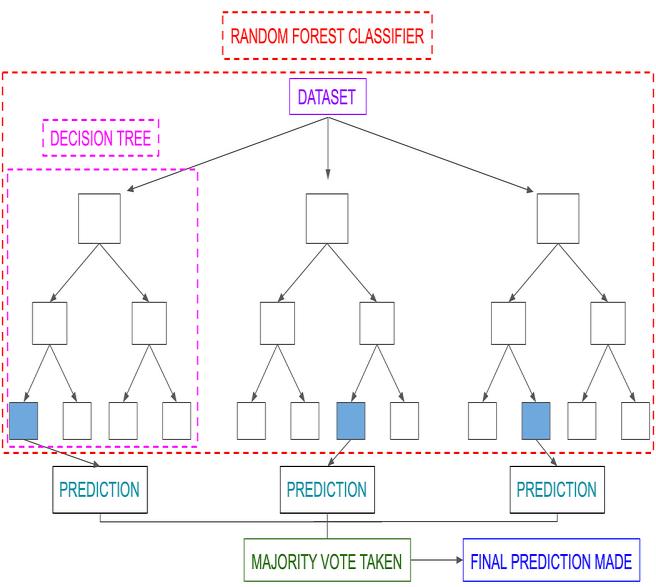
2. RandomForest(RF) is an algorithm that integratesseveralDTsbyensemble learning. RFgenerallyusesthemeanormodeofthepredictionresults ofeachDTdefinedinthedecisiontreeasthefinalprediction value. RF inPythonscikit-learn package uses mean aspredictor variable.RF is less likely tosuffer fromoverfittingthanindividualDTsbecauseeachDTinthe randomforestcannotseethefullpictureofthetrainingset. Each DT onlytrainspart of thefeaturedata anddoesnot rememberallthenoiseinthetrainingset.
4.3 Proposed Algorithm for Global Terrorism Detection
Detecting global terrorism using machine learning algorithms like Random Forest is a complex task that involves handling a large volume of data from various sources,includingsocialmedia,governmentreports,news articles,andmore.Here'sahigh-leveloutlineofanalgorithm thatcouldbeusedforglobalterrorismdetectionusingthe RandomForestalgorithm:
1.DataCollectionandPreprocessing:
-Gatherdatafromvarioussources,includingdatabasesof pastterroristincidents,open-sourceintelligence,andsocial media.
- Preprocess the data by cleaning it, handling missing values,andconvertingitintoastructuredformatsuitablefor machinelearning.
- Feature extraction: Extract relevant features such as location, date, terrorist group, attack type, casualties, and more.
International Research Journal of Engineering and Technology (IRJET) e-ISSN: 2395-0056
Volume: 11 Issue: 08 | Aug 2024 www.irjet.net p-ISSN: 2395-0072
2.DataLabeling:
-Labelthedatainstancesaseither"terroristactivity" or "non-terroristactivity."Thislabelingcanbedonebasedon historicaldataandexpertknowledge.
3.FeatureEngineering:
-Createadditionalfeaturesthatmayaidinthedetectionof terrorism,suchassentimentanalysisofsocialmediaposts, geopoliticalfactors,economicindicators,etc.
4.DataSplitting:
- Split the dataset into training, validation, and test sets. ThetrainingsetisusedtotraintheRandomForestmodel, thevalidationsetisusedforhyperparameterstuning,and thetestsetisusedforevaluation.
5.RandomForestModel:
- Train a Random Forest classifier using the training dataset. Random Forest is an ensemble method that combines the predictions of multiple decision trees to improveaccuracyandreduceoverfitting.
- Tune hyperparameters like the number of trees, tree depth,andminimumsamplesperleafusingthevalidation settooptimizeperformance.
6.ModelEvaluation:
- Evaluate the Random Forest model on the test dataset usingappropriatemetricssuchasaccuracy,precision,recall, F1-score,andROC-AUC.
- Use cross-validation techniques to ensure the model's robustness.
7.Deployment:
-Oncethemodelperformswell,deployitinareal-timeor batchprocessingenvironmenttocontinuouslymonitorand detectterroristincidents.
8.MonitoringandFeedbackLoop:
-Continuouslycollectnewdataandfeeditintothemodel forreal-timemonitoring.
- Implement a feedback loop to retrain the model periodicallywithnewdatatoadapttoevolvingpatternsof terrorism.
9.ModelMaintenance:
-Regularlyupdatethemodelwithnewdataandretrainit tomaintainitsaccuracyandeffectiveness.
- Monitorthemodel'sperformanceandmake necessary adjustmentstoaccountforchangesintheglobalterrorism landscape.
It'simportanttonotethatthisisasimplifiedoverview,and theactualimplementationofsuchasystemisacomplexand ongoingprocessthatrequiresdomainexpertise,dataprivacy considerations,andcollaborationwithrelevantauthorities and organizations. Additionally, ethical and legal considerations should be taken into account when implementingsuchasystemforglobalterrorismdetection.
Tablebelowcomparestheweightedaveragevaluesforall thethreemodelsimplemented.
Algorithms
Table1:ComparisonsofWeightedAverageF1Score Values.
ThechartbelowrepresentstheweightedF1Score Comparisonsofallthethreemodels.
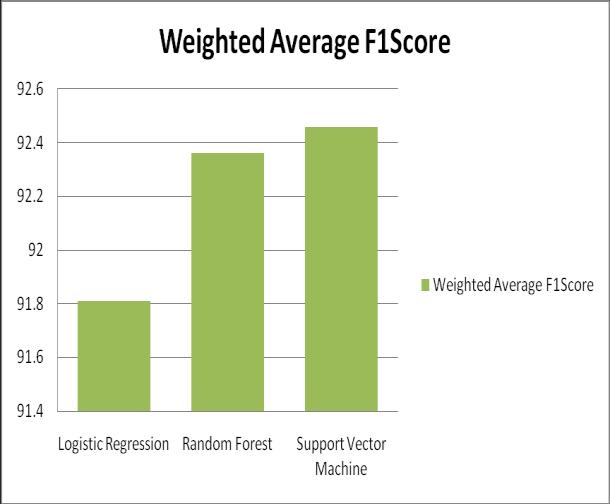
Figure4:ComparisonchartforweightedF1Score.
Tablebelowcomparestheaccuracyvaluesforallthethree modelsimplemented.
Algorithms Accuracy (%)
LogisticRegression 92
SupportVectorMachine 92
RandomForest 93
Table6.2:ComparisonsofWeightedAverageF1Score Values.
International Research Journal of Engineering and Technology (IRJET) e-ISSN: 2395-0056
Volume: 11 Issue: 08 | Aug 2024 www.irjet.net p-ISSN: 2395-0072
ThechartbelowrepresentstheaccuracyComparisonsofall thethreemodels.
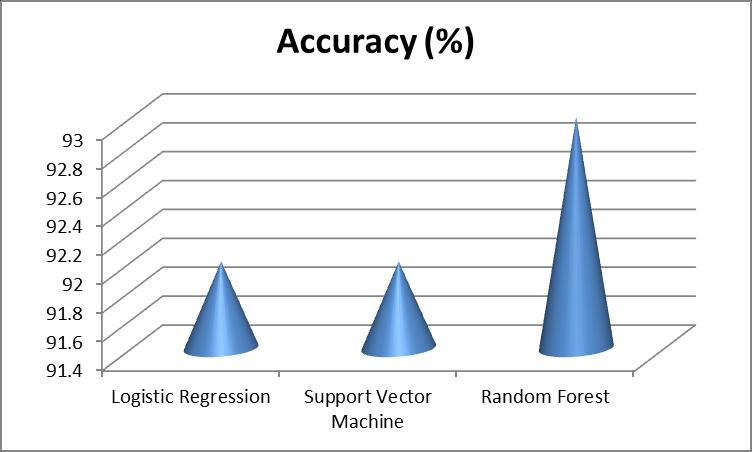
5:Comparisonchartforaccuracy.
5. Conclusion
Intheeraofartificialintelligence,ourresearchfocuseson the application of BN in the consequence assessment of terrorist attack. After literature review, we conclude two shortcomingsintheapplicationofBN:
(1)Thestrongcorrelationbetweentheinfluencingfactors violatestheconditionalindependenceassumption(CIA)in BN;
(2)Howtoobjectivelyscreeneffectiveevaluationindicators fromalargenumberofindicators.
Aiming attheabove twoproblems, we introduceRandom Forest to propose a new weighted model. From the perspective of entirety, the RF-based consequence assessmentmodelofterroristattackisdesigned,combining objectivedataandexpertknowledge.Firstly,RFisappliedto filtereffectiveevaluationindicatorsobjectively.Then,RBis adoptedbyusingmultipledecisiontreestocalculateweights ofindicatorsandthemodelisbuiltbystructurelearningand parameter learning. Finally, assessment experiments are conductedwithterroristattackeventsrecordedbyGTDto verifytheproposedmodel’sfeasibilityandperformance.The experiment results show that the Random Forest model based on multiple decision trees has higher evaluation accuracy and more reliable interpretability than the traditionalmodels.
6. References
[1]. K.Sacco,V.Galletto,E.Blanzieri,Howhasthe9/11 terrorist attack influenced decision making? Appl. Cogn. Psychol.17(2003)1113–1127.
[2]. T. Kapitan, Terrorism in the Arab-Israeli conflict, Terrorism(2004)175–191.
[3]. J.M. Sorel, Some questions about the definition of terrorismandthefightagainstitsfinancing,Eur.J.Int.Law 14(2003)365–378.
[4]. B.S. Frey, S. Luechinger, A. Stutzer, Calculating tragedy: assessing the costs of terrorism, J. Econ. Surv. 21 (2007)1–24.
[5]. M.Abdalsalam,C.Li,A.Dahou,S.Noor,AStudyof theEffectsofTextual FeaturesonPredictionofTerrorism AttacksinGTDDataset,Eng.Lett.29(2021).
[6]. D.D.Atsa’am,R.Wario,F.E.Okpo,TerrorClassify:an algorithm for terror groups placement into hierarchical categoriesofcasualtiesandconsequences,J.Appl.Secur.Res. 15(2020)568–579.
[7]. L. Hellmueller, V. Hase, P. Lindner, Terrorist Organizations in the News: A Computational Approach to Measure Media Attention towards Terrorism, Mass CommunicationandSociety,2021.
[8]. S.Tickle,I.Eckley,P.Fearnhead,AComputationally efficient,High-DimensionalMultipleChangepointProcedure with Application to Global Terrorism Incidence, arXiv preprint,2020arXiv:2011.03599.
[9]. G.M.Campedelli,M.Bartulovic,K.M.Carley,Learning futureterroristtargetsthroughtemporalmeta-graphs,Sci Rep11(2021)1–15.
[10]. M.I.Uddin,N.Zada,F.Aziz,Y.Saeed,A.Zeb,S.A.Ali Shah, et al., Prediction of future terrorist activities using deepneuralnetworks,Complexity2020(2020).
[11]. A.S. Tawadros, Mapping terrorist groups using networkanalysis:Egyptcasestudy,J.Humanit.Appl.Soc.Sci. (2020).
[12]. G.M.Tolan,O.S.Soliman,Anexperimentalstudyof classification algorithms for terrorism prediction, Int. J. Knowl.Eng.-IACSIT1(2015)107–112.
[13]. M. Khorshid, T. Abou-El-Enien, G. Soliman, A comparison among support vector machine and other machinelearningclassificationalgorithms,IPASJInt.J.Comp. Sci.3(2015)26–35.
[14]. R.S. Alhamdani, M.N. Abdullah, I.A. Sattar, RecommenderSystemforGlobalTerroristDatabaseBased onDeepLearning,Int.J.Mach.Learn.Comput.8(2018).
[15]. Y. Jun, X. Tong, H. Zhiyi, and L. Yutong, "Hazard Grading Model of Terrorist Attack Based on Machine Learning,"2019.
[16]. T.Jani,"Predictingsuccessofglobalterrorist,"2019.
[17]. S.B.Salem,S.Naouali,Patternrecognitionapproach in multidimensional databases: application to the global terrorismdatabase,Int.J.Adv.Comp.Sci.Appl.(IJACSA)7 (2016).
International Research Journal of Engineering and Technology (IRJET) e-ISSN: 2395-0056
Volume: 11 Issue: 08 | Aug 2024 www.irjet.net p-ISSN: 2395-0072
[18]. M.M. Khorshid, T.H. Abou-El-Enien, G.M. Soliman, HybridClassificationAlgorithmsForTerrorismPredictionin Middle East and North Africa, Int. J. Emerge. Trend. Tech. Comp.Sci.4(2015)23–29.
[19]. S. Nieves, A. Cruz, Finding Patterns of Terrorist GroupsinIraq:a KnowledgeDiscoveryAnalysis,in:Ninth LACCEI Latin American and Caribbean Conference (LACCEI’2011),EngineeringforaSmartPlanet,Innovation, Information Technology and Computational Tools for SustainableDevelopment.Medellin,2011.
[20]. M.Adnan,M.Rafi,ExtractingpatternsfromGlobal Terrorist Dataset (GTD) Using Co-Clustering approach, J. Independ.Stud.Res.13(2015)7.
[21]. V.Kumar,M.Mazzara,A.Messina,J.Lee,AConjoint ApplicationofDataMiningTechniquesforAnalysisofGlobal TerroristAttacks,in:InternationalConferenceinSoftware EngineeringforDefenseApplications,2018,pp.146–158.
[22]. Gordon,Florescu,Sharan,2015.ProspectsforLone WolfandSIMADterrorism.Technol.Forecast.Soc.Chang.95, 234–251. http://dx.doi.org/10.1016/j.techfore.2015.01. 013.(June).
[23]. Lappin,Yaakov,2016.Analysis:newgenerationof terrorists may lead to much bigger escalation. In: The Jerusalem Post, (March 14, http://www.jpost.com/ArabIsraeliConflict/Analysis-New-generation-of-terrorists-maylead-to-much-bigger-escalation447923.RetrievedApril19, 2016).
[24]. The Top 15 Countries for Military Expenditure in 2016: Niall McCarthy, Contributor Forbes.com. See:https://www.forbes.com/sites/niallmccarthy/2017/04/ 24/the-top-15-countries-for-military expenditurein-2016infographic/#7ac183a043f3.
[25]. J.Richards,EuropeandtheNatureoftheTerrorist Threat in 2007. Online:http://intellibriefs.blogspot. Com/2007/07/europe-and-nature-of-terrorist-threat.html., (accessedon716.07).
[26]. https://www.pri.org/stories/2017-07-14/more-75percent-terrorist-attacks-2016-took-place-just-10countries.).
[27]. D.Alexander,BusinessConfrontsTerrorism:Risks andResponses,TheUniversityofWisconsinPress,Terrace Books,2004.
[28]. Top Security Threats and Management: Issues Facing Corporate America, 2003 Survey of Fortune 1000 Companies. Online: http://www.asisonline.org/newsroom/surveys/pinkerton.p df.(Accessedon7.16.07).
[29]. The Statistics Portal. See:https://www.statista.com/statistics/518611/primarytargets-of-terroristattacks.
[30]. U.S.DepartmentofState,StatisticalInformationon terrorism in 2015. See:https://www.state.gov/j/ct/ rls/crt/2015/257526.htm. and, ,http://www.datagraver.com/case/people-killed-byterrorism-peryear-in-western-europe-1970-2015.
[31]. P. D’Arcy, Terrorists, enemies of mankind, Law EnforcementExecutiveForum(March2002).
[32]. Countering the Changing Threat of International Terrorism, report from the National Commission on Terrorism, Washington, DC, June 2000,www.fas.org/irp/threat/commission.html. (Downloaded1.24.03).
[33].
See:https://www.theatlantic.com/international/archive/20 14/12/terrorist-attacks-on-schools-havesoared-in-the-past10-years/383825.