International Research Journal of Engineering and Technology (IRJET) e-ISSN:2395-0056
Volume: 11 Issue: 08 | Aug 2024 www.irjet.net p-ISSN:2395-0072
DESIGN AND IMPLEMENTATION OF AN ENHANCED MODEL OF SUPPORT VECTOR MACHINE WITH RADIAL BASIS FUNCTION AND PARTICLE SWARM OPTIMIZATION FOR DETECTION OF DDoS ATTACKS
Anthony Obogo Otiko1, Emmanuel A. Edim2 , Emmanuel U. Oyo-Ita3
1’3Department of Computer Science, University of Cross River State, Calabar.
2Department of Computer Science, University of Calabar
Abstract:
The increasing reliance on networked systems in the Information and Communication Technology (ICT) landscape has made them crucial for managing Critical Infrastructure (CI) and information access. However, this dependence has also made these systems vulnerable to Distributed Denial-of-Service (DDOS) attacks, which disrupt services by flooding target hosts with traffic. Traditionalsecuritymeasuresoftenfallshortagainstthese attacksduetotheirdynamicnatureandevolvingtactics.To address this challenge, various researchers have explored the potential of Machine Learning (ML). This study proposesahybridsolutionthatcombinesaSupportVector Machine (SVM) with a Radial Basis Function (RBF) kernel and Particle Swarm Optimization (PSO) for feature selectiontoenhanceDDOSattackdetectionaccuracy.Using the KDD-99 dataset, the SVM-PSO model is trained and evaluated, achieving a superior performance of 99.99% compared to SVM-RBF alone with 99.72%. The findings demonstrate the efficacy of the proposed approach in detecting DDOS attacks, showcasing its potential for bolstering cyber defences. Additionally, comparative analysis with state-of-the-art algorithms highlights the superior accuracy of the SVM-RBF-PSO model, underscoring its effectiveness in mitigating DDOS threats. This study contributes valuable insights into enhancing network security through innovative machine learning techniques, addressing the persistent challenges posed by DDOSattacks.
Keywords: Algorithm, artificial intelligence, Denial of Service,DistributedDenialofService,KernelPCA,Support VectorMachine,MaliciousTraffic.
1.0 Introduction
In the rapidly evolving landscape of Information and Communication Technology (ICT), the reliance on networked systems for information access and communication has become paramount (Agboola, 2023).
WiththeexpansionofservicesfacilitatedbyICT,including the management of Critical Infrastructure (CI), society's dependencyonthesesystemshasgrownsubstantially.Any disruption to these systems, even for short durations, can have far-reaching consequences across various facets of modernlife.
DistributedDenial-of-Service(DDOS)attacks,inparticular, have emerged as a significant threat in the digital realm (Kaur et al., 2019). These attacks leverage distributed computing power to inundate target hosts with traffic, leading to service disruptions. The proliferation of DDOS attacks,coupledwiththelimitationsoftraditionalsecurity measures, has made them a persistent challenge for networkdefenders.
Despite efforts to mitigate DDOS attacks, their dynamic nature and evolving tactics pose ongoing challenges for detection and prevention. Traditional security measures oftenproveinsufficientagainstthescaleandsophistication of modern DDOS attacks, necessitating innovative approachestobolstercyberdefenses(Shuklaetal.,2022)
Hence, diverse researchers have applied the viabilities of MachineLearning(ML),knowledge-basedapproaches,and statistical analysis to tackle the problem of DDOS attacks However, each method presents its unique set of limitations and challenges. For instance, statistical methods often struggle to precisely determine the normal distribution of network packets (Sharafaldin et al., 2019). WhileMLtechniquesofferpromisingresults,however,the optimal selection of best features remains a primary concernconsideringtheprodigioussizeofdatasets.
While traditional Feature Selection (FS) methods have demonstrated viability, their efficacy remains subject to scrutiny(KhaireandDhanalakshmi,2022).Notably,recent trends underscore the increasing adoption of Metaheuristic approaches,particularlyaswrappermethodsfor feature selection, showcasing substantial effectiveness in mitigatingtheimpactofoverwhelmingdatasetsizeswithin
International Research Journal of Engineering and Technology (IRJET) e-ISSN:2395-0056
Volume: 11 Issue: 08 | Aug 2024 www.irjet.net p-ISSN:2395-0072
the context of DDOS attack detection. Considering Metaheuristic approaches for FA, (Paniri et al., 2020) applied Ant Colony (AC), (Awadallah et al., 2022) applied Binary Horse herd optimization algorithm, (Rostami and Kaveh, 2021)utilizedthebiogeography-basedoptimization(BBO) and artificial bee colony (ABC), (Rostami et al., 2020) integrated Particle Swarm Optimization (PSO) on medical datasetforFS.Allthemethods haveshowntheviabilityof AIapproachesinmachinelearning.
InresponsetotheescalatingthreatposedbyDDOSattacks, thisstudyproposesamachinelearning-basedsolutionthat hybridizes the Support Vector Machine (SVM) with the Radial Basis Function (RBF) kernel. Furthermore, the selectionoffeaturesisoptimizedusingtheParticleSwarm Optimization (PSO) algorithm. By integrating SVM with PSO, the aim is to enhance the accuracy and reliability of DDOSattackdetection.
The proposed model is applied to the KDD-99 dataset obtainedfromtheUCIMachineLearningRepository,which contains instances of both normal and malicious network activities. Leveraging this dataset, the study seeks to train and evaluate the effectiveness of the SVM-PSO model in discerning patterns indicative of DDOS attacks within networktraffic.
The primary contribution of this study lies in the applicationofPSOasafeatureselectionmechanismonthe SVMRBFkernelforclassifyingnetworkattacks.
2.0 Related Works
Malik and Aslam (2013) devised a hybrid approach that combines multi-objective particle swarm optimization with the random forest algorithm. The authors suggest employingthismethodtoeffectivelyidentifyProbeattacks to enhance the detection rate and reduce the rate of false alarm discovery while identifying Probe attacks. Particle Swarm Optimization (PSO) removes superfluous features, whereasRandomForest(RF)identifiesProbeassaults.The author’sproposedapproachhasadetectionrateof90.7%.
Liet al.,(2018)constructed a model that incorporatesthe Gini index. This model comprises the gradient boosting decision tree (GBDT) and particle swarm optimization (PSO). The Gini index was used to select the best feature subset. The network assault was detected using the gradient lifting decision tree algorithm. The GBDT parameters were optimized using the Particle Swarm Optimization (PSO) technique. The model was evaluated based on its detection rate, accuracy, F1-score, precision, and false alarm rate. An evaluation was carried out using theNSL-KDDDataset.Accordingtothefindings,themodel
demonstrated high accuracy and effective intrusion detectioncapabilities.Themodelachievedadetectionrate of 78.48%, a precision rate of 96.44%, an F1-score of 86.54%,andafalseacceptancerateof3.83%.
Ren et al. (2019) proposed an IDS integrating data sampling, feature selection, and a unified hybrid data optimization procedure. The model achieved optimal training dataset selection and feature identification using GeneticAlgorithm(GA)andRandomForest(RF).
Nazir and Khan (2021) introduced Tabu Search–Random Forest (TS–RF) for feature selection, demonstrating an accuracy rate of 83.12% and a false positive rate (FPR) of 3.7%ontheUNSW-NB15dataset.Despitepositiveresults, they acknowledged not addressing the class imbalance issue in the dataset. Overall, these studies contribute valuable insights into the application of advanced techniques for intrusion detection, showcasing strengths andareasforfurtherenhancement.
3.0 Research Methodology
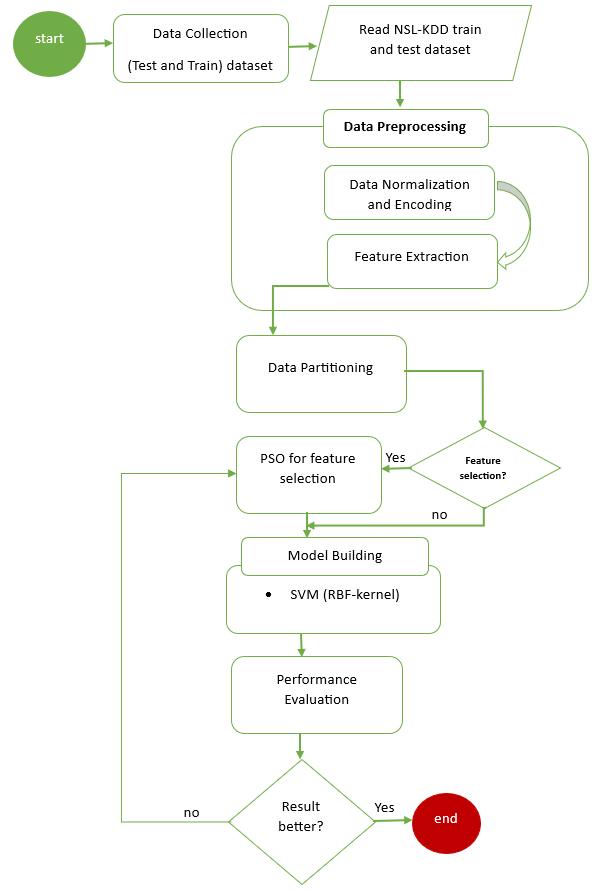
The proposed research methodology comprises three key phases: data preprocessing, feature selection, and classification with performance evaluation. Firstly, in the data preprocessing phase, the objective is to refine and clean the raw data to prepare it for analysis. This involves tasks such as handling missing values, normalizing data, andeliminatingnoiseoroutliersto ensurethedata isin a suitable format for subsequent analysis. Secondly, in the feature selection phase, the focus is on identifying and extractingessentialattributesfromthepreprocesseddata. The aim is to retain only those features that significantly contribute to detecting network intrusions, thereby reducing dimensionality, enhancing model performance, and improving result interpretability. To achieve this, a meta-heuristic approach utilizing the PSO algorithm for feature selection is proposed. Lastly, the classification and performance evaluation phase involves using the features selected by the PSO algorithm to train a machine learning classification model, specifically the SVM algorithm. SVM categorizesnetworkactivitiesasnormalorintrusivebased on learned patterns. Following training, the model's performance is assessed using metrics such as accuracy, precision, recall, and F1-score to ensure its reliability and effectiveness in identifying network intrusions. The proposed methodology approach can be visualized in Figure3.1.

International Research Journal of Engineering and Technology (IRJET) e-ISSN:2395-0056
Volume: 11 Issue: 08 | Aug 2024 www.irjet.net
Figure 3.1: ResearchDesign
3.1 Dataset Description
TheKDDdatasethas41attributesandoneclasslabelwith more than 4 million instances (Ibor et al., 2015; Aggarwal andSharma,2015). Thedatasethas severalversionsfrom which10% of the training data with 494, 021 instances is usedinthisempiricalstudy. Thetestsetcontains311,079 instances, which are used to evaluate the performance of themodelforaccuracy,FPRandothermetrics. Thedataset also has a class label that indicates the type of attack for each instance. Different configurations of this dataset are availablewithvariationinthenumberofinstancesbutthe number of attributes in each case is 42. The attribute labeled 42 in the data set is the class attribute which indicates whether a given instance is a normal connection instanceoranattack.
3.2 Data Preprocessing
The data preprocessing phase is essential to address the disparate range of values exhibited by each characteristic in the intrusion detection data. This phase involves characterizing the data, which includes converting text features to normal values and standardizing numerical features. Specifically, the numerical characteristics of the intrusiondataarestandardizedusingtheformulaoutlined inthispaper.
p-ISSN:2395-0072
Thisobjectiveisaccomplishedbynormalizingeachfeature variable,denotedasVij,totheinterval(0,1).
3.3 Feature Selection
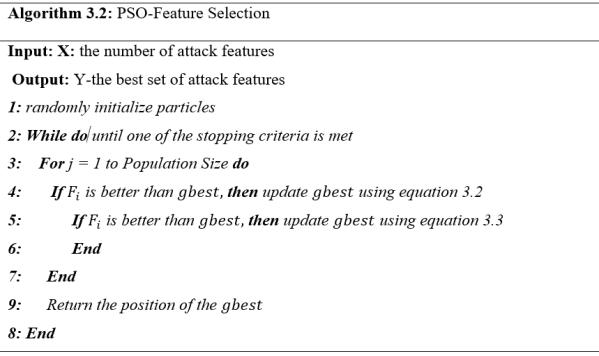
Considering the number of features from the KDD dataset and the number of intrusion records, feature selection becomes essential. Hence, the proposed feature selection techniques aim to reduce the dimensionality of a feature set while retaining the most relevant features. In DDoS detection, it enhances efficiency by discarding irrelevant features.Therefore,toachieveareducedfeatureselection, thestudyproposesusing the Particle Swarm Optimization (PSO) algorithm. PSO optimizes by mimicking the social behaviour of birds foraging for food. Each particle represents a potential solution and possesses position, velocity,andfitnessvalue.Thealgorithmiterativelyrefines binary feature vectors to maximize the accuracy of the Random Forest classifier. Particles traverse the search space, updating positions based on the objective function. The goal is to identify a subset of features that maximizes classifierperformance.Theglobalbestsolutionrepresents the selected features with the highest accuracy on validation sets. The particle’s velocity is updated using equation3.2
Theparticle’spositionisupdatedusingEquation3.3
In the equations, ��symbolizes the ����ℎ iteration of PSO, ������indicatessearchspace����ℎ dimension,wsignifiesthe inertia weight, ��1 and ��2 are acceleration factors, ��1 and ��2 are random numbers between [0,1]. And ������ and ������ and ������ are (pbest) and (gbest) respectively. ������ (pbest) is the best particle in the ����ℎ iteration and ������ (gbest) isthebestparticleinalliterationsuntilthen.
The algorithm for the PSO feature selection techniques is presentedinalgorithm3.2.
International Research Journal of Engineering and Technology (IRJET) e-ISSN:2395-0056
Volume: 11 Issue: 08 | Aug 2024 www.irjet.net p-ISSN:2395-0072
3.4 Classification Algorithm
Thisstudyfocusesonaddressingthechallengeofdetecting Distributed Denial of Service (DDOS) attacks through a classification approach. Considering the nature of DDOS attacks from the KDD dataset as a classification problem, the research proposes employing the Support Vector Machine (SVM) algorithm. SVM is a well-established machinelearningtechniquerenownedforitseffectiveness in classification tasks. Rooted in the concept of solving large-dimensional problems' dual forms, SVM aims to construct a classifier based on a minimal set of support vectors,therebyadheringtotheprincipleofstructuralrisk minimization (Gaye et al., 2021). The support vector machine (SVM) stands out as an elegant and powerful supervisedmachinelearningalgorithm,widelyutilizedfor regression and classification tasks. Its versatility lies in its ability to predict non-linearly separable patterns by projectingtheoriginalfeaturespaceintoahyperplaneina higher-dimensional space. SVM is considered a nonparametric algorithm, as it recalls and stores all training datasetinstances.
For,thekernel,theRadialBasisFunction(RBF)kernelwas applied The RBF kernel was used to map non-linear boundaries of the input space into a higher dimensional feature space considering that the kernel value lies between0and1.
calculated according to four main criteria which are True Positive (TP), True Negative (TN), False Positive (FP), and FalseNegative(FN)asfollows:
i. True Positive (TP): Indicates when an alarm is generatedandthereisanintrusion.
ii. False Negative (FN): Indicates when an alarm is notgeneratedbutthereisanintrusion.
iii. False Positive (FP): Indicates when an alarm is generatedbutthereisnointrusion.
iv. True Negative (TN): Indicates when an alarm is notgeneratedandthereisnointrusion.
Accuracy quantifies the ratio of accurately classified instances, encompassing both true positives and true negatives, relative to the total number of instances, as demonstratedinequation3.5:
Precision: the precision metric represents the proportion of accurately classified attack flows (True Positives, TP) relativetoalltheclassifiedflows(TP+FalsePositives,FP) Equation3.6illustratesthemathematicalrepresentationof theprecisionmetric.
Recall: this metric signifies the proportion of correctly classified attack flows (TP) relative to all generated flows (TP + False Negatives, FN). The formula is shown in equation3.7:
Here, ‖���� ����‖2 is the squared Euclidean distance betweenthetwofeaturevectorsand σisafreeparameter. ���� and����,depictedasfeaturevectorsinsomeinputspaceis givenas:
3.3 Performance Evaluation
To evaluate the performance of the SVM-PSO model, the accuracy, precision, recall, and f1-score metrics are proposed. The criterion for each of the metrics is
F-measure, also known as F-score, measure combines precision and recall into a single metric using their harmonic mean, providing a balanced evaluation of classification performance. Equation 3.8 presents the mathematicalexpressionforcalculatingtheF-score.
Result and Discussion
This section outlines the findings from an empirical study and application that aimed to forecast network anomaly detectionusingtheKDD-99datasetsourcefromtheKaggle machine learning repositories. The use of machine learning algorithms, specifically the SVM-RBF-PSO
International Research Journal of Engineering and Technology (IRJET) e-ISSN:2395-0056
Volume: 11 Issue: 08 | Aug 2024 www.irjet.net p-ISSN:2395-0072
algorithm is part of the study technique. The developed models are then thoroughly validated using performance metricsincludingF1-score,precision,andrecall.
4.1 Environmental Setup
TheAnacondaprogrammingenvironment'scomputational resiliencewasutilizedinthecreationofthenetworkDDOS model. The complexities of the model were executed on a Windows operating system with a dual-core Intel Core i5 processor and 4GB RAM, and they were smoothly integrated into the Python programming language. Implementation was done using SKlearn API, which is designed for complex deep neural network applications. Important Python modules like NumPy, in addition to SKlearn, enabled sophisticated numerical operations, and pandas took care of dataset integration and parsing. A flexible visualization application called Matplotlib was used to show the graphical behaviour of painstakingly constructedmachinelearningmodels.
4.2 parameter Settings
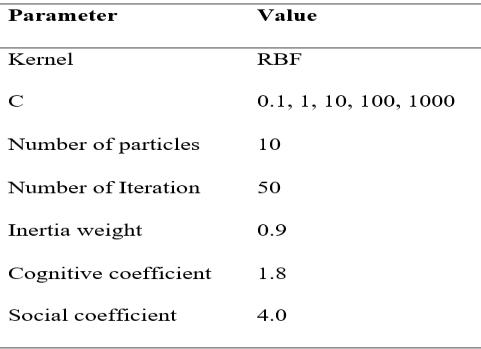
Table4.1presentstheparametersettingsfortheSVM-PSO modelusedinfeatureselectionanddetection.FortheSVM algorithm, for the kernel, the RBF kernel was tested. This kernel transforms input data into higher-dimensional space.TheCparameter,rangingfrom0.1to1000,balances decision boundary smoothness and correct classification. PSO parametersincluded 10particles fortraversal and 50 iterations for updating positions. The inertia weight (0.9) balances previous velocities, while cognitive (1.8) and social (4.0) coefficients influence particle movement towards historical and neighbour best-known positions, respectively.
4.0 Result Presentation
The results between SVM-RBF and SVM-RBF-PSO models ontheKDD-99datasetarepresentedinTable4.2.Interms
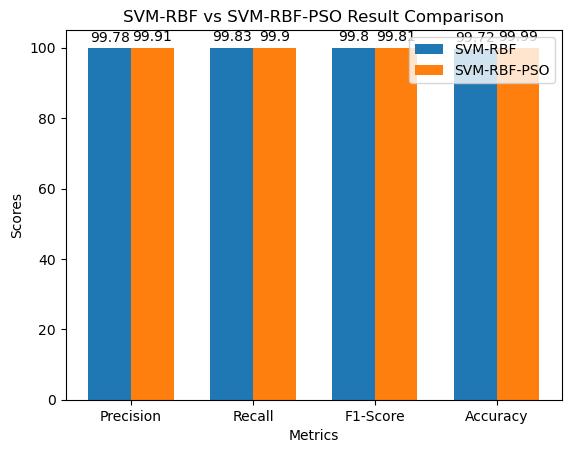
of precision, SVM-RBF achieved a score of 99.78%, while SVM-RBF-PSO slightly outperformed it with a precision scoreof99.91%.Similarly,intherecall,SVM-RBFachieved a score of 99.83%, whereas SVM-RBF-PSO showed a slightly higher recall score of 99.90%. When considering theF1 score, SVM-RBF hada scoreof99.80%, while SVMRBF-PSO maintained a comparable score of 99.81%. Notably, in terms of accuracy, SVM-RBF achieved a high accuracy of 99.72%, whereas SVM-RBF-PSO exhibited a notablyhigheraccuracyof99.99%.
Table 4.2: SVM-RBFandSVM-RBF-PSOResultComparison
TheseresultsindicatethattheSVM-RBF-PSOmodel,which integrates Particle Swarm Optimization (PSO) for feature selection, performed slightly better across all metrics comparedtotheSVM-RBFmodel withoutPSOintegration. Moreover, the significant increase in accuracy demonstrates the effectiveness of the PSO algorithm in enhancing the performance of the SVM model for DDOS attackdetectionontheK99dataset.
Figure 4.1: SVM models Performance.
Figure 4.1 Bar chart presents a comparison of the SVMRBFandSVM-RBF-PSOperformancemetricsbasedonfour evaluation metrics: accuracy, recall, F1-score, and precision.Thex-axisshowseachmeasure,whilethey-axis
Table 4.1: ParameterSettingsforSVM-PSOmodel
International Research Journal of Engineering and Technology (IRJET) e-ISSN:2395-0056
Volume: 11 Issue: 08 | Aug 2024 www.irjet.net p-ISSN:2395-0072
shows the scores that each model received. The SVM-RBF model andthe SVM-RBF-PSOmodel havetwobars next to each other for every metric. Each bar's height reflects the score that the corresponding model received for that specificmetric.Thisvisualizationmakesiteasytocompare the two models quickly across a range of measures, revealing which model performs better overall and for each indicator in particular. The SVM-RBF-PSO model performsbetterthantheSVM-RBFmodelinthisparticular instanceonallmeasures,asshown.
4.4 SVM- RBF-PSO Comparison with Other Works
Given the meta-heuristic nature of the wrapper feature selection method employed in this approach, a comparative analysis was conducted to assess the efficacy oftheSVM-RBF-PSOalgorithm.Thisassessmentinvolveda juxtaposition with some selected state-of-the-art algorithms that utilize meta-heuristic wrapper feature selection techniques specifically tailored for addressing DDoS attacks. The results of this comparative evaluation are presented in Table 5, shedding light on the performance of the SVM-RBF-PSO algorithm in relation to its counterparts in the domain of advanced algorithmic approaches.
Table 4.3: SVM-RBF-PSOcomparisonforDDOS
Aslam(2013)
and Khan(2021)
Keys: Gradient boosting decision tree (GBDT) and particle swarm optimization(PSO),TabuSearch–RandomForest(TS–RF),RandomForest (RF)andParticleSwarmOptimization(PSO).SVM-RBF-PSO.
In Table 4.3, a comparative analysis is presented, evaluating the performance of various algorithms that consideredmeta-heuristicapproachesforfeatureselection inaddressingDistributedDenialofService(DDoS)attacks. The algorithms under consideration include RF-PSO proposed by Malik and Aslam (2013) with an accuracy of 90.7% on the KDD dataset, GBDT-PSO introduced by Li et al. (2018) achieving an accuracy of 78.48% on the same
dataset,andTS–RFbyNazirandKhan(2021)attainingan accuracy of 83.12%, although the specific dataset used is notmentioned.
Notably, the current study introduces the SVM-RBF-PSO algorithm, reporting a higher accuracy of 99.99% on the KDD dataset. This suggests that the SVM-RBF-PSO algorithm outperforms the compared algorithms in terms of accuracy for DDoS attack detection. The utilization of a Support Vector Machine (SVM) with a Radial Basis Function (RBF) kernel in conjunction with Particle Swarm Optimization (PSO) for feature selection appears to contributetoamoreeffectivedetectionmechanism.Figure 19 shows the graphical presentation of the methods that appliedmetaheuristicsapproachesforfeatureselection.

In conclusion, this study presents a comprehensive approachtoaddressthechallengeofdetectingDistributed Denial of Service (DDOS) attacks in network traffic. By integrating machine learning techniques, specifically the SVMalgorithmwiththeRBFkernel,andoptimizingfeature selection using the PSO algorithm, the proposed model aims to enhance the accuracy and reliability of DDOS attack detection. The empirical evaluation conducted on the KDD-99 dataset demonstrates the effectiveness of the SVM-RBF-PSO model compared to the SVM-RBF model without PSO integration. Across multiple performance metrics including precision, recall, F1-score, and accuracy, the SVM-RBF-PSO model consistently outperforms the SVM-RBF model. Notably, the SVM-RBF-PSO model achieves a notably higher accuracy of 99.99%, indicating
attack
Figure 4.2: FSMetaHeuristicsApproachComparison
International Research Journal of Engineering and Technology (IRJET) e-ISSN:2395-0056
Volume: 11 Issue: 08 | Aug 2024 www.irjet.net p-ISSN:2395-0072
itssuperiorperformanceinidentifyingnetworkintrusions. Furthermore, a comparative analysis with state-of-the-art algorithms employing meta-heuristic approaches for feature selection highlights the efficacy of the SVM-RBFPSO algorithm. Compared to other algorithms such as RFPSO, GBDT-PSO, and TS-RF, the SVM-RBF-PSO algorithm achieves the highest accuracy of 99.99%, showcasing its effectiveness in detecting DDOS attacks. In summary, the integration of SVM with RBF kernel and PSO for feature selection presents a robust solution for DDOS attack detection, offering superior performance compared to existing methods. The findings of this study contribute valuableinsightsintotheapplicationofadvancedmachine learning techniques for enhancing cybersecurity in network environments. Further research can explore additional datasets and fine-tune the proposed model for real-world deployment, ultimately strengthening network defencemechanismsagainstevolvingcyberthreats.
Reference
Agboola,O.P.,Bashir,F.M.,Dodo,Y.A.,Mohamed,M.A.S.,& Alsadun, I. S. R. (2023). The influence of information and communication technology (ICT) on stakeholders' involvement and smart urban sustainability. EnvironmentalAdvances,13,100431.
Aggarwal, P., & Sharma, S. K. (2015). Analysis of KDD dataset attributes-class for intrusion detection. Procedia ComputerScience,57,842-851.
Awadallah,M.A., Hammouri,A.I.,Al-Betar,M.A.,Braik,M. S.,&AbdElaziz,M.(2022).BinaryHorseherdoptimization algorithm with crossover operators for feature selection. Computersinbiologyandmedicine,141,105152.
Gaye, B., Zhang, D., & Wulamu, A. (2021). Improvement of supportvectormachinealgorithminbigdata background. MathematicalProblemsinEngineering,2021,1-9.
Ibor, A. E., &Epiphaniou, G. (2015). A hybrid mitigation technique for malicious network traffic based on active response. International Journal of Security and Its Applications,9(4),63-80.
KaurChahal,J.,Bhandari,A.,&Behal,S.(2019).Distributed denial of service attacks: A threat or challenge. New ReviewofInformationNetworking,24(1),31-103.
Khaire, U. M., & Dhanalakshmi, R. (2022). Stability of featureselectionalgorithm:Areview.JournalofKingSaud University-Computer and Information Sciences, 34(4), 1060-1073.
Malik, A. J., & Khan, F. A. (2013). A hybrid technique using multi-objective particle swarm optimization and random forests for PROBE attacks detection in a network. In 2013 IEEE International Conference on Systems, Man, and Cybernetics(pp.2473-2478).IEEE.
Paniri, M., Dowlatshahi, M. B., & Nezamabadi-Pour, H. (2020). MLACO: A multi-label feature selection algorithm based on ant colony optimization. Knowledge-Based Systems,192,105285.
Rostami, M., Forouzandeh, S., Berahmand, K., & Soltani, M. (2020). Integration of multi-objective PSO-based feature selection and node centrality for medical datasets. Genomics,112(6),4370-4384.
Rostami, O., & Kaveh, M. (2021). Optimal feature selection for SAR image classification using biogeography-based optimization (BBO), artificial bee colony (ABC) and support vector machine (SVM): a combined approach of optimization and machine learning. Computational Geosciences,25,911-930.
Sharafaldin, I., Lashkari, A. H., Hakak, S., & Ghorbani, A. A. (2019). Developing realistic distributed denial of service (DDoS)attackdatasetandtaxonomy.In2019International Carnahan Conference on Security Technology (ICCST) (pp. 1-8).IEEE.
Shukla,M.,Tupsamudre,H.,&Lodha,S.(2022).Enterprise Security: Modern Challenges and Emerging Measures. In Research Anthology on Business Aspects of Cybersecurity (pp.441-470).IGIGlobal.
Nazir, A., & Khan, R. A. (2021). A novel combinatorial optimization-based feature selection method for network intrusiondetection.Computers&Security,102,102164.
Li, L. Yang, Y., ShenshenBai, J.C., Xiaoyun, C. (2018). Towards Effective Network Intrusion Detection: A Hybrid Model Integrating Gini Index and GBDT with PSO. Journal ofSensors,1-10
J. Ren, J. Guo, W. Qian, H. Yuan, X. Hao, H. Jingjing (2019). Building an effective intrusion detection system by using hybrid data optimization based on machine learning algorithms. Secur Commun Netw,2019