
International Research Journal of Engineering and Technology (IRJET) e-ISSN: 2395-0056
Volume: 11 Issue: 08 | Aug 2024 www.irjet.net p-ISSN: 2395-0072

International Research Journal of Engineering and Technology (IRJET) e-ISSN: 2395-0056
Volume: 11 Issue: 08 | Aug 2024 www.irjet.net p-ISSN: 2395-0072
Veena N. Murthy1 , B.M. Krishna2 , Arun Kumar K.3
1P.G Student, JSS STU & University Campus, Karnataka, India
2 Associate professor, JSS STU & University Campus, Karnataka, India
3 Associate professor, Government Engineering College, K.R. Pete, Karnataka, India
Abstract - The Karnataka State Pollution Control Board (KSPCB) is the regulatory body responsible for enforcing environmental laws and regulations in Karnataka. Various studies have been conducted to assess the amount of raw sewage entering the natural nalla/ lakes in Mysuru city. One such study was carried out under the guidance of KSPCB to examine confluence locations of sewage with stormwater valleys (also known as Raja Kaluve) in Sewage District 'C' of Mysuru City. The objective of the study was to identify the main areas where sewage andstormwaterdrainsconverge,to measure the amount of sewage flowing into the major stormwater drains that lead to the Sewage Treatment Plant (STP) and to evaluate the quality of wastewater that enters the natural nalla. Major confluence locations of sewage and stormwater drains (Raja Kaluve) were identified. Records were created to document the confluence locations and quantify the mixed flow of untreated sewage and treated effluent that enters the natural nallas/lakes. The study revealedthat a significant volume ofrawsewagefromDistrict 'C' was entering the natural nalla, which would subsequently travel and reach Paschim Vahini, posing a threat to the ecosystem. BOD andTotalcoliformlevels ofthewatersamples at the confluence locations exceeded the limits prescribed by CPCB.
Key Words: Confluence, Drains, Mysuru city, Raja Kaluve, Sewage.
MysuruisacitylocatedinthesouthernpartofKarnataka.It isknownforitspalaces,richculture,andpeacefulness.The administrativeseatofMysuruDistrictisoneofthelargestin Karnataka. It is 770 meters above mean sea level with geographicalcoordinatesof12.18°N76.42°E.Currently,the city has a population of about 13,16,000 and a floating population of approximately 50,000 to 1,00,000 during DasaraFestival.
ThecitygetsitssurfacewatersourcesfromtheKaveriand Kabinirivers.Newlydevelopedand extendedareasunder Mysuru Urban Development Authority (MUDA) limits are suppliedwithBorewell(BW)water.Thetotalwatersupply tothecityfromsurfacesourcesisabout214MillionLiters perday(MLD)(4WTPsatMelapura,Hongalli,Belagola,and Rammanahalli),whichismorethantheminimumpercapita
ratesupplyof135litres,aspertheCentralPublicHealthand EnvironmentalEngineeringOrganization(CPHEEO)norms.
Mysuru has an underground drainage (UGD) system that coversabout70%ofthecity’sarea.Itcomprisesfivemajor sewageDistricts,A,B,C,D&E,withintheComprehensive DevelopmentPlan(CDP)boundary,andtwoDistricts,G&F, outsidetheCDPboundary.Thetotallengthofthesewerline providedisabout1560km,andthetotalinstalledcapacityof SewageTreatmentPlants(STPs)inthecityisabout172.5 MLD(3nos.-60MLD,67.5MLD,45MLD).Thetotalquantity of sewage collected is about 95 MLD, about 55% of the amountgenerated.
InthecaseofSewageDistrict‘C’,itisobservedthatonlya smallamountofsewageisreachingtheSTPduetovarious issues. These include obstructions during solid waste dumping in the stormwater drains carrying untreated sewage,non-operationofinterceptionanddiversionworks, ongoingpipelineworksandrepairsofaeratorsintheSTP. The Kesare STP, which is of aerated lagoon type, has a designed capacityof 45 MLD.However,it canonlytreata fraction of the total sewage generated, which reaches the STP through the underground drainage system. The untreated sewage flows into the stormwater drains and eventuallyreachesthenaturalnalla.
InKarnataka,twomaintypesofsewagetreatmentplantsare used to treat domestic sewage from small and medium towns.Wastestabilizationponds(WSP)andaeratedlagoons werepreferredforeasyoperationandmaintenance.These technologiessuccessfullytreatedsewageeffluentwithBOD (BiochemicalOxygenDemand)levelsof30mg/l orlower. However, as the Central Pollution Control Board (CPCB) establishedstringenteffluentparametersfortreatedeffluent discharge to land or water bodies, with BOD levels of 10 mg/lorlowerandCOD(ChemicalOxygenDemand)levelsof 50mg/lorlower,someSTPshavebeenupgraded.
In recent years, technologies like Sequential Bioreactors (SBR), Membrane Bioreactors (MBR), Moving Bed Bioreactors(MBBR),andSoilBiotechnology(SBT)havebeen constructedtotreatdomesticsewage.
International Research Journal of Engineering and Technology (IRJET) e-ISSN: 2395-0056
Volume: 11 Issue: 08 | Aug 2024 www.irjet.net p-ISSN: 2395-0072
TheearlierWSPs/ aeratedlagoon-typeSTPshaveproven effective in reducing some of the parameters but not all. ParameterslikeBODandCODoftreatedeffluentinUrban Wastewater(UWW)arewithinthepermissiblelimitssetby CPCBfordisposingofUWWonlandforirrigation.However, the continuous usage of this effluent for agricultural purposesmayharmthesoil.Ithasalsobeenfoundthatthe aerated lagoon treatment is ineffective in treating or reducing coliform bacteria, which is used as a surrogate organismformicrobialpathogens(Severnietal.,2019[1])
Insomecases,sewageenterslakesdirectlywithoutbeing treated.JyotirmoySarma(2020[2])explainsthatentering wastewaterintolakesfromdrainsisasignificantissueand proposesdiversifyingwastewaterflowsintourbanlakesby constructinginterceptionanddiversionstructures.Ifthatis notpossible,providingonsitewastewatertreatmentattheir entrypointstothelakeisproposed.
When untreated municipal wastewater is suddenly dischargedintoriverecosystems,ithassignificantadverse environmental, economic, and social impacts. Parameters such as orthophosphates, nitrites, and nitrates intensify eutrophication(MichałPreisner,2020[3])
Severalexistingurbanlakesareinfringedupon,followedby the dumping of solid waste into them. Manjunatha et al. (2022 [4]) have determined that lakes in Mysuru city are polluted and deteriorating due to urbanization pressures, illegal waste dumping, the inflow of sewage water and industrialeffluents,andavarietyofweedsinfestingmajor portionsofthelakes.Asignificantdecreaseincleansurface water bodies negatively impacts moisture content and groundwater.
Effective strategies for connecting all households to the sewage system must be undertaken for a healthy environment.Raisingawarenessandeducatingcommunities iscrucialinpromotingresponsiblewastemanagementand encouraging community participation. Adequate infrastructureforcollecting,treating,anddisposingofsolid wasteandwastewatermustbeestablished(ZiéAdamaetal., 2023[5])
Thestudywasconductedovertwomonths(fromDecember 2023toJanuary2024)toinvestigatetheimpactofsewage dischargeonwaterbodies.Themethodologyconsistedof5 stages,asindicatedinFigure1.Primarydatawerecollected for one month by visiting the site, conducting a reconnaissance survey, measuring the flow in major stormwater drains and analyzing the water samples collected at confluence locations. Supporting information wascollectedandcollatedfromvarioussourcessuchasthe KSPCB,KarnatakaUrbanWaterSupplyandDrainageBoard (KUWSDB), Mysuru City Corporation (MCC), research papers,etc.
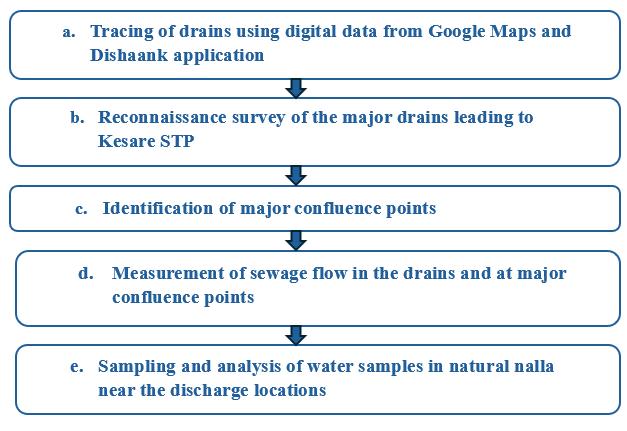
Fig -1:Studymethodology
Primarydata,namelyphotographsofthepollutedlocations andSewageTreatmentPlants,wasobtainedfromtheproject sites. Supporting information was collected and collated fromvarioussourcessuchastheKarnatakaStatePollution ControlBoard(KSPCB),KarnatakaUrbanWaterSupplyand Drainage Board (KUWSDB), KGIS website, Directorate of MunicipalAdministrationwebsiteandresearchpapers.
In2001,theAsianDevelopmentBankfinanciallyassistedin installinganundergrounddrainagesystemtoserveDistrict C,whichisinthenorthernpartofMysurucity.Thisincluded asewernetwork,trunkmains,outfallsewers,wetwells(3in total),andasewagetreatmentplant(aeratedLagoons)with acapacityof30MLD.
As part of the Atal Mission for Rejuvenation and Urban Transformation (AMRUT) grants, KUWSDB recently made furtherimprovementstothesystemin2021.Theseincluded the construction of a common wet well cum pump house, additionalpumpingmachineryandenhancementoftheSTP capacityfrom30MLDto45MLD.Interceptionanddiversion work was also done to divert sewage from stormwater drainstotheSTP.
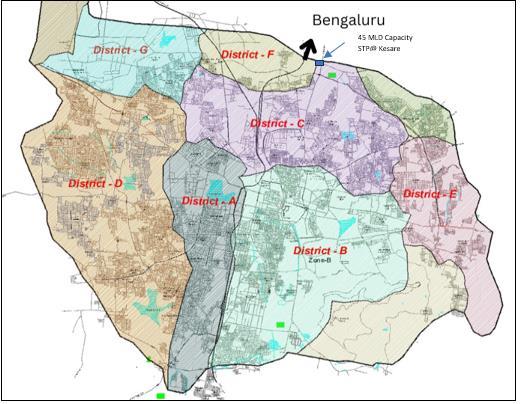
ThevarioussewageDistrictsofMysurucityandthelocation ofKesareSTPareshowninFigure2.
International Research
Volume: 11 Issue: 08 | Aug 2024 www.irjet.net p-ISSN: 2395-0072
For the current study, Google Maps and Dishaank applications were utilized to track the major drains in District'C'ofMysurucity.Thedetailsoftheoriginationof stormwaterdrainsandtheconfluencelocationsofsewage werealsorecorded.
Areconnaissancesurveywasconductedinthestudyarea based on the traced information. Photographs and videos that included details of Global Positioning System (GPS) coordinatesweretaken.Locationsofnaturalnallas,drains, and manholes, as well as details of the surrounding landmarks,roads,andareas,wereobtained.
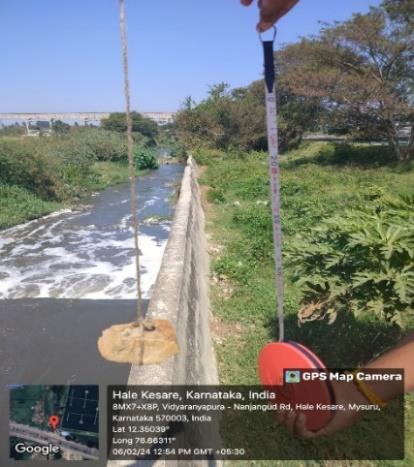
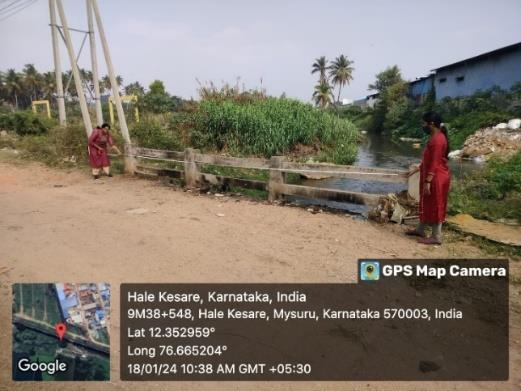
Thefloatmethodwasusedtomeasuretheliquidflowina drain.Thismethodisnon-intrusiveandinvolvestiminghow long it takes for a float to travel a certain distance in a straight section of the drain. Additionally, the width and depthoftheflowweremeasured.Theliquidflowwasthen calculated by multiplying the wetted cross-sectional area withtheflowvelocity.Sincethedepthofthedrainisgreater andvelocityathigherdepthswillbelessduetofrictionthan thesurfacevelocity,acorrectionfactorof0.80wasadopted. On each day of flow investigation, three sets of measurementswereobtainedduringpeak,averageandlean periods. Three different periods were considered to determinetheamountofflowperday.Thefirstperiodisa peakflowperiodthatlasts4hours,thesecondperiodisan averageflowperiodthatlasts6hours,andthethirdisalean flowperiodthatlasts14hours.Finalvaluesarrivedwitha toleranceof-5%,whichaccountsforanypossibleerrorsor approximationsthatmayhaveoccurredduringtheprocess.
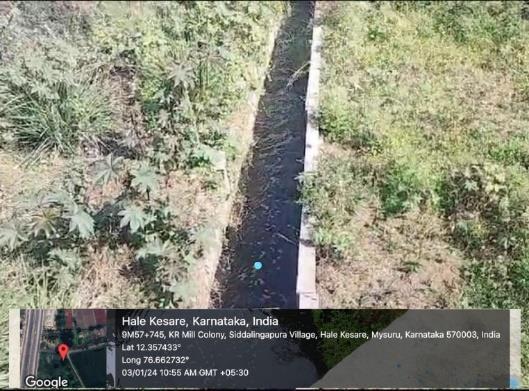
The process for measuring flow depth and velocity is detailedinPlates1,2,and3.
Samples of sewage and treated effluent from STP were collected using the grab sampling technique" at identified confluencepointsfollowingprescribedstandards.Theentire sampling and analysis process was witnessed, and the resultswereinterpreted.
Research
Volume: 11 Issue: 08 | Aug 2024 www.irjet.net p-ISSN: 2395-0072
SewageDistrict'C'isthemostdenselypopulatedareaofthe city, with a current population of the sewage District of 3,90,000.Factoringinafloatingpopulationofapproximately 30,000,thetotalsewagegeneratedfromdomesticsourcesis approximately 43.5 MLD. The existing STP at Kesare is designedtohandleacapacityof45MLD.Basedonthestudy, itisobservedthatinsomeregionsofthesewageDistrict‘C’, the sewer network's trunk mains have been connected to stormwater drains, resulting in sewage being discharged intothem.Additionally,thesestormwaterdrainsaregetting blockedduetothedumpingofsolidwaste,includingplastic bottles,bags,clothes,thermocols,cushionsandmore.
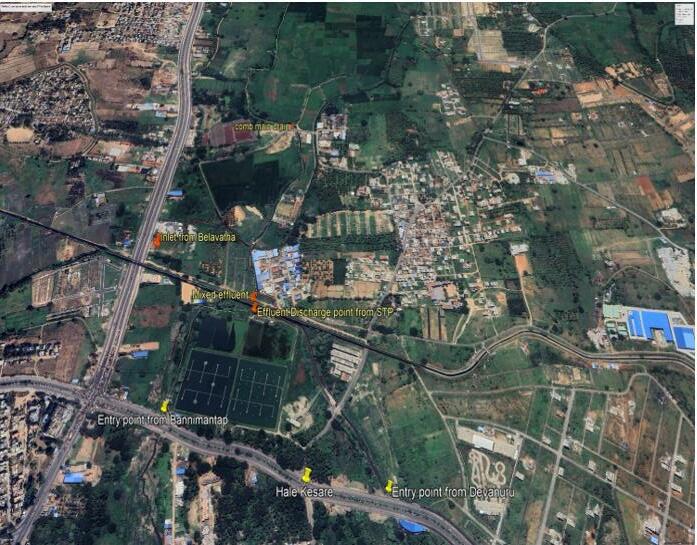
Due to ongoing work on the outfall sewer main along the DevanurValley,sewagefromtwooutfalls-Bannimantapand Belavatta-isbeingreceivedatSTP.Asaresult,asignificant amountofsewagefromtheDevanursideisnotreachingthe STPandisbypassingthetreatmentplant.Additionally,the sewageflowinginBannimantapandBelavattastormwater drains does not enter the STP for treatment through interceptionanddiversionworksprovidedaroundtheSTP. Instead, the sewage directly flows into the natural nalla behindtheSTP. AsatellitemapoftheKesareSTPanddrains leadingtotheSTPisshowninPlate5.
MLD),isduetomanyestablishments,institutions,industries, etc.,thathaveborewellsaswatersupplysources.Presently, only 7 MLD of sewage is being treated at STP, while the designedcapacityis45MLD.
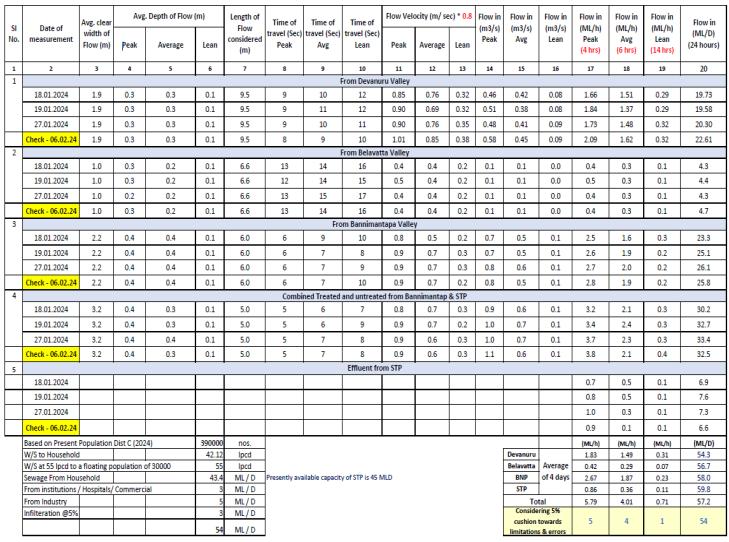
AstatementofflowcalculationsisindicatedinTable1.
Table 1: MeasurementofFlowinstormwaterdrains
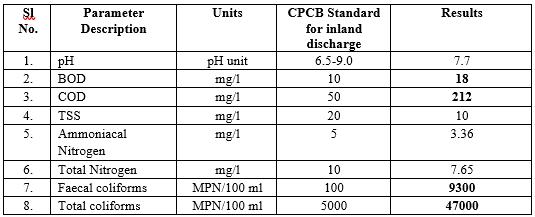
The samples collected from the confluence location were testedandanalysedforcriticalparameterssuchaspH,BOD, COD,TSS,AmmoniacalNitrogen,TotalNitrogen,andfaecal coliforms.Thesamples'parameterswerefoundtobebeyond thelimitsprescribedbyCPCBinthecaseofBOD,COD,faecal, andtotalcoliforms,asshowninTable2
Table 2: Combined RawSewage&treatedSampleTestResults
Basedontheinvestigation,thecumulativeflowbeyondthe STPduringpeakhoursis5.0millionliters(ML)perhour,the averageflowis4.0MLperhour,andtheleanflowis1.0ML perhour.
Therefore, considering 4 hours of peak flow, 6 hours of average flow, and 14 hours of lean flow, the total flow reachingthenaturalnalla,includingthetreatedeffluent,is approximately 54 MLD. The additional quantity of wastewater,beyondthedomesticsewagequantity(about9
A study of sewage District ‘C’ of Mysuru city involved a surveyofvariousstormwaterdrainstowhichsewagewas being discharged.Majorconfluence points ofsewage with themainstormwaterdraininsewageDistrict'C'ofMysuru citywereidentifiedandmapped.Itwasfoundthat87%of untreated wastewater and 13% of treated effluent were entering the natural nallas, which flowed through agriculturalfieldsandeventuallyreached“PaschimVahini”, polluting the source of drinking water supply to
International Research Journal of Engineering and Technology (IRJET) e-ISSN: 2395-0056
Volume: 11 Issue: 08 | Aug 2024 www.irjet.net p-ISSN: 2395-0072
Srirangapatna.Thedischargeparametersofthecombined flowexceededthepermissiblelevelsprescribedbyCPCB.
Topreventuntreatedsewagefrommixingwiththetreated effluent, it is crucial that all the sewage from District 'C' reaches the Sewage Treatment Plant (STP) without any hindrance.STPshouldworkefficientlytomeetthedischarge standards set by CPCB. Concerned authorities should promptly clear the accumulated solid waste in the stormwaterdrains,ensuringthesmoothflowofsewagefrom the drains to the STP. They should also take necessary measures to prevent the dumping of solid waste into the stormwater drains. Installing Trash Screens/floating barriersatstrategiclocationsinthestormwaterdrainscan preventsolidwastefromhinderingtheflow.Furthermore, anOnlineContinuousEffluentMonitoringSystem(OCEMS) and flow meters must be installed at the STP for efficient systemmonitoring.
The slope of the drains was not measured in the current study, which influences the quantum of flow in the drain. Continuousmonitoringmustbedone24x7foratleastone summer season using the required infrastructure/ equipment/instrumentsformoreaccurateresults
ThefirstauthorwouldliketoacknowledgeDrB.M.Krishna, AssociateProfessoratJSSSTU,Mysuru,andArunKumarK., AssociateProfessoratGovt.EngineeringCollege,K.R.Pete for their guidance; B.M. Prakash, Senior Environmental Officer at KSPCB, Mysuru; Asif Iqbal Khaleel, Executive Engineer at KUWSDB, Mysuru city division; and Nagaraje Gowda, Assistant Executive Engineer, Mysuru city corporation.
[1] SevereniAshili,HarikaranahalliPuttaiahShivarajuand George Jessen, “Assessment of Microbial Load, Reduction efficiency of Sewage Treatment Plants in Mysore,Karnataka”,ResearchGate,2019,pp.1–11.
[2] JyotirmoySarma,“ApproachtoRehabilitationofUrban Lakes: A Case Study in Mysore City”, International JournalofEngineeringandTechniques,vol.6(2),2020, pp.1-4.
[3] MichałPreisner,“SurfaceWaterPollutionbyUntreated MunicipalWastewaterDischargeDuetoaSewerFailure, EnvironmentalProcesses”,Springer,vol.7,2020,pp.767 –780.
[4] ManjunathM.C,IncharaChamaiyaSwamy,Prabhavathi M.C., Basavarajappa T., “Slow Death of lakes in the HeritagecityofMysuru,KarnatakaState,Indiathrough GeospatialApproach”,InternationalAdvancedResearch
Journal inScience,EngineeringandTechnology, vol.9, 2022,pp.18-26.
[5] Zié Adama Ouattara Kouassi Dongo, Komlavi Akpoti, AmosT.Kabo-Bah,FrancisAttiogbé,EbenezerKwadwo Siabi,ChuDonatusIwehandGuemegboHypolitheGogo, “AssessmentofSolid&Liquidwastesmanagementand health impacts along with failed sewerage systems of Africancountries”,FrontiersinWater,2023,pp.1–16.