
International Research Journal of Engineering and Technology (IRJET) e-ISSN: 2395-0056
Volume: 11 Issue: 08 | Aug 2024 www.irjet.net p-ISSN: 2395-0072

International Research Journal of Engineering and Technology (IRJET) e-ISSN: 2395-0056
Volume: 11 Issue: 08 | Aug 2024 www.irjet.net p-ISSN: 2395-0072
Om
Rajkumar Solavat1, Prof. Vijay Bhosale2 , Dr Ajay Gangrade2
1Mtech Student, Dept. of Mechanical Engineering, K J Somaiya College of Engineering, Somaiya Vidyavihar University, Mumbai, Maharashtra 2Faculty, Dept. of Mechanical Engineering, K J Somaiya College of Engineering,
Abstract - This project is all about creating a cool system that turns human footsteps into electricity! Electricity, as you know, is super important and we're using more of it every day, especially with more people around. While renewable sources like solar and wind energy are great, they have some limits. Did you know that an average person takes about 3,000 to 5,000 steps? It’s true! Locations like malls and airports always have long lines. So, why not put a footstep power system at these places? As people step onto it, we can generate electricity. This energy will be produced every day. Our project combines the piezoelectric effect with the Rack & Pinion mechanism
Key Words: Piezoelectric Effect, Rack and Pinion Mechanism, Power Generation, Non-Conventional Energy, Static Structural Analysis, Deformation.
Walking is one of the most essential things we do! And electricity? It’s the energy we rely on the most. As our population grows and technology advances, our need for electricity keeps increasing. There are so many ways to generate power like solar systems using sunlight, wind turbinesusingbreezes,orhydropowerplantstoo!Yetthese renewable options have their downsides. That makes it crucialtoexploreothersolutionsforgeneratingelectricity. Onefunideaismakingasystemthatcapturesenergyfrom humanfootsteps.
Believeitornot,energyplaysasignificantroleinourdaily lives. Our lifestyle depends on having enough energy available to keep everything running smoothly. So understandinghowwegetenergyandhowitchangesform isquiteimportant!Withawarenessgrowingaboutthelimits of our planet's energy resources, countries are starting to rethinkhowtheymanageenergyuseandcutdownonwaste.
When we walk, it's easy to overlook the force we're exerting itoftengoestowaste!Thisprojectaimstocapture that kinetic energy and turn it into electric power. Rememberpedalpower?It’sbeenaroundsincethe1800s!A gearboxcanconnecttoaflywheeltomakeadynamospin [1].Wecanwhipuparound1,000wattsfromjust120-150 steps!Whenpeoplestepdown,theirforcetransformsinto mechanical energy thanks to the rack & pinion setup that helpsgenerateelectricityviaaDCGenerator[2].
InworkbySaranyaG.etal.,theydemonstratedhowhuman movementsonpiezoelectricsensorscreateelectricpower. Thesensorscompressandproducekineticenergythatshifts into electrical form [3]. Also, an RFID (Radio Frequency Identification)systemallowsonlyauthorizeduserstoutilize this charging mechanism [4]. Another paper by Shivani Mahesh Pandit and team examined systems that not only generate & store energy but allow for monitoring too [5]. Imagine having this Wi-Fi-connected IoT system showing real-timevoltagedata[6]!Piezoelectricsensorscanbeset up in various combinations series or parallel to yield maximumvoltage[7].
UsingdatafromBangladesh'spopulationdensityshowshow piezoelectricmaterialscangenerateenergyeffectively;one studynotedthatwithjust12piezoelectricsensorsoccupying one square foot and someone weighing 50 kg stepping down eachstepcouldyieldatleast1volt[10].
Create an innovative non-conventional energy source andspreadtheword
Cutbackheavyrelianceontraditionalenergysources
Storegeneratedelectricityforfutureuse
Aimforcost-effectiveelectricityproduction
Provideaccessibleelectricityinruralareas
1.2
Populated areas should tap into wasted footsteps for extraenergy
Generatedelectricitycanhelplocalneeds
It has potential large-scale community benefits while also promoting better health through active participation
Manysimilarsystemscouldarisethattapintowasted footstepenergy
2. MAKING OF FOOTSTEP POWER GENERATION MODEL
2.1 Components of the model
1. Rack Gear:
Rack gears are used to change over pivoting development into straight movement. A stuff rack has straight teeth cut into one surface of a square or round segment of bar and
© 2024, IRJET | Impact Factor value: 8.226 | ISO 9001:2008 Certified
International Research Journal of Engineering and Technology (IRJET) e-ISSN: 2395-0056
Volume: 11 Issue: 08 | Aug 2024 www.irjet.net p-ISSN: 2395-0072
workswithapinion,whichisalittletube-shapedgearfitting withthestuffrack.Byandlarge,gearrackandpinionareall inallcalled"rackandpinion".Therearenumerouswaysof usinggears.Asamechanicalcomponenttomovetoturninto directmovement,gearracksarefrequentlycontrastedwith ball screws. The use of racks in place of ball screws has advantagesanddisadvantages.Theupsidesofastuffrackare its mechanical effortlessness, enormous burden conveying limit, and no restriction to the length, and so forth. The backlash,ontheotherhand,isadrawback.Aballscrewhas highprecisionandlowerbacklash,butitslimitationinlength duetodeflectionisoneofitsdrawbacks.

2. Pinion Gear:
Apinionisaroundgeargenerallythemoremodestoftwofit gearsutilizedinafewapplications,includingdrivetrainand rackandpinionframeworks.

3. Piezoelectric Sensors:
Adeviceknownasapiezoelectricsensorconvertschangesin pressure,acceleration,temperature,strain,orforceintoan electrical charge to measure them. In a combination of parallelandseries,twosetsofthreepiezoelectricsthatare connectedinserieswillbeattached.
4. Springs:
A spring is portrayed as a flexible body, whose limit is to contortwhenstackedandtorecoveritsspecialshapewhen weightisremoved.Therearemanydifferentkindsofsprings, butinthiscase,weusedahelicalcompressionspringwith fourspringsbecausethatwaswhatweneeded.
5. DC Generator:
Dynamo changes over mechanical revolution into electric power.Agadgettransformsdirectflowintoelectricpower utilizingelectromagnetism.ItdealswithFaraday'sregulation. The dynamoutilizes a turning twist of wire andappealing fields to change over mechanical upset into beating direct current.
6. Battery:
An electric battery is a gadget comprising at least one electromechanical cell that converts synthetic energy into electricalenergy.Thereisapositiveorcathodeterminaland anegativeoranodeterminalineachcell.Detailofbattery:
Batterylimitis121.3Ah.
Thisisachargeableone.
Batterychargingtime20min.
Workinghoursoftwohours
2.2 3D SolidWorks Design of the model
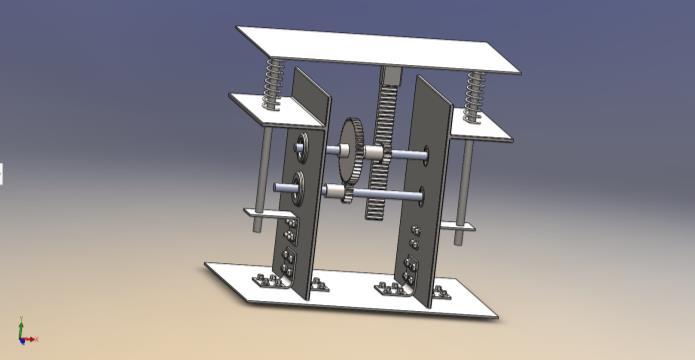
Fig.-3: 3DDesigninSolidWorks
ThisplanismadeutilizingSolidWorksProgramming.Many orders like square shape, line, and so forth were utilized. Making a 3D model of the framework in SolidWorks is a significant piece of the venture, creating all system components.Gatheringoftherelativemultitudeofpartsin SolidWorkswiththeappropriateaspectswillbedone.
2.3 Connection of Piezoelectric Sensors
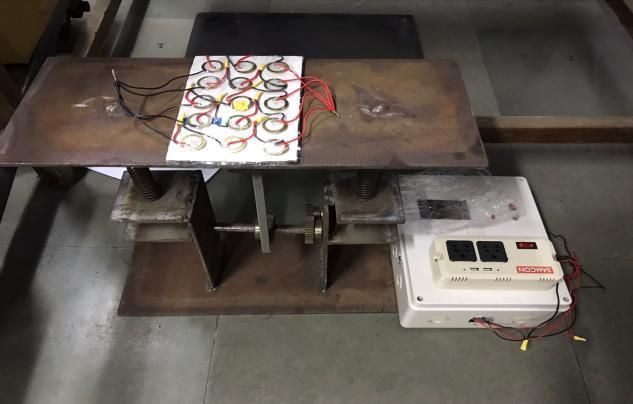
Thepiezoelectrictransducerwillbeassociatedinseriesand equal association. Prior to utilizing the piezoelectric
International Research Journal of Engineering and Technology (IRJET) e-ISSN: 2395-0056
Volume: 11 Issue: 08 | Aug 2024 www.irjet.net p-ISSN: 2395-0072
transducertocreateelectricenergy,theassociationwasnot set in stone to pick the improved result from the piezoelectric transducer. The figure depicts three seriesconnectedpiezoelectrictransducers.Twoarrangementsof three piezoelectric that are associated in series are appended in lined up for series-equal association The multimeterisassociatedwiththepiezoelectrictransducers toquantifythevoltageandflowacrosstheassociation.
2.4 Working Principle of the Model
Atthepointwhenpowerisappliedtotheplate,thespring gets packed. The Rack here drops upward down. This outcomeinapivotofthepiniongearcoincidedwiththerack gear. The pinion moves one full circle for each full compression. At the point when power gets let out of the plate,thepinionturns1roundtripintheoppositecourse. Thiscauses a pivot ofstuffmatches(gearsAn andB). The upperplate'spiezoelectricsensortilewillalsobesubjectedto simultaneousforce.Thegeneratorassociatedwiththelast stuffandPowerappliedonapiezoelectrictilebringsabout thepowerage.Asaresult,thissystemwillgeneratepowerin both directions. An AC-DC converter bridge connects the generator'soutputtoa12Vleadacidbattery.ThisBattery willstorethegeneratedenergy.StepCountsandgenerated voltagewillbedisplayedonanLEDDisplayconnectedtoit.
3. TECHNICAL ANALYSIS
1. Spec details for gears:
Parameters Rack Gear Pinion Gear/ Spur Gear No.ofTeeth 35 25 PressureAngle 20 Degrees 20 Degrees
PitchDiameter - 50
2. Battery specifications:
Lead Acid Battery recharge rating stands at twelve volts alongwithoneamp-hourcapacity(12V&1.3Amp).
3. Charging Time:
Theproducedenergyisappliedtothefootstepsandstored in a storage device called BATTERY. So, it is taken as an essentialphenomenontodeterminethechargingtimetaken by the battery. In this project, the battery is used with a batteryratingof1.3AH(amperehour).
Charging Time=Battery Rating/Charging Current
4. Battery Backup Time:
Battery Backup Time=Battery Rating/Load Applied
5 Theoretical Power Output:
To calculate the power generated theoretically, it is importanttodeterminetheforceexertedonthemodel.Let theforceappliedbecalculatedas,
Force = m.g
Work done =Force x Displacement Power= Work done/Sec
Let the load applied by the body be 50kgs, then we can considerthemaximumdisplacementofthespringas0.05m Thenweget,
Force =50 x 9.81=490.5N
Work done =490.5 x 0.05 i.e., work done = 24.525 J
Power=24.525\60 i.e., power =0.4087 J/s
Power generated per hour = 0.4087 x 3600 = 1471.5 Watts
6
Power can be calculated in terms of obtained voltage and current when the load is applied to the footsteps. The readingsarenotedbyusingtheMultimeter.
Power = Voltage x Current
Here,whenthefootisdepressedduetotheappliedloadon thefootstepsthecalculatedpowerisasfollows.
Letusassume, foronestepof20kgofloadappliedonthe footsteps, the generated voltage is 2.6V and the average currentproducedis12milliamps.Then,
Power generated = 2.6 x 0.012 = 0.0312
Power generated per hour is 0.0312 x 3600 = 112.3 watts.
Thus,theobtainedpowerforcontinuousloadappliedonthe footstepsfor1houris 112.3 watts.
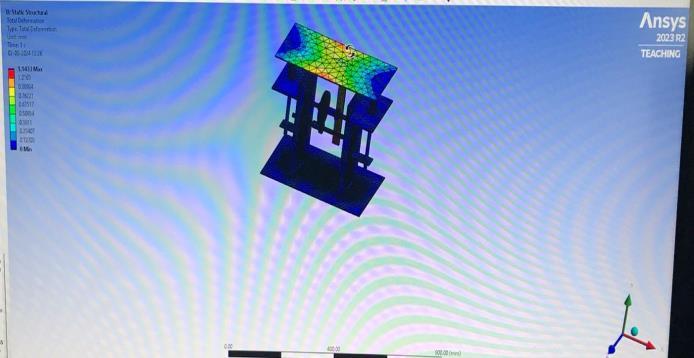
Astaticstructuralanalysisdecidestherelocations,stresses, deformations, strains, and powers in designs or parts broughtaboutbyloadsthatdon'tprompthugelatencyand dampingimpacts.
It is essential to know how much distortion is on the top platewhentheparticularburdenisapplied.Forthisreason, thestaticstructuralanalysisisactedintheAnsys,bytaking intoaccountthetypicalloadofapersonforexample60Kg
International Research Journal of Engineering and Technology (IRJET) e-ISSN: 2395-0056
Volume: 11 Issue: 08 | Aug 2024 www.irjet.net p-ISSN: 2395-0072
Themaximumtotaldeformationwegetis1.1433mmand Theminimumtotaldeformationwegetis0mm.
4. CONCLUSION
This project is the most efficient and reasonable energy answer for everyday citizens. This can be utilized for the overwhelming majority of applications in country regions wherepoweraccessibilityisextremelylowormissing. By utilizing this model, we can drive D.C. loads. It is particularlyappropriateforuseinjam-packedregions.This can be utilized in road lighting, as a charging port, and lightingforasphaltsidestructures.
Intheeventthatthissystemisconveyedthennotjust,we candefeattheenergyemergencyissueyetthislikewiseadd tomakingasolidworldwidenaturalchange.Itisashrewd andsolidframeworkandproducesupto2000Wofpower
A piezoelectric tile is equipped to produce more voltage whenamoredrawn-outtimeistaken.Subsequently,power will be produced in both the ways from rack and pinion systemandpiezoelectricsensorstileonthetop.Thispower canbeeasilystoredinthebattery.
5. ACKNOWLEDGEMENT
IwouldliketorecognizeandsaythankstoProf.Mr.Vijay BhosaleandDr.AjayGangrade,DepartmentofMechanical Engineering, KJSCE whose capable direction, excitement, imaginativethoughts,apathetictolerance,shrewdremarks, andcriticismwereusefulinthefinishofourpaper.
6. REFERENCES
1) “PowerGenerationFootstep”byShirazAfzal,Farrukh Hafeez,2015
2) “FootstepPowerGeneration”byRajeevRanjanTiwari, RahulBansal,Quamruzzaman,2019
3) “Footstep Power Generating System” by Saranya G , ManikandanV,BalajiJ,KandeshM and Karthikeyan A,2021
4) “Advanced Footstep Power Generation System Using RFID For Charging” by Regatta Sahithi Reddy, Uppala ChaitanyaPrakash,ThotaChaitanya,2022
5) “SmartFootstepsPowerGenerationSystem”byShivani MaheshPandit;NehaSalunke;TrinityChettiar;Prachi Raut,2021
6) “Experimental study on footstep power generation systemusingpiezoelectricsensor”byR.JaiGanesh,D.B. Shanmugam,S.Munusamy,T.Karthikeyan,2021
7) “Parametric analysis of piezoelectric-sensor array in foot step power generation system” by Sanjit V K; Nirmitha S; Remya Jayachandran; Vijayadurga P; YashaswiniGY,2022
8) Munaswamy, B. et al. (2018) „Mechanical Footstep PowerGeneration‟,5(2),pp.291–298.
9) Pokale,R.S.(2016)„DesignandanalysisofaMechanical Devicetoharvestenergyfromhumanfootstepmotion‟, 3(1),pp.1–5.
10) HR Nayan, “Power Generation Using Piezoelectric Material,” Journal of Material Sciences & Engineering JournalofMaterialSciences&Engineering,vol4,pp1-4, 2015.