
International Research Journal of Engineering and Technology (IRJET) e-ISSN: 2395-0056
Volume: 11 Issue: 08 | Aug 2024 www.irjet.net p-ISSN: 2395-0072
International Research Journal of Engineering and Technology (IRJET) e-ISSN: 2395-0056
Volume: 11 Issue: 08 | Aug 2024 www.irjet.net p-ISSN: 2395-0072
Shaikh Shadab Hossain1, Surya AM2, Ullas C3, Girija S4
1,2,3Department of Electronics and Communication, Dr.Ambedkar Institute of Technology, Bengaluru, Karnataka, India
4 Professor, Dept. of Electronics and Communication, Dr.Ambedkar Institute of Technology, Bengaluru, Karnataka, India ***
Abstract - Quantum computers are the next great technology that will take over the world, because of it applications on difficult problems related to the classical computers. The proposed work attempts to create an ALU usingthequantumtechnologyanditscircuitsusingquantum gates. The ALU performs 7 qubit operations in the local simulator and also the same is executed on the cloud on the using the quantum computer hosted by IBM. Analysis is carried to find the differences between the simulator output and the quantum computer output. Here a 16 qubit ALU capable of performing all the arithmetic and logical operations is also built, that executes on the simulator. The simulator locally replicates the properties of quantum computer on local system.
Key Words: Qubits, Qiskit, ALU, Registers, Gates
1.INTRODUCTION
Quantum computing is an advanced form of computing rooted in quantum mechanics, combining principles from physics, mathematics, computer science, and information theory. It offers significant advantages over classical computers, such as higher computational power, lower energyconsumption,andexponentiallyfasterprocessing,by manipulatingmicroscopicparticleslikeatoms,electrons,and photons.
Thispaperintroducesquantumcomputing,beginningwith the evolution of traditional computing and the limitations thathaveledtothedevelopmentofquantumtechnologies.It explainsthebasicconceptsofquantumcomputing,including keyquantumpropertieslikesuperposition,entanglement, andinterference.
The paper also explores the architecture, hardware, software,design,types,andalgorithmsspecifictoquantum computers,highlightingtheirpotentialimpactonareassuch ascybersecurity,trafficoptimization,medicine,andartificial intelligence. While small-scale quantum computers are currently being developed, ongoing research suggests a promisingfutureforthistechnology.
Finally,thepaperdiscussestheimportance,advantages,and disadvantagesofquantumcomputers,emphasizingtheneed to understand the challenges of traditional computing to fullyappreciatethepotentialofquantumtechnology.
Classical computers use bits that represent either 0 or 1, while quantum computers use qubits, which can exist in superpositions of states, representing both 0 and 1 simultaneously. Each state in a superposition has an associatedamplitude,acomplexnumberthatdiffersfromthe positiveprobabilitiesinclassicalcomputing.Bymanipulating theseamplitudes, quantumalgorithmscan amplifycorrect answersandcanceloutincorrectones,offeringasignificant speed advantage over classical computers for certain problems.
Quantumcomputingpowerincreasesexponentiallywiththe number of qubits, unlike the linear relationship between transistors and processing power in classical computing. Quantum computers excel in tasks like optimization, data analysis,andsimulations,whereasclassical computersare bettersuitedforeverydayprocessingtasks
Themainobjectivesofourproposedsystemareasfollows:
Todevelopcomputingsystemusingquantumgates toanalyseitsperformance.
Toolstoleveragethequantumparadigmtodevelop anALU.
4/8qubitALUforperformingarithmeticandlogical operations on numbers such as Addition, Subtraction,AND,OR, NOT.
SimulationofthequantumcircuitusingQiskitand IBMcloudquantumlab.
Comparisonandanalysisofotherquantummodules withrespecttoQiskit.
International Research Journal of Engineering and Technology (IRJET) e-ISSN: 2395-0056
Volume: 11 Issue: 08 | Aug 2024 www.irjet.net p-ISSN: 2395-0072
Overview on Quantum Computing and its Applications in ArtificialIntelligence[15]:-
This paper explores the fundamental components of quantumcomputingandexaminesitspotentialtoenhance artificialintelligence(AI)applications.Quantumcomputing and AI share several complementary features. Quantum computersofferAIandmachinelearningalgorithmsfaster trainingtimesandgreatercomputationalpoweratalower cost, while AI can contribute essential error correction algorithms to quantum computing. The paper highlights successful implementations of AI algorithms on quantum computers, including unsupervised learning methods like clustering and principal component analysis, as well as supervised learning techniques such as support vector machines.
Reversible Arithmetic Logic Gate (ALG) for Quantum Computation[7]:-
Currently,computationsbasedonBooleanalgebrausing silicon-basedsemiconductortechnologyareirreversibledue to a mismatch between thenumber of inputs andoutputs. Reversiblelogiccircuits,whichmapuniqueinputstounique outputs,offerasolution,enablingemergingapplicationssuch as low-power design, quantum computation, optical computing, bioinformatics, and nanotechnology. The ArithmeticLogicUnit(ALU),akeycomponentincomputing, performs intensive arithmetic and logical operations. This paperemphasizestheneedforareversibleALUtosupport futurecomputingtechnologies.Itproposesa4x4reversible gatethatperformsbotharithmeticandlogicoperations,and comparesitwithotherreversiblegateslikeTSG,HNG,and MKGintermsofquantumcost,I/Olines,andToffoligates. Theproposedgateoutperformsexistingmethods,ensuring efficient execution of operations such as full addition, full subtraction, and various logical operations with reduced hardwarecosts,whereothergatesfallshort.
TheImplementationofReversibleGatesinDesignof1bit,4bitALUand8b/10bEncoder&Decoder[8]:-
Theuseofconventional,irreversiblelogicgatescanresult in high power consumption and is incompatible with quantumcomputation.Reversiblecircuits,ontheotherhand, areessentialforquantumcomputingandhaveapplicationsin digitalcommunication,signalprocessing,cryptography,and computer graphics. These circuits minimize gate usage duringsynthesisandavoidredundantinput-outputpairs.This paperpresentsthedesignof1-bitand4-bitarithmeticlogic units (ALUs), as well as an 8b/10b encoder and decoder, using both conventional and reversible logic gates. The designsweresynthesizedonFPGAandcodedandsimulated using Xilinx 14.7 and ModelSim 6. Performance analysis, considering factors like propagation delay, quantum cost,
garbage outputs, and the number of reversible gates used, showsthattheproposeddesignsdeliversuperiorresults.
Low Power 8 Bit quantum ALU Implementation Using ReversibleLogicStructure[9]:-
Reversible computation, which leverages principles of quantummechanics,hassignificantlyinfluenceddigitallogic design.Reversiblelogicunits,essentialforrecoveringinput states from outputs, will impact instruction sets and highlevel programming languages, necessitating their reversibilityforoptimalefficiency.Futureadvancementsin reversible logic will pave the way for new computer architecturesandenhancedquantumalgorithms.
While much of the literature has focused on designing reversiblelogic gate structures and arithmetic units, there hasbeenlimitedefforttowardsdevelopingreversibleALUs. Thisworkintroducesnovelprogrammablereversiblelogic gates and demonstrates their application in designing a reversible Arithmetic Logic Unit (ALU). An 8-bit ALU was designedandverifiedusinga1-bitALU,anditwascompared withexisting8-bitALUsintermsofpowerdissipationand propagationdelay.TheproposedALUoffersmoreoperations with a given number of select inputs and consumes less power, making it suitable for low-power VLSI design, nanotechnology,quantumcomputing,andopticalcomputing.
Classical Qiskit is an open-source SDK for working with quantumcomputers,allowinguserstocreateandmanipulate quantum programs. These programs can run on IBM Quantum Experience devices or local simulators. Qiskit supportsquantumhardwarelikesuperconductingqubitsand trapped ions, following the circuit model of quantum computation.

International Research Journal of Engineering and Technology (IRJET) e-ISSN: 2395-0056
Volume: 11 Issue: 08 | Aug 2024 www.irjet.net p-ISSN: 2395-0072
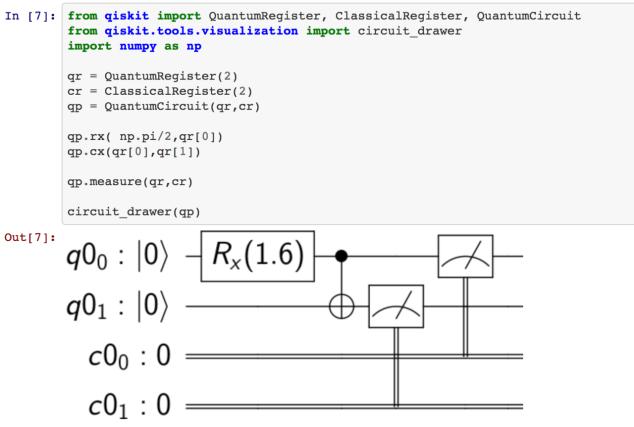
Qiskit,developed by IBMResearch,isan open-source SDK created to support software development for IBM's cloud quantumcomputingservice,IBMQuantumExperience,with contributionsfromacademicinstitutions.Whiletheprimary version is in Python, early explorations into Swift and JavaScript have ceased, leading to the development of MicroQiskit, a simplified version for alternative platforms.Qiskit provides various Jupyter notebooks that demonstrate quantum computing applications, including exercises and source code for scientific studies. An opensourcetextbookbasedonQiskitservesasauniversity-level supplement for courses on quantum algorithms and computation.
Qiskitiscomposedofelementsdesignedtomakequantum computingaccessibletousersofallskilllevels,allowingthem to design, experiment, and run applications on quantum computersorsimulators.Itsupportsdevelopmentfromlowlevelmachinecode(OpenQASM)tohigherabstractionlevels for non-experts. The circuit library offers a collection of essential circuits and gates, which can be used to build algorithms or work with circuits difficult to simulate classically
Transpilation, a key process in Qiskit, involves rewriting quantum circuits to align with a specific device's topology and optimizing them for noisy quantum systems. This process,whichoftenincludesiterativeandconditionalsteps, ensuresthat
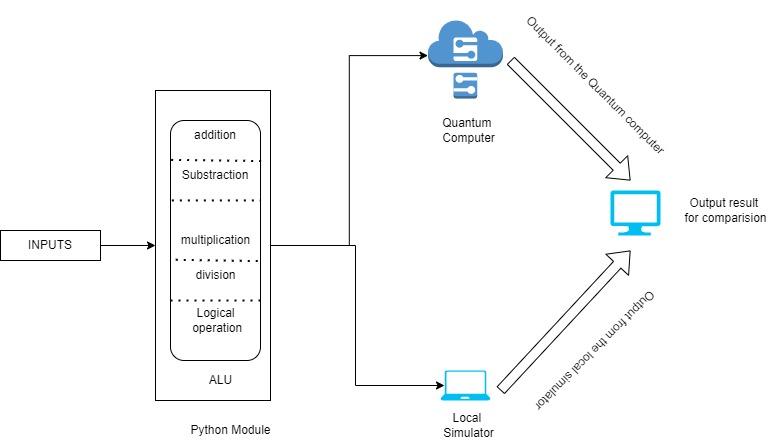
We developed a 7-qubit ALU that operates on both a local simulatorandanactualquantumcomputerinthecloud.A comparisonbetweenthetworevealedasignificantexecution timedifference.Additionally,wecreateda16-qubitALUthat runsonthesimulator,asthecurrentquantumcomputeronly supportsupto7qubits.
Quantum computers have the potential to transform computation by solving problems that are intractable for classicalcomputers.Althoughnoquantumcomputerisyet capable of outperforming classical computers, significant progressisbeingmade.Severalcompanieshavedeveloped non-error-correctedquantumcomputerswithtensofqubits, some of which are accessible to the public via the cloud. Quantum simulators are also advancing in areas like molecularenergeticsandmany-bodyphysics.
Asthesesmallsystemsbecomeavailable,anewfieldfocused on near-term quantum applications is emerging. This progresscouldenableustorealizesomeoftheadvantagesof quantumcomputingwellbeforethedevelopmentoflargescale,error-correctedquantumcomputersisachieved.
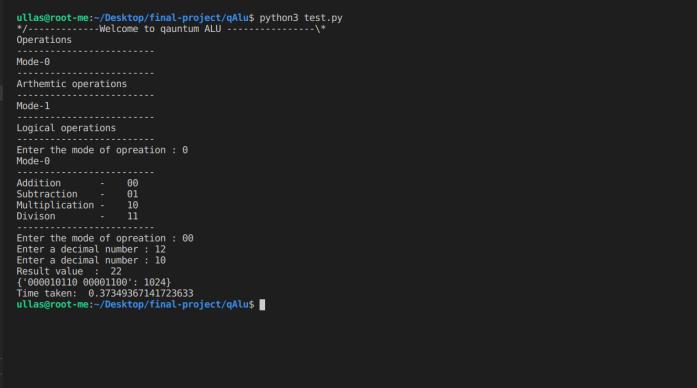
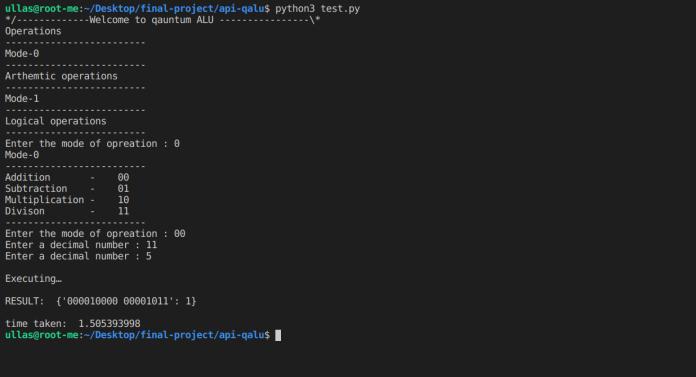
For Addition (fig 2) the number is first converted to its binaryformandthenthebinaryformissenttothesimulator andthequantumcomputerinthecloudwhereitutilizesbigendiantoreadthebinarynumberandthenperformaddition
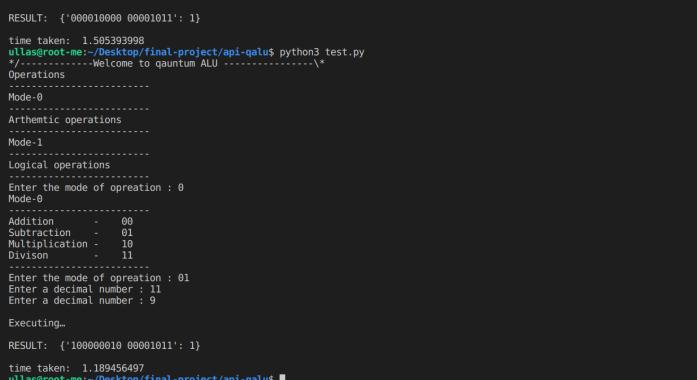
For Subtraction(fig3) the number is first converted to its binaryformandthenthebinaryformissenttothesimulator andthequantumcomputerinthecloudwhereitutilizesbigendian to read the binary number and then perform Subtraction
Volume: 11 Issue: 08 | Aug 2024 www.irjet.net
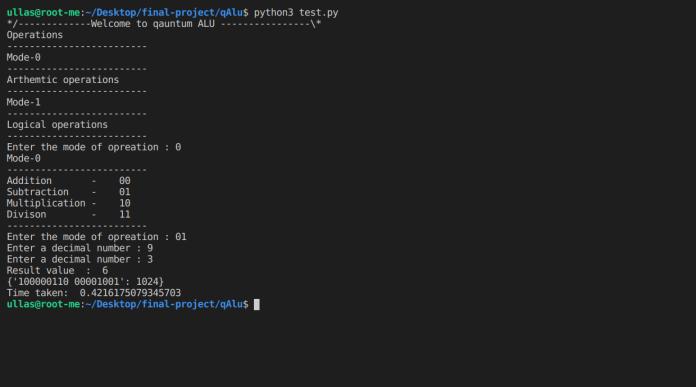
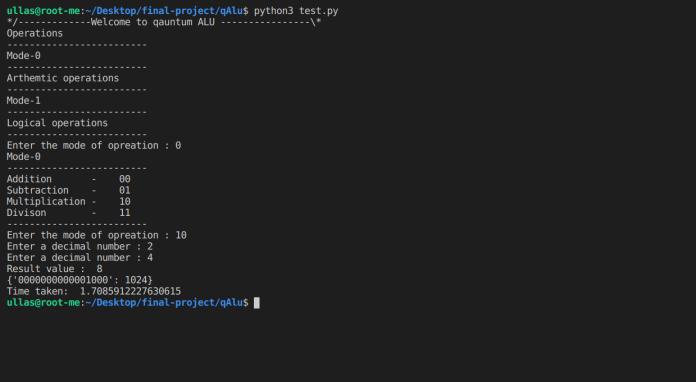
ForMultiplication(fig4)thenumberisfirstbroughttothe closestmultipleof10byaddingorsubtractinganumberthen theaddedorsubtractednumberisalsomultipliedwiththe multiplierandthenthefirstconvertedtoitsbinaryformand thenthebinaryformissenttothesimulatorandthequantum computerinthecloudwhereitutilizesbig-endiantoreadthe binarynumberandthenperformmultiplicationafterthatit addsorsubtractsaccordingtotheoperationperformedinthe beginning
6.4
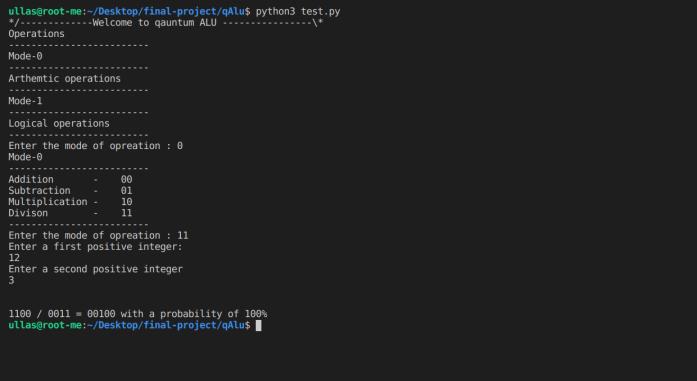
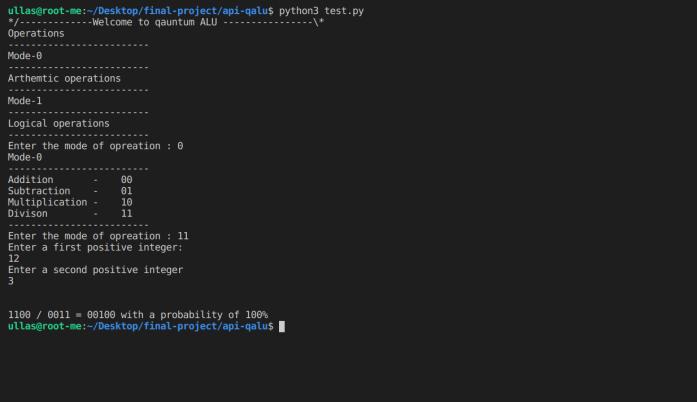
ForDivision(fig5)thenumberisfirstbroughttotheclosest multipleof10byaddingorsubtractinganumberthenthe added or subtracted number is also multiplied with the multiplierandthenthefirstconvertedtoitsbinaryformand thenthebinaryformissenttothesimulatorandthequantum computerinthecloudwhereitutilizesbig-endiantoreadthe binarynumberandthenperformdivisionafterthatitaddsor subtracts according to the operation performed in the beginning.
6.5
ForOROperation(fig6)thenumberisfirstconvertedtoits binaryformandthenthebinaryformissenttothesimulator andthequantumcomputerinthecloudwhereitutilizesbigendian to read the binary number and then operation is performed.
ForANDOperation(fig7)thenumberisfirstconvertedtoits binaryformandthenthebinaryformissenttothesimulator andthequantumcomputerinthecloudwhereitutilizesbigendian to read the binary number and then operation is performed
International Research Journal of Engineering and Technology (IRJET) e-ISSN: 2395-0056
Volume: 11 Issue: 08 | Aug 2024 www.irjet.net p-ISSN: 2395-0072
ForXOROperation(fig8)thenumberisfirstconvertedtoits binaryformandthenthebinaryformissenttothesimulator andthequantumcomputerinthecloudwhereitutilizesbigendian to read the binary number and then operation is performed
7. CONCLUSION
Quantumcomputingispoisedtorevolutionizeourapproach to solving complex problems. Although still in its developmentalinfancy,thistechnologyholdsthepromiseof significantadvancementsinareaslikeprocessoptimization, cryptography, and machine learning. Despite existing challengessuchastheneedforspecializedalgorithmsand therequirementforextremeoperationalconditions,recent developments indicate that quantum computers may eventually surpass classical systems in tackling specific, previouslyintractableproblems.
Inourstudy,wedevelopeda7-qubitArithmeticLogicUnit (ALU)andtesteditusingbothlocalsimulatorsandcloudbasedquantumcomputers,uncoveringanotabledifference inexecutiontimesbetweentheseplatforms.Additionally,we designed a 16-qubit ALU to simulate the actual quantum computer of current cloud-based systems, which are restrictedtoamaximumof7qubits.Theseresultshighlight the potential of quantum computing as well as its current hardware constraints. With ongoing technological advancementsandincreasingaccesstoquantumsystemsvia cloud platforms, we are approaching a future where the theoretical advantages of quantum computing may soon become practical, marking the dawn of a new era in computation.
[1] IBMResearchBlog.2019-10-22.Retrieved2020-01-21
[2] "On"QuantumSupremacy"".IBMResearchBlog.201910-22.Retrieved2020-01-21.
[3] "Googleresearchershavereportedlyachieved"quantum supremacy"".MITTechnologyReview.
[4] Das,A.;Chakrabarti,B.K.(2021)."QuantumAnnealing andAnalogQuantumComputation".Rev.Mod.Phys.80 (3):1061–1081.arXiv:0801.2193.Bibcode:2008RvMP...80.1061D.Cit eSeerX10.1.1.563.9990. doi:10.1103/RevModPhys.80.1061.S2CID14255125.
[5] (2021).StatisticalStructureofQuantumTheory.Lecture NotesinPhysics.-Holevo,AlexanderS.
[6] Ying,M.(2019).Quantumcomputation,quantumtheory and AI. Artificial Intelligence, 174(2), 162– 176. doi:10.1016/j.artint.2009.11.009. reaction-using-aquantum- computer-MikeMcrae
[7] Reversible Arithmetic Logic Gate (ALG) for Quantum Computation M. Arun1∗ , S. Saravanan2 1 School of Electronics Engineering, VIT University, Vellore632014, India 2 Department of ECE, PSG College of Technology,Coimbatore-634002,India.
[8] The Implementation of Reversible Gates in Design of 1bit,4-bitALUand8b/10bEncoder&DecoderNayana D.K1,SujathaB.K21ResearchScholar,JainUniversity, Associate Professor, School of Electronics & Communication Engineering, REVA University, Bangalore,India.2HeadandProfessor,Departmentof TelecommunicationEngineering,M.S.R.I.T.,Bangalore, India.
[9] LowPower8BitquantumALUImplementationUsing ReversibleLogicStructureVijayG.Roy1,P.R.Indurkar2 , D. M. Khatri3 1, 2, 3RTMNU, Nagpur University, B.D.C.O.E.,Sevagram,Wardha,M.S.,India.
[10]Forthcoming applications of quantumcomputing: peekingintothefutureVikasHassija1,VinayChamola2, Adit Goyal1, Salil S. Kanhere3, Nadra Guizani41DepartmentofCSEandIT,JaypeeInstituteof Information Technology, Noida, India2Department of ElectricalandElectronicsEngineering,BITSPilani,Pilani, India3School of Computer Science and Engineering, UNSWSydney,Australia4SchoolofElectricalEngineering and Computer Science, Washington State University, Pullman,WA99163,USA.
[11]Quantum Computing: Principles and Applications Yoshito Kanamori (University of Alaska Anchorage) Seong-MooYoo(UniversityofAlabamainHuntsville)
[12]QuantumComputers:Registers,GatesandAlgorithms, PaulIsaacHagouelandIoannisG.Karafyllidis.
[13]DesignofImprovedArithmeticLogicUnitinQuantumDotCellularAutomataSaeedRasouliHeikalabad1Mahya RahimpourGadim1
[14]Quantum Computing Circuits and Devices Travis S. Humble1,HimanshuThapliyal2,EdgardMu˜noz-Coreas2,
International Research Journal of Engineering and Technology (IRJET) e-ISSN: 2395-0056
Fahd A. Mohiyaddin1*, Ryan S. Bennink 1Quantum ComputingInstitute,OakRidgeNationalLaboratory,Oak Ridge, Tennessee USA 2Department of Electrical & Computer Engineering, University of Kentucky, Lexington, Kentucky USA*Present Address : Semiconductor Technology and Systems, Imec, Kapeldreef75,3001Leuven,Belgium.
[15]OverviewonQuantumComputinganditsApplicationsin Artificial Intelligence Nahed Abdelgaber, Dr. Chris Nikolopoulos Computer Science and Information SystemsBradleyUniversityPeoria,Illinois,USA.
[16]R.Landauer,Irreversibilityandheatgenerationinthe computing process, IBM Journal of Research and Development,5(1961)183-191.
[17] S. G. Younis and T. F. Knight, Asymptotically zero energysplit-levelchargerecoverylogic,inProc.Wkshp. LowPowerDesign,1994,pp.177-182.
Volume: 11 Issue: 08 | Aug 2024 www.irjet.net p-ISSN: 2395-0072 © 2024, IRJET | Impact Factor value: 8.226 | ISO 9001:2008