
International Research Journal of Engineering and Technology (IRJET) e-ISSN: 2395-0056
Volume: 11 Issue: 08 | Aug 2024 www.irjet.net p-ISSN: 2395-0072

International Research Journal of Engineering and Technology (IRJET) e-ISSN: 2395-0056
Volume: 11 Issue: 08 | Aug 2024 www.irjet.net p-ISSN: 2395-0072
MAYANK SAHU1 , Prof. JASPREET WALIA2
1P.G. Student M.I.T.S. Gwalior (M.P.)
2Assistant Professor at Madhav Institute of Technology and Science, Gwalior(M.P.)
Abstract - Urbanization is a global phenomenon transforming cities and their transportation systems. With rapid urban growth comes increased vehicular traffic, often leading to congestion and associatedchallenges.Thisresearch paper presents a case study of Jabalpur City in India to assess the impact of urbanization on traffic congestion and explore potential mitigation strategies. The study begins with a comprehensive literature review to establish the theoretical framework and identify key factors contributing to urban traffic congestion. Drawing upon existing research, the paper outlines the various dimensions of urbanization, including population growth, economic development,andinfrastructure expansion, and their implications for traffic congestion. Using a mixed-methods approach, the research employs both quantitative and qualitative analyses to assess the current state of traffic congestion in Jabalpur City.
The research contributes to the understandingofurbantraffic congestion dynamics in the context of rapid urbanization, offering valuable insights for urban planners, policymakers, and transportation authorities in Jabalpur City and similar urban centers facing similar challenges. Ultimately, the study aims to inform evidence-based strategies for sustainable urban mobility and enhance the quality of life for residents in Jabalpur City.
Key Words: Urbanization, Traffic congestion, Smart city, transportation.
1.INTRODUCTION
Urbanizationisa definingfeatureofthemodern era, with more than half of the world's population now residing in cities. This rapid urban growth brings about numerous benefits,includingeconomicopportunities,improvedaccess toservices,andculturalvibrancy.However,italsopresents significant challenges, particularly in the realm of transportation.Oneofthemostpressingissuesassociated withurbanizationistrafficcongestion,whichhasbecomea pervasiveprobleminmanycitiesworldwide,includingthose in India. This research paper aims to assess the impact of urbanization on traffic congestion in Jabalpur City and explorepotentialstrategiestoaddressthispressingissue.
The focus of the study is analyzing the impact of urbanizationontrafficcongestion.
Urbanizationisanindexoftransformationfromtraditional ruraleconomiestomodernindustrialone.Itisprogressive concentration (Davis, 1965) of population in urban unit. Quantification of urbanization is very difficult. It is a long termprocess. KingsleyDavishasexplainedurbanizationas process(Davis,1962)ofswitchfromspreadoutpatternof humansettlementstooneofconcentrationinurbancenters. Itisafiniteprocess acyclethroughwhichanationpassas they evolve from agrarian to industrial society (Davis and Golden,1954). Hehasmentionedthreestagesintheprocess ofurbanization.Stageoneistheinitialstagecharacterizedby rural traditional society with predominance in agriculture and dispersed pattern of settlements. Stage two refers to accelerationstagewherebasicrestructuringoftheeconomy and investments in social overhead capitals including transportation,communicationtakeplace.
The number of total population has increased from 23.84 croresin1901to102.7croresin2001whereasnumberof populationresidinginurbanareashasincreasedfrom2.58 crores in 1901 to 28.53 crore in 2001. India’s urban populationconstitutesasizeableproportionofworld’surban population.Thiscanbewellcorroboratedformthefactthat every 12th city dweller of the world and every 7th of the developingcountriesisfromIndia.
Urbanpopulationincreasedfrom26millionin1901to62 millionin1951–anincreaseofonly36millionin50years. Buttheabsoluteincreaseduringthenextthreedecadeswas oftheorderof94millionduring1951-81.Thisindicatesthat programmesofindustrializationdidmakeanimpactinterms ofpopulationabsorptioninurbanareas,thoughitsimpact wasverydiscernible.During1981-91,urbanpopulationin absolutetermsreachedthefigureof285millionaccounting for27.8percentoftotalpopulation.
International Research Journal of Engineering and Technology (IRJET) e-ISSN: 2395-0056
Volume: 11 Issue: 08 | Aug 2024 www.irjet.net p-ISSN: 2395-0072
Table -1: PopulationofIndiabyResidence(1901-2001)
1901 1827 238396327 25851873 212544454
1911 1825 252093390 25941633 226151757
1921 1949 251321213 28086167 223235046
1931 2072 278977238 33455989 245521249
1941 2250 318660580 44153297 274507283
1951 2843 361088090 62443709 298644381
1961 2363 439234771 78936603 360298168
1971 2590 598159652 109113977 489045675
1981 3378 683329097 159462547 523866550
1991 3768 844324222 217177625 627146597
2001 5161 1027015247 285354954 741660293
Source:CensusReport,Govt.ofIndia,1901-2001
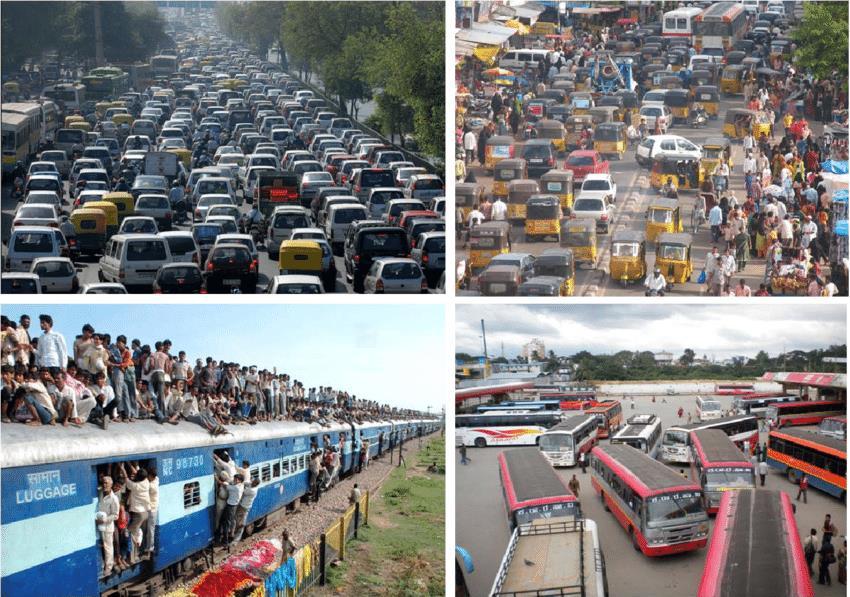
Thereare300millioncars,trucksandbusesworldwide. There will be heavy traffic jams at major junctions during peak hours. Traffic jams lead to excessive wastage of petroleum products leading to fuel problems. During rush season, vehicles are parked and overloaded, hence the chances of accidents are higher. Combustion of petroleum products and diesel increases carbon dioxide which contributes to global warming, air pollution and noise pollution,besidescarbondioxide,carbonmonoxidewhichis emittedbyautomobiles.Noisepollutionaffectsbothhearing andnon-hearingorgans.Auditoryeffectsincludefatigueand deafnessinhumans.On-auditoryeffectsincludeinterference withmovement,communication,irritation,lossofworking capacity,andpsycho-physicaldisorders.WhileMumbaistill has the best urban transport system and city buses are reasonablyavailableinChennai,AhmedabadandPune,the transportpictureinallIndiancitiesisgrim.Onereasonwe arestuckinthismessisthatwhenplanningcityexpansion, we still follow the Western concept of travel time and distanceasdeterminantsofthelocationofactivities.Thishas ledtothedivisionofcitiesintozoning,whichrequiresmore travel.Also,ourcitizensareunabletopaythefinancialfareto use the public transportation system due to low income levelsandaffordability.Therefore,allcitybusservicessuffer suchlargeannuallossesthattheycannotexpandormaintain thefleettomeettheneedsofthecity.
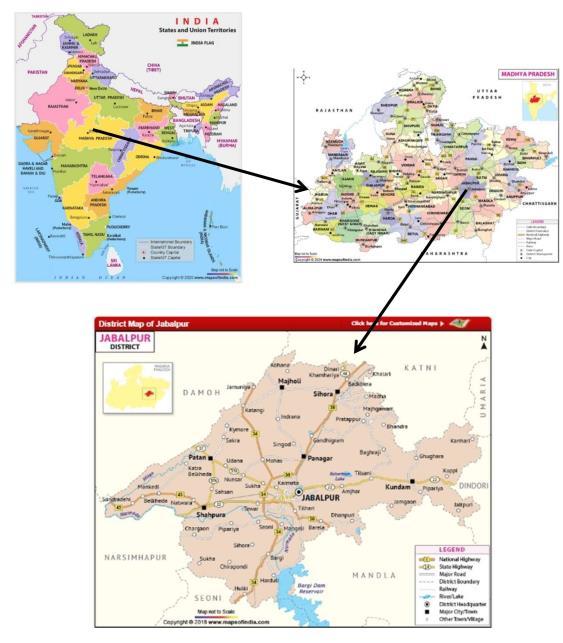
Fig-2:LocationmapofthestudyareaJabalpurcity (Source:http://www.mapsofindia.com) Census
Jabalpur, a significant city in the central Indian state of Madhya Pradesh, has undergone substantial urbanization over the past few years. With its rich history, educational institutions, and industrial growth, Jabalpur offers a fascinating case study for analyzing the impacts and processes of urbanization in a mid-sized Indian city. This investigationdelvesintothevariousaspectsofurbanization in Jabalpur, such as population shifts, infrastructure improvements, economic growth, social changes, and environmentalchallenges.Jabalpurboastsarichhistorical heritage,havingservedasasignificanthubduringthereigns ofvariousdynasties,includingtheKalchuris,Gondwana,and Marathas.
International Research Journal of Engineering and Technology (IRJET) e-ISSN: 2395-0056
Volume: 11 Issue: 08 | Aug 2024 www.irjet.net p-ISSN: 2395-0072
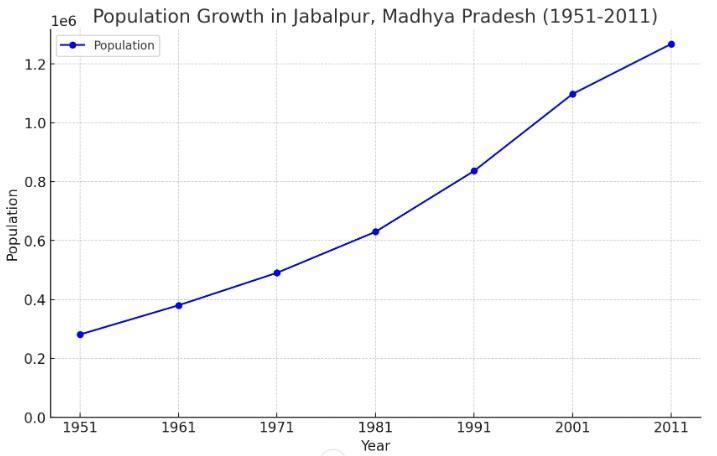
Urbanization in Jabalpur is characterized by substantial population growth. As per the 2011 Census of India, Jabalpur'spopulationsurpassed1.26million,representinga considerable rise from prior years. This growth can be attributedtobothnaturalincreaseandmigrationfromrural areasandsmallertowns,whereindividualsseekimproved employmentprospectsandlivingstandards.
Urbanizationtypicallyboostseconomicgrowth,resultingin jobcreationandhigherincomelevelsforthepopulation.In Jabalpur, like in numerous other urbanizing areas, the growthofindustries,services,andcommercehasenhanced the standard of living. As people have more disposable income,theyareabletoaffordvehicles,leadingtoarisein vehicleownership.
Asthenumberofvehicleownersgrows,sodoesthetraffic congestion on the roads, resulting in extended commute timesandheightenedstresslevels.
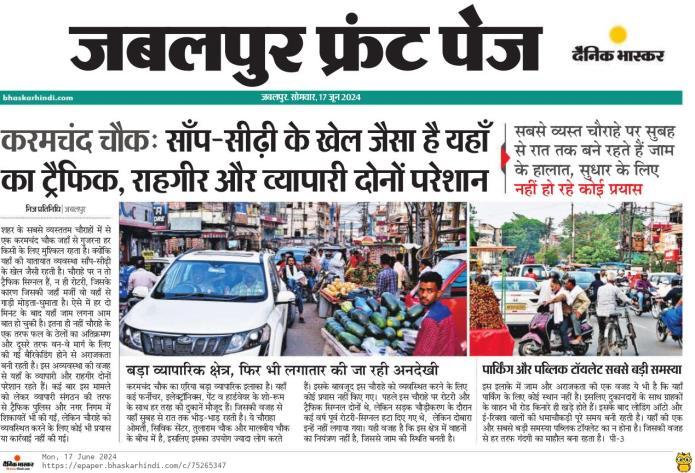
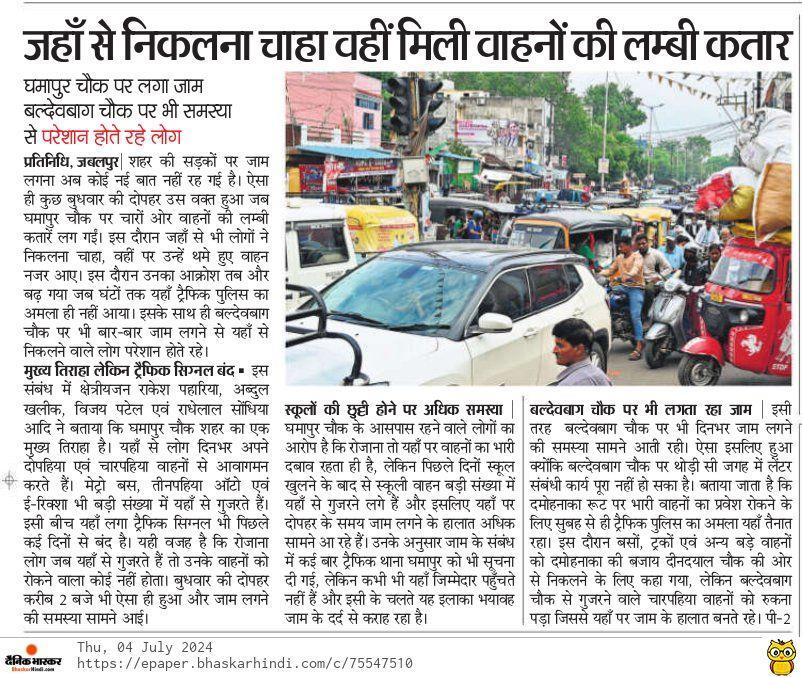
An increased quantity of vehicles on the road leads to enhancedairpollution,whichmayresultinsignificanthealth consequencesfortheinhabitantsofurbanareas.
Urbanization presents both opportunities and challenges, withtrafficcongestionbeingasignificantissuethatimpacts the economic, environmental, and social aspects of urban life. To tackle this problem, a comprehensive approach is necessarythatincludesinvestmentsinpublictransportation, infrastructuredevelopment,improvedurbanplanning,and effectivepolicymeasures.Byimplementingthesestrategies, cities can reduce the negative consequences of traffic congestionandpromotesustainableurbandevelopment.
[1] DavisKingsley(1962):"UrbanisationinIndia–Pastand Future",inTurner,R.(ed.)India'sUrbanFuture,University ofCaliforniaPress,Berkley.
International Research Journal of Engineering and Technology (IRJET) e-ISSN: 2395-0056
Volume: 11 Issue: 08 | Aug 2024 www.irjet.net p-ISSN: 2395-0072
[2] Davis, K. (1965). The urbanization of the human population.ScientificAmerican,213(3),41-53
[3] Brockerhoff, M. (1999) Urban Growth in Developing Countries: A review of Projections and Predictions, PopulationanddevelopmentReview,Vol25.No4,PP757778
[4]Brockerhoff,M.andBrennam,E(1998)Thepovertyof citiesinDevelopingRegions,PopulationsandDevelopment Review,Vol24,No1,pp75-114.
AUTHORPROFILE

MAYANK SAHU M.Plan M.I.T.S. Gwalior (M.P.)
Guide name :Prof. JASPREET WALIA
Assi. Prof. M.I.T.S. Gwalior