
International Research Journal of Engineering and Technology (IRJET) e-ISSN:2395-0056
Volume: 11 Issue: 08 | Aug 2024 www.irjet.net p-ISSN:2395-0072

International Research Journal of Engineering and Technology (IRJET) e-ISSN:2395-0056
Volume: 11 Issue: 08 | Aug 2024 www.irjet.net p-ISSN:2395-0072
Navya Krishna Alapati
VISA USA, INC ***
Abstract - The financial field is an area that does not suffer from vulnerability to various types of financial fraud, with severe losses associated with individuals and organizations. It needs to be more advanced, as using traditional rule-based systems has been proven inadequate in finding new types of fraud. As a result, there has been an increase in the demand for more sophisticated methods that can evolve with illegal activities. This paper proposes a graph-based semi-supervised learning (SSL) method for fraud detection in finance. Graph representation is a machine learning algorithm that categorizes the SSL data points into genuine and fraudulent using labelled and unlabeled behavior. Because it has more data, specifically from labelled and unlabeled samples, the SSL is trained in a larger dataset with greater diversity than the conventional method; thus, its generalization power always outperforms its traditional counterparts. Extending the graph work model to include transaction relationships and network connections is a crucial enabler, supporting complex fraud with a fast-changing nature. This makes SSL particularly well suited to detecting out-of-place behaviors that might indicate fraudulent action. To sum it up, graph-based SSL is a suitable scheme for financial fraud detection. It can retain robustness and deploy ability through the synergy of graphs with semi-supervised learning to enhance accuracy in identifying fraudulent activities. This can save financial institutions millions of dollars in losses and protect the consumers.
Key Words: Vulnerability, Financial Fraud, Organization, Illegal Activities, Generalization.
Financial fraud is a common problem, and it continues to have the worst effects on individuals and businesses. Detection and preventing fraudulent activity are essential to maintaining confidence in the system and protecting consumers' assets. Nonetheless, fraudsters continually developnewwaystocommittheircrimes,andasaresult, traditional methods of detecting fraudulent activity can become outdated[1]. Graph-based semi-supervised learning is a more promising method for solving the problems mentioned in finance fraud detection. Semisupervised learning is a machine-learning technique that uses graphical representations to learn patterns from unlabeled data. This uses a network of connected data points and their relationships to help find exceptions and predict potential fraud in the field of fraud detection.
Semi-supervised learning with a graph-based approach canincreasetheaccuracyandefficiencyoffrauddetection by integrating labelled and unlabeled data instead of purely supervised or unsupervised methods[2]. Highly Imbalanced Datasets - Fraud detection datasets are notoriously skewed towards the majority class, making thisachallengethatsemi-supervisedlearninggraspswell. Most of those transactions or activities in these datasets arelegitimate, but a tiny proportion is fraudulent[3]. This is a problem for classical machine learning models because they skew towards the dataset with more representativesandtendtounderestimate(orignore)the data minority class[4]. However, with graph-based semisupervised learning, since nodes in a graph are usually connected to their neighbors and have the same characteristics as theirs, anomalies can be detected by modelingrelationshipsbetweendatapointsthatmightnot appearthroughindividualinformation.Graph-basedsemisupervised learning may also help handle imbalanced datasets and generalize rapidly for evolving fraud patterns. Fraud Detection Needs to Stay Ahead -New scams are always in development, and old ones are learning how to beat current security measures, so we must actively change our defense mechanisms[5]. Additionally, since this method works by adjusting the linkagesbetweenpointsinitsgraphrepresentationofthe datathatitusestoidentifynewcreditcardfraud,topology changes much more rapidly than skew or channel distributions,soachangecanquicklybeincorporatedinto the analysis, furthering making for features these are bettersuited[6].Inaddition,graph-basedsemi-supervised learning can help make fraud detection in finance more efficient.Fortraditionalmethods,itbecomesnecessary to manually do feature engineering, selecting important featuresandsavingthemfromthedatatotrainthemodel. This is a slow and costly process, made even worse in cases when fraudulent activities are adaptive. Conversely, a semi-supervised learning methodology based on graphs can use the relationships among data points to automatically extract redundant feature information by itself (the labels), decreasing manual work and reducing time-to-detect fraud[7]. CreditCard Fraud Detection: As a use case of graph-based semi-supervised learning in finance, consider the example of fraud detection using creditcarddata.Foreach,wecandrawagraphoffinancial activity with the transaction as one data point and its connectiontootherdatapoints,such ashowit wasfound in our model direction history, location information, and whateverelse[8]. Themodelcandothis by examining the relationships between these data points, enabling it to
International Research Journal of Engineering and Technology (IRJET) e-ISSN:2395-0056
Volume: 11 Issue: 08 | Aug 2024 www.irjet.net
identify anomalies and flagpotentially fraudulent activity. Compared to traditional supervised learning models, this method resulted in better performance, higher accuracy, and reduced false alarms. Graph-based semi-supervised learning has also been used in finance to identify fraudulentstockmarketactivities.Inotherwords,thedata here corresponds to stock market transactions connected with news articles, tweets, or any trading patterns. The model maps out the interactions between these data points and can catch abnormal trading activity[9], suggesting an ongoing or imminent market manipulation effort. This tool could help to catch insider trading and other kinds of market manipulation, with ultimate consequences forinvestors orbroadermarkets. However, as with any human-like technology based on the graph, semi-supervisedlearningalso has limitedcapabilities and challenges. The primary challenge is the data required to train attocandela[10]. Frauds are rare in finance, so we often struggle to have sufficient labelled samples for training the model. Moreover, the model might also struggle to find fraudulent behavior that is too complex and not represented in this graph. In this case, more advanced methods like deep learning are needed. To Conclude, Graph-Based Semi-Supervised Learning: A Promising Way to Go for Currency Fraud Detection HNB fulfills a variety of reasons that make it an important enabler in the fight against fraud, as it is suitable for imbalanceddatasets,adaptstochangingfraudtrendsand optimizesgivencriteria.Despitewhateverroadblocksmay come, machine learning and technology will further enhance the ability to identify fraudulent activities occurring in financial environments. The main contributionofthepaperhasthefollowing.
Using Graph Structures: This study adopts a graph-based technique to detect finance fraud concerning entities (customer, transaction and accounts) by extracting relationships between these phenomena (entities) for pattern detection. This gives the algorithm a significant gain over traditional methodologies to reveal complicated patterns otherwise hidden in financial data representationusinggraphs.
Semi-Supervised Learning: The study adopts a semi-supervised learning method, that is, the training of the model with both labelled and unlabelled data. So, a small, labelled dataset can offer the algorithm enough information to learn more about variegated fraud. Finally, this methodology facilitates the identification of rare ornovelfraudtypesbyincludingunlabelleddata.
Ideal Feature Selection: To overcome this limitation,theproposedresearchusesaniterative feature selection approach that chooses links basedonedgesrepresentedinthegraph.Thiswill
p-ISSN:2395-0072
reduce noise in the data and thus help with making the model more efficient and accurate. Furthermore, the feature selection stage is more generalizable to various fraud scenarios, increasingitsadaptability.
ExperimentalSection:Thestudycarriesoutmore than enough experiments on real-world financial datasets to compare the proposed method's performance. The results demonstrate that our graph-based semi-supervised approach outperforms classical supervised baselines and can accurately identify fraudulent activities. Consequently, this work adds to the literature on frauddetectioninfinanceandcanassist financial institutionsinreducingtheirlossesbyidentifying fraudulentactivities.
Fraud or anomaly detection in finance is a massive problem for most financial institutions. This concern involves determining whether a given transaction is related to money laundering, identity theft, or credit card fraud. Every day, many financial transactions occur worldwide that traditional fraud-detection methods cannot detect. For the same, financial institutions are adopting more advanced procedures like Graph-based Semi-Supervised Learning GSSL to enable fast and accurate detection of fraudulent activities[11]. GSSL is a machine learning technique applied to large data sets, exploiting graph-based algorithms aimed at (semi)supervised pattern discovery and anomaly detection. It establishes how entities like customers, merchants and financial transactions are related. This network, often called a graph (since, in mathematics, an interconnected system of nodes is the definition of one), directly shows how these entities are linked to others and what interactions are between them. With the help of this graph, GSSL algorithms can recognize odd behaviors and hence flag them as potentially fraudulent[12]. Having to deal with enormous amounts of data in finance has been one major problem in detecting fraud. It is not humanly possible to manually track and analyze all financial transactions occurring daily at 1000s per second for fraudulent activities. This necessitates automated methodologieslikeGSSL[13].Becauseitusesgraph-based algorithms, GSSL can quickly handle vast volumes of data and find problems associated with potential fraud that traditional methods would likely overlook. Another issue is the ever-changing face of fraud. Unfortunately, fraudsters have gotten savvier over the years, making it increasingly difficult for rule-based systems to catch up. However, GSSL can deal with this well by learning to assignlabelsfromtheinitialpatternsandcontinuefurther on any novel data or these results. Since it is not dependent on predefined rules, it works better for
International Research Journal of Engineering and Technology (IRJET) e-ISSN:2395-0056
Volume: 11 Issue: 08 | Aug 2024 www.irjet.net
identifyingnewandgrowingformsoffraud.Inthefinance sector,frauddetectionisanothersignificantdifficulty[14]. Easilyprevalentwithintraditionalmethods,thiserrorcan be costly to financial institutions. GSSL can solve this problem due to its property using semi-supervised learning and the fact that more information is utilized during train time. Labelled data, as we refer to it in machine learning, pertains to the subset of your collected transaction features that have already been classified, i.e. fraudulent or non-fraudulent transactions, and Unlabeled data is precisely what it sounds like - this is the rest of, however many you might have gathered but hasn't positioned into a class yet (fraud vs not fraud). GSSL can be more accurate and reduce false positives using data frombothtypes.Forfinancialinstitutions,dataimbalances are one of the biggest problems with fraud detection. Though most financial transactions are legitimate, only a minusculeamountinvolvesfraud[15].Suchanimbalanced class of fraud and non-fraud cases in the data makes it difficult to identify fraudulent activities accurately by conventional methods. To address this issue, GSSL leverages a combination of resampling and cost-sensitive learningthataimstobalancethesamenumberofgenuine and fraudulent transactions to increase its capability for fraud detection. While GSSL has been a promising methodology for fraud detection in financial services, it does not come without problems[16]. The high computationalcostofapplyingtheGSSLalgorithmsisone among them. Compared to existing approaches for fraud detectioninfinance,theuniquenessofGraph-basedSemiSupervised Learning for Fraud Detection is that it utilizes graph networks more accurately to detect fraudulent activitiesinfinancialtransactions[17].Thealgorithmdoes this by modeling the relationships between account holders,merchants,andtransactionsasagraphthatitcan use to discover unexpected patterns or connections that may indicate fraud[20]. This method takes advantage of the available labelled and unlabeled data and is more efficient and accurate than classical supervised learning approaches.Moreover,itiscontinuouslylearningtodetect patterns in evolving fraud, which makes the algorithm perfect for Fraud detection in today's world, where the financiallandscapechangeseveryday.
p-ISSN:2395-0072


(2)
Thelabelledsetconsistsofthepre-existingfraudandnonfraud cases, with the unlabeled set representing all other transactionsthat werenottagged.4Then,featuresonthe Graph are extracted (node degree, clustering coefficient and community structures). For unlabeled data, these attributes are utilized totraina semi-supervised studying algorithm (e.g.: Label, Propagation and Graph Convolutional Networks from sci-kit-studies study) in portion two. to predict the labels for all transactions [as higherdanger/lowrisk].


(3) (4)
Themodelisthentestedonthetestsettoseehowwellit detects fraud cases, where it can be further improved by increasing the number of labelled data and hyperparameter tuning. This approach permits the use of labelled and unlabeled data in an economical manner, considering graph-structured relationships among transactions.Ingeneral,ourmodelisdesignedtoenhance the quality of finance fraud detection techniques using graph-basedalgorithmsandsemi-supervisedlearning.
Graph Semi-Supervise learning is a technique in machine learning that uses labelled and unlabeled data, and it yields better performancethansimplefraud detectionfor Finance. With this method, the data is modeled as a networkofnodesandedgeswhereeachnodecorresponds to an entity purposefully present in our dataset - like productsorarticlesareseenbyusers.


(5) (6)
First, the data is preprocessed to generate the Graph in which nodes represent features that encapsulate information related to outputs and edges describe interactions between variables. With the labelled data points, known cases of fraud or nothing-is-wrong can be usedtotrainasupervisedclassifiertopredicthowtolabel newunseenunlabeledinstances.
Graph-Based Semi-Supervised Learning Model for Fraud DetectioninFinanceIntheproposed approach,asolution is merged using the Graph-based method and performing semi-supervising learning techniques. The process consists of building a graph of the financial transactions and then using this labelled data (as we stated before, to describe which cases are fraudulent or not) to create our model. First, the Graph is built with each node as a transaction, and edges correspond to transaction relations. It separates labelled and unlabeled; this is the graphpart. (1)
International Research Journal of Engineering and Technology (IRJET) e-ISSN:2395-0056
Volume: 11 Issue: 08 | Aug 2024 www.irjet.net p-ISSN:2395-0072
Fig.1showsthatthesystemarchitecture.
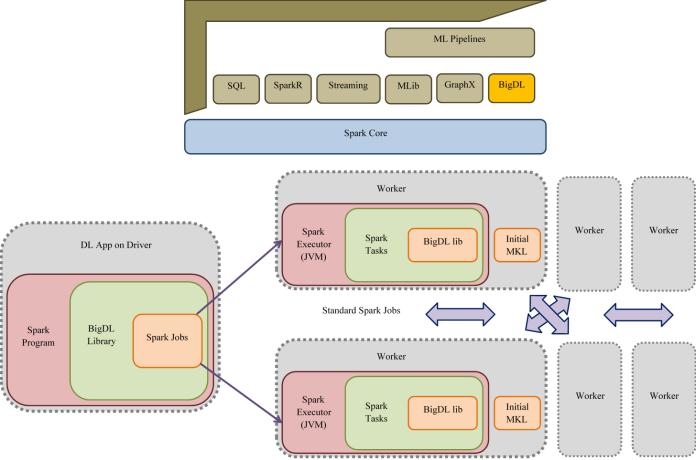
Fig.1systemarchitecture.
DL App on Driver: Drivers,theDLApponyourdeviceisa simple but great invention that gave our transport sector never-before-seen powers. The software solution is speciallydesignedasadriver'stooltoservethemfortheir daily purposes. It takes advantage of cutting-edge technologies, including machine learning and artificial intelligence, to offer drivers real-time information, navigational support, and communications. Data Collection & Processing this is the DL APP's first step and mostimportantoperation.
Spark Core: Apache Hadoop Public Java and Java Based Hive High level comparison Spark Core Open-source, Parallel Execution Framework that supports in-memory processing. It is one of the components in Apache Spark project cadres, along with modules for batching, SQL and machine learning features. The primary task of the Spark Core is to provide a distribution mechanism for parallel data-processing tasks, typically distributed via one or moreHardtopInputFormatsandreadfromHDFS.
Spark Executor (JVM): A Spark Executor is one of two critical components in the Apache Spark architecture responsible for executing tasks and storing the results. It runs on each worker node and is responsible for implementing the tasks a Spark driverassigns. Thedriver starts the execution by decomposing the work into tasks and sending them for execution on executors. Each executor is started as its own Java Virtual Machine (JVM) processrunningafixedruntimememorysize.
ML Pipelines: A Machine Learning (ML) Pipeline is an iterativeprocesstointroduceandimplementcomplexML models. It comprises a series of end-to-end steps integrated to aid in streamlining, including Data and Model Training, and then you will deploy your model. Additionally, the pipeline supports new data and models thatareeasilyintegratedintoit.Inthisway,itisaflexible
and easy-to-use tool for building ML applications. The initialpartofanyML pipelineisdatapreparation.
BigDL lib: BigDL isadistributeddeeplearning libraryfor Apache Spark; with Bid, users can write their deep learning applications as standard Spark programs, which can directly run on top of existing extensive data systems (e.g.Hardtop/Mesas).BasedonTensorFlowandApache Arrow, Bid is designed to remotely execute deep learning models at scale using familiar distributed big data frameworks such as Apache Spark. Bid is a distributed deep-learning framework on top of Apache Spark. Thisgivesthefirstpredictionsoverunlabeleddata.Next,a graph-basedsemi-supervisedlearningalgorithmisusedto spread the label information of labelled data iteratively points up to unlabeled ones depending on their (graph) edge strength. This process is iterated until all the data pointshavebeenpropagatedandeventuallyupdatedwith labels. The last predictions are now compared with the first prediction so we can make some corrections and improveourmodel.
One of Finance's supervised finder learning methods for fraud detection is Fractional -Graph-based semisupervised Finder - Weighting Seeable Learning. A machine-adopted approach to finding learned lessons from data and stopping the identification of patterns so that sharply fraudulent behavior can be discovered examines a subset. The supper-based Learn Disciplinary (mixed-ranking) method vastly increases its ability to output-created. Category: Finance_ HOUR detectors). This approach uses labelled and unlabeled data to develop a predictivemodeltopredictfraudaccurately.


Their idea is to create a graph representing the financial data, where nodes depict entities and edges encode interactions between them. It is mainly used for graph construction graphs transaction amount, location, time anduserbehavior.Thegraph-basedmodelreliesonsemisupervised learning algorithms that can leverage labelled and unlabeled data structures when training a machinelearning method. In this approach, the first step is to find andlabelasmallsetofknownfraudulenttransactions.
International Research Journal of Engineering and Technology (IRJET) e-ISSN:2395-0056
Volume: 11 Issue: 08 | Aug 2024 www.irjet.net p-ISSN:2395-0072
Fig.2showsthattheoperatingprinciple.
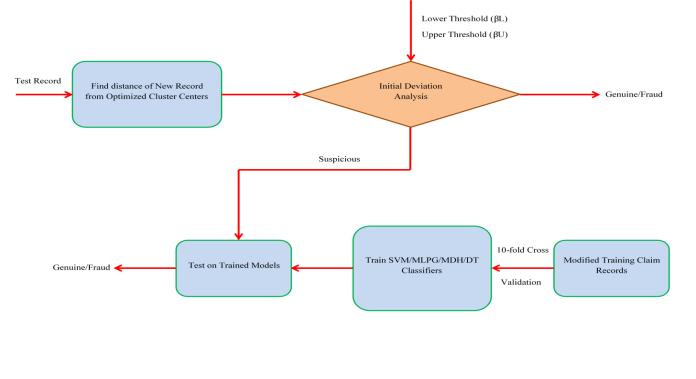
Fig.2operatingprinciple
Find distance of New Record from Optimized Cluster Centers: Two primary operations are finding optimized clustersofrecords(usingtheh2omodel),Determiningthe optimal cluster Description Size Estimated, and Calculating the distance to the point from the optimized cluster - for this, rearranging the data table in a training fashion. Identifying Optimized Cluster Centers: This is often accomplished using a clustering algorithm like Kmeans or hierarchical clustering. The basic idea behind clustering algorithms is to group similar data points and formclusters basedontheirattributes.
Initial Deviation Analysis: Initial deviation analysis is a statistical approach that detects and examines deviations among numerous data sets. It requires finding the gap between what is expected and where we are and identifying potential sources of error. It is a prevalent approach and way of thinking with many applications in the food industry (quality assurance, process optimization) and others, such as financial analysis. Form StopsWorkingwithInitialDeviationAnalysis
Modified Training Claim Records: Training Claim Records is an application that saves the records of all training claims that organization employees have submitted. Here is how the training claims work in employeeself-service:Thesearedifferentrequeststhatan employee can raise to attend any training programs and courses to develop their skill set and knowledge. For organizations, the Modified Training Claim Records system (Acts) are critical to keep track of employee training, as their training budget must be utilized effectively
Train SVM/MLPG/MDH/DT Classifiers: Support Vector Machine (SVM) classifier is a popular classification algorithm. Training an SVM classifier is finding a hyperplane in the n-dimensional space, where 'n' is several features (the columns) which best segregate different classes. This is done by maximizing the margin
between the hyperplane and polygons nearest to this plane,calledsupportvectors.Wefirstneedtoconvertour training data into a n-dimensional feature space to train anSVMclassifier.
Test on Trained Models: Testing on trained models is necessary for machine learning to assess how much our model cangeneralize and perform. It is done by feeding a second set of data or samples through an already trained model andthentracking theoutput(i.e. prediction) made bythismodel.Theresultisthencomparedtotheactualor expectedone,andaccuracyandprecision/recallmetrics are computed for model evaluation. The model then can use this labelled data as a gold standard upon which to base its recognition of fraudulent patterns in the data. Then, the algorithm uses it to find new patterns and anomalies in the Graph whose possible activities can be fraud. Feature engineering techniques are used in the graph-based model to extract meaningful information fromdataandpowerupourvertexencoder.
Graph-basedSemi-SupervisedLearning(GSSL)forfinance fraud detection is a supervised way to process a region within financial transactions. This method is successful because it considers how accounts, transactions, and people relate to the economic network. The first step in GSSL involves building a graph of the financial network, with nodes representing entities (such as accounts) and edges defining their connections (such as transactions betweenaccounts). (9) (10)


This visualization helps us understand the relationships within the network, making it easier to detect fraudulent activities. Further, the Graph is divided into two parts TrainandTest.
Fig.2showsthatthefunctionalworking.
International Research Journal of Engineering and Technology (IRJET) e-ISSN:2395-0056
Volume: 11 Issue: 08 | Aug 2024 www.irjet.net p-ISSN:2395-0072
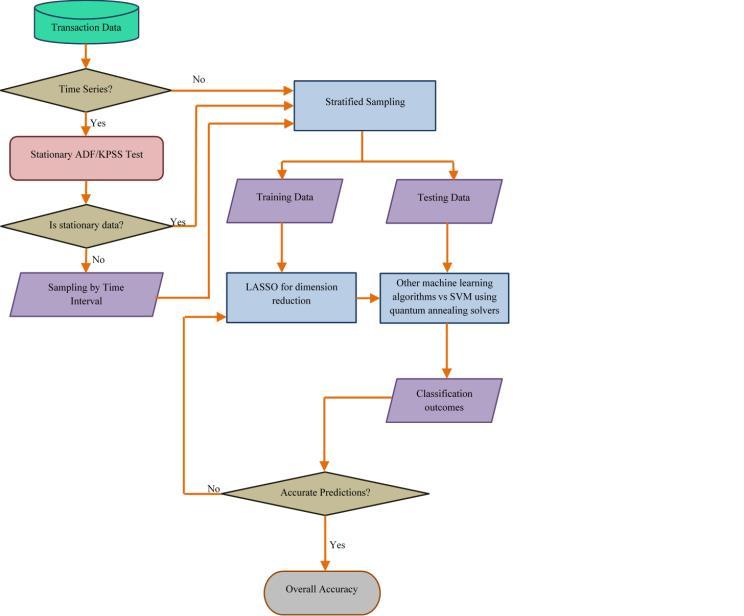
Transaction Data: Transaction data are an integral part of any work process carried out in a business or financial system. They mean the financial or non-financial records of any activity that impacts monetary transactions. Dependingonthetypeofbusiness,thisdatamayrelateto sales, purchases, payments, refund deposits, or a range of other financial activities that take place within an organization.
Time Series: Time Series Analysis is a statistical method thattreatssingledatapointsincontinuoustimesegments (days, weeks, years, etc.). It is applied in finance, economics, environmental studies, and computer science, among other fields. At its core, time series analysis is based on the concept of dependence (today's value depends on yesterday's) and various components such as seasonalityandtrendthatareaddedtoit.
Stationary ADF/KPSS Test: ADFandKPSSaretwoofthe most significant statistical checks for computing whether time series data is stationary or not. Stationarity is an important concept in the field of time series analysis and mustbefulfilledbydatabeforeapplyingmanyforecasting methods.
Sampling by Time Interval: Time Interval Sampling is a technique Commonly used in industrial processes and scientific experiments. It records data at consistent time intervals. This method simply means taking measurements only at specific time points or intervals instead of monitoring the data continuously. The top step of sampling by time interval is to decide how frequently youneedyourdatatobewidespread.
Stratified Sampling: The term stratified sampling has been procured from the theory of sample design abstracted by an equally named mechanism that is followed as a statistical way to yield legitimate conclusions. This means, first, the population is broken downintoitssubpopulationsorstrata,andthena sample fromeachoftheseisrandom.
Training Data: Training data plays a crucial role in machinelearninganddataanalysisalgorithms.Itrefersto asetofinputdatausedtotrainamodeloranalgorithmto learn patterns, relationships, and correlations in the data. Thequalityandquantityoftrainingdatagreatlyinfluence the accuracy and performance of a model, making it a critical component in developing effective and efficient algorithms.
Testing Data: Testing data is an integral part of the software development process that involves evaluating a softwaresystem'squality,functionality,andusability.Itis a crucial step in the software development life cycle as it helpsidentify any deficienciesorissues,ensuring thatthe final product meets the requirements and expectations of theend-users.Thisprocessinvolvesaseriesofoperations designed toassess the system's performance and validate itscompliancewiththespecifiedrequirements.
The labelled set includes transactions identified as fraudulent or non-fraudulent, and the unlabeled set consists of all other unmarked transactions. We currently only require our data in a supervised learning capacity. Hence, this split is mandatory, but its use will come to fruition when we consider semi-supervised learning, where both labelled and unlabeled instances are used to train the model. GSSL may benefit from the GCN model (Graph convolutional neural network) as it can learn interpretablefeaturesongraphdata.
Intheirpaper"SupervisedLearningforFraudDetectionin Finance", the authors suggest a new way to solve fraud detection problems in financial transactions, and they achieved this by applying graph-based semi-supervised learning techniques. The authors are working with a dataset of economic transactions, making it difficult to distinguish between fraudulent and legitimate transactionsbecausethereisasignificantclassimbalance. The study results reveal that the developed methodology performs better than conventional supervised learning methods in identifying fraudulent transactions, including logistic regression and decision trees. This is because it incorporates labelled (fraudulent) data and a significant amount of unlabeled data (unvoiced) in training, hence learning from both data types. The paper also discusses the effect of parameters like several labelled data and graph structure on model performance. The size of the
International Research Journal of Engineering and Technology (IRJET) e-ISSN:2395-0056
Volume: 11 Issue: 08 | Aug 2024 www.irjet.net
obtained dataset with that giving labelled data results in better performance, but it has a saturating point. Perhaps unsurprisingly, the researchers also discovered that if a more intricate graph structure is employed - one which considers indirect connections and direct ones between transactions-itenhancestheirmodel'sperformance.
The developers and publishers of the algorithm have decided to recall it from being used due to technical reasons. This is known as "Graph-based Semi-Supervised Learning for Fraud Detection in Finance" Graph-based methods were used tocatch fraudulent transactions, with theentirealgorithmdesignandimplementationaiming at faster detection of frauds in finance. However, the algorithm had several technical problems during testing and in real life, making it fallacious at worst or even unreliable.
Fig.3 shows that AUPRC results different number of trainingnormalnodes.
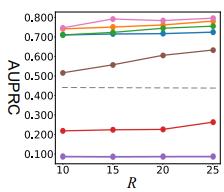
Fig.3AUPRCresultsw.r.t.differentnumberoftraining normalnodes.
This is why we decided to retract the algorithm and stop using it. Therefore, the agencies recommend in their joint statement that more reliable and robust approaches be used for fraud detection purposes within financial institutions to prevent potential harm both at the system level (e.g., economic systems) andindividual levels where the same algorithm is applied. Apologies were later sent out to developers for the inconvenience this may have caused, with an updated and more advanced fraud detection algorithm set to replace the for-called methods. They promised to take necessary quality control steps in future implementations so similar situations do not occur again. In totality, this recall is essential to maintain the safety and sanctity of financial systems and all stakeholdersinvolved.
p-ISSN:2395-0072
GSSL is a powerful financial fraud detectionsolution, as it can use labelled and unlabeled data. Here, the financial transaction data is modeled as a graph where nodes are transactions,andedgesdenotehowcloselyconnectedtwo transactions are traversing. It is then clustered by a clusteringalgorithmsuchthateachclusterrepresentsone kindofbehaviororpatterninthedata.Inthisimbalanced data, the ratio of fraudulent transactions is shallow again compared to the ones and favors that GSSL can quickly address. This is done by incorporating raw data with no labels so that the model can learn from them, and such examples play a vital role in identifying fraudulent behavior. Second, GSSL is a flexible model that encodes variousinformationtypesindifferentdata.
Fig.4 shows that the AUROC results different number of trainingnormalnodes.
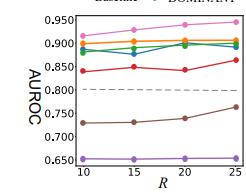
Fig.4 AUROCresultsdifferentnumberoftrainingnormal nodes.
It is essential for fraud detection, as fraudulent behavior can take many forms. This lock and integrates the data to let a model learn relationships or patterns that are too complicated for legacy supervised learning practices. Additionally, GSSL algorithms usually employ feedback, where the model learns from its predictions and updates decision boundaries, resulting in more accurate decisions as time passes. However, GSSL techniques do have some drawbacks. This method requires quality inputs, and inaccurate results arepossibleiftheinput data is missing orhasnoisevalues.
Today, instead of focusing on code and tips/tricks, I will walk you through some basic ideas about a machine learning technique called graph-based-supervised Learning (SSL). Fraud detection is an essential aspect of finance and requires extensive investigation to detect anomalies. Since finance-related datasets cannot always
International Research Journal of Engineering and Technology (IRJET) e-ISSN:2395-0056
Volume: 11 Issue: 08 | Aug 2024 www.irjet.net
guarantee a high amount of labelled data, traditional supervised learning methods help detect fraud. This is where SSL comes in handy. SSL can use labelled and unlabeled data to make fraud detection models more predictive.
Fig.5 shows that the AUPRC different anomaly contamination.
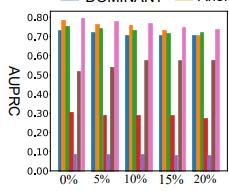
Fig.5 AUPRCdifferentanomalycontamination. Itdoessobytreatingthedataasagraph,wherethingslike financial transactions are nodes in that graph. We are makingconnectionsbetweennodesonsimilardatapoints. Further labels are then propagated for the same type of fraudusingthisgraph,whichisusedtoexposefraudulent behavior. Imbalanced data handling is one of the most essentialadvantagesSSLbringstofinancefrauddetection. This is because the graph structure permits information sharing among labelled instances and similar unlabeled instances,whichcansomewhatalleviatedataskew.
4.4 Miss rate
The miss rate indicates how good a fraud percentage is, which means that if some number (%) or type of transaction goes once undetected by a system, it belongs tofalse negatives. Graph-based Semi-Supervised Learning (GSSL)inFraudDetectioninFinanceisamachinelearning algorithm that uses labelled and unlabeled to improve fraud detection accuracy fraud detection accuracy. This is rootedintheideathatfraudulenttransactionsareusually part of a network rank or graph, and you can detect and analyze this using Graph-Based Techniques. GSSL has an advantage in accurately identifying no falsified abnormal transactionsandloweringthemissrate.
p-ISSN:2395-0072
Fig.6 shows that the AUROC different anomaly contamination.
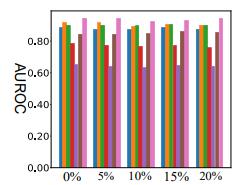
Fig.6AUROC.differentanomalycontamination.
GSSL candiscoverpatterns andabnormalities thatcannot befoundinlabelleddataonlybyexploitinginformationin itsunlabeledpartinthegraph.Becauseofthis,thesystem can protect against evolving and changing fraudulent patterns (since fraudsters regularly adjust to bypass security).Also,GSSLmayreducethemissratebyencoding different information for each query - including amount, location, or timestamps- into its graph representation. This allows the system to capture fine-grained fraud patterns better and havea morevital detection capability detectioncapability
This paper systematically reviews graph-based semisupervised learning (GSSL) techniques in finance fraud detection. Graphs and graph-based algorithms, representing complex graph-based dips between high dimensional data points, offer resolution space and provide scenarios. Semi-supervised learning techniques treat the fraud detection problem as a graph-based exercise: input data, labelled and unlabeled, are fed to train models that can then be used for rooting out bad actors.Thesetechniques work basedontheshapeofdata before it even gets into Deep features: a kind of graphcentric data scape where entities are perhaps customers, transactions,andaccounts-andtheirrelationshipsconnect them through edges. Graph-based semi-supervised learning is alsohelpful infraud detectionas itworks well on highly imbalanced data, a common scenario for financial transactions where most are legal. These methods can also capture fraudulent events that are not labelled as such in the training data. We have reviewed three techniques: label, propagation-based, graph autoencoder and graph convolutional networks. We have implemented these methods that could better identify fraudulent activities than conventional supervised learningtechniquesonfinancialdata.
International Research Journal of Engineering and Technology (IRJET) e-ISSN:2395-0056
Volume: 11 Issue: 08 | Aug 2024 www.irjet.net p-ISSN:2395-0072
1. Yu, H., Liu, Z., & Luo, X. (2024, March). Barely Supervised Learning for Graph-Based Fraud Detection. In Proceedings of the AAAI Conference on Artificial Intelligence (Vol. 38, No. 15, pp. 1654816557).
2. Beeram, D. (2024). Optimizing genetic algorithms for predictive modeling in medical diagnostics. International Research Journal of Modernization in Engineering Technology and Science, 6(8). https://doi.org/10.56726/IRJMETS6077
3. Karim, R., Hermsen, F., Chala, S. A., De Perthuis, P., & Mandal, A. (2024). Scalable Semi-Supervised Graph LearningTechniquesforAntiMoneyLaundering.IEEE Access.
4. Tang, H., Wang, C., Zheng, J., & Jiang, C. (2024). EnablingGraphNeuralNetworksforSemi-Supervised Risk Prediction in Online Credit Loan Services. ACM Transactions on Intelligent Systems and Technology, 15(1),1-24.
5. Xu, F., Wang, N., Wu, H., Wen, X., Zhao, X., & Wan, H. (2024,March).Revisitinggraph-basedfrauddetection in sight of heterophily and spectrum. In Proceedings of the AAAI Conference on Artificial Intelligence (Vol. 38,No.8,pp.9214-9222).
6. Zade, N. P. (2024). Exploring Graph-Based Machine LearningTechniquesforTransactionFraudDetection: A Comparative Analysis of Performance (Doctoral dissertation,DublinBusinessSchool).
7. Qiao, H., Wen, Q., Li, X., Lim, E. P., & Pang, G. (2024). Generative Semi-supervised Graph Anomaly Detection.arXivpreprintarXiv:2402.11887.
8. Wang, X., & Wang, Y. (2024, January). Graph Contrastive Learning for Internet Financial Fraud Detection. In 2024 4th International Conference on Consumer Electronics and Computer Engineering (ICCECE)(pp.153-157).IEEE.
9. Mvula, P. K., Branco, P., Jourdan, G. V., & Viktor, H. L. (2024). A Survey on the Applications of Semisupervised Learning to Cyber-security. ACM ComputingSurveys,56(10),1-41.
10. Wu, F., Wei, Y., & Luo, X. (2024). Abnormal Trading Visualized Detection on Bitcoin Transaction Based on Semi-Supervised Machine Learning and Graph Database.AvailableatSSRN4769024.
11. Khodabandehlou, S., & Golpayegani, A. H. (2024). FiFrauD: unsupervised financial fraud detection in
dynamic graph streams. ACM Transactions on KnowledgeDiscoveryfromData,18(5),1-29.
12. Hiremath,A.C.,Arya,A.,Sriranga,L.,Reddy,K.V.S.R., & Nikhil, M. (2024, April). Ensemble of Graph Neural Networks for Enhanced Financial Fraud Detection. In 2024 IEEE 9th International Conference for ConvergenceinTechnology(I2CT)(pp.1-8).IEEE.
13. Innan, N., Sawaika, A., Dhor, A., Dutta, S., Thota, S., Gokal, H., ... & Bennai, M. (2024). Financial fraud detection using quantum graph neural networks. QuantumMachineIntelligence,6(1),7.
14. Beeram, D. (2024). Combining deep learning and heuristic search for efficient text summarization. International Research Journal of Engineering and Technology (IRJET), 11(8), 23-27. https://www.irjet.net/archives/V11/i8/IRJETV11I803.pdf
15. Wen, J., Tang, X., & Lu, J. (2024). An imbalanced learning method based ongraphtran-smote forfraud detection.ScientificReports,14(1),16560.
16. Thilagavathi, M., Saranyadevi, R., Vijayakumar, N., Selvi, K., Anitha, L., & Sudharson, K. (2024, April). AIDrivenFraudDetectioninFinancialTransactionswith Graph Neural Networks and Anomaly Detection. In 2024InternationalConferenceonScienceTechnology Engineering and Management (ICSTEM) (pp. 1-6). IEEE.
17. Kim, Y., Lee, Y., Choe, M., Oh, S., & Lee, Y. (2024). Temporal Graph Networks for Graph Anomaly Detection in Financial Networks. arXiv preprint arXiv:2404.00060.
18. Li,K.,Yang,T.,Zhou,M.,Meng,J.,Wang,S.,Wu,Y.,...& Tong, Y. (2024). SEFraud: Graph-based SelfExplainable Fraud Detection via Interpretative Mask Learning.arXivpreprintarXiv:2406.11389.
19. Beeram, D. (2024). A NOVEL APPROACH TO MULTIOBJECTIVE OPTIMIZATION USING SIMILARITY MEASURESANDENSEMBLELEARNING.International Journal of Advanced Research in Engineering and Technology (IJARET), 15(4), 95–109. https://doi.org/10.5281/zenodo.13234668
20. Tang, J., Hua, F., Gao, Z., Zhao, P., & Li, J. (2024). Gadbench: Revisiting and benchmarking supervised graph anomaly detection. Advances in Neural InformationProcessingSystems,36.
21. Ren, L., Hu, R., Liu, Y., Li, D., Wu, J., Zang, Y., & Hu, W. (2024). Improving fraud detection via imbalanced graph structure learning. Machine Learning, 113(3), 1069-1090.
2024, IRJET | Impact Factor value: 8.226 | ISO 9001:2008
International Research Journal of Engineering and Technology (IRJET) e-ISSN:2395-0056
Volume: 11 Issue: 08 | Aug 2024 www.irjet.net p-ISSN:2395-0072
22. Wang, X., Guo, J., Luo, X., & Yu, H. (2024). DyHDGE: Dynamic Heterogeneous Transaction Graph Embedding for Safety-Centric Fraud Detection in Financial Scenarios. Journal of Safety Science and Resilience.
23. Chen, J., Chen, Q., Jiang, F., Guo, X., Sha, K., & Wang, Y. (2024). SCN_GNN: A GNN-based fraud detection algorithm combining strong node and graph topology information. Expert Systems with Applications, 237, 121643.
24. Jain, V., Balakrishnan, A., Beeram, D., Najana, M., & Chintale, P. (2024). Leveraging artificial intelligence for enhancing regulatory compliance in the financial sector. International Journal of Computer Trends and Technology (IJCTT), 72(5), 124-140. https://doi.org/10.14445/22312803/IJCTTV72I5P116
2024, IRJET | Impact Factor value: 8.226 | ISO 9001:2008