
International Research Journal of Engineering and Technology (IRJET) e-ISSN: 2395-0056

International Research Journal of Engineering and Technology (IRJET) e-ISSN: 2395-0056
Girish Nayak1, Pavan2, Sanjay S3, Rohith Mahanthesh4, Uday J5
1,2,3,4 Student, Dept. of ECE, Mangalore Institute of Technology & Engineering, Karnataka, India
5 Senior Assistant Professor, Dept. of ECE, Mangalore Institute of Technology & Engineering, Karnataka, India
Abstract - These days, soil-based agriculture faces challengesfromavarietyofman-madefactors,including urbanisation and industrialization. The decrease of soil fertility and quality is also a result of uncontrolled chemical usage in agriculture, abrupt natural disasters, and climate change. Because of this, researchers have created a brandnew alternative farming method known as soil-less agriculture, or hydroponics. Plants can be grown hydroponically in a nutrient-rich, water-based solution.Manydifferentplants,crops,andvegetablescan be grown with hydroponics. When compared to natural soil-based cultivation, hydroponically produced final productstypicallyhavegreaterqualityyields,tastes,and nutritional values. This type of agriculture is becoming more and more wellliked worldwide, in both developed and developing nations, and it is also inexpensive, disease-free, and environmentally benign. In many nations, it has excellent prospects in conjunction with advancedspaceresearchtoaddressthescarcityofarable land in situations when suitable cultivable land is unavailable. Therefore, hydroponics would be a better method to meet the demand for nutrition in the world while also producing a variety of fruits, vegetables, and feedwhileadvancingthefuture.Hydroponicsmaybecome one of the new methods used in the future to feed the world's population.
Key Words: Arduino UNO, Deep water culture(DWC),Charcoal filter,TDS sensor,nutirents
1.INTRODUCTION
Theagriculturalindustryiscrucial.However,astechnology advances, the industrial sector is growing as well. The narrownessofagriculturallandisimpactedbytherise.One possible way to solve these issues is to implement a hydroponicsystem. agricultural method. Hydroponicsisa techniqueforgrowingplantsthatuseswaterasaplanting mediainsteadofsoilandafertilisersolutionthattheplants require. Deep Water Culture (DWC) is one of the community's hydroponic methods. DWC is a hydroponic method that feeds plant roots with nutrient solutions directly. The plant's root will always be immersed in a nutritionalsolutionthankstotheDWCtechnology[1].This kind of hydroponics, called Deep Water Culture, enables indoor or boxed planting. When planting inside a box, TL lamps can be used in place of natural sunlight. Aerated nutrient solutions are necessary in this DWC hydroponic
technique in order to introduce dissolved oxygen to the water, as a deficiency in oxygen will hinder plant roots' ability to absorb nutrients. For plants to maintain their nutritional needs, nutrient solutions must be available to them constantly. The productivity and quality of lettuce growninhydroponicsystemsaresignificantlyinfluencedby nutrition. Determining the quality of lettuce products requiresabalancedabsorptionofnutrients[2].
[1].”Asurveyofsmarthydroponicssystems”byFatmataM, Mahdi Musa and Farouq Aliyu : The paper goes on to explainthe basicsofhydroponicsandthevariousways in which the system can be implemented. The authors have triedtocreateasautomatedmodelandhavetriedtofindout the optimal root zone of crops such as lettuce. the study Automated system developed to control pH and concentrationofnutrientsolutionevaluatedinhydroponic lettuce production carried out control of pH and the concentrationofplantdoesnotdie.
[2].“Cost effective smart Hydroponics Monitoring and Controlling System Using IOT” by Ullah and A Aktar: The paper presents a cost-effective IoT-based system for monitoringandcontrollinghydroponicfarmingparameters suchaswaterlevel,pH,humidity,andtemperaturethrougha mobile application. The literature survey highlights the innovation and improvement in nutrient solution level control for DWC hydroponics, addressing previously overlookedareas.Theproposedsystemleveragesmodern technology to enhance the efficiency and reliability of hydroponic farming, contributing to better crop managementandhigherproductivity.
[3].In the study “A Development of automatic MicrocontrollerSystemforDeepWaterCulture pHcontrol onDWChydroponicsusesapHsensorasareaderofthepH valueinsolution.Inaddition,inthisstudyalsopaidattention tothelevelofnutrientsolutionbyflowingwaterintoandout of the reservoir. In this study, monitoring the level of nutrient solution is important to maintain the level of nutrientsolutionthatisappropriatetothereservoir.
ButmonitoringstillusesLCDsandremotemonitoringand control cannot be carried out. In the study Electrical Conductivity and pH Adjusting System for Hydroponics carriedoutcontroloftheconcentrationofnutrientsolution andpHusinglinearregressionmethodonredlettuceand greenlettuce.
Volume: 11 Issue: 08 | Aug 2024 www.irjet.net p-ISSN: 2395-0072 © 2024, IRJET | Impact Factor value: 8.226 | ISO 9001:2008
International Research Journal of Engineering and Technology (IRJET) e-ISSN: 2395-0056
Volume: 11 Issue: 08 | Aug 2024 www.irjet.net p-ISSN: 2395-0072
[4.] "Automated system developed to control pH and concentrationofnutrientsolutionevaluatedinhydroponic lettuce production” carried out control of pH and the concentration of plant does not die. This research was carried out by taking sample data by adding AB solution using a solenoid valve. But this research is still done in a simulationandhasnotbeenimplementedintherealsystem.
Inthisstudya newsystem willbedesignedtocontrolthe levelofnutrientsolutionsinhydroponicplantsoftheDWC typeusinglinearregressionmethods.Withthelevelcontrol system of nutrient solutions using this linear regression method,itisexpectedthattherewillbenomorehydroponic plantsfromDWCthatdiebecausetherootsoftheplantare notsubmergedinnutrientsolution.a workableoptionfor ventilationcontrolinpracticalsituations.
[5.]“ Sani Saleh Hussaini's "Evaluation of Potential Use of Charcoal as a Filter Material in Water Treatment" Yahaya Hassan Mato: Charcoal has the capability to eliminate pathogenic organisms, turbidity, and dissolved iron from drinking water, according to research.Additionally, the additionofmineralslikesodiumandpotassiumtothewater throughthecharcoalbasefiltermadethewatertastebetter. UtilizingorganichydroponicsfordomesicurbanfarmingThe reportincludesanumberofcasestudiesofdomesticurban agricultureinitiativesthatmakeuseoforganichydroponics. These initiatives show that incorporating organic hydroponicsintosmallscaleurbangardeningisbothfeasible and advantageous. In addition to encouraging sustainable living techniques and enhancing local food security, residents have successfully cultivated a wide range of vegetable .
[6].“Electrical Conductivity and pH Adjusting System for HydroponicsbyusingLinearRegression”Theoptimizationof plantgrowthhasledtoagreatdealofattentionbeingpaidto the research of electrical conductivity (EC) and pH correctioninhydroponicssystems.Plantsthathaveaccurate ECandpHmanagementhaveefficientnutrientabsorption andavailability.Conventionaltechniquesfrequentlycallfor labor-intensive,pronetohumanerrormanualmodifications. Recentdevelopmentshavelookedintoautomatedsystems thatuselinearregressionmethodstoprovidefinecontrol.In order to improve the efficiency and dependability of hydroponicfarmingandconsequentlyimprovecropyields and resource management, Kaewwiset and Yooyativong (2017)madeasubstantialcontributionbycreatingasystem thatuselinearregressiontoforecastandmodifyECandpH valuesinreal-time.
[7].“Adevelopmentofanautomaticmicrocontrollersystem for Deep Water Culture (DWC)” Modern agriculture has evolved substantially with the advent of autonomous microcontrollersystemsforhydroponics,namelyforDeep WaterCulture(DWC).Inordertomonitorandregulatevital indicatorsincludingnutritionlevels,pH,watertemperature, anddissolvedoxygen,thesesystemscombinesensorsand
microcontrollers. Precise changes are guaranteed by automation, which encourages ideal plant growth and minimizes the requirement for user intervention. Studies demonstrate how these systems can improve crop yields, sustainability,andresourceefficiency.Recentresearchhas concentrated on enhancing sensor precision, system dependability, and user interface design to increase the effectivenessandaccessibilityofautomatedDWCsystems forhydroponicsmall-andlarge-scaleoperations.
[8]."A survey of art tydroponics systems", Due to their advantages in both functionality and aesthetics, art hydroponics systems which combine hydroponic technology with creative design are becoming more and more popular. These methods combine effective plant growing with eye-catching design elements including hangingdisplays,verticalgardens,andmodularbuildings. According to recent study, maximizing hydroponic techniques and producing artistic value go hand in hand, improving both productivity and attractiveness. Research alsoemphasizethepsychologicalandecologicaladvantages ofarthydroponics,pointingoutthatitcanenhancemental health,enhanceairquality,andencourageenvironmentally friendlyurbanliving.Inadditiontopromotingsustainable agriculture methods, this interdisciplinary approach stimulatescreativity.


International Research Journal of Engineering and Technology (IRJET) e-ISSN: 2395-0056
Volume: 11 Issue: 08 | Aug 2024 www.irjet.net p-ISSN: 2395-0072
Summary and Future scope
The hydroponic method known as Deep Water Culture (DWC) involves immersing plant roots in a nutrientrich water solution. In order to oxygenate the water and encouragehealthyrootgrowthandnutrientabsorption,it makesuseofareservoirsystemwithanairpump.InDWC systems, charcoal filters are frequently utilized to remove odors and clean the air that circulates in the growing environment. With the DWC supplying effective fertilizer deliveryandthecharcoal filter preservingairquality,this combinationguaranteesplantsgrowinthebestconditions possible, making it a popularoptionforindoor andurban gardening lovers looking for high-yield, clean growing solutions.
DeepWaterCulture(DWC)hydroponicsystemshavemadea majordevelopmentinsustainableagriculturemethodswith the addition of charcoal water filters. Because activated charcoal can filter out pollutants from water, plants are given healthier, cleaner water that improves nutrient absorptionandspeedsupgrowth.Thisisimportantbecause ittacklestheissueofwaterqualityinhydroponicsystems, whichhasabiginfluenceonthehealthandproductivityof plants
DWC systems with charcoal filters provide a workable alternative for indoor and urban farming in light of the growing problems associated with soil degradation and water constraint. These systems are perfect for densely populatedplaceswheretraditionalfarmingisdifficultsince theycan providelarger yieldsin lessspaces. Additionally, usingcharcoalfiltersminimizestheenvironmentalimpact andisinlinewithecofriendlypracticesbyreducingtheneed forchemicaltreatments. Therewillbeagreaterneedfor effectiveandsustainablefoodproductiontechniquesasthe world'spopulationgrows.Inordertoaddressthisdemand, DWC hydroponics with charcoal water filters can offer a dependable and environmentally friendly method of growing.Thesesystemshavethepotentialtoimprovefood security, lessen the impact of agriculture, and foster resilienceinfoodproductionbyguaranteeingcleanerwater andhealthierplants.Thiscreativestrategymaybecrucialin reshaping agriculture in the future to make it more ecologicallyfriendly,efficient,andsustainable.
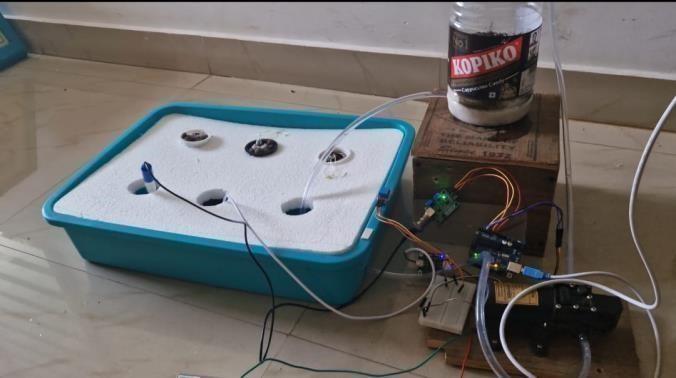
Inthissmallproject,acharcoalfilterisaddedtoDeepWater Culture(DWC)tocreateahydroponicsmonitoringsystem. Thissystemusesfiltrationtoregulatewaterqualitywiththe goal of optimising plant development. By purifying the nutritionalsolution,thecharcoalfilterpromotesthehealth andgrowthofplants.Monitoringsensorsprovidereal-time dataformodificationsbyensuringthatcriticalparameters like pH, EC (Electrical Conductivity), and temperature are within ideal ranges. This integrated method offers an effective and sustainable indoor gardening solution by combining hydroponic farming with smart water management.
[1] JohanAndriPratamaetal.,"GrowingInsightsandYouth Knowledge in the NFT Hydraulic Application," publishedbyResearchand Community Development Center,KONTRIBUSIA,vol.2,no.1,2019.
[2] Yi-hsuanhsieh,ssu-peili&ting-ilee,"Theapplicationof organichydroponicsonhomegrownurban agriculture in taiwan, wit Transactions on Ecology and the Environment,Vol217,pp987- 995
[3] AdesinaAkinmeji, SanjayMisra,AkshatAgrawaletal., “COST-EFFECTIVE DESIGN FOR A HYDROPONICS FARM", 1Center of ICT/ICE Research, Covenant University,Ota, Nigeria.
[4] H.-J. Kima, T. Yang, M.-Y. Lin and P.Langenhoven, "Plant propagation for successful hydroponic production",DepartmentofHorticultureandLandscape Achitecture,PurdueUniversity,625 Agriculture Mall Drive,WestLafayette,Indiana 47907,USA.
[5] Baiyin, B.; Tagawa, K.;Yamada, M.; Wang, X.; Yamada, S.;Shao, Y.; An, P.; Yamamoto, S.; Ibaraki,Y. Effect of Nutrient Solution FlowRate on Hydroponic Plant Growthand Root Morphology.Plants202110,1840. https://doi.org/10.3390/plants10091840.
[6] FalmataModu,AdamAdam,FarouqAliyu,AuduMabu, Mahdi Musa, "A survey of art tydroponics systems", ASTES Journal,Vol.5,No.1.
[7] SaaidMF,YahyaNAM,NoorMZH andAliMSAM 2013“Adevelopmentofanautomaticmicrocontroller systemforDeepWaterCulture” Proc. - 2013 IEEE 9th Int. Colloq. Signal Process.
[8] Abou-HadidAF,Abd-ElmoniemEM,El- ShinawyMZ andAbou-ElsoudM1996 “Electricalconductivity effect ongrowthandmineralcompositionoflettuceplantsin hydroponicsystem” Acta Hortic. 434 59–66
International Research Journal of Engineering and Technology (IRJET) e-ISSN: 2395-0056
Volume: 11 Issue: 08 | Aug 2024 www.irjet.net p-ISSN: 2395-0072
[9] S,TakahashiHW,CamaraCAPandNixdorfSL2012 “Automated system developed to control pH and concentration of nutrient solution evaluated in hydroponiclettuceproduction Comput.” Electron. Agric. 8453–61
[10] Kaewwiset T and Yooyativong T 2017 “Electrical ConductivityandpHAdjustingSystemfor Hydroponics byusingLinearRegression”in 2017
2024, IRJET | Impact Factor value: 8.226 | ISO 9001:2008