
International Research Journal of Engineering and Technology (IRJET) e-ISSN: 2395-0056
Volume: 11 Issue: 08 | Aug 2024 www.irjet.net p-ISSN: 2395-0072

International Research Journal of Engineering and Technology (IRJET) e-ISSN: 2395-0056
Volume: 11 Issue: 08 | Aug 2024 www.irjet.net p-ISSN: 2395-0072
Richa Sapre1 , Arti Panchal2 , Harsh Raut3 , Vaibhav Zarapkar4, Dr. Sunil Wankhade5
1,2,3,4Student, MCT’s Rajiv Gandhi Institute Of Technology, Mumbai, Maharashtra, India. 5Professor & Head Of Department ,Dept. of Information Technology ,MCT’s Rajiv Gandhi Institute Of Technology, Mumbai, Maharashtra, India.
Abstract – This paper describes a course recommendation system created with Python and Streamlit for interactive visualization. To provide personalized course recommendations, the system uses machine learning algorithms such as course similarityanalysis, user profiling, clustering (using PCA), K-Nearest Neighbours (KNN), and Non-Negative Matrix Factorization (NMF). The course recommendationprocessbeginsbyanalyzingcoursemetadata and user interactions to create a course-user matrix. This matrix is used to cluster related courses based on criteria such as subject, difficulty level, and prerequisites. Principal Component Analysis (PCA) is used to minimize dimensionality while keeping significant information, resulting in more efficient course clustering.
User profiling is then used to determine individualpreferences and learning behaviours. The technology uses K-Nearest Neighbours (KNN) to identify comparable users based onhow they engage withcourses.Non-Negative MatrixFactorization (NMF) isused to extract latent components from user-course interactions, allowing for personalized suggestions based on the user’s preferences and learning history. The course recommendation systemis integrated into a user-friendlyweb interface called Streamlit, which allows users to enter preferences, browse recommended courses, and provide comments. User research andcomparative analysis show that the system is effective at offering relevant and diverse course suggestions, which improves the learning experience across different topics and ability levels.
Key Words: Course Recommendation System, Machine Learning,Streamlit,UserProfiling,Clustering,KNN,NMF, PCA.
The emergence of online platforms offering a wide range of educational courses across many areas and disciplineshasrevolutionizedthelearninglandscapeinthe eraofdigitaleducation.Thisdemocratizationofinformation provideslearnerswith unprecedented options, but it also adds the taskof navigating a large catalogue of courses to discover onesthat best meet their own requirements and interests. This problem emphasizes the necessity of personalized course recommendation systems, which use powerful machinelearning algorithms to provide targeted recommendationsandspeedupthecoursediscoveryprocess. Our project aims to addressthis difficulty by designing,
developing, and implementing an intelligent course recommendation system using Pythonand Streamlit a modern framework for creating interactive online applications.Oursolutionisbuiltaroundtheintegrationof powerfulmachinelearningmethodssuchascoursesimilarity analysis,userprofile,clustering(augmentedwithPrincipal ComponentAnalysis,PCA),K-NearestNeighbours(KNN),and Non-Negative Matrix Factorization (NMF). Using these algorithms,oursystemseekstoprovidepersonalizedcourse recommendationsthatarecloselyalignedwitheachlearner’s specificpreferences,interests,andlearningprofile.Themajor goal ofourcourserecommendationsystemisto empower students by making tailored choices that improve their educational experience. To accomplish this, our algorithm first examines all course metadata, including subject categories,descriptions,difficultylevels,andprerequisites. Thisinformationisutilizedtocreateacompletecourse-user interactionmatrixthatincludesspecificuserbehaviourssuch as course completion rates, user ratings, and frequency of involvement. To create accurate and relevant recommendations, our system employs machine learning techniquessuchasclusteringanddimensionalityreduction withPCA.Userprofilingisanimportantaspectofoursystem that aims to capture individual learner preferences and behaviours.OurmethodusesK-NearestNeighbours(KNN) and Non- Negative Matrix Factorization (NMF) to identify comparableusersbasedontheircourseinteractions,andit extractslatentcomponentsfromuser-courseinteractions.
This personalized approach enables our system to adjust recommendationstoeachuser’suniquelearninghistoryand interests.Furthermore,thecourserecommendationsystem islinkedintoauser-friendlywebinterfacecalledStreamlit, which allows learners to enter their preferences, explore recommendedcourses,andprovidecomments,allowingthe recommendationprocesstoberefinedovertime.Ourcourse suggestionsystemismorethanjustconvenient;itaimsto improve the educational experience by creating a more personalized and interesting learning environment. By bridgingthegapbetweenlearnersandthevastuniverseof online educational resources, our approach intends to improve course discovery, encourage study of new disciplines,and,eventually,improvetheoverallefficacyand enjoyment of learning. Through thorough evaluation and comparisonanalysisagainstbaselinealgorithms,wehopeto demonstrateoursystem’susefulnessandutilityinoffering ac- curate, diversified, and personalized course recommendations targeted to individual learners across
International Research Journal of Engineering and Technology (IRJET) e-ISSN: 2395-0056
Volume: 11 Issue: 08 | Aug 2024 www.irjet.net p-ISSN: 2395-0072
multiple domains and ability levels. In conclusion, our research aims to contribute to the field of educational technology by creating an innovative course recommendation system that uses machine learning and interactive online interfaces to empower learners in their pursuitforknowledge.Oursolutionintendstorevolutionize howlearnersdiscoverandengagewitheducationalcontent onlinebyintegratingadvancedalgorithmsanduser-centric designconcepts,resultinginamorepersonalizedandricher learningexperience.
The topic of course recommendation systems has advanced significantly due to innovative techniques and algorithmsdescribedinextantliterature.Shahetal.(2017) introduced a closeness-based regularization method for online matrix factorization, specifically applied to course recommendersystems.Theirworkfocusesonimprovingthe robustnessandefficiencyofmatrixfactorizationtechniques, whicharefundamentaltomanyrecommendationsystems.
Liangetal.(2019)exploreddataminingtechniquesfor analyzing students’ course choices using cash rules and decision trees. This study emphasizes the importance of leveraging data-driven approaches to uncover patterns in studentbehavior,whichcaninformcourserecommendation strategies.
KamilaandSubastian(2019)investigatedtheapplication ofK-NearestNeighbors(KNN)andNaiveBayesalgorithms for recommending advanced courses to students. Their researchhighlightstheeffectivenessofsimpleyetpowerful machine learning techniques in course recommendation tasks.
Fu and Ma (2021) proposed an improved recommendation method based on content filtering and collaborative filtering, combining the strengths of both approaches to enhance recommendation accuracy. Their hybridapproach demonstrates the potential of integrating multiple recommendation strategies to achieve superior performance.
Salehi and Kamalabadi (2015) presented a hybrid recommendationapproachbasedonsequentialpatternsof accessed materials and learners’ preference trends. This study emphasizes the importance of incorporating user behavior and sequential learning patterns into the recommendationprocess.
Collectively, these works highlight the wide range of methodologyandalgorithmsusedincourserecommendation systems, from matrix factorization and data mining techniquestocollaborativefilteringandhybridapproaches. Building ontheinsightsandfindingsof previous research, ourstudyaimstoadvancecourserecommendationsystems byintegratingnovelmachinelearningalgorithmswithinan
interactive web- based framework, allowing learners to receivepersonalizedandeffectivecourserecommendations.
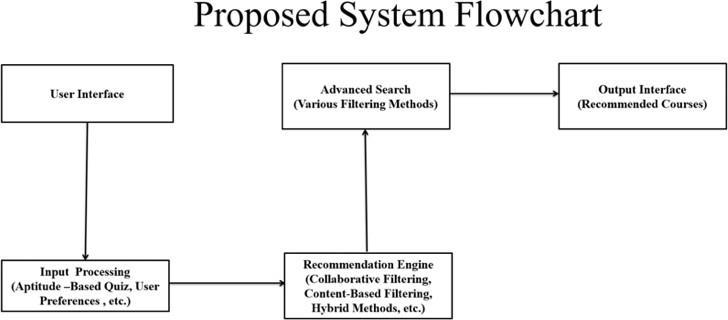
Theprojectreportforthecourserecommendationsystem proposesacompletestrategyforutilizingmachinelearning techniques to provide individualized course recommendations.Studentstakeacustomizedmini-quizon thetopicoftheirchoiceafterloggingin,whichassessestheir level of competency. The system automatically suggests coursesgroupedintointroductory,medium,andadvanced levelsbasedonquizscores.
Usersreceivethoroughfeedbackaftersubmitting,along withagraphshowingtherightandwronganswers.Afeature that recommends advanced courses also gives consumers theabilitytoinvestigatespecialistMLtools.Thisfeaturelets users adjust hyper-parameters such the Course Similarity threshold by providing a choice of six algorithms: Course Similarity,UserProfile,Clustering,ClusteringwithPCA,KNN, andNMF.ThroughtheintegrationofaCourseradatasetand theutilization ofStreamlitinPython, thissystemseeks to improveuserengagementandofferinsightfulinformation aboutcoursesimilarity,facilitatingwell-informeddecisionmakingrelatedtoeducationalendeavours.
The system provides an intuitive interface for users to interact with, offering a seamless and user-friendly experience. To access personalized features, users are required to log in, enabling the system to tailor recommendations based on individual preferences and historicalinteractions.
Uponloggingin,usersengageinapersonalizedmini-quiz designed to evaluate their knowledge and interests in specificsubjects.Thequizservesasapivotalcomponentin understanding users’ learning profiles, aiding in the generationoftailoredcourserecommendations.
Following completion of the quiz, users receive comprehensive feedback based on their responses. Leveraging this in- formation, the system generates recommendationsforcoursescategorizedintointroductory, medium,andadvancedlevels,aligningwithusers’identified proficiencyandinterests.
International Research Journal of Engineering and Technology (IRJET) e-ISSN: 2395-0056
Volume: 11 Issue: 08 | Aug 2024 www.irjet.net p-ISSN: 2395-0072
D. SuggestedAdvancedCourses
Users have the option to explore suggested advanced courses, which delve deeper into specialized topics, particularlyinmachinelearning.Thisfeatureoffersaccessto advanced algorithms and filtering methods, empowering users to expand their knowledge and skills in specific domains.
E. MachineLearningAlgorithms
The system boasts a diverse array of machine learning techniques and parameters that users can select and customize.Optionsincludecoursesimilarityanalysis,user profiling,clustering(withPCA),K-NearestNeighbors(KNN), and Non- Negative Matrix Factorization (NMF), providing flexibility and adaptability in generating course recommendations.
F. TrainingandPrediction
Users have the capability to train the system’s model using preset parameters and selected algorithms. By incorporating user inputs and preferences, the system leverages machine learning technology to predict course similaritiesandrecommendrelevantlearningpathways.
G. ConclusionsandInsights
Upon receiving course recommendations, users gain access to detailed conclusions and insights regarding recommended courses and their similarities. This information equips users with the knowledge needed to makeinformeddecisionswhenselectinglearningpathways andcourses,ultimatelyenhancingtheeffectivenessoftheir educationaljourney.
TheseMachineLearningmodelsarepivotalinleveraging userdataandcoursemetadatatooptimizerecommendation accuracy and relevance, ultimately enhancing the overall learning experience for users. Through a detailed examination of these models, we aim to elucidate their contributionstotheefficacyandfunctionalityofourcourse recommendationsystem.
Thisalgorithmiscomputedtofindthepotentialsimilarity between new and the existing data. The new data is subsequentlyassignedtoadifferentgroup.Sinceitemploys avarietyofmethodstodeterminehowsimilartwosetsof dataare,cosinesimilarityhasbeenappliedtothisspecific goal.Pandas was,infact,usedtoalterthedatainthiscase.
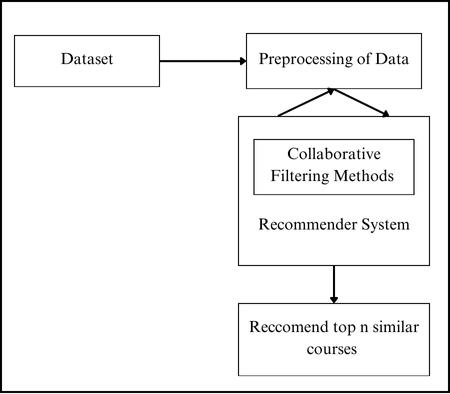
Fig -2:KNN
Numpylibraryfunctionsareusedtoperformfundamental mathematicalandscientificoperations.Thefunctionofthe matplotlibraryisincharge ofgraphical data chartingand display. Scipy libraries are used to solve mathematical problems.Learners’choicesandcourseratingsaregathered throughcollaborativefiltering. Similarpreferencesserveas thefoundationforuser-generatedcourserecommendations. Theclusteringmechanismisemployedintherecommender systemenhancement.Byclusteringobjects,thosethatare similar to each other but not much to objects in other clustersaregroupedtogether.Forreviewsbycoursedataset, cluster analysis and KNN are used to maximize output creation.LessonsforKNNneedtobesimilar.Weusemany methods like Pearson-Baseline, Pearson, Euclidean, Minkowski, Manhattan, Cosine, Jaccard, and Hamming to checkthis.Weusecosineinourcase.
PrincipalComponentAnalysisisamathematicalmethod for visualizing data approximately. It illustrates the relationshipsandsimilaritiesamongvariouselements.PCA aidsinsimplifying
International Research Journal of Engineering and Technology (IRJET) e-ISSN: 2395-0056
Volume: 11 Issue: 08 | Aug 2024 www.irjet.net p-ISSN: 2395-0072
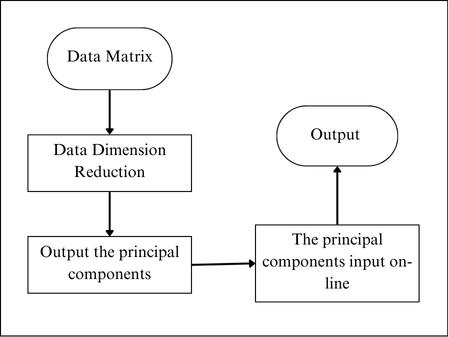
The data by reducing its dimensions, and it is employed priortocreatingmodels.PCAisamathtechniquetoseedata inaroughway.Itshowshowthingsrelateandlookalike PCA helps to make data simpler. It reduces dimensions of numbers,andit’susedbeforemakingmodels.Inclustering, we group people who share similar traits together. What clusterathingfallsintotellsusaboutit.Wecanalsoshow eachmemberofaclusterbyusingtheaveragetraitsofthat group.
Afterwecluster things, we can show them in a PCA view. Thishelpsusseewheredatasitsonthefirstplanebasedon theircluster.Inotherwords,makingclustersletsusseedata inwaysmorethan just on a two-axis scatterplot.
Clusteringisamethodinmachinelearningthatgroups likerowsinadataset.Afterrunningaclusteringmethod,a newcolumnshowsupinthedatasettoshowwhichgroup eachrowof data fits into best.Since rows of data,or data points,oftenarepeople,moneydeals,papersorotherkey things,thesegroupstendtoformclustersofalikethingsthat havemanyreal-worlduses.Clusteringissomeofthetime alludedtoasunsupervisedmachinelearning.
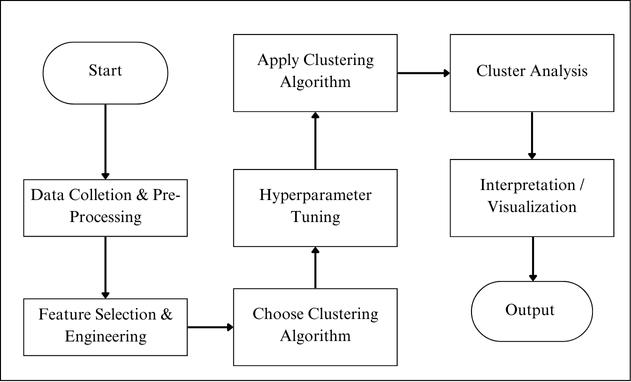
Fig -4:Clustering
To perform clustering, names for past known results – a subordinate, y, target or name variable – are for the most
partpointless.Forillustration,whenapplyingaclustering strategy in a contract advance application handle, it’s not fundamental to know whether the candidates made their pastcontractinstallments.Ormaybe,yourequirestatistic, psychographic,behavioral,geographicorotherdataaround thecandidatesinacontractportfolio.Aclusteringstrategy willatthatpointendeavortobunchthecandidatesbasedon that data. This strategy stands in differentiate to administeredlearning,inwhichcontractdefaultchancefor unusedcandidates,forillustration,canbeanticipatedbased ondesignsininformationlabeledwithpastdefaultresults.
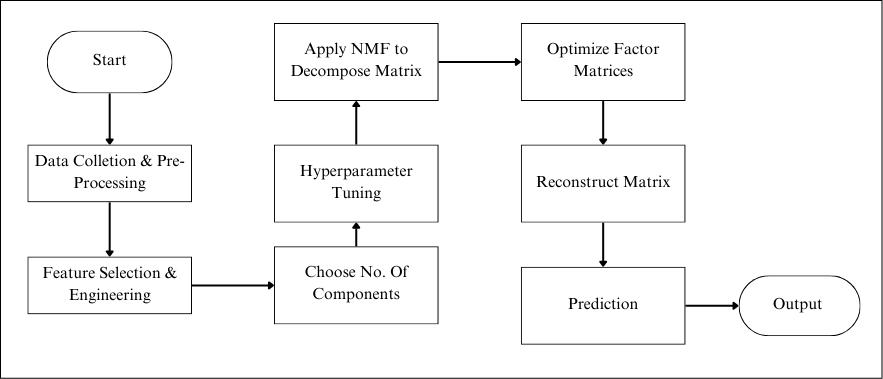
Non-negativematrixfactorization(NMF)isatechnique fordividingabignon-negativematrix(X)intotwosmaller matrices(AandB).AandB areoflower rank,hencethey havefewercolumnsthanX.Whenmultipliedtogether, AB approaches X as closely as feasible. NMF is a method for reducingthesizeofhugedatasetswhileretainingthemost criticalinformation.
Fig
It is commonly used in fields such as: Recommendation systemsaredesignedtoproposeproductsorservicesthat usersmaybeinterestedin.Textmininginvolvesidentifying patternsandsubjectsintextdata.Imageanalysisinvolves extracting features from photographs. NMF is an effective approach for identifying meaningful patterns and hidden insightsinmassivedatasets.NMFemploysideasfromlinear algebra and multivariate analysis. The method repeatedly altersAandB’svaluesuntiltheirproductapproachesX.This approach assures that the base and weight values are not negativewhilepreservingtheoriginaldatastructure.NMF terminates when the approximation error converges or a presetnumberofiterationsarereached.Itmustbeseeded with a value to act as the starting point for subsequent cycles.Thisisbecausetheprocessingspaceisverylarge,and there is no global minimization technique. As a result, correct initialization is critical for achieving significant results.
Significant achievements and outcomes have been accomplishedbydevelopingandimplementingourcourse recommendationsystem,whichhascontributedtothefield ofpersonalizedlearningandeducationaltechnology.
International Research Journal of Engineering and Technology (IRJET) e-ISSN: 2395-0056
Volume: 11 Issue: 08 | Aug 2024 www.irjet.net p-ISSN: 2395-0072
Tobegin,oursystem’suserinterfacehasenabledseamless interaction and engagement, giving users with a simple platformtoexplorecourserecommendationsbasedontheir interests and competence levels. The addition of a personalizedmini-quizuponuserloginhasbeenuseful in understandinguniqueuserpreferencesandknowledgegaps, allowingthesystemtoproducecorrectandrelevantcourse recommendationscategorizedasintroductory,medium,and advanced. This user-centric strategy has improved user happiness and system adoption, resulting in a more personalizedandefficientlearningexperience.Second,the employment of machine learning methods (such as PCA, KNN,andNMF)hasresultedinpreciseandeffectivecourse recommendations.Usingthesealgorithms,oursystemcan adapt to a wide range of user preferences and learning habits,providingbespokerecommendationsthatareclosely alignedwitheachuser’sownlearningpath.Theadditionof additionalfilteringmethodsforinvestigatingspecializedmachinelearningtopicshasexpandedthesystem’scapabilities, allowinguserstogodeeperintoadvancedcoursesandgain specializedknowledgeintheirfieldsofinterest.Finally,the training and prediction capabilities of our system have alloweduserstodirectlyshapetherecommendationmodel. Userscantrainthesystemusingspecifiedparametersand algorithms, providing useful feedback that improves the accuracy and relevancy of course recommendations over time.Theavail-abilityofthoroughfindingsandinsightsinto recommended courses has enabled users to make more informed judgements when choosing learning paths, enablinga more plannedandpurposefulapproachtoskill development and educational success. The effective implementationofourcourserecommendationsystemhas shown concrete results in improving users’ learning experiences. By combining intuitive user interface design, personalized quiz modules, advanced machine learning algorithms,andinteractivetrainingcapabilities,oursystem has effectively personalized course recommendations, empowered users to explore advanced learning opportunities, and facilitated informed course selection decisions.Thesefindingshighlightthepowerofpersonalized recommendationsystemstochangeeducationaltechnology and create lifelong learning journeys suited to individual needsandgoals.
The project opens up exciting possibilities for further enhancements and expansions in the domain of learning. Based on the search results, some potential future scope ideas for course recommendation systems using machine learningareasfollows:
Incorporate more advanced machine learning techniques:
The search results mention using techniques like decision trees, collaborative filtering, and neural networks. Future work could explore implementing
moresophisticatedMLmodelslikedeeplearning,graph neuralnetworks,orreinforcementlearningtoimprove the accuracy and personalization of course recommendations.
Integrate course prerequisites and program requirements:
Thecurrentsystemsfocusmainlyonuserpreferences and past course selections. Future systems could incorporate information about course prerequisites, degreeprogramrequirements,andacademicpoliciesto provide more comprehensive and relevant recommendations.
Leveragemulti-modaldata:
In addition to course enrollment data, future systems could utilize other data sources like student demographics,academicperformance,extracurricular activities,andevencampusengagementtobuildmore holistic user profiles and make better course recommendations.
Improveexplainabilityandtransparency:
Developing course recommendation systems that can explain their reasoning and recommendations to studentscouldin-creasetrustandadoption.Techniques like interpretable machine learning models and visualization tools could enhance the transparency of therecommendationprocess.
Expandtoprogram-levelrecommendations:
Rather than just recommending individual courses, future systems could provide guidance on entire academicprograms,majors,orcareerpathwaysbased onastudent’sinterests,skills,andgoals.
Incorporatereal-timefeedbackandadaptation:
Continuously updating the recommendation models basedonstudentfeedbackandbehaviorcouldallowthe systems to adapt and improve over time, providing morepersonalizedandrelevantcoursesuggestions.
Extend to lifelong learning and professional development:
Courserecommendationsystemscouldbeexpandedbeyond traditional academic settings to support continuous learning and career development for workingprofessionals.
Thefuturescopeforcourserecommendationsystemsusing machinelearninginvolvesleveragingmoreadvancedtechniques, integrating additional data sources, improving explain-ability,expandingthescopeofrecommendations,
International Research Journal of Engineering and Technology (IRJET) e-ISSN: 2395-0056
Volume: 11 Issue: 08 | Aug 2024 www.irjet.net p-ISSN: 2395-0072
and enabling real-time adaptation and lifelong learning support.
Inconclusion,theuseofmachinelearningtechniquesfor courserecommendationsystemshasshowngreatpotential in enhancing the educational experience for students. By leveraginghistoricaldata,userpreferences,andadvanced algorithms,thesesystemscanprovidepersonalizedcourse recommendations that align with a student’s academic interests,goals,andlearningstyles.
ArtiPanchalandHarshRautplayedpivotalrolesinthe developmentofthiswork,withArtiandHarshleadingthe designandimplementationoftherecommendationsystem and integration, and Richa Sapre snd Vaibhav Zarapkar focusingonfrontendintegration,UI/UXenhancements,and performance optimization as well as contributed to the literature review, providing essential insights and supporting theproject’sfoundation.
We wish to express our sincere gratitude to Dr. Sanjay U. Bokade,Principal,andProf.Dr SunilB.Wankhade,Professor &HeadofDepartmentofInformationTechnologyatMCT’s RajivGandhiInstituteofTechnology,forprovidinguswith the opportunity to work on our project, ”Course Recommendation Using Machine Learning.” This project would not have been possible without the guidance and encouragement of our project guide, Prof. Dr. Sunil B. Wankhade, and his valuable insights of our project. We would also like to thank our colleagues and friends who helpeduscompletethisprojectsuccessfully.
[1] Shah, D.; Shah, P.; Banerjee, A. Closeness based regularizationforonlinematrix-factorizationissue:An application to course recommender systems. In MethodsoftheTENCON2017 2017IEEERegion10 Conference,Penang,Malaysia,5–8November2017;pp. 1874–1879.Liang,Y.;Duan,X.;Ding,Y.;Kou,X.;Huang, J. Data Mining of Students’ Course Choice Based on CashRulesandChoiceTree.[1]
[2] In Methods of the 2019 4th Around the world Conference on Tremendous Data and Computing, Guangzhou, China, 10–12 May 2019; pp. 247–252 Kamila,V.Z.;Subastian,E.KNNandGuilelessBayesfor Optional Advanced Courses Recommendation. In Strategiesofthe2019AroundtheworldConferenceon Electrical, Contraptions and Information Planning (ICEEIE), Denpasar, Indonesia, 3–4 October 2019; Volume6,pp.306–309[2]
[3] In Methods of the 2019 4th Around the world Conference on Tremendous Data and Computing, Guangzhou, China, 10–12 May 2019; pp. 247–252 Kamila,V.Z.;Subastian,E.KNNandGuilelessBayesfor Optional Advanced Courses Recommendation. In Strategiesofthe2019AroundtheworldConferenceon Electrical, Contraptions and Information Planning (ICEEIE), Denpasar, Indonesia, 3–4 October 2019; Volume6,pp.306–309[3]
[4] Fu L, Ma X. An Improved Recommendation Method BasedonContentFilteringandCollaborativeFiltering. Complexity.[4]
[5] M. Salehi and I. N. Kamalabadi, ”Hybrid Recommendation Approach for Learning Material BasedonSequentialPatternoftheAccessedMaterials and the Learners’ Preference Trends,” in IEEE TransactionsonKnowledgeandDataEngineering,vol. 27,no.4,pp.992-1005,April2015.[5]
[6] Wan,Y.Lan,J.Guo,J.Xu,L.PangandX.Cheng,”ADeep EnsembleforPersonalizedCourseRecommendation,” in IEEE Transactions on Knowledge and Data Engineering,vol.32,no.8,pp.1596-1609,1Aug.2020. [6]
[7] M. Isma’il, U. Haruna, G. Aliyu, I. Abdulmumin and S. Adamu, ”An Autonomous Courses Recommender System for Undergraduate Using Machine Learning Techniques,” 2020 International Conference in Mathematics, Computer Engineering and Computer Science(ICMCECS),2020,pp.1-6.[7]
[8] T.X.Liao,X.H.Feng,Y.L.Sun,H.T.Wang,C.LiaoandJ. B. Li, ”Online Teaching Platform Based on Big Data Recommendation Sys- tem,” 2020 5th International ConferenceonInformationandEducationInnovations (ICIEI),2020,pp.35-39.[8]
[9] J. P. Niyigena and Q. Jiang, ”A Hybrid Model for ELearning Resources Recommendations in the Developing Countries,” 2020 4th International Conference on Deep Learning Technologies (ICDLT), 2020,pp.21-25.[9]