
International Research Journal of Engineering and Technology (IRJET) e-ISSN:2395-0056
Volume: 11 Issue: 08 | Aug 2024 www.irjet.net p-ISSN:2395-0072

International Research Journal of Engineering and Technology (IRJET) e-ISSN:2395-0056
Volume: 11 Issue: 08 | Aug 2024 www.irjet.net p-ISSN:2395-0072
Sumit Bhatnagar1, Roshan Mahant2
1Individual Researcher, New Jersey, USA
2LaunchIT Corp, Urbandale, IA USA
Abstract- As part of their digital transformation, financial service companies can greatly benefit from the implementation of a microservice architecture. We can build a service-oriented architecture (SOA) application using the architecture to enhance its overall performance and maintainability. This enables the applicationtoconsistofseveralsmallercomponentsthat operate independently and simultaneously. In the financialservicesindustry,theaccuracyofartifactstates holds immense significance. Given that an inaccurate artifact state or anomalous artifact operation(s) could potentially ruin the entire application, it is crucial to conductananalysisoftheartifactoperationswithineach microserviceduringthedesignprocess.Inthisstudy,we present a technique for identifying anomalies through the characteristics of artifacts associated with the microservicearchitecture.Followingthis,weidentifythe properties of artifacts. As a result of technological improvements and shifting client expectations, the financialsectoriscurrentlygoingthroughatremendous upheaval. Among these advancements, microservices architecture has emerged as a key enabler of agility, scalability, and innovation in banking systems. This paper delves into the relationship between microservicesandbankingsecurity,emphasizingtheuse of microservices to strengthen financial systems in the face of growing cyber security risks. The microservices architecture simplifies the development, deployment, andscalabilityofbigfinancialapplicationsbyseparating them into smaller, self-contained services. This modular approach not only makes the system more reliable and helps separate problems, but it also makes continuous integration and delivery (CI/CD) easier, which lets you respondquicklytochangesinthemarketandnewrules. However, the implementation of microservices introduces new security challenges, such as controlling inter-service communication, ensuring data integrity, and safeguarding against attack detection and protection.
Keywords -microservices,artifactanomaly,workflow
Inrecentyears,microservicearchitecturehasgarnereda lotof interest due to the numerous advantages itoffers, particularly in applications that are both sophisticated
andlarge.Thestrategyisbasedontheideaofdividingan applicationintoanumberofsmallerservicesthatservea specificpurpose.Thismakestheprocessofdevelopment and maintenance simpler, more efficient, and more scalable.Microservicearchitectureisespeciallyhelpfulin thecontextoffinancialsystems,whicharefrequentlybig andcomplicatedandcallforhighlevelsofreliabilityand faulttolerance.Wewilldiscusstheadvantagesofutilizing microservicearchitectureinfinancialsystems,alongwith thechallengestosuccessfullyimplementthisstrategy,in the following paragraphs. Compared to organizations that specialize in financial technology, the majority of traditionalfinancialserviceshavebecomelessinnovative over thecourseof the past few years. This is mostlydue to the fact that these services rely heavily on their big, monolithic legacy systems. To a large extent, these systems are highly stiff, and they frequently become maintenance headaches due to their limited adoption of new technologies and performance [1]. Overall, they are quite rigid. The adoption of system design that is more adaptivetochanges,suchasnewtechnologiesandfaster performance requirements, is something that organizations that provide financial services are contemplating in order to maintain their competitive edge [2].An example of a service-oriented architecture (SOA) is the microservice design, which breaks down large applications into smaller, autonomous parts called microservices that can operate in tandem. [1, 2]. Microservices are also known as microservices. The abilitytoscaleandoperateamicroserviceindependently at smaller granularities is one of its defining characteristics. which allows for a significant improvement in both the system's performance and its abilitytobemaintained.Everymicroservice,forinstance, has the ability to adopt a variety of technological platforms that are optimally suited to the performance levelsthatitrequires.
The process of developing applications that use the microservice architecture frequently uses workflow models.Thesemodelsassistinboththedevelopmentofa microservice and the planning of its partnership with other service units. Conducting an analysis of artwork is absolutely necessary to ensure accurate workflow execution. We define artifacts as the data or objects specified, employed, or referenced by the operations within a workflow. Despite the well-behaved workflows,
International Research Journal of Engineering and Technology (IRJET) e-ISSN:2395-0056
Volume: 11 Issue: 08 | Aug 2024 www.irjet.net p-ISSN:2395-0072
conflictsbetweentheoperationscouldpotentiallyleadto erroneous states. The distribution of microservices across multiple locations necessitates a thorough examinationoftheartwork.Thisisbecauseaninaccurate artifact state has the potential to corrupt the entire system. For instance, the process of message passing might propagate an improper state from one microservicetoothermicroservices.
In this paper, the authors provide methods for identifyingsuspiciousartifactsinsidemicroservices.This research's topic is "Fortifying Financial Systems: The Intersection of Microservices and Banking Security." Initially, they determine the quality of the artworks by analyzing the microservices' features. They first show two methods that use these properties to detect abnormalities, and then they turn a microservices workflow model into the appropriate SP-tree structure.
Using the detection result, the designer can make adjustments to the service application to prevent the system from experiencing a failure state. E.g., below: DigitalBankingArchitecture
Microservices in finance Sector
Microservices and layered architectures are the most commontypesofarchitecturesforcorebankingsystems. Asaresult,itisessentialtodisclosetheirmostimportant characteristics, as well as their strengths and weaknesses, in order to create an excellent fintech solutionandmakeaninformeddecision.Therefore,let's beginwithastratifiedstructure.
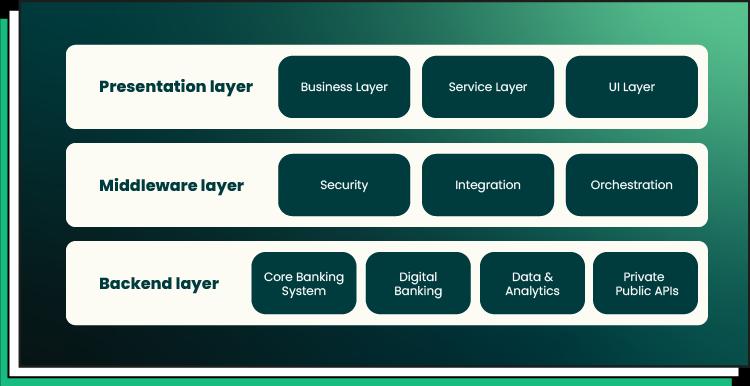
The presentation layer, often known as the front end, middleware, and backend, are the components that makeupastandardtiereddesign,asdepictedinfigure1. Modularity,scalability,andmaintainabilityareamongits most important characteristics. These characteristics make it simple to implement changes and add new features. Each layer of this design represents a different module, simplifying the development of this architecture. Additionally, we can apply different scales to each layer separately. At long last, it is feasible to improveonelayerwithout havingan effect ontheother layers.
A number of benefits, including ease of creation, clarity, and simplicity, are associated with this digital bank design. Therefore, we can use it to build large and complex banking solutions, improve existing ones, and incorporatenewfeatures.
The performance overhead and rigidity of a layered design are two reasons why it is considered to be a weakness. Communication between levels may complicate the process of setting up and carrying out functions. In addition to this, the layered method is typicallystiff,whichmakesitdifficulttomakechangesin asinglelayer.
International Research Journal of Engineering and Technology (IRJET)
Volume: 11 Issue: 08 | Aug 2024 www.irjet.net
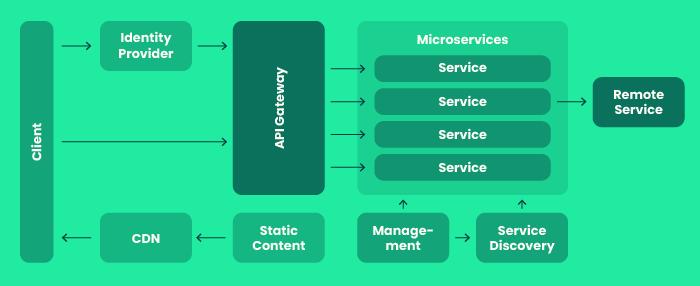
Figure II depicts the microservices-based architecture. Figure II displays a variety of services that are deployable independently. Each service performs a specific business function, and these services communicate with each other. Numerous digital banks constructtheirbankingapplicationsusingmicroservices architecture. Now, let's explore the factors that contribute to its popularity. In addition to providing the largestprospectsforscalability,microservicesalsomake itpossibletointegratewithawidevarietyofthird-party servicesinaseamlessmanner.
Thescalabilityofmicroservicearchitectureisamongthe most important advantages that use this design. Sometimes, financial systems are difficult to understand since they are made up of a wide variety of components that need to be controlled and maintained. Microservice architecture makes it possible to divide and partition these components with ease, which makes it simpler to scale the system up or down according to the requirementsofthecircumstance.Thegeneralscalability andflexibilityofthesystemisimprovedasaresultofthis functionality, which enables developers to tweak or add newfeaturestothesystemwithoutcausingdisruptionto thesystemasawhole.
Microservicedesigninfinancialsystemsoffersa number of benefits, one of which is more agility. The ability to
swiftlyreacttochangingmarketconditionsandcustomer requirementsisanessentialqualityforfinancialsystems. By enabling developers to rapidly adjust and add new features to the system, microservice architecture makes itpossibleforfinancialsystemstobemoreadaptableand sensitivetocircumstancesthatarealwaysshifting.
Financial systems are required to have a high degree of reliability and tolerance for errors. It is of the utmost importance that the system be able to get back up and runningwithoutanyinterruptionsintheeventthatithas a breakdown or an outage. This helps to lessen the impact of any failures or outages that may occur. Microservice design offers fault isolation and containment.Thetestingandmonitoringofthesystemis also simplified by this approach, which enables developerstoquicklydiscoverandresolveanyproblems thatmayarise.
One of the advantages of microservice architecture is its ability to support the utilization of many technologies. Financial systems typically consist of a variety of components, each constructed using a variety of technologies or computer languages. Microservice architecture enhances the system's overall performance and scalability by allowing the construction of each componentusingthemostappropriatetechnology.
International Research Journal of Engineering and Technology (IRJET)
Volume: 11 Issue: 08 | Aug 2024 www.irjet.net p-ISSN:2395-0072
Implementing microservice architecture presents challengesdespiteitsbenefits.Thesechallengesinclude:
When working with huge and complicated financial systems, microservice architecture can be particularly difficulttounderstandandimplement.Thecomplexityof the system increases in proportion to the number of microservicesthatarepresent,makingitmoredifficultto manage and maintain. It is necessary to practice careful planningandmanagementinordertoguaranteethatthe system will continue to be scalable, maintainable, and secure.
Inaddition,testingmightbeadifficulttaskwhendealing with microservice architecture. It is necessary for us to perform unique tests on each microservice in order to verifythatit functionsappropriatelyand integrates with the other microservices that are present in the system. Performing this might be a time-consuming process that calls for meticulous organization and coordination in ordertoguaranteethatthetestingiscomprehensiveand efficient.
Theuseofmicroservicearchitectureinfinancialsystems may pose challenges in terms of maintaining data consistency. It is difficult to guarantee that the data is consistent throughout the entire system because each microservicecouldhaveitsowndatastoreordatabase.
Careful design and management are required to ensure data synchronization and consistency across all
microservices. There is a kind of software design known as microservices architecture. This form of architecture divides an application into a collection of small, independent services. Every service handles its own process and communicates with others via well-defined APIs. In order to design and maintain complex systems, developers have the ability to develop, launch, and scale these services independently of one another. This providesavarietyofbenefits.
By easing the introduction of new white-label solutions, Finbox helps financial institutions and fintechs increase their customer base and revenue. One of these is an investmentproduct.

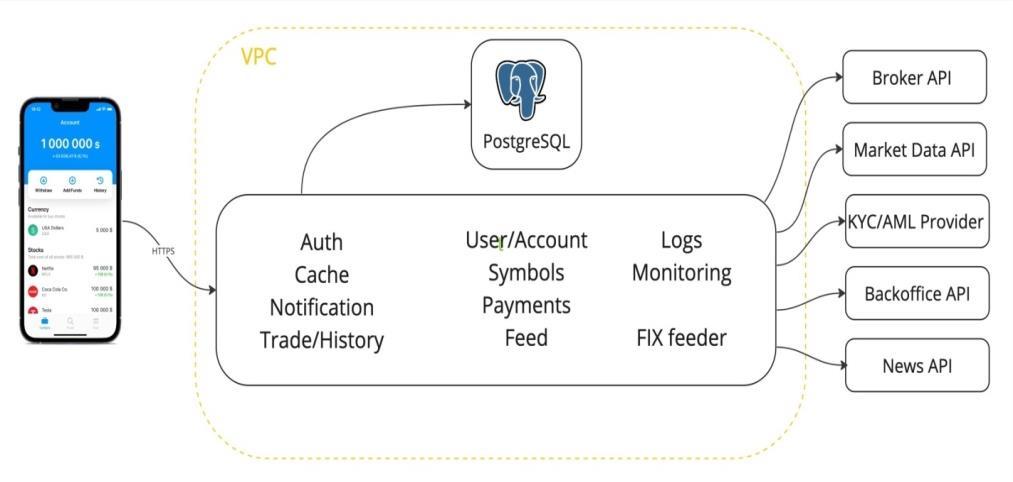
Through the use of the Java Spring Framework, we initially developed and constructed the backend using the Java SpringFramework ina monolithic architecture. Using the PostgreSQL database, they were able to construct everything into a single application. This strategy expedited the implementation of business logic and guaranteed the consistent achievement of goals. On the other hand, it contributed to issues in terms of performance and scalability. Because of a specific use case, the FIX protocol was experiencing a period of high load.Sincewewantedtoavoidprogramcrashes,wehad todeviseworkarounds.
International Research Journal of Engineering and Technology (IRJET) e-ISSN:2395-0056
Volume: 11 Issue: 08 | Aug 2024 www.irjet.net p-ISSN:2395-0072
Authentication and authorization, caching, and notification services are some of the components that the financial services platform offers to banks and fintech companies in order to assist them in expanding their user base and capitalization, trade history, user account management, symbol management, payment gateway, data feed, log monitoring, FIX feeder, broker API, market API, KYC/AML service, back-office API, and newsfeed.Theplatformwasinitiallyconstructedusinga monolithic architecture that included the Java Spring Framework and PostgreSQL, as depicted in Fig. 1. Because of the high load on the FIX protocol, it faced performanceandscalabilityissues.Toaddressthese,the platform transitioned to a microservices architecture withasynchronoustaskprocessingviaKafka,leveraging HTTPS and web sockets for stability. This transition
allowed for independent scaling and better resource utilization, resulting in improved response times, throughput, and system stability, while also ensuring complianceandefficientuserandtrademanagement.As showninFig.3,Monolithicarchitecture
Thenextiterationaimedtopreventissueswiththehigh load and frequent failures of the FIX Feeder, while also enhancing the scalability of the API Gateway layer. This time, the challenge lay at the core of the system. Given the high degree of coupling in the software, any modification would result in crushes occurring in unexpected locations. Ineffective horizontal scaling was a result of errors that occurred during the design and implementationofthearchitecture.[1]
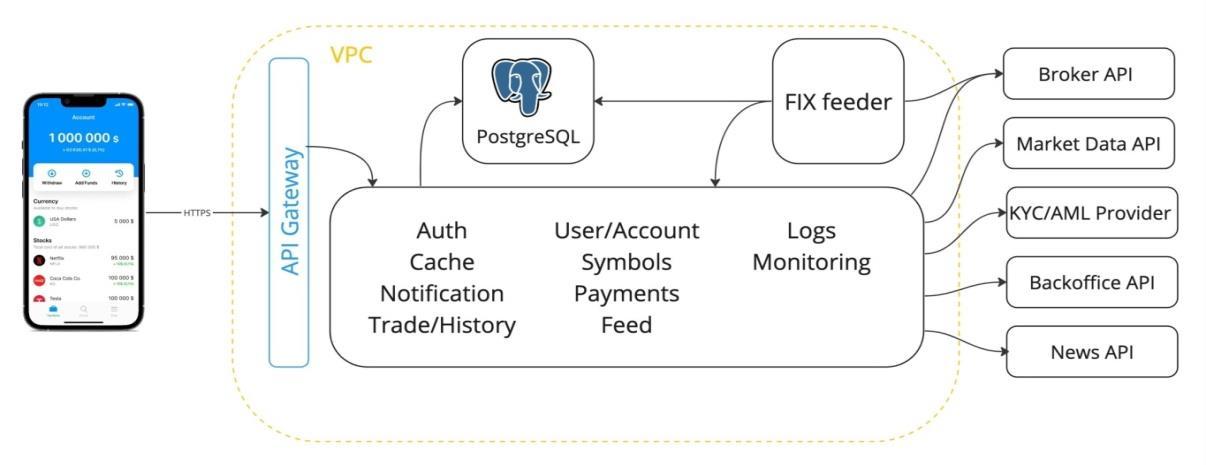
After learning from these two phases, we made the decision to transition to a fully decoupled microservices architecture, utilizing Kafka for asynchronous task processing. This system is currently quite flexible and scalable, able to accommodate changes in both the codebase and the architecture, as demonstrated in Figure 5: Microservices architecture. The core
microserviceshandletheprimaryfunctionality,allowing for dynamic scaling of each service. On the other hand, the peripheral is responsible for managing connectivity with devices and APIs provided by third parties. They decided to switch from the FIX protocol to HTTPS and Web Sockets because of the stability and usability of theseprotocols.
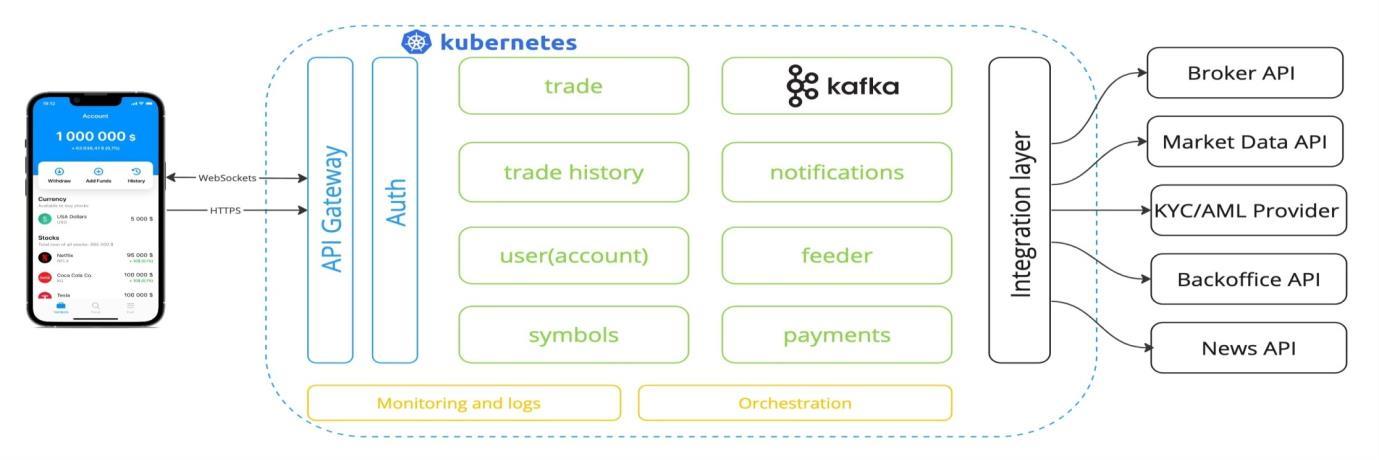
Fig.5Microservicesarchitectureintegrationmodelforfinanceindustry
International Research Journal of Engineering and Technology (IRJET) e-ISSN:2395-0056
Volume: 11 Issue: 08 | Aug 2024 www.irjet.net
Response time is a critical performance metric that measuresthetimetakento processa requestfromstart tofinish.Ina monolithicarchitecture,theresponsetime can be longer due to the tightly coupled nature of the components, leading to potential bottlenecks. Transitioning to microservices architecture aims to reduce response time by decoupling components and enablingparallelprocessing.[1]
Monolithic Architecture
RTmonolithic = ∑
Where:
RTiistheresponsetimeforeachrequestiii
Nisthetotalnumberofrequests
Microservices Architecture:
RTmicroservices = ∑
Where:
RTjistheresponsetimeforeachrequestjjj
Misthetotalnumberofrequests
ImprovementinResponseTime(IRT):
IRT=RTmonolithic−RTmicroservices
Load(L)
Theory:
Theloadisthenumberofmessagesorrequestshandled by the system per unit time. A high load on a single component in a monolithic architecture can lead to performance degradation. Increasing both performance and reliability can be accomplished by distributing the load among a number of different microservices.LHTTPS+WebSockets =
Amicroserviceisdefinedasaprogrammableunitthatis surrounded by contexts and has the ability to communicate with every other microservice through message forwarding. [3]. On various platforms, such as physical machines, virtual machines, or containers, we can manage, deploy, and scale different microservices independently [4]. An application with a microservice architecture can be built by assembling several distributedmicroservices,eachofwhichhandlesitsown process and communicates with others through message-based protocols. This design has at least three features: it is context-bound, smaller than a typical
service in service-oriented architecture (SOA) [5], and operationally independent. Based on the observation of these traits, the following is a list of artifact attributes that can be located and identified: Through the use of a messaging mechanism, the independence feature ensures that the artifacts included within each microservice are independent of those contained within another microservice using a messaging mechanism. This facilitates the transfer of the artifact from one microservice to another. It is possible for each microservice to have its own unique context because of the limited context characteristic. When a message passes an artwork from one microservice to another, each microservice's context can give it a different name. However, the artifact itself remains separate and autonomous. The smaller size and independent propertiesofeachmicroservicemakeitpossibleforitto readily expand horizontally [6]. This allows it to concurrently operate on multiple instances. This scenario allows for the simultaneous presence of identical independent artifacts on multiple processes in different locations. Using the above information about artifacts, finding strange artifacts within each microserviceoftheapplication(intra-microservice)can help check the accuracy of the artifact states sent betweenmicroservicesandkeepthesystemfromfailing. In the context of a microservice's related workflow, we canexamineanartifact'serroneousstatewithoutregard to processes external to the microservice. When we exchange an artifact via a message and send it to other microservices or service units, we can interpret the act ofreceivingamessageaswritingontheartifact,andwe can also consider each parameter it represents as a reading on the artifact. The following definition [7] identifies an artifact as having an intra-micro service artifactanomalyifitexhibitsabnormal Read,Write, and Killoperations.(1)Aconcurrentartifactanomalyoccurs when two parallel operations on the same artifact fall intooneofthefollowingpairs:(Kill,Write),(Kill,Read), or (Write, Write). A continuous artifact anomaly arises when two successive operations on the same artifact end, read, write, or terminate. written, written, or written.
Using the microservice architecture [2], they are able to modelthedesignofamicroserviceasaworkflowthatis contained within a pool. This enables the microservices to communicate with one another via message passing. Figure 6 provides a visual representation of an example ofthemicroservicesparadigm.
The workflow modeling process employs a structured workflow model (SW). They use this model to avoid stalemate or unwanted recurrence. [8] This paradigm guaranteesthatajointnodeaccompanieseachsplitnode at a specific level, and that nodes within the split-joint
International Research Journal of Engineering and Technology (IRJET) e-ISSN:2395-0056
Volume: 11 Issue: 08 | Aug 2024 www.irjet.net p-ISSN:2395-0072
structurelackanyedgesconnectingtonodesbeyondthe structure.Eachjointnodeislocatedatthesamelevel as the split node. To streamline linear computation, researchers utilized a specialized tree structure known as a sequential and parallel tree (SP-tree) [9]. The sequentialstructurepositionsthechildnodesontheleft side, while the parallel structure positions them on the right side. In this structure, each SW node is associated with a matching SP-tree node N. When considering its
structure, an SP tree can be defined as follows: A child positionedtotheleftoftheN symbolizestheimmediate successor that is 0½V in the southwest direction. Software uses split nodes like AND, XOR, and Loop to express split-joint structures. The first node in the softwarestructureinitiatesa new branchasa right-side child. The structure's direct heir is represented by a youngster on the left side. To symbolize a road that is empty, we build a node that says "Empty" in Figure 7.
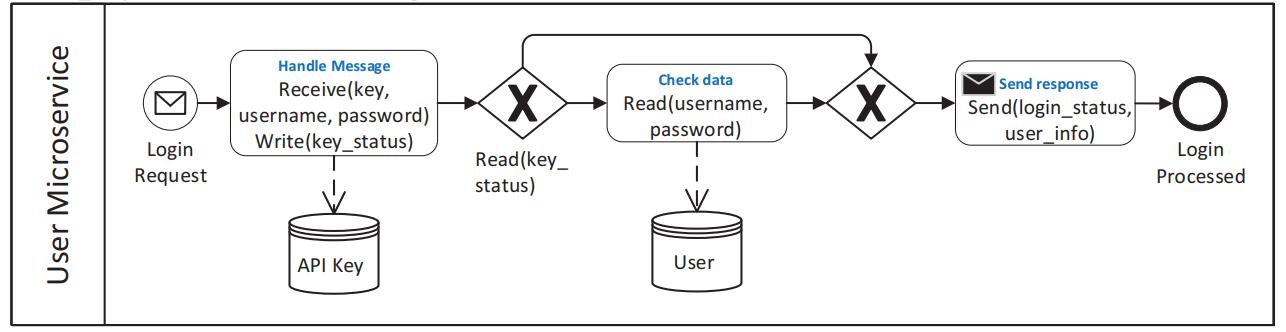
exampleofmicroservicemodeledinSW
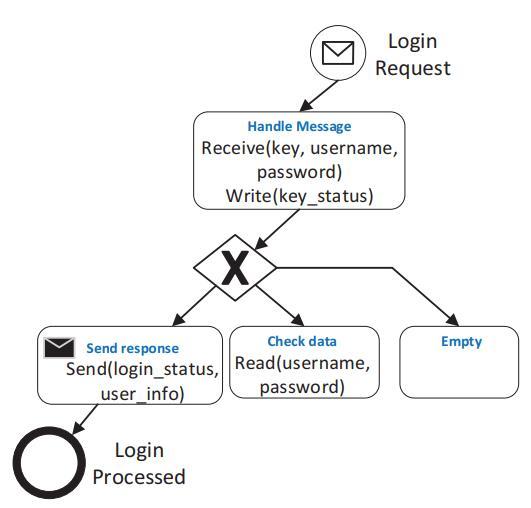
examplefortransforminganSWintoaSP-Tree
International Research Journal of Engineering and Technology (IRJET) e-ISSN:2395-0056
Volume: 11 Issue: 08 | Aug 2024 www.irjet.net p-ISSN:2395-0072
DetectionofContinuousAnomaly
One way to characterize a continuous anomaly is with a three-tuple(v,m,n).Inthisscenario,artifactvisusedon nodembeforemovingontonoden.Becausemprecedes n, there is no processing of v between m and n. Each possible combination of m and n operations is an operation pair: (Kill, Read), (Kill, Kill), (Write, Kill), or (Write, Write). Detecting continuous abnormalities in the SP-tree is the purpose of Algorithm 1, which is derived from [9]. The algorithm employs a leftmost depth-first technique, incorporating a recursive procedure to traverse the SP-tree node by node. Once youhavearrivedatanode:(1)Ifthenodeinquestionis an activity node, the algorithm will gather information abouttheflowofdata.Itwillthenidentifyanyanomalies within the current node. In the case of split nodes, the algorithm will recursively find anomalies within the currentnodeandanychildnodesontherightside,using thedataflowinformation.Afterthat,itwilleitherreturn the data flow from the right side or call its successor recursivelyifoneexists.Uponcompletionofthetask,we examinealltheSPtreenodes.
Algorithm 1:
ContinuedDetectionofAbnormalities(SAD)
Application:SP-treenodeProduced:SP-treeelement
A set of continuous abnormalities switch is a global variable.{
cDVH(³6WDUW´):
The left-hand child must initiate data flow information returnSAD.
cDVH(³(QG´);
returnnode=Null;
cDVH(³$cWiYiW\´);
returnProcessActivityNode(node);
cDVH(³;25´):
returnProcessXorNode(node);
cDVH(³$1D´);
returnProcessAndNode(node);
cDVH(³/RRS´):
returnProcessLoopNode(node);
}
For ProcessActivityNode Analysis of anomalies in an activity node primarily entails the following five steps: (2)Locatetheassemblageofartifactsthatpossesseither aKilloraWriteoperationpriortoreachingthatspecific node,referredtoasLKandLWsets,respectively.(3)use thiscollectiontoidentifyanycontinuousanomalies;and (4) find the collection of artifacts in that node that have thefirstandlastoperations,whicharecalledSAsets.(1) call the left-side child recursively; (2) call the left-side childiteratively;(3)updatetheLKandLWbasedonthe SA sets used in the successor node; and (6) return the data flow for analysis appropriately if there is no leftside child. For ProcessXorNode they can divide the process of discovering continuous anomalies into two independentcomponents:(1)theexpression,and(2)the branches.Thissectionprovidesadetailedexplanationof both these components. When discussing an XOR structure, there is an operation that involves artifacts; hence,itispossibleforananomalytooccurasaresultof itsactioninthenodesthatcamebeforeit.Followingare the four steps that make up the first part: The process involvesfoursteps:(1)identifyingthenode'sSAsets;(2) determining its LK and LW; (3) identifying the oddities in the XOR node's expression; and (4) altering LK and LWbasedontheSAsets,therebyidentifyingtheoddities in the XOR branches. There are four steps involved in this process. The three steps that make up the second partarelistedbelow:
Find the problem and get the data flow by calling each childontherightsidemultipletimes;(2)changeLKand LW based on the data flow from step (1), which is used to find the problems in the child on the left side. which might be thought of as a successor to the XOR structure in SW. (3) If there is no child on the left side, then the data flow should be returned for processing in the appropriatemanner.Otherwise,therecursivecallshould beperformedtothechildontheleftside.
For ProcessAndNode The technique bypasses expressions in AND split nodes and goes straight to the right-hand children to identify the continuous abnormality. The detection process consists of four steps: Using the flow data gathered in step (2), they proceedasfollows:First,theydeterminetheLKandLW foreachchildontherightsideoftheANDnode.Next,we checkforanyanomaliesandcollectdatathroughmutual recursive calls. Finally, we update the variables LK and LW. Next, make a recursive call to the child on the left side. If there is no child on the left side, return the data flowforanalysisintheappropriatemanner.[10]
For ProcessLoopNode Combiningalliterationsintoone reduces the need for duplicate computation due to the loop body's recurring structure and control, making iterating more efficient for finding continuous abnormalities in a loop. Eliminating unnecessary computations will help achieve this. They categorize
International Research Journal of Engineering and Technology (IRJET) e-ISSN:2395-0056
Volume: 11 Issue: 08 | Aug 2024 www.irjet.net
continuous anomalies associated with a loop based on thelocationofthetwoprocessesthatmakeuptheloop. This is because two actions taken on the same artifact constitute a continuous anomaly. If the first operation takes place outside of the loop and the second occurs insidetheloop,wecanrefertotheanomalyaspre-loopend.Theyrefertotheanomalyasanintra-loopanomaly whenbothproceduresoccurinsidetheloop.
Anirregularitywithafirstoperationoccurringinsidethe loop and a second operation occurring outside of it is knownasatailed-loopanomaly.
The following six steps comprise the formula: Start by obtaining theloopnode'sSAsets.2.AcquireLKand LW components. 3. Look for any irregularities in the loop node before it ends. 1. 4. Repeatedly invoking the righthand child will return any abnormalities in the loop body, whether they occur before or after the loop ends. 5.UpdateLKandLWtoidentifythetailloopanomaly.5. Using a recursive function, call the left-hand child. Take the data flow back to analysis if the left side does not include any children, return the data flow for analysis.[11]
IftwonodesintheSWareclosetoeachother(mandn), theycanrunatthesametime.TheNCPthatcamebefore this one is an AND split node. Using an AND split node for each of the two nodes m and n, we test artifact V extensively. Consider the following as a three-tuple: (v, m, n). Hence, it has the option to select (Write, Write), (Kill,Read),or(Kill,Write)asthepairofprocessesinm and n. Using Algorithm 2, they can identify concurrent anomalies in an SP tree by employing a leftmost depthfirst strategy. [12]. This algorithm uses a recursive approachtoexploretheSPtreenodebynode.Whenthe algorithm reaches a node The algorithm will return a unioncontainingtheartifact(s), theiroperation,andany otherelementswithinthecurrentnode.Thisset,named a_set, not only returns the value from the recursive call toitschild,butalsoreturnsthevalueitself.Onthe right side, there is a separate collection known as branch_a_set that is associated with each AND node's distinct branches. This set encompasses all a_sets derived from the top node to its final successor in this branch. After gathering all the branch_a_sets, the algorithm scrutinizes each pair of branch_a_sets to identifyanycontemporaneousanomalies.
Algorithm 2:
DetectionofConcurrentAnomalies(CAD)
Application:SP-treenodeResults:a_set{}
International variables: collection of simultaneous
outliers
p-ISSN:2395-0072
When the node type is not Start, End, or AND, then gatherallobjectsandtheiroperationsandsavethemin
a_set;
}
switch(typeofnode){
cDVH(³Start´):
returnCAD(childintheleftside);
cDVH(³End´):
return{};
cDVH(³Activity´):
if(childintheleftsideexist){
return(a_setɷCAD(childintheleftside)); }else{
return(a_set);
}
cDVH(³Loop´):
a_set=a_setɷCAD(childintherightside);
return(a_setɷCAD(childintheleftside));
cDVH(³;25´):
for(inti=0;i<anumberofimmediatechildintheright side;i++){
a_set=a_setɷCAD(ithchildintherightside);
}
return(a_setɷCAD(childintheleftside));
cDVH(³$1D´):
branch_a_set[];
for(inti=0;i<anumberofimmediatechildinthe rightside;i++){
branch_a_set[i]=CAD(ithchildintherightside);
a_set=a_setɷbranch_a_set[i];
}
International Research Journal of Engineering and Technology (IRJET) e-ISSN:2395-0056
Volume: 11 Issue: 08 | Aug 2024 www.irjet.net p-ISSN:2395-0072
for(inti=0;i<branch_a_set.size;i++){
for (int j=i+1; j<branch_a_set.size; j++) { Detect the concurrent anomaly by comparing branch_a_set[i] and branch_a_set[j];
} } return(a_setɷCAD(childintheleftside));
Algorithm 2'soperations: When the algorithm reaches a node, it will first determine the type of node that it is currently examining and then perform a detection that corresponds to that kind. When the node is a Start, the algorithmcallsthechildontheleftsideofthetree,which alternates between levels. The answer is an empty set, indicating that the SP-tree for the end node has ended. ThismethodtakesanactivitynodeandreturnsitsA_set plusthevalueoftherecursivecalltoitsleftmostchild,if any. If the activity node does not have a child, the proceduredirectlyreturnsitsa_set.[13]
The method initiates a recursive call to retrieve all the a_sets from the child on the right and its successor, if any.Themethodthenperformsaunionoperationonall ofthesesets.Next,themethodjoinsthevaluesthatwere returned with the a_set of the Loop node. A loop node, forexample,couldhandlethis.Theprocedurefinishesby returning the union of the current a_set and the value received by a call to the child on the left that proceeded backwards,takingcareofthechildontheleft.Tocreate a union, the technique takes all the a_sets from the children of an XOR node and puts them together. The recursivecallcollectsallthea_setsfromeachdirectchild ontherightandanysubsequentchildren.Next,itmerges the returned value with the a_set of the XOR node. Finally, it takes care of the left child in a way that is similartowhathappensintheloopnode[14].
It functions similarly to the XOR node, joining all the a_setsassociatedwitheachchildontherightsideofthe ANDnode.Itmakesa recursivecall foreachdirectchild on the right. This call retrieves all a_sets from that child and its successor, if any. We also save the returned number in a separate branch. It will figure out the ongoing anomaly in each pair of branch sets once it has dealtwithallthechildrenontherightside.Theleftkidis takencareoflast,likealoopnode.It’s[15]
When it comes to financial institutions and fintech companies, using a microservices design is essential because the financial sector is always changing. This methodhasmanyadvantages,includingmorescalability,
better fault separation, faster development, and more customization. Additionally, it ensures the framework meets strict security and compliance standards. Transitioning from a monolithic architecture to a microservices architecture significantly enhanced the financial services platform's performance, scalability, and stability. The use of Kafka for asynchronous processing and HTTPS/WebSockets for communication ensuredamoreresilientandefficientsystem,capableof handling high loads and providing a superior user experience. To summarize, the incorporation of microservice architecture is not only a technological movement, but rather a transformative journey for financialinstitutions.Inthedynamicfinancialindustry,it iscrucial forattainingoperational excellence,increasing client delight, and maintaining a competitive advantage. Businesses may secure their future growth and success in the digital age by adopting this architectural paradigm, which puts them at the forefront of financial innovation. Microservice architecture can provide significantadvantagestofinancialservicesectorsasthey undergo digital transformation. Distributed microservices, each operating independently as its own process and interacting with other microservices through message-based protocols, can compose a microservice-based financial application. During the application design process, it is critical to analyze the artifact operations that occur within each microservice. An anomalous artifact operation can lead to an inaccurateartifactstate,potentiallycorruptingtheentire application. This article delves into the attributes of artifacts within a company's microservice design, taking into account the characteristics of microservices. These characteristics provide a method to prevent the system utilizing the microservice architecture from entering a state of failure. In order to guarantee that the artifacts sent to other microservices are accurate, this method employs the detection of artifact abnormalities within each microservice. They can categorize the intramicroserviceartifactanomalyintotwotypes:continuous and concurrent, where two sequential or parallel operations on the same artifact lead to abnormal behavior. We present a method to detect intra-micro service artifact anomalies with a SP-tree structure for each micro service. The presented methods show that theycandetectintra-microserviceanomalies.
References
1. https://medium.com/firstlineoutsourcing/micr oservices-architecture-in-financial-systemsbenefits-challenges-and-use-casesb388ed01f8a3
2. https://forbytes.com/blog/digital-bankingarchitecture/
International Research Journal of Engineering and Technology (IRJET) e-ISSN:2395-0056
Volume: 11 Issue: 08 | Aug 2024 www.irjet.net p-ISSN:2395-0072
3. F.J. WangandF.Fahmi, "Constructinga Service Software with Microservices," in the Proceedings of 2018 IEEE World Congress on Services(SERVICES),pp.43-44,2018.
4. S. Newman, Building Microservice: Designing Fine-GrainedSystems,O'ReillyMedia,2015.
5. F.Fahmi,P.-S.HuangandF.-J.Wang,"Improving the Detection of Sequential Anomalies Associated with a Loop," in the Proceedings of 2019IEEE43rdAnnualComputerSoftwareand pplications Conference (COMPSAC), pp. 127134,2019.
6. S.X. Sun, J. L. Zhao, J. F. Nunamaker,and O. R. L. Sheng,374-391,2006.
7. P.S.Huang,F.Fahmi,F.J.Wang,"Improvingthe Detection of Artifact Anomalies in a Workflow Analysis",undersubmissionreview.
8. N. Dragoni, et al., Microservices: Yesterday, Today, and Tomorrow, Present and Ulterior SoftwareEngineering,pp.195-216,2017.
9. N. Dragoni, et al., Microservices: how to make your application scale. International Andrei ErshovMemorial Conferenceon Perspectives of SystemInformatics,pp.95-104,2017.
10. T. Erl, Service-Oriented Architecture: Analysis and Design for Services and Microservices, PrenticeHall,2016.
11. D Temporal Structural Workflow Computer Software and Applications Conference Workshops 2014 IEEE 38th International, pp. 480-485,2014.
12. Chen, P. Qi, Y. Hou, D. Causeinfer: Automated end-to-end performance diagnosis with hierarchical causality graph in cloud environment. IEEE Trans. Serv. Comput. 2016, 12,214–230.
13. Lin, J.Chen, P. Zheng, Z. Microscope: Pinpoint performanceissueswithcausalgraphsinmicroservice environments. In Proceedings of the International Conference on Service-Oriented Computing, Hangzhou, China, 12–15 November 2018; Springer: Berlin/Heidelberg, Germany; pp.3–20.
14. Chen, H. Chen, P. Yu, G. A framework of virtual war room and matrix sketch-based streaming anomaly detection for microservice systems. IEEEAccess 2020, 8,43413–43426.
15. Meng, L.Ji, F. Sun, Y.Wang, T. Detecting anomaliesinmicroserviceswithexecutiontrace comparison. Future Gener. Comput. Syst. 2021, 116,291–301.