
International Research Journal of Engineering and Technology (IRJET) e-ISSN: 2395-0056
Volume: 11 Issue: 08 | Aug 2024 www.irjet.net p-ISSN: 2395-0072

International Research Journal of Engineering and Technology (IRJET) e-ISSN: 2395-0056
Volume: 11 Issue: 08 | Aug 2024 www.irjet.net p-ISSN: 2395-0072
Ankit Das1 , Anushka Behere2
1 Student, Dept. of Computer Science Engineering (Cyber Security), Thakur College of Engineering and Technology, Mumbai, Maharashtra
2Student, Dept. of Computer Science Engineering (Cyber Security), Thakur College of Engineering and Technology, Mumbai, Maharashtra ***
Abstract - Phishingattemptsaregettingmorecomplexand employ questionable URLs to trick people into giving out sensitiveinformation.ThisstudyinvestigateshowwellAIand machine learning can identify various phishing efforts. We evaluated the efficacy of three machine learning models XGBoost, SGD, and AdaBoost in identifying malicious URLs by examining a UC Irvine dataset and examining characteristics such URL length, special characters, HTTPS usage, and the existence of suspicious keywords. XGBoost outperformed AdaBoost and SGD, according to our results, with the maximum accuracy of 99.95%. This illustrates how sophisticated machine learning techniques may be used to improve the identification of phishing attempts and emphasizes the necessity of ongoing model adaption and improvement in order to combat changing cyberthreats.
Key Words: Phishing Attacks, Cybersecurity, AI, Machine Learning, XGBoost, SGD, AdaBoost, Feature Extraction, Accuracy,Precision,Recall,AdversarialAttacks.
Theinternet'srapidexpansionhascompletelychangedhow individuals obtain services and information, providing previously unheard-of levels of convenience and connectedness.However,theriseindigitalizationhasalso givenrisetoanumberofcyberthreats,themostprevalent and harmful of which is phishing. Phishing is a deceptive techniqueusedbycybercriminalstopretendtobereputable companies and trick victims into divulging private informationsuchaspasswords,creditcarddetails,andother sensitivedata.Phishingassaultshavechangedthroughout time,becomemorecomplexanddifficulttoidentify.
Phishingattackshaveevolvedintonew,sneakierformsin recent years, such as manipulating and changing website URLs. Attackers now use sophisticated techniques to producespoofURLsthatarealmostidenticaltorealones, fooling even the most watchful internet users. Heuristicbasedtechniquein[1]canidentifynewlycreatedmalicious web-sitesinreal-timebyusingsignaturesofknownattack payloads.However,thisapproachwouldfailtodetectnovel attacks that result in zero-day exploits and signature detection is often evaded by attackers using change in patternsandobfuscationtechniques.Obfuscationtechniques usedbytheattackertoevadestaticdetectionin malicious
URLs. Since obfuscation-based features have been widely usedforphishingattacks[2,3],wealsostudytheeffectofthe obfuscationtechniquesondifferenttypeofmaliciousURLs todeterminewhichattacktypeismostlyaffectedwithwhat kindofobfuscationtechnique
Thenumberofattackshassignificantlyincreasedasaresult of this change in phishing strategies. Over 255 million phishing attacks were reported, according to a thorough analysisbySlashNextthatexaminedbillionsoflink-based URLs,attachments,andnaturallanguagemessagesviaemail, mobile,andbrowserchannels.Unbelievably,since2021,the frequencyoftheseattackshasincreasedby61%[4].These results highlight a crucial point: the increasingly complex strategies used by hackers can no longer be defeated by outdated security solutions like firewalls, secure email gateways, and proxy servers. To further complicate detectionattempts,attackersarenowstartingtheirassaults fromtrustedplatforms,suchaspersonal andprofessional messagingapps,inadditiontocompromisedservers.
ThedifficultyofrecognisingfraudulentURLsismademore difficultbytheongoingdevelopmentofphishingtechniques. Cybercriminals constantly modify their tactics to evade detection, making it challenging for current security measurestostayuptodate.Retrievingrelevantdatafrom URLs, suchas length, the existence of particular protocols (HTTP/HTTPS), and the quantity of special characters, is necessaryforeffectivedetection[5,6].However,tofurther impedethedetectingprocess,attackersusetechniqueslike URL obfuscationand themaliciousexploitationofreliable websites. Furthermore, real-time detection systems have scalabilityissues,particularlyfororganisationswithlimited infrastructure,becausetheyrequireasignificantamountof computationalpowertoevaluateURLsandthematerialthat goesalongwiththem.
Theincorporationofartificialintelligence(AI)andmachine learning (ML) into cybersecurity has become a viable approachtoimprovephishingdetectionskillsinresponseto these issues. Large-scale datasets are used by AI-driven systems to find patterns and anomalies suggestive of phishingattempts,greatlyincreasingdetectionaccuracy[7] Withthehelpofthesetechnologies,onemaykeeponestep ahead of cybercriminals by constantly learning about and adjustingtonewthreats.
International Research Journal of Engineering and Technology (IRJET) e-ISSN: 2395-0056
Volume: 11 Issue: 08 | Aug 2024 www.irjet.net p-ISSN: 2395-0072
The purpose of this research project is to investigate and assess the various AI-driven methods for phishing attack detection. The study will investigate several machine learning models and approaches through a thorough literatureanalysisinordertodeterminethebesttacticsfor thwartingphishingassaultsintheconstantlychangingfield ofcybersecurity.
A crucial component of cybersecurity is phishing URL detection,whichshieldsusersfromphonywebsitesthataim to steal sensitive data like credit card numbers and login credentials. Machine learning (ML) and deep learning approaches have advanced throughout time, leading to changes in traditional detection systems. However, these systems remain vulnerable to adversarial attacks, where malicious actors deliberately manipulate URLs to evade detection.Thisliteraturereviewexaminesthecurrentstate ofadversarialanalysisinphishingURLdetection,focusingon various methodologies, their effectiveness, and resilience againstadversarialexamples.
Elsadigetal.[8]providesauniqueURLphishingdetection algorithm based on BERT feature extraction and deep learning.Elsadigetal.[8]explainthatusingBERTallowsthe modeltocapturecontextualinformationfromURLs,which improvesdetectionaccuracy.AccordingtoElsadigetal.[8],a naturallanguageprocessing(NLP)algorithmwasappliedto theuniquedata column,yieldinga largenumberofusable datafeaturesintheformofrelevanttextinformation.Elsadig et al. [8] shows that a deep convolutional neural network methodwasutilizedtodetectphishingURLs,achievingan accuracyof96.66%intheexperimentalresults.
Blumetal.[9]usesonlinelearninginordertoperformURL classification.Theirworkusesasimilarsetoflexicalfeatures. However,theBlumetal.’s[9]worktotallydiscardstheuseof host-basedfeatures.Theirclassifierachievesanaccuracyof around97%ifqualitytrainingdatacanbeprovided.Thenew workextendsBlumetal.'s[9]workbyincorporatinghostbasedfeatures.Host-basedcharacteristicsareproventobe reliablemarkersforidentifyingphishingURLs[10].
Another significant contribution is Karim et al. [11] which proposes a hybrid approach combining multiple ML techniquestodetectphishingURLs.Karimetal.[11]explains that the system integrates feature-based methods and machinelearningclassifierstoenhancedetectionaccuracy. While Karim et al. [11] notes that this hybrid model demonstrates improved robustness compared to singlemethod approaches, it remains vulnerable to adversarial sample.
Acriticalexaminationofadversarialattacksagainstphishing detectionsystemsisprovidedinthestudybyShirazi etal. [12].Shirazietal.[12]focusesonhowadversarialsamples canbeusedtounderminetheeffectivenessofphishingURL
detectors.Shirazietal.[12]demonstratesthatbycarefully craftingadversarialURLs,attackerscansignificantlyreduce the detection accuracy of even the mostadvanced models. This research by Shirazi et al. [12] highlights the need for developing robust adversarial defenses to enhance the resilienceofphishingdetectionsystems
In 2023, the authors Sasi et al. [13] introduced a novel approach towards detecting phishing URLs employing a generative adversarial network (GAN) with a variational autoencoder(VAE)asthegeneratorandatransformermodel with self-attention as the discriminator. Sasi et al. [13] reportsthatthemodeliseffective,achievinganimpressive accuracyof97.75%intheresults.
AGoogleScholarsearchshows100+researchpapersfrom 2021 to 2024 investigating how adversarial attacks can compromisephishingURLdetectionsystems.Thesestudies explorevariousadversarialtechniquesandtheirimpacton ML models, highlighting the significant threat posed by adversarial examples. However, very few of these papers propose effectivesolutionswith goodaccuracy to mitigate these attacks, indicating a substantial gap in the current research.
Whilesignificantprogress has been madein phishingURL detection through advanced ML and deep learning techniques, the challenge of adversarial attacks remains prevalent. In the future, research should focus more on strengthening detection systems’ and creating strong adversarialdefenses.Onepotentialsolutiontolessenthese risksistoincorporateadversarialtraining,inwhichmodels aretrainedwithadversarialcases.Thisistheapproachwe willbeimplementinginourresearchpaper.
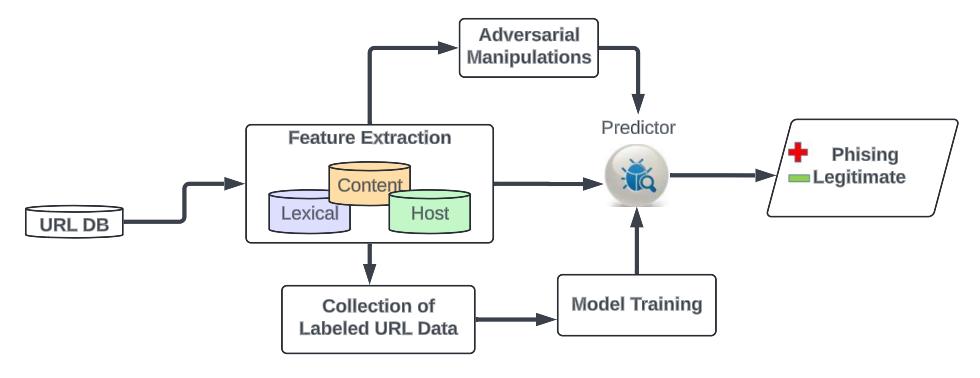
Thebasicmethodforphishingdetectioninvolvescollectinga dataset of URLs, extracting relevant features that may indicatemaliciousintent,andthenusingmachinelearning modelstoclassifytheURLsaseitherlegitimateorphishing. Traditionalapproachesoftenrelyonlexicalanalysis,content inspection, and host-based features to make these determinations.
3.1 Dataset:
ThequalityofthepredictionofaMLalgorithmisstrongly related to the quality of its training set. The Machine Learningapproachrequiresasupervisedlearningalgorithm, andtherefore,thesampleswillneedtobelabelledaseither legitimateorphishing[14]
We used a publicly available dataset from UC Irvine to identifyphishingURLs.Ithasover11000records[15].
International Research Journal of Engineering and Technology (IRJET) e-ISSN: 2395-0056
Volume: 11 Issue: 08 | Aug 2024 www.irjet.net p-ISSN: 2395-0072
- Special Characters:Countofcharacterssuchas'@','?','-', '=','.','#','%','+','$','!','*',',','//',and'/'in the URL.An increasednumberofspecialcharacterscanbearedflag,as attackersofteninsertthesecharacterstoconfuseusersor security filters. Phishing URLs e.g. have more dots comparedtobenignones[19].
- Digit Count: URLs with many digits are often generated programmaticallyandmightbeusedinphishingattacks.A higher digit count can indicate an attempt to mask the URL's true nature or make it appear legitimate, which couldincreasethelikelihoodofitbeingaphishingURL.
3.2 Feature Extraction:
We extracted various features from the URLs to help distinguishbetweenlegitimateandphishingURLs.
Thesefeaturesfallintothreecategories:
3.2.1 Lexical Features
LexicalfeaturesaretheliterarypropertiesofaURL,suchas hostnamelength,URLlength,symbolscontainedintheURL, and so on. Lexical features have grown in popularity in machine learning due to their lightweight computation, safety, and excellent classification accuracy [3]. Because manymaliciousURLshaveabrieflifecycle,lexicalfeatures remain available even when dangerous web pages are unavailable.[16]
Features related to Length:AdditionofvariablesintheURL makes length longer. [18, 20]. such as, Length of URL (URL_Length),domain(Domain Length)
- URLlength:ReturnstheURL'soveralllength.LongerURLs are used to trick consumers or conceal harmful content, raisingsuspicions.IncreaseinURLlengthmaybeasignof increasedphishingactivity
- Domain length: Short or excessively long domain names canbesuspicious.PhishingURLsoftenusedomainnames thatareeitherveryshort(tomimicpopularwebsites)or verylong(toincludeextrawordsandavoiddetection).
Type ratio:TheproportionofdifferentURLtypesbasedon length. A higher type ratio suggests that a particular URL standsoutinlengthcomparedtoothersinitscategory.Ifa phishing URL has a significantly different length ratio, it couldsignalananomaly,increasingthesuspicionlevel.
- Letter Count: A higher letter count typically suggests a more descriptive or legitimate-looking URL. However, excessivelylongURLswithmanylettersmightalsobeused in phishing attempts to disguise the true destination, especiallyifcombinedwithsuspiciouspatterns.
URL entropy: Measurestherandomnessorunpredictability of the URL. High entropy indicates a more random and complexURL,whichisoftenasignofphishingattempts,as attackersmightuseencodedorobfuscatedURLstobypass securitymechanisms.
3.2.2
Has_HTTPS:VerifiesifHTTPSisusedbytheURL.Although HTTPSisfrequentlyconnectedtosecurewebsites,phishing websitescanalsouseHTTPStolookauthentic.WhileHTTPS by itself does not ensure security, its absence may be a reliable sign of a phishing effort. A URL that isn't secured usingHTTPSismorelikelytoraisearedflag.
Has_Shortening_Service: Determines if a service for shortening URLs is being used. Phishing attempts often utilize URL shorteners (like bit.ly) to hide the true destination. Shortening service-enabled URLs may be reportedaspossiblydangeroussincetheyconcealtheentire URL path, making it harder for visitors to determine the actualdestination.
Has_IP_Address: Checks if the URL contains an IP address. URLs with raw IP addresses instead of domain names are oftenassociatedwithphishingandothermaliciousactivities. The use of an IP address can be a significant red flag, as legitimate websites typically use domain names. A URL containing an IP address is more likely to be identified as phishing.
Features related to count of Symbol, Digit and Letters: The frequencyofcharactersintheURLarecalculatedintheform ofletters,tokensandsymbol[16,17,18].Thesecharacters arecategorizedandcountedfromthesecomponentsofURLs
Has_javascript_Code: Identifies if JavaScript code is embedded in the URL. It is unusual for a URL to contain JavaScript code, which might be used to run malicious scripts, reroute users, or carry out other undesirable operations. If the URL contains JavaScript code, there is a significantchancethatitwillbeclassifiedasphishing
International Research Journal of Engineering and Technology (IRJET) e-ISSN: 2395-0056
Volume: 11 Issue: 08 | Aug 2024 www.irjet.net p-ISSN: 2395-0072
Has_Text_Encoding: Checks if the URL has text encoding parameters.TextencodinginURLscanbeusedtoobfuscate content or hide malicious intent. URLs with encoded componentsareoftenhardertointerpretandcanindicatean attempt to bypass security filters, making them more suspicious.
Contains_suspicious_words: Identifies the presence of suspicious words like 'login', 'secure', 'update', 'confirm', 'invoice', 'post', 'important', and 'required'. Since these keywords are frequently used to deceive visitors into thinkingtheURLisaffiliatedwithareputableservicethat needstobeactedupon,theirexistenceisastrongindicator ofphishing.
ThemotivationbehindusingURLhost-basedfeaturescomes from Ma et al.’s work [21]. They obtained significant metadataforaURLfromtheDomainNameSystem(DNS), includingA(theURL'sIPaddress),MX(theIPaddressofthe mailexchanger),NS(theIPaddressofthenameserver),and PTR(pointer)records.
Num subdomains: determines how many subdomains are there in the URL. Since attackers often employ several subdomains to generate complicated URLs that look legitimate at first glance, having a high number of subdomains can be a sign of phishing. Subdomains like "login.bank.security.example.com" are one way that a phishingURLcouldimitateareliabledomain.
Age of Domain: This feature was calculated from WHOIS information, measures the time since the domain was registered. Phishing sites often use newly registered domainstoavoiddetection,soashorterdomainagecanbe indicativeofaphishingattempt.
Inourstudy,weusedadatasetfromUCIrvineandfocused on extracting a comprehensive set of features from each URL. These features were categorized into three main groups:lexical,content,andhost-basedfeatures.Thedataset wassplitintotrainingandtestingsetswithan80:20ratioto buildandevaluatethemodelseffectively.
We introduced a new approach by calculating a unique feature called the type-ratio, which represents the proportionofdifferentURLtypesbasedonlength,providing anadditionallayerofanalysis.
Additionally, we used a combination of traditional special character counts and more advanced features like URL entropy and presence suspicious words, which looked for specific keywords commonly associated with phishing attempts.
We trained three machine learning models XGBoost, SGD, and AdaBoost on these features to enhance detection accuracy.
We evaluated the performance of three machine learning models for phishing detection in our research - XGBoost, SGD,andAdaBoost.Theaccuracyofthesemodelswasused togaugetheirperformance.
XG Boost Classifier .9995 1.00 .9991 .9996 AdaBoost Classifier .9934 .9957 .9991 .9974 SGD Classifier .7069 .9957 .9991 .9974
XGBoostachievedanimpressiveaccuracyof99.95%,proved its potent capability to identify phishing URLs with high precision. This high performance can be attributed to XGBoost's robust gradient boosting framework, which effectivelyhandlescomplexpatternsandinteractionswithin thefeatureset.
AdaBoostalsoperformedwell,withanaccuracyof99.34%. AdaBoost's ensemble approach, which combines multiple weak classifiers into a strong predictor, contributed to its effective classification of URLs, although it slightly lagged behindXGBoost.
The accuracy of 70.69% for SGD (Stochastic Gradient Descent)wasnoticeablylower.Therearevariousreasonsfor this decreased performance. Because SGD is a more straightforwardlinearmodel,itmightnotbeabletohandle thedataset'scomplicatedfeatureinteractions.Itmightnotbe asgoodatidentifyingthesubtlepatternslinkedtophishing URLs as XGBoost and AdaBoost, which are more sophisticated and designed to deal with such complexity. Furthermore,themodel'ssensitivitytofeaturescalingand parametertweakingmayhaveanimpactonitsperformance; therefore, for best outcomes, rigorous optimization is necessary.Additionally,themodel'sperformancemightbe influencedbyitssensitivitytofeaturescalingandparameter tuning, which requires careful optimization for optimal results.
Overall,whileXGBoostandAdaBoostdemonstratedexcellent accuracyindetectingphishingURLs,SGD'ssimplerapproach anditslimitationsinhandlingcomplexfeaturesledtoalower accuracy. This highlights the importance of selecting appropriatemodelsbasedonthecomplexityoftheproblem andthenatureofthedata.
International Research Journal of Engineering and Technology (IRJET) e-ISSN: 2395-0056
Volume: 11 Issue: 08 | Aug 2024 www.irjet.net p-ISSN: 2395-0072
In this paper, we investigated how well machine learning methodsworktoidentifyphishingURLs,avitalaspectfor new age cybersecurity. Our results show that using sophisticatedalgorithmscangreatlyimprovetheprecision andeffectivenessofphishingdetectionsystems.Wereduced the likelihood that users would be exposed to phishing attacks by precisely identifying bad URLs using a combinationoffeatureextractiontechniquesandmachine learningmodels.
Thefindingshighlighthowcrucialitistocontinuouslytrain andmodifymodelsinordertostayuptodatewiththeeverevolving strategies used by hackers. Our research also emphasizesthenecessityoflarge-scaledatasetsthatcapture thelatestphishingpatternsinordertostrengthendetection systems'resilience.
The incorporation of machine learning in phishing URL identification is a viable approach to augmenting online security,giventheongoingsophisticationofcyber-attacks.In an increasingly digital society, future research should concentrate on improving existing models, investigating hybridtechniques,andcreatingreal-timedetectionsystems that can successfully counter phishing threats. By giving theseinitiativestoppriority,wecanhelpmaketheinterneta saferplaceforbothindividualsandbusinesses.
[1] Abdelhamid, N., Aladdin, A., Thabtah, F.: Phishing detectionbasedassociativeclassificationdatamining.Expert Syst.Appl.41(3),5948–5959(2014)
[2] Le, A., Markopoulou, A., Faloutsos, M.: PhishDef: URL names say it all. In: Proceedings IEEE, INFOCOM. IEEE (2011)
[3]Garera,S.,Provos,N.,Chew,M.,Rubin,A.:Aframework for detection and measurement of phishing attacks. In: ProceedingsoftheACMworkshoponRecurringmalcode,pp. 1–8.ACM(2007)
[4]SlashNext-thestateofphishingreport(2023).Retrieved fromhttps://slashnext.com/wpcontent/uploads/2023/10/S lashNext-The-State-of-Phishing-Report-2023.pdf
[5] Doyen Sahoo, Chenghao Liu, and Steven C.H. Hoi. MaliciousURLDetectionusingMachineLearning:ASurvey. https://doi.org/10.1145/nnnnnnn.nnnnnnn(2019)
[6] Iwendi, C.; Jalil, Z.; Javed, A.R.; Reddy, G.T.; Kaluri, R.; Srivastava,G.;Jo,O.KeySplitWatermark:ZeroWatermarking Algorithm for Software Protection Against Cyber-Attacks. IEEEAccess(2020)
[7] Arathi Krishna V, Anusree A, Blessy Jose, Karthika Anilkumar,OjusThomasLee,2021,PhishingDetectionusing Machine Learning based URL Analysis: A Survey, INTERNATIONALJOURNALOFENGINEERINGRESEARCH& TECHNOLOGY(IJERT)NCREIS(2021)
[8]ElsadigM,IbrahimAO,BasheerS,AlohaliMA,Alshunaifi S, Alqahtani H, Alharbi N, Nagmeldin W. Intelligent Deep MachineLearningCyberPhishingURLDetectionBasedon BERTFeaturesExtraction.Electronics.(2022)
[9] Blum, A., Wardman, B., Solorio, T., and Warner, G., “LexicalFeatureBasedPhishingURLDetectionUsingOnline Learning”. in AISec ’10 Proceedings of the 3rd ACM workshop on Artificial Intelligence and Security, Illinois, USA,ACMNewYork,NY,USA,pp.54-60(2010)
[10]MA,J.,Saul,L.K.,Savage,S.,andVoelker,G.M.,“Learning to Detect Malicious URLs”. in ACM Transactions on Intelligent Systems and Technology. 2, 3, Article 30 April, ACMNewYork,NY,USA,pp.1245-1254(2011)
[11]A.Karim,M.Shahroz,K.Mustofa,S.B.BelhaouariandS. R. K. Joga, "Phishing Detection System Through Hybrid MachineLearningBasedonURL,"inIEEEAccess,vol.11,pp. 36805-36822(2023)
[12] Shirazi, H., Bezawada, B., Ray, I., Anderson, C. AdversarialSamplingAttacksAgainstPhishingDetection.In: Foley, S. (eds) Data and Applications Security and Privacy XXXIII. DBSec 2019. Lecture Notes in Computer Science(), vol11559.Springer(2019)
[13] Sasi, Jishnu Kaitholikkal, and Arthi Balakrishnan. "Generative adversarial network-based phishing URL detectionwithvariationalautoencoderandtransformer." Int J Artif Intell 13.2:2165-2172(2024)
[14]Christou,O.,Pitropakis,N.,Papadopoulos,P.,McKeown, S.andBuchanan,W.,“PhishingURLDetectionThroughToplevel Domain Analysis: A Descriptive Approach”. In Proceedings of the 6th International Conference on Information Systems Security and Privacy (ICISSP), pages 289-298(2020)
[15]Datasetfromhttps://archive.ics.uci.edu/datasets
[16] Chu, W., et al.: Protect sensitive sites from phishing attacksusingfeaturesextractablefrominaccessiblephishing URLs.In:IEEEInternationalConferenceonCommunications (ICC)(2013)
[17]Thomas,K.,etal.:Designandevaluationofareal-time URL spam filtering service. In: Proceeding of the IEEE SymposiumonSecurityandPrivacy(SP)(2011)
International Research Journal of Engineering and Technology (IRJET) e-ISSN: 2395-0056
Volume: 11 Issue: 08 | Aug 2024 www.irjet.net p-ISSN: 2395-0072
[18] Abdelhamid, N., Aladdin, A., Thabtah, F.: Phishing detectionbasedassociativeclassificationdatamining.Expert Syst.Appl.41(3),59485959(2014)
[19] Xiang, G., et al.: CANTINA+: a feature-rich machine learningframeworkfordetectingphishingwebsites.ACM Trans.Inf.Syst.Secur.(TISSEC)14(2),21(2011)
[20] Xu, L., et al.: Cross-layer detection of malicious websites.In:ProceedingsoftheThirdACMConferenceon DataandApplicationSecurityandPrivacy.ACM(2013)
[21] Ma, J., Saul, L., Savage, S., and Voelker, G., “Beyond Blacklists: Learning to Detect Malicious Web Sites from SuspiciousURLs”.inKDD’09Proceedingsofthe15thACM SIGKDDInternationalConferenceonKnowledgeDiscovery andDataMining,Paris,France,ACMNewYork,NY,USA,pp. 1245-1254(2019)