
International Research Journal of Engineering and Technology (IRJET) e-ISSN: 2395-0056
Volume: 11 Issue: 08 | Aug 2024 www.irjet.net p-ISSN: 2395-0072

International Research Journal of Engineering and Technology (IRJET) e-ISSN: 2395-0056
Volume: 11 Issue: 08 | Aug 2024 www.irjet.net p-ISSN: 2395-0072
SS Karthik1 , Velkur Harsath Kumar2 , Shreeraj Halemane3 , Ruthvik Yadav4
*1,2,3,4Formerly, Dept. of Mechanical Engineering, RNS Institute Of Technology, VTU, Bangalore, Karnataka, India
Abstract - India is an agriculture-based country in where, up to 70% of people depend on farming as their main source of income. Also economically, farmers are very poor due to which they cannot purchase tractors and other costly equipment hence they use the traditional method of farming such as bullocks, horses and he-buffalo for operations. This will not satisfy the need for energy requirements of agriculture as compared to other countries in the world. So, our thought process is that human and animal efforts can be minimized to a large extent by some advanced mobility solution which will be suitable for small scale farmers from both an economic and labour-efficiency perspective. Hence, we put forward this robot which will satisfy all such needs and solve the difficulties. In this project, we used a 12V motor for digging/ploughing operation, the next two operations are the manual base which is sowing (using a barrel with help of a motor and patterned openings) and levelling (a simple earth flattener where height can be adjusted) Overall, these functions are controlled by an Arduino Uno Controller with our indigenous programming, one can program it based on their needs and requirements. This machine performs three farming operations (digging, sowing & levelling) which are used in small scale farming. By using the above implements, one may perform various farming operations efficiently and economically. Also in the in the future the same technology can be implemented with a Solar Panel so it can recharge utilize the Solar Power and save traditionally produced electricity.
Key Words: Autonomous Field Robots, Robotics, Embedded C Programming, Arduino Uno, H-Bridge Motor Control, Geared DC Motors, Agricultural Technology, Offhighwaytechnology,Ploughing.
In India generally, the conventional methods of seed sowing include use of an animal-drawn funnel and pipes driller/drillingwiththehelpofatractoratractor.Thefirst methods required lot of man power and a very time and energy-consuming. However, operators of tractor-based drilling equipment are subjected to significant noise and vibrations, which can negatively impact their health and productivity At present, the primary focus in the development of autonomous field robots is on enhancing speed, improving energy efficiency, refining guidance sensors and their accuracy, and integrating advanced technologiessuchaswirelesscommunicationandGPS.
In the earlier decades agricultural technology was not developed well. Hence, they were seeded by hand. Since the technology is quite developed it’s not required to do seeding in sunlight. By using robotic technology, one can sit in their comfort zone and perform seeding operation justbytrackingtherobot’smotion.
The main reason behind the automation of farming processes is to save the time and energy required for performing repetitive farming tasks and increase the productivity of yield by treating every crop individually using the precision farming concept. Designing such robots is modelled based particular approach and certain considerations agricultural environment in which it is going to work. These considerations and different approachesarediscussedinthispaper.Ploughingtheland and sowing the seeds are the primary operations in the plantationinAgriculture.Theworkreplaceshumanpower withroboticmeans.The idea behind this work is tomake agriculture cost-effective by reducing the human interventionandfossilfuel.Withthisview,amultipurpose ploughingmachineisdesignedanddeveloped.This Robot will be very useful for agricultural purposes and very simpletoconstruct.
•Tocreateaprototypemodelfirstthatcanclubploughing, seedingandlevelling.
•To be used for peanuts, Toor dal, Ragi, Jowar, corn and othergraincrops.
•Minimize the engine emission near the fields and environment
•Implementautonomoustechnologyforreducingasmuch humaninterventionaspossible
•To create a vehicle that can alternate the purpose of a tractorcomparativelyatalowercost.
•Effective utilization of time and energy required for performing repetitive farming tasks and increase the productivityofthefields.
International Research Journal of Engineering and Technology (IRJET) e-ISSN: 2395-0056
Volume: 11 Issue: 08 | Aug 2024 www.irjet.net p-ISSN: 2395-0072
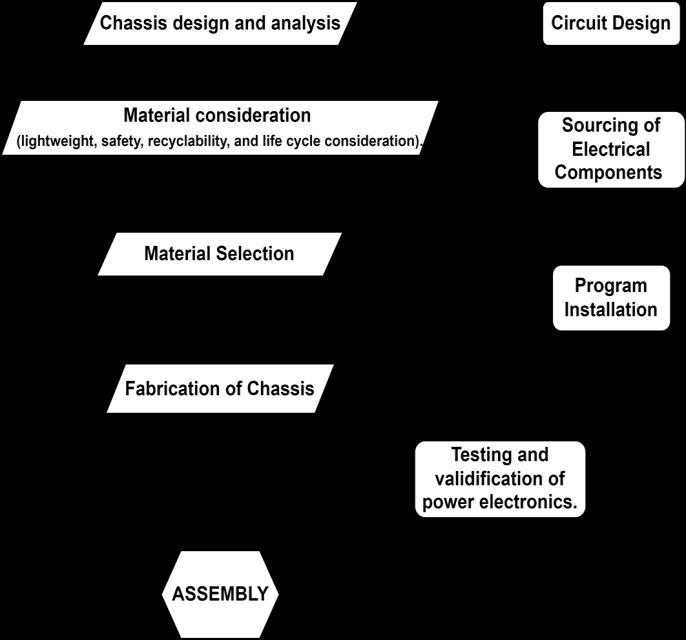
Fig -1:Flow-chartforMethodology
• The chassis design of the prototype model was made on Solid Works, AutoCAD and the electrical circuitlayoutdesignisdoneondiagrams.net.
• After considering our requirements and needs we havechosenmildsteelduetotheavailabilityofthe material ina thin sheet. Theweldabilityof rest of the parts to the frame is also a consideration that wastakenintoaccount.
• Afterplanningandselectingthematerial,wemove on to the fabrication stage of the chassis and the tools for the operations that are designed accordingtotherequirementsandconstraints.
• By taking all the fabricated parts we assemble themasperthedesign.
• The electrical components are mounted on a cardboard according to the circuit layout. The connections to the components from the power sourcetothewheelsarewired.
• Once the fabrication of the model and electrical connections is completed, then both of them are assembled and carried forward for testing of the prototype.
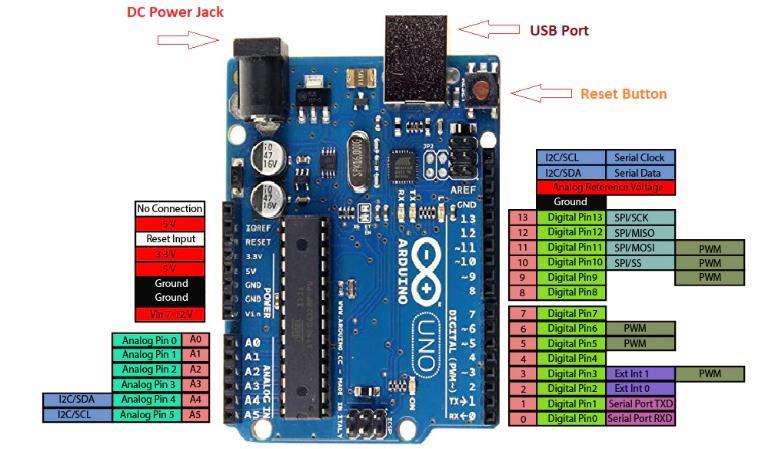
Fig -2:ArduinoUnoPinAllocations
Source: https://www.theengineeringprojects.com/ Component
Uno 1 5V-supply
3 L298NIC
PowerSupply (Battery) 1 12VDC,7.5Ah
Ultrasonic Sensor 1 HC-SR04
Wi-FiModule 1 ESP8266,8Pins
GearedDC motors 4 10RPM,12V
a) Arduino: It is an open-source platform that provides both hardware and software for designing single-board microcontrollers and kits, enabling the creation of digital devices and interactiveobjectsthatcansenseandcontrolboth physicalanddigitalelements
b) H-Bridge: With these control pins, we can managethemotor'sdirection,allowingittomove forward or backward. This is achieved by applyingeitheraHIGH(5Volts)orLOW(Ground) logicsignaltotheinputs,determiningthemotor's spinningdirection.
c) Power Supply: The source of power we have selected here is a battery of 12 Volts and a capacityof7.5Ah.
d) Ultrasonic Sensor: It measures the distance of a target object by emitting ultrasonic sound waves, and then converts the reflected sound into an electrical signal which is understandable for the machine.
International Research Journal of Engineering and Technology (IRJET) e-ISSN: 2395-0056
Volume: 11 Issue: 08 | Aug 2024 www.irjet.net p-ISSN: 2395-0072
e) Wi-Fi Module: It includes a built-in TCP/IP protocol stack, allowing straightforward connectiontoamicrocontrollerforWi-Finetwork access. In our setup, this component facilitates communication between our remote (cellphone) andtheArduinocontroller
f) Geared DC motors: A geared DC motor consists of a motor and gearbox combined. The gearbox allows the motor to augment its torque output while decreasing its overall speed. Essential characteristics of a geared DC motor include its speed (in RPM) and voltage. In this instance, the DCmotor possessesa 10 RPMspeed and runson 12V.Gearcanbechosenbasedonneed,matching theloadtopullandusageitcanbedecided.
Note: Below mentioned operations are in the same sequenceasinactualworking.Alsorespectiveimplements can be designed based on convenience and crop/field design.
1. Ploughing Operation: The upper arm of the ploughingtool isweldedtotheframeofthe Robot. As theRobotmovesforwardploughingtakesplace.
2. Seed Sowing Operation:Thetoolisusedfordropping seeds into the soil. The seeds poured from the funnel that is connected to one side of the barrel, the other endisconnectedtothemotorwhichrotatesthebarrel
3. Levelling Operation: The levelling tool is connected tobackoftheframe,whichisusedtoleveloutthesoil oncediggingisdonefollowingseedsowing.
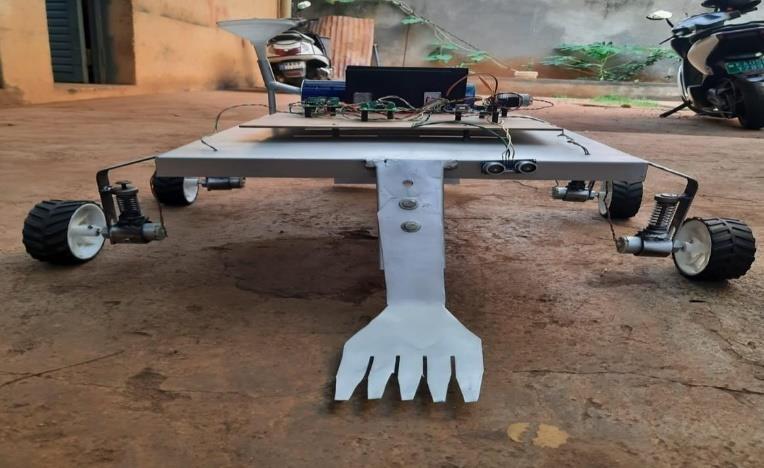
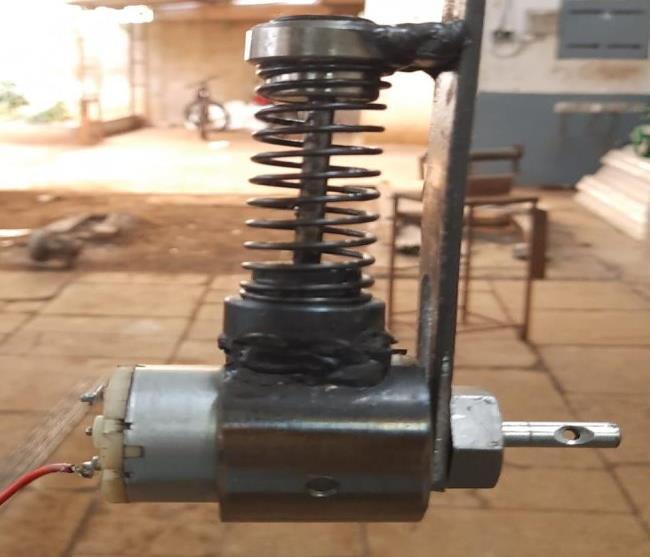
This model that we’ve fabricated is supposed to simulate an actual field work which is never flat and clean. The unevenness, ups and downs in a rough terrain of a farm needs a machine that has a proper Robot dynamic designed. So, to make our model to work on an uneven surface we have utilized the independent suspensions system
Working: The rod in the middle of damper (shown in fig 4.1) acts as displacing agent for the respective wheel/motor it is mounted to which is intended to help stabilize the robot when encountered with an obstacle in anagriculturalfield.
International Research Journal of Engineering and Technology (IRJET) e-ISSN: 2395-0056
Volume: 11 Issue: 08 | Aug 2024 www.irjet.net p-ISSN: 2395-0072
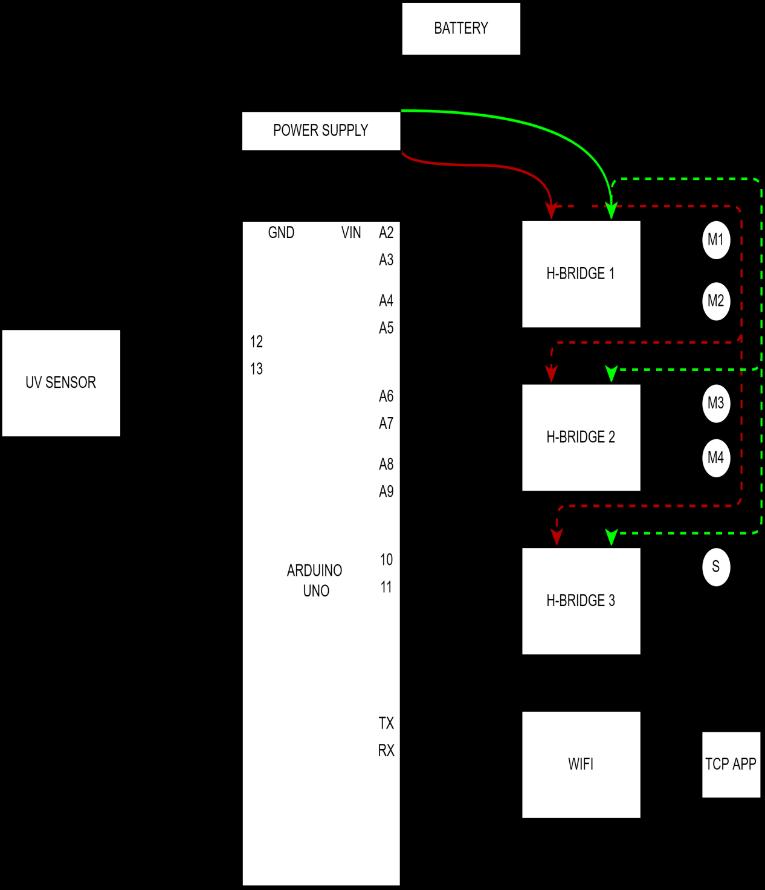
Fig -5:Terminalconnectiondiagram
6.
“Autonomous Mobility Agricultural Robot” was successfully completed along with trials in three agricultural operations that are ploughing, seeding and thenleveling Wewereabletobringittolifewiththehelp of Embedded C programming on Arduino Uno The robot willperformallthethreeoperationsautonomouslyonit’s own with just a click of a button through an app on cellphone.
In the future, fully automated farms will allow robots to handle tasks such as mowing, fertilizing, pest and disease monitoring, harvesting, and tilling. This level of automation makes sure the farmer just supervises the operation rather than part taking in it. This robot can be slightly tweaked, i.e the base code/programming can be modified based on one’s requirement for using it on different kinds of crop. Hence, it is a very practical robot which would definitely aid the farmers in this current generation.
This technology requiredlessmanpower,lessertimeand cheaper infrastructure/investment when compared to conventionalmethods,soifweproducetheminabigscale the cost will decease very significantly and we aim that this project will help bring at least a small impact in the agriculturalsociety.
Based on the overall performance of the machine we can definitely say that the project will satisfy the need of small-scalefarmer.
[1] K.Lakshmisudha,S.Hegde,N.Kale,S.Iyer,“Smart Precision Based Agriculture Using Sensors”, International Journal of Computer Applications (0975-8887),Volume146,No.11,pp.36-38,2011.
[2] M. Ramu, CH. R. Prasad, "Cost effective atomization of Indian agricultural system using 8051 microcontroller", International Journal of Advanced Research in Computer and Communication Engineering, vol. 2, no. 7, pp. 2563-2566,2013.
[3] Naga RohitGunturi, “Micro Controller Based Automatic Plant Irrigation System”, International Journal of Advancements in Research & Technology, Volume 2, pp.1436- 1439, Issue4, 2013.
[4] S. R. Nandurkar, V. R. Thool, R. C. Thool, “Design and Development of Precisib on Agriculture System Using Wireless Sensor Network”, IEEE InternationalConferenceonAutomation, Control, EnergyandSystems(ACES),2014.
[5] M.K.Gayatri, J.Jayasakthi, G.S.Anandhamala, “Providing Smart Agriculture Solutions to Farmers for Better Yielding Using IoT”, IEEE International Conference on Technological Innovations in ICT for Agriculture and Rural Development,2015.
[6] M. Dwarkani, R. Ram, S. Jagannathan, R. Priyatharshini, “Smart Farming System Using Sensors for Agricultural Task Automation”, IEEE International Conference on Technological Innovations in ICT for Agriculture and RuralDevelopment,2015.
[7] D. Chaware, A. Raut, M. Panse, A. Koparkar, "Sensor Based Automated Irrigation System", International Journal of Engineering Research & Technology (IJERT), vol. 4, no. 05, pp. 33-37, 2015.
[8] R.Jain,S.Kulkarni,A.Shaikh,A.Sood,"Automatic Irrigation System for Agriculture Field Using Wireless Sensor Network (WSN)", International Research Journal ofEngineering and Technology (IRJET), vol.3, no. 04, pp. 16021605,2016.
[9] N. Gondchawar, R.S.Kawitkar, “IoT Based Smart Agriculture”, International Journal of Advanced
International Research Journal of Engineering and Technology (IRJET) e-ISSN: 2395-0056
Volume: 11 Issue: 08 | Aug 2024 www.irjet.net p-ISSN: 2395-0072 © 2023, IRJET | Impact Factor value: 8.226 | ISO 9001:2008
Research in Computer and Communication Engineering, Vol.5, Issue 6, pp.838- 842, June 2016. [10] https://www.robotshop.com/media/files/pdf/ar duinomega2560datasheet.pdf
[10] M.Priyadarshini,L.Sheela,“CommandBasedSelfGuided Digging and Seed Sowing Rover”, International Conference on Engineering Trends andScience&Humanities(ICETSH-2015).
[11] Ankit Singh, Abhishek Gupta, AkashBhosale, SumeetPoddar, “Agribot: An Agriculture Robot”, International Journal of Advanced Research in ComputerandCommunicationEngineeringVol.4, Issue1,January2015.
[12] N. Firthous Begum, P. Vignesh, “Design, and Implementation of Pick and Place Robot with Wireless Charging Application”, International JournalofScienceandResearch(IJSR-2013).
[13] Buniyamin N., Wan Ngah W.A.J., Sariff N., Mohamad Z, “A Simple Local Path Planning Algorithm for Autonomous Mobile Robots”, International Journal of Systems Applications, Engineering & Development Issue 2, Volume 5, 2011.
[14] Ms. Trupti A.Shinde , Dr. Jayashree. S. Awati, “Design and Development of Automatic Seed Sowing Machine”, Journal for Scientific Research &Development.
[15] SurajVUpadhyaya,VijayaVittalaGowdaG,Poojith M B, Vikranth, “A Review of Agricultural Seed Sowing”, International Journal of Innovative ResearchinScience,EngineeringandTechnology.
| Page53