
Volume: 11 Issue: 07 | July 2024 www.irjet.net
Volume: 11 Issue: 07 | July 2024 www.irjet.net
Sunil Magan More*1 , Dr. Brajesh Mohan Gupta*2
*1Phd Scholar, Department of Electrical and Electronics Engineering, Sri Satya Sai University of Technology and Medical Sciences, Sehore MP, India.
*2Professor, Department of Electrical and Electronics Engineering, Sri Satya Sai University of Technology and Medical Sciences, Sehore MP, India.
Abstract - Battery thermal management system (BTMS) Control and maintain the temperature of a battery cell at Different weather conditions. The range can be decided by BTMS. Thermal management is very important in the EV automobile sector, for the safety & performance of the vehicle. Battery performancedecreaseswithincreaseinheatinside the battery cell whenever load on battery increases. Even when atmospheric temperature changes battery temperature increases which may cause thermal runaway in the battery, also in different cold conditions battery ability to deliver power effectively will reduce. Various methods use for BTMS such as Active, Passive, Phase change material(PCM), thermal insulation, thermal monitoring & control system. During this paper the thermos-electric module is used to control the temperature in various environmental conditions. Thermo electric coder is a solid state device that utilizes the peltier effect to transfer heat when an electric current flows through it. The battery temperature is controlled in the range of 10°C to 30°C. Which is very necessary for to improve the battery efficiency in the electric vehicle
Key Words: BTMS-BatteryThermalManagementsystem, TEC–Thermoelectriccoder,SoC-StateofCharge,SoH-State ofHealth,BTM-BatterythermalModel
Liquids have higher heat capacity than air, so they can absorbmoreheatperunitvolume.Thismakesliquidcooling systems more effective at removing heat from batteries. Liquid Cooling systems can help to prevent thermal runawayandextendbatterylifespan.(1)Astudyfoundthat PCM/copperfoamcanbeusedtocoolbatterymodulesand maintain a uniform temperature. The most efficient arrangementwasfoundtobeastaggeredarrangementwith a50%fillfactor.(2)Batterystateestimationmethodsare used to estimate the internal state of a battery. This is important for operating a battery-powered system effectively,sustainably,andsafely.(3)Aflexibleapproachto obtainreliableelectricalandthermaldesignofLIBsystems for automotive applications is proposed. The approach is suitable for identifying promising concepts and general designrecommendations.(4)Itisimportanttokeeplithiumionbatteriesattemperaturesbelow50°Candrapidlyheator
self-heatthempriortooperatingatcoldtemperatures.(5) Traditional air cooling is not effective for battery thermal management. Direct immersion in a single-phase, nonconductivecoolingfluidisthemostefficientandreliableway tocoolbatteries.(6)Theschemeusesactivethermalcontrols to cool or heat battery cells based on the power requirements and temperature variation. The scheme can significantly improve the efficiency and reliability of the BMS. (7) To keep lithium-ion batteries (LIBs) operating within their safe temperature range and ensure their performanceandsafety,researchershavedevelopedvarious battery thermal management systems (BTMSs). The most common BTMSs are air cooling, liquid cooling, and phase changematerial(PCM)cooling.(8)Thedevelopmentofan advancedintegratedBMSischallengingduetotheneedfor accuratephysics-basedmodels,effectivechargingandcell balancing algorithms, and thermal models. (9) A model of thermal dynamics in battery packs was developed to improvesafetyandreduceweightandcost.Themodelisa simplification of the full CFD/FEM model, but it is still accurate enough for real-time implementation. (10) Early models of lithium batteries were simplified to fit the computational power available at the time. Today's computerscansimulatetheentirecellsandwich,sothereis no need for these simplifications. This paper presents the full-cell-sandwich model in its most developed form, and discussesitsapplications,suchasinterpretingexperimental dataandoptimizinggeometricparameters.(11)Lithium-ion batteries are widely used in consumer electronics due to theirhighenergydensity,highpowerdensity,longservice life, and environmental friendliness. However, lithium-ion batteries for vehicles have high capacity and large serialparallelnumbers,whichposechallengesintermsofsafety, durability, uniformity, and cost. To ensure the safe and reliable operation of lithium-ion batteries in vehicles, a batterymanagementsystem(BMS)isneededtocontroland managethebatteries.(12)Thermalmanagementsystemsare essential for battery packs in electric vehicles to prevent overheatingandsafetyhazards.Thispaperreviewsthethree main types of thermal management strategies: air management, fluid management, and phase-change materials.Parallelairmanagementisthemostefficientand cost-effective,whileliquidmanagementismorecomplexand expensive.Phase-changematerialsalsoguaranteeexcellent
International Research Journal of Engineering and Technology (IRJET) e-ISSN: 2395-0056
Volume: 11 Issue: 07 | July 2024 www.irjet.net p-ISSN: 2395-0072
heatdissipation.(13)Electricvehicles(EV)developfastand becomepopularduetotheirzeroemissionandhightank-towheelsefficiency.However,somefactorslimitthegrowthof theelectricvehicle,especiallyperformance,cost,lifetimeand safetyofthebattery.Therefore,themanagementofbatteries is important in order to reach the maximum performance when operating at various conditions. Battery Thermal Management is one among the key functions of the BMS systemofbatteries Duringthis thevariousthermalaspects of the battery such as Heating, Cooling, Ventilation and Vibrations of battery is regulated to take care of the constant battery temperature at required level during the battery Charging and Discharging process to ultimately improve its Life Cycles and efficiency. The cycle life goes down slowly below 10°C due to anode plating causing sluggishchemicalreactionsanddropsoffquicklyabove60°C duetothebreakdownofelectrodematerials.Thus,generally thetemperaturemustbecontrolledbetween20°Cand40°C tomakesuretheperformanceandcyclelifeforthechemical batteries like Lithium-ion. Thermo-electric modules can convertelectricvoltagetotemperaturedifferenceandviceversa. Here the previous effect is adopted. Meaning it transfersheatthroughthemodulebyconsumingelectricity directly. Some fans with cooling and heating tubes are installedtoenhanceheattransferbyforcedconvection.It’s easytomodifybetweencoolingandheatingoperations. To realizethat,thepolesofelectrodeshavetobereversedand alsothetemperatureismaintainedbyregulatingthevoltage supplytothemodulesinfourstages,withtheassistanceofa PIC18F458 microcontroller. Which makes this technique universalandcanbeadoptedinanyEVatanyatmospheric conditions.Thecombineapassiveliquidcoolingsystemwith thermo-electricmodule,thecombinedsystemisinaposition Cool-down the battery even lower than the intake air temperature,butthefacilityisstilllimitedtoaroundsome hundredsofwattsandlessthanone
2] Objective:
1. To develop a BTMS model for balancing the different coolingandheatingcircuitswithinthebatterypacktofulfil theperformancerequirements.
2.Usedifferentmodetocoolthebatterytemperaturewithin specifiedrange
3]
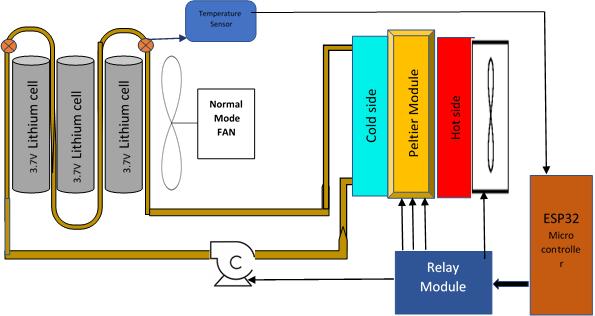
3.1) Battery Thermal Management Systems (BTMS) :
TheBTMSisasystemthatmanagestheheatgeneratedby thebatterycellsinanelectricvehicle.Ithelpstokeepthe battery cells within their optimal operating temperature range,whichimprovestheirperformanceandlifespan.The BTMS typically includes heat dissipation, temperature uniformity,insulation,andmonitoringfeatures.
Here are some of the key benefits of a BTMS:
Improvedbatteryperformance:ABTMScanhelptoimprove the performance of the battery by keeping it within its optimaloperatingtemperaturerange.Thiscanleadtolonger range,fastercharging,andbetteroverallperformance.
Extended battery lifespan: A BTMS can help to extend the lifespanofthebatterybypreventingitfromoverheatingor freezing.Thiscansaveyoumoneyonreplacementbatteries.
Improvedsafety:ABTMScanhelptoimprovethesafetyof thebatterybypreventingthermalrunawayandothersafety hazards.
If you are considering buying an electric vehicle, it is importanttomakesurethatithasaBTMS.Thiswillhelpto ensurethatyourbatteryperformswellandlastsformany years.
Here are some additional things to keep in mind about BTMS:
The specific features and design of a BTMS will vary depending on the type of electric vehicle and the battery technologyused.
BTMSsarebecomingincreasinglysophisticatedasbattery technologycontinuestoevolve.
The cost of BTMSs is also decreasing, making them more affordableforelectricvehiclemanufacturers.
International Research Journal of Engineering and Technology (IRJET) e-ISSN: 2395-0056
Volume: 11 Issue: 07 | July 2024 www.irjet.net p-ISSN: 2395-0072
Over voltage: Cancauselithiumplating,whichisaprocess wherelithiummetalisdepositedonthesurfaceoftheanode. Thiscancauseashortcircuitbetweentheelectrodes,which canleadtoafireorexplosion.
Uneven temperature distribution:Can cause local deterioration, which can lead to a loss of capacity and performance.Itcanalsoleadtothermalrunaway,whichisa chainreactionthatcanoccurinalithium-ionbatteryifitgets toohot.Thiscancausethebatterytocatchfireorexplode.
To prevent these problems, it is important to operate lithium-ionbatterieswithintheirsafeoperatingrangeandto keepthebatteriescool.
Herearesometips:
Use a battery management system (BMS) to monitor the voltageandtemperatureofthebatteries.
Chargethebatteriestothecorrectvoltage.
Donotdischargethebatteriestoodeeply.
Keepthebatteriescool.
Avoiduneventemperaturedistribution.
Inspectthebatteriesregularlyforsignsofdamage.
3.3 Operating Requirements:
The battery temperature should be controlled within temperaturelimitstoavoidthethermalissuesandimprove theperformance.Thetemperaturerangeaffectsthebattery power and battery cycle life, as shown table no. 1. At the identicaltime,thetemperaturedistributionshouldbeeven tomakesure the batteryperformanceandlifetime.That’s also the rationale why the battery thermal management systemisnecessarytothebatterysystem.
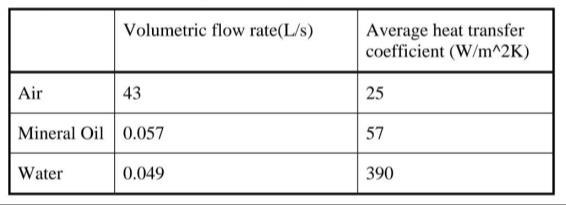
TableNo.1Thevolumetricflowrateandaverageheat transferco-efficientatthesamemassflowrate50g/s
Whentemperaturerangesfrom20°Cto40°C,batterypower reaches maximum. The cycle life goes down slowly below 10°C thanks to anode plating and drops off quickly above 60°Cduetothebreakdownofelectrodematerials.Generally, thetemperaturemustbecontrolledbetween20°Cand40°C to ensure the performance and cycle life. Moreover, the
temperaturedistributioniscontrolledunder5Ktomaintain the safety and lifetime of the battery (Pesaran, 2002). Additionally, ventilation is additionally essential to the batterysystemandwillbetakenintoaccount.
3.4) Liquid cooling: ThenextTableshowsthatatthesame flow rate the air volume is much bigger than the water volume,whiletheairheattransfercoefficientiswaylower than water heat coefficient. So for air cooling to dissipate heattheutmostamountaswatercooling,itrequireshigher volumetricflowwhichsuggestsmorespaceandmorepower. Aircoolingsystemstakeuplargerspaceandconsumemuch moreenergycomparedtoliquidcoolingsystems.
There are three sorts of cooling systems, namely passive cooling system, active cooling system, and refrigerant coolingsystem.
The passive cooling system is suffering from the ambient temperature,becausethewarmthdissipationisdependent ontheradiatorandtheradiatordissipatesheatthroughthe temperature difference between liquid and the ambient temperature.Undernormalcircumstances,itworkswell,but underhighambienttemperatureit’sinsufficient.
Active cooling systems have good thermal performance which may keep the battery pack within the operating temperature and keep temperature distribution between cellsevenbecauseofthehighheatcoefficientofthecoolant. Thankstomanyauxiliariesandmovingparts,thestructure is complicated and difficult to take care of. It also has the tendencyofleakingout.
Compared to active cooling systems, direct refrigerant cooling systems are more efficient because they use refrigeranttocoolthesysteminsteadofusingrefrigerantto coolcoolantfirstandthenusingcoolanttocoolthesystem. The weaknesses of refrigerant cooling systems are complicated structure and difficult maintenance, also potentialtoleakoutandsoon.
ThethermoelectriceffectasshowninFig.3.2 isthedirect conversionoftemperaturedifferencestoelectricvoltageand vice versa via a thermocouple. A thermoelectric device creates a voltage when there’s a different temperature on eachside.Conversely,whenavoltageisappliedthereto,heat is transferred from one side to the opposite, creating a temperature difference. At the atomic scale, an applied gradient causes charge carriers in the material to diffuse fromthehotsidetothecoldside.Theterm"thermoelectric effect"encompassesthreeseparatelyidentifiedeffects:the Seebeckeffect,Peltiereffect,andThomsoneffect.Whenan electrical current is passed through a circuit of a thermocouple, heat is generated at one junction and absorbedattheoppositejunction. Thisisoftenknownas the Peltier effect: the presence of heating or cooling at an
International Research Journal of Engineering and Technology (IRJET) e-ISSN: 2395-0056
Volume: 11 Issue: 07 | July 2024 www.irjet.net p-ISSN: 2395-0072
electrified junction of two different conductors. This principleofpeltiereffectisemployedinthissystem
Toimprovecooling/heatingpowerofpassiveliquidsystems, there are two possible upgrades. One is through thermoelectric modules, which can be introduced here. Thermoelectricmodulecanconvertelectricvoltagetotemperature difference.Herethepreviouseffectisadopted. Meaningit transfersheatthroughthemodulebyconsumingelectricity directly.TheschematicstructureispresentedinFigure.
Two fans with cooling and heating tubes are installed to enhance heat transfer by forced convection. To mix a passiveliquidcoolingsystemwiththermo-electricmodule, the combined system is in a position to cool down the batteryevenlowerthantheintakeairtemperature,butthe facilityisstilllimitedtoaroundsomehundredsofwattsand lessthanonekW.It’seasytomodifybetweencoolingand heating operation. To realise that, the poles of electrodes havetobereversed.Thermo-electricshavesmallandlightweight structures and can turn a heating element to an efficientcoolingelementbyreversingthepolarity.Without movingpartstowear,thermo-electricsarereliable,durable andoflowmaintenance.Andalsoeasytoexchangeincaseof failure. In addition, operation is quiet and vibration-free. The performance is related to the required temperature difference. The greater the temperature difference is, the lowerthepumpingcapacityis,untilitstopsperformingat 70K.
Thermo-electrics have small and light-weight structures and can turn a heating element to an efficient coolingelementbyreversingthepolarity.Withoutmoving partstowear,thermo-electricsarereliable,durableandof low maintenance. And also easy to exchange in case of failure. In addition, operation is quiet and vibration-free. The performance is related to the required temperature difference.Thegreaterthe
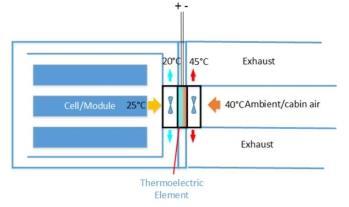
Figno.3.2thermoelectricelement
temperature difference is, the lower the pumping Fig 3.2 capacityis,untilitstopsperformingat70K.Sounderheat the temperature difference is great and thermo-electrics performbadly.
4. Result & Discussion:
As shown in fig no. 3.3 the following steps are necessary whendesigningathermoelectriccoolingapplication:
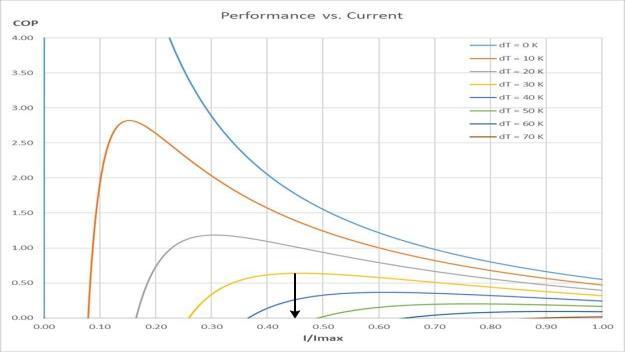
Estimateheatloadoftheobjecttobecooled:- 10Watton eachPeltier
Figno.3.3GraphofBatteryPerformanceVsCurrent
Definetemperatureworkingrangeofobjectandheatsink:ColdSideTemp=15°C;HotSideTemp.=45°C
ChooseaPeltierelementthatsatisfiestherequirements:PeltierTEC12704
Choose a TEC controller with suitable power range :Vmax=12V;Imax=4Amp
Choose a heat sink for the Peltier element: - Al Heat sink (40×40×20)mm
Chooseafantoairtheheatsink(optional):-12VDCFan
Choosetheobjecttemperaturesensorandtheoptionalsink sensor
ChooseapowersupplyfortheTECcontroller:-16Watts
Thisisaniterativeprocess. Testyourexperimental setup, improveitandrepeattheabovesteps.
Therearetwothermalparameterswhicharenecessaryto selectaPeltierelement.
MaximumcoolingcapacityQmax
TemperaturedifferencedT
We assume a Lithium ion battery pack with a heat load of QC = 10 W tobecooledto10°CdegreesCelsius.(TO =15 °C)Let'ssaythatthebatterytemperatureis35°Candthe heat sink temperature TS is expected at 40 °C. Thus, the temperature difference between the cold side and the hot side of the Peltier element dT is 30 K. It’s important to remember that it would be incorrect to calculate dT as difference between ambient air temperature and desired batterytemperature.4.2ChoosingaPeltier/TECModuleour goalistofindaQmax thatislargeenoughtocovertheneeded QC andyieldsthebestCOP. Intheperformancevs.current graphwelocatethe maximumof the dT =30 Kcurve at a
International Research Journal of Engineering and Technology (IRJET) e-ISSN: 2395-0056
Volume: 11 Issue: 07 | July 2024 www.irjet.net p-ISSN: 2395-0072
currentof I/Imax = 0.45.Ingeneral,thisratioshouldnotbe higherthan0.7. usingthatfactorforthecurrentwefindin theheat pumped vs. current graphthe value QC/Qmax = 0.25 for the given temperature difference dT = 30 K and relativecurrentof0.45.
NowwecancalculatetheQmax forthePeltierelement.
Qmax =QC /0.25=10W/0.25= 40 W
Intheperformancevs.currentgraphwefind COP = 0.6 for ourpreviouslyreadoutI/Imax.Thisallowsustocalculate
Pel =QC /COP=10W/0.6= 16.7 W.
Peltier element manufacturers offer a wide range of elements.Intheirproductlinewelookforanelementwitha Qmax of40W.AswehaveatemperaturedifferenceofdT=30 K,asinglestagePeltierelementissufficient.
Asanexample,wechooseaPeltierelementwithQmax=41W, dTmax=68K,Imax=5AandVmax=15.4V.
Theoperatingcurrentandvoltagearecalculatedasfollows:
I = Imax * (I/Imax) = 5 A * 0.45 = 2.25 A V =Pel /I=16.7W/2.25A= 7.42 V
4.3 Battery Temperature effect with BTMS by outside temperatures
A battery initial temperature Variation with respect to surroundingtemperatureandvoltageareverifiedearlier.It wasfound thatbatteryTemperatureismainlyaffected by the surrounding environment temperature. While, the dynamic operation of the battery in this environment for continuously long hours also results in potential temperaturerise,whichmayresultindisturbingdischarge electrochemistryofthebatteryandalsofurtheraffectingthe life of the battery. Here in the below table no.4.1 battery temperaturesatvariousenvironmentaltemperatureswere tested and it was found that the battery temperature is mainlyaffectedbytheoutsidetemperaturewhichisvariable accordingtotheclimateanddailyenvironmentalconditions. Dynamicworkingofbatteriesinsuchharshenvironments nearly tackling at 40°C to 45°C may even damage the cell electrochemistryandreduceitsperformanceandlife.Also wehaveseenattemperaturesbelow10°Cbatterychemical reactionsgetsluggishagainreducingitsperformance.
In next table no.4.2, 4.3, 4.4, 4.5 the separate behavior is shownfortheBTMS.Therearetotal4modesshowninthe nexttableswhichwillgiveaclearideaaboutthebehaviorof thebatterycellatvarioustemperature
Outside Temperat ures in Degree Celsius Battery Temperatu re without BTMS from temperatur esensor1st
ModeofOperation
1st mode:-Normal
Mode
2nd Mode :-
CoolingMode
3rd Mode:-Boost
CoolingMode
4th Mode :-
Table no. 4.1 Battery Temperature effect with BTMS by outsidetemperatureatvariousmodes
Volume: 11 Issue: 07 | July 2024 www.irjet.net
withBTMSfrom 2ndtemperature sensorreading.
Tableno.4.2BatteryTemperatureeffectwithBTMSby outsidetemperatureatMode1
Sr. No. Outside Temperat ures in Degree Celsius
1
2
Temperature without BTMS from temperature sensor1st 2nd Mode :- Cooling Mode
with BTMS from 2nd temperature sensor reading.
Sr.No.
Outside Temperatur es in Degree Celsius
Battery
Temperatur e without BTMS from temperatur esensor1st 4th Mode :HeatingMode
Battery Temperatur e with BTMS from 2nd temperatur e sensor reading.
1 5° 6 4th mode 20
16
16
15
4th mode 12
-20° -20 4th mode 8
Tableno.4.5BatteryTemperatureeffectwithBTMSby outsidetemperatureatMode4
4.4 Result Explanation:
Tableno.4.3BatteryTemperatureeffectwithBTMSby outsidetemperatureatMode2 Sr.N
Outside Temperatures in Degree Celsius
Battery Temperat ure without BTMS from temperatu re sensor 1st 4th Mode :Heating Mode
Battery Temperat ure with BTMS from 2nd temperatu re sensor reading.
1 5° 6 4thmode 20
2 2° 2 4thmode 18
3
4thmode 16 4
5
4thmode 16
-5 4thmode 15
6 -10° -10 4thmode 12
7 -20° -20 4thmode 8
Tableno.4.4BatteryTemperatureeffectwithBTMSby outsidetemperatureatMode3
Here, for creating such environments, we have used the external heater and cooler to test the battery at various temperatureconditionsrangingfromextremelyharshhot stateof60°Ctoextremelycold -20°CTemperature, andit wasfoundthat:Fornormaltemperaturerangefrom20°to 27°C the fan was alone enough to cool the battery temperatureandeasilybringitto20°to22°Cusingthe1st modeofourBTMSforHotTemperaturesmaybeinsummers andduringdaytimerangingfrom28°to36°CtheFanwould benotenoughtocooldownbatterytemperatureandsoone ofthepeltiersetsismadeONhereusing2ndCoolingmodeof ourBTMS.Herenowliquidflowingthroughtubeswhichis chilledbypeltierisusedto coolbatteryand quicklybring downitstemperaturetoourdesiredrangei.e.between15°C to 20°C. For Extreme hot conditions in harsh summers Daylight, the temperatures may reach 45°C and may even aboveandsoherefullcoolingrequirementsareneededto bringdown the batterytemperature.So,here bothpeltier sets working with 3rd mode of Booster cooling of BTMS is used to bring down the battery temperature in desired temperaturerangefrom18°to24°C.Herenowliquidsflow through both peltier and get cooled faster and thus also coolingthebattery.ForColdwinterconditionstemperatures rangingfrom0°to5°Coreven belowreducedthebattery cell operation due to sluggish reactions. So here a single peltier set working in reversed polarity phase using 4th mode,createsthesameheatingeffectasitwasproducingthe coolingeffectearlieronthesamesidethroughwhichliquid is flowing. Now due to faster heating of peltier, the liquid also gets heated and thus effectively also brings up the batterytemperatureto15to20°Cwhichisbestforbattery performance.
2395-0056
Volume: 11 Issue: 07 | July 2024 www.irjet.net p-ISSN: 2395-0072
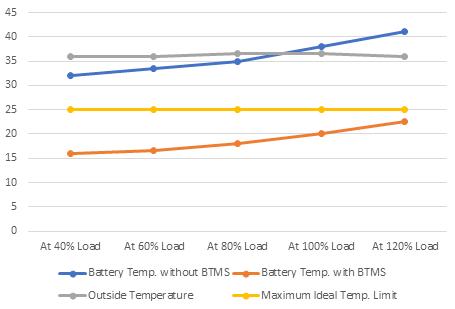
Herewehavetestedthedifferentbatteryloadingconditions to test its effects on the battery temperature. The temperatureofthebatterydoesn'tvarylargelywithrespect tovariousloadingcyclesonit,forvariousconditions.From the Graph below Figure it was seen that battery temperatureliesintherangeoftheoutsideenvironmental temperature,buttheremaybecertainriseintemperature abovetheenvironment,ifcontinuousdynamicoperationof batteryismadeatheavyloadingconditions.Thismayresult in an increase of battery temperatures from 0-6°C temperatureextrafromtheoutsidetemperatures.Wecan see that loading on the battery above 80% of its total capacity results in a slight increase in temperature of the batteryaboveitsoutsidetemperature.Andwhentheloadon the battery increases above its limit or total capacity, in dynamic conditions the temperature of the battery rises significantlyaffectingbatteryperformanceanditslife.But withhelpofourBTMSoperatingin2nd and3rd modeswe can cool down the battery temperature even below the maximumdesiredtemperaturevaluei.e25°Cshownbythe yellowline.ThustheorangelineofBTMSparalleltoactual battery temperature before BTMS is the desired temperaturerangeofthebattery(15-25°C)maintainedby theBTMS,whichisthemainobjectiveofourproject.
5. Conclusion
Batterymanagementsystemscanbearchitectedusing avarietyoffunctionalblocksanddesigntechniques.Careful considerationofbatteryrequirementsandbatterylifegoals will guide you in determining the right architecture, functional blocks and related ICs to create your battery management system and charging scheme to optimise batterylife.Inelectricvehicles,thenecessityofdesigninga battery thermal management system was determined to keep the battery pack temperature in the optimum temperaturerangeunderhotandcoldclimaticconditions. Thus,theefficiencyandlifetimeofthebatteryincreased.In thecaseof using a liquid cooledandheatedsysteminthe battery thermal management system high efficiency is achieved.Butitisbadatkeepingbatterytemperaturewithin
the optimum operating temperature. Therefore, it was determined that the electric vehicle thermal management systemshouldconsistofaliquidcooledandheatedsystem for which Thermoelectric Peltier module is used here to provide the heat difference to the liquid. Due to the advantageofpeltiertosupplybothheatingandcoolingby changingthepolarityithadbecomeeasytoprovideoptimal temperaturetothebatterypack.
6. Reference:
1. Venkatakrishnan S, Vikram Sudhan V.M, Sabari kandappan S, Vishwanath S, Saravanan S, Pandiyan P, “Battery Thermal Management System” 6th International Conference on Advance Computing & Communication System,IEEE2020, 978-1-7281-5197-7/20.
2. Shivam Prajapati, Yogesh Upadhyay, Yogesh Kumar, Manish Kumar Singh “Investigation of Thermal Management System of a Lithium-Ion Battery in Electric Vehicle"ELSEVIER.
3. Haakon karlsen, Tao dong,(member, IEEE),Zhaochu yang1 and rui carvalho, “TemperatureDependence in Battery Management Systems for Electric Vehicles: Challenges, Criteria, and Solutions”, Digital Object Identifier 10.1109/ACCESS.2019.2943558, Volume 7,2019.
4. Christoph Reiter, Nikolaos W assiliadis, Markus Lienkamp, “Design of Thermal Management Systems for Battery Electric Vehicles”, 2019 Fourteenth International Conference on Ecological Vehicles and Renewable Energies (EVER), 978-1-7281-3703-2/19/$31.0002019 EuropeanUnion.
5. Todd M. Bandhauer, Srinivas Garimell and ThomasF.Fullerb,“ACriticalReviewofThermalIssuesin Lithium-Ion Batteries” Journal of The Electrochemical Society,1583R1-R252011.
6. David w. Sundin and sebastian sponholtz, “Thermal Management of Li-Ion Batteries With SinglePhase Liquid Immersion Cooling” VOLUME 1, 2020, IEEE Open journal of Vehicular Technology.Digital Object Identifier10.1109/OJVT.2020.2972541.
7. Eugene Kim and Kang G. Shin, Jinkyu Lee, “RealTime Battery Thermal Management for Electric Vehicles” ICCPS'14,April14-17,2014,Berlin,Germany,978-1-47994930-4/14/$31.00©2014IEEE.
8. Shuai Maa, Modi Jianga, Peng Taoa, Chengyi Songa, Jianbo Wua, Jun Wangb,Tao Denga,Wen Shanga,“Temperature effect and thermal impact in lithium-ion batteries: A review”, Progress in Natural Science:MaterialsInternational28(2018)653–666.
International Research Journal of Engineering and Technology (IRJET) e-ISSN: 2395-0056
Volume: 11 Issue: 07 | July 2024 www.irjet.net p-ISSN: 2395-0072
9. M. Foad Samadi and Mehrdad Saif, “Integrated Battery Management System”, Springer International Publishing Switzerland 2015, M. Fathi (ed.), Integrated Systems:InnovationsandApplications,DOI:10.1007/9783-319-15898-3_11.
10. Andrey Smyshlyaev, Miroslav Krstic, Nalin Chaturvedi, Jasim Ahmed, and Aleksandar Kojic, “PDE Model for Thermal Dynamics of a Large Li-Ion Battery Pack”, 2011 American Control Conference on O'Farrell Street,SanFrancisco,CA,USAJune29-July01,2011,9781-4577-0079-8/11/$26.00©2011AACC.
11. Karen E. Thomas,John Newman, Robert M. Darling, “Mathematical Modeling of Lithium Batteries”, Advances in Lithium-Ion Batteries Edited by W. van Schalkwijk and B. Scrosati, Kluwer Academic/Plenum Publishers, 2002, 345-392. DoI : 10.1007/0-306-475081_13.
12. Languang Lu, Xuebing Han, Jianqiu Li, ianfeng Hua, Minggao Ouyang, “A review on the key issues for lithium-ion battery management in electric vehicles, Journal of Power Sources 226 (2013) 272-288, 03787753/$ e see front matter 2012 Elsevier B.V. All rights reserved, http://dx.doi.org/10.1016/j.jpowsour.2012.10.060.
13. Xiongbin Peng, Akhil Garg, Jian Zhang, Li Shui, “Thermal Management System Design for Batteries Packs of Electric Vehicles: A Survey”, 978-1-5386-09712/17/$31.00©2017IEEE
BIOGRAPHIES


SunilMaganMoreistheResearch scholarfromSSSUTMS,SehoreMP. Till date he have published many papersininternationalconference & journals. His research area is Electric vehicle and Switchgear & protection.
Dr. Brajesh Mohan Gupta is professor in the department of Electrical and Electronics Engineering at SSSUTMS, Sehore andpublishedmanypapersinSCI or scopes index journal. Area of specialization is high voltage and power system and electric vehicles