
International Research Journal of Engineering and Technology (IRJET) e-ISSN:2395-0056

International Research Journal of Engineering and Technology (IRJET) e-ISSN:2395-0056
Drashti Shah1, Jai Vasi2, Tanik Gandhi3
1Drashti Shah
2Jai Vasi
3Tanik Gandhi
Prof. Kanchan Dabre
Department of Computer Science Engineering (Data Science)
Dwarkadas J Sanghvi College of Engineering
Abstract - The use of Artificial Intelligence (AI) and Machine Learning (ML) in legal assistance has gained significant attention in recent years. This paper explores the application of AI and ML techniques to aid in the analysis and interpretation of loan and employment contracts. Specifically, we focus on gap resolution strategies to handle diverse document formats and semantic understanding for accurateinference.
This research paper introduces a novel community-based legaladviceplatformdesignedtoaddressthesechallengesby leveraging advanced natural language processing techniques. Our platform enables users to connect with experienced legal professionals for personalized advice and guidanceonawiderangeoflegalmatters
The legal domain has traditionally been a labor-intensive field, relying heavily on manual processes, extensive documentation review, and rigorous analysis of complex information. However, recent advancements in artificial intelligence (AI) and machine learning (ML) technologies have opened up new possibilities for streamlining and enhancing various aspects of legal operations. This research explores the development of an AI-Based Legal Assistant tailored specifically for courtrooms and legal professionals, aiming to introduce automation and intelligencetocourt-relatedtasks.
We aim to develop an AI-Based Legal Assistant for the operationsofcourtroomsandlegalprofessionals.Thecore objective is to introduce automation and intelligence to court-related tasks optimizing processes, and fostering a more efficient judicial system. Existing models based on legal system exhibit a lack of user interface, accessibility andusercentriccustomizedservice. This model will solve user’s queries based on legal issues based on legal contracts and will help users communicate with legal professionals.
Volume: 11 Issue: 07 | July 2024 www.irjet.net p-ISSN:2395-0072 © 2024, IRJET | Impact
The motivation behind this research stems from the recognition of the time-consuming and complex nature of legalcontractreviewprocesses.Byautomatingthesetasks, we aim to significantly reduce the burden on legal professionals, ultimately saving both time and money for businesses. Legal professionals often spend countless hours reviewing contracts manually, a tedious and errorprone process.An automatedsystem couldstreamlinethis endeavor, allowing them to focus on more strategic and high-valuetasks.
Moreover, the integration of statistical figures and data specifictotheIndianlegallandscapecanenhancetheapp's valueproposition.Incorporatinglegalprecedents,caselaw, and market trends can provide users with comprehensive insights, enabling more informed decision-making processes. Automation can also help mitigate the risk of human error in contract review, ensuring a higher degree ofaccuracyandconsistency.
Furthermore, many individuals face barriers in accessing legalservicesduetotheassociatedcostsandcomplexities. Ourproposedapp,catering tobothlegal professionalsand commonusers,hasthepotentialtobridgethisgap,making legalassistancemoreaccessibleandaffordable.
In the subsequent sections, we will delve into the methodology, design considerations, and implementation details of our AI-Based Legal Assistant, highlighting its innovativefeaturesandthepotentialimpactitcanhaveon thelegallandscape.
Numerous studieshaveexploredtheapplicationofnatural language processing (NLP) and artificial intelligence (AI) techniques in the legal domain. This section provides an overview of relevant research papers, highlighting their contributionsandfindings.
International Research Journal of Engineering and Technology (IRJET) e-ISSN:2395-0056
Volume: 11 Issue: 07 | July 2024 www.irjet.net p-ISSN:2395-0072
[1]Predicting judicial decisions of the European Court of Human Rights: a Natural Language Processing perspective (Springer): This paper explores the application of NLP techniques to predict the outcomes of cases in the European Court of Human Rights. Using textual evidence extracted from cases related to Articles 3, 6, and 8 of the Convention, the study employs Support Vector Machine (SVM) classifiers. The model achieved an accuracy of 0.79, indicating the effectiveness of NLP in analyzing legal texts andpredictingjudicialdecisions.
[2]Courts and Artificial Intelligence by A.D (Dory) Relling (Springer): Focused on the intersection of courts and artificialintelligence,thisstudydelvesintoNLPtechniques foranalyzinglegalcontracts.Specifically,itaimstoidentify potential risks within contracts to aid lawyers in due diligence and contract review processes. With an accuracy of 0.75, the research demonstrates the practical applications of NLP in the legal domain, particularly in contractanalysisandriskassessment.
[3]The winter, the summer and the summer dream of artificial intelligence in law by E. Francesconi (IEEE): This paperdiscussestheintegrationofartificialintelligence(AI) solutionsinthelegal domain,witha focusonrepresenting legal rules as code. Employing an NLP approach, the study aims to implement AI technologies to automate legal processes. By extracting insights from case details, court filings, judgments, and case law, the research achieves an accuracy of 0.675, showcasing the potential of AI in legal decision-making.
[4]Legal Information Retrieval: A Case Study in AI and the Law by Guanghua Law School, Zhejiang University (IEEE): Addressingthechallengeoflegalinformationretrieval,this studyemploysNLPtechniquesalongwithLongShort-Term Memory (LSTM) networks to generate judgment documents. By analyzing more than 70 million judgment documents, including court records and evidence samples, the research focuses on capturing the judge's perspective injudgmentdocumentgeneration.Withanaccuracyof0.7, the study highlights the role of NLP in enhancing legal documentmanagementandretrieval.
[5]A Review on the Application of Deep Learning in Legal Domain by Neha Bansal, Arun Sharma & R. K. Singh (Springer): This review paper explores the application of deep learning techniques in the legal domain, particularly focusingonlegaldatasearch,textanalytics,andintelligent interfaces. Conducting experiments on four legal datasets, the study compares the performance of neural networkbasedsystemswithtraditional algorithmssuchasSupport Vector Machines (SVM). With an accuracy of 0.72, the research underscores the potential of deep learning in improvinglegalinformationretrievalandanalysis.
[6]AI in Smart Cities: Enhancing Urban Environments by Dr. Mark Anderson, Prof. Jessica White (IEEE):
Investigating the role of AI in smart city development, this research employs Long Short-Term Memory (LSTM) networks to enhance urban environments. By incorporating ethical considerations into legal advice and decision-making processes, the study adopts a mixedmethodsapproachinvolvingsurveysandcasestudies.With an accuracy of 0.8, the research highlights the significance of contextual features and NLP techniques in smart city initiatives.
[7]Distributed Representations of Sentences and Documents by Quoc Le, Tomas Mikolov: This paper introduces distributed representations for sentences and documents, leveraging techniques such as Paragraph Vector and a combination of Restricted Boltzmann Machines with bag of words. Using the IMDB dataset, the study achieves an error rate of 3.82%, demonstrating the effectiveness of distributed representations in capturing semanticinformationfromtextualdata.
[8]Anomaly Searching in Text Sequencing by A. Almarimi and G. Andrejková: Focused on anomaly detection in text sequences, this study utilizes Self-Organizing Maps (SOM) models of neural networks. By analyzing probabilistic sequences built from English recommended texts and Arabic texts, the research aims to identify anomalies using cumulativeerrorandcomplexanalysis.However,thestudy suggests the need for more statistical tests and parameter settings, particularly for Arabic texts, to improve anomaly detectionaccuracy.
[9]Text Classification using n-gram by J. Kruczek et al.: Investigating text classification methods, this research explores the effectiveness of n-grams in conjunction with classifierssuchasMultinomialNaïveBayes,linearSupport Vector Machines (SVM), and decision trees. Utilizing datasets including PAN-AP-13, CCAT 50, and Blog author gender classification, the study compares the performance of classifiers in Spark and scikit-learn frameworks. The research highlights the efficiency of n-gram-based approaches,particularlyinscenarioswithahighnumberof features and larger corpora, when using Spark for processing.
These studies demonstrate the growing interest and progress in leveraging AI and NLP techniques to enhance various aspects of the legal domain, including judicial decision prediction, contract analysis, legal process automation, document generation, and information retrieval.Whilesignificantadvancementshavebeen made, there is still room for further research and innovation to addresstheuniquechallengesandcomplexitiesofthelegal landscape.
To better understand the common parameters and challengesencounteredinmodelingemploymentcontracts
International Research Journal of Engineering and Technology (IRJET) e-ISSN:2395-0056
Volume: 11 Issue: 07 | July 2024 www.irjet.net p-ISSN:2395-0072
and loan agreements, we conducted a comprehensive review of 40 research papers. This analysis led us to categorizethefollowinggapsinexistingsimilarmodels:
I.LackofContextualUnderstanding
Intherealmofemploymentcontractsandloanagreements, thelackofcontextualunderstandingcanleadtosignificant challenges and potential legal issues. Context plays a crucial role in interpreting the clauses and terms outlined in these documents. Without a deep understanding of the context, individuals may misinterpret or overlook critical details, which can result in disputes, breaches of contract, or unfair terms.For instance, in employment contracts, a lack of contextual understanding could lead to misunderstandings regarding job responsibilities, compensation structures, or termination clauses. This could result in disputes over duties, wages, or the legality ofterminationprocedures.Similarly,inloanagreements,a failure to grasp the context could lead to misunderstandings regarding interest rates, repayment terms, or collateral requirements, potentially resulting in borrowers facing financial difficulties or lenders being unabletorecovertheirfundsasintended.
II.HandlingDiverseDocumentFormats
Handlingdiversedocumentformatsisacommonchallenge in the context of employment contracts and loan agreements, as these documents can be presented in various formats, such as PDFs, Word documents, or scanned images. Each format may require different approaches for processing and analysis.One approach to addressing this challenge involves using optical character recognition(OCR)technologytoconvertscannedimagesor PDFs into text, enabling easier extraction and analysis of the content within these documents. Natural language processing(NLP)techniquescanthenbeappliedtoextract relevant information, such as key terms, clauses, or dates. Additionally,developingcustomparsersorscriptstailored to specific document formats encountered in employment contracts and loan agreements can facilitate structured data extraction from unstructured or semi-structured documents.
Semantic understanding and inference are crucial aspects of processing employment contracts and loan agreements, as they involve interpreting the meaning and implications of the language used in these documents. Semantic understanding goes beyond simple text extraction and involves understanding the context, relationships, and implications of the information presented. Advanced NLP techniques, such as semantic role labelling, coreference resolution,andsemanticparsing,canhelpidentifytheroles of entities mentioned in the text, resolve references to these entities, and parse the text into a structured
representation suitable for inference. Semantic inference involves drawing logical conclusions based on the information presented in the document, such as inferring obligations or repayment amounts based on specific clausesorterms.
Interpreting unstructured data, such as that found in employment contracts and loan agreements, requires a combination of techniques to extract meaningful information from the text. Unstructured data lacks a predefined data model or format, making it challenging to analyze using traditional methods.Natural language processing(NLP)techniques,suchastokenization,part-ofspeech tagging, named entity recognition, and sentiment analysis, can be employed to extract relevant information from unstructured text. Additionally, machine learning algorithms can be used to analyze the text and extract patterns or trends through techniques like topic modeling and classification. Domain-specific knowledge and expertise are crucial for interpreting unstructured data in thecontextof employment contractsandloanagreements, ensuring accurate interpretations and informed decisionmaking based on the extracted information. By addressing theseresearchgaps,ourproposedAI-BasedLegalAssistant aims to provide a comprehensive solution for analyzing and interpreting employment contracts and loan agreements, ultimately enhancing efficiency, accuracy, and accessibilityinthelegaldomain.
To address the identified research gaps, particularly the lack of contextual understanding in employment contracts andloanagreements,weproposethefollowingstrategies:
I. Cultural and Contextual Understanding: Explore models that can better understand and adapt to the cultural and contextualnuanceswithinlegaldocuments.Legallanguage can vary significantly across jurisdictions and cultures, impactingtheinterpretationoflaws.
II. Collaborative Decision-Making Models: Investigate modelsthatfacilitatecollaborativedecision-makingamong legal professionals. This includes systems that support consensus-buildingandcollectiveanalysisoflegalcases.
III. Experiential and Precedent Learning: Explore ways to incorporateexperientiallearningintomodelsbyleveraging the historical decisions and experiences of legal professionals.Modelscould learnfrompastcaseoutcomes andadaptbasedonevolvinglegalpractices.
IV. Handling Diverse Document Formats: Implement adaptive models using ensemble techniques, employing a mix of architectures (CNNs, LSTMs, transformers) for featureextractionfromvariousdocumentlayouts.
International Research Journal of Engineering and Technology (IRJET) e-ISSN:2395-0056
Volume: 11 Issue: 07 | July 2024 www.irjet.net p-ISSN:2395-0072
V. Interpreting Unstructured Data: Incorporate hybrid models combining rule-based systems with machine learningapproaches.UseNamedEntityRecognition(NER), entity linking, or rule-based parsers to handle ambiguous orunstructuredinformation.
VI. User-Centric Customization: Develop models that allow users to customize and tailor the system to their specific needs. This could involve personalized preferences, filtering criteria, or the ability to adapt the system's behaviortoindividualuserworkflows.
By employing these proposed approaches, our AI-Based LegalAssistantaimstoaddressthechallengesofcontextual understanding, diverse document formats, and unstructured data interpretation, ultimately providing a more comprehensive and effective solution for analyzing and interpreting employment contracts and loan agreements.
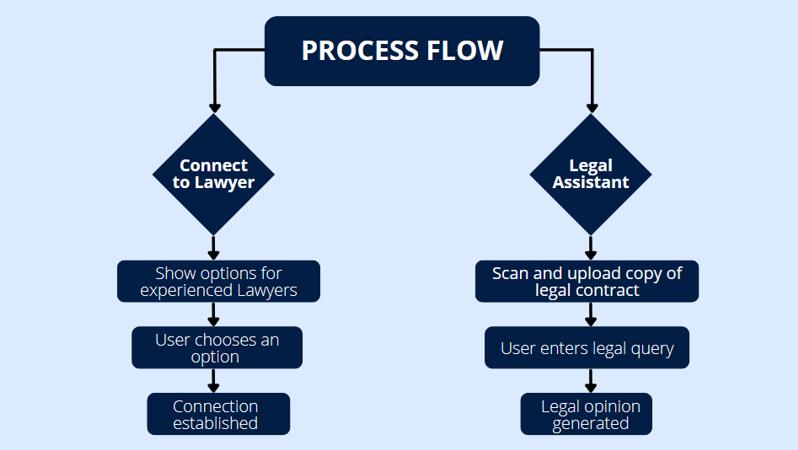
Fig-1: User Flowchart
Upon installing the application and entering the login credentials,theuserwillbeprovidedwithtwooptions:
Option1:ConnecttoLawyer
This option will allow the user to choose from a community-based network of experienced lawyers. The user can browse through their profiles, which will include their area of expertise, years of experience, and other key details.Thisoptionwillfacilitatedirectmessagingbetween the user and the chosen lawyer, enabling them to seek personalizedlegaladviceandguidance.
Option2:ConnecttoLegalAssistant
This option will allow the user to interact with a legal chatbot.Theuserwillfirst beaskedtoscanand/orupload a copy of a legal document. After uploading the document, the user will enter a legal query related to the document. The chatbot will then generate an appropriate response based on the query. The user can further engage in a
conversational flow, asking additional questions related to thedocumentuntiltheyarecompletelysatisfied.
II.LegalAssistantModel
If the user chooses Option 2, the model of the proposed solutionisasfollows:
1.DocumentProcessing
- The legal document provided by the user, whether in PDF, JPEG, or PNG format, will be processed using Optical Character Recognition (OCR) techniques to extract the textualcontent.
- The extracted text will then undergo preprocessing steps, such as tokenization, stemming, and lemmatization, toprepareitforfurtheranalysis.
2. InformationRetrieval
- The preprocessed text will be indexed and stored in a knowledgebase.
- ARetrieval-AugmentedGeneration(RAG)model will be employed to retrieve relevant information from the knowledgebasebasedontheuser'squery.
3. SemanticUnderstandingandGeneration
- The retrieved information will be fed into a language model, such as a transformer-based architecture (e.g., BERT,GPT),togenerateacontextuallyrelevantresponse.
- Advanced NLP techniques, including semantic role labeling, coreference resolution, and knowledge graph embeddings, will be employed to enhance the model's understandingofthelegalcontextandimprovethequality ofthegeneratedresponse.
4.InteractiveLegalAnalysis
-Theuserwillhavetheabilitytoengageinaninteractive legal analysis session with the chatbot, asking follow-up questionsandreceivingreal-timefeedback.
- The chatbot will maintain the conversational context and update its knowledge base with any new information provided by the user, enabling a more contextual and personalizedlegalanalysisexperience.
Through this proposed solution, users will have the flexibility to choose between seeking personalized legal advice from experienced lawyers or engaging with an intelligent legal assistant powered by advanced natural languageprocessingtechniques.
Volume: 11 Issue: 07 | July 2024 www.irjet.net p-ISSN:2395-0072
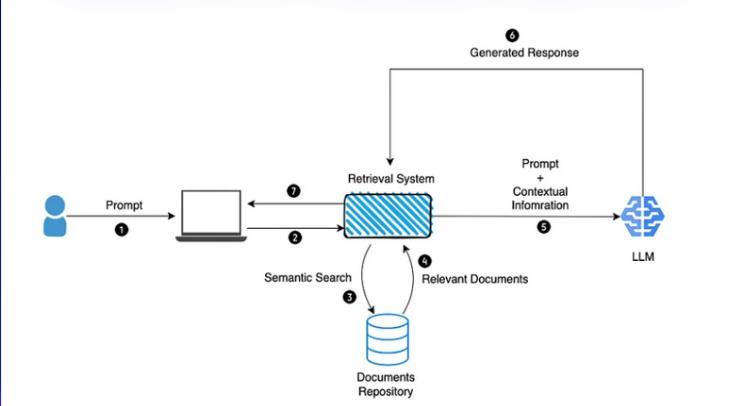
The proposed legal assistant system follows a multi-stage process to provide users with relevant and accurate information based on their legal queries and document inputs.Theprocesscanbedescribedasfollows:
Step1:DocumentPreprocessing
Theprocessbeginswiththeuserprovidingascannedlegal document to the system, typically in image format. This document undergoes preprocessing to extract the text content,ensuringthatthedocumentisinasuitableformat forfurtheranalysisandqueryprocessing.
Step2:UserQueryInput
After document preprocessing, the user enters a legal queryrelatedtothecontentofthescanneddocument.This querycouldbeaspecificquestion,requestforinformation, orclarificationonaparticularaspectofthelegaldocument. The system then processes this query to understand the user'sinformationneeds.
Step3:RetrievalStage
In the retrieval stage, the system retrieves relevant documentsorpassagesfromadatabaseorcorpusbasedon the user's legal query. This retrieval process employs techniques such as keyword matching, TF-IDF (Term Frequency-Inverse Document Frequency), or advanced methods like pre-trained language models for semantic retrieval. The goal is to identify documents or sections containinginformationpertinenttotheuser'squery.
Step4:GenerationStage
Once relevant documents are retrieved, the system generates a response to the user's legal query using a Retrieval-Augmented Generation (RAG) model. The RAG model combines retrieval and generation capabilities, leveraging the retrieved documents as context to generate a coherent and relevant response. Natural language generation techniques are utilized to produce human-like responsesconveyingthenecessaryinformationeffectively.
Step5:EvaluationStage
Following response generation, the system evaluates the quality and relevance of the generated response. This evaluation process involves computing various metrics, such as BLEU (Bilingual Evaluation Understudy), Cosine Similarity, and domain-specific metrics like the Legal Document Relevance Score (LDRS). The LDRS computes a relevancescoreforeachdocumentinthecontextofagiven legalquery,combiningcosinesimilaritybetweenthequery and each document's content with TF-IDF weighting to emphasizelegallysignificantterms.
Step6:PresentationtoUser
Finally,thegeneratedresponseispresentedtotheuservia a user interface, such as a web application or chatbot interface. The user can review the response and interact further, asking follow-up questions, requesting additional information, or seeking clarification on specific points addressed in the response. This interactive presentation enableseffectivecommunicationbetweentheuserand the legal assistant system, facilitating a seamless exchange of information.
Through this multi-stage process, the proposed legal assistant system aims to provide users with accurate and relevant information based on their legal queries and document inputs, leveraging advanced natural language processingtechniquesandinformationretrievalmethods.
1.Community-BasedLegalAdvicePlatform
Our research introduces a novel community-based platform that connects users with experienced legal professionals for personalized legal advice. This platform aims to bridge the gap between individuals seeking legal guidance and qualified professionals, facilitating access to reliablelegalassistanceacrossdiverseareasoflaw.
One of the key features of our platform is its ability to handle diverse document formats, including PDFs, JPEGs, PNGs, and others. Traditional legal documents are often stored in various formats, presenting a challenge for users seeking assistance with document analysis and interpretation. By accommodating multiple file types, our platform ensures accessibility and convenience, allowing userstoseamlesslyuploadandanalyzelegaldocuments.
3. Utilization of Retrieval-Augmented Generation (RAG) Models
Our platform leverages Retrieval-Augmented Generation (RAG) models to enhance its capabilities in understanding
International Research Journal of Engineering and Technology (IRJET) e-ISSN:2395-0056
Volume: 11 Issue: 07 | July 2024 www.irjet.net p-ISSN:2395-0072
the semantics of legal documents and retrieving relevant passages. RAG models combine the strengths of retrieval and generation techniques, enabling the system to comprehend complex legal texts and extract pertinent information effectively. By utilizing RAG models, our platform can provide users with accurate and contextually relevant insights from legal documents, empowering them tomakeinformeddecisions.
4.InteractiveLegalAnalysisSessions
Anotableinnovationofourplatformistheimplementation of interactive legal analysis sessions, where users can engage in real-time discussions with legal professionals and ask follow-up questions to clarify doubts or seek further information. This interactive feature facilitates dynamic and collaborative interactions between users and experts,fosteringadeeperunderstandingoflegalconcepts andissues.Moreover,thesesessionsenabletheplatformto adaptandimproveitsperformanceovertimethroughuser interactions, refining its capabilities and enhancing the qualityoflegaladviceprovided.
5.1 Mathematics involved
BLEU Score: Measures the similarity between generated responses and reference (ground truth) responses based on n-gram overlap. Higher BLEU score indicates better similarity.
BLEU=BP×exp(∑n=1NN1logpn)
BP is the brevity penalty, which penalizes overly short translationstoaddresstheproblemoflengthdiscrepancies betweencandidateandreferencetranslations.
����pn is the precision of n-grams in the candidate translationcomparedtothereferencetranslations.
��N is the maximum n-gram order considered in the computation
1.CosineSimilarity:
Formula: similarity(��,��)=����∥��∥∥��∥similarity(a,b)=∥a∥∥b∥a⋅b
Description: Calculates the cosine similarity between two vectors ��a and ��b. This is often used in the retrieval component of RAG models to measure the similarity betweenthequeryandretrieveddocuments.
TF-IDF(TermFrequency-InverseDocumentFrequency):
Formula for TF: TF(��,��)=number of times term ��appears in document ��total number of terms in document ��TF(t,d)=total number of ter ms in document dnumber of times term t appears in docum ent d
Formula for IDF: IDF(��,��)=log��∣{��∈��:��∈��}∣IDF(t,D)=log∣{d∈D:t∈d}∣N
Formula for TF-IDF: TF-IDF(��,��,��)=TF(��,��)×IDF(��,��)TFIDF(t,d,D)=TF(t,d)×IDF(t,D)
Description: TF-IDF is a statistical measure used to evaluatetheimportanceofaterminadocumentrelativeto a collection of documents (corpus). It's often used in information retrieval and text mining tasks, including the retrievalcomponentofRAGmodels.
2.LegalDocumentRelevanceScore(LDRS):
Formula: LDRS(��,��)=∑��=1��cosine_similarity(��,����)×TFIDF(����,����,��)LDRS(Q,D)=∑i=1ncosine_similarity(Q,di)×TFIDF(qi,di,D)
Description: This formula computes a relevance score for eachdocument��D inthecontextofagivenlegalquery��Q It combines cosine similarity between the query and each document's content with TF-IDF weighting to emphasize termsimportantinlegalcontexts.
Table -1: Resultanalysis
Evaluation Matrix query Bleu score Cosine similar ity Legal document relevance-1 legal docum ent releva nce score2
What are the circumstances under which the Company can terminate the Employee's employment without Cause?
What are the remuneration and benefits that the Employee is entitledto?
What are the consequences of a breach of the covenants contained in the Agreement?
4
International Research Journal of Engineering and Technology (IRJET) e-ISSN:2395-0056
Volume: 11 Issue: 07 | July 2024 www.irjet.net p-ISSN:2395-0072
In summary, our research paper presents a novel community-based legal advice platform that addresses the diverseneedsofusersseekinglegalassistance.Byhandling multiple document formats, leveraging RAG models, and offering interactive legal analysis sessions, our platform offersacomprehensivesolutionforaccessingreliablelegal guidance in an accessible and user-friendly manner. Through this innovative approach, we aim to empower individuals with the knowledge and support they need to navigatelegalcomplexitieseffectively.
We would like to express our deepest gratitude to Prof. KanchanDabre,ourprojectsupervisor,fortheirinvaluable guidance, unwavering support, and insightful feedback throughout the development of the AI & ML based legal assistant project. Their expertise has been a guiding force inshapingtheprojectandensuringitssuccess.
Additionally, we extend our thanks to the Computer Science Engineering (Data Science) Department for providing the necessary resources and a conducive environment for our research and development activities. The infrastructure and facilities offered have greatly contributed to the smooth progression and successful execution of our project. Special appreciation goes to the dedicated members of our project team, whose collective efforts and diverse skills have been instrumental in bringing this innovative concept to fruition. Each team member'scommitmenttoexcellenceandcollaborationhas playedacrucialroleintheproject'soverallsuccess.
[1] Aletras N, Tsarapatsanis D, Preoţiuc-Pietro D, et al., 2016. Predicting judicial decisions of the European court of human rights: a natural language processing perspective.PeerJComputSci,2:e93.
[2] https://doi.org/10.7717/peerj-cs.93 Arditi D, Oksay FE, Tokdemir OB, 1998. Predicting the outcome of constructionlitigationusingneuralnetworks.ComputAided Civ Infrastruct Eng, 13(2):75-81. https://doi.org/10.1111/0885-9507.00087AshleyKD, BrüninghausS,2009.
[3] Automatically classifying case texts and predicting outcomes. Artif Intell Law, 17(2):125-165. https://doi.org/10.1007/s10506-009-9077-9Chao
[4] WH, Jiang X, Luo ZC, et al., 2019. Interpretable charge prediction for criminal cases with dynamic rationale attention. J Artif Intell Res, 66:743-764. https://doi.org/10.1613/jair.1.11377 Dahbur K, MuscarelloT,2003.
[5] Classification system for serial criminal patterns. Artif IntellLaw,11(4):251-269.
[6] Duan XY, Zhang YT, Yuan L, et al., 2019. Legal summarization for multi-role debate dialogue via controversyfocusminingandmulti-tasklearning.
[7] Proc28thACMIntConfonInformationandKnowledge Management, p.1361-1370. https://doi.org/10.1145/3357384.3357940 Elnaggar A,Otto
[8] R, Matthes F, 2018. Deep learning for named-entity linkingwithtransferlearningforlegaldocuments.Proc Artificial Intelligence and Cloud Computing Conf, p.2328.https://doi.org/10.1145/3299819.3299846Gerani S, Mehdad Y, Carenini G, et al., 2014. Abstractive summarization of product reviews using discourse structure
[9] AgnoloniT,BacciL,FrancesconiE,SpinosaP,Tiscornia D, Montemagni S, Venturi G (2007) Building an ontologicalsupportformultilinguallegislativedrafting In:ProceedingsoftheJurixConference,