
International Research Journal of Engineering and Technology (IRJET) e-ISSN:2395-0056
Volume: 11 Issue: 07 | July 2024 www.irjet.net p-ISSN:2395-0072

International Research Journal of Engineering and Technology (IRJET) e-ISSN:2395-0056
Volume: 11 Issue: 07 | July 2024 www.irjet.net p-ISSN:2395-0072
Alaa N. Alanssari
Lecturer
Professor,
Department of
Mathematic,
Abstract - The meeting of noise and low contrast typically amplifies the difficulty of segmenting images by their dual nature. However, we demonstrate an unconventional approach: attempting to achieve the utmost degree of accuracy in segmenting via a hybridization of multiple methods into a single flow. Let's begin with CLAHE, which takes charge of local contrast enhancement; followed by Gaussian smoothing, an actor that possesses dual capabilities first, they retain information regarding the edge of the object, and second, they eliminate noise that is not tolerated. Then Canny edge detection: this method is used to differentiate strong pixels from thin, weak ones, the method is based on the gradient of the pixels.
We don't conclude here. After the Canny procedure, the role of the morphological procedure is significant. They improve the map of the edge by taking care of the small regions of noise and closing the gaps (these are not welcome). This is the methodology we follow! Through experimental results that have already been successful, it has surpassed other methods in terms of accuracy when dealing with images that are of low quality, this is an example of innovation! This paints a bright picture of how effective our fusion strategy is likely to be; it represents a significant advancement since we address specific details that are embedded in noise (commonly encountered in tasks like object recognition or image analysis) at specific locations. The capacity of our methodology to deal with different image situations and the effectiveness of the many types of noise it can address can be considered as a significant advantage an advantage that can be utilized to enhance the effort towards improving the delineation of images (hence this process in challenging environments). To end: we're transferring a superior product.
Key words: Segmentation, Low-Quality Images, Contrast Enhancement, Edge Detection, Morphological Operations.
Splittinganimageintomeaningfulpiecescanbetermedas themostimportantaspectofhandlingimagesthisiswhat we refer to as segmentation. The primary goal of this
Faculty of Basic Education, University of Kufa, Najaf, Iraq
activity is to isolate the main objects in the foreground from their background, which holds significance in areas such as medical imaging and remote sensing, along with objectrecognitionsystems.Successfulsegmentationpaves wayforvaluablefeatureinformationthatshouldideallybe extracted for classification and image analysis; however, achieving high-quality delineation from noisy or low contrast images is a Herculean task. An impasse difficulty many a researcher faces while working on this topic hinderingtheirprogress.
Common approaches to segmenting, such as thresholding, region growing, and edge detection, typically require the presence of a clear distinction between regions or a uniformity within the regions. While these methods are effective in certain situations, they are greatly limited by noise or low contrast that makes them ineffective [1]. Similarly, traditional approaches that use segmentation are unsuccessful in situations like: remote sensing, where a common quality sensor is obstructed by environmental areas that are standard, but the contrast between these areasislow,thispreventstheidentificationoffeatures[2].
A new method of segmenting images is under development.Amoreadvancedone.notyourtypicalhighquality images that other methods have an easier time dealing with because of their limitations. One innovation that is particularly noteworthy is adaptive filtering: a method that adjusts its parameters based on the specifics of the image at hand. When combined with cutting-edge edge detection technology that is highly resilient to noise, we have a solution that can recognize features regardless of what others are doing. Among the exhibited innovative approaches is Contrast Limited Adaptive Histogram equalization(CLAHE),whichisrenownedforitsemphasis on enhancing local contrast enhancement. Disparate lighting conditions that are adverse to the standard technique often lead to features that are more apparent than other techniques would have missed. These conditions are typically caused by information that is background. This is an example of image segmentation that is redefined, every new method provides a path to more complex and durable solutions to real-world problems, but which are still undisclosed... One additional
Volume: 11 Issue: 07 | July 2024 www.irjet.net p-ISSN:2395-0072
feature of the reveal is Canny's edge detection, which can find thin edges in images even when there is noise that masks the details (effectively). These are just a few common examples of different technological fields. Not all situationsareappropriatefortheseuniqueattributes)[3].
There is still no unified method developed, in spite of all such progress. This method would need to combine different strategies harmoniously into one integrated systemthatcanadaptivelychangebasedonvaryinglevels of image quality. Existing techniques tend to concentrate on particular areas like contrast enhancement or edge detectionhoweverthereisthedemandforanall-inclusive structure that integrates these techniques together due to their capability of attaining strong segmentation under variedlow-qualityimagingscenes[4]
Although considerable headway has been achieved in the evolution of high-level segmentation techniques, there appears a conspicuous lacuna where most appropriate unification that could blend contrast enhancement and adaptivesmoothing togetherwith edge detection intoone harmonized single approach is to be defined. The approachesavailabletendtofallintotwoextremes:either highly standard and generic which deprives them of adaptability needed when noise levels and contrasts vary from image to image, or overly specific hence not able to be widely applied on a wide range of low-quality images [5] Clearly the problem statement is having a methodology tailored for every unique image yet maintaininghighsegmentationaccuracy.
An algorithm is introduced in this paper. It consists of CLAHE, Gaussian smoothing, Canny edge detector, and morphological operations. The methodology starts by using CLAHE to enhance contrast locally; it is then followed by applying Gaussian smoothing to reduce noise (but keep edges) and Canny edge detection that uses dual thresholds for strong edge pixels selection. Eventually, morphological operationsare used to fine-tune the binary edge map: by plugging gaps and removing small noise clusters.Theexperimentalresultsshowthattheproposed algorithm achieves better performance than other methods leading to an improved accuracy in low-quality image segmentation under noisy conditions (which typically limits feature extraction applications). This demonstratesaviablesolutionthatcanbemoreadaptable androbusttowardsdifferenttasksinimageprocessing[6].
2. Contrast Enhancement with CLAHE:
CLAHE stands for Contrast Limited Adaptive Histogram Equalization. This is an advanced method used in image processing to improve contrast of images especially those
with low contrast or inadequate light conditions that cannot be addressed effectively using standard histogram equalization techniques which globally adjust image contrast.CLAHEdiffersinthatitoperatesonsmallregions or tiles within the image [7], [8] which makes it more appropriate when uneven illumination and intricate backgrounds might interfere with efforts to bring out detailsintheimage[9],[10]
TheconceptofCLAHEinvolvespartitioningtheimageinto disjoint regions called tiles and performing histogram equalizationoneachtileseparately.Theintensityvaluesof the resulting image are computed by interpolating the transformation function bilinearly [9], [11]. Bilinear interpolation is used to avoid artifacts that might appear due to quantization error during computation of AHE for small regions. Let be an m*n region extracted from. Then clippingcanbedescribedas:
( ) ( ( ) )
where ( )isthehistogramofpixelintensitiesfortile ( ), and “clipLimit” is the maximum allowed value for any histogram bin. Excess pixels beyond this limit are redistributedacrossthehistogram.
The cumulative distribution function (CDF) is computed foreachtile'sclippedhistogramandusedtomapthepixel valuestoenhancecontrast[12],[13],[14]:
( ) ∑ ( )
where is the total number of pixels in the tile. The new pixelvalueisthengivenby: ( ) ( ( )) ( )
where ( )istheoriginalintensity, and arethe minimum and maximum intensity values, and is theminimumvalueoftheCDF.
Bilinear interpolation is used to blend the edges of adjacenttilestoavoidvisibleseams.Thepixelvalueat the boundarybetweentilesiscomputedasaweightedaverage of the corresponding values from the neighboring tiles [11],[15]
Volume: 11 Issue: 07 | July 2024 www.irjet.net
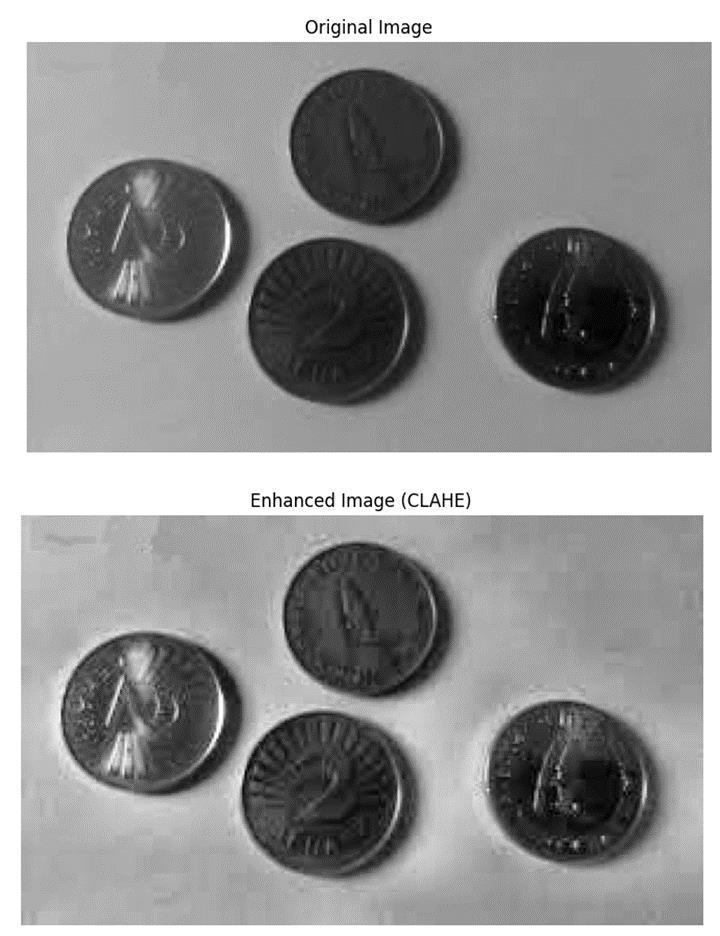
Gaussiansmoothingisanimportantpre-processingstepin imageprocessing.Itspurposeistoreducenoiseandimage detail [16]. The mechanism behind Gaussian smoothing involves the convolution of the image with a Gaussian kernel. This kernel takes the form of a bell-shaped curve thatdistributesthepixelweighttoitsneighborsaccording to the values of a Gaussian function. This function in two dimensionscanbedefinedas:
where ( ) is the value of the Gaussian function at coordinates ( ),and (sigma)isthestandarddeviation of the Gaussian distribution, controlling the extent of smoothing. The Gaussian kernel’s size is typically chosen tobelargeenoughtocapturesignificantfeaturesbutsmall enoughtoavoidexcessiveblurring[17],[18]
TheGaussiankernelisgeneratedbasedonthespecified The kernel is symmetrical and its size is usually determinedbytheruleofthumb:
-ISSN:2395-0072
Kernel . This ensures that the kernel capturesthemajorityoftheGaussianfunction'ssignificant values[16]
The image is convolved with the Gaussian kernel, where each pixel in the image is replaced by a weighted average of its neighboring pixels. The weights are determined by the Gaussian function, with closer pixels having higher weightsandmoredistantpixelshavinglowerweights.
)
∑ ( ) ( )
where ( )isthesmoothedimagevalueat ( ), ( ) is the original image value at the neighboringcoordinates,and ( )istheGaussiankernel value at offset ( ). The summation extends over the kernel’s dimensions 2k+1. When convolving near the edges of the image, methods such as padding with zeros, replicating edge pixels, or using a mirror of the image are appliedtohandleboundariesandavoidartifacts[1].
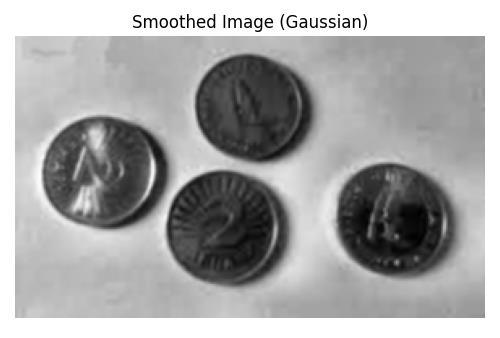
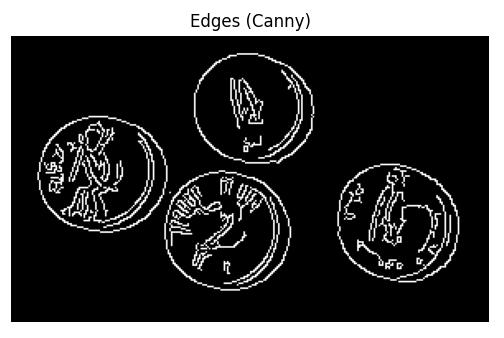
Edge Detection using Canny is a widely used technique in image processing fordetecting edgeswithin animage, the Cannyedgedetectorisknownforitsabilitytodetectedges withhighaccuracywhile beinglesssensitiveto noise[19], [20].
5.
is the initial step in the Canny edge detection process, which involves computing the intensity gradients of the image [21] This is typically done using convolution operationswithgradientoperators.
Volume: 11 Issue: 07 | July 2024 www.irjet.net p-ISSN:2395-0072
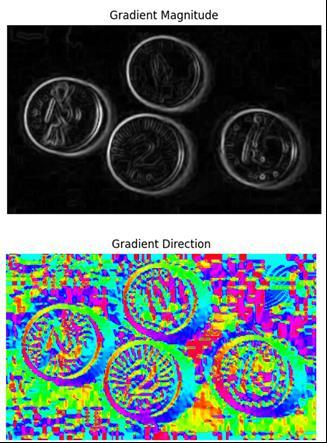
Although the Sobel operator is often used for gradient computation, the Canny algorithm utilizes a similar approach to determine the gradients along the x and y directions [22]. The gradients and are computed as follows: Thegradientmagnitude anddirection arethenderived fromthesecomponents:
only the most significant edges, enhancing the clarity and accuracy of edge detection. Mathematically, it involves comparing the gradient magnitude of a pixel with the magnitudes of neighboring pixels along the gradient direction. If a pixel's magnitude is not greater than the neighboringpixels,itissuppressed:
{ ( ) ( )
This step effectively reduces the thickness of edges and minimizesspuriousresponses
7. Edge tracking by hysteresis
Further refines edge detection by employing two thresholds:
A high threshold to identify strong edges and a low threshold to track edges thatareconnectedtostrong edges. Pixels with gradient magnitudes above are immediatelyclassifiedasedges.
( )
Thegradientmagnitudeindicatestheedgestrength,while the gradient direction shows the orientation of the edge [19],[21].
6. Non-maximum suppression
Is a technique used to thin out the edges and suppress all gradient values that are not local maxima along the direction of the gradient [22], [23]. This process retains
Pixels with gradient magnitudes between and are classified as edges only if they are connected to pixels thatareabovethehighthreshold: ( )
If ( )
If ( )
This dual-threshold method ensures that genuine edges arepreservedwhilefalseedgesduetonoiseareminimized [24],[25],[26]
Volume: 11 Issue: 07 | July 2024 www.irjet.net p-ISSN:2395-0072
The main goal of the study is to devise a novel technique for image segmentation particularly tailored for lowquality images. We introduce the CLAHE technique which is a mixture of different methods that make feature delineation effective even in unfavorable lighting conditions and complicated backgrounds due to poor image quality. Gaussian smoothing helps in preserving significant edges while reducing noise; Canny edge detection guarantees precise edge detection based on gradient magnitude and direction; morphological operations further refine detected edges by eliminating small noise clusters. The new approach is far better than traditional methods and significantly boosts the accuracy of segmentation an indication of how much this study contributes to the field of image processing with innovative techniques. We present an innovative composite technique marrying contrast enhancement, noise reduction, and edge detection under a single umbrella. This novel methodology is designed to address theshortcomingsinherentinmanytraditionalapproaches by its ability to dynamically adjust to diverse image conditions. Thisadaptability makesoursystema versatile toolthatcanbeappliedacrossvariousfieldssuchasobject recognition,biometricanalysisormedicalimagingwithout breaking a sweat. In the future work, the combination of CLAHE with Canny edge detection supported by morphological operations irrespective of the type of noise and contrast situations is expected to provide better handling not only does it propose itself as a pragmatic solution but also an efficient one for any other case that mightsurfacelaterdowntheroad.Wearenotonlylooking at improving adaptability through an adaptive framework offutureimagesbasedon machinelearning(which would just make our algorithm more adaptive) but also taking into consideration the level and nature of noise or quality degradationinthoseimages weaimmuchhigher.higher. Thispaperintroducesanewapproachinimageprocessing that deals with three main aspects contrast enhancement, noise reduction, and edge detection all under one unified methodologicalframework.Whenstandardtechniquesfail duetopoor-qualityimages,theproposedapproachisable to adapt on-the-fly based on the specific conditions of the image in real-time: a solution that sees itself playing a reliable role across different applications like object recognition or biometric systems and even medical imagingrequirements.AddressingCLAHEandCannyedge detection with morphological operations eachdesigned to handle specific types of noise and particular scenarios in contrast situations this is an innovative strategy towards these two highly distinct components through their conjoined process for the first time ever unveiled. Next
steps for research should focus on improving adaptability possibly through machine learning empowering the algorithm to better cope at different levels of noise complexities and varied image degradations it might encounteratruntime.
[1] Rafael C. Gonzalez and Richard E. Woods, Digital imageprocessing,4thed.PEARSON,2019.
[2] R. M. Haralick and L. G. Shapiro, “Image segmentationtechniques.,” ComputVisGraphImage Process, vol. 29, no. 1, pp. 100–132, 1985, doi: 10.1016/S0734-189X(85)90153-7.
[3] A. K. Jain, R. P. W. Duin, and J. Mao, “Statistical pattern recognition: A review,” IEEE Trans Pattern Anal Mach Intell,vol.22, no. 1,pp.4–37,Jan. 2000, doi:10.1109/34.824819.
[4] Nobuyuki Otsu, “A Threshold Selection Method from Gray-Level Histograms,” IEEE Trans Syst Man Cybern, vol. 9, no. 1, pp. 62–66, Jan. 1979, doi: 10.1109/TSMC.1979.4310076.
[5] David Forsyth and Jean Ponce, Computer Vision - A ModernApproach.Pearson,2012.
[6] Sonali, S. Sahu, A. K. Singh, S. P. Ghrera, and M. Elhoseny,“Anapproachfor de-noisingandcontrast enhancement of retinal fundus image using CLAHE,” OptLaserTechnol,vol.110,pp.87–98,Feb. 2019,doi:10.1016/j.optlastec.2018.06.061.
[7] P. Patel and A. Bhandari, “A Review on Image ContrastEnhancement Techniques,” SMART MOVES JOURNAL IJOSCIENCE, vol. 5, no. 7, p. 5, Jul. 2019, doi:10.24113/ijoscience.v5i7.217.
[8] S. Venkatesh, P. Subhashini, and Somasundaram .K, “Image Enhancement and Implementation of CLAHE Algorithm and Bilinear Interpolation,” Cybern Syst, pp. 1–13, 2022, doi: 10.1080/01969722.2022.2147128.
[9] S. M. Pizer et al., “Adaptive Histogram Equalization and Its Variations,” Comput Vis Graph Image Process,vol.39,pp.355–368,1987.
[10] A. Vidhyalakshmi and C. Priya, “Image Enhancement of Metastasis And Acrometastasis Images Using Clahe With Weiner Filter,” in 2020
International Research Journal of Engineering and Technology (IRJET) e-ISSN:2395-0056
Volume: 11 Issue: 07 | July 2024 www.irjet.net p-ISSN:2395-0072
International Conference on Computer Science, EngineeringandApplications(ICCSEA),2020,pp.1–8.doi:10.1109/ICCSEA49143.2020.9132947.
[11] M. Hayati et al., “Impact of CLAHE-based image enhancementfordiabeticretinopathyclassification through deep learning,” in Procedia Computer Science, Elsevier B.V., 2022, pp. 57–66. doi: 10.1016/j.procs.2022.12.111.
[12] S. C. Huang, F. C. Cheng, and Y. S. Chiu, “Efficient contrast enhancement using adaptive gamma correction with weighting distribution,” IEEE TransactionsonImageProcessing,vol.22,no.3,pp. 1032–1041,2013,doi:10.1109/TIP.2012.2226047.
[13] I. Humied, F. Abou-Chadi, I. A. Humied, and F. E. Z. Abou-Chadi, “Image Contrast Enhancement Techniques: A Comparative Study of Performance,” 2016. [Online]. Available: https://www.researchgate.net/publication/37077 0923
[14] S. S. Dhanyal and S. Nandyal,“An Effective Machine Learning-based Segmentation and Feature Extraction Technique for Muscular-Disorder,” in 2023 3rd International Conference on Pervasive Computing and Social Networking (ICPCSN), Los Alamitos, CA, USA: IEEE Computer Society, Jun. 2023, pp. 475–482. doi: 10.1109/ICPCSN58827.2023.00083.
[15] Sonali, S. Sahu, A. K. Singh, S. P. Ghrera, and M. Elhoseny,“Anapproachfor de-noisingandcontrast enhancement of retinal fundus image using CLAHE,” OptLaserTechnol,vol.110,pp.87–98,Feb. 2019,doi:10.1016/j.optlastec.2018.06.061.
[16] I. Zufria and M. Syahnan, “Improved Digital Image Quality Using the Gaussian Filter Method,” International Journal of Information System & Technology Akreditasi, vol. 5,no. 158, pp. 556–563, 2022.
[17] R. Szeliski, Computer Vision: Algorithms and Applications 2nd Edition, 2nd ed. Springer, 2022. [Online].Available:https://szeliski.org/Book,
[18] B.GargandG. K.Sharma,“Aquality-awareEnergyscalable Gaussian Smoothing Filter for image processing applications,” Microprocess Microsyst, vol. 45, pp. 1–9, Aug. 2016, doi: 10.1016/j.micpro.2016.02.012.
[19] M.A.KabirandM.R.H.Mondal,“Intensitygradient based edge detection for pixelated communication systems,” The Journal of Engineering, vol. 2019, no. 12, pp. 8463–8470, Dec. 2019, doi: 10.1049/joe.2019.0822.
[20] S. M. Taher, M. Ghanim, and C. S. Der, “Applied Improved Canny Edge Detection for Diagnosis Medical Images of Human Brain Tumors,” AlMustansiriyah Journal of Science, vol. 34, no. 4, pp. 66–74,Dec.2023,doi:10.23851/mjs.v34i4.1392.
[21] M. Kasthuri, “Performance analysis of gradient based image edge detection,” Int J Health Sci (Qassim), pp. 12851–12857, May 2022, doi: 10.53730/ijhs.v6ns1.8205.
[22] D. J. Chen, H. T. Chen, and L. W. Chang, “Toward a unified scheme for fast interactive segmentation,” J VisCommunImageRepresent,vol.55,pp.393–403, Aug.2018,doi:10.1016/j.jvcir.2018.06.011.
[23] J. A. M. Saif, M. H. Hammad, and I. A. A. Alqubati, “Gradient Based Image Edge Detection,” International Journal of Engineering and Technology, vol. 8, no. 3, pp. 153–156, Mar. 2016, doi:10.7763/ijet.2016.v6.876.
[24] N.Tao,“EnhancedCannyAlgorithmforImageEdge Detection in Print Quality Assessment,” Traitement du Signal, vol. 40, no. 3, pp. 1281–1287, 2023, doi: 10.18280/ts.400347.
[25] S. Mohamed, M. B. Elboshy, S. A. Gamel, and H. A. Khater, “Advancing Cardiac Image Processing: An Innovative Model Utilizing Canny Edge Detection for Enhanced Diagnostics,” in 2024 41st National Radio Science Conference (NRSC), 2024. doi: 10.1109/NRSC61581.2024.10510522.
[26] W.A.Mustafa andM.M.M.Abdul Kader,“AReview of Histogram Equalization Techniques in Image Enhancement Application,” in Journal of Physics: Conference Series, Institute of Physics Publishing, Jun. 2018. doi: 10.1088/17426596/1019/1/012026.