
International Research Journal of Engineering and Technology (IRJET) e-ISSN: 2395-0056
Volume: 11 Issue: 07 | July 2024 www.irjet.net p-ISSN: 2395-0072
International Research Journal of Engineering and Technology (IRJET) e-ISSN: 2395-0056
Volume: 11 Issue: 07 | July 2024 www.irjet.net p-ISSN: 2395-0072
Bidisha Talukdar1 , Vaibhav Nagpal2
1Student, Dept. of ECE, Manipal University Jaipur, India
2 Student, Dept. of ECE, Manipal University Jaipur, India
Abstract – The importance of rail transportation in sustainable transport is mainly due to their safe, trustworthy, high capacity, and energy-effective characteristics. Urban rail transit, which has witnessed rapid global development in recent years particularly among developed and developing countries alike, is faster, safer,moreconvenient,andofferslargecapacitieswiththe applicationofCommunication-BasedTrainControl (CBTC) system.ThisstudyexplorestheprinciplesofaCBTCsystem that defines its working mechanism; it also identifies subway lines using CBTC systems. It provides an understandingofthebenefitsassociatedwithCBTCfocusing on automation of train control systems essential to contemporary railways that offer new approaches to expandingurbanpopulationsthroughadvancedenthralling efficient secure solutions. Therefore, CBTC utilizes high precision train positioning methodology and has two-way communicationbetweentrainsandwaysideequipment for complete automated train operation systems in large continually expanding towns. This paper illustrates the advantages of CBTC technology, showingthat it cansafely increasecapacityandefficiencyonbusyurbanlines,hence developing train signaling systems to accommodate increasingdemandaswellastrafficcapacity
Key Words: CBTC, Urban rail transit, Sustainable transport, Train positioning methodology, Automation of train control.
List of Abbreviations
ATO: Automatic Train Operation, ATP: Automatic Train Protection, ATS: Automatic Train Supervision, CBTC: Communication-Based Train Control, LTE: Long-Term Evolution, GSM-R: Global System for Mobile Communications – Railway, TETRA: Terrestrial Trunked Radio, MA: Movement Authority, RCS: Radio Communication System, VOBC: Vehicle On-Board Controller, ZC: Zone Controller, RATP: Regie Autonome des Transports Parisiens (Autonomous Paris Transport Authority), MTR: Mass Transit Railway, SMRT: Singapore Mass Rapid Transit, ERTMS: European Rail Traffic Management System, IoT: Internet of Things, IEEE: Institute of Electrical and Electronics Engineers, ATS: Automatic Train Supervision, MA: Movement Authority, ZC: Zone Controller, ATP: Automatic Train Protection,
ATO: Automatic Train Operation, ATS: Automatic Train Supervision, AP:AccessPoint
1.INTRODUCTION
Traditionally,railwaysignalingsystemsemployedinIndia, liketheAbsoluteBlockandAutomaticBlocksystemswere using fixed-length blocks with downtime between a train and another one moving in the same direction. These mechanisms ensure safety but fail to enhance track capacity. Consequently, alternative approaches such as Communications Based Train Control (CBTC) have been implemented in some countries. CBTC is an advanced wireless communication-based signaling system that offers high-resolution real-time train control information, enabling reduced headways between trains on the same line and reducing the need for extensive track-side equipment. Currently, this system is being installed on Metro Railways across India where each metro uses differentcommunicationtechnologiessuchasLTE,GSM-R, and TETRA resulting in some differences between them [13,8].
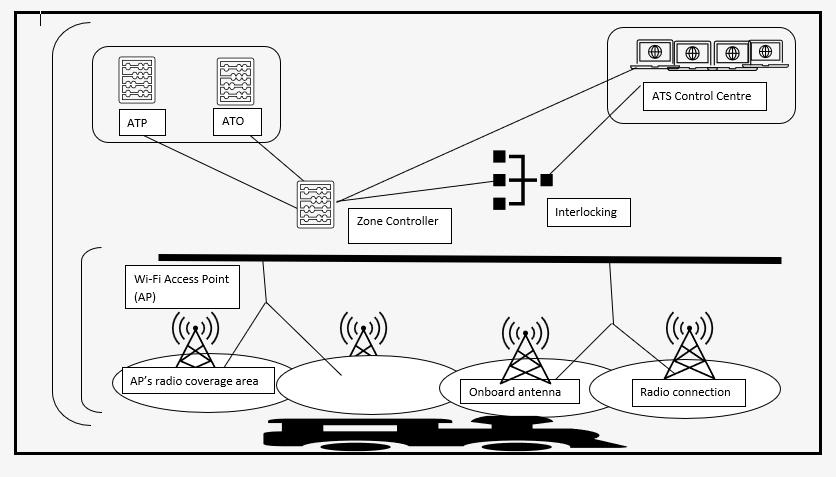
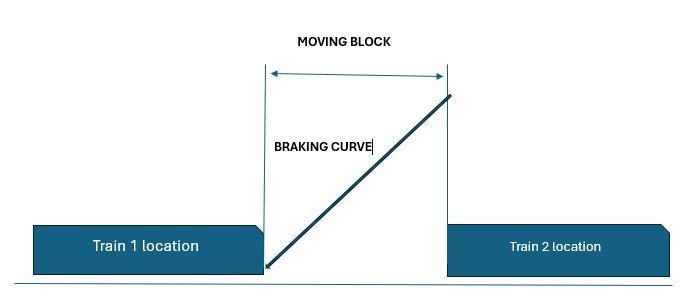
In CBTC systems, trains continuously compute and transmit their status which includes their exact positions, speedsoftrainstraveldirectionsandbrakingdistancesto the distributed along wayside equipment through radio communication. This constant exchange of information allows for precise calculation of areas occupied by trains thusdefiningsafepointsonthetrackthatmustbeavoided by other trains [11]. If each train keeps getting updated aboutthedistanceof the other,thenall trainscancontrol their speed and keep at a safe distance between them for passengers to feel safe as well as comfortable [4]. Increasingrailwaytransportationefficiencyisaboutspeed and capacity. Speed is limited but capacity can be increasedbyshorteningthe headwaybetweentrains.The two-way communication in CBTC systems allows to move froma fixed-block toa moving-block system wheretrains are separated by an absolute braking distance. But trajectory prediction which considers the leading train movementiskeytosafetyandefficiency.
Active communication in CBTC means frequent exchange between control center and trains about dynamics and characteristics. Trajectory prediction in CBTC means calculations are made with the actual leading train
International Research Journal of Engineering and Technology (IRJET) e-ISSN: 2395-0056
Volume: 11 Issue: 07 | July 2024 www.irjet.net p-ISSN: 2395-0072
movement, not as a static object. It avoids emergency brakingandissafedriving.
A dynamic headway system based on predicted trajectories is another big thing in CBTC. It uses future information to calculate safe distance between trains and updates it in real-time [1]. It also has contingency for communicationdisruption, soitcansafelyswitchtomore conservativemodewithoutsafetycompromise.
Overall,CBTCisgoodforefficiencyandsafetyofrailway.It replaces fixed block signaling with continuous real-time data transmission.Real-timemonitoringmeanstrainscan runfaster,schedulingismoreaccurateandcollisionriskis reduced.That’swhyit’skeyformodernurbanrail[3].
In short, CBTC is a big thing in signaling technology, electronic, communication and automatic control. As population grows and transportation demand increases, CBTC will be needed for safe, efficient and high-capacity railways everywhere. Research is ongoing and will bring evenmoresolutionsforfuturerailchallenges[8].
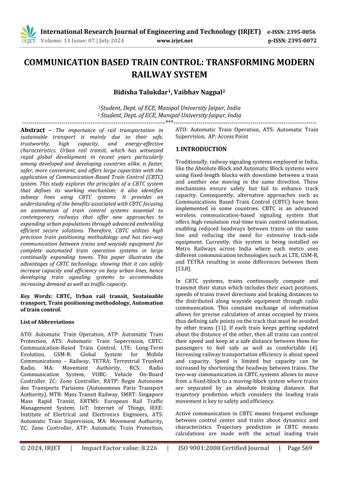
2.1 Basic Principles
CBTC is a sophisticated signaling technology meant to be used in increasing the effectiveness and safety of railbased transport. CBTC can be specified based on IEEE 1474[13]. CBTC relies on high resolution train location determination in contrast to track circuits, bidirectional datacommunicationbetweenthetrainborneandwayside
equipment in a continuous manner, as well as both train borne and wayside processors for the provision of ATP, ATO,andATSfunctions[13,15,8].
The chief concept of CBTC is that information is shared between the train and equipment on the ground in realtime.Thisrealtimecommunicationhelpsinaprecisegrip bycalculatingtheintervalsbetweentwotrainsmovingon the same track with the consideration to speed and the braking distance and hence does not require separate blocks. This variable increase in the safety margins enables the trains to be closer increasing operations efficiencywithoutcompromisingsafetythresholds[1,2].
CBTC systems consist of four major subsystems: CBTC systemsconsistoffourmajorsubsystems:
1. Automatic Train Supervision (ATS) Equipment: ATS equipment, located at central and wayside facilities, is required to recognize the trains, monitor and indicate them, perform manual/automatic route establishing, and controltheoperationstoconformwiththeschedule[2].
2. Wayside Equipment: This also entails the processorbased controllers located at central as well as at the wayside in relation to the train borne equipment’s externalinterlockingandATS.MAsettings,ATP,ATO,and ATS are also accomplished by these controllers that consist of track-bound equipment required for chief specificabsolutereferencepositioning’s[1,2].
3. Train-Borne Equipment: Including processor-based controllersandsensorsforspeedmeasurementaswellas location determination, train borne equipment communicates with train subsystems, wayside equipment and/or ATS equipment. Also, it addresses train location identification,speedandMAlimitmanagement,aswellas otherfunctionsofATPandATO[1].
4. Data Communication Equipment: Situated at the wayside, centrally as well as aboard the trains, this equipment isuseful fortwo-waydata communicationand inter-train communication which makes the exchange of informationswiftandefficient[10,13].
International Research Journal of Engineering and Technology (IRJET) e-ISSN: 2395-0056
Volume: 11 Issue: 07 | July 2024 www.irjet.net p-ISSN: 2395-0072
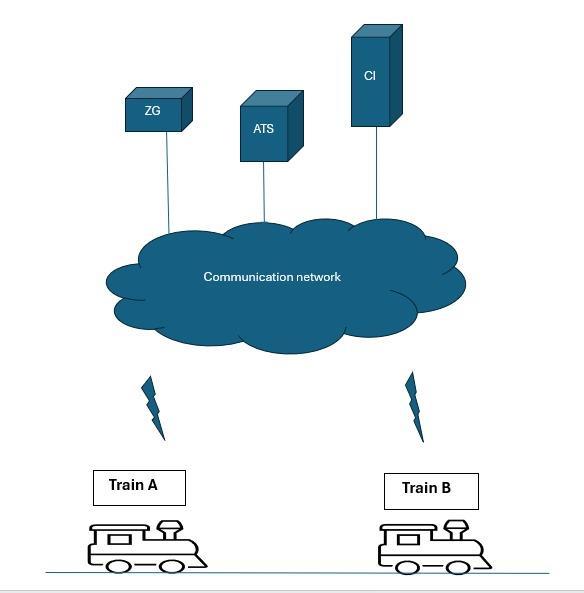
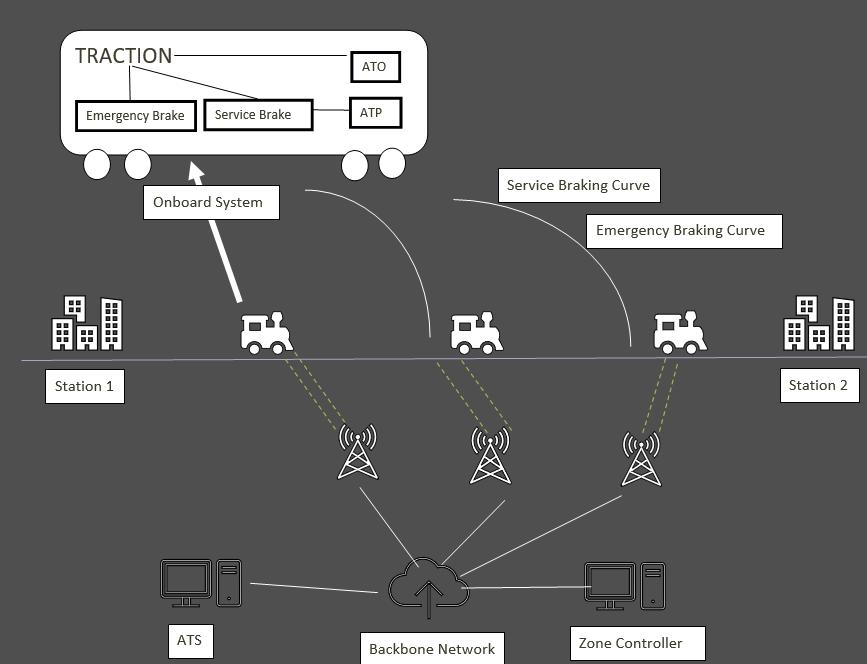
InCBTC,signalingcommunicationoftrainsaswellaswith other train borne wayside equipment is done through radio-based control facilities. The Vehicle On-Board Controller (VOBC) sends periodic control information to thewayside,cooperatesorislinkedwiththeonboardATP and ATO systems. An onboard ATP subsystem is responsible for safety issues,whereastheATOsubsystem is charged with the running of the train. The main idea of the communication is based on Radio Communication System (RCS) that consists of radios and antennas and software that provides the possibility of permanent data transfer[10,11,12,13].
Within the zone, the wayside zone controller (ZC) is responsiblefortrainseparation,calculatingthemovement authority and is further made up of necessary ATP and ATO subsystem. Train to track side interface is made throughapswhichactasinterfacepointslettingformation ofanetworkforcontinuousdatatransfer[11,12,13].
Inoperation,CBTCinvolvesseveralstages:
- real-time accurate identification of the train location withouttheuseoftrackcircuits[11,12].
-Communicationfromthetrainofthelocationandstatus ofthetraintothewaysidecontrollers[11,12].
- Transmission of MA to train-borne systems and generationofMA[10,12,13].
- Adherence to ATP profiles and the activation of MA by systemsmountedintrains.
-Communicationsbetweenwaysidecontrollersandother external interlockings concerning commands and the status of those interlockings, as well as data exchange betweensetsoftrain-bornecommunicationequipment.
Thisisa principleofCBTCtocalculatesafeseparation in realtimetoenablereducedtrainseparationandincreased capacity as it eliminates the fixed block sections and enables trains to run safely at closer distances to one another.
CBTC is considered as a key advancement in current signaling system as it utilizes continual and high-capacity communication technologies to make advancement in the railway operations with detailed train control, better safety,andthisincreasesthetrackcapacity.
3.
3.1
CBTCsystemisbuiltonaveryreliable,real-timetwo-way wirelesscommunicationtrain-to-tracksideequipmentand vice versa. This real-time data exchange forms one of the core enablers of CBTC’s high-end functionality. First, wireless networks are high capacity and low latency to establish continuous communication between the trains and the control center through accurate positioning of
Volume: 11 Issue: 07 | July 2024 www.irjet.net p-ISSN: 2395-0072
trains, updating speed and status of the trains, and controlling commands’ transmission in real time. CBTC systemsuseseveraltypesofwirelesstechnologiessuchas Wi-Fi, LTE, and future 5G interfaces [16]. The decision on the new technology to be adopted is informed by among others the bandwidth needed, the coverage needed and the general system specifications. CBTC solutions are designed to have at least one backup mode of communication, as well as provide auxiliary communication systems to guarantee conversation if primary means of signaling is compromised. It is evident thatcommunicationsystemsmustbedesignedtoaddress such factor as tunnels, urban canyons and high-speed movement of the rail. Proper design and optimization of the radio network are critical for the proper coverage of the network throughout the network. Mitigation of interferences and ways of operating with potential interference sources are some of the major aspects of implementingCBTC[13].
CBTC system incorporates a full range of Automatic Train Control functions which assist in minimizing the dependency on the drivers and improving the overall systems performance. The three main components of automatic train control in CBTC are: The three main componentsofautomatictraincontrolinCBTCare:
1. Automatic Train Protection (ATP): This safety critical consists of several functions that are vital in preventing dangerous interaction between trains, managing the train speed and ensuring that the train movements conform to the granted authorities. Key ATP functions are constant speed check and control, calculation of safe braking profile, and checking the interlocking between the routes [8,12,13,14].
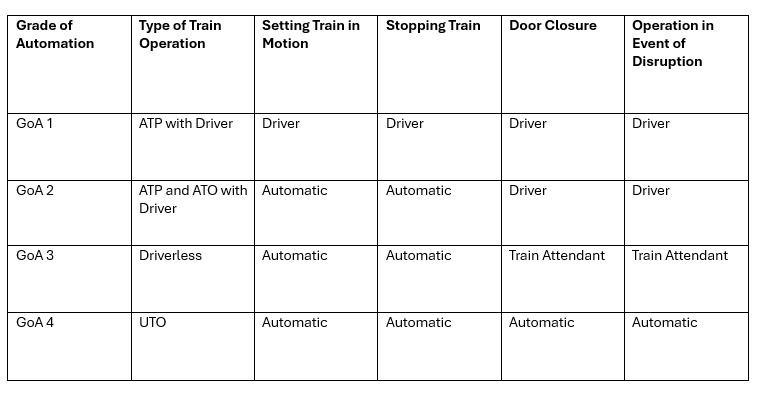
2. Automatic Train Operation (ATO): ATO deals with the real-time control of operation of a train through aspects such as acceleration and braking, stopping at ordinal platforms, opening and closing of the doors as well as energy utilization. ATO can however exist at different levels of automation ranging from level three where the vehicle is driven by the operator with some assistance to level four where the vehicle is mostly self-driven [12,13,14].
3. Automatic Train Supervision (ATS): ATS holds the overall responsibility for all rail networks and the control of operations by providing live schedule management, automatic setting of routes, traffic control, and dealing withabnormalconditionsandservices.
These three components are mutually integrated to achievethehighlevel ofautomationandtherebyincrease thetrainoperationsefficiencyandsafety[12,13,14].
Safety plays a very crucial role in rail business and so CBTC systems contain various layers of safety to help protectagainstthesepotentialfailuremodesandbusiness operational risks. It is noteworthy that CBTC systems incorporatea fail-safeconcept;that is,incase ofa failure, the immediate state is safe; decision critical functions are protected by duplication; and the integrity of the whole systemiscontinuouslychecked.
In addition to generic speed exceedance protection, CBTC-ATP provides other safety features such as rollback protection, safe door control interlocking, work area protection and level crossing protection whenever necessary. The train location and speed specifics plus the fact that it is a real-time system enables the system to compute braking distance, hence improving the safety of thewholesystem.
One of the most important issues that need specific attention and protection within the framework of CBTC operationiscybersecurity.Sincethesesystemsdependon data communication, effective and efficient cyber security measures must be put in place. Such measures include encryptingofallsafety-criticaldatawhicharetransmitted through a particular line, provisions of a safe means of authenticating the users, controlling for security intrusions and identification of such intrusions and prevention of their occurrence, and periodic security checksandupgradeofsecurityprovision[9].
CBTCsystemsarealsoimplementedwithredundancyfor partial system failings; they transition to more conventional modes of operation or switch to backup systems and comes with very organized steps and guidelines for additional manual intervention when necessary.
Itispertinenttomentionthatoneofthemainreasonsfor integratingCBTCistoimprovetheproductivityandability of the rail systems, especially in the urban areas. CBTC helps to improve the acceleration and braking curves, manage the car’s speed to consume less energy and find themosteffectivewayofcoasting.
Moving block signaling is one of the aspects of CBTC efficiencies, but it is the major one because it can quadruple the line capacity compared to the fixed block system. In moving block operation, distance between trainsisarrivedatinreal-time;thus,a traincanbecloser to the next one behind it than the train in front of the control point, meaning shorter intervals between trains andoptimumusageoftracks.Someofitsfeaturesinclude the Moving block operation as well as precise train control, that leads to a headway movement of 60-90
International Research Journal of Engineering and Technology (IRJET) e-ISSN: 2395-0056
Volume: 11 Issue: 07 | July 2024 www.irjet.net p-ISSN: 2395-0072
seconds in some systems depending on complexities hence enhance through put without having to add track structures[12,15].
CBTC also helps in achieving energy beneficial driving patterns, the synchronization of acceleration and deceleration of number of trains, and the use of regenerative energies of brakes. Often, disasters are unexpected, and due to the real-time management and adaptability of the given system, it is possible to quickly react to disruptions and, therefore, does not significantly affectthenetwork’sperformance.
CBTC systems come in as versatile with modularity and scalability where CBTC may be fitted in different environmentsofarail.Thesearethewaysidesystemsthat involve interlocking, zone controllers, onboard systems that involve train control computers, communications systemandcentral control systemthatinvolvesATS.This flexibility enables staged installations, improvements and enlargements, plus interfacing with currently installed signalingequipment.
CBTC can be implemented in metro/subway systems, lightrail &trams,commuterrail,andevensomemainline ones. The flexibility of CBTC makes it possible to be adoptedonsmallsinglelineoperationorverylargemultilineoperations,aswellasverycomplexnetworks.
The modularity of CBTC also applies to the fact that it is applicable on a train operating spectrum from trains mannedbydriverstocompletelydriverlesstrains.Suchan advantage provides rail operators with flexibility to increase degrees of automation as per the flow of operations[12,15].
The CBTC systems are equipped with a special feature knownasAutomaticTrainSupervision(ATS)thathelpsto define many instruments helping to manage the general network interchange.Development ATS systemscanhave capabilities, which change the schedule depending on the current situation, define automatically the route for the train and optimize the work in the junctions and terminals.
Advanced traffic control models include the current position of the train, schedule, passengers’ demand, and limitationsofthesystemto work efficiently.ATSpresents application tools for quick identification and deployment oftheoccurrence,theimmediateexecutiveofcontingency plans,aswellasintegrationofcrisisresponses[5,8].
Inadditiontorealtimeperformancevariables,CBTC-ATS systems are equipped with an historical data acquisition
featureaswell asbuilt-inautomaticreportingcapabilities vital in meeting instituted regulatory reporting requirementsfordata.Ahugeamountofoperational data has the potential to enhance the system performance and make well-aimed decisions about the network’s further development.
CBTC (Communications-Based Train Control) technology has several advantages over the previous train signaling technology especially with regards to the effectiveness, security and carrying capacity of the existing and future railnetworks.Thesesystemsthereforeoptimizetheuseof infrastructure through what is known as headway convergence to enhance carrying capacities within the
International Research Journal of Engineering and Technology (IRJET) e-ISSN: 2395-0056
Volume: 11 Issue: 07 | July 2024 www.irjet.net p-ISSN: 2395-0072
network. CBTC offers higher range and control which enhances the operational rail quality and brings about continuous safety in train separation and over speed in utilizationofthetracks.
Maintenance costs are lower with CBTC because these systems can run trains without drivers; thus, lowering operation costs. Also, CBTC has fewer physical components and thus, substantially requires less wayside equipment and hence their maintenance. This, added to thefactthatmodernCBTCsystemsaremuchmorereliable than two decades ago, means that CBTC systems keep track of when certain components need to be replaced or serviced, therefore allowing the CBTC system to service the needs of the signaling system and proactively fix any problems, which reduces costs and leads to less system down-time.
CBTCenhancesthecapacityofrailsystemsasitallowsfor shortheadwaythusimprovingthecarryingcapacity.CBTC systems greatly help in safety. Moreover, such measures are applied by means of ATP and ATO that mitigate the potentialhumanerror.Forexample,Marmaraystatedthat no worker lost his/her life or sustained an injury after they adopted CBTC while the company witnessed 22 accidents in 2012, which were attributed to motorist errorsundertheoldmanagementsystem[8].
Another advantage of CBTC systems is energy saving for the system users. They allow more efficient driving compared to manual interventions and employment of regenerative braking energy. This not only helps to save energy, but it also entails environmental sustainability as well.
CBTC systems are known to enhance passengers’ experience through better and variable information transmission and updates. Other facilities like announcements, doors and timetable information make traveling more comfortable and less strenuous for the passengers.
Hybrid systems also reduce the influence of human error since they incorporate automatic control reducing the chances of an accident due to a human factor. Moreover, these systems can be integrated with other modern controlsystemslikeERTMSasseeninMarmarayandthis improves the flexibility as well as functionality of the systems[9].
Inter-car and inter-train communication is always a criticalpartinCBTCsystems,asitisnecessaryforproper, seamless sharing of information between trains and control centers. This enhances the scheduling, planning, and execution that takes place in any organization, thus heightening the effectiveness of its operations. The use of securityfeatures,especiallyintheaspectoftheblockchain helps to make CBTC systems secure from hacking and
other cyber-related incidents hence keeping the rail operationssafe.
CBTC roadmap also provides the efficiency and the orderlyrunning oftrainsthus promotingorderlinessthus thesatisfactionofpassengers.Theadaptabilitytoincrease operation automation also helps to cut down on the need forhumanintervention and thusimprovesthe stability of trainservices.
Finally, CBTC is an emergency proof solution as the progress in the field of data communication and control techniques proved that it is a sound and long-term strategy for contemporary rail systems. Therefore, the sustainability is guaranteed, and the ongoing progressive enhancement of the rail transit systems can be established.
Consequently, CBTC systems are a safer, faster, more efficient, more capacity-utilizing system overall, achieving higher levels of operational performance. The successful implementation in systems like Marmaray has provided them with an attractive role to transform the present course of the urban rail transit making them effective assetsforthemodernrailnetworks.
Judging by the complexity of solving various problems when creating CBTC systems, it can be noted that the existingrailnetworksfacealotofdifficultiesinupgrading to these systems. Maniacal processes like implementation of new technologies require specialty and proper planning, which may take time and lot of effort. The scholar also stated that the initial capital cost which is needed to establish as the CBTC systems also pose challengewithrailwayoperatorsforawideracceptance.
IntegratingdifferentCBTC systemfrom differentvendors may pose some problems of compatibility which makes it necessary to standardize the CBTC system. Due to these issuesof non-interoperability,integration ofCBTC system within the existing network might be a costly affair as it mayneed more resources.Furthermore,thedaily,weekly and timely maintenance and technical support that are requiredfortheCBTCsystemstooperateasexpectedcost a lot of money and manpower from the transportation authorities.
Security threats are also another major issue with the CBTC systems by they rely on digital communication networks.Theintegrationofthesesystemsishighcoupled withthedigitalaspect;thesesystemsarepronetohacking hence requiring high-security features for defense. While putting into practice and when ensuring these security measures, there can be certain challenges that exist, and these challenges can include the trade-off between maintaining higher system security and having optimum
International Research Journal of Engineering and Technology (IRJET) e-ISSN: 2395-0056
Volume: 11 Issue: 07 | July 2024 www.irjet.net p-ISSN: 2395-0072
operational efficiency and speed of train control mechanisms[7,13].
Other issues that training entails for the operating and management of CBTC systems are also challenging since appropriatetrainingforthe personnel isneeded.Thiscan take ample time, and this depends on the number of qualified people thus can result in scarcity of skilled workforce in the rail business. While the employment of CBTC systems promises safer and efficient operations, trainingstaff on how tohandlesuchsystems isimportant andcouldbedemanding;therefore,itwouldrequireother things such as training expenditures, time, and resources to ensure that the system is run efficiently. And solving these problems is crucial to ensure the effective application and functioning of CBTC systems in today’s railwayinfrastructure[7,12].
CBTCsystemsareanimpressivestepin the development ofrailtransportthatgivessafer,moreefficient,andhigher capacitysolutionsto urban railways.CBTCintegratesreal time data communication, accurate positioning of trains, and automated operations which improves operation productivity, used track time, and overall customer satisfaction. There are some issues that are imposed by CBTC like; initial and later implementation expense, compatibility, and security concern that may be considered as negative impacts of CBTC but the positive impacts of headway, low maintenance cost, enhanced safety make it a vital technology for modern urban rail transit.Intheprogressionofthecitiesaswellastherising need for transportation, CBTC will be the key driver for futuresustainablerail.
[1] Modrzejewska,A.(2020).Automatictrainoperationin the CBTC system. Prace Naukowe - Politechnika Warszawska. Transport, 131, 99–118. https://doi.org/10.5604/01.3001.0014.9004
[2] Chang-Qian, Z. (2007). Automatic train operation and itscontrolalgorithmbased onCBTC. SciSpace-Paper. https://typeset.io/papers/automatic-train-operationand-its-control-algorithm-based-on-fiykbgmcre
[3] Bin, N., Tao, T., Min, Q. K., & Hai, G. C. (2010). CBTC (Communication Based Train Control): system and development. In Developments in heat transfer (pp. 37–44). https://doi.org/10.2495/978-1-84564-4949/05
[4] Zhu, L., Yu, F. R., & Wang, F. (2015). Introduction to communications-basedtraincontrol. SciSpace-Paper https://typeset.io/papers/introduction-tocommunications-based-train-control-5qg13s20mi
[5] Teng,L.,Guanhua,F.,Hong,Z.,Ruimin,L.,&Xianglei,G. (2019). An engine for automatic testing of a CBTC system. SciSpace - Paper. https://typeset.io/papers/an-engine-for-automatictesting-of-a-cbtc-system-3iktz970rw
[6] Katsuta,K.(2015).Costeffectiverailwaysignallingby wireless communication among onboard controllers and switch controllers. IET Intelligent Transport Systems, 9(1), 67–74. https://doi.org/10.1049/ietits.2013.0169
[7] IEEE Xplore Full-Text PDF: (n.d.). https://ieeexplore.ieee.org/iel7/6979/6910343/068 08529.pdf
[8] Yüksel, T., & Öztürk, Z. (2018). A STUDY ON COMMUNICATIONS BASED TRAIN CONTROL (CBTC) SYSTEM AND ITS BENEFITS. ResearchGate https://www.researchgate.net/publication/3345102 14_A_STUDY_ON_COMMUNICATIONS_BASED_TRAIN_ CONTROL_CBTC_SYSTEM_AND_ITS_BENEFITS
[9] Soderi,S.,Masti,D.,Hämäläinen,M.,&Iinatti,J.(2023). Cybersecurity Considerations for communication based train control. IEEE Access, 11, 92312–92321. https://doi.org/10.1109/access.2023.3309005
[10] Gao,Y.(2023).Researchontheautonomoustrain control system based on vehicle- to-vehicle communication. Applied and Computational Engineering, 6(1), 1476–1483. https://doi.org/10.54254/2755-2721/6/20230971
[11] Farooq, J., Bro, L., Karstensen, R. T., & Soler, J. (2017). A Multi-Radio, Multi-Hop Ad-Hoc radio communication network for Communications-Based Train Control (CBTC). Proceedings of the 2018 IEEE 87th Vehicular Technology Conference. https://doi.org/10.1109/vtcfall.2017.8288281
[12] Martinez, L., & Martin, U. (2020). TERMINOLOGY, DIFFERENCES, AND CHALLENGES OF COMMUNICATIONS-BASED TRAIN CONTROL AND EUROPEAN TRAIN CONTROL SYSTEMS. WIT Transactions on the Built Environment https://doi.org/10.2495/cr200021
[13] An Introductory Handbook on Communications BasedTrainControl(CBTC), GOVERNMENTOF INDIA MINISTRY OF RAILWAYS, CAMTECH/S/PROJ/2020-21/SP9/1.0February
Available:https://indianrailways.gov.in/railwayboard /uploads/directorate/eff_res/camtech/S&T%20Engin eering/YearWise/4_An%20Introductory%20Handboo k%20on%20CBTC_April%202021(1).pdf
International Research Journal of Engineering and Technology (IRJET) e-ISSN: 2395-0056
Volume: 11 Issue: 07 | July 2024 www.irjet.net p-ISSN: 2395-0072
[14] BASICS OF RAILWAY SIGNAL ENGINEERING, G.V.RAO-ITD2,2020,G.V.RAO-ITD2G.V.RAO-ITD2
Available: https://iriset.railnet.gov.in/content/ppt/sig/S1P.pdf
[15] System Master Documentation- SDS For SSC 3.1 Projects,SIEMENS,2018
© 2024, IRJET | Impact Factor value: 8.226 | ISO 9001:2008
| Page