
International Research Journal of Engineering and Technology (IRJET) e-ISSN: 2395-0056
Volume: 11 Issue: 07 | July 2024 www.irjet.net p-ISSN: 2395-0072

International Research Journal of Engineering and Technology (IRJET) e-ISSN: 2395-0056
Volume: 11 Issue: 07 | July 2024 www.irjet.net p-ISSN: 2395-0072
Pranshu Mishra1 , Mr. Pravek Sahu2
1Research Scholar, M. Tech. (Structural Engg.) 2Assistant Professor, Department of Civil Engineering, Jhada Sirha Government Engineering College, Jagdalpur Chhattisgarh India.
Abstract - The outstanding properties of concrete, such as its cost-effectiveness, strength, and moldability,accountforits widespread use in construction. Concerns over the environmental impact of cement manufacturing, however, drive ongoing research into alternatives. The production of more durable and environmentally friendly concrete, the wise use of resources, and the ensuingdecreaseinmaintenanceand life cycle costs can all lead to improved cementitious system performance. The goal of adding ultra-fine additives such as nano-silica to cementitious systems is to improve the characteristics of plastic and hardened materials. The latest advancements in nanotechnology offer promising solutions to these issues. This work explores the simultaneous application of nano-silica(NS)andnano-titaniumoxide(NTO) to enhance the mechanical properties and sustainability of concrete.
Key Words: traditional concrete, Concrete with Nanosilica and Nano-titanium oxide, Workability, Compressive, Tensile, and flexural strength.
1.INTRODUCTION:
The outstanding properties of concrete, such as its costeffectiveness, strength, and moldability, account for its widespread use in construction. Concerns over the environmentalimpactofcementmanufacturing,however, driveongoingresearchintoalternatives.Theproductionof more durable and environmentally friendly concrete, the wise use of resources, and the ensuing decrease in maintenance and life cycle costs can all lead to improved cementitioussystemperformance.Thegoalofaddingultrafineadditivessuchasnano-silicatocementitioussystemsis to improve the characteristics of plastic and hardened materials.
1.1 Nanotechnology in concrete:
Thelatestadvancementsinnanotechnologyofferpromising solutions to these issues. This work explores the simultaneous application of nano-silica (NS) and nanotitaniumoxide(NTO)toenhancethemechanicalproperties andsustainabilityofconcrete. Thepercentageofnano-silica is1%,1.5%,3%andnanotitaniumdioxideis3%2.5%and 1.0%.Followingtheexperimentalexamination,thestrength ofthemechanicalqualitiesincreasedastheamountofnano-
silica in the concrete increased, but the concrete's workabilityalsodropped.
2. AIM:
Anexperimentalstudyexamininghownano-silicaandnano titaniumoxideaffectthemechanicalandfreshpropertiesof M-35gradeconcrete.
2.1 OBJECTIVE:
Toascertaintheimpactofconcrete'sworkability toinvestigatehownanosilicaaffectsconcrete's compressiveandtensilestrength.
Research should primarily concentrate on creatinglightweight,extremelydurableconcrete thatcontainsnanosilica.
3. LITRATURE REVIEW:
G. Dhinakaran et. al. (2014) analysedthemicrostructure and strength properties of concrete with Nano SiO2. The silica was ground in the planetary ball mill till nano size reachedanditwasblendedinconcretewith5%,10%and 15% b.w.c. The experimental results showed gain in compressive strength with maximum strength for 10% replacement.
Heidari and Tavakoli (2012) investigated the combined effectofreplacementofcementbygroundceramicpowder from 10% to 40% b.w.c.andnanoSiO2 from0.5to 1%.A substantial decrease in water absorption capacity and increaseincompressivestrengthwasobservedwhen20% replacementisdonewithgroundceramicpowderwith0.5to 1%astheoptimumdoseofNanoSiO2particles
Alireza Naji Givi et.al. (2012) studied the effect of Nano SiO2particlesonwaterabsorptionofRHAblendedconcrete. Itisconcludedthatcementcouldbereplacedupto20%by RHA in presence of Nano SiO2 particle up to 2% which improvesphysicalandmechanicalpropertiesofconcrete.
4.
4.1 Nano silica and nano titanium dioxide: Wepurchased powderednano-silicafromavarietyofindustries.Here,we
International Research Journal of Engineering and Technology (IRJET) e-ISSN: 2395-0056
Volume: 11 Issue: 07 | July 2024 www.irjet.net p-ISSN: 2395-0072
study the effects of nano-silica penetration on the fresh propertiesofconcrete.Aftertestinginthelab,wefoundthat 95%oftheparticlesinnano-silicaare12nminsizeandhave aspecificgravityof2.4.NTOisavailableforpurchaseand has a particle size range of 15–30 nm. The photocatalytic qualitiesofnano-titaniumoxidearehighlyprized,asisits capacitytoimprovethecompressivestrengthandlongevity of concrete, particularly under harsh environmental circumstances. The Combined Impact of Nano-Titanium dioxide and Nano-Silica Even though there isn't much research on them together, early tests indicate that concrete's fresh and hardened qualities have significantly improved. This study attempts to close this gap by methodicallyexaminingtheircumulativeinfluence.
4.2 Cement: The concrete mix design utilizes regular, common portland cement. Following the purchase of a cementbag,anumberoftestswereperformedoncement samplestodeterminetheirquality.Thelaboratorytesting yieldedallofthecementsampleresultsaccordingtoIndian guidelines; cement samples were used for all of the tests. 3.07and8%arethespecificgravityandfinenessofcement, respectively.
4.3 Fine Aggregate: Therawcomponentsfortheconcrete mixdesignarefineaggregates,definedasaggregateswitha particle size of less than 4.75 mm. To determine the fine aggregates'quality,anumberoftestswererunontheraw sample, and every test was carried out in a lab setting in accordancewithIndianregulations.Thisresearcheffortuses zone II sand as fine aggregate. Its specific gravity, water absorption, and fineness modulus are, in that order, 2.46, 1.12,and2.587%.
4.4 Coarse aggregate: The primary component of the concrete mix is coarse particles. The 4.75 mm to 40 mm particle size range includes coarse-classified aggregates. Several tests were conducted on the raw material to determinethequalityofthecoarseaggregates,andallthe resultswerediscoveredafterthetestwascarriedoutinthe laboratory.Allthetestswereconductedinalaboratoryas perIndianstandards.Thecoarseaggregate'sspecificgravity, finenessmodulus,andwaterabsorptionare2.57,7.29and 0.79%respectively.
4.5 Water: The concrete mix is mixed using standard tap water. The water samples underwent a pH test, and the resultsshowedthatthewater'spHwas7.2.
5. MIX DESIGN STEPS FOR M-35
(A) Design Required:
1.GradeOfconcrete=M35
2.Typeofcementused=OPC-53
3.NominalSizeofaggregateused=20mm
3.Degreeofsitecontrol=Good
4.Exposurecondition=VerySevere
5.Workabilityofconcreteassumed=75mm
6.Methodofconcreteplacing=manual
7.Minimumcementcontent=340kg/m3
(B) Test result for material:
1.Specificgravityofcement=3.07
2.Specificgravityofcoarseaggregate=2.57
3.Specificgravityoffineaggregate=2.46
4.Waterabsorptionofcoarseaggregate=0.79
5.Waterabsorptionforfineaggregate=1.12
6.Conformingzoneofsand=zoneII
(C) Target mean strength = 43.25 N/mm2
(D) Selection of water cement ratio = 0.45
(E) Selection of water content = 165.579 kg/m3
(F) Cement content = 375.496 kg/m3
(G) Coarse aggregate (per m3) = 991.094 kg
(H) Fine aggregate (per m3) = 555.31 kg
5.1 Tests on concrete mixture:
Workability test:
Itispossibletomix,transport,anduseconcreteforcertain purposes. The slump test serves as the methodology for evaluatingworkability.Theslumpconeisfilledwiththree layersofnewlymixedconcrete,eachofwhichistamped25 times with a regular rod. The C:S:A ratio for conventional concreteis1:1.67:3.03,whiletheC:S:Aratiofornano-silica concreteis1.1.47:2.63.
Table-1 SlumpValuesofConventionalConcrete.
Table-2 SlumpValuesofNano-silicateconcrete S.
International Research Journal of Engineering and Technology (IRJET) e-ISSN: 2395-0056
Volume: 11 Issue: 07 | July 2024 www.irjet.net p-ISSN: 2395-0072
Addition of nano silica and nano titanium dioxide is Inclusiondecreasesworkability.
6.1 CASTING OF SPECIMEN: The specimens were cast in accordance with IS 10086-1982. The unfinished cube, cylinder,andbeamsampleswerecuredinawaterpondfora periodof28days.Atsevenandtwenty-eightdaysofage,the nanomaterialconcretewascomparedtonormalconcrete.
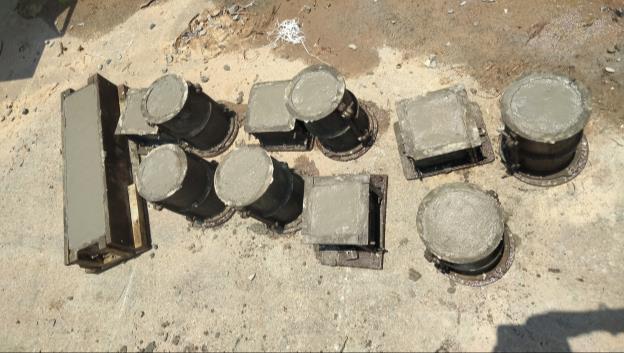
- CastingofCubes,Beam&Cylinders.
Compressive Strength test: Thesize ofthecastconcrete cube was 150 × 150 × 150 × 150 mm, and it underwent testingforoneweekandfourweeks.Pistheappliedload, andAisthecross-sectional area (150×150×1500mm); hence,theformulaforcompressivestrengthisP/��
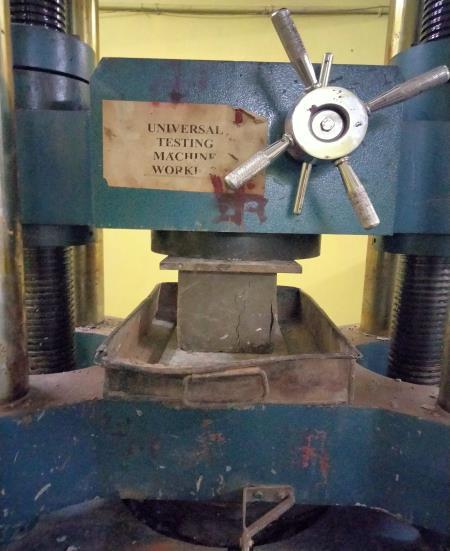
chart-1: Compressivestrengthbehaviourforconventional concreteafter7and28-daysvsnanosilicateconcrete.
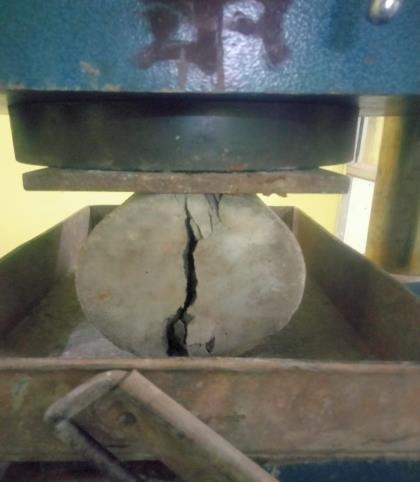
Split tensile strength: Usingcylinderswithadiameterof 150mmandaheightof300mm.Ittooksevenandtwentyeightdaystopourandtestthecylinder.Pistheload,Disthe cylinder's diameter, and L is the cylinder's length. The dividedtensilestrengthisequalto2P/πDL.
International Research Journal of Engineering and Technology (IRJET) e-ISSN: 2395-0056
Volume: 11 Issue: 07 | July 2024 www.irjet.net p-ISSN: 2395-0072
Table-4 TensileStrengthresultsforconcretespecimen:
Table-7 FlexuralStrengthresultsforconventionalconcrete:
Chart-2: Tensilestrengthbehaviourofconcreteafter7 and28-daysvsnanosilicateconcrete.
Flexural Strength test: To produce bending, a universal testingapparatusdeliversaforceof2000KNtoaspecimen of a beam of 150 x 150 x 700 mm. The maximum applied load on the specimen is recorded. We observed that the strengthoftheconcretemixhadgrownbetween7and28 days.WL/bd2isequivalenttofstrength.
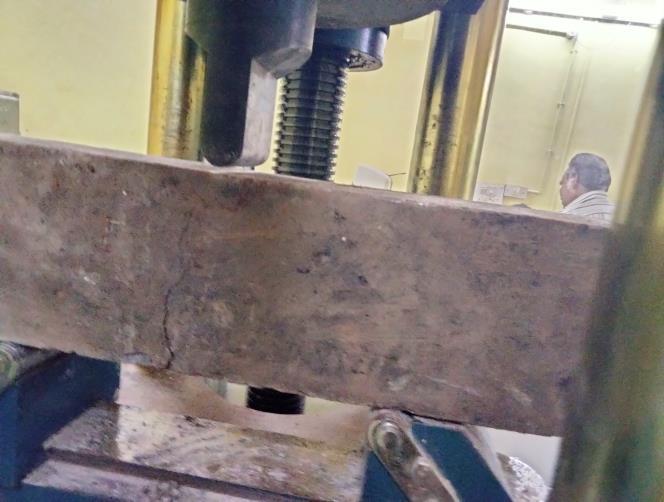
Fig-4: flexuralstrengthtestinuniversaltestingmachine.
Chart-3: Flexuralstrengthbehaviourofconventional concreteafter7and28-daysvsnanosilicateconcrete.
8. CONCLUSION:
the present study, it was concluded that the addition of different concentrations of titanium silicate nano particles enhanced some of the materialproperties
Increasedhardnessoftheconcrete
Themostoptimumenhancementis1%.
Theaforementionedresultindicatesthatachieves 1% of the mix-35's compressive, and tensile strengths.
9. SCOPE OF RESEARCH:
Evaluationofthebond,creep,shrinkage,andother engineering parameters of concrete treated with nano-silicaisnecessary.
Thecreationofconcretewithnano-silicainjection that is lightweight and incredibly durable Need shouldbetheprimarysubjectofstudy.
10. REFERENCES:
1. MayankNigam,ManvendraVerma“Effectofnanosilica on the fresh and mechanical properties of
International Research Journal of Engineering and Technology (IRJET) e-ISSN: 2395-0056
Volume: 11 Issue: 07 | July 2024 www.irjet.net p-ISSN: 2395-0072
conventional concrete” Department of Civil Engineering, GLA University, Mathura, Uttar Pradesh,India.
2. DeepikaRana,Dr.G.P.Khare,Mr.DushyantKumar Sahu,“Experimentalstudyofstrengthpropertyof concreteusingnanosilica”.
3. IS 10262:2019 Recommended Guidelines for ConcreteMixDesignBureauofIndianstandardNew Delhi.
4. BureauofIndianStandardsIS516:1959Methodsof TestsforStrengthofConcrete.
5. Indian Standard code456:2000 of practice for general structural use of plain and reinforced concrete.
6. IS383:1970Codeforfineandcoarseaggregatefor concrete.
7. ConcreteTechnology:TheoryandPracticebyM.S. Shetty
8. Haneen AlTawaiha, Fadi Alhomaidat and Tamer Eljufout“AReviewoftheEffectofNano-Silicaonthe Mechanical and Durability Properties of CementitiousComposites”.
9. Ms.S.Bharathi,Dr.A.M.Arunmohan,Dr.A.Karthik, Hariharan,ArwinExperimentalStudyonStrength ofConcreteUsingNanosilica”.
© 2024, IRJET | Impact Factor value: 8.226 | ISO 9001:2008