
International Research Journal of Engineering and Technology (IRJET) e-ISSN: 2395-0056
Volume: 11 Issue: 07 | July 2024 www.irjet.net p-ISSN: 2395-0072

International Research Journal of Engineering and Technology (IRJET) e-ISSN: 2395-0056
Volume: 11 Issue: 07 | July 2024 www.irjet.net p-ISSN: 2395-0072
Trishir Patel1, Milli Shakhla2
1M. Tech Student, L.J. University Ahmedabad
2Millie Shakhla, Assistance Professor, Civil Engineering Department, L.J. University, Ahmedabad, India
Abstract - Open floors, also known as soft floors, are a typical feature of contemporary high-rise structures in urban India. These elements are not particularly appealing in structures constructed in seismically active regions; numerous instances of intense shaking during previous earthquakes have attested to this. Open (soft) first-floor high-rise structures are nevertheless frequently built in developing nations like India, despite the fact that they are vulnerable to collapse from earthquakes. There are fewer chances to build an earthquake resistant system when there is a soft floor, either for aesthetic or business reasons. Etabs software was used to develop and analyze the plan's symmetrical flexible story structure for the current study. The structure is analyzed using both static and dynamic analytic techniques. Attached dampers are used on the structure to reduce seismic energy and boost structural integrity. Using Etabs software, the composite damper structure was modeled and assessed using the same parameters. A comparison is made between the displacement, story drift, and main shear data.
Key Words: Structures, Analysis, Seismic Response, Earthquake, Viscous Damper, Wind Analysis, Etabs, Staad Pro
1.INTRODUCTION
Inthemetropolis,parkinghasbecomean essential aspect of the majority of high-rise structures. In order to make parking easier, the building's first level is often open and wall-free. High-rise structures known as "soft-rises" contain large apertures that allow for parking or commercialspaces.Thismeansthattherearenopartition walls (RC or construction) between the first-floor columns.AccordingtoIS-1893:2016(PartI),asoftflooris defined as one that has less than 80% of the average lateralstrengthofthethreeabovelevelsorlessthan70% of the upper layer. Less than 60% of the upper layer or less than 70% of the average stiffness of the three layers abovecharacterizea verysoftlayer'slateral stiffness.Tall buildings are primarily affected by three types of loads: snow loads, dynamic loads (such as earthquakes, wind, explosions,collisions,etc.),andgravity(bothliveanddead loads). The two dead loads that most significantly influence building design are earthquake and wind loads. Depending on the time, wind loads can be separated into static and dynamic loads. Seismic loads on structures are causedbybothhorizontalandverticalearthquakemotion.
In structural members, these horizontal forces result in axial forces, bending moments, torsional moments, and shear forces. Seismic analysis is used to make sure a structurerespondsappropriatelytoseismicloads.
Anapparatusthatdistributesthekineticenergyofseismic waves passing through a building or other structure is called a seismic damper. During earthquakes, seismic dampers lessen the vibrations in buildings. Dampers improve the structure's strength and lessen its tendency to distort. Adhesive, viscoelastic, friction, vibration, tuned mass,performance,andmagneticdampersaresomeofthe seismic dampers utilized in tall buildings. Types of Dampers:
1) ViscousDampers
2) ViscoelasticDampers
3) FrictionDampers
4) TunedMassDampers
5) YieldingDampers
6) MagneticDampers
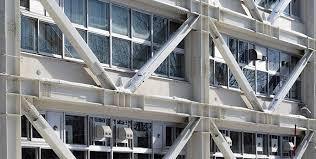
● The goal of this project is to investigate the seismic response of structures with dampers installed at various levels of soft layers since dampers are the most efficient structural system forbuildingdesign.
● Examine the impact of dampers in order to enhance soft-story structures' seismic performance.
International Research Journal of Engineering and Technology (IRJET) e-ISSN: 2395-0056
Volume: 11 Issue: 07 | July 2024 www.irjet.net p-ISSN: 2395-0072
● Comparative analysis of different seismic parameters, including layer shear, undamped, damper,andbaseshearforsolidlayers.
1.3
● Superiorityoftechnology
● Infrastructureinnovation
● Because of the quickening rate of population growth
● Growingneedforparkingandhousing
● Financialprogress
● Aestheticpreferenceincities
[1] Akshay Shaji, Amrutha Binu, Dibi Divakaran, Swaraj V, “Seismic Analysis of Soft Storey Buildings”, International Journal of Scientific & Engineering Research
Thisstudycomparestheseismicbehaviourofseveralsoftstoryframebuildingmodelsreinforcedwithstiffcolumns, shear walls, and bracing to the soft-story frame model. Response spectrum analysis is carried out using ETABS, and variables such main shear, stiffness, interaxial drift, andlayerdriftareexamined. When sheared walls are used in construction, the structure's strength is improved and displacement is decreased in comparison to reinforced concrete structures. When compared to other models, the shear wallmodel'smainshearwasfoundtobetheleast.
[2] Pravesh Gairola, Mrs. Sangeeta Dhyani, “Seismic Analysis of Open Soft Storey Building for Different Models”, International Journal of Engineering Research & Technology
This paper presents the results of an investigation of the seismic behavior under earthquake loads of various models of soft floor buildings, including bare frame, infill frame,spanframe,andshearwallframe.Incontrasttothe soft layer offered, it improves the structure's durable mobilitywhengivenadifferentmodel. Ineveryinstance,thetoplayerhadthelowestsingle-layer shear strength, whereas the first layer had the strongest. Thebareframemodelisshowntohaveahighersoliddrift. The comparison shows that the shear wall model has the highestrigidity.Thesefindingsdemonstratethattheshear wallsystemisthebestmodeloutofallofthemandoffers better retention and performance against seismic variations.
[3] Eben C. Thomas, “Seismic Response of Soft Storey Buildings with Viscoelastic Dampers”, International Journal of Engineering Research & Technology
The current study looked into how soft-story structures with VED performed seismically. ETABS software is used to do dynamic analysis while taking various time history
analyses into account. Roof acceleration, interstory drift, and upper story displacement were examined in relation to the software's output for models with and without dampers.
Building earthquake resistance can be significantly reduced with viscoelastic dampers. Compared to conventional dampers, VEDs require no maintenance and aresimpletoinstall.VEDs'primarybenefitisthattheycan absorb even minute tremors, whereas friction dampers, whichalsoactasdampers,canonlyabsorbseismicenergy uptoapredeterminedthreshold.
[4] S. uttamraj, K. Mythili, “Analysis of Soft Storey for Multi Storied Building in Zone-4”, International Journal of Research and Innovation (IJRI)
The behavior of soft floor buildings at various floor levels under the action of seismic stress and wind load is analyzedandstudiedinthisthesisanalysisofsoftfloorfor high-rise buildingsinzone 4.The finiteelementapproach isemployed.Etabssoftwarewasusedforallanalyses.For every model, base shear, layer displacement, and layer driftarecomputedandcompared.
The study's findings demonstrate that the soft floor will significantlyimpactthebuilding'sstructural behaviorand capacity to support lateral loads. Structural abnormalities affectchangesandrelativetaledrifts.
[5] S. Zubair Ahmed, K.V. Ramana, Ramancharla Pradeep Kumar, “SEISMIC RESPONSE OF RC FRAME STRUCTURE WITH SOFT STOREY”, International Journal of Research in Engineering and Technology
Three scenarios were analyzed and a model of this building, R.C.C. I) Bare model (model without walls). II) A bottom-layered open model. III) Ground level structural steel model. In ETABS, the building model is dynamically analyzed. Store drifts, lateral displacements, lateral force, layer stiffness, base shear, time period, and torque are all taken into consideration while evaluating a building's performance.
It was discovered that the exposed sub-floor's steel bracing system greatly increases the building's structural strength and lessens the displacement of its maximum story span. It was discovered that the sub-floor steel structurehadaminimalX-typetorsionaleffect.
[6] Uma Devi R, Kavitha S, Sahana S Sastry, “Seismic Performance of A RC Frame with Soft Storey Criteria”, International Journal of Research in Engineering & Technology
An attempt was made to look at the seismic behavior of multi-story buildings with soft soil floors in the current study.Soft-plyframeswereshowntobelessresilientthan infillframeswhensubjectedtoseismicloads. Becausethefirstfloorofanopenfirstfloorframeislarger than the top floor, which could lead to the collapse of the
International Research Journal of Engineering and Technology (IRJET) e-ISSN: 2395-0056
Volume: 11 Issue: 07 | July 2024 www.irjet.net p-ISSN: 2395-0072
structure, filled frames should be used instead of open firstfloorframesinseismicareas.
Three different models were considered for the analysis andtheyare:
● Model 1: Building without soft storey(Conventionalbuilding).
● Model 2: Building with ground storey as soft storey.
● Model 3: Building with ground storey as soft storeywithdampers.
For this study, a 7-storey building model with a 5 meters length for each bay, regular in plan was chosen. The buildings were assumed to be fixed at the base. The buildings were modeled using software ETABS. Models were studied by comparing storey displacement, storey drift and base shear in X and Y direction for all structural models. The dimensions and loads were selected accordingtoIS456:2000andIS875:1987codes.
Buildingparametersareasfollows:
● G+7Building
● Symmetrical
● Floortofloorheight:3m
● Softstoreyheight:4m
● Mediumstrengthsoil
● M20andFe500
● Columnsize:300mmX600mm
● Beamsize:300mmX600mm
● SeismicZoneIV
● Deadload:25KN/m2
● Liveload:2.5KN/m2
● Floorfinish:1KN/m2
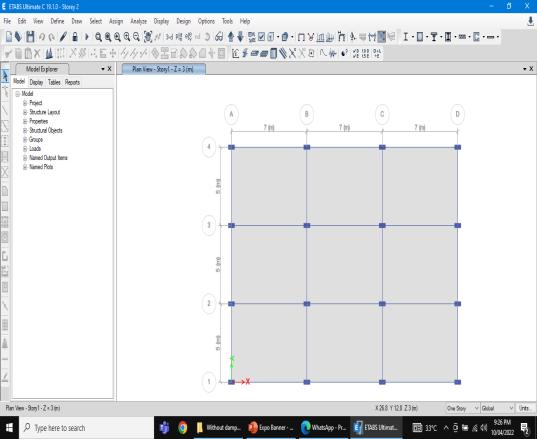
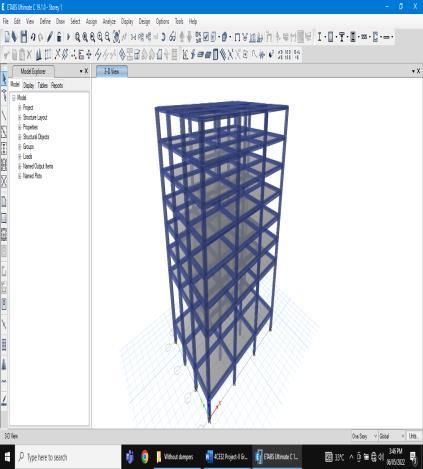
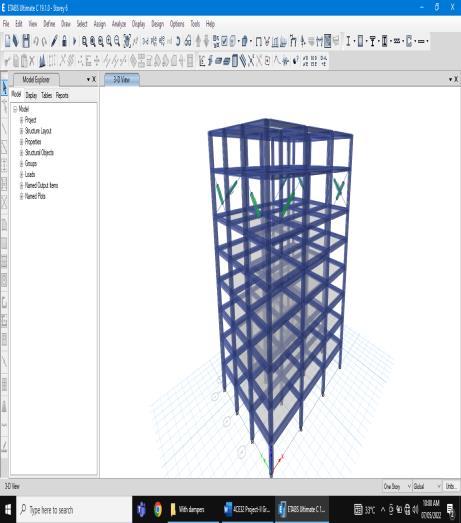
As per IS 1893: 2016 (part 1), for the purpose of determining seismic forces, India is classified into four seismic zones. The design horizontal seismic coefficient As, for a structure shall be determined by the following expression: Ah–ZISa/2Rg
(ProvidedthatforanystructurewithT≤0.1s,thevalueof AhwillnotbetakenlessthanZ/2whateverbethevalueof I/R)Where,
ZZonefactor,isfortheMaximumConsideredEarthquake (MCE) and service life of structurein a zone. The factor 2 in the denominator of Z is used so as to reduce the Maximum Considered Earthquake (MCE) zone factor to thefactorforDesignBasisEarthquake(DBE).
I-Importancefactor,dependinguponthefunctionaluseof the structures, characterized by hazardous consequences of its failure, post-earthquake functional needs, historical value,oreconomicimportance.
International Research Journal of Engineering and Technology (IRJET) e-ISSN: 2395-0056
Volume: 11 Issue: 07 | July 2024 www.irjet.net p-ISSN: 2395-0072
R-Responsereductionfactor,dependingontheperceived seismic damage performance of the structure, characterizedbyductileorbrittledeformations.However, theratio(I/R)shallnotbegreaterthan1.0.
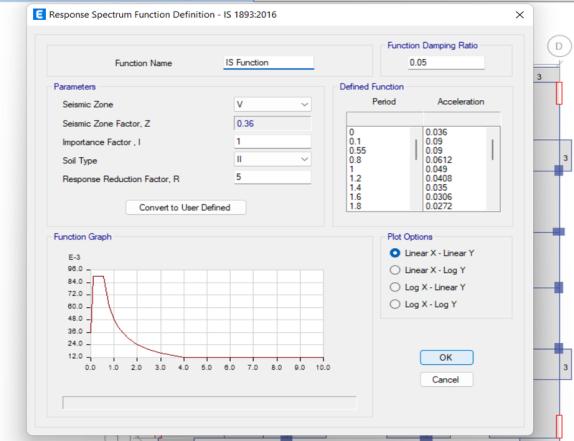
Sa/g-Averageresponseaccelerationcoefficient.Thevalue depends upon the soil type and the selected soil type is typeIImediumsoil.
Seismic parameters are considered as per IS 1893(Part1):2016
• Soiltype=II
• Seismiczones=V
• SeismicZoneFactor=0.36
• Importancefactor=1
• Responsereductionfactor:5
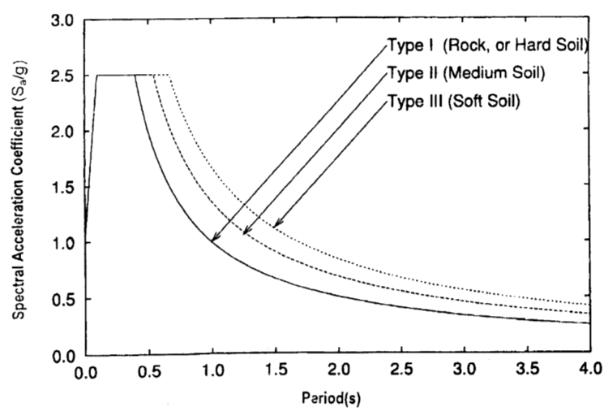
The peak response of a simple harmonic oscillator to a transienteventisdisplayedinaresponsespectrum,which is a function of frequency or period. The oscillator's damping and natural frequency determine the response spectrum.Asaresult,ratherthandirectlyrepresentingthe excitation'sfrequencycontent(asinaFouriertransform), itinsteadrepresentsthesignal'simpactona hypothetical systemwithonedegreeoffreedom(SDOF).
FVD 250 is linear with fixed end properties used for project. The Mass is 44kg and Weight is 250kN. Based on previous studies adding dampers to the exterior corner gives much more effective results, hence dampers are added at a corner. Fluid viscous dampers with different forces can be used for different types of buildings, since structuremodelledisofhighheight;smallerdeviceswere usedtostartanalysis.
Thedampingforceofviscousdamperisgivenby,
F=CVα
where,F–Thedampingforce
C-Thedampingcoefficient
V-VelocityofPiston
α–VelocityExponent
Thistabulardatacanbefedinprogramasshownbelow. ETABS MENU=> Define=> Link Properties=> Add new Link=>LinkPropertyData.
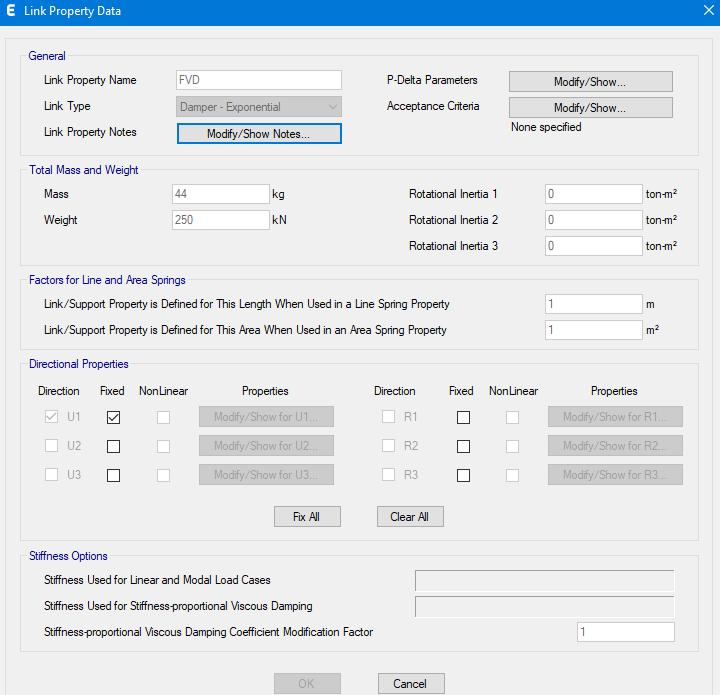
7:LinkPropertiesinEtabs
Case1:ComparisonbetweenConventional&Softstorey
Case2:ComparisonbetweenSoftStorey&Softstoreywith dampers
Analysis results and conclusion are Discussed based on followingparameters:
● StoreyDisplacement
● Storeydrift
● Storeystiffness
● Baseshear
Volume:
Displacementdeterminesthestructure'sfailurepattern;it is the parameter with the greatest significance. The displacement of the model with and without a viscous damper is observed in the current study. By adding a damper to the structure, we find that the displacement of thestructureisdecreased.
4.3 Base Shear
Baseshear isthe maximum expectedlateral forces on the structure's base that are expected as a result of seismic activity. Its mathematical value is determined by multiplying the net vertical forces at the base by a factor knownasthehorizontalseismiccoefficient,whosevalueis dependentonvariousfactorssuchastheseismiczone.
4.2
The drift is a prevalent feature in multi-story buildings as thenumberofstoriesgrowsinthestructure.Storydriftis the difference between the lateral displacements of two floors that are next to each other in a structure. The responsespectrummethod,ordynamicanalysis,isusedto model and analyze the structure. The structure's story driftvaluesarereportedforbothwindandseismicloads.
Figure12:BaseShearinXdirection
Figure13:BaseShearinYdirection
5. CONCLUSIONS
Effectsonmodelshavebeenshownintheformofgraphin successive part of results by comparing various parameters such as displacements, storey drifts and base shear. Hence from the obtained results the following conclusionsaremade,
International Research Journal of Engineering and Technology (IRJET) e-ISSN: 2395-0056
Volume: 11 Issue: 07 | July 2024 www.irjet.net p-ISSN: 2395-0072
1) Storeydriftandstoreydisplacementofsoftstorey buildingincreaseby7.8%and10.3%respectively, whencomparedtoconventionalbuilding.
2) By using viscous damper in the structure, the story drift and storey displacement at soft storey is reduced by 53.7% and 47.89% respectively whencomparedwithoutdampersmodel.
3) The displacement value at mid-story in a soft storey with Dampers model is the smallest (47.53%).
4) Storey drift is slightly increasing at a top floor becausesoftstoreyeffectattoplevelisnegligible.
5) From the comparative study it is clear that building with dampers at corner has better performancewhenseismicforcesareconsidered.
[1] Abhishek Kumar Maurya, V.K. Singh “Analysis of Building Using Viscous Dampers in Seismic”, International Journal of Advances in Mechanical and Civil Engineering, Volume-5, Issue-3, Jun.2018
[2] Akshay Shaji, Amrutha Binu, Dibi Divakaran, Swaraj V “SEISMIC ANALYSIS OF SOFT STOREY BUILDINGS”, International Journal of Scientific & Engineering Research Volume 10, Issue 5, May2019
[3] IS 875 (Part 1):1987, “Code of practice for design loads (other than earthquake) for buildings and structures”, Part 1, Dead loads, Bureau of Indian standards,NewDelhi,1989
[4] Eben.C. Thomas “SEISMIC RESPONSE OF SOFT STOREY BUILDINGS WITH VISCOELASTIC DAMPERS”, International Journal of Engineering Research&Technology,SpecialIssue2015
[5] Uma Devi R, Kavitha S, Sahana S Sastry “SEISMIC PERFORMANCE OF A RC FRAME WITH SOFT STOREY CRITERIA”, International Journal of Research in Engineering & Technology Volume 4 Issue3,March2015
[6] IS 1893 (Part 1):2002, “Criteria for earthquake resistant design of structures”, Bureau of Indian standards,NewDelhi,2002
[7] IS 875 (Part 2):1987, “Code of practice for design loads (other than earthquake) for buildings and structures”, Part 2 Live loads, Bureau of Indian standards,NewDelhi,1989
[8] IS 875 (Part 3):1987, “Code of practice for design loads (other than earthquake) for buildings and structures”, Bureau of Indian standards, New Delhi,1989
[9] S. uttamraj, K. Mythili “ANALYSIS OF SOFT STOREY FOR MULTI STORYED BUILDING IN ZONE-4”, International Journal of Research and Innovation (IJRI), Volume 1 Issue 1, September 2014