
International Research Journal of Engineering and Technology (IRJET) e-ISSN: 2395-0056
Volume: 11 Issue: 07 | July 2024 www.irjet.net p-ISSN: 2395-0072

International Research Journal of Engineering and Technology (IRJET) e-ISSN: 2395-0056
Volume: 11 Issue: 07 | July 2024 www.irjet.net p-ISSN: 2395-0072
Zalak Chavda1, Stephy Patel2
1Student, Dept. of Computer Engineering (Software Engineering), Lok Jagruti Kendra University, Ahmedabad, Gujarat, India
2Professor, Dept. of Computer Engineering, Lok Jagruti Kendra University, Ahmedabad, Gujarat, India
Abstract - In biometric authentication systems, verifying signatures is an essential task. In this paper, a Siamese Convolutional Neural Network (CNN) approach to signature verification on the CEDAR dataset is presented. The sigmoid function is used for classification, and Euclidean distance is used to measure similarity in the Siamese network. CNN layers make use of ReLU activation functions. The contrastive loss function and accuracy score are used to evaluate the model after the dataset has been divided into training and testing sets. Our test findings show how well the suggested approach works, obtaining a high degree of accuracy when separating real signatures from fakes.
Key Words: Signature Verification, Convolutional Neural Network, Siamese Network, CEDAR Dataset, Euclidean Distance, Sigmoid Function, ReLU Activation
1.INTRODUCTION
Formanyapplications,includingbanking,legaldocuments, and access control, signature verification is essential to identityauthentication.Theaccuracyandrobustnessneeded for real-world applications are frequently lacking from traditional methods that rely on handcrafted features. ConvolutionalNeuralNetworks(CNNs)havedemonstrated impressive gains in image recognition tasks, such as signature verification, since the introduction of deep learning.TheapplicationofaSiameseCNNarchitecturefor signatureverificationissuggestedbythisstudy.TheSiamese network, which is intended to learn similarity metrics between input pairs, is made up of two identical subnetworksthatshareweights.Trainingandassessmentare conducted using the CEDAR dataset, a benchmark for signature verification. The sigmoid function is utilized to classify the data, and the Euclidean distance is used to measure the similarity between feature vectors. NonlinearityisintroducedwithintheCNNlayersthroughtheuse ofReLUactivationfunctions.
Traditionalmachinelearningalgorithmsandtheextraction of handcrafted features were the main strategies used in early approaches to signature verification. Recent developments in deep learning have shown how effective
CNNs are at tasks involving feature extraction and classification. Particularly Siamese networks have drawn interestbecauseoftheircapacitytolearnsimilaritymetrics, whichmakesthemappropriatefortasksinvolvingpairwise comparisonslikesignatureverification.
3.1
This study uses the CEDAR dataset, which includes multiplepeople'ssignaturesthatarebothrealandfaked.The datasetisdividedintotestingandtrainingsetstoallowfora thoroughassessmentofthemodel'sperformanceonuntested data.
The signature images must be resized to a fixed dimension, grayscaled, and have their pixel values normalized as part of the preprocessing steps. By standardizing the input data, these procedures increase trainingprocessefficiencyandboostmodelperformance.The preprocessing function divides pixel values by 245 to normalizeimagesandresizesthemtoafixedsizeof220x155 pixels.[4][2]
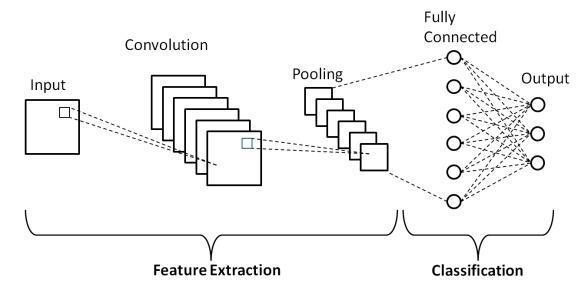
Aninstanceofadeeplearningsystemcreatedespecially for handling structured grid data, like pictures, is the convolutional neural network (CNN). Here are the main elementsandcharacteristics:
Convolutional Layers: In order to create feature maps, theselayersapplyanumberoffilters,alsoknownaskernels, totheinputpicture.Specificpatterns,suchasedges,textures, ormoreintricatestructures,aredetectedbyeachfilter
Activation Functions: Rectified Linear Unit (ReLU) activationfunctionsareusedtointroducenon-linearityafter convolutionaloperations,whichaidsinthenetwork'sability tolearnmoreintricatepatterns.
PoolingLayers:Theselayersusemethodssuchasaverage or max pooling to minimize the spatial dimensions of the
International Research Journal of Engineering and Technology (IRJET) e-ISSN: 2395-0056
Volume: 11 Issue: 07 | July 2024 www.irjet.net p-ISSN: 2395-0072
feature maps. By doing this, the computational effort is lessenedandtherepresentationsbecomeinvarianttoslight inputtranslations.
FullyConnectedLayers:Thefullyconnectedlayersina network do high-level reasoning following a number of convolutionalandpoolinglayers.Theselayerscreatethefinal output,suchclassscoresinaclassificationchallenge,using theflattenedfeaturemaps.
Training: Labeled data is used to train CNNs. Using gradient descent and backpropagation techniques, the weightsofthefiltersandneuronsareadjustedthroughout the training phase to reduce the discrepancy between the expectedandactualoutputs.
CNNsareincrediblyefficientinawiderangeofcomputer vision tasks, such assegmentation, object recognition,and pictureclassification.Thisisbecausetheycanautomatically andadaptivelyidentifyspatialfeaturehierarchiesfrominput images.[1][5]
3.4 Siamese Network Architecture
TwoidenticalCNNsmakeuptheSiamesenetwork,and they each process one of the input signature images. Convolutional, pooling, and fully connected layers are components of every CNN's architecture. To add nonlinearity,theconvolutionallayersuseReLU(RectifiedLinear Unit)activationfunctions.[6][8]
Thelayoutofthearchitectureisasfollows:
1. ConvolutionalLayer1:96filters,11x11kernelsize, ReLUactivation
2. BatchNormalization
3. Max Pooling Layer 1: 3x3 pool size, strides of 2, padding='same'
4. Convolutional Layer 2: 256 filters, 5x5 kernel size, ReLUactivation
5. BatchNormalization
6. Max Pooling Layer 2: 3x3 pool size, strides of 2, padding='same'
7. DropoutLayer1:0.3dropoutrate
8. Convolutional Layer 3: 384 filters, 3x3 kernel size, ReLUactivation,padding='same'
9. Convolutional Layer 4: 256 filters, 3x3 kernel size, ReLUactivation
10. Max Pooling Layer 3: 3x3 pool size, strides of 2, padding='same'
11. FlattenLayer
12. FullyConnectedLayer1:1024units,ReLUactivation, L2regularization
13. DropoutLayer2:0.3dropoutrate
14. FullyConnectedLayer2:128units,ReLUactivation, L2regularization
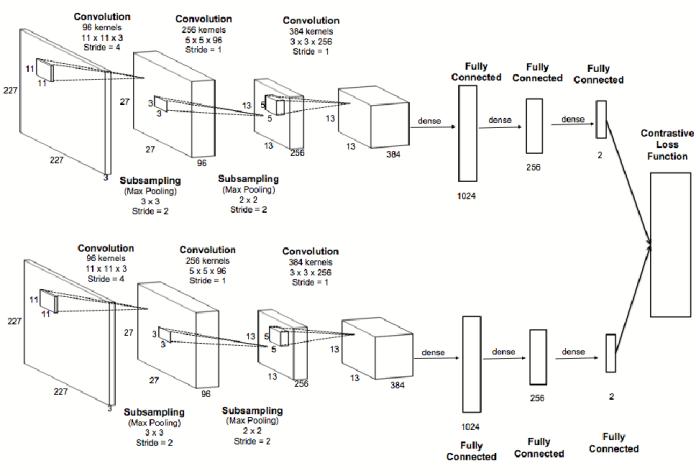
Thesimilaritybetweenthefeaturevectorsproducedby thetwinnetworksiscalculatedusingtheEuclideandistance TheEuclideandistance d betweentwofeaturevectors f1and f2 iscomputedas:
d(f1,f2)=∑i=1n(f1,i−f2,i)2
3.6 Classification
TheEuclideandistanceismultipliedbyasigmoidfunction togenerateaprobabilityscorethatindicateswhetherornot the two input signatures belong to the same person. The sigmoidfunction��(��)σ(x)isdefinedas:[7]
σ(x)=1+e x1
International Research Journal of Engineering and Technology (IRJET) e-ISSN: 2395-0056
Volume: 11 Issue: 07 | July 2024 www.irjet.net p-ISSN: 2395-0072
Theoutputprobabilityisthresholdedtomakethefinal binaryclassification.
3.7 Loss Function
A contrastiveloss functionis used totrain the Siamese network.Itisdefinedas:
L(y,d)=(1 y)21d2+y21(max(0,m d))2
where ��y is the binary label (0 for genuine pairs, 1 for forgedpairs)and��m isamarginparameter[3]
3.8 Data preparation
Therearetrainingandtestingsetswithinthedataset.The testing set is used for assessment, and the training set consistsofpairsofrealandfakesignatures.
3.9 Training the Model
Fromthetrainingset,pairsofrealandfakesignaturesare usedtotraintheSiamesenetwork
3.10 Evaluation
Metricsincludingaccuracy,precision,recall,andF1-score areusedtoassessthemodel'sperformance
4. EXPERIMENTAL SETUP
4.1 Training and Testing Split
The training and testing sets of the CEDAR dataset are split80:20.Modelparametersareoptimizedonthetraining set, and the model's performance on untested data is assessedonthetestingset.
4.2 Training
Fromthetrainingset,pairsofrealandfakesignaturesare usedtotraintheSiamesenetwork.Alearningrateof0.0001 is applied when using the Adam optimizer. Over several epochs,thecontrastivelossfunctionmustbeminimizedas partofthetrainingprocess.
4.3 Evaluation
Accuracy,precision,recall,andF1-scoremetricsareused to assess the model's performance.The accuracy score is calculatedas:
Accuracy=Total Number of Predictions/Number of CorrectPredictions
5.1
Afterafewepochs,theSiamesenetworkconvergesand thelossfunctiongraduallydrops.Themodelexhibitsstrong learningbehaviorandcandistinguishbetweenrealandfake signatureswithaccuracy.
5.2
The robustness and generalizability of the model are demonstrated by its high accuracy on the testing set. The model'sperformancemetricsareshowninTable1
Table -1: PerformanceMetrics
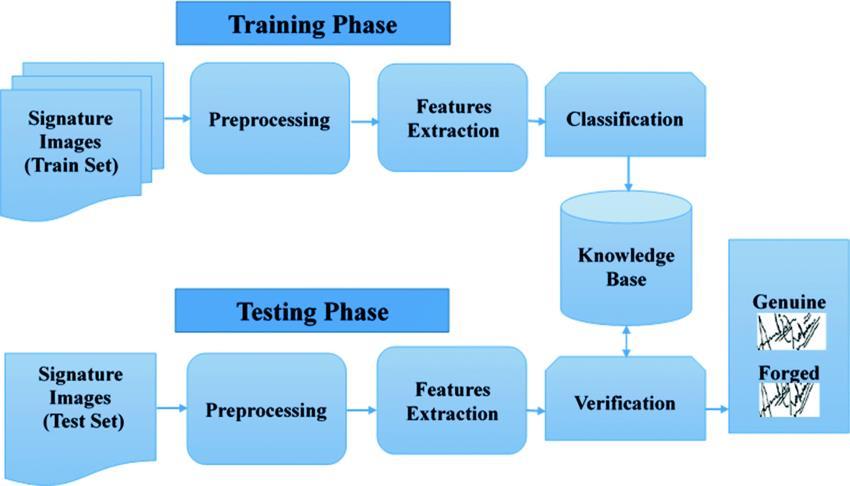
Fig -3:Stepsofsignatureverificationsystem
5.3 Discussion
ReLUactivationfunctionsareusedintheCNNlayersto aidin themodel's efficient learning ofcomplexfeatures.A trustworthysimilaritymetricandclassificationmethodare offered by the sigmoid function and Euclidean distance, respectively. The SiameseCNN architectureis effectivefor signature verification, as evidenced by the high accuracy score
6. PROPOSED
Importthecedardatasetsandrequiredlibrariestoinitialize the process. Resize images as necessary and display them using the imshow() method from the matplotlib. pyplot
International Research Journal of Engineering and Technology (IRJET) e-ISSN: 2395-0056
Volume: 11 Issue: 07 | July 2024 www.irjet.net p-ISSN: 2395-0072
module.UtilizetheEuclideandistancemetrictocalculatethe similarity score between any two feature sets based on extractedfeatures.Computethecontrastivelossbetweenthe true labels and predicted labels. When input pairs are labeled as similar, the Siamese network brings the output featurevectorsclosertogether;whenlabeledasdifferent,it pushesthefeaturevectorsapart.EachbranchoftheSiamese network functions to embed the input image into a space wheregenuinesignaturesofaspecificwriterarecloserto eachothercomparedtoforgeriesorsignaturesofdifferent writers. This is facilitated by the chosen contrastive loss function, which is commonly used in Siamese networks. EmployaCNNarchitecturefortheimageidentificationtask. TheparametersfortheCNNlayers,includingfiltersizesfor convolutionandpoolinglayers,areprovidedas N x H x W (where N isthenumberoffilters, H istheheight,and W is the width). Padding is necessary to convolve the filter startingattheinputimage'sfirstpixel.RectifiedLinearUnits (ReLU) are used as the activation function for all convolutionalandfullyconnectedlayeroutputsacrossthe network.Batchnormalizationisimplementedtogeneralize thelearnedfeatures.Dropoutisappliedwitharateof0.3for the final two pooling layers and 0.5 for the first fully connected layer. The output of the second convolutional layer(normalized,pooled,andwithdropout)isconnectedto 3843x3kernelsinthethirdlayer.Thefourthconvolutional layer contains 256 3x3 kernels. Consequently, the neural networklearnshigher-levelormoreabstractfeatureswith largerreceptivefieldsandfewerlower-levelfeatures.The firstfullyconnectedlayercomprises1024neurons,andthe second fully connected layer comprises 128 neurons .The Sigmoid activation function is used in the output layer to produceafinaloutputrangingbetween0and1,indicating thedegreeofsignaturematch.Thenetworkistrainedusing a normalized feature vector. A test signature is deemed authenticiftheoutputneuronproducesavaluecloseto+1 and forged if the output is close to -1. The CNN model is trainedoversomeepochs.Followingtrainingandvalidation, themodelachieved98%accuracyonthetests.
This paper uses the CEDAR dataset to present a Siamese CNN-basedmethodforverifyingsignatures.Becauseofthe model's high accuracy and resilience, biometric authentication systems in the real world can use it. The application of this method to other biometric verification tasksandtheintegrationofextrafeaturescanbeexploredin futurework.
[1] Prakash Ratna Prajapati, Samiksha Poudel, Madan Baduwal, Subritt Burlakoti, Sanjeeb Prasad Panday "Signature Verification using Convolutional Neural Network and Autoencoder" Journal of the institute of engineering2021Volume16,No.11810-3383
[2] Eman Alajrami, Belal A. M. Ashqar, Bassem S. AbuNasser, Ahmed J. Khalil, Musleh M. Musleh, Alaa M. Barhoom, Samy S. Abu-Naser "Handwritten Signature Verification using Deep Learning" IJEAIS 2019 Vol. 3 2643-9670
[3] FadiMohammadAlsuhimat, FatmaSusilawatiMohamad "Offline signature verification using long short-term memoryandhistogramorientationgradient"BEEI2022 Vol.12No.12302-9285
[4] WijdanYassenA.AlKarem,EmanThabetKhalid,Khawla. H.Ali"HandwrittenSignatureVerificationMethodUsing ConvolutionalNeuralNetwork"IJEEE202310.37917
[5] H. Kaur and M. Kumar, “Signature identification and verificationtechniques:state-of-the-artwork,”Journal ofAmbientIntelligenceandHumanizedComputing,vol. 14,no.2,pp.1027–1045,2023.
[6] Muhammad Fawwaz Mayda, Aina Musdholifah "Siamese-Network Based Signature Verification using SelfSupervisedLearning"IJCCS2023
[7] T.M.Ghanim,M.I.Khalil,andH.M.Abbas,“Comparative studyondeepconvolutionneuralnetworksdcnnbased offlinearabichandwritingrecognition,”IEEEAccess,vol. 8,pp.95465–95482,2020.
[8] Li, Y.; Xu, D.; Huang, L.; Yang, X.; Gong, Y. Offline Signature Verification Using a Two-Stream Network. IEEEAccess,10,2022,42136-42147.