
International Research Journal of Engineering and Technology (IRJET) e-ISSN:2395-0056
Volume: 11 Issue: 07 | July 2024 www.irjet.net p-ISSN:2395-0072

International Research Journal of Engineering and Technology (IRJET) e-ISSN:2395-0056
Volume: 11 Issue: 07 | July 2024 www.irjet.net p-ISSN:2395-0072
1M.Tech. Student, Dept. of Mining Engineering, CTAE, MPUAT, Udaipur, Rajasthan, India
2Professor, Dept. of Mining Engineering, CTAE, MPUAT, Udaipur, Rajasthan, India
Abstract - The marble extraction process is associated with environmental issues like change in landscape, noise pollution, change in ground water, air pollution, marble slurry can cause land degradation etc. With the ever increasing focus on environment, the mining industry needs to adapt to sustainable mining for better growth and economic development. Marble is mined in Rajsamand (Rajnagar region) by conventional method i.e by wedges with feathers, semi-mechanised method and mechanised method. Morwad, Dharmeta, Arna, Nijharna, Jhanjar are the marble varieties mined in Rajsamand. The sustainability of marble mining operations at Rajsamand, the most productive marble mining area in world has been analysed. A total of 5 different varieties of marble mines were selected and Analytical Hierarchy Process (AHP) is adopted on the basis of key factors of sustainability (technical, economical, safety, social, ecological and rock condition) for selecting the most sustainable mining method. The research demonstrated that conventional mining is least sustainable, resulting in more waste, cracks, irregularly shaped blocks, high working faces, back breaks, rock falls, and accidents. It was concluded and advised that conventional mining methods should be replaced with more sustainable mining methods, namely semi-mechanized mining at the Dharmeta and Jhanjhar marble deposits and mechanised mining at the Morwad, Arna, and Nijharna marble deposits.
Key Words: Sustainability, Marble, Analytical hierarchy process, Varieties, Key factors
1.INTRODUCTION
Mining is the process of extracting valuable minerals from the earth's crust. It is a metamorphosed limestone created by re-crystallisation under temperature conditions aswellas regionalmetamorphism, according to the geological definition. A sedimentary carbonate rock called marble is created when limestone or dolomite undergoes metamorphism. White is the colour of the most pure calcite (CaCO3) marble. Marble that contains hematite (Fe2O3) is reddish in colour, while marble that contains limonite (FeO (OH) nH2O) is yellow. Marble's green hue is caused by the presence of serpentine(Mg,Fe)3Si2O5(OH).4
When it comes to marble reserves, both in terms of qualityandquantity,Rajasthanisthericheststateinthe nation.Rajasthanhassignificantreservesofhigh-quality marble, estimated at 1231 million tonnes (M.T.). Udaipur-Rajsamand, Makrana-Kishangarh, and Banswara-DungarpuraresomeofRajasthan’simportant marble-occurrenceregions.
The largest marble deposits in India is made up by Rajnagar marble occurring around Rajnagar and Kelwa townsinRajsamandquarterofsouth-centralRajasthan. Rajsamand marble belongs to late Paleoproterozoic Aravali Supergroup. It is substantially white, coarsegranulated and compact dolomitic marble. Mining is presently being carried out as several, small to medium sized, open sites using conventional and mechanised operations.
The ecology suffers during the extraction of a natural stone.Thechangeinthelandscapeis probably themost noticeable effect. Quarrying can potentially ruin or displaceplantoranimalhabitats.Evenifhabitatsarenot entirely destroyed, quarrying's general environmental disturbance, such as noise pollution, changes to ground orsurfacewater,andgroundvibrations,canstillhavean impact on biodiversity by impairing species' reproductive cycles and causing habitats to dry out or flood.Marbledust, whichis producedduringthemining process,canharmsoil quality,pollutetheair,whichcan have an impact on plant physiology, and taint water sources, making them unfit for human consumption or agriculturaluse.
In the study "Our Common Future," Brundtland (1987), defined sustainability as the process of meeting existing demands without compromising the capacity of future generations to satisfy their own needs. Enhancing research and development for sustainable manufacturing has become crucial for the industrial sectorduringthepastthreedecades.
The Analytic Hierarchy Process (AHP) is a system that combines math and psychology to organise and analyse complicated decisions. It consists of three parts: the primary objective or issue you're attempting to resolve, all potential answers, or alternatives, and the standards by which you'll evaluate the options. By putting the
decision'scriteriaandpotentialoutcomesintonumerical form and connecting them to the main objective, AHP offers a logical framework for making necessary decision.
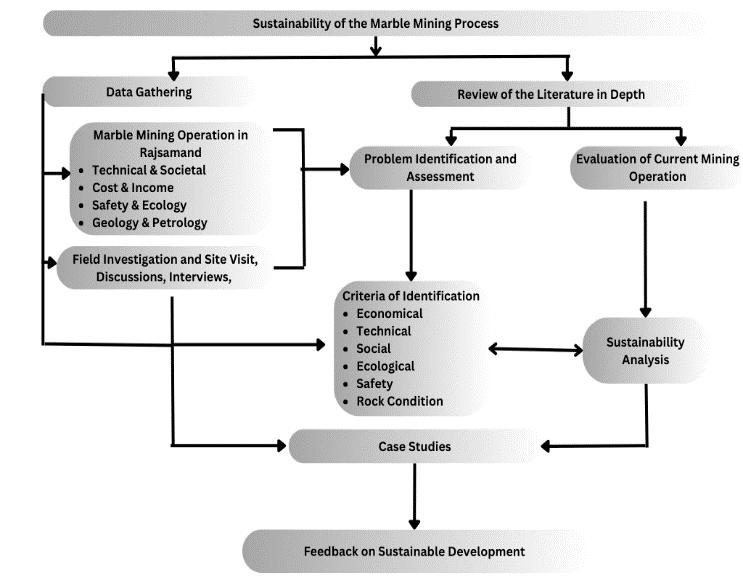
The research methodology is presented in Fig. 1. The marbleareaofRajsamandwasselectedforassessingthe sustainability of ongoing mining operations. InRajnagar (Rajsamand),over50marblequarrieswereinspectedin order to evaluate the viability of existing mining operations. Both the many types of marble found in Rajsamandandthevariedtechniquesusedtominethem were identified. Field visits, site investigations, and group discussions with various stakeholder groups, including lease holders, mining engineers, and supervisors working at various marble quarries in Rajsamand, were used to gather production data, accident records, geological information, meteorological information, lease data, and other information. The sustainability parameters were identified based on the data gathered, and from these the most important parameters for the study were further chosen. These parameters include economic aspects, technical elements,socialfactors,ecologicalfactors,safetyfactors, and rock conditions. On the basis of the data collected, sustainabilityofmarbleoperationwaspursuedfurther.
AHPisatoolforsupportingmulti-criteriadecisions.Itis typically employed to choose the finest alternative. Six criteria and three options were chosen (Tables 1.1 and 1.2). Using a ranking matrix shown in Table 1.3and to analyse each criterion's value in relation to others, importance rankings are assigned based on the criteria. AsshowninTable1.4,prioritiesaredeterminedforeach element in the hierarchy, and a normalised matrix is constructedafterpair-wisepreferencecomparison.
Table-1: Detail of alternative
Table-2: Detail of criteria
Figure 2 shows the hierarchical structure of AHP for choosing the best sustainable marble mining technique. Thestepsperformedareasfollows:
1. Identification of the important economical, technical, social, ecological, safety and rock condition sustainability aspects for marble mining operation in Rajnagar(Rajsamand).
2. AHP was used to analyse the main sustainability factors.
3. Three mining methods that are employed in operationstominedimensionstoneareidentified.
4. Decomposetheissueintohierarchy.
5. Quantificationofimportantsustainabilityelementsby comparingtheirimportancetootherones. International Research Journal of Engineering
International Research Journal of Engineering and Technology (IRJET) e-ISSN:2395-0056 Volume: 11 Issue: 07 | July 2024 www.irjet.net
Table-3: Fundamental scale of AHP, (Saaty 1980)
1 Equallypreferred Twoactivitiescontributeequallytotheobjective 3 Moderately Experienceandjudgementslightlyfavouroneactivityoveranother 5 Strongly Experienceandjudgementstronglyoressentiallyfavouroneactivityover another 7 Verystrongly Anactivityisstronglyfavouredoveranotheranditsdominancedemonstratedin practice
9 Extremely Theevidencefavouringoneactivityoveranotherisofthehighestdegree possibleforaffirmation
2,4,6,8, Intermediate values Usedtorepresentacompromisebetweenpreferenceslistedabove
Table-4: AHPs Pairwise preference comparison and normalised matrix I CriteriaScores(PairwisePreference Comparison)
International Research Journal of Engineering and Technology (IRJET) e-ISSN:2395-0056
Volume: 11 Issue: 07 | July 2024 www.irjet.net p-ISSN:2395-0072
6. Utilising the gathered data to create a pair-wise comparison matrix of the sustainability factor based onjudgementvalues.
7. Creatinganormalisedmatrixbydividingeachcolumn element'svaluebythetotalofthatcolumninthepairwise comparison matrix that was formed in the previousstep.
8. Using the normalised matrix and averaging each elementofeachrowtocreatetheprioritymatrix.
9. Do a consistency ratio (CR) calculation.In comparison to judgements made only at random, this is used to gaugeandexaminetheconsistencyofjudgements.
10.Quantification of options by comparing relative weightstootheroptionsforeachfactor(criteria).For each alternative MMM, SMM, and CMM with respect to each factor,thesteps fromsteps 5th to8th are repeated. Five matrices of order 3x3 are as a consequenceobtained.
11.Figuring out the proportional importance of each choice in relation to each criterion. figuring out how desirableeachalternativeis.
12.Finding the most sustainable mining technique is the last phase. Calculated by multiplying the priority matrix of elements by the relative weights of the alternatives'factors(Gupta,Jayal,andJawahir2010).
There are numerous types of marble to be found throughout Rajsamand, but especially in Rajnagar. Data was gathered for this project from Rajnagar's marble deposits. As case studies, five distinct marble deposits werechosen.Theseconsistof:
2.2.1 Morwad Marble - Rk Marble
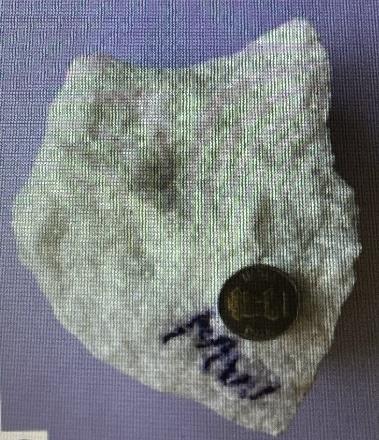
In the Rajasthani Rajsamand district of Piplantri, this mine first opened its doors in 1993. It is the biggest open-air white marble mine in the world and has historically produced the most marble. It accounts for around 15% of the nation's total marble production on its own. 10.6 MT of ore have been extracted from the mine thus far. Under shallow marine circumstances, an intricately folded and metamorphosed assemblage formed, primarily made of argillaceous and calcareous facies of rock. This has an off-white, crystalline quality withfinegrainsandagreycolourstripeasshowninFig 3.2.Thequartzinthemarbleissmoky.
2.2.2
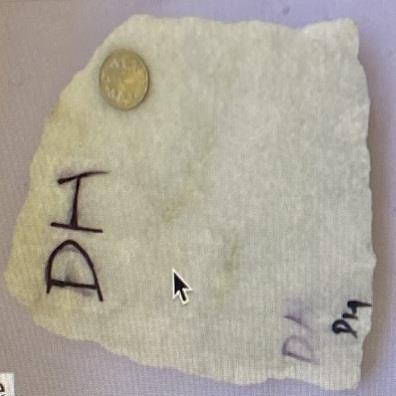
Dharmeta Marble is a white marble with a light grey or green colour or pattern as shown in above Fig 3.3. It is amazing with its unique design pattern and colour dots.Dharmetaisdistinguishedbypatchesofyellowand green. Dolomite and calcite are minerals found in thisvariety, along with trace amounts of amphibole, quartz, and opaque minerals. The green specks on the stonecanbeseenmoreclearlybymistingitwithwater.
2.2.3
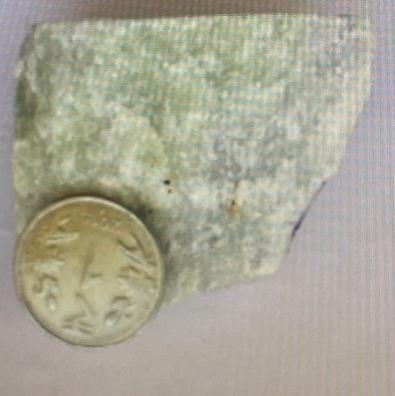
The Arna variety has sporadic green patches and is coarse to medium-grained as shown in above Fig. 3.4. Calcite, dolomite, and amphibole are all present in the Arna variety. It is the type of marble where it is easy to
Volume: 11 Issue: 07 | July 2024 www.irjet.net
findcomparablepatternsinlargequantities.Thistypeof crystal is fine and has a rough, glazy surface.Because of howclosely thedesignofarna marble resembles thatof makrana dungri marble, it is often referred to as semidungrimarble.
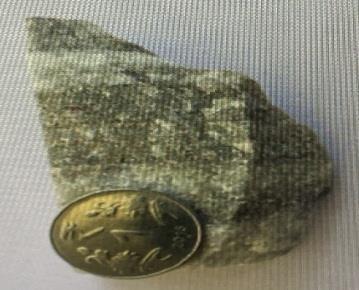
White Indian marble stone known as "Nijharna white marble" has distinctive brownswirl patterndecorations all over it. One of the well-known white foundation marbles with brown strikes and a brown colour tone is Nijharna White Marble as shown in above Fig. 3.5. Nijharna is a foliated, fine- to medium-grained marble withalight-todark-browncentimetre-scaleband.Itisa siliceous and biotite-partitioned type with medium to coarsegrainsize.
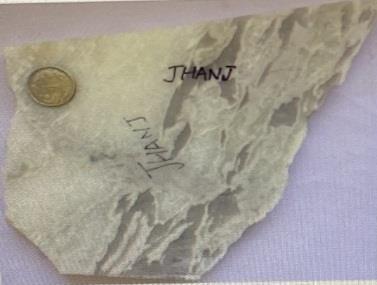
TheAravalisupergroupiswherethemarbleresourcesin Jhanjararefound.Dolomitic marbleis foundinthelocal marble resources. Off-white, medium-grained, and crystalline, with greyish or greenish colour lines as showninFig.3.6above.Thelayersofthemarblecontain schist. Jhanjar has discontinuous, light grey, whitish, medium-to-coarse-grained grains. Medium- to coarsegrainedblack,hazypatchesofsilicaarepresent.
Thesignificanceofsustainabilitycriteriaforeachmining alternative was calculated for the five case studies, and thefindingsareshowninTable4.1.Thecriteriawiththe highest influence and attractiveness value are also highlightedinTable4.1.Thetotalsustainabilityanalysis
for the alternatives is presented in Fig. 4.1 - 4.5. The sustainability analysis of each criterion and the most sustainableminingmethodassociatedwitheachdeposit isshownbelow:
The results show that economic variables promote the use of mechanised mining in the Morwad and Nijharna case studies, i.e., 1 and 4, with values of 0.5 and 0.5, respectively. This is mostly due to the market value of marble, and more financial profits can be obtained by using mechanised mining, which produces regularshapedblockswhileproducingless waste. However,the economiccomponent,i.e.,2,withavalueof0.65,ismore favourable to the use of conventional mining in case study Dharmeta. Because of its low price and strong demand, marble is ideally suited for conventional drilling and blasting technique, which is less expensive and more efficient. Furthermore, case studies Arna and Jhanjhar,i.e.,3and5,witheconomicfactorvaluesof0.5 and 0.5 are more sustainable if mined using the semimechanised mining approach. TheArna depositis made upoffissures,andtherockconditionsareunfavourable. The overall cost of mechanised mining of the Jhanjhar deposit is relatively high, and the marble has discontinuouslenses.
In terms of technological factors, it is advised that all marble varieties use mechanised mining methods. This is primarily because the Rajsamand area has an abundanceofminesforallofthesemarblevarieties,and inthis competitiveera,you musthavethegreatesttools and technologies. The demand for all of these marble variantsisgreat,andtheresourcesareplentiful,making thejustificationformechanisedminingevenstronger.In addition to all of this, mining machinery is now readily accessibleforloan,asistechnicalandtrainedlabour.
Mechanised mining is the most sustainable mining method based on social aspects in the Morwad and Nijharna case studies, which are 1 and 4, respectively. The highest attractiveness values for both of these deposits are due to the fact that regular-shaped blocks provide more surface rent to locals and have fewer traffic and transportation difficulties. Natural resources arewastedlessthanwithotherminingtechnologies.For theothercasestudies,Dharmeta,Arna,andJhanjhar,i.e., 2, 3, and 5, semi-mechanised mining methods are recommended because the people are employed, which immediatelyimprovestheirlivingconditions. International Research Journal of Engineering and Technology (IRJET) e-ISSN:2395-0056
International Research Journal of Engineering and Technology (IRJET) e-ISSN:2395-0056
Volume: 11 Issue: 07 | July 2024 www.irjet.net p-ISSN:2395-0072
The findings show that mechanised mining has the highest desirability values for the case studies Morwad, Arna, and Nijharna (cases 1, 3, and 4), while semimechanised mining is most desirable for the other case studies Dharmeta and Jhanjhar (cases 2 and 5). This is because both mechanised and semi-mechanised mining methods have a lower environmental effect due to the use of advanced mining equipment such as chainsaws,
It is one of the most important sustainability qualities, with the highest desirability ratings for mechanised mining in the Morwad, Arna, and Nijharna case studies (1, 3, and 4, respectively). Similarly, greater desirability ratings for semi-mechanised mining are reported in the case studies of Dharmeta and Jhanjhar, i.e., 2 and 5. These desirability values are high due to the convenience and safety of handling mining equipment andmachinery.
diamond wires, and hydraulic excavators. Similarly, quarry expansion and regular-shaped block extraction generatelesswaste(lessthan20%).Asaresult,theyare the most sustainable in terms of environmental impact. Semi-mechanised mining is recommended slightly more for case studies 2 and 5, because the mining region is moreunhabitated.
The most sustainable mining method from rock conditions is mechanised mining for the case studies Morwad,Arna,andNijharna,i.e.,1,3,and4.Mechanised miningispreferablefor1,3,and4becauseifweusethe semi-mechanised mining method for these marble varieties, the wastage will increase. Semi-mechanised miningismorefavourableforthecasestudiesDharmeta and Jhanjhar, i.e., 2 and 5, due to the rock consisting of fissuresandcracks.
Table-5: Overall desirability values of major sustainability parameters across all case studies.

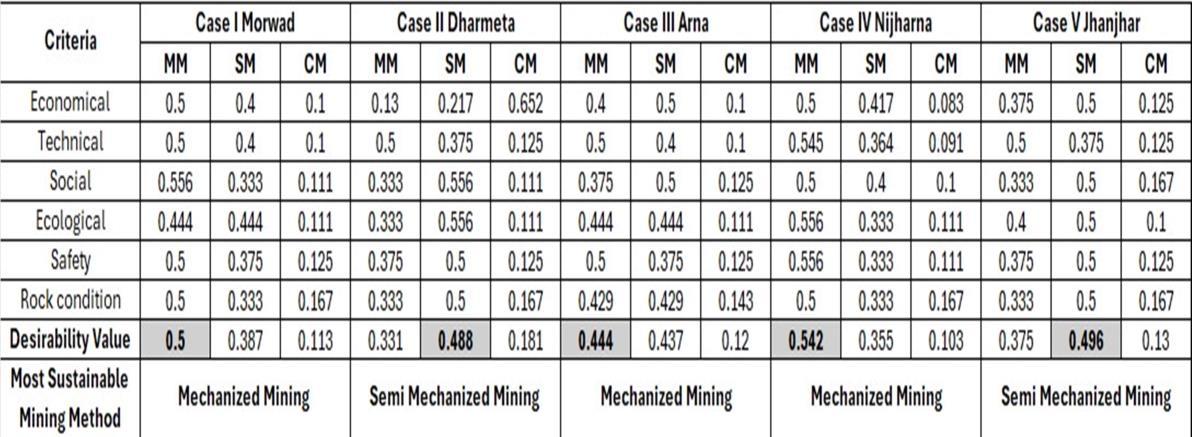
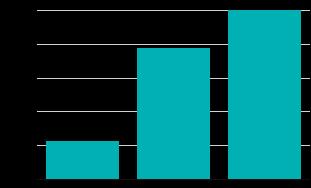

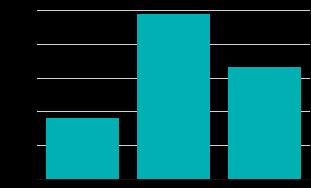
Fig-7: Dharmeta sustainability analysis
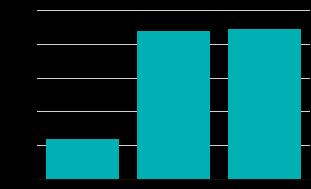
Fig-8: Arna sustainability analysis
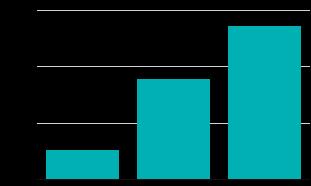
Fig-9 Nijharna sustainability analysis
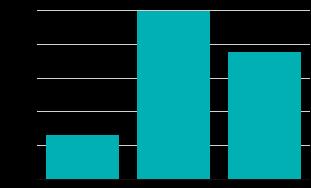
Fig-10 Jhanjhar sustainability analysis
This research examines the overall sustainability of marble variants in Rajsamand using case studies. According to the findings, mechanised mining (rope cutting) is the most sustainable option in the case studies. Morwad, Arna, and Nijharna, while semimechanised mining (expansion material) is more viable forcasestudiesinDharmetaandJhanjhar.
Conventional mining is unsustainable for any of the deposits because to increased mining and processing losses, despite decreased mining costs. Uncontrolled blasting in traditional mining can cause micro- and macro-cracks in both blasted and unblasted rock formations. Furthermore, conventionalmining methods cannotproduceregularorgeometricblocks,whichisthe method's fundamental shortcoming. Traditional mining practices raise health and environmental concerns, and they are also hazardous to workers and inhabitants of mining communities. Furthermore, developing a
International Research Journal of Engineering and Technology (IRJET) e-ISSN:2395-0056
Volume: 11 Issue: 07 | July 2024 www.irjet.net p-ISSN:2395-0072
benchingsystemusingthismethodisextremelydifficult, anditshouldbereplacedwithsemi-mechanisedmining.
This methodology was validated by deploying it in selected marble mines ranked from low to high. It was determined to be useful and simple to apply, and it has the potential to improve the mining industry's sustainabilitypractices.
Trainings, seminars, and campaigns should be held on a regular basis to educate and acquaint mining stakeholders about sustainable development and its benefits.
Future research studies can consider additional elements such as climate, infrastructure, location, accessibility,andmineclosure.
Itakeittobeproudprivilegetoavailthisopportunityto express my sincere and deep sense of gratitude to my major advisor Dr. S.C. Jain, Professor, Department of Mining Engineering, College of Technology and Engineering, MPUAT, Udaipur for this stimulating guidance, constructive suggestion, keen and sustained interest and incessant encouragement bestowed during the entire period of investigation, as well as critically goingthroughthemanuscript.
Iamgratifiedtorecordsincerethankstothememberof the advisory committee Dr. Anupam Bhatnagar, Professor & Head, Department of Mining Engineering, CTAE, Udaipur; Dr. Narayan Lal Panwar, Associate Professor,DepartmentofMechanicalEngineering,CTAE, Udaipur; Dr. Chitranjan Agarwal, DRI Nominee and Associate Professor, Department of Mechanical Engineering, CTAE, Udaipur for this generous gestures and valuable suggestion in planning and execution of thisstudy.
With respect and deep sense of gratitude, I hereby express my thank to Dr. P.K. Singh, Dean, College of Technology and Engineering, Udaipur for providing necessaryfacilitiestocarryoutmywork.
[1] Anderson, B., Berry, D., & Shields, D. 2019. Sustainable Development and Its In?luence on Mining Operations on Federal Lands: A ConversationinPlainLanguage: United States pp.14.
[2] Arman, H., Othman, N., & AbuBasha, F. 2021. A Practical Model to Assess and Improve Sustainability in Stone and Marble Industry in the
Palestinian Territories. Journal of Applied Science and Engineering, 25 : 551-566.
[3] Bôas,R.C.V.,Shields,D.J.,Snolar,S.V.,Anciaux,P., & Oo nal, G. (Eds.). 2005. A review on indicators of sustainability for the minerals extraction industries. CYTED-CETEM, pp.110-185
[4] Franks, D.M., Brereton, D., and Moran, C.J. 2010. Managingthecumulativeimpactsofcoalminingon regional communities and environments in Australia. Impact Assees. Proj. Appraisal 28 : 299312.
[5] IuCN,W.1991.UNEP.1980. The World Conservation Strategy. Switzerland.pp.5-10
[6] ISO-14301: 1999 Environmental Performance Evaluation- Guideline and General Principles. Tech. rep. Geneva, CH: International Standard Organization pp.270-290.
[7] Jain, R., Z. C. Cui, and J. K. Domen. 2016. “Environmental impact of mining and mineral processing”. Elsevier, Butterworth Heinemann Publ., pp.322-325.
[8] Jawahir, I. S., & Dillon Jr, O. W. 2007. Sustainable manufacturing processes: new challenges for developing predictive models and optimization techniques. In: Proceedings of the Wirst international conference on sustainable manufacturing, Montreal, Canada pp.1-19.
[9] Le, Thanh & Le Van, Cuong, 2018. Research and development and sustainable growth over alternative types of natural resources. Economic Modelling, Elsevier, vol. 70(C),pp215-229.
[10] Mudroch, A., U. Stottmeister, C. Kennedy, and H. Klapper. 2002. Remediation of abandoned surface coal mining sites. Series: Environmental Engineering. Springer, New York, pp.175-176.
[11] McCullough, C.D.,Lund, M.A.2006. Opportunities for Sustainable Mining Pit Lakes in Australia. Mine Water Environ. 25: 220-226.
[12] Rajaram, V., Dutta, S., & Parameswaran, K. (Eds.). 2005. Sustainable mining practices: a global perspective. CRC Press pp.190-224.
[13] Reuter,M.,Hudson,C.,VanSchaik,A.,Heiskanen,K., Meskers,C.,&Hagelü ken,C.2013.Metalrecycling: opportunities, limits, infrastructure. A report of the working group on the global metal Wlows to the international resource panel pp.41-68.
International Research Journal of Engineering and Technology (IRJET) e-ISSN:2395-0056
Volume: 11 Issue: 07 | July 2024 www.irjet.net p-ISSN:2395-0072
[14] Sueyoshi, T.,and Yuan,Y. 2018. Measuring energy usage and sustainability development in asian nations by DEA intermediate approach. J.Econ.Struct 7:6-7.
[15] Vishwambhar Prasad Sati, 2015. Socio-economic and Environmental Impacts of Stone Mining in Shivpuri District, Madhya Pradesh, India, Journal of ScientiWic Research and Reports 4(01):2320-0227, pp.47-54.