
Volume: 11 Issue: 07 | July 2024 www.irjet.net p-ISSN:2395-0072

Volume: 11 Issue: 07 | July 2024 www.irjet.net p-ISSN:2395-0072
Shrutika Malve* , Mahesh Vaswani* , Abhay Shanbhag* , Prof. Sarang Joshi
SCTR’s
Pune Institute of Computer Technology
Abstract
Inmental healthcare,depressionpresentsa significant challenge, especially given the sensitivities around personalhealthdataandtheneedfortailoredtherapies. This project introduces an innovative Federated Machine Learning (FML) framework designed specifically to analyze and predict depression while preservingdataprivacyandenhancingmodelaccuracy.
Traditional depression analysis methods strug-gle with maintaining patient confidentiality and ensuring diverse datasets. Centralized data col-lection, while thorough, poses substantial privacy risks and can deter participation, particularly in mental health contexts. Moreover, these methods often fail to capture the diverse manifestations of depression across different demographics, leading to less effective predictive models and interventions. The FML framework addresses these concerns by processing data locally on individual users’ devices,safeguardingpersonalinformationandensuring that sensitive data remains on the user’s device. This approach enhances privacy and incorporates diverse and heterogeneous data, resulting in a model that is inclusive and representative of various depression manifestations. The primary goal is to create a robust, scalable model capable of accurately predicting depression and providing insights for personalized treatment strategies. By leveraging FML, the project aims to set a new standard in mental health care analytics, offering a privacy-conscious, scalable solution that can handle diverse data sources. This approach has the potentialtorevolutionizementalhealthcare,providinga deeper under- standing of depression and paving the wayformoreeffective,personalizedcaresolutions.
Withinthedomainofmentalhealthcare,theformidable challenge of addressing depressionis magnified by the intricate interplay of personal health data sensitivity and the demand for tailored therapeutic strategies. This re- search project, titled "Developing a Federated Learning-Based System for Personalized Mental Health Assessment and Prediction," introduces a groundbreakinginitiative–aFederatedMachineLearning (FML) framework meticulously crafted for the analysis and prediction of depression. The primary focus is on fortifying data privacy and refining the precision of
predictive models which will be an extension to work in Korkmazetal.,2022
Conventional methods employed in depression analysis
Prabhudesai et al., 2021 , Minkowski et al., 2021 confront a dual dilemma: the imperative to uphold patient data confidentiality and the necessity to ensure the of datasets. Centralized data collection, though comprehensive, poses substantial privacy risks, potentially deterring participation, particularly within the sensitive realm of mental health care. Moreover, such centralized approaches as given by Zhang, 2022 often fall short in accommodating the di- verse manifestations of depression across various demographics, leadingtolesseffectivepredictivemodelsandinterventions. The pro- posed FML framework addresses these intricate challengesbyempoweringlocaldataprocessingonindividual users’ devices, a strategic move aimed at safeguarding personal information. This methodology ensures that sensitive data remains within the user’s device, markedly enhancing privacy. Beyond its privacy-centric advantages, this approach allows for the assimilation of diverse and heterogeneous data, culminating in a model that is both inclusive and representative of the myriad manifestations of depression. The overarching objective of this project is to craft a robust, scalable model proficient in accurately predicting depression, offering insights crucial for informing personalized treatment strategies. Leveraging the capabilities of FML, the project aspires to establisha new standardinmentalhealthcareanalytics
– A solution characterized by privacy conscious- ness, scalability, and adaptability to diverse data sources. This innovativeapproachholdsthepotentialtorevolutionizethe landscape of mental health care, promising a more nuanced understanding of depression and heralding a new era of effective,personalizedcaresolutions.Laietal.,2021
In Konec ˇný et al., 2017 insights into the fundamentals of federated learning, emphasizing strategies to enhance communication efficiency in distributed machine learning. It lays a foundationfor understanding how federatedlearning principlescanbeappliedtomentalhealthanalysis. International Research Journal of Engineering and Technology (IRJET) e-ISSN:2395-0056
InMcMahan etal., 2023,Pranto andAl Asad,2021and Korkmaz et al., 2022 authors explorecommunicationefficientlearningofdeepnet-worksfromdecentralized data, offering valuable techniques for privacy-preserving machine learning. The principles presented in this paper contribute to the privacy-conscious designof the proposedFederatedMachineLearningframework.
2.3 Towards Reliable and Empathetic Depression-Diagnosis-Oriented Chats
ThispaperLanetal.,2024proposesanovelframework for using chatbots in preliminary depression diagnosis through interactive conversations with potential patients. It acknowledges the complexity of blending task-oriented and empathetic chit-chat elements in diagnosis- related dialogues, which necessitates both professional expertise and empathy. Traditional dialogue frameworks often prioritize single optimization goals, whichmaynoteffectivelycater tothe multifacetednature of depression diagnosis conversations. Similar work is carriedoutatGuptaetal.,2022
To address these challenges, the paper Ogamba et al., 2023 introduces an innovative ontology definition and generation framework specifically tailored for depression diagnosis dialogues. This framework aims to combine the re- liability of task-oriented conversations withtheempatheticappealofchit-chat,therebyenhancing the effectiveness of chatbots in supportingindividuals withdepressionsymptoms.
2.4 Scalability and Adaptability in Federated Learning
Addressing the scalability and adaptability aspects of federated learning, Concone et al., 2022 explores the concept of distributed learning. The methodologies discussed provide a basis for creating a scalable and adaptable Federated Machine Learning framework capable of handling diverse data sources in mental healthanalytics.
By incorporating insights from these key studies, the literature survey establishes a foundation for the development of the proposed Federated Learning-Based SystemforPersonalized MentalHealthAssessmentand Prediction.
3.1 Server-sideImplementation:
The Keras library was used to define a multi- class classification model for mental health analysis. The model architectureconsistedofasequentialstackoflayers:
• Input Layer: This layer received the in- put data with a shape based on the number of features in the training data
• Hidden Layer: A Dense layer with 100 neurons and ReLU activation was used asthe first hidden layer. L1 regularization (kernel-regularizer = l1-reg) was applied tothislayertopotentiallypreventoverfitting.
• Output Layer: A Dense layer with 5 neurons and softmax activation was employed as the output layer, suitable for multi-class classification with five mental health classes (normal, stress, anxiety, depression, loneliness).
• Dropout: ADropoutlayerwitharateof
0.25wasincludedtorandomlydropoutaportion of neurons duringtraining,furtherhelpingtopreventoverfitting.
This model architecture was then employed within the federated learning framework for collaborative training on thedistributedmentalhealthdataset.
3.2 Client-sideImplementation:
Clientdevices,alsorunningFlaskinPython,playedacrucial role in the federated learning process. They received the global model from the server and trained it locally on their own mental health data, ensuring that the raw data never left their device. Secure communicationwith the server was maintained through SSL encryption. Additionally,tofurther protect privacy, differential privacy techniques, such as adding noise to updates, could be optionally implemented. After training, clients sent the updated model weights back to the server, contributing to the global model without compromisingtheirdata.
3.3 Federated Learning Architecture:
The federated learning setup included a centralserver and multiple client devices. The server managed the training process by distributing initial model weights, collecting updates from the clients, and aggregating them using methods like federated averaging. This approach combined
The server, built with Python and using Flask for client communication, managed the federated learning process. Initially, it created the global model with TensorFlow/Keras, tailoredto the specific needs of mental health data, such as multi-class classification. While clients handled core data preprocessing, the server took care of additionaltaskslikelabelencodingandone-hotencoding for the target variable. During training, the server split the data, distributed initial model weights, collected updates from clients,andaggregated themtoforma new globalmodel.To ensure privacy, optional security measures like differential privacyandSSLencryptionwereimplemented.
Volume: 11 Issue: 07 | July 2024 www.irjet.net p-ISSN:2395-0072
the insights gained by clients from their local data without exposing the data it- self, enabling collaborationwhilemaintainingprivacy.
3.4
We developed a multi-class classification neural network model using TensorFlow/Keras on the server, specifically tailored to a mental health dataset that included conditions like depression and anxiety. The training process followed a federated learning approach: the server sent initial model weights to the clients, who then trained the model locally on their own data. After training, the clients sent the updated weights back to the server, which aggregated these up-dates using methods like federated averaging to create an improved global model. We assessed the model’s performance on a separate test set, using metrics such as accuracy, precision, recall, and F1-score for each mentalhealthcondition.
Evaluation Metrics: We evaluated the model’s performanceonaheld-outtestsetusingvariousmetrics:
• Test Accuracy: The model achieved a test accuracy of0.8014,indicatinggoodgeneralizabilitytounseen data.
• Loss: The final training loss converged to 1.4052, suggestingreasonablelearningprogress.
• Overall AUC (macro-averaged): The model achieved a macro-averaged Overall AUC of 0.95, demonstrating good discrimination between the mentalhealthclasses.
• Per-Class Performance: The model’s performance also varied across different mental health classes. Precision, recall, and F1-score metrics revealed an averageprecisionof0.70,anaveragerecallof0.80,and anaverageF1-scoreof0.73.
By employing these evaluation metrics, we comprehensively assessed the performance of the federatedlearningmodelformentalhealthanalysis.
This research uses a federated learning approach to analyze mental health, aiming to distinguish between normal, stress, anxiety, depression, and loneliness. The client-server architecture ensures privacy-preserving training of a multi-class classification model with TensorFlow/Keras. We also use a separate questionnaire to collect user data for analysis. Additionally, as an optional feature, a chatbot can be integrated to offer users a platform for mental health inquiries.
Thecentralserverbeginsbycreatingtheinitialglobal model using the TensorFlow/Keras Sequential API. This model architecture is specifically designed for the mental health data underinvestigation,asdescribedinsection1ofthe previous response. Once established, the model architecture and its corresponding weights are securely distributed to participating client de- vices through well-defined APIs. Securecommunicationprotocolsareemployedtoensurethe integrityandconfidentialityofthetransmit-tedinformation.
Upon receiving the model architecture and weights, client devices can reconstruct the model locally without compromising the privacy of their raw data. This localized model is then leveraged to predict mental health labels (normal,stress,anxiety,depression,loneliness) fortheclient’s owndata.
Following the local prediction phase, a feder- ated learning loop is established. This loop fa- cilitates the iterative improvement of the global model by incorporating knowledge gained from each participatingclient.Here’s the breakdown of thisloop:
• Client-side Retraining and Data Collec- tion: Basedonthe predicted label, user responses from the separate questionnaire, and optionally, interactions with the chatbot(ifintegrated),clientscanperformlo-calretrainingon their model using their own data. User responses and chatbot interactions, when applicable, contribute to enrichingtheclient-sidedatausedforre-training.
• Updated Weight Transmission: Afterretraining,theclient transmits the updated model weights back to the server. Thistransmissionshouldoccurthroughsecurechannelsto ensuredataintegrity.
The server aggregates the model updates received from multiple clients using techniques like federated averaging. Federated averaging allows the server to combine the knowledge gained by individual clients while preserving privacy, as it operates on the updated model weights withoutaccessingtherawclientdata.Theaggregatedweights are then used to update the global model on the server. This iterative process of local training, weight transmission,and aggregation enables the global model to continuously improve by incorporating insights from all participating devices, user responses from the separate questionnaire, and optionally,interactionswiththechatbot.
International Research Journal of Engineering and Technology (IRJET) e-ISSN:2395-0056
Theprogressivelyimproved global model,re- sidingon the server, can then be utilized for further analysis or integrated into a recommendation engine. This engine can leverage the predicted mental health label, user responses from the questionnaire, and chatbot interactions (if applicable) to deliver even more relevant con- tent. For instance, the top eight most relevant questions (e.g., for self-assessment or intervention) could be displayed based on the user’s predicted state, their responses in the questionnaire, and the information gleaned from the chatbot conversation(ifavailable).
Thechatbot,asanoptionalfeature,provides userswith a safe space to ask questions and receive informative, contextually relevant responses about mental health in adescriptivemanner. Itisdesignedtoavoidcollecting any personally identifiable information (PII) from the user,ensuringprivacyOrešc ˇaninetal.,2024 Interactions with the chatbot can con- tribute valuable data for client-side retraining, potentially enhancing the model withadditionalinsights.
This federated learning approach offers an effective solution for collaborative training on a distributed datasetwhilesafeguardinguserprivacybykeepingraw data on client devices. Through the client-server architecture, secure communication protocols, a separate questionnaire, and the optional chatbot, this method supportsthe developmentofa robust, privacypreserving model for mental health analysis. It also provides users with a potentialsupportsys- tem through the chatbot, enhancing the overall utility and
Volume: 11 Issue: 07 | July 2024 www.irjet.net p-ISSN:2395-0072 accessibilityofthesystem.
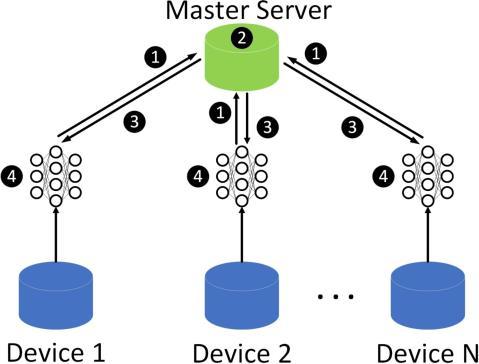
Figure1:ArchitectureofFederatedMachineLearning
This research explores the application of federated learning in mental health analysis, focusing on
distinguishing between normal, stress, anxiety, depression, and loneliness. The pro- posed approach utilizes a clientserver architecture and employs TensorFlow/Keras for privacy-preserving training of the model. Additionally, a separate questionnaire gathers user data for analysis, and optionally,achatbotcanbeintegratedtoofferaplatformfor user inquiries. The federated learning architecture ensures user privacy by keeping raw data on client devices. The model is trained iteratively through the transmission of updated model weights from clients to the server for aggregation, without disclosing the underlying individual data. This collaborative approach facilitates the development of a robust model by incorporating insights from a distributed dataset. The key findings of this research include:
• The feasibility of employing federated learning for mentalhealthanalysiswhilepreservinguserprivacy.
• The effectiveness of the separate questionnaire in enrichingtheclient-sidedatausedformodeltraining.
• The potential benefits of a chatbot in pro-viding user support and enhancing the model’s understanding throughuserinter-actions(ifintegrated).
This research opens doors for further exploration in the domain of federated learning for mental health analysis. Herearesomepromisingavenuesforfutureinvestigation:
• Incorporation of additional data sources: Explore the integration of sensor data (e.g., wearables) or anonymized electronic health records to potentially improvethemodel’saccuracy.
• Differential privacy advancements: Explore novel techniquesfordifferentialprivacytofurtherenhanceuser privacywhilemaintainingmodelperformance.
• Explainable AI for mental health: Develop interpretable models to understand the factors influencing the model’s predictions,potentiallyleadingto moretargetedinterventions.
• Large-scale federated learning deployments: Evaluate the scalability of the pro- posed approach in real-world scenarioswithalargernumberofparticipants.
6 Outcome/ results of research (screenshots of work done)
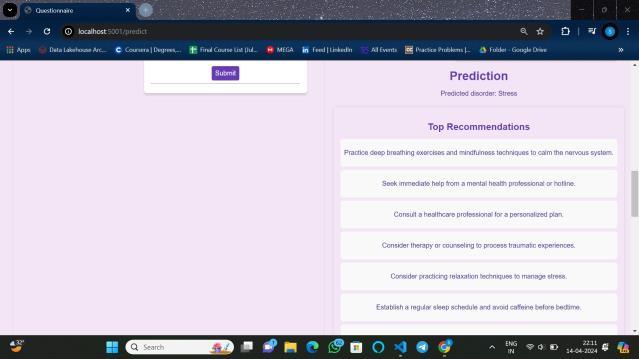
Development of a Mental Health Diagnosis System: Successfully implemented a system capable of diagnosing mental health disorders based on user responses to a questionnaire.
International Research Journal of Engineering and Technology (IRJET) e-ISSN:2395-0056
Volume: 11 Issue: 07 | July 2024 www.irjet.net p-ISSN:2395-0072
Integration of Machine Learning Models: Integrated machine learning models using Keras and TensorFlow topredictmentalhealthdisorderswithhighaccuracy.
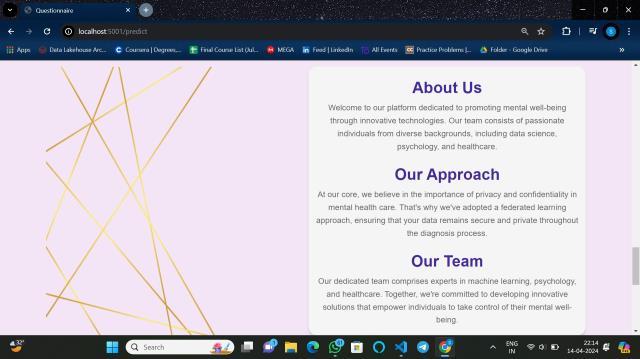
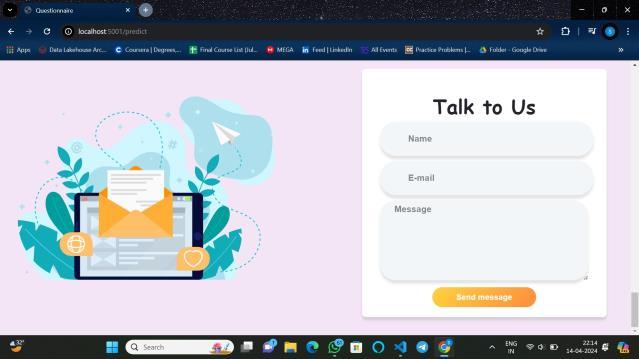
Creation of a Web Interface: Developed a userfriendly web interface using Flask, HTML, and CSS, allowing users to interact with the diagnosis system conveniently.
Enhanced User Experience: Implemented features such as clear questionnaire prompts and responsive designtoenhanceuserexperi-enceandaccessibility.
Application of Modern Engineering Tools: Utilized Python, Flask, Keras, Tensor- Flow, HTML, and CSS to create a robust and efficient mental health diagnosis system.
Successful Demonstration of Federated Learning: Demonstrated the feasibility of federated learning techniques for enhancing model performance while preservingdataprivacy.
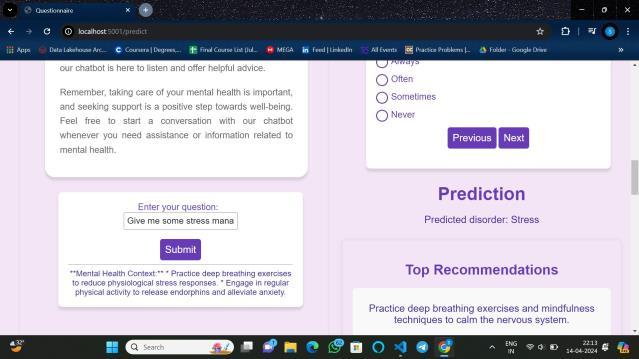
Recommendation Engine Integration: Integrated a recommendation engine basedonpredictionresultsto provide personalized recommendations for mental healthsupportresources.
Incorporation of Chatbot Functional- ity: Implemented chatbot functionality to provide immediate support and guidance to users based on theirresponsesanddiagnosisresults.
References
Federico Concone, Cedric Ferdico, Giuseppe Lo Re, and Marco Morana. 2022. A federated learning approach for distributed human activity recognition. In 2022 IEEE International Conference on Smart Computing (SMARTCOMP), pages 269–274. Arti Gupta, Chanchal Maurya, Khyati Dhere, and Vijay Kumar Chaurasiya. 2022. Wellness detection using clustered federated learning In 2022IEEE6thConferenceonInformationand Communication Technology (CICT), pages 1–5. Jakub Konec ˇný, H. Brendan McMahan, Fe- lix X. Yu, Peter Richtárik, Ananda Theertha Suresh, and Dave Bacon. 2017. Federated learning: Strategies for improving communica-tionefficiency
Abdulkadir Korkmaz, Ahmad Alhonainy, and Praveen Rao. 2022. An evaluation of fed- erated learning techniques for secure and privacy-preserving machine learning on med- ical datasets. In 2022 IEEE Applied ImageryPatternRecognitionWorkshop(AIPR),pages1–7.
Fan Lai, Xiangfeng Zhu, Harsha V. Mad- hyastha, and MosharafChowdhury.2021. Oort:
Efficient federated learning via guided partici- pant selection.
Kunyao Lan, Cong Ming, Binwei Yao, LuChen,and Mengyue Wu. 2024. Towards reliable and empathetic depression-diagnosis-orientedchats.
H. Brendan McMahan, Eider Moore, Daniel Ramage, Seth Hampson, and Blaise Agüera y Arcas. 2023. Communication-efficient learn- ing of deep networks fromdecentralizeddata.
LauraMinkowski,KristiinaValterMai,andDharmendra Gurve. 2021. Feature extraction to identify depression and anxiety based on eeg. In 2021 43rd Annual International Conference of the IEEE Engineering in MedicineBiologySociety(EMBC),pages6322–6325.
Maria Ogamba, Joseph Gitonga, Betsy Muri- ithi, John Olukuru, and Joseph Sevilla. 2023. Wellness buddy: An aimentalhealthchatbotforkenyanuniversitystudents. In 2023 First International Conference on the Advancements of Artificial Intelligence in African Context (AA-IAC),pages1–6.
Dražen Orešc ˇanin, Tomislav Hlupic´, and Boris Vrdoljak. 2024. Managing personal identifi- able information in datalakes. IEEEAccess,12:32164–32180.
Siddharth Prabhudesai, Apurva Mhaske, Manvi Parmar, andSumedhaBhagwat.2021.Depres-siondetectionand analysis using deep learn- ing: Study and comparative analysis. In 2021 10thIEEE InternationalConference on Com- munication Systems and Network Technologies (CSNT),pages570–574.
Md. Appel Mahmud Pranto and Nafiz Al Asad.2021. A comprehensivemodeltomonitormen-talhealthbasedon federated learning and deep learning. In 2021 IEEE International Confer- ence on Signal Processing, Information,Com-municationSystems(SPICSCON),pages 18–21.
Ye Zhang. 2022. The intelligent prediction model of collegestudents’mentalhealthbasedonclusteranalysis algorithm. In 2022 Inter- national Symposium on Advances in Informat- ics, Electronics and Education (ISAIEE),pages653–657.
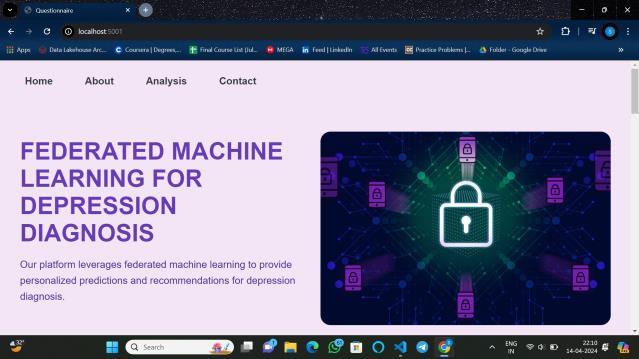
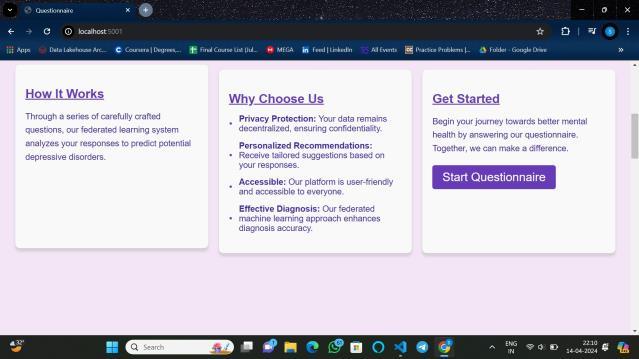
Implementation2
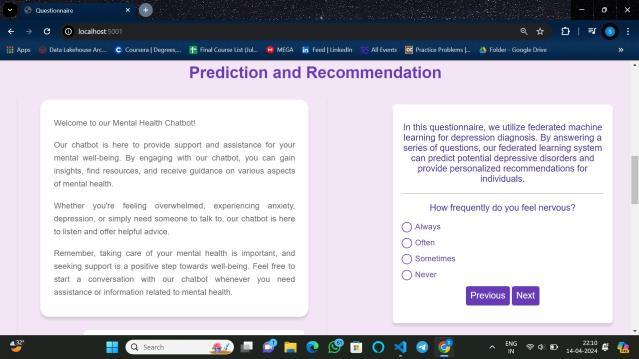
Implementation4
Implementation6
International Research Journal of Engineering and Technology (IRJET) e-ISSN:2395-0056
Volume: 11 Issue: 07 | July 2024 www.irjet.net p-ISSN:2395-0072
Implementation7