
International Research Journal of Engineering and Technology (IRJET) e-ISSN: 2395-0056
Volume: 11 Issue: 07 | July 2024 www.irjet.net p-ISSN: 2395-0072

International Research Journal of Engineering and Technology (IRJET) e-ISSN: 2395-0056
Volume: 11 Issue: 07 | July 2024 www.irjet.net p-ISSN: 2395-0072
Yash Singh1, Anuj Kamal2, Ashish Gaur3, Rohit Rai4, Mukul Saxena5
1B.Tech Student, Dept of Civil Engineering, Rajkiya Engineering College, Kannauj, 209732, Uttar Pradesh, India
2B.Tech Student, Dept of Civil Engineering, Rajkiya Engineering College, Kannauj, 209732, Uttar Pradesh, India
3B.Tech Student, Dept. of Civil Engineering, Rajkiya Engineering College, Kannauj, 209732, Uttar Pradesh, India
4B.Tech Student, Dept of Civil Engineering, Rajkiya Engineering College, Kannauj, 209732, Uttar Pradesh, India
5Assistant Professor, Dept of Civil Engineering, Rajkiya Engineering College, Kannauj, 209732, Uttar Pradesh, India ***
Abstract - This paper examines the correlation between Rajkiya Engineering College, Kannauj, Uttar Pradesh, India’s indoor environmental quality (IEQ) and student outcomes, such as perceived learning, course satisfaction, and IEQ satisfaction. Descriptivestatisticsanalysishasusedtoexamine thedata that was gatheredfrom157 students throughout the course of four floors at various times. The findings display a significant impact onscholar results fromIEQ, whichincludes thermal conditions, indoor air quality, acoustic situations, lighting conditions, furnishings, aesthetics, era, and look at conditions. The IEQs of different employees businesses and zones did, however, various drastically. Common troubles covered loudness, cramped quarters, uncomfortable temperature sensations, and terrible indoor air best. The properly-being, comfort, and productiveness ofoccupantsrely closelyonIEQ, andinformationitcanassistdiscoverregionsin which building parameters need to be stepped forward. The results indicated that favourable pupil results were linked to the IEQ of the lecture rooms, which covered such things as temperature, indoor air fine, acoustic conditions, lighting conditions, furnishings, aesthetics, technology, and view conditions. Thepaper analysesthefactorsaffectingtheIEQfor students inside the lectures/classrooms of educational building of Rajkiya Engineering College, Kannauj, Uttar Pradesh, India during different time period.
Key Words: IEQ, Educational buildings, Acoustic comfort, IAQ, Visual comfort, Thermal comfort
Humansspend90–95%oftheirtimeindoors,andaminimum of 30% of nonindustrial buildings are thought to be problematicbuildings,withindoorairpollutionbeingamajor contributingfactor.Thehealthandacademicperformanceof childrengreatlydependontheindoorairqualityinschool classroomsbeingcharacterized.Numerousindoorpollutants, including dust, allergens, volatile organic compounds, and more,cancontaminateclassrooms.Notonlycanindoorair pollution cause short- and long-term health issues for employeesandstudents,butitcanalsolowerproductivity.It is crucial to have desirable indoor air first-class (IAQ) to assure that teachers and students perform better and are extra effective. A study performed during the week discovered that university college students had been
spendingagoodsizedamountoftimeinterior,upto87%in their time, in which they were challenge to environmental affects. It is critical to investigate how the school room surroundings influences college students' overall performance and health due to the fact they spend lots of timeincollegeanddormsattemptingtoresearch.Research hasrelatedlong-termhealthproblems(e.g.,cardiovascular sicknesses,bronchialasthma-relatedissues)withintellectual health problems that are not right now apparent. The college's interior air can be more contaminated than its outside since the latter has remarkable air flow and no obstructionstothefloatofair.
The indoor surroundings have a full-size impact on mastering,trendyoperatingpatterns,fitness,andmonetary growth.TheNationalBuildingCodeofIndiaPartIV–(2016) divides buildings into nine categories: residential, commercial, commercial, keep, mercantile, academic, institutional, assembly, and unsafe [1]The location and environmentalqualityoftheeducationalbuilding,aswellasa numberofbuilding-relatedaspectslikethebuilding'supkeep, cleanliness,andcondition,allhaveanimpactontheindoor environmental quality (IEQ), according to the US EPA (2010)[2]
Inunique,giventhatcollegestudentsspendextratimeinthe lectureroomthaninsomeotherinternalfacultyplacingfor instructionalpurposes,thestudyroom'sIEQhasarightaway impactonstudentoutcomes,whichincludemasteringand pleasure. In order to decide how college college students' happiness with their getting to know settings and publications, in addition to their belief in their mastering, changedintodetermined,aconceptualmodelrepresenting several IEQ standards associated with the bodily environment of lecture rooms turned into designed and tested.Intheprocess,apathanalysiswascarriedouttolook intothestructurallinksbetweenvariablesatthesametime. This can help us understand more about how planned environmentsaffecthumanoutcomes.
Sinceone-fifthofthearena'spopulationspendsgreaterthan 30% of their time in academic centers such as faculties, universities, and schools, these structures are many of the mostsignificant.Theindoorenvironmentalpleasant(IEQ)of any facility is closely correlated with how nicely humans researchandexecutespecialjobs.Whengrowingsustainable
International Research Journal of Engineering and Technology (IRJET) e-ISSN: 2395-0056
instructional facilities, one of the fundamental matters to maintain in mind is indoor environmental fine (IEQ). The domain of "indoor environmental quality" (IEQ) accommodatesmanysub-domainnamesthathaveanimpact onthewell-beingofpeoplelivingwithinastructure.Indoor environmental quality of education building is shown in [Figure-1],whichisgivenbelow.
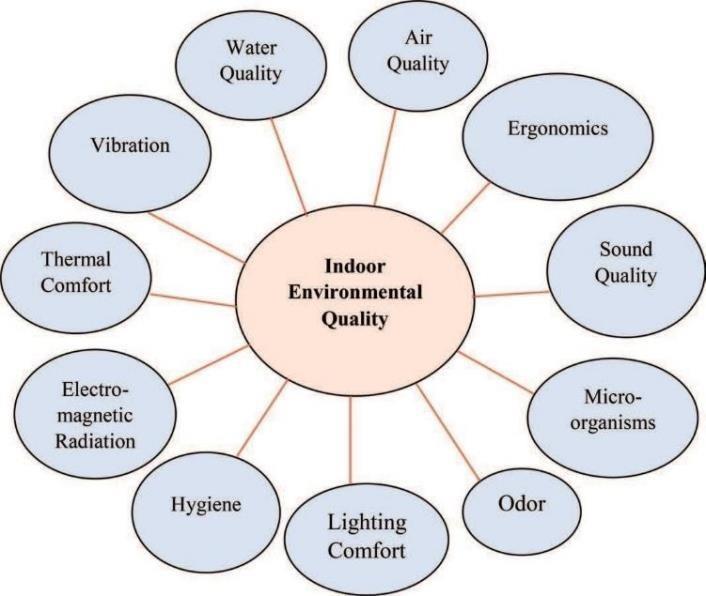
The diverse interior areas determined in constructed property, consisting of houses, offices, faculties, and hospitals,makeuptheindoorsurroundings.Thestateofthe indoor environment has been a prominent study is an industry hobby even before the COVID-19 pandemic. Improving the first-rate of lifestyles of constructing occupants,growingworkperformanceorsimplyinabidto make a constructing greater sustainable are few motives whystudiesintoIEQhasgainedlotsofreactionintheAEC industry. IEQ also refers to the quality of a building environment on the subject of the fitness and wellness of folksthatoccupyspaceinsideit.TheIEQislinkedtoindoor human comfort that is usually assessed from four factors: thermal, air first-class, visual, and acoustic consolation. Respiratory comfort is commonly expressed as indoor air first-rate(IAQ).
Theindoorenvironmentqualityofa school facilitycanbe assessed using two different approaches: subjective and objective.Objectiveevaluationtechniquesrelyonbaseline relationshipsbetweentheenvironmentalcircumstancesand user satisfaction instead of directly capturing the actual experience of the occupants in order to compress the environmental characteristic using reference ranges of physically acceptable parameters. Methods of subjective evaluationofindoorenvironmentalconditionsareassessed usingquestionnaire-basedsurveys.
The primary intention of the research is to deal with the pressing want for evaluating and enhancing the indoor environmental excellent (IEQ) of educational facilities, in particularlecturerooms.Thepurpose oftheobserveis to envision how students perceive the temperature, lighting fixtures, noise levels, and air first-class as a way to make upgrades on the way to make the gaining knowledge of surroundingsextrasnugandconducive.
The realization that IEQ significantly affects students' comfort, well-being, and academic achievement served as the driving force. The study aims to create healthier and more productive learning environments for kids by concentrating on educational buildings. Furthermore, the studyaimstoofferinsightfulinformationtolawmakersand educational institutions so they may prioritize IEQ improvements in their buildings, thereby improving the entireeducationalexperienceforstudents.
Additionally,theexpandingoperationsinterestinIEQand thegrowingemphasisonsustainabilityandhuman-centered designineducationalenvironmentsserveasdrivingforces for the study. The study aims to address IEQ variables in order to meet the increasing need for environmentally friendly and healthful indoor environments for educators and students. All things considered, the study's purpose stemsfromthegoal toaddressthecritical IEQfeatures in educationalfacilitiesinordertosupportstudents'academic achievementandwell-being.
Therearesomeusefulstudiesinthisarea.Thefollowingare worthmentioning.Ormanetal., [3]haveresultedthatthe assessmentoftheoverallcomfortoflectures/roomsofan educational building which turned into carried out by the respondents which were gathered with the aid of the questionnaire approach. They in addition analyzed that during this study the bodily parameters of the indoor environmentwererecordedsimultaneouslytotheprocessof completingthequestionnairepaperwork.Yerragolametal., [4]havesuggestedthatthemethodofimprovingindoorair qualityinclassroomsofeducationalbuildingsbyventilation involvesbringinginfreshairandremovingstaleair.Itisthe process of controlling indoor air quality and halting the spreadofdiseasesthroughthefreshairintheclassroomsof educationalbuilding.Tomaintainatallerlowerlayerwitha lower concentration of carbon dioxide, we analyses the effectiveness of displacement and down flow ventilation systemsinthisprocess.Carslawetal.,[5]areelaboratethe fiveindoorairchemistryintheirresearchworkthataffects theindoorairqualityforclassroomsofeducationalbuilding, which are reactivity in indoor environments, mapping organic constituents indoors classrooms, the role of the occupantinindoorairchemistry,indoormodelingstudies, and new materials and modern technologies indoors classrooms.Leeetal.,[6]haveelaboratedoftheirstudythat the preservation improved relative humidity the various
Volume: 11 Issue: 07 | July 2024 www.irjet.net p-ISSN: 2395-0072 © 2024, IRJET | Impact Factor value: 8.226 | ISO 9001:2008
International Research Journal of Engineering and Technology (IRJET) e-ISSN: 2395-0056
Volume: 11 Issue: 07 | July 2024 www.irjet.net p-ISSN: 2395-0072
quantitative IEQ parameters, and occupant pride with thermal comfort, air great, overall pride, and general productiveness.Theresultsoftheexaminerarepredictedto beimplementedinfuturediscussionsconcerningoccupant satisfaction and to play a massive role in fostering the attractiveness and implementation of constructing renovationstoenhanceIEQ.Morandi,Pittana,etal.,[7]have described in their study, it presents the design and experimental validation of questionnaire, able to capture occupantspersonalstateandsatisfactionfortheindividual aspectsotheindoorenvironmentalanditsglobaldomains. Mihai and Iordache [8] expanded their investigation to determinespecificcomponentsoftheinnerenvironmental qualityofaneducationalbuilding.Theyalsodiscoveredthat numerousessentialfactorsinfluencetheoverallbestofthe indoor surroundings, along with thermal consolation, acousticcomfort,indoorairquality,andvisibleconsolation. Thisobservesbecamecarriedoutinaneducationalbuilding. Theyalsospotlightthewanttoupgradeorrenovatehomes toimproveindoorenvironmentalqualitythatmayresultin lower running charges and better occupant productivity. Horr,andArifetal.,[9]theirreviewarticlefocusesonthe factthatoccupantcomfortandwell-beingisinfluencedby indoorenvironmentalquality(IEQ).Theyalsodescribedthe relationship between IEQ and well-being, highlighting the impact on overall productivity and potential long-term healthimplicationsforthe population. Theyalsosaidthat buildingdesignprinciplesmusttakeintoaccounttheneeds, comfortandwell-beingoftheoccupants.Pistore,etal.,[10] theassessmentofindoorenvironmentalhigh-quality(IEQ) in secondary colleges states that particular emphasis is located on thermal comfort. We also implemented three integrated approaches: objective evaluation by measuring the subjective reactions of students and teachers, and dynamicsimulation.Theyalsodemonstratedtheimportance ofconsideringbothobjectiveandsubjectiveassessmentsof hisIEQineducationalinstitutions.Turunenetal.,[11]havea lookatinvestigatedhowquestionnaire-basedself-reported signs can be used to examine the prevalence of selfpronouncedsymptoms amongststudentsinside the study room and their possible relationship with IEQ in the classroom.SarbuandSebarchievici,[12] their study found that energyconsumptionishighlydependentnotonly on occupant comfort requirements, but also on building materials, thermo physical properties of buildings, and utilitysystemperformance.Mydinetal.,[13]wefoundthat observing relationships between variables and analyzing data is the main purpose of qualitative research methods. Wealsoanalyzedtheindoorenvironmentalquality,lighting, andthermalcomfortofeducationalfacilities.Zhaoetal.,[14] stated that indoor environmental nice (IEQ) is likewise stimulated by using pollutants produced in the interior spaces of educational homes. Contaminants that may degrade indoor air first-class (IAQ) in lecture rooms in schooling buildings include mould, micro organism, allergens, unstable natural compound debris (VOCs), and formaldehyde.Perssonetal.,[15]havecenteredthatmaking
use of energy-effective windows could be an stepped forwardassociationthanhavingaprofoundlycoveredwall withouthomewindowsfortheinstructivestructure.
Although the vicinity of glazing has no direct impact on thermalconsolation,itdoeshaveanimpactontheamountof strength used that is associated with the situations of the academicbuilding'sinteriorsurroundings.
The prime objectives of present study have been given below.
1. To collect the subjective responses for indoor environmentalqualityineducationalbuilding.
2. Toexaminetheparametersofindoornaturalnature ofaninstructivestructureandalsounderstandthat how the students’ perceive the environmental changes.
3. To assess various types of comfort inside the lectures/classroomsofaneducationalbuilding,itis necessary to investigate comfort and satisfaction, which are considering the thermal, visual and acousticexperiences.
4. To evaluate the contribution of each comfort by usingequivalent questionsforeachindoornatural natureofaninstructivestructure.
5. To examine the factors affecting the IEQ (overall comfort)forstudentsinsidethelectures/classrooms of an educational building during different time period.
The objectives of this study are to evaluate the fine of the surroundingsinclassroomstheuseofvariousparameters which include air great, thermal consolation, visual consolation,acousticconsolationandnormalhigh-quality. Thestatisticsofthislookatturnedintoaccruedbysurvey approach.
Thispapercameaboutinsidethearea-basedtotallyindoor environmental exceptional of an educational engineering collegebuilding(lecture/classrooms)ofthree-story,which might be located in Rajkiya Engineering College, Kannauj, UttarPradesh,India.Atthisinstance,thesurveyingtechnique has been applied to an experimental research of the evaluation of the interior environmental quality of several lecturesandclassroomsattheeducationalbuildingofRajkiya EngineeringCollege,Kannauj.
International Research Journal of Engineering and Technology (IRJET) e-ISSN: 2395-0056
Volume: 11 Issue: 07 | July 2024 www.irjet.net p-ISSN: 2395-0072
Nine lecture rooms positioned within the instructional constructingoftheRajkiyaEngineeringCollegeKannauj,in Uttar Pradesh, India, have been investigated during November2023toJanuary2024.
The weather of Uttar Pradesh is temperate in spring and summer time, warm and dry in summer (average temperature30°Cto42°C,averagemosttemperature27°C to35°CinJuly),bloodlessandarid.Wetinwintryweather (whereminimumtemperatureandJanuarytemperatureare 17°Cand5°C).
Theindividualswerestudentstakingguidesinthoselessons. Theresearchersemailed980collegestudentstofilloutthe websurvey.Thesurveychangedintofinishedwiththeaidof 157 college students and the reaction charge turned into sixteen%.Thereisamassivedifferencebetweenmen(eighty two %) and college students (18%). In addition, many students(77.9%)spend3tofourhoursperweekinoneof thelecturerooms.
Personalinformationofstudents(age,genderandclothing stage); diploma of pleasure with temperature, visible, acousticconsolationandindoorsbest;andgeneralcomfort stageturned into evaluated for each query. Students have been asked to rate their emotions of warmth (Available Vocabulary (AMV)) on a scale of 5:2 (2). Additionally, contributors have been asked to fee the sound quality of environmentsaccordingtoeveryexcellentelement(thermal delight(TS),soundpride(US),acousticpleasure(AS),and IAQ satisfaction) and ordinary comfort. To fee mood, 5 points are weighted from -1 to +1 (very dissatisfied, disappointed,neutral,gladandreallyhappy).Inthestudies, 157collegestudentscrammedouttheabovesurvey.
Correlation and regression analysis techniques have been usedtoexaminetherelationshipandeffectsbetweentheIEQ factor (Overall Comfort) and selected predictor variables suchasThermalcomfort,AirQuality,andVisualComfort.
4.3.1 Karl Pearson Correlation Coefficient
TheKarlPearson’sCoefficientofCorrelationisaparametric measureoftherelationshipoftwocontinuousvariables.
ThePearson’sCoefficientofCorrelationisgivenbelow:]
Where, isthePearson’sCoefficientofCorrelation, arethestandarddeviationofthevariables.
ThePearson’sCoefficientofCorrelationliesbetween-1 to+1.
Symbol, , i.e.,
The multiple regressionanalysis istheuseful techniqueto study the effect of different independent variables or predictor variables on a dependent variable. The multiple regression analysis technique can be employed when the dependent variable is measured on an interval scale. The independent variables are measured preferably in the interval scale, but the method can work when they are measured either in ordinal or in nominal scales. The regression suggests the method attempts to express a dependent variable as a mathematical function of the independent variables. This study is more than one independent variables or predictor variables, so the regression equation is called the multiple regression equation.
Thegeneralformofthemultiplelinearregressionmodels fortheanalysishasgivenbelow:-
Where, isthedependentvariable; aretheregressionCoefficient; aretheindependentvariablesorpredictor variable;and, istheerrorterm.
Themajorfindingsanddiscussionaremadeinthisstudyof the indoor environmental quality of educational building whichisgivenbelow.
5.1
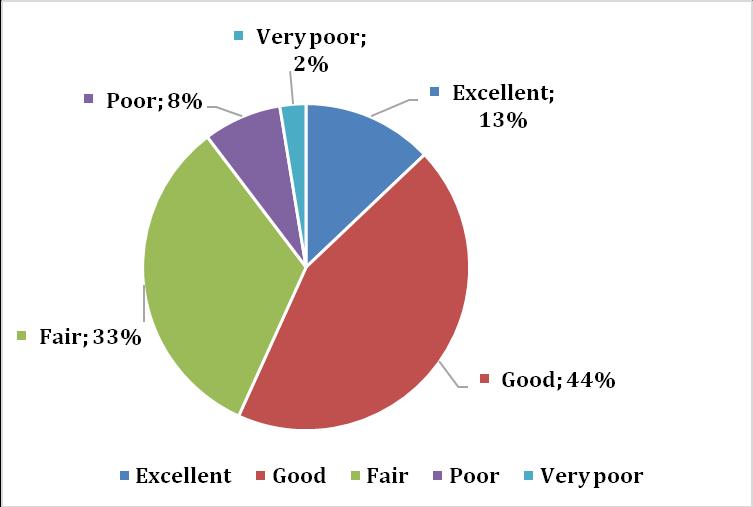
Taking the classroom climate into consideration was also important for the general purpose of the study. Most participantsstatedthattheairqualitywasgood,whichmet their needs and contributed to good learning. However, a significantnumberofpeoplereportpoorindoorairquality, indicatingthatthereareissuesthatneedtobeaddressedto improve indoor air quality. Many participants additionally indicatedthattheywerereadytotakeactionintheeventthat theyobtainedreviewsofawfulweatherconditions,together withstartingorultimatehomewindows.Thisdemonstrates theimportanceofgivingstudentsexpertiseandmanipulate over their surroundings, as a result empowering them to
International Research Journal of Engineering and Technology (IRJET) e-ISSN: 2395-0056
Volume: 11 Issue: 07 | July 2024 www.irjet.net p-ISSN: 2395-0072
improvethesurroundings.Here,thechartoftheIndoorAir Qualityofeducationalbuildingisgivenbelowin [Figure-2].
5.2 Visual Comfort
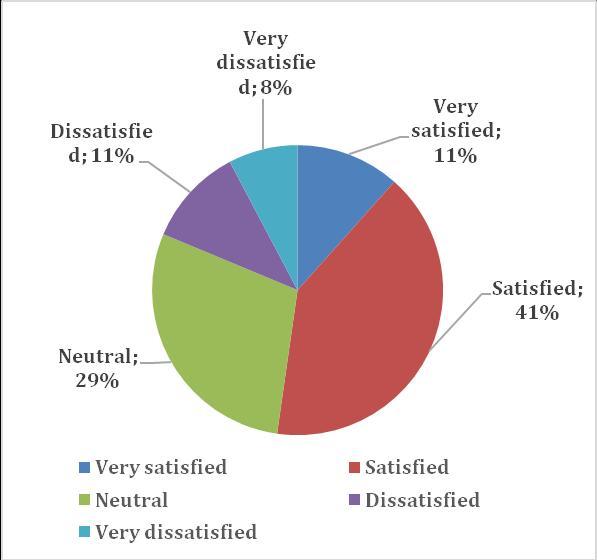
Amongst the IEQ indicators is light which was also considered for this studies. On this, most respondents perceivedthelightdegreewithintheclassroomsasokayas proven in [Figure-3], indicating that it become generally exceptionalforreadingandvisualduties.However,asmall percentofrespondentsdeterminedthelightstageeithertoo bright or dim, suggesting the need for modifications or upgradesinlightingdesign.Here,thechartofvisualcomfort ofeducationalbuildingisgivenbelowin [Figure-3].
5.3 Thermal Comfort
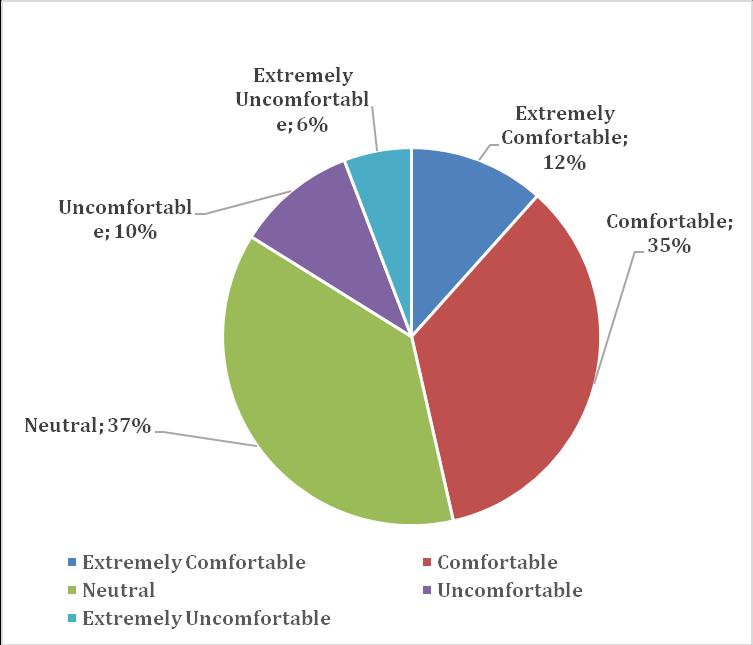
Amongotherthings,questionswereaskedaboutthefeeling of warmth in student rooms. As shown in [Figure-4], the analysis confirmed that maximum individuals defined the room temperature as neutral and cool, indicating usual comfort.However,forthereasonthatfactsbecomecollected inthecourseofthewintryweathermonths,thefactthatthe chances are barely less warm shows that there are
differencesinthetemperatureconditionsinthefaculties.But asmallpercentagefeltverycold;thisshowsthattheneedsto be improved in cold weather. Here, the chart of thermal comfortofeducationalbuildingisgivenbelowin [Figure-4]
5.4
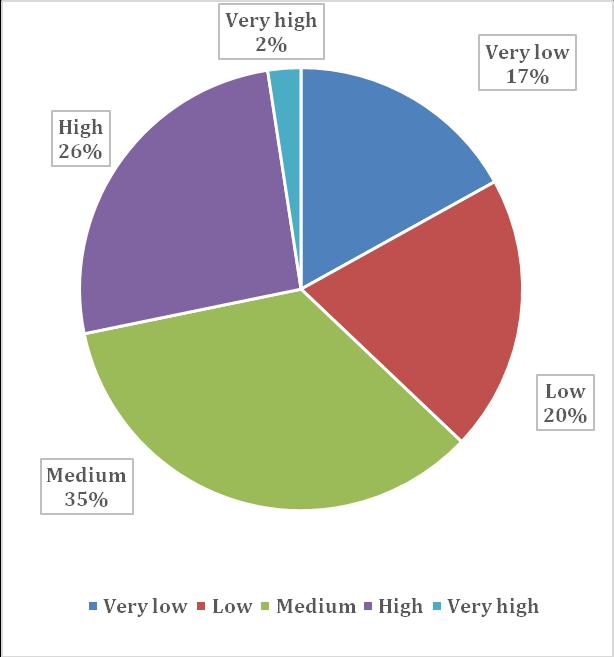
Another important indicator of IEQ is the noise level evaluated during the research process. External noise was foundtobeacceptable,althoughexcessivenoisethatcould impair the senses was sometimes reported. Apparently, a large percent verify that noise inside the lecture room impactstheirconcentrationandemphasizetheimportanceof takingmeasurestogovernnoisethatallowsyoutoresearch better.Here,thechartofacousticlevelnotionofeducational buildinghasshowninsidethe [Figure-5]
International Research Journal of Engineering and Technology (IRJET) e-ISSN: 2395-0056
Volume: 11 Issue: 07 | July 2024 www.irjet.net p-ISSN: 2395-0072
Finally, students recognized the overall impact of IEQ on concentration, with temperature ranking as the most influentialfactor,followedbyairquality,noise,andlighting. ThesefindingsprovidevaluableguidanceforimprovingIEQ inhighereducationbuildings,aimingtocreatecomfortable, healthy,andconducivelearningenvironmentsthatoptimize students’well-beingandacademicperformance.
Since data collection was on the 5-point scale and the extremes of the different factors are considered as the dissatisfactionlike extreme coldand many more,itcanbe seen from the [Table-1], that most of the occupants are satisfied with the indoor environment of the building. A series of data analysis procedures was applied. First, the collecteddatawerepurifiedthroughastandardprocedure for handling missing responses, dealing with outliers, and checkdataquality,assuranceandanalysisofconsistency.
Regardingthethermalenvironmenteachfloorhasmaximum comfort during the morning classes except ground floor whichshowsmostsatisfactionafter11:50AM(firstbreak). Regarding Indoor Air Quality, ground floor is the best one becauseitremainsalmostsamewholedaywhilethirdfloor showsmostvariation,passingthroughfirstfloorandsecond floor. It can be seen that most of the time students are satisfied with the lighting conditions of the classroom becauseofthemorenumberofwindowsandglasswall,but somestudentsweredissatisfiedbecauseoftheglareeffect. Acoustic environment and insulation are perceived highly satisfortyforthe majorityofthestudents each floor, buta great percentage of students (18%) feel uncomfortable becauseoftheoutsideconstructionatthetimeofsurvey.
Table-1: Mean Occupants Satisfaction for IEQ
Source:AuthorsCalculation.
TheselectedpredictorvariablesforIEQfactorsaregiven in [Table-2], which have been used for the descriptive statisticalanalysisandcorrelationandregressionanalysis.
Table-2: Selected Predictors of Overall Comfort for IEQ of Educational Building
International Research Journal of Engineering and Technology (IRJET) e-ISSN: 2395-0056
Volume: 11 Issue: 07 | July 2024 www.irjet.net p-ISSN: 2395-0072
5.
6.
Source:AuthorsCalculation.
In order to analyze the collected responses, descriptive statisticaltesthasperformedasmean,median,andmodefor eachIEQfactor(temperature,airquality,lighting,acoustics) acrosseachfloorofdifferentclassdurationshascalculated. [Table-3],isshownthedescriptivestatisticsofIEQfactors.
Table-3: Descriptive Statistics for IEQ factors of Educational Building
Likewise correlation coefficientof the air quality with overall comfort is 0.933. The coefficient indicates a significant positive relationshipbetweentheairqualityandoverallcomfort.Itimplies thatifthermalcomfortincreasesthentheoverallcomfortincreases significantly.
Table-4: Pearson’s Coefficient of Correlation Analysis of IEQ factors
Source:AuthorsCalculation.
Now, we have calculated the coefficient of correlation between overall comfort and all selected predictors using Pearson’sCorrelationanalysismethod,andANOVAtestby regressionmodelhasperformedwhicharegivenbelow.
5.7 Correlation of Selected Predictors with IEQ Factors
Here, we have calculated the coefficient of correlation between overall comfort and all selected predictors using Pearson Correlation analysis method. The correlation analysis of the selected predictor variables with the IEQ factor is presented in [Table-4]. The table shows that the correlation coefficient of thermal comfort with overall comfort is 0.959. Here the magnitude of correlation coefficient indicates a high positive significant association with thermal comfort and overall comfort. It implies that with increase in amount of thermal comfort, the overall comfortincreasesaccordingly.
**.Correlationissignificantatthe0.01level(2-tailed).
*.Correlationissignificantatthe0.05level(2-tailed).
Source:AuthorsCalculation.
5.8 Analysis of Variance for IEQ factors
TheANOVAforthismodelisgivenin [Table-5].Thevalueof Fishighlysignificant;sowerejectthenullhypothesisthat allcoefficientsaresimultaneouslyzero.ValueofR,RSquare and Adjusted R Square are 0.999, 0.997 and 0.995 respectively. Here, Adjusted R Square is taken into considerationbecause;the numberof observationsisless than 50. Also all predictors are entered in the model. Therefore, Adjusted R Square is necessary to examine the variationexplainedinoverallcomfortwiththehelpofsetof predictorvariables.
Table-5: ANOVA Table for Estimated Model of IEQ of Educational Building
DependentVariable:OverallComfort.
Predictor Variables: Thermal Comfort, Air Quality, Visual Comfort.
Source:AuthorsCalculation.
International Research Journal of Engineering and Technology (IRJET) e-ISSN: 2395-0056
Volume: 11 Issue: 07 | July 2024 www.irjet.net p-ISSN: 2395-0072
Here,overall comfortis dependentvariableand the set of other variables are predictor variables. In this analysis, forwardstep-wisemethodisused.Itisfoundthatonlythree variables, namely, thermal comfort, air quality, and visual comfort entered in this model. These three predictor variables have jointly explained 99.9 percent variation in overall comfort over the period of time 10:00.AM. to 5:00 PM. Also R Square Adjusted value 99.5 percent is highly statisticallysignificant.
Theregressioncoefficientofvariablethermalcomfortis 0.59 which is significant. It means that per unit increase indicator of thermal comfort; status of overall comfort is increasedbyamountof0.59.Thisvariableisemergedinthis analysisasveryimportantfortheprogrampointofviewfor furtherstrategy.Theresultisgivenbelowin [Table-6]
Table-6: Regression Results for IEQ factors of Educational Building Predictor Variables
DependentVariable:OverallComfort.
Source:AuthorsCalculation.
6. CONCLUSIONS
Thesatisfactionscoreoftheoccupantsforquestionsforthe eachfloorfromGtoG+3ofthebuildingwereidentifiedtobe aboveaverageat2.9,2.97,2.7and2.5respectively.Thefour floors of the building were regarded as classrooms and laboratory where, on average, no abnormalities were observed.However,theresultfromanalysingtheresponse data of building through a drill-down and floor-by-floor visualizationbysurveyquestion,floor,andgenderrevealed the lowest satisfaction scores for noise-related survey questions.Thisindicatesthatthefloor-by-flooranalysisis necessary to identify IEQ factors and the reasons for the satisfactionofoccupants.
Further,theresultoftheanalysisfortheresponsesfromall the four floor of academic building at REC KANNAUJ at different timing during the classes showed that the satisfaction level with the noise was low in all floors. The
negative effect of noise and poor acoustics on students’ productivity is extensively established. Noise from machinery (such as printers, phones etc.) can also expose researchbuildingoccupantstounwantednoises,andalack ofcapacitytocontrolthosesoundscanreduceproductivity. This study also showed that acoustic qualities affect the workproductivityandsatisfactionofthebuildingoccupants.
Theresultsindicatethatthelowestscoresweregivenbythe thirdandfourthflooroccupants.Onthethirdfloor,abiased response was observed because of a temporary event (Anotherbuildingconstructioninsidethecampus).Thus,the scores of responses to certain questions were biased on somefloorsbecauseoftemporaryevents;thisisaninherent characteristicofthesurveymethod,andmeasuresmustbe implementedtominimizesuchbiasbyconductingsurveys regularly (e.g., at least quarterly) or before and after a particular(predictable)event.
Monitoring and enhancing the indoor environmental quality in educational buildings contributes to greater performance, a healthy environment, and enhanced instructional activities. Using questionnaire methods of qualitativeanalysis,thisstudyoffersaframeworktocombine lighting, thermal, visual, and acoustics comfort data for lecturesandclassroomsofeducationalbuildings.
Thestudyfocusedonassessingtheindoorenvironmental quality (IEQ) in educational buildings, specifically in classrooms.Thefindingshasrevealedinsightsintostudents' perceptions of temperature,air quality,lighting, and noise levels,highlightingareasforimprovementtocreateamore comfortableandconducivelearningenvironment.Thestudy also emphasized the importance of addressing thermal comfort,airquality,lighting,andnoisecontrol tooptimize students’ well-being and academic performance for educationalbuilding.
[1] National Building Code of India, Part-4 Fire and Life Safety,BureauofIndianStandards,Delhi,India,2016.
[2] USEPA(2010),“BuildingAirQuality(BAQ):AGuidefor Building Owners and Facility Managers”, Available at: http://www.epa.gov/iaq/largebldgs/baq page.htm [accessedMarch(2014)].
[3] L.J.Orman,N.Siwczuk,N.Radek,S.Honus,J.Piotrowski, L.Debska,“ComparativeAnalysisofSubjectiveIndoor Environment Assessment in Actual and Simulated Conditions”, Energies (2024), 17, 656. Website: https://doi.org/10.3390/en17030656
[4] G. S. Yerragolam, C.J. Howland, R. Yang, Richard J.A.M. Stevens,R.Verzicco,D.Lohse,Effectofairflowrateon CO2 concentration in down flow indoor ventilation, Indoor Environments 1 (2024) 100012. Website:
International Research Journal of Engineering and Technology (IRJET) e-ISSN: 2395-0056
Volume: 11 Issue: 07 | July 2024 www.irjet.net p-ISSN: 2395-0072
https://www.sciencedirect.com/journal/indoorenvironments.
[5] N. Carslaw, G. Beko, S. Langer, C. Schoemaecker, V.G. Mihucz,M.Dudzinska,P.Wiesen,S.Nehr,K.Huttunen,X. Querol, D. Shaw, A new framework for indoor air chemistry measurements: Towards a better understanding of indoor air pollution, Endoor Environments 1 (2024) 100001. Website: https://www.sciencedirect.com/journal/indoorenvironments
[6] J.W. Lee, S.M. Lee, S.E. Lee. Importance of indoor environmentalqualitysurveysforevaluatingrenovation effects. Journal of Building Engineering 78 (2023) 107726.
[7] F. Morandi, I. Pittana, F. Cappelletti, A. Gasparella, A. Tzempetikos,AssessingOverallIndoor,Environmental ComfortandSatisfaction:EvaluationofaQuestionnaire ProposalbyMeanofStatisticalAnalysisofResponses, ASHRAE(2022).(www.ashrae.org).
[8] T. Mihai, V. Iordache, Determining the indoor environmentqualityforaneducationalbuilding,Energy Procedia85(2016)566–574.
[9] Y. A. horr, M. Arif, M. Katafygiotou, A. Mazroei, A. Kaushik, E. Elsarrag (2015), Impact of indoor environmental quality on occupant well-being and comfort:Areviewoftheliterature,InternationalJournal ofSustainableBuiltEnvironment(2016)5,1–11.
[10] L. Pistore, F. Cappelletti, P. Romagnoni, A. Zonta, AssessmentoftheIEQintwohighschoolsbymeansof monitoring, surveys and dynamic simulation. Energy Procedia82(2015)519–525.
[11] M. Turunen, O. Toyinbo, T. Putus, A. Nevalainen, R. Shaughnessy, U. Haverinen-Shaughnessy, Indoor environmental quality in School buildings, and the healthandwellbeingofstudents,InternationalJournal of Hygiene and Environmental Healt, 217, (2014), 5, March,, 733-739. Website: http://www.elsevier Com/locate/ijheh.
[12] I. Sarbu, C. Sebarchievici, Aspects of indoor environmentalqualityassessmentinbuildings.Energy andBuildings,(2013).60:p.410-419.
[13] M.A.O.Mydin,N.M.Sani,A,Rahim,M.Ismail,Evaluation of Indoor Environment Quality (IEQ) of Educational Buildings,JournalofEnvironmentandEathScienceISSN 2224-3216 (Paper) ISSN 2225-0948 (Online) Vol 2, No.8,(2012).
[14] Z.Zhao,Z.Zhang,Z.Wang,M.Ferm,Y.Liang,D.Norback, Asthmaticsymptomsamongpupilsinrelationtowinter indoorandoutdoorairpollutioninschoolinTaiyuan,
China, Environ Health Perspect 116 (1), 190-197, (2008).Website:http://dx.doi.org/10.1289/ehp.10576.
[15] M.L.Persson,A.Roosa,M.Wall,Influenceofwindowsize ontheenergybalanceoflowenergyhouses,Energyand Building(2006),Vol38,No.3,p.181-188.
2024, IRJET | Impact Factor value: 8.226 | ISO