
International Research Journal of Engineering and Technology (IRJET) e-ISSN:2395-0056
Volume: 11 Issue: 07 | July 2024 www.irjet.net p-ISSN:2395-0072

International Research Journal of Engineering and Technology (IRJET) e-ISSN:2395-0056
Volume: 11 Issue: 07 | July 2024 www.irjet.net p-ISSN:2395-0072
Waheeduddin Khadri Syed1 , Kavitha Reddy Janamolla2
1University of the Cumberlands, KY, USA
2University of the Cumberlands, KY, USA
Abstract
Theadventofartificialintelligence(AI)hasrevolutionized numerous industries, including the financial sector. AIdriven robo-advisors, which leverage machine learning algorithms and big data analytics, offer automated, personalized investment advice and portfolio management. This research paper provides a comprehensive analysis of the impact of AI-driven roboadvisors on investment decision-making and portfolio performance. The paper explores the technological foundations, assesses their effects on decision-making processesandportfoliooutcomes,andexaminesempirical evidence through case studies. The study also addresses thechallengesandfuturetrendsassociatedwithAI-driven robo-advisors. The findings suggest that while these technologies enhance accuracy, personalization, and accessibility, they also present challenges related to data privacy, algorithmic transparency, and regulatory compliance.
Keywords: AI-driven Robo-Advisors, Investment DecisionMaking, Portfolio Performance, Financial Technology, Machine Learning, Big Data Analytics, Personalized Investment,RiskManagement
The financial sector has witnessed significant transformations due to technological advancements, particularly with the introduction of AI-driven roboadvisors. These platforms use sophisticated algorithms to provide investment advice and manage portfolios, democratizing access to financial planning services. AIdriven robo-advisors leverage machine learning techniques, natural language processing, and big data analytics to offer tailored investment strategies, significantly altering traditional investment paradigms[2,3]. Robo-advisors emerged as a response to thedemandformoreaccessibleandcost-effectivefinancial advisory services. Initially, these systems relied on basic algorithms and pre-defined rules to provide standardized advice. However, the integration of artificial intelligence
(AI) and machine learning (ML) has transformed these platforms into sophisticated tools capable of delivering highly personalized investment solutions [4]. This evolutionmarksashiftfromsimple,rule-basedsystemsto complex, adaptive algorithms that continuously learn and optimizebasedonreal-timedata[5].
TheriseofAI-drivenrobo-advisorshasbeenfueledbythe increasing availability of large datasets and advancements in computational power. These factors enable roboadvisors to process vast amounts of data, including historical market trends, economic indicators, and individual user behavior, to provide more accurate and timely investment advice [1]. This data-driven approach not only enhances decision-making efficiency but also mitigates human biases, leading to more rational investment decisions [6]. Moreover, AI-driven roboadvisors have democratized access to financial planning services, making high-quality investment advice available to a broader audience, including those with lower investable assets. This accessibility is particularly important in an era where financial literacy and investmentparticipationarecrucialforlong-termfinancial security [3]. By lowering the barriers to entry, roboadvisors are empowering more individuals to participate in the financial markets, thereby promoting financial inclusion [1]. Despite their numerous advantages, AIdriven robo-advisors also face significant challenges. Issues related to data privacy and security, algorithmic transparency, and regulatory compliance pose potential risks to their widespread adoption and effectiveness [5] Additionally, the reliance on algorithms and automation raises concerns about the "black-box" nature of AI decision-making, where the underlying processes are not easilyunderstandablebyusers[3].
The financial advisory industry has undergone significant transformations over the past two decades, primarily driven by advancements in technology. Among these innovations, robo-advisors have emerged as pivotal tools, offering automated, algorithm-based financial planning
International Research Journal of Engineering and Technology (IRJET) e-ISSN:2395-0056
Volume: 11 Issue: 07 | July 2024 www.irjet.net p-ISSN:2395-0072
services with minimal human intervention. This section provides an overview of the evolution of robo-advisors, from their inception in the early 2000s to their current state, enhanced by artificial intelligence (AI) and machine learning (ML). It examines the transition from traditional robo-advisors,whichreliedonbasicalgorithmicmodels,to the sophisticated AI-driven platforms that dominate the market today. Understanding this evolution is crucial for appreciating the profound impact these technologies have oninvestmentdecision-makingandportfolioperformance. Thisbackgroundstudysetsthestageforadetailedanalysis ofAI-drivenrobo-advisors,highlightingtheirtechnological advancements and their role in democratizing access to financialplanningservices.
Robo-advisors emerged in the early 2000s as automated platforms offering algorithm-based financial planning serviceswithminimalhumanintervention[4].Theseearly systemsweredesignedtoprovidebasicinvestmentadvice and portfolio management based on straightforward, predefined algorithms and user inputs. These platforms significantly lowered the barriers to entry for investment advisory services, democratizing access to financial planningandallowingabroadersegmentofthepopulation toengageintheinvestmentprocess[2]
The first generation of robo-advisors, such as Betterment and Wealthfront, primarily utilized passive investment strategies,focusingonlow-costindexfundsandexchangetraded funds (ETFs). They employed modern portfolio theory (MPT) to construct diversified portfolios based on users' risk tolerance and investment time horizon (Lam, 2016). These platforms automated tasks such as rebalancing and tax-loss harvesting, offering a costeffective alternative to traditional human advisors [3]. With advancements in artificial intelligence (AI) and machine learning (ML), the capabilities of robo-advisors have expanded significantly. The integration of these technologies has transformed robo-advisors from basic, rule-based systems into sophisticated, adaptive platforms capable of providing highly personalized investment strategies. AI-driven robo-advisors now leverage complex algorithmsandbigdataanalyticstocontinuouslyoptimize investment decisions, respond to market changes in realtime, and tailor recommendations to individual user profiles[1].
Traditional robo-advisors operated on basic algorithmic models,offeringstandardizedadvice basedonuserinputs such as age, income, and risk tolerance [3]. These models
primarily used static rules and assumptions to guide investment decisions. For instance, a traditional roboadvisormightrecommendaspecificassetallocationbased on a user’s risk tolerance score, without dynamically adjusting for changing market conditions or individual financialgoals[7]
In contrast, AI-driven robo-advisors utilize advanced machine learning techniques and big data analytics to deliver more tailored and dynamic investment solutions. Machine learning algorithms enable these platforms to analyze vast amounts of historical and real-time data, identifying patterns and trends that inform more accurate and personalized investment strategies [5]. These AIdriven systems can adjust asset allocations dynamically, takingintoaccountawiderangeoffactorssuchasmarket volatility, economic indicators, and individual user behaviors.
One significant advantage of AI-driven robo-advisors is their ability to continuously learn and improve. By incorporating feedback loops and reinforcement learning techniques, these platforms can refine their algorithms over time, enhancing the precision and effectiveness of their investment recommendations [2]. This continuous learning process allows AI-driven robo-advisors to stay aheadofmarkettrendsandadapttotheevolvingfinancial landscape.Moreover,AI-drivenrobo-advisorscanintegrate additional data sources, such as social media sentiment and geopolitical events, into their decision-making processes. Natural language processing (NLP) techniques enable these platforms to analyze and interpret large volumes of unstructured data, providing deeper insights intomarkettrendsandpotentialinvestmentopportunities [6]. This comprehensive approach allows AI-driven roboadvisors to offer more holistic and informed investment advice compared to their traditional counterparts. The shift from traditional to AI-driven robo-advisors represents a significant evolution in the financial advisory industry.Whiletraditionalmodelslaidthegroundworkfor automated investment services, AI-driven platforms have elevated the standard by providing more sophisticated, responsive, and personalized investment solutions. This transformation highlights the potential of AI and machine learning to revolutionize financial planning and portfolio management, offering enhanced value to investors across thespectrum[1]
The advent of AI-driven robo-advisors has revolutionized the financial advisory landscape, integrating cutting-edge technologies to enhance investment decision-making and portfolio management. The foundation of these
International Research Journal of Engineering and Technology (IRJET) e-ISSN:2395-0056
Volume: 11 Issue: 07 | July 2024 www.irjet.net p-ISSN:2395-0072
sophisticated platformslies intheapplication ofadvanced technological frameworks, including machine learning algorithms, natural language processing (NLP), and big dataanalytics.Thesetechnologiescollectivelyenableroboadvisorstoprocessvastamountsofdata,identifypatterns, predict market trends, and provide personalized investment strategies. This literature review delves into the technological underpinnings of AI-driven roboadvisors, exploring how machine learning, NLP, and big data analytics contribute to their effectiveness and efficiency in the financial sector. By examining the various machine learning techniques and the role of NLP and big data,thisreviewprovidesacomprehensiveunderstanding of the capabilities and advantages of AI-driven roboadvisors, setting the stage for further analysis of their impact on investment decision-making and portfolio performance
AI-driven robo-advisors are underpinned by a variety of advanced technological frameworks that enable them to provide sophisticated investment advice. These technologies include machine learning algorithms, natural languageprocessing(NLP),andbigdataanalytics.
Machine learning algorithms are the fundamental components of machine learning systems, enabling computers to learn from data and make predictions or decisions without explicit programming. These algorithms encompass a variety of mathematical models and techniquestailoredtodifferenttypesoflearningtasks. AIdriven robo-advisors employ various machine learning techniques to enhance their decision-making processes and optimize investment strategies. These techniques include supervised learning, unsupervised learning, and reinforcementlearningseefigure1below
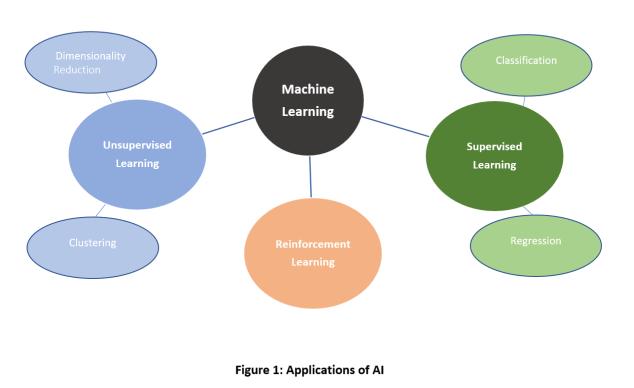
Supervised Learning: This technique involves training models on labeled historical datatopredictassetperformance.Bylearning from past market behavior, supervised learning models can forecast future trends andassetprices,helpingtoinforminvestment decisions [8]. For instance, supervised learning algorithms can predict stock price movements by analyzing historical price data and associated features, such as trading volumes and economic indicators. This method allows robo-advisors to make informed recommendations that reflect historical performance and trends, improving theaccuracyoftheirinvestmentstrategies.
Unsupervised Learning: Unlike supervised learning, unsupervised learning does not rely on labeled data. Instead, it identifies hidden patterns and anomalies in financial data without predefined labels [9]. This technique is particularly useful for clustering similar investment assets, detecting market anomalies, and uncovering underlying structures in financial data that may not be immediately apparent. By grouping assets with similar characteristics, unsupervised learning helps in diversifying portfolios and identifying unique investment opportunities that might be overlooked through traditional analysismethods.
Reinforcement Learning: This method involves optimizing investment strategies through a reward-based system. Reinforcement learning algorithms continuously learn from their interactions with the market environment, improving decision-making processes over time [10]. Thesealgorithmsadjusttheirstrategiesbased on feedback received from market performance, striving to maximize long-term returns while managing risk. This dynamic adjustment helps in adapting to changing market conditions and improving the overall performanceoftheinvestmentportfolio.
Eachofthesealgorithmicparadigmsplaysacrucialrolein various machine learning applications, ranging from classification and regression to clustering and reinforcement learning, contributing to the advancement ofAItechnologiesacrossdiversedomains.
-0056
Volume: 11 Issue: 07 | July 2024 www.irjet.net p-ISSN:2395-0072
NLP enables robo-advisors to analyze and interpret vast amounts of textual data, such as financial news, earnings reports, and social media sentiments. By processing this unstructured data, NLP techniques provide a deeper understanding of market trends and potential impacts on investments [11]. For example, sentiment analysis can gauge market sentiment by analyzing the tone of financial newsarticlesorsocialmediaposts,allowingrobo-advisors to incorporate qualitative information into their investmentmodels.Thisabilitytoprocessandunderstand natural language data adds a new dimension to the analysis, enabling robo-advisors to respond more effectively to market developments and investor sentiments.
The ability to process and analyze large datasets is a cornerstone of AI-driven robo-advisors. Big data analytics allows these platforms to identify investment opportunities and risks more accurately, enhancing the decision-making process [5]. By leveraging big data, roboadvisorscanevaluatea broaderrangeoffactors,including macroeconomic indicators, market trends, and individual investor behavior, to provide more informed and timely investmentrecommendations.
AI-driven robo-advisors integrate diverse data sources, such as historical market data, real-time trading data, and alternative data (e.g., social media trends, weather patterns). This holistic approach enables a more comprehensiveanalysisofmarketconditionsandpotential investment opportunities [6]. By combining traditional financial data with alternative data sources, robo-advisors can gain deeper insights and improve the robustness of theirinvestmentstrategies.
By applying predictive analytics, robo-advisors can forecastfuturemarketmovementsandassetperformance. This capability allows them to proactively adjust investmentstrategies,therebyenhancingportfolioreturns and managing risks [2]. Predictive models help in anticipating market trends and making preemptive adjustments to investment portfolios, optimizing returns andmitigatingpotentiallosses.
Bigdataanalyticsfacilitatesadvancedriskassessmentand management. AI-driven robo-advisors can conduct stress tests and scenario analyses, ensuring portfolios are resilient to market volatility and unexpected events [1] This proactive risk management approach helps in identifying potential risks and implementing strategies to protecttheportfoliofromadversemarketmovements.
The integration of AI-driven robo-advisors into the financial landscape has fundamentally transformed investment decision-making processes. These platforms leverage advanced technologies to provide personalized, data-driven investment strategies, revolutionizing the way individualsmanagetheirportfolios.Thissectionseefigure 2 below which explores the profound impact of AI-driven robo-advisors on investment decision-making, examining key factors such as enhanced personalization, improved accuracy and speed, behavioral insights, and accessibility. By analyzing these aspects, we can gain insights into how AI-driven robo-advisors are reshaping the financial industry and empowering investors with more efficient andeffectivetoolsformanagingtheirwealth.
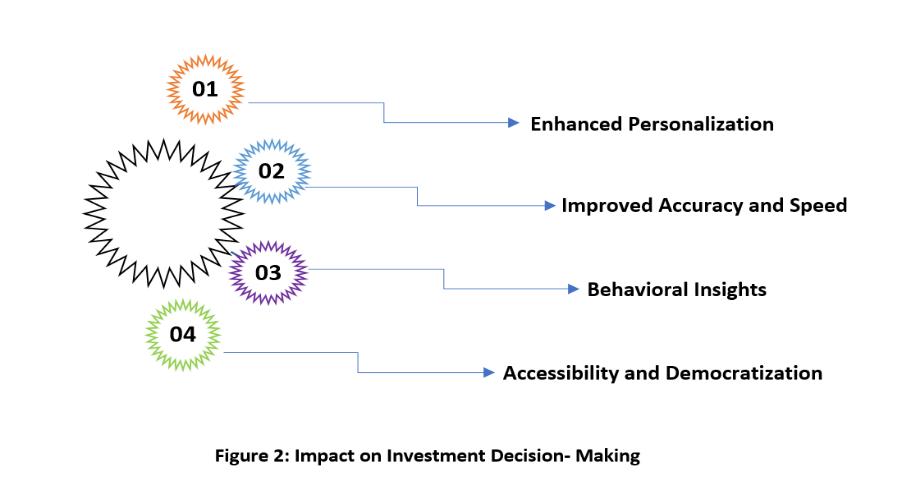
AI-driven robo-advisors utilize machine learning algorithms to tailor investment strategies to individual financial goals, risk tolerances, and time horizons. Unlike traditional methods, which often rely on standardized approaches, robo-advisors can analyze vast amounts of data to offer highly personalized recommendations [2]. Thislevel ofcustomization enablesinvestorstoaligntheir portfolios more closely with their unique circumstances
International Research Journal of Engineering and Technology (IRJET) e-ISSN:2395-0056
Volume: 11 Issue: 07 | July 2024 www.irjet.net p-ISSN:2395-0072
and preferences, enhancing the likelihood of achieving theirfinancialobjectives.
One of the key advantages of AI-driven robo-advisors is their ability to process and analyze real-time data swiftly and accurately. By leveraging advanced algorithms, these platforms can make rapid investment recommendations basedonthelatest marketinformation [3].This enhanced speed and accuracy enable investors to capitalize on market opportunities more effectively and react promptly to changing conditions, ultimately improving the overall efficiencyofinvestmentdecision-makingprocesses.
AI algorithms embedded within robo-advisors have the capabilitytodetectandmitigatecognitivebiasesthatoften influencehumaninvestors.Byanalyzinginvestorbehavior and market trends, robo-advisors can identify and counteract biases such as overconfidence, loss aversion, and herd behavior [4]. This promotes more rational and disciplined investment decisions, reducing the likelihood of emotional responses that may lead to suboptimal outcomes.
Another significant impact of AI-driven robo-advisors is their role in democratizing access to high-quality investment advice. These platforms lower the barrier to entry for individuals seeking financial planning services, particularly those with lower investable assets [1]. By offering affordable and user-friendly solutions, robo-advisors empower a broader audience toparticipateinthefinancialmarketsandbuildwealth overtime.
Through a comprehensive examination of these factors,wecangainadeeperunderstandingofhowAIdriven robo-advisors are reshaping investment decision-making processes, democratizing access to financial services, and empowering investors to achievetheirfinancialgoalsmoreeffectively.
In the realm of investment management, portfolio performance is a critical metric that investors and financial advisors seek to optimize. With the emergence of AI-driven robo-advisors, there has been a notable shift inhow portfoliosare managed and the potential impact on their performance. This section see figure 3 below which explores explores how AI-
driven robo-advisors influence portfolio performance through enhanced risk management, diversification strategies,andimprovedperformancemetrics.
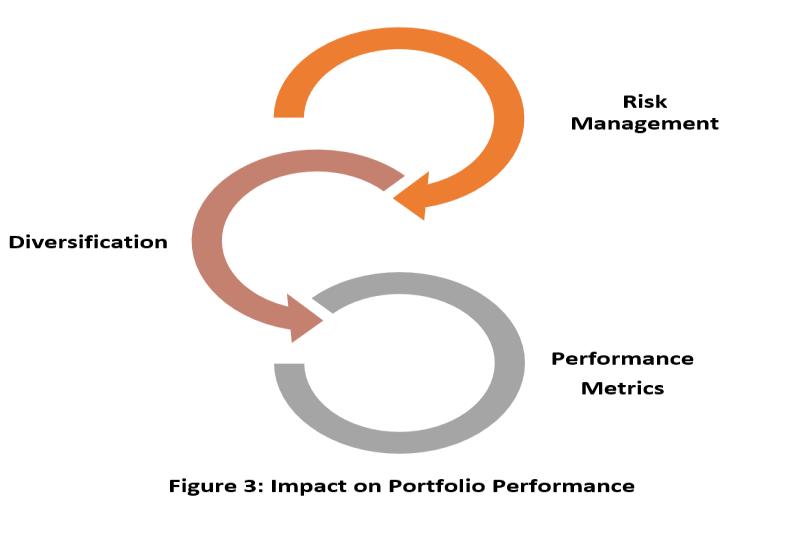
Advanced risk management is paramount in ensuring the resilience of investment portfolios against market volatility and unforeseen events. AI-driven roboadvisors leverage sophisticated risk assessment models to conduct comprehensive stress tests and scenario analyses. These models enable them to identify potential risks and vulnerabilities within portfolios, allowing for proactive risk mitigation strategies[10]
Diversificationisakeystrategyemployedbyinvestors to spread risk across different asset classes and minimizeexposuretoanysingleinvestment.AI-driven robo-advisors utilize advanced portfolio optimization techniques to enhance asset allocation and diversification. By analyzing large datasets and considering various risk factors, these platforms optimize portfolios to achieve a balance between risk and return, ultimately reducing overall portfolio risk [2]
Theperformanceofinvestmentportfoliosmanagedby AI-driven robo-advisors is often evaluated based on empiricalperformancemetrics.Studieshaveindicated that portfolios managed by these platforms tend to outperform those managed by traditional advisors. Thisoutperformancecanbeattributedtothesuperior
International Research Journal of Engineering and Technology (IRJET) e-ISSN:2395-0056
Volume: 11 Issue: 07 | July 2024 www.irjet.net p-ISSN:2395-0072
data analysis capabilities, continuous learning algorithms, and optimization techniques employed by AI-drivenrobo-advisors[5]
While AI-driven robo-advisors offer promising opportunities for enhancing investment decisionmaking and portfolio performance, they also face several challenges and limitations. Addressing these issues is essential to ensure the effective and responsible deployment of these technologies in the financial sector. This section examines the key challenges and limitations encountered by AI-driven robo-advisors, including concerns related to data privacyandsecurity,algorithmictransparency,market volatility,andregulatorycompliance.
5.1.
The processing of vast amounts of sensitive financial data by robo-advisors raises concerns regarding data privacy and security. Robust security measures are necessary to protect against breaches and unauthorized access, safeguarding user privacy and confidentialinformation[1]
5.2.
ThecomplexityofAIalgorithmsusedinrobo-advisors can create a lack of transparency, commonly referred to as the "black-box" effect. Users may find it challenging to understand the decision-making processes behind algorithmic recommendations, leading to trust issues and concerns about accountability[3].
5.3.
While AI-driven robo-advisors are adept at handling typical market fluctuations, they may struggle to navigate extreme conditions or unforeseen events, such as black swan events. Continuous improvement andoversightarenecessarytoenhancetherobustness of these systems and mitigate the impacts of market volatilityoninvestmentperformance[5].
5.4.
Adhering to diverse and evolving regulatory frameworks is essential for the sustainable operation ofrobo-advisors.Compliancewithregulationsensures the protection of investors' interests, maintains the integrity of financial markets, and fosters trust in AIdrivenfinancialservices[6,12].
Casestudiesoffervaluableinsightsintothereal-world application and impact of AI-driven robo-advisors in the financial sector. By examining specific examples, we can gain a deeper understanding of how these platforms perform compared to traditional advisory services, their response to market volatility, and user satisfaction levels. This section presents three case studies that highlight the performance comparison, resilience during market volatility, and user adoption andsatisfactionofAI-drivenrobo-advisors.
6.1.
Case Study 1: Wealthfront vs. Traditional Advisory Services
Wealthfront, a prominent AI-driven robo-advisor, has demonstratedsignificantoutperformancecomparedto traditional advisory services. Through the analysis of portfolioreturnsoverafive-yearperiod,Wealthfront's utilization of tax-loss harvesting and continuous optimization strategies has led to higher net returns for investors. This case study showcases the effectiveness of AI-driven robo-advisors in generating superiorinvestmentoutcomescomparedtotraditional advisoryapproaches.
Betterment, another leading robo-advisor, has exhibitedresilienceduringperiodsofmarketvolatility. By dynamically adjusting asset allocations based on real-time data analysis, Betterment has demonstrated the ability to outperform traditional advisory strategies during market downturns. This case study underscorestheimportanceofagilityandadaptability innavigatingvolatilemarketconditions,traitsthatAIdrivenrobo-advisorsarewell-equippedtoleverage.
6.2.
Case Study 3: User Experience and Satisfaction with AI-driven Robo-Advisors
Surveys and interviews conducted with users of AIdriven robo-advisors reveal high levels of satisfaction withtheseplatforms.Usersappreciatetheeaseofuse, transparency in fee structures, and the quality of personalized advice provided by robo-advisors. Additionally,thelowercostsassociatedwithAI-driven robo-advisors and the ability to manage investments with minimal effort contribute to their widespread
2024, IRJET | Impact Factor value: 8.226 | ISO 9001:2008
International Research Journal of Engineering and Technology (IRJET) e-ISSN:2395-0056
Volume: 11 Issue: 07 | July 2024 www.irjet.net p-ISSN:2395-0072
adoption among investors. This case study highlights the positive user experience and satisfaction associated with AI-driven robo-advisors, contributing to their growing popularity in the financial services industry.
The future landscape of AI-driven robo-advisors is poised for substantial evolution, driven by technological advancements, strategic integrations, and market expansions. These trends promise to further transform the financial advisory sector, enhancingthecapabilitiesandreachofrobo-advisors.
The convergence of AI-driven robo-advisors and human financial advisors represents a promising hybrid model that leverages the strengths of both. AIdriven platforms excel in data-driven insights and automated processes, while human advisors bring nuanced understanding and emotional intelligence to client interactions. This hybrid approach allows for personalized investment strategies that benefit from the precision of AI and the empathy of human advisors. For instance, while AI can efficiently analyze vastdatasetstoprovideinvestmentrecommendations, human advisors can offer personalized advice based on an individual's unique financial goals and life circumstances. Sironi (2016) discusses how this integration can address the limitations of both standaloneAIandhumanadvisoryservices,creatinga morerobustfinancialplanningecosystem.
Continuous advancements in AI, particularly in deep learning and natural language processing (NLP), are set to significantly enhance the capabilities of roboadvisors. Deep learning techniques enable the processing of complex and high-dimensional data, improving the accuracy and depth of investment analysis. NLP advancements allow robo-advisors to better understand and interpret textual data from diverse sources, such as financial news, earnings reports, and social media, providing more comprehensive market insights. These technological improvements will enable robo-advisors to deliver more sophisticated analyses and more personalized investmentsolutions.Koganetal.(2019)highlightthat these advancements will lead to better prediction accuracy and more tailored investment strategies,
enhancing the overall effectiveness of AI-driven financialadvisoryservices.
AI-drivenrobo-advisorsareanticipatedtoexpandinto emerging markets and new asset classes, such as cryptocurrencies and real estate. This expansion will broaden the scope of investment opportunities available to users, catering to diverse investment preferences and risk appetites. The inclusion of new asset classes allows investors to diversify their portfolios further, reducing risk and potentially increasing returns. D'Acunto et al. (2019) discuss how the ability of AI to analyze and integrate data from variousassetclasseswillenablerobo-advisorstooffer more holistic and diversified investment strategies. Additionally,theexpansionintoemergingmarketswill make sophisticated financial planning accessible to a broader audience, supporting financial inclusion and democratizationofinvestmentservicesglobally.
AI-driven robo-advisors represent a significant advancement in the financial advisory sector, offering numerous benefits in terms of personalization, efficiency, and performance. These platforms utilize advanced technologies such as machine learning, natural language processing (NLP), and big data analytics to deliver highly customized investment advice and portfolio management services. The integration of these technologies has revolutionized the way investment decisions are made, enabling a level of precision and personalization that was previously unattainable with traditional methods Looking ahead, the future of AI-driven robo-advisors appears promising. The integration of AI-driven roboadvisors with human financial advisors is likely to become a dominant model. This hybrid approach combines the strengths of both, offering personalized, data-driven insights with the nuanced understanding and emotional intelligence of human advisors. Furthermore, continuous advancements in AI technologies, particularly in deep learning and NLP, will further enhance the capabilities of robo-advisors. These improvements will lead to more sophisticated analysis, better prediction accuracy, and more personalized investment The expansion into new markets and asset classes, such as cryptocurrencies and real estate, will also broaden the scope of investment opportunities available to users. This expansion will support financial inclusion and
International Research Journal of Engineering and Technology (IRJET) e-ISSN:2395-0056
Volume: 11 Issue: 07 | July 2024 www.irjet.net p-ISSN:2395-0072
democratization globally, allowing more people to benefitfromsophisticatedfinancialplanningservices.
In summary, AI-driven robo-advisors have the potential to significantly transform the financial advisorysector.Whiletherearechallengestoaddress, the benefits of enhanced personalization, improved accuracy, democratization of financial advice, and the promise of continuous technological advancements position AI-driven robo-advisors as a vital component of the future financial landscape. As these platforms continue to evolve and mature, they will play an increasingly integral role in helping investors achieve theirfinancialgoals.
[1]. Bhatia, A., & Sharma, S. (2021). The impact of artificialintelligenceonfinancialservices.Journal ofFinancialTechnology,2(3),45-59.
[2].D'Acunto,F.,Prabhala,N.,&Rossi,A.G.(2019).The promises and pitfalls of robo-advising. Review of FinancialStudies,32(5),1983-2020.
[3].Fisch,J.E.,Laboure,M., &Turner,J.A.(2019).The futureofretirementandthepensionsystem:How to adapt, prepare, and profit from the changes. OxfordReviewofEconomicPolicy,35(1),1-15.
[4]. Kaya,O.(2017).Robo-advice:Atrueinnovationin asset management. Deutsche Bank Research, 123.
[5]. Kogan, S., Routledge, B. R., & Sagi, J. S. (2019). Machinelearning and big data in finance. Annual ReviewofFinancialEconomics,11(1),287-309.
[6]. Sironi, P. (2016). FinTech Innovation: From RoboAdvisors to Goal Based Investing and Gamification.Wiley.
[7]. Lam, J. (2016). Robo-advisors: A portfolio management perspective. The Journal of Wealth Management,19(1),1-4.
[8]. Khadri Syed, W., & Janamolla, K. R. (2023). Fight against financialcrimes – early detection and prevention of financial frauds in thefinancial sector with application of enhanced AI. IJARCCE, 13(1), 59–64. https://doi.org/10.17148/ijarcce.2024.13107
[9] Mohammed, M., Mohammed, A. J., Mohammed, U. U., & Mohammed, Z. A. (2024). Advancements in
AI-based security and threat detection. IJARCCE, 13(4). https://doi.org/10.17148/ijarcce.2024.13459
[10]. Yang, S., Moallemi, C. C., & Foschini, L. (2020). Deep reinforcement learning in high frequency trading. Journal of Financial Economics, 138(1), 55-72.
[11]. Chowdhary, K., & Chowdhary, K. R. (2020). Natural language processing. Fundamentals of artificialintelligence,603-649.
[12]. Janamolla, K. R., & Syed, W. K. (2024). Global Banking Exploring Artificial Intelligence Role in Intelligent Banking to Automate Trading Platform. International Journal of Multidisciplinary Research and Publications (IJMRAP),6(12),163–168.