
International Research Journal of Engineering and Technology (IRJET) e-ISSN: 2395-0056
Volume: 11 Issue: 07 | July 2024 www.irjet.net p-ISSN: 2395-0072

International Research Journal of Engineering and Technology (IRJET) e-ISSN: 2395-0056
Volume: 11 Issue: 07 | July 2024 www.irjet.net p-ISSN: 2395-0072
Sheela N S1 , Surekha Bijapur1 , Dr. J Venkata Krishna2
1 Research Scholar, Dept. of Computer Science and Engineering, Srinivas University, Mangaluru, Karnataka, India
2 Associate Professor, Dept. of Computer Science and Engineering, Srinivas University, Mangaluru, Karnataka, India
Abstract - NeuralNetworksareinspiredbyhumanbrain,to makethecomputertoprocess data. NeuralNetworksareused in Deep Learning which is a subset of Machine Learning and Artificial Intelligence. Many models of Neural Networks are implemented based on the target applications. This paper provides an overview about deep learning. Initially, the development of deep learning is described. Later it focuses on thebasicconcepts ofNeuralNetworksessentialtounderstand theworking. Thirdlyit focuses onfew key modelssuchas Feed Forward Neural Network, Recurrent Neural Network, and ConvolutionalNeuralnetworktheirarchitectureandworking. At last, it discusses about the trends of deep learning.
Keywords: Deep Learning, Neural Networks, Artificial Intelligence, Machine Learning, Feed Forward Neural Network, Convolutional Neural Network, Recurrent Neural Network.
Deep learning, a class of machine learning techniques teachesthecomputerstoprocessdatainawaythehuman braindoes.Deeplearningusesmultilayeredneuralnetworks which is inspired by human brain to solve the complex problems. The key difference between deep learning and machine learning is the underlying neural network architecture.Machinelearningusessimpleneuralnetwork whereasDeeplearningusesmorelayeredneuralnetworks.
The evolution of deep learning can be traced back to the earlydaysofartificialintelligenceandneuralnetworks.The primarygoalofdeeplearningandartificialneuralnetworks istomakeacomputersystemtosimulatehumanbrain.The history of deep learning takes us back to 300 BC, AssociationismtheorystatedbyAristotle[1].Associationism isatheorystatesthatmindisasetofconceptualelements thatareorganizedasassociationsbetweentheseelements [2].
The evolution of deep learning starts in 1942, with the conceptofartificialneuron.WarrenMcCullochandWalter Pittsdeveloped a mathematical model which based on the workingofbasicbiologicalneuron.Thatartificialneuronis called MCP-neuron. That laid the foundation for Deep Learning[2].
In 1949 Donald Hebb considered as the father of neural networks, introduced Hebbian Learning Rule, in his book “The Organization of Behavior”whichlaysthefoundation ofmodernneuralnetwork.Thisruleexplainshowneurons adaptandformstrongerconnectionsthroughrepeateduse [3].In 1958 Frank Rosenblatt introduced the first perceptron to mimic the human brain's learning process, whichhighlyresemblesmodernperceptron[4].
Back-propagation a learning procedure which repeatedly adjusts the weights of the connections in the network to minimize a measure of the difference between the actual output vector of the net and the desired output vector is proposedbyDavidE.Rumelhartetal.in1986[5]
In1998LeNet-5DevelopedbyLeCunetal.,LeNetwasoneof the first successful applications of convolutional neural networks (CNNs), a Gradient-Based Learning Applied to handwritten digit recognition tasks was a major step in learningfromdata[6].
Hintonetal.proposeddeepbeliefnetworks(DBNs)in2006, a generative model for digit classification. This reignited interestindeeplearningbydemonstratingtheircapabilityto learnhierarchicalrepresentations[7].In2012Krizhevskyet al.'sAlexNetachievedsignificantbreakthroughsusingdeep convolutional neural network to classify high-resolution imagesclassification[8],markingthebeginningofthedeep learningera.
Rob Fergus et al. made an improvement of AlextNet with greater accuracy and named as ZFNet [13] in 2013. A GoogleNet[19]waspropsedbySzegedyetal.in2014called asInception-V1toassessthequalityinthecontextofobject detection and classification. In 2014 VGGNet [20] a deep convolutional network introduced by Simonyan et al. for large-scaleimageclassification.Laterin2015KaimingHeet al. used Residual Networks (ResNets) [21] for computer vision applications like object detection and image segmentation.
Inthissectionwearediscussingveryessentialconceptsand terminologiesinordertounderstanddeeplearning[9].
Neuron: a neuron forms the basic structure of a neural network.A neuronisa mathematical model receivesan
International Research Journal of Engineering and Technology (IRJET) e-ISSN: 2395-0056
Volume: 11 Issue: 07 | July 2024 www.irjet.net p-ISSN: 2395-0072
input,computestheweightedaverageofitsinputandthen applies a bias to it. Post that, it passes this resultant term throughanactivationfunctionand generates a nonlinear outputwhichiseithersent tootherneuronsforfurther processingoritisthefinaloutput.
Activation function: itismathematicalfunctionwhichtakes linearinputandproducenonlinearoutput.Therearethree typesofactivationfunction:
Binary Step: It is a very simple activation function. The binaryoutputisproducedbythefunctionwhichisbasedon whethertheinputisaboveorbelowcertainthreshold.
Linear activation function: It is also a simple activation function. It is similar to straight line equation f(x)=x. The outputisproportionaltoinput.Itisusedonlyintheoutput layerastheydon’tcapturenonlineardata.
Nonlinear activation function: It is a very complex activation function. It produces nonlinear output. These functionsareusedtoaddnonlinearity,throughwhichitis possible to achieve non-linear mappings from inputs to outputs. Thus it is important to use non-linear activation functionsinneuralnetworks[10].
Themostcommonlyusednon-linearactivationsare:
Sigmoid or Logistic Activation Function: Itisthecommon activationfunctionusedinneuralnetwork[11].Itisgivenas below:
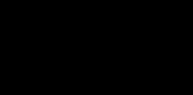
inwhich,x (-,+),f (0,1)
Tanh Function (Hyperbolic Tangent): It is same as sigmoidactivationfunction.Itrangesbetween-1to1.The equationoftanhfunctionis:
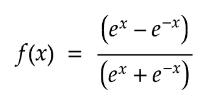
ReLU Function: RectifiedLinearUnitisalsooneofthemost commonlyusedactivationfunctioninneuralnetwork.Itisa mostefficientfunction.Itismathematicallyrepresentedas:
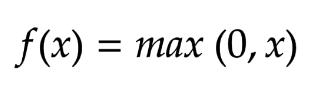
Theabovefunctionsarethemostcommonlyusedactivation functions.Therearethevariationsofthefunctionswhichare usedasactivationfunctions.
Weights: Weightsarethenumericalvaluesassociatedwith eachinputvalues.Itdeterminestheimportanceoftheinput
in predicting the input. Initially the weights are selected randomlyandlateradjustedinthebackpropagation.
Bias: It is a numeric value which help us to shift the activationfunction.Therearemanytechniquestoinitialize thebiasvalue.
Epoch: Anepochisonecycleoftrainingtheneuralnetwork with all the training data. This one cycle includes both forwardpassandbackwardpass.
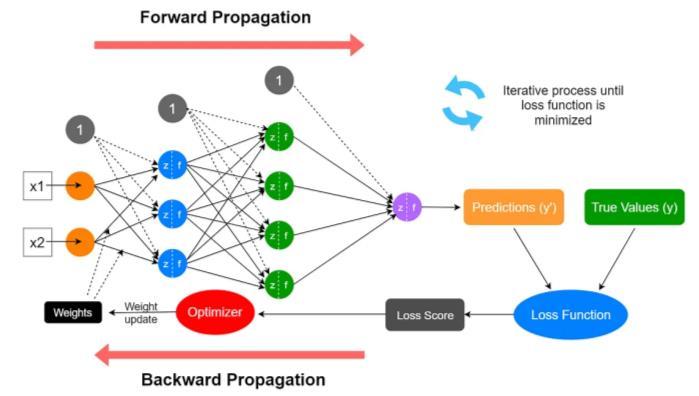
Neuralnetworkmakesthedecisionsinamannersimilarto thehumanbrain.Figure1[22]showstheworkingofNeural NetworkTheinputispassedthroughthenetworklayersto generateoutput.Thelayersinvolvedinthemodelareone inputlayer,oneoutputlayerandoneormorehiddenlayers. Theinputisfedintoinputlayer.Thehiddenlayersprocess the input data by applying the activation function to the weightedsumoftheseinputsandpassestheresulttonext layer.Thiswillcontinueuntilitreachestheoutputlayer.In outputlayerthenetworkoutputisgenerated.Thelossscore iscalculatedandoptimizerisusedtoadjusttheweightsand biasesinbackpropagation.
In this section we are focusing on more popular neural network models such as Feed Forward Neural Networks, Recurrent Neural Networks and Convolutional Neural Networksamongsttheavailablemodels.Wearepresenting thearchitecture,workingandapplicationsofthosemodels.
Feedforwardneuralnetworkisverysimpleandbasicneural networks.Asthenameindicatestheinputflowsfrominput layer to output layer through hidden layers. There is no feedback from the output layer to input layer. The model comparespredictedoutputwiththeactualoutputandadjust the weights according to the error value. Many such iterationsresultinthemoreaccuratepredictionofoutput.
International Research Journal of Engineering and Technology (IRJET) e-ISSN: 2395-0056
Volume: 11 Issue: 07 | July 2024 www.irjet.net p-ISSN: 2395-0072
Feed forward neural networks are categorized into two categoriessinglelayerandmulti-layerbasedonthelayers [12].
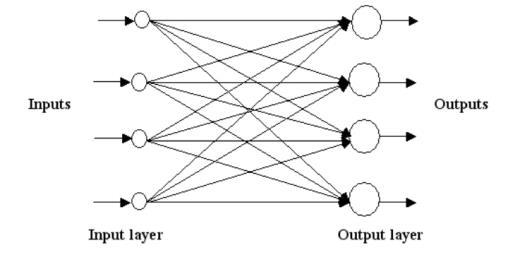
Singlelayerfeedforwardneuralnetworkisasshowinthe figure2[12].Ithasonlytwolayersinputandoutput.Each inputisgiventooutputlayerdirectlytoproduceoutput.The finaloutputiscomputedbysumminguptheoutputsfromall neurons ofoutputlayer. Thismodel is limitedinhandling complexdatabecauseofsinglelayer.
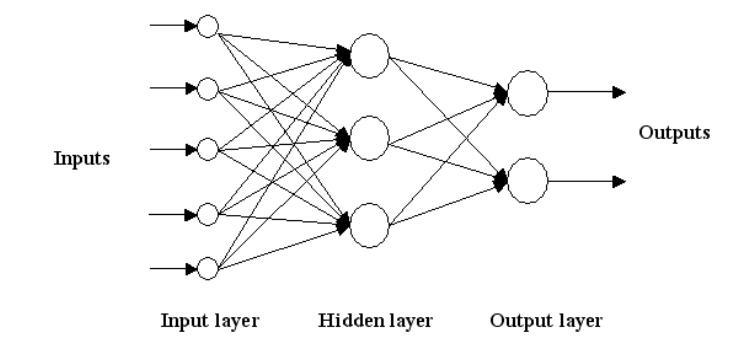
Multi-layeredfeedforwardneuralnetworkisalsocalledas multi-layer perceptron (MLP). It has a multiple layers of neurons.Thelayersareaninputlayer,anoutputlayerand oneormorehiddenlayers.Figure3[12]showsoneofsuch MLP. It is referred as 5-3-2 network because there are 5 inputneurons,3hiddenneuronsand2outputneurons.
Back propagation algorithm is one of the most popular algorithmsusedtotrainthefeedforwardneuralnetworks.It isa supervisedlearning methodthe weights ofthe neural networkareadjustedusingthisalgorithm.Duringalearning phase,theoutputofthenetworkiscomparedwiththeactual outputtoknowhowwellthemodelisworkingbasedonthe difference.Thisdifferenceiscalledaserrorvaluebasedon this value the weights are adjusted in each epoch of the learningphase.
CNNs are specialized neural networks also known as ConvNet.Itisbasicallyusedforcomputervisiontasks like object recognition, image classification, detection and segmentation.
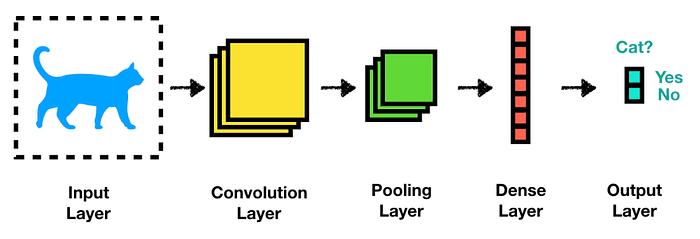
Thelayerssuchasconvolutionallayers,poolinglayersand fullyconnectedlayersthekeyscomponentsofconvolutional neuralnetworks.AtypicalCNNarchitectureisasshownin the figure 4 [23]. It consists of repetitions of a stack of severalconvolutionlayersandapoolinglayer,followedby oneormorefullyconnectedlayers.
Convolution
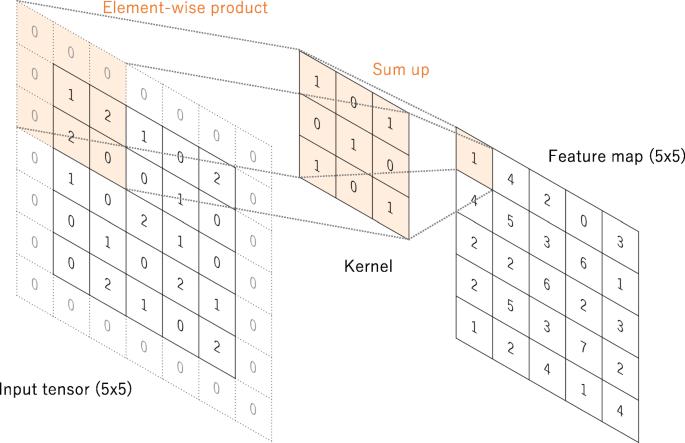
ItisthefundamentalcomponentinCNNthemathematical operationconvolutionisperformed.Convolutionisalinear operation used to extract the feature. The steps of this operationareasfollow.
1 Kernel a small arrayofnumbersisappliedacross thetensoranarrayofnumbersthatrepresentsthe input.
2 Element-wise multiplications are performed betweeneachelementofkernelandthetensorat eachlocationofthetensorstartingfromthetop-left cornertoright.
3
Theproductfromtheabovestepissummedupto obtainoutputvaluecalledasfeaturemap.
4 Theabovestepsarerepeateduntiltheimagematrix isfullycovered.
TheconvolutionoperationisasshownintheFigure5[14] The outputof convolution operation isthen passed to the nonlinearactivationfunctionReLU.
Pooling layer
Poolinglayerprovidedownsamplingoperation,whichisa technique used to reduce the dimensions of feature maps while retaining the essential information. There are many typesofpooling[26]
Maxpooling:willselectthemaximumvalueofthe featuremapregioncoveredbythefilter.
Global pooling: Every channel of the feature map getsreducedtosinglevalue
Average pooling: The average value of the presented elements in the feature map’s region coveredbythefilteriscomputed
International Research Journal of Engineering and Technology (IRJET) e-ISSN: 2395-0056
Volume: 11 Issue: 07 | July 2024 www.irjet.net p-ISSN: 2395-0072
Fully connected layer
Itisalsoknownasdenselayer[14].Theinputtothislayeris one-dimensionalmatrixgeneratedbythelastpoolinglayer. TheReLUistheactivationfunctionusedinthislayer.
RNNsareanotherkeymodelofNeuralNetworks.Theyare derived from feed forward neural networks but internal memorycapabilitymakesitdifferentfromthefeedforward neuralnetwork(figure6[25]).RNNsareusedforsequence prediction. They are also popular in natural language processing.
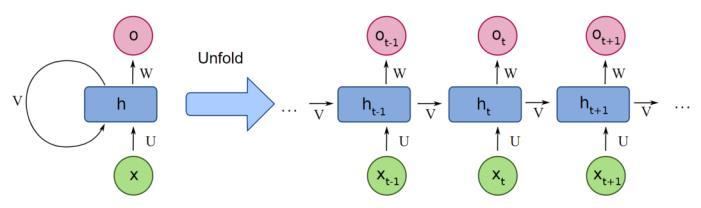
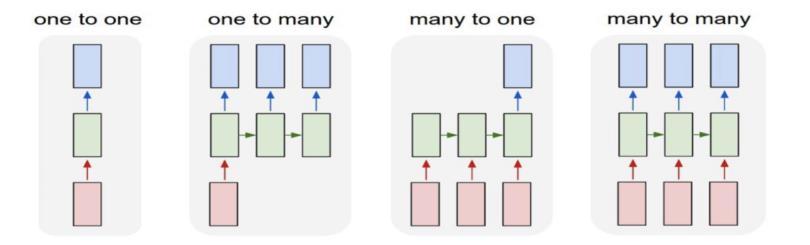
Figure7[24]showsthetypesofRNN.Therearefourtypes of RNN based on the number of inputs and number of outputsinthenetworksuchas:
One-to-one:oneinputandoneoutput
One-to-many:oneinputandmanyoutputs
many-to-one:manyinputsandoneoutput
many-to-many:manyinputsandmanyoutputs
Generative AI- GenerativeAIisanAItechnologythatcan generatevarious new contentslike text, image,audio etc., basedonwhatithaslearnedfromexistingcontent[15].Itis a subset of Deep Learning make use of Generative AdversarialNetworksandimplementthemodels.
Natural Language Processing(NLP)- NLPisasubfieldofAI uses the machine learning and deep learning to make a devicetounderstandandgeneratethetext[16].NLPisused widerangeofapplicationsindailylifelikesearchengines, chatbots,virtualassistanceandmuchmore.
Explainable AI(XAI)- XAIisanAIwhichproduceoutputand make users to understand it easily by providing transparencyofthemodelworking.Thismakesthemodel trustworthy.TheapplicationdomainsofXAIareagriculture, healthcare,finance,computervisionandsomany[17].
Continual Learning- Continual Learning(also known asIncrementalLearning, Life-longLearning) is a conceptto learn a model for a large number of tasks sequentially withoutforgettingknowledgeobtainedfromthepreceding tasks, where the data in the old tasks are not available anymore during training new ones. It has three scenarios task-incremental learning(Task-IL), domain-incremental Learning(Domain-IL)andclass-incrementallearning(ClassIL)[18].
Hybrid models- This model combines different types of deepneuralnetworksorotherMLtechniquesinordertoget thegoodperformanceandaccuracy.
DeeplearningisasubsetofArtificialIntelligenceprovides powerful tools for data analysis and decision-making as resultrevolutionizedmanyfields.InThisreviewpaperwe highlighted the historical development, key architectures andtrendsofdeeplearning.Alongwithcontinuousevolution andaddressingcurrentchallengesitprovidesusthefuture researchdirections.
[1] WHBurnham.Memory,historicallyandexperimentally considered. i. an historical sketch of the older conceptions of memory. The American Journal of Psychology,2(1):39–90,1888.
[2] Haohan Wang & Bhiksha Raj “On the Origin of Deep Learning”,arXiv:1702.07800 [cs.LG], 2017
[3] D.O. Hebb, The organization of behavior; a neuropsycholocigal theory, A Wiley Book in Clinical Psychology62(1949)78.
International Research Journal of Engineering and Technology (IRJET) e-ISSN: 2395-0056
Volume: 11 Issue: 07 | July 2024 www.irjet.net p-ISSN: 2395-0072
[4] Rosenblatt, F. (1958). The Perceptron: A probabilistic modelforinformationstorageandorganizationinthe brain.PsychologicalReview,65(6),386-408.
[5] Rumelhart,D.E.,Hinton,G.E.,&Williams,R.J.(1986). Learning representations by back-propagating errors. Nature,323(6088),533-536.
[6] LeCun, Y., Bottou, L., Bengio, Y., & Haffner, P. (1998). Gradient-based learning applied to document recognition. Proceedings of the IEEE, 86(11), 22782324.
[7] Hinton, G. E., Osindero, S., & Teh, Y. W. (2006). A fast learning algorithm for deep belief nets. Neural Computation,18(7),1527-1554.
[8] Krizhevsky, A., Sutskever, I., & Hinton, G. E. (2012). ImageNetclassificationwithdeepconvolutionalneural networks.AdvancesinNeural InformationProcessing Systems,25,1097-1105.
[9] Bishop,ChristopherM.,andHughBishop. Deeplearning: Foundations and concepts.SpringerNature,2023.
[10] Sharma, S., Sharma, S., & Athaiya, A. “Activation functionsinneuralnetworks”,InternationalJournalof EngineeringAppliedSciencesandTechnology,2020Vol. 4,Issue12,ISSNNo.2455-2143,Pages310-316
[11] B.Ding,H.QianandJ.Zhou, "Activationfunctionsand their characteristics in deep neural networks," 2018 Chinese Control And Decision Conference (CCDC), Shenyang,China,2018,pp.1836-1841,
[12] Sazlı,M.H.(2006).Abriefreviewoffeed-forwardneural networks. CommunicationsFacultyofSciencesUniversity of Ankara Series A2-A3 Physical Sciences and Engineering, 50(01).
[13] Zeiler, M. D., & Fergus, R. (2014). Visualizing and understanding convolutional networks. In Computer Vision–ECCV 2014: 13th European Conference, Zurich, Switzerland, September 6-12, 2014, Proceedings, Part I 13 (pp.818-833).SpringerInternationalPublishing.
[14] Yamashita,R.,Nishio,M.,Do,R.K.G. et al. Convolutional neural networks: an overview and application in radiology. Insights Imaging 9,611–629(2018).
[15] Feuerriegel,S.,Hartmann,J.,Janiesch,C.,&Zschech,P. (2024). Generative ai. Business & Information Systems Engineering, 66(1),111-126.
[16] Khurana,D.,Koli,A.,Khatter,K. et al. Naturallanguage processing: state of the art, current trends and challenges. MultimedToolsAppl 82,3713–3744(2023).
[17] Saranya A., Subhashini R., A systematic review of Explainable Artificial Intelligence models and applications: Recent developments and future trends, Decision Analytics Journal, Volume 7, 2023, 100230, ISSN2772-6622
[18] VandeVen,G.M.,&Tolias,A.S.(2019).Threescenarios forcontinuallearning. arXiv preprint arXiv:1904.07734
[19] Szegedy, C., Liu, W., Jia, Y., Sermanet, P., Reed, S., Anguelov,D.,...&Rabinovich,A.(2015).Goingdeeper withconvolutions.In Proceedings oftheIEEEconference on computer vision and pattern recognition (pp.1-9).
[20] Simonyan, K., & Zisserman, A. (2014). Very deep convolutional networks for large-scale image recognition. arXiv preprint arXiv:1409.1556
[21] He, K., Zhang, X., Ren, S., & Sun, J. (2016). Identity mappings in deep residual networks. In Computer Vision–ECCV 2016: 14th European Conference, Amsterdam, The Netherlands, October 11–14, 2016, Proceedings, Part IV 14 (pp. 630-645). Springer InternationalPublishing.
[22] https://medium.com/data-science-365/overview-ofa-neural-networks-learning-process-61690a502fa
[23] https://towardsdatascience.com/convolutional-neuralnetwork-a-step-by-step-guide-a8b4c88d6943
[24] https://builtin.com/data-science/recurrent-neuralnetworks-and-lstm
[25] https://www.analyticsvidhya.com/blog/2022/03/abrief-overview-of-recurrent-neural-networks-rnn/
[26] https://www.geeksforgeeks.org/cnn-introduction-topooling-layer/