
International Research Journal of Engineering and Technology (IRJET) e-ISSN: 2395-0056
Volume: 11 Issue: 07 | July 2024 www.irjet.net p-ISSN: 2395-0072
International Research Journal of Engineering and Technology (IRJET) e-ISSN: 2395-0056
Volume: 11 Issue: 07 | July 2024 www.irjet.net p-ISSN: 2395-0072
Aarya Sutar1 , Parth Shah2 , Yashika Sonchatra3, Priyanka Deshmukh4
1Graduate Student, K.J. Somaiya Institute of Technology, Mumbai, Maharashtra, India
2Graduate Student, K.J. Somaiya Institute of Technology, Mumbai, Maharashtra, India
3Graduate Student, K.J. Somaiya Institute of Technology, Mumbai, Maharashtra, India
4Assistant Professor (Computer Department), K.J. Somaiya Institute of Technology, Mumbai, Maharashtra, India
Abstract -Inthis digitalera,facerecognition systemplays a vital role in almost every sector. Face recognition is one of the mostly used biometrics. It can used for security, authentication, identification, and has got many more advantages. Despite having lowaccuracy when compared to iris recognition and fingerprint recognition, it is being widely used due to its contactless and non-invasive process in this project, we have developed a platform for an attendance system. we have tried to eliminate the traditional system of attendance by using the main feature of a user i.e., his/her face. So, our system basically uses faces to mark the attendance for a particular session. This system consists of four phases- database creation, face detection, face recognition, attendance updating. Database is created by the images of the students in class. Face detection and recognition is performed using OpenCV and Local Binary Pattern Histogram algorithm respectively. Faces are detected and recognized from live streaming video of the classroom.
Key Words: Face Recognition, Biometrics, Security, Authentication, Attendance System, OpenCV, Local Binary Pattern Histogram
In today’s colleges, attendance management is critical to academic success, but traditional methods are inefficient and error-prone. Our advanced facial attendance technology uses facial recognition to track attendance accurately and efficiently without the need for in-person or written checks. The system instantly captures and processes student facial images to ensure accurate data doesnotdisrupttheflowoftheclassroom.Byeliminating manual input, teacherscan focus moreonteaching.Facial recognition technology provides high accuracy across multiple situations, reducing errors made with manual methods. Detailed reporting will help identify regular attendance and monitor overall status to provide timely support to students. Our face-based attendance system improves learning outcomes by simplifying attendance management and providing insight. Detailed reports help identify irregular attendance and track overall trends, enablingpromptsupportforstudents.
Face recognition is an important technology used to recognize people in all areas of daily life and is closely related to the perception of the human brain. The human retinainterpretslightpatterns,classifiesshapes,sizesand textures, and compares them to stored symbols to recognize faces. This process is difficult to replicate in technology,butthelargememoryandprocessingpowerof computers help overcome human limitations. These features make face recognition a good biometric method by comparing real-time images with images in the database to ensure accuracy. In airport security, it increases security by identifying passengers according to the watch list. It helps police track and arrest suspects in criminal investigations. Social media platforms use facial recognition to tag people in photos so they can be easily identifiedandcontacted.
Facial recognition can also be used to lock and unlock personal devices, providing a secure and convenient way to protect user data. Important points have been made along the way. A key first step was the introduction of principal component analysis (PCA) in 1988. Over the years, further advances in machine learning and artificial intelligence have increased the accuracy and speed of facial recognition machines, making them reliable and widelyapplicable.Deeplearningandadvancedalgorithms todealwithvariouschallengessuchaschangesinlighting, faces, and orientation. Its integration with security systems,social media,andpersonal devicesdemonstrates its importance in daily life, providing both convenience andenhancedsecurity.
The process of student attendance, such as attendance or passing an attendance sheet, can interfere with teaching and examination. This process not only takes up valuable classroomtime,butalsoaddsrepetitiveworkforteachers to count students and keep attendance records. Students are also prone to cheating as their friends can register to not come to school. To address these issues, facial recognition systems offer attendance tracking solutions
International Research Journal of Engineering and Technology (IRJET) e-ISSN: 2395-0056
Volume: 11 Issue: 07 | July 2024 www.irjet.net p-ISSN: 2395-0072
that eliminate these barriers and administrative burdens. procedures. This technological advancement not only savestime,butalsoincreasesaccuracy,ensuringthatonly genuine attendees are marked as present. But there are challenges to using face recognition instantly. The system must distinguish between familiar and unfamiliar images, managetheslowlearningprocess,andadapttochangesin lightingandhead.
Work under time constraints and maintain high accuracy. This includes overcoming issues such as background changes, lighting, poses, and facial expressions. A robust facerecognitionsystemmustprovideconsistent,fast,and accurate student identification regardless of these changes. By doing so, the system can improve attendance management,reducecheating,andallowteacherstofocus more on teaching, ultimately improving learning outcomes. By seamlessly integrating with existing attendance management software, the system also providesreal-timedataandinsights.
The author of the paper [1] proposed an attendance system that uses facial recognition and RFID to track student entry and exit, combining RFID technology with real facial recognition to ensure the accuracy of attendance information. This combination leverages the power of both technologies to provide a reliable and effective system for monitoring student activities in schools. An online attendance system is used to capture and record student activities. This method uses unique patterns in the iris that remain constant throughout a person's life, making it a reliable biometric identifier. The system captures a high-resolution image of the iris and matches it with a registered pattern to verify the user's identity and ensure attendance is accurate. The facial recognition system Oriented Gradient (HOG) and Support VectorMachine(SVM)algorithmsinFigure1aredesigned for various real-time situations. Using the Viola-Jones algorithm for face detection, HOG for feature extraction, and SVM for classification, solutions that can cope with diversity and robust environment are provided. and Fisher, a facial algorithm for face recognition, found Eigenface accuracy to be between 70% and 90%. This study shows the advantages and disadvantages of both algorithms, with eigenfaces being easier and faster, while Fisher’s face can distinguish different individuals. (DWT for face recognition), discrete cosine transforms (DCT), and radial basis function (RBF) neural networks achieved an accuracy of 82%. This method utilizes different extractiontechniquesandneuralnetworkstoimprovethe accuracyoffacerecognition.
[8] developed a classification model for COVID-19 that outperformed competing models using central neural network (CNN) and multi-objective (MODE). The deep
learning capabilities of CNN combined with MODE’s optimization techniques form an efficient and effective model to diagnose COVID-19 from medical images. [9] proposedanadaptivelearningmethodofautomatictyping evaluation (AER) using a health map to improve the learning process. This new approach uses a graphical representation of the learning process to improve the accuracy and reliability of automatic scoring. [10] achievedaccuracyonYaleandAT&Tfacedatabasesusing CNN and transfer learning for face recognition. Using transfer learning makes the models more efficient before training them on large datasets, thus improving their performanceonsmallspecificdatasets.
[11]appliedArcFaceforfacerecognitionandachievedthe best performance on Labeled Faces in Nature (LFW), Cross-Age LFW (CALFW), and Cross-Pose LFW (CPLFW) datasets.ArcFaceintroducesanadditionalangularmargin for the SoftMax function, which improves the discriminationofthelearnedfeatures.[12]DevelopedCos Face for face recognition using large cosine loss (LMCL), which performed well on LFW, YouTube Faces (YTF) and Mega Face datasets. The LMCL function sharpens the boundaries of classes, thus improving the ability of the model to distinguish different individuals. [13] Proposed DR-GAN (Decoupled Representation Generative Adversarial Network) for face recognition with transformation on Multi-PIE, CFP (Celebrity in Front Profile)andIJB-A(IARPAJanusBenchmark)Development. A) database. DR-GAN learns to separate behavioral changes from individual features to improve the robustness of face recognition in different environments. The importance of this technology in achieving accuracy and reliability in practical use. The combination of advanced techniques, deep learning models and new techniques continues to push the boundaries of face and biometricsystems.
Students register by entering their information and their photoistakenandstoredinasecurelocation.Theseinitial steps ensure that the system accurately and correctly collects facial information for each student. In the classroom, the system captures live video to instantly show faces. These detected faces are then compared to images stored in the database to identify each student. Once verification is complete, the system automatically marks the student as continuing. The process is divided intofourmainstages:
1. Database Creation: At this stage, student images are captured and pre-processed to ensure consistency and quality. This includes adjusting lighting and angles to enhancetheexperience.
2. Face Detection: The system uses the Haar-Cascade classifiertoscanlive videos todetectfaces.Thisclassifier
Volume: 11 Issue: 07 | July 2024 www.irjet.net p-ISSN: 2395-0072
isamachinelearning-basedmethodthatusespositiveand negative images to train a bracketing function to identify objectsinotherimages.
3. Face Recognition: Face recognition is then done using the Local Binary Pattern Histogram (LBPH) method. This machine effectively converts the facial image into histograms representing the face, creating physical differencebetweendifferentpeople.
4. Update Attendance: Once the face is recognized the system will update the attendance record by marking the recognized face as present in the Excel worksheet. This eliminates the need for attendance, reduces errors and saves time. It is accurate and effective, ensuring that tracking of participants is reliable and less likely to make errors.
Additionally, by integrating with existing attendance management software, it can provide a better understanding of students’ attendance patterns, helping teachers analyze situations and resolve issues in a timely manner.
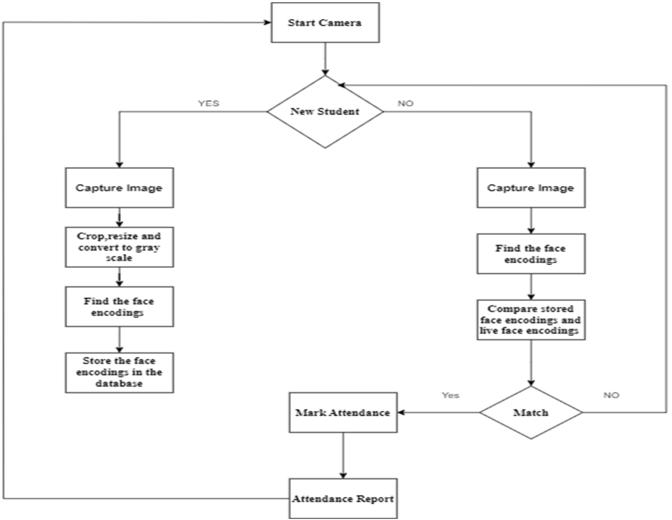
Face attendance combines three main components: database, face recognition module, and web application. The database, which uses MySQL and was tested using XAMPP, stores important information about students, including names, IDs, and face numbers. This information ensures that all relevant information is securely stored and easily accessible by the face recognition system. Face recognition uses a face recognition library to identify and identifyfacesonreal-timenetworkcamerasandcompares them with stored codes to update attendance records accurately and efficiently. Built on Flask, the web
application provides an excellent customer experience by allowing students to upload photos, view attendance information,andmanageattendance.
Attendance tracking and user management interfaces to improve accessibility and ease of use. Authentication and authorization are managed by Flask-Login and FlaskSecurity, ensuring secure access to sensitive data and work. Face detection and recognition using OpenCV and the face recognition library, using the Haar cascade for initial face detection and deep learning models for accuratefacerecognition.
ParticipantdataisstoredinadatabasemanagedbyFlaskSQLAlchemyandcanbeeasilyexportedtoExcelusingthe pandas function library to facilitate data analysis and reporting.Thesystemisdeployedonawebplatformusing Gunicorn or uWSGI to provide efficient and real-time management. OpenCV provides basic image processing including gradient computation, segmentation, and face detection using histograms of oriented gradients (HOG). The technology captures the patterns and features of the face by calculating the gradient expression used for segmentationanddetection.
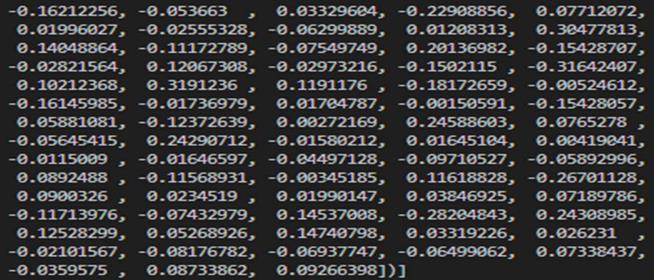
Face encodings are code vectors generated by deep learning models that represent a unique face, making the face similar and recognizable. This approach provides good performance in many cases; it works well with lighting, facial, and orientation changes. procedure. IntegrationwithFlask-SQLAlchemyensuresdataintegrity, while the use of pandas helps with data management and distribution.DeployingproductionserversusingGunicorn oruWSGIincreasesthecapacityoftheapplicationandthe abilitytohandlemultiplemixedusers,providingareliable solution for uptime. The tracking system can reduce the impactofthegrid,reduceerror,andprovideeffectiveand reliable solutions for today’s schools. Through the use of technology and powerful design, face-based engagement improvestheoverallmanagementofstudentengagement, helping to improve work management and good education.
International Research Journal of Engineering and Technology (IRJET) e-ISSN: 2395-0056
Volume: 11 Issue: 07 | July 2024 www.irjet.net p-ISSN: 2395-0072
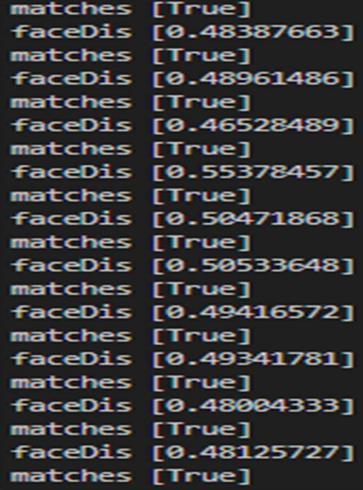
The Flask Face Attendance App uses face recognition to provide simple attendance management. The system uses the camera as a simple face recognition tool to facilitate user registration, login, and attendance tracking. The app providesaccurateattendance data using OpenCVandface recognition libraries to effectively identify and identify users. User data (including username, password, and face code)issecurelystoredina MySQLdatabasemanagedby the Flask-SQLAlchemy extension to ensure data integrity andsecurity.
The program will record the employee attendance status and store it directly in the database for the client. The record now ensures that attendance records are up-todate and reflect the nature of the users, reducing inconsistencies that are often associated with the use of guidelines. Use the pandas library to efficiently export attendance data to Excel so users can download and view attendance data when needed. This distribution makes it easy to analyze, publish, and share data, allowing users andadministratorstoeasilytrackattendancepatternsand trends.Enteryourcontent,captureyourvisuals,andcode themforfutureanalysis.PoweredbyOpenCVandtheface recognition library, face recognition detects faces in webcamaddressesandcomparesthemtostorednumbers to verify identity. This approach increases security and prevents fraud by ensuring that only registered users can accessandparticipate.Allowaccess.
This security is important to maintain the integrity of attendancedataandensurethatonlyauthorizeduserscan access the system. The Flask framework integrates with Flask-Login and Flask-Security to provide a strong authentication and authorization mechanism to protect
application security. It offers both simple and practical, practical and reliable solutions. It minimizes the effort required by customers and administrators, making it indispensable for today's attendance management. The applicationsimplifiestheattendanceprocess,reducingthe time and resources used by manual checks, allowing organizationstofocusonimportanttasks.Sexanduseofa friend.Thebrowser-basedinterfaceisintuitiveandallows users to easily navigate and perform appropriate tasks without requiring much training. Use Gunicorn or uWSGI to deploy the application to customer production to ensure that it can manage multiple users simultaneously and provide an effective and efficient solution for access control.Demonstrateitseffectivenessandwidespreaduse from schools to environmental organizations. Flask face app sets new standards in accuracy, security and performance, using technology and powerful design to becomethenewsolutioninattendancemanagement.
[1] Hapani, Smit, et al. "Automated Attendance System Using Image Processing." 2018 Fourth International Conference on Computing Communication Control and Automation(ICCUBEA).IEEE,2018.
[2] Hapani, Smit, et al. "Automated Attendance System Using Image Processing." 2018 Fourth International Conference on Computing Communication Control and Automation(ICCUBEA).IEEE,2018.
[3] Akbar, Md Sajid, et al. "Face Recognition and RFID Verified Attendance System." 2018 International Conference on Computing, Electronics & Communications Engineering(iCCECE).IEEE,2018.
[4] Okokpujie, Kennedy O., et al. "Design and implementation of a student attendance system using iris biometric recognition." 2017 International Conference on Computational Science and Computational Intelligence (CSCI).IEEE,2017.
[5] Rathod, Hemant Kumar, et al. "Automated attendance system using machine learning approach." 2017 International Conference on Nascent Technologies in Engineering(ICNTE).IEEE,2017.
[6] https://www.superdatascience.com/blogs/opencvface-recognition
[7]. A brief history of Facial Recognition, NEC, New Zealand,26 May 2020.[Online]. Available: https://www.nec.co.nz/market-leadership/publicationsmedia/a-brief-history-of-facialrecognition/
[8]. Face detection, TechTarget Network, Corinne Bernstein, Feb, 2020.[Online]. Available:
International Research Journal of Engineering and Technology (IRJET) e-ISSN: 2395-0056 Volume: 11 Issue: 07 | July 2024 www.irjet.net p-ISSN: 2395-0072
https://searchenterpriseai.techtarget.com/definition/face -detection. Paul Viola and Michael Jones, Rapid Object Detection using a Boosted Cascade of Simple Features. Accepted Conference on Computer Vision and Pattern Re cognition,2001.
[9]. Face Detection with Haar Cascade, Towards Data Science-727f68dafd08,Girija Shankar Behera, India, Dec 24,2020.[Online]
[10]. Face Recognition: Understanding LBPH Algorithm, Towards Data Science90ec258c3d6b,Kelvin Salton do Prado, Nov 11, 2017. [Online]. Available:https://towardsdatascience.com/facerecognition-how-lbph-works-90ec258c3d6b
[11].WhatisFacialRecognitionandhowsinisterisit,The guardian, Ian Sample, July, 2019. [Online]. Available: https://www.theguardian.com/technology/2019/jul/29/ what-is-facialrecognition-and-how-sinister-is-it
[12].KushairyKadir,MohdKhairiKamaruddin,Haidawati Nasir, Sairul I Safie, Zulkifli Abdul Kadir Bakti, “A comparativestudybetweenLBPandHaar-likefeaturesfor Face Detection using OpenCV", 4th International Conference on Engineering Technology and Technopreneuship(ICE2T)
[13].Senthamizh Selvi.R,D.Sivakumar, Sandhya.J.S , Siva Sowmiya.S, Ramya.S , Kanaga Suba Raja.S,"Face Recognition Using Haar - Cascade Classifier for Criminal Identification",InternationalJournalofRecentTechnology andEngineering(IJRTE),vol.7,issn:2277-3878,,issue-6S5, April 2019. [9]. Robinson-Riegler, G., & Robinson-Riegler, B.(2008).
BIOGRAPHIES

AaryaSutar GraduateStudent ComputerEngineeringDepartment KJSomaiyaInstituteofTechnology