
International Research Journal of Engineering and Technology (IRJET) e-ISSN: 2395-0056
Volume: 11 Issue: 07 | July 2024 www.irjet.net p-ISSN: 2395-0072

International Research Journal of Engineering and Technology (IRJET) e-ISSN: 2395-0056
Volume: 11 Issue: 07 | July 2024 www.irjet.net p-ISSN: 2395-0072
Tushar Raj Jha1 , Dr. G. P. Khare2
1Research Scholar, M. Tech. (Structural Engg.)
2Professor and Head, Department of Civil Engineering, Jhada Sirha Government Engineering College Jagdalpur Bastar, Chhattisgarh India.
Abstract - The research used red mud instead of cement to examine the characteristics of concrete. The Bayer Process, which turns bauxite ore into alumina, has a low energy efficiency and produces a lot of red mud, or dusty, high alkalinity bauxite residues. Red mud is produced almost at the same mass ratio as metallurgical alumina and is dumped into sealed or unsealed artificial impoundments, or landfills, which poses serious environmental problems. It is composed of silica, iron, titanium, and aluminum oxides, as well as a few other trace elements. Red mud's presence of alumina and iron oxide makes up for limestone, the main raw material used to make cement, which lacks these elements. Soda content in red mud, which is utilized to produce clinker, balances the sulphur in pet coke, which is used to burn clinker to produce cement, and improves the cement's setting properties. Although there are a number of red mud utilization options, none of them have shown to be commercially or economically successful thus far. The primary emphasis of the project work is whether the red mud obtained is suitable for construction. In M40 grade concrete, the replacement percentages for red mud are 0%, 4%, 6%, 8%, and for hydrated lime, 0%, 1%, 2%, and 3% by weight of cement, respectively.
Key Words: traditional concrete, Concrete with red mud, hydrated lime and basalt fibre, Workability, Compressive, Tensile, and flexural strength.
Bauxiteisthemineralthatyieldsaluminummetal.Avariety of distinct oxides and hydroxides of silicon, iron, and aluminummakeupbauxiteore'smakeup.Theprimaryraw materials used in Bayer's alumina production process are causticandbauxite.Thisprocessproducesredmud,whichis typicallydumpedasanon-valuebyproductinthebackyard of an alumina refinery known as the "red mud yard." Red mud has very limited industrial application. An enormous 3.0-acreareaisrequiredannuallytostoretheredmudand dykes.Thequalityofbauxiteusedasarawmaterialandthe processofproducingaluminaresultintheindustrialwaste known as red mud. There are two types of red mud: sintering red mud and Bayer red mud. With current technology, every 1 t of alumina produced results in the productionof0.8to1.76tofredmud.
1.2. Bayer Process bauxite: Alumina, or smelting grade alumina,istheresultofrefiningbauxiteusingthetechnique known as the Bayer process. Alumina is the precursor to aluminum.Generally,onetonofaluminarequiresbetween 1.9and3.6tonsofbauxite,dependingontheore'squality. The term "Bayer cycle" refers to the cyclical natureof the Bayer process. Digestion, clarity, precipitation, and calcinations are the four stages involved. Additionally, employing red mud enhances the concrete's capacity to absorb impacts and lowers production costs. Red mud functions well as a binding agent and aids in keeping reinforcement from corroding. One useful waste product that can help the construction sector is red mud. By using red mud as a partial substitute for cement in concrete and hydrated lime to help red mud achieve pozzolanicqualities,thisresearchstudyaimstoaddressthe issuesassociatedwithbothredmudandcement.Asaresult, thestudyalsoconcentratesonaddinglimeasanadditiveto enhancethestrengtheningresults.
1.3. Sinter Process of bauxite: Sintering is a thermal process that turns a metallic or ceramic powder (or a powder compact) into a bulk material that typically has residual porosity.It occurs belowthe melting pointofthe primary constituent material. The material undergoes specific chemical and physical changes throughout the sinteringprocess.
1.4 Availability of Red Mud: With 43.6% of the nation's totalproduction,Orissaisthestatethatproducesthemost bauxiteinIndia.Jharkhand(19.2%),Maharashtra(13.3%), MadhyaPradesh,Chhattisgarh(11.4%),andAndhraPradesh (12.5%)follow.AccordingtoBalasubramaniametal.(1987), thedistrictsthatproducethemostbauxiteareKoraputand SundargarhinOrissa,GumlaandLohardagain Jharkhand, VishakhapatnaminAndhraPradesh,KolhapurandRatangiri in Maharashtra, Bastar, Bilaspur, Surguja, Mandla, Satna, Jabalpur, and Shahdol in Madhya Pradesh, Chhattisgarh, Jamnagar,Kachchh,andJunagarhinGujarat,andSalemand NilgiriinTamilNadu.
International Research Journal of Engineering and Technology (IRJET) e-ISSN: 2395-0056
Volume: 11 Issue: 07 | July 2024 www.irjet.net p-ISSN: 2395-0072
Anexperimentalinvestigationintotheeffectsofbasaltfiber, hydratedlime,andredmudonthestrengthcharacteristics ofM-40gradeconcrete.
2.1 OBJECTIVE:
Determinewhetherindustrialwastescanbeusedto makecement.
Determine whether industrial solid waste can be used as a raw material, blending material, or additive.
Characterization of industrial wastes using physical-chemicalandmineralogicaltechniques.
To investigate the limitations associated with the useofindustrialwaste.
To offer suggestions for encouraging the use of industrialwaste.
To determine the effect of the workability of concrete.
Toexaminetheeffectsofredmud,hydratedlime, and basalt fiber on the compressive, tensile, and flexuralstrengthsofconcrete.
(d) P. Syam Sai (2017) Inthisstudy,experimentshavebeen performedtoevaluatethequalityattributesofthealuminum redmudTestsamplesweremadewiththereplacementof020%atanintervalof50%redmudand5%hydratedlime with cement bond in M40 and M50 grade concrete. To impartthecementationpropertyofredmud,hydratedlime isincorporated.Thisstudyemphasizesthepromisingusage ofredmudinsustainabledevelopment
3.
(a) Hanumantha Rao. C H.V, Satyanarayana P.V.V, Naidu. P. S (2018): Have compared engineering properties of naturalsoilandredmudandtheyfoundthatredmudisa siltsizedominatingindustrialwasteandexhibitedhighdry densityandshearstrengthvalues.Redmudcanbeusedas fill material, embankment material, foundation material, subgradematerial,andbackfill material asreinforcedand unreinforced in retaining walls, it also reduces thrust on naturalsoilswhenusedasconstructionmaterial.
(b) MSS Lima, L P Thives, V Haritonov and K Bajars (2017): studied the application of red mud in the construction industry, its hazardous nature is a great challenge to researchers to develop new methods for the application of red mud. Research work covers two main areas cement production/ceramic material and road construction. Backgrounds from other researchers were taken into consideration and analyzed according to environmental,economic,andtechnicalfeasibility
(c) Akarsh. N. K (2017): The study presents the work of examining the likelihood of supplanting Portland cement withredmud.Asaresultofputtingawayissues,thewaste contrarilyinfluencestheearth.Totacklethisissue,Portland cementwassupplantedupto40%ofredmudbyweightof cement. The properties of the concrete, like compressive, tensile, and flexural strength of red mud concrete were evaluated This study shows that the addition of red mud enhancesthepropertiesofconcrete.
4.1 Basalt fibre: Because of their exceptional mechanical and thermal qualities as well as their chemical stability, basalt fibers (BFs) have garnered a lot of interest in the composites sector. BFs are highly valuable commercial products with a wide range of applications in the constructionandpolymersectors.Thefiber-matrixinterface isanothercrucialcomponentthataffectshowwellbasaltfiber-reinforcedcomposites(BFRCs)operatethroughoutthe courseoftheirservicelife,eventhoughBFdosageisamajor influence and mechanical performance improves dramaticallyasthedosageincreases.Transferringstressand improvingthemechanicalcharacteristicsofthecomposite depend on the adhesion between the matrix and the BF. Meltingbasaltrockattemperaturesbetween1450and1500 degreesusingaplatinum-rhodiumalloybushingresultsin the continuous fiber known as basalt fiber. Known as the "volcano rock silk" of the twenty-first century, this new fabricprotectstheenvironmentandisalsoknownasgolden fiberduetoitsgolden-browncolor.
4.2 Cement: ThePortlandcementutilizedinthisexperiment wasordinary,grade53.Wetestedthecementinaccordance withIS12269-1987.Cementwasputthrougha battery of testing to ensure it met IS 12269-1987 requirements. Cementisabinderinconstruction;itsolidifies,hardens,and holdsothermaterialstogether.Theconcretemixdesigncalls forregular,ordinaryportlandcement.Cementsampleswere purchasedinbagsandsubjectedtonumeroustestsinorder toassesstheirquality.Everytestresultfromthelaboratory testing,whichusedcementsamplesforeverytest,complied withIndianstandards.Cementhasaspecificgravityof3.12 andafinenessof6.5%.
4.3 Fine Aggregate: It is the aggregate that, for the most part, passes the 4.75 mm IS filter and includes no more coarseparticlesthanwhatthestandardallows.Thesource states that fine aggregate can be characterized as: Fine aggregate for the current study used river sand that was readilyaccessiblelocallyandcompliedwithIS383:1970's Grading Zone II. Several tests were performed on the raw sampleinordertoassessthequalityofthefineaggregates; all testing was conducted in a laboratory environment in compliancewithIndianlaws.ZoneIIsandservesasthefine aggregateinthisstudyproject.Itsspecificgravityis2.46,its waterabsorptionis1.14,anditsfinenessmodulusis2.55%, inthatorder.
International Research Journal of Engineering and Technology (IRJET) e-ISSN: 2395-0056
Volume: 11 Issue: 07 | July 2024 www.irjet.net p-ISSN: 2395-0072
4.4 Coarse aggregate: The study employed hard crushed granite stone with coarse aggregates that confirmed to a gradedaggregateofsize10mminaccordancewithIS:3831970.Coarseaggregateisdefinedasgradedaggregateofits nominalsizebasedonsizeparticlesmakeupthemajorityof theconcretemix.Coarse-classifiedaggregatesfallwithinthe 4.75 mm to 40 mm particle size range. To ascertain the quality of the coarse aggregates, multiple tests were performed on the raw material; all of the findings were discovered subsequent to the test's execution in the laboratory. According to Indian guidelines, every test was carried out in a laboratory. The specific gravity, fineness modulus,andwaterabsorptionofthecoarseaggregateare 2.62,7.16,and0.76%,respectively.
4.5 Water: Specimensarecastandcuredusingclean,fresh water. According to Indian standards, the water is comparatively free of organic materials, silt, oil, sugar, chloride,andacidicstuff.Specimensarecastandcuredusing clean,freshwater.AccordingtoIndianstandards,thewater is comparatively free of organic materials, silt, oil, sugar, chloride,andacidicstuff.Hydrationistheprocessbywhich cementitiousmaterialsandwatercombinetomakecement paste. Cement paste joins the aggregate pieces, fills in the spacesbetweenthem,andcreatesaflexibleOneusesregular tapwatertomixtheconcretemix.ApHtest onthewater samplesrevealedthattheirpHwas7.01.
4.6 Hydrated Lime: Madefromlimestone,hydratedlimeis akindofdrypowder.Theprocessofconvertingoxidesinto hydroxides involves combining water with quicklime. Hydratedlimeismostcommonlyusedtocreateplasterand mortarswhenmixedwithcement,sand,orwater.Ca(OH)2, or calcium hydroxide, is its chemical name. Calcium hydroxideisanothernameforhydratedlime.Slakedlime, alsoreferredtoascalciumhydroxide,isanothernamefor purehydratedlimepower.Whitedrypowerisproducedby carefullyslakingquicklime withwater. The excessslaking water evaporates as the reaction's released heat is then gathered.Ourpurehydratedlimehasthechemicalformula Ca(OH)2. Compared to low-grade hydrated lime (65% purity), hydrated lime has a larger amount of calcium hydroxide(90%)init.
4.7 Red Mud: contains a variety of contaminants that are bothsolidandmetallicoxide-bearing,anditposesoneofthe major disposal issues facing the aluminum industry. The oxidizedironpresent,whichcanaccountforupto60%of themassoftheredmud,iswhatgivesititsredcolor.Apart fromiron,theotherpredominantparticlesincludetitanium oxide,silica,andunbleachedresidualaluminum.Discarding redmudisachallengingtask.Themud,awasteproductof theBayerprocess,hasapHbetween10and13,makingit extremelybasic.2.64isthespecificgravity.
(A) Design Required:
1.GradeOfconcrete=M40
2.Typeofcementused=OPC-53
3.Nominalsizeofaggregate=20mm
3.Sitecontrol=Good
4.Exposure-condition=Extreme
5.Workabilityofconcrete-assumed=100mm
6.Methodofconcrete-placing=manual
7.Minimumcement-content=360kg/m3
(B) Test results for material:
1.Specificgravityofcement=3.12
2.Specificgravityofcoarseaggregate=2.62
3.Specificgravityoffineaggregate=2.46
4.Waterabsorptionofcoarseaggregate=0.76
5.Waterabsorptionforfineaggregate=1.14
6.Conformingzoneofsand=zoneII
(C) Target mean strength = 48.25 N/mm2
(D) Selection of water cement ratio = 0.40
(E) Selection of water content = 177.50 kg/m3
(F) Cement content used = 363.760 kg/m3
(G) Coarse aggregate used = 1153.86 kg/m3
(H) Fine aggregate used = 607.07 kg/m3
5.1 Test on concrete mixture:
Slump-cone test for workability of concrete: Constructing aconcreteworkabilitytestisnecessarysinceconcretecan bemixed,transported,andusedincertainapplications.The slumptestisthemethodmostfrequentlyemployedtoassess workability.Inalabenvironmentorontheconstructionsite, thistestismostfrequentlyusedtoascertaintheconsistency of concrete. Three layers of freshly mixed concrete, each stamped25timeswithastandardrod,arepouredintothe slump cone. Not every aspect influencing workability is quantified.Still,itprovidesdataregardingtheconsistencyof concrete between batches and serves as a helpful control test.Forconventionalconcrete,theC:S:Aratiois1:1.50:2.86, whereasfordesignmixconcrete,itis1.1.66:3.19.
Table-1 SlumpValuesofConventionalConcrete.
Volume: 11 Issue: 07 | July 2024 www.irjet.net
Table-2 SlumpValuesofdesignmixedconcrete.
Compressive Strength test:
Theadditionofhydratedlime,redmud,andbasaltfiber improvesworkability.
6.1 Casting of concrete sample: Thespecimenswerecast in accordance with IS 10086-1982. The unfinished cube, cylinder,andbeamsampleswerecuredinawaterpondfora periodof28days.Atsevenandtwenty-eightdaysofage,we contrasted the red mud, hydrated lime, and basalt fiber concretewithordinaryconcrete.
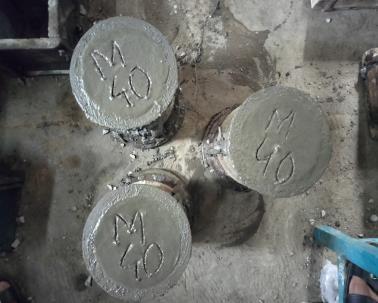
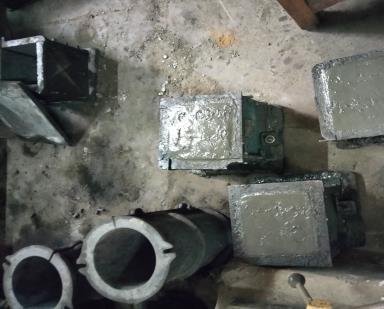
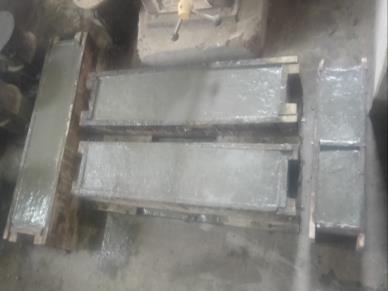
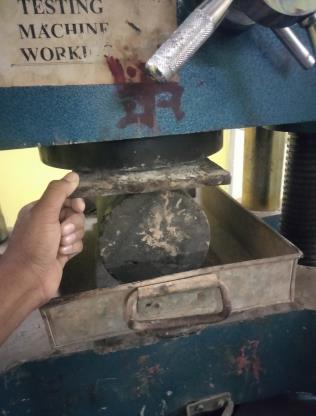
The maximum compressive load that a material can bear beforefailingisdeterminedviaamechanicaltest.Thetest object,whichisoftenshapedlikeaprism,cylinder,orcube, is compressed by a load that is applied progressively between the plates of a compression testing machine. in spite of their strong compressive strengths. The crushing strengthofconcrete,oftenknownasthecubestrength,can befoundbybreakingacube.Aone-weekandafour-week test were conducted on the 150 x 150 x 150 mm cast concrete cube. The compressive strength formula is P/��, whereAisthecross-sectionalarea(150×150×150mm) andPistheappliedforce.
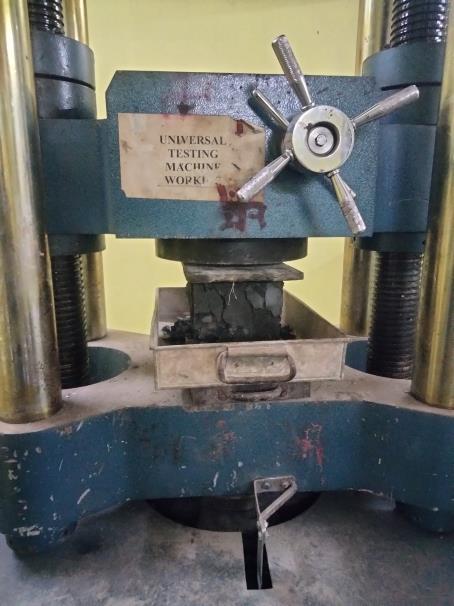
Table-3 CompressiveStrengthresultsforConcrete.
Volume: 11 Issue: 07 | July 2024 www.irjet.net p-ISSN: 2395-0072
Chart-1: Compressivestrengthbehaviourfor conventionalconcreteafter7and28-daysvsredmud concrete.
Split tensile strength:
Applying 300 mm in height and 150 mm in diameter cylinders.Thecylindertookseventy-eightdaystotestand pour. The cylinder's length is L, its diameter is D, and the load is P. 2P/πDL is equal to the divided tensile strength. Because of its low tensile strength and brittle nature, concrete is typically not expected to withstand direct tension. Nonetheless, figuring out the concrete's tensile strengthisessentialtofiguringouttheweightatwhichthe componentscouldshatter.Onetypeoftensionfailureisthe cracking.Thesplittingtensilestrengthofcylindricalconcrete specimens,suchasdrilledcoresandmoldedcylinders,can beascertainedusingthistestmethod.
and28-days
Flexural Strength test:
of M-40GradeConcrete
behaviourofconcreteafter
mudconcrete.
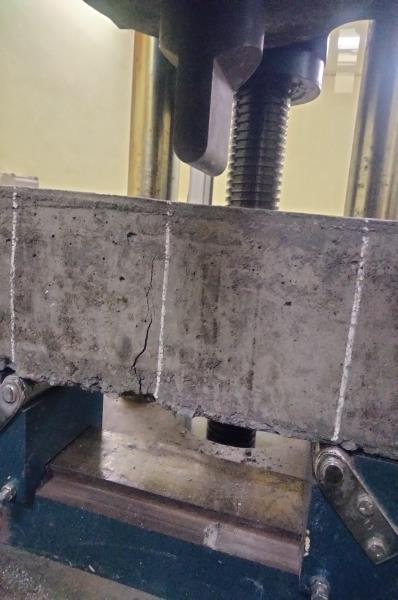
Auniversaltestinginstrumentappliesaforceof2000KNto aspecimenconsistingofabeamof150x150x700mmin ordertocausebending.Recordedisthemaximumapplied loadonthespecimen.Afterseventotwenty-eightdays,we sawanincreaseintheconcretemix'sstrength.Fstrengthis equaltoWL/bd2.
International Research Journal of Engineering and Technology (IRJET) e-ISSN: 2395-0056
Volume: 11 Issue: 07 | July 2024 www.irjet.net p-ISSN: 2395-0072
2. IS 10262:2019 Recommended Guidelines for ConcreteMixDesignBureauofIndianstandardNew Delhi.
3. BureauofIndianStandardsIS516:1959Methodsof TestsforStrengthofConcrete.
4. Indian Standard code456:2000 of practice for general structural use of plain and reinforced concrete.
5. IS383:1970Codeforfineandcoarseaggregatefor concrete.
flexuralStrengthof M-40GradeConcrete
Chart-3: Flexuralstrengthbehaviourofconventional concreteafter7and28-daysvsredmudconcrete.
7. CONCLUSION:
One efficient way to replace cement is using red mud,whichalsoallowsforextensivewasteproduct usage.
Redmuddidnotalterthequalitiesofthecement; rather, it enhanced the cement's quality by shortening the setting time and increasing its tensile,flexural,andcompressivestrengths.
Embankmentlandfillsareadesirablealternativefor roadbuildingsincetheyhaveagreatpotentialfor large-scalereuse.
Itisthereforefeasibletoreplace10%OPCwithred mud.
8. FUTURE SCOPE:
Findtheoptimumpercentagecriteriaforredmud.
Cost analysis of ordinary concrete and mud concrete.
10. REFERENCES:
1. P.SyamSai,ChandanaSukesh“Strengthproperties ofconcreteby usingred mudasa replacement of cementwithlime” .
6. ConcreteTechnology:TheoryandPracticebyM.S. Shetty.
7. Mohamed Emierul & Akilah Mahmoud InfrastructureUniversityKualaLumpur,MALAYSIA “Red mud as a cement partial replacement in concreteadmixturewithhydratedlime”
8. P. Ashok1, M.P. Sureshkumar2 “Experimental StudiesonConcreteUtilizingRedMudasAPartial ReplacementofCementwithHydratedLime”.
9. A.Bayat,A.Hassani,A.A.Yousefi“Effectsofredmud on the properties of fresh and hardened alkaliactivatedslagpasteandmortar”.
10. SnehaSamal,AjoyK.Ray,AmitavaBandopadhyay “Proposalforresources,utilizationandprocessesof redmudinIndia Areview”.
11. Li Wang, Ning Sun, Honghu Tang and Wei Sun “A ReviewonComprehensiveUtilizationofRedMud andProspectAnalysis”.