
International Research Journal of Engineering and Technology (IRJET) e-ISSN: 2395-0056
Volume: 11 Issue: 07 | July 2024 www.irjet.net p-ISSN: 2395-0072

International Research Journal of Engineering and Technology (IRJET) e-ISSN: 2395-0056
Volume: 11 Issue: 07 | July 2024 www.irjet.net p-ISSN: 2395-0072
Li Zhouji1 , Intan Irieyana Bint Zulkepli 2
1Student, Faculty of Engineering & Built Environment, Lincoln University College, Kuala Lumpur, Malaysia
2 Assistant Professor, Faculty of Engineering & Built Environment, Lincoln University College, Kuala Lumpur, Malaysia
Abstract - The structural design of the electric vehicle battery bracket significantly affects the noise, vibration, and harshness (NVH) characteristics of the electric vehicle. This paper takes the battery bracket as its object of study, examining its vibration characteristics through frequency response analysis and modal analysis. The aim is to verify the validity of the support structure design. This paper takes the battery bracket as its object of study, employing frequency response analysis and modal analysis to investigate its vibration characteristics and validate the rationality of the structural design of the battery bracket. Firstly, a 3D model of the battery bracket was constructed, and a run strength analysis and constrained modal analysis were conducted using the NASTRAN solver. The results demonstrate under the forward and downward working conditions, the maximum stress exceeds the yield strength of the material. Additionally, the first-order mode is below the idle excitation of the engine. Following the design principle of the bracket structure, the original structure is optimized by increasing the thickness of the bracket steel plate and the number of connection points. The simulation results demonstrate that the stiffness of the optimized bracket enhances the design requirements. Consequently, this research provides a theoretical basis for the design and optimization ofthe bracket structure.
Key Words: electric vehicle battery bracket, strength analysis,modalanalysis,vibrationcharacteristics.
Noise, vibration, and harshness (NVH) performance are important indicators of vehicle quality. The vibration and noise problems during use are not only a source of pollutionofthesoundenvironmentoutsidethevehiclebut also cause discomfort and even injury to occupants or cargo within the vehicle [1-2]. A vehicle's NVH target system comprises four levels: vehicle level, system level, subsystemlevel,andcomponentlevel.ToachievetheNVH target of the entire vehicle, it is necessary to design and adjustthecomponentswithineachsystemsothattheycan ensure that the performance of the entire vehicle aligns withthedesignrequirementsduringthesynthesisprocess fromthetop-downapproach[3-4].
The battery bracket of an electric vehicle is a component ofthebodysystem,thefunctionistomountthebatteryon the body. The battery bracket is situated close to the powertrain. Consequently, any vibrations transmitted from the powertrain will also affect the battery bracket, which will then be transmitted to the vehicle body. This results in an increase in noise and vibration levels within the body [5]. It is imperative to analyze and optimize the vibration characteristics of the battery bracket during the developmentanddesignofthevehiclebody,whichplaysa positive role in shortening the design cycle and reducing the development cost. In the literature [6], the finite elementtechniquewasemployedtoconductbothstrength and modal analyses for the water tank bracket of a light truck, along with subsequent road verification and modal testing. In the literature [7], a solution to the cracking problem of a light truck sub-tank bracket was sought through a vibration strength analysis of its finite element model.Theliterature[8]presentsapowerbatterybracket scheme devised by the established design principles. Through finite element technology, the structure of the power battery bracket is subjected to modal analysis, impact strength analysis, frontal collision simulation analysis, and mounting bolt force analysis. This enables achievingastable,fixed-powerbatterywithinthesmallest possiblespace.
Literature[9]performeda frequencyresponseanalysisof the pipeline to obtain the effect of acceleration excitation on the stress distribution of the pipeline system. Literature [10] solved the fracture problem of air condition lines by adding brackets, which can avoid the excitation sympathetic vibration. To address the fracture issue associated with the urea tank bracket of trucks, a strengthanalysiswasconductedusingANSYS Workbench software. The analysis result revealed that the maximum stresslocationwasidenticaltotheactualfracturelocation. The stress of the urea tank bracket was significantly diminished through the implementation of reinforcement andprotectionmeasures.
This paper presented a 3D model of the battery bracket basedonarealvehicleandcarriedoutastrengthanalysis and a constrained modal analysis using the NASTRAN
International Research Journal of Engineering and Technology (IRJET) e-ISSN: 2395-0056
Volume: 11 Issue: 07 | July 2024 www.irjet.net p-ISSN: 2395-0072
solver. Following the structural design principles of the bracket, the original structure is optimized. Subsequently, theoptimizedstructureisalsoverifiedthroughsimulation analysis, demonstrating that the battery bracket could meet the design requirements. Therefore, this research offered a theoretical foundation for designing and optimizingthesupportingstructure
Frequency response analysis described the relationship between the external excitation, once transformed using the Fourier transform, and the target response. By employing this technique, it is possible to ascertain the vibration performance of a system across a range of frequencies. The dynamical equations of a linear timeinvariantsystemwithndegreesfreedomcanbeexpressed asfollows[12-14]:
( ) ( )
Where M is the mass matrix, Cis the dampingmatrix,Kis the stiffness matrix, u is the displacement vector, is the velocity vector, is the accelerated vector, and F(t) is the loadfunction.
Thedisplacementvectorcanbewrittenas: ( ) ( )
Upon substituting the solution into equation (1), the followingresultisobtained:
( )( ( ) ( )) ( ) ( )
Where A is amplitude, is inherent frequency, is the phase, and t is time. The displacement of the system frequency response can be obtained by solving the equation
Modal analysis is mainly employed to calculate the vibration frequency and vibration pattern of the system structure. According to the modal analysis, the system’s inherent frequency and modal formation can be determined.Thesystemmotiondifferential equationis as follows[15-16]:
, -*��+ , -{��} , -*��+ *0+ (3)
Where [M] is the mass matrix, [C] is the damping matrix, [K]isthestiffnessmatrix,andXistheresponsevector.
When[C] 0,letX Asin(ωt+φ)intoequation(3): (, - , -)*��+ 0 (4)
Where is eigenvalue,*��+is eigenvector. Eigen equation ofequation(4)isasfollows:
���� [, - , -] 0 (5)
The intrinsic frequency of the system and its modal formationscanbedeterminedbysolvingequation(5).
To design an electric vehicle battery holder that can meet the requisite performance standards, two fundamental principlesareadheredto:
1.Avoidingtheexcitationfrequencyofthemainexcitation source
The battery is connected to the vehicle body through a bracket, thereby forming a 'spring-mass' system. This system is primarily susceptible to external excitation frequencies generated by the engine and road surface. When these frequencies coincide with the system frequency, the system will generate sympathetic vibration and transmit vibration to the body through the battery bracket, which in turn affects the NVH performance of the body. Therefore, it is essential to avoid these excitation frequenciesduringthedesignprocess.
Inthispaper,acertainhybridelectricvehicleisaresearch object, and the powertrain comprises an engine and an electric motor. The engine idling excitation is regarded as an external excitation because of pronouncing more vibration. The engine excitation frequency is calculated as follows[17]:
��
60 (6)
Wherekisthenumberofcylinders,nistherotationspeed, andTisthenumberofstrokes.Weconsidertheengineis4 cylindersand4strokes;therotationspeedis1000rpmat idling, and we calculate the engine idling excitation frequencyf=33Hzbyequation(6).
2.Ensuringthesufficientstrengthofthebatterybracket
To prevent deformation or breakage when subjected to shock loadsundervariousworkingconditions,thebattery holdershouldhaveacertainlevelofstrength.Thestrength of the battery bracket is expressed by the safety factor, whichiscalculatedusingthefollowingformula:
Volume: 11 Issue: 07 | July 2024 www.irjet.net p-ISSN: 2395-0072
Where σb is yielding strength, σx is the max stress at workingcondition.Kislargerthan1ingeneral.
OBJECTIVES
4.1
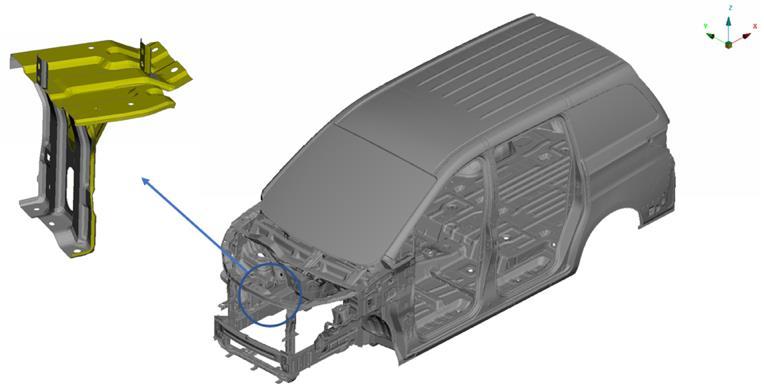
According to a real hybrid electric vehicle, modeling softwareisusedtoestablisha3Dsolidmodel,asshownin Figure 1. Then use the finite element simulation software ANSA to pre-process the 3D solid model. To simplify the solution, choose the right side of the front of the vehicle wherethebattery bracketislocatedtomesh,asshownin Figure 1. The geometric features of the model are simplified,andtheneutralsurfaceisextracted.Themodel of the battery bracket is meshed by a 4mm shell, with a total mesh count of approximately 210,000. The connection between each sheet metal part is simulated using RBE3 and RBE2, and the battery is simulated by establishing CONM2. Table 1 describes the information about batteries The battery’s mass is 200kg, and the positionofthemasscenterisX=116.97mm,Y=441.89mm, andZ=545.58mm.
-1: Batteryinformation
The material properties of the vehicle body and battery bracket are shown in Table 2. Among them, the material selected for the power battery bracket is DC01, with a thicknessof0.8mm.
Table -2: Materialinformation
The battery bracket is situated in a harsh working environment,and itisalsosubjectedtoload impacts from manyworkingconditions,suchasverticalshocks,forward andreversebraking,andleftandrightturns.Therefore,the fatigue of the bracket should be carefully evaluated in the design. In strength simulation analysis of the bracket, boundaryconditionsareaddedtothefiniteelementmodel: constraints on the six freedoms of the model truncated surfaceandthesixfreedomsofthecenterofthefrontand right suspension mounting points; Considering the working conditions of the battery bracket and the load resultsoftheroadtest,theloadsarerespectivelyloadedin theaccelerationfieldsof5Ginthefront,5Gintheback,5G intheleft,5Gintheright,and10Gintheverticaldirection, asshowninTable3.
Table -3: Loadsindifferentworkingconditions Working Conditions
ThematerialofthebatterybracketisselectedasDC01.The battery sets the mass unit to solve the maximum stress under different working conditions using the NASTRAN solver,andtheanalysisresultsareshowninTable4
Volume: 11 Issue: 07 | July 2024 www.irjet.net
Table -4: Resultsofthestrengthindifferentworking conditions Working
The results of the above calculation demonstrate that the maximum stress of the battery bracket under working conditions 1 and 5 is 182.5 MPa and 181.5 MPa, which exceeds the yield strength of the material (171 MPa). It indicates a potential risk of strength design. Further optimizationofthedesignisthereforenecessary.
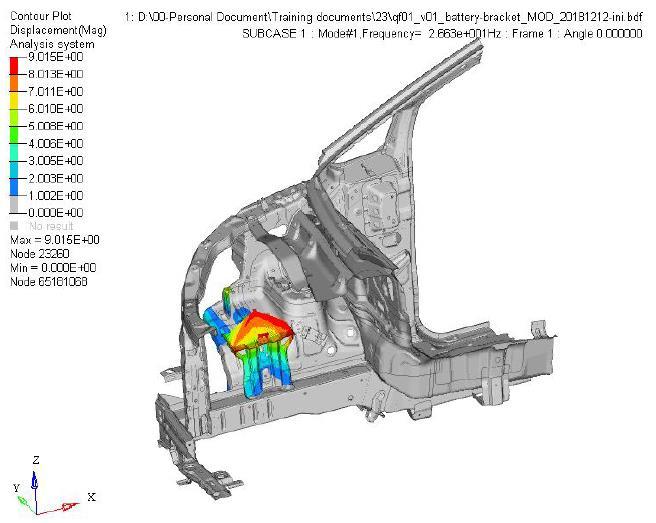
To avoid sympathetic vibration of the battery bracket under engine idle excitation, which affects the NVH performance ofthe body,it isnecessaryto ensure thatits first-ordermodesundertheconstrainedmodesareabove the engine idle excitation of 33 Hz, which we calculated before. Boundary conditions that constrain six freedoms on the truncated surface of the model are established on the finite element model. The first-order modal frequenciesofthe battery bracketare26.6Hz,40Hz,and 64HzbyusingtheNASTRANsolver,asshowninFigure2. The modal configurations are bending around the X-axis, Y-axis, and Z-axis. In this instance, the risk of generating sympatheticvibrationexistsbecausethefrequencyof26.6 Hz is below the target value for engine idle excitation, so thebracketstructureisrequiredtooptimize.
The results of the strength and modal analysis of the battery bracket taken above indicate the presence of structural deficiencies. The strength and modality of the batterybracketarecontingentuponstiffnessandmass.To enhance the performance of the bracket, it is essential to circumvent excessive length, augment the number of connectionpointsbetweenthebracketandthebody,refine thedistributionofthesepoints,orincreasethethicknessof thesteelplateofthebattery.Inthispaper,thestructureof thebatterybracketisoptimizedthroughthefollowingtwo aspects:
1.increasingthethicknessofthesteelplateofthebattery
Increasing the material thickness can enhance stiffness without modifying the bracket material. In this paper, the thickness of the bracket material is increased from the original0.8mmto1.2mm.
2.increasingthenumberofconnectingpointsbetweenthe batterybracketandthevehiclebody
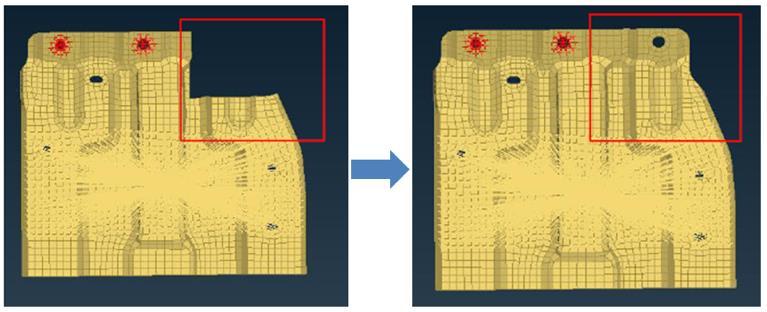
The upper bracket is originally connected to the vehicle bodyattwopoints.Asillustratedinthediagram,increasing one connection point on the right side can enhance the stiffnessofthebracketwithoutaffectingtheinstallationof otherparts.Asshowninfigure3.
The optimized battery bracket has been subjected to strength analysis and modal analysis. The simulation results are presented in Table 5. It can be seen that the safetyfactorexceeds1underfiveworkingconditions.The first-ordermodalfrequenciesundertheconstrainedmodes are 40Hz, 53Hz, and 64Hz, which avoids the engine idle excitation frequency. Additionally, the maximum strain energy of the bracket has been significantly reduced, indicating that the stiffness of the bracket has been enhanced. As shown in figure 4. In conclusion, the optimizedschemefulfillstherequisite strengthandmodal state design, demonstrating the optimization scheme's feasibility
International Research Journal of Engineering and Technology (IRJET) e-ISSN: 2395-0056
Volume: 11 Issue: 07 | July 2024 www.irjet.net p-ISSN: 2395-0072
Table -5: Simulationresultsoftheoptimizedbattery bracketinstrengthanalysisunderdifferentworking conditions Working
[1] Pang Jian. (2015). Automotive body noise and vibrationcontrol.MechanicalIndustryPress
[2] Liu, X.C.. (2018). Automotive NVH Performance Development.MechanicalIndustryPress.
[3] Pang, J., Chen, G., & He, H.. (2006). Automotive Noise and Vibration: Theory and Applications. Beijing UniversityofTechnologyPress.
[4] Shi, H.M., & Huang, Q.P.. (2013). Mechanical vibration systems:analysis,modeling,testing,countermeasures. Next volume. Huazhong University of Science and TechnologyPress.
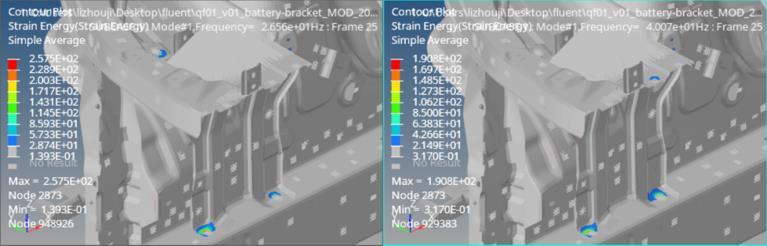
Fig -4:Strainenergyoffirst-ordermodesbendingaround theX-axis:(a)intheoriginalscheme,(b)intheoptimized scheme.
This paper presents a study of the vibration characteristicsofthebatterybracket basedontheelectric vehicle. Initially, a 3D model is constructed, and then the NASTRAN solver isused to performstrengthanalysisand modal analysis on the processed model. The simulation results demonstrated that the original battery bracket cannot meet the requisite strength target value under frontward and downward conditions Additionally, the first-order vibration frequency under constrained modes islessthantheengineidlespeedfrequency,indicatingthe presence of design defects. According to the design principle of the bracket structure, the stiffness of the bracket is improved by increasing the thickness of the steelplateandincreasingthenumberofconnectionpoints between the bracket and the body. This allows the optimizedbracket'sstrengthandmodalanalysisresultsto reachthedesigntarget.Thispaperpresentedthevibration characteristics of the battery bracket and verified the design principle of the reasonableness of the bracket structure. Furthermore, it offers a theoretical foundation forthedesignofbracketstructures,whichcanshortenthe design cycle and reduce the development cost of the enterprise.
[5] Bao, X.D., & Zhang, X.N.. (2017). Design and fatigue verificationofureatankbracketforheavycommercial vehicles.MechanicalDesignandManufacturing(3),4.
[6] Li, H.Y. (2020). Analysis of vibration cracking and structural optimization of the sub-tank bracket of a lighttruck.MechanicalDesignandResearch,36(5),5.
[7] Zhao,J.N.,Wang,X.J.,Yu,Y.Y.,Zhang,H.J.,Zhang,B.H.,& Guo, K.C.. (2020). Research on the structural performance of power battery holders based on hybrid vehicles. Automotive Practical Technology (9), 4.
[8] Tousignant,T., Govindswamy,K., Tomazic,D., Eisele, G., & Genender, P.. (2013). NVH Target Cascading from Customer Interface to Vehicle Subsystems. SAE 2013NoiseandVibrationConferenceandExhibition.
[9] Quan, L.X., Li, D., Wang, H.X, & Cao, Y.. (2016). Acceleration load response analysis of a bulletsupported aviation hydraulic line. Vibration and Shock,35(21),5.
[10] Gong, S. S., Wang, Y. J., Chen, M., & Xu, Z. Z.. (2020). Optimization study on random vibration fatigue analysis of the automotive air-conditioning piping system.AutomotiveTechnology(10),5.
[11] Cao,B.J.,Zhang,G.T.,Wang,C.J.,Chen,Z.A., Wang,Q.,& Li, W.. (2018). Research on analyzing heavy-duty vehicle urea tank brackets based on the workbench. HeavyDutyVehicles(4),2.
[12] Ma, N., & Zhou, X. T.. (2019). Optimized design of battery carrier structure for a certain type of pure electric vehicle. Mechanical Engineering and Automation(1),3.
[13] Du, Q., & Wang, P.B.. Strength analysis and optimization of battery bracket based on an electric
International Research Journal of Engineering and Technology (IRJET) e-ISSN: 2395-0056
Volume: 11 Issue: 07 | July 2024 www.irjet.net p-ISSN: 2395-0072
vehicle. 2015 Chinese Society of Automotive EngineeringAnnualConference.
[14] Li,Z.&WangH..(2016).Finiteelementanalysisofair conditioner compressor bracket. Automotive Components(8),5.
[15] Xu J.L., Ren, Y.Z., Ke Y.H., & Liu Q.H.. (2019). Theoretical analysis and experimental study of rear axle shell modal state of a crossover vehicle. MechanicalDesignandManufacturing(2),4.
[16] Huang, C.C., Cheng, J., Guan, C.H., Wang, J.C.. (2018). Modal analysis of automotive torsion beam rear suspension. Mechanical Design and Research, 34(01), 107-112.
[17] Dong,Y.P..(2020).Modalanalysisandoptimizationof air-conditioning compressor bracket for an electric vehicle.AutomotiveWorld(1),1.
BIOGRAPHIES

Li Zhouji was born in Henan, China, in1989. She received M.S. degree in engineering and management in 2016 from PolitecnicodiTorino
She is currently working toward the Ph. D degree in Lincoln University College. Her research interests include structural optimization, energy efficient high-speedmotordrive.
2024, IRJET | Impact Factor value: 8.226 | ISO 9001:2008