
International Research Journal of Engineering and Technology (IRJET) e-ISSN: 2395-0056
Volume: 11 Issue: 07 | July 2024 www.irjet.net p-ISSN: 2395-0072

International Research Journal of Engineering and Technology (IRJET) e-ISSN: 2395-0056
Volume: 11 Issue: 07 | July 2024 www.irjet.net p-ISSN: 2395-0072
Rajalakshmi Deshpande1
1Rajalakshmi Deshpande MS (Construction Management), Auckland University of Technology, Auckland, New Zealand
Supervisor: Dr Dat Doan, Senior Lecturer, Auckland University of Technology, Auckland, New Zealand
Abstract - Construction and Demolition Waste Recycling Enterprises (CDWREs) face challenges within the circular economy framework in developing countries. This study highlights key obstacles such as market competitiveness, operational inefficiencies, and regulatory barriers. CDWREs often encounter higher costs and lower product awareness comparedtotraditionalmaterialproducers.Additionally,they facedifficultiesduetoinadequatewastecollectionandsorting infrastructure, coupled with a lack of investment in modern recycling technologies. These problems are further compounded by inconsistent government regulations and complex permitting processes, which hinder the growth and sustainability of CDWREs. Adopting a circular economy framework greatly enhances resource efficiency by reusing materialsfromconstruction anddemolition.Thisreducesthe relianceonvirginmaterials,conservesnaturalresources,and lowers carbon emissions from raw material extraction. It promotes sustainable waste management by minimizing landfill use and pollution. The circular economy also drives innovation and economic growth, increasing demand for recycled materials and fostering new technologies that improverecyclingefficiencyandproductquality.Thiscreates new market opportunities, enhances competitiveness, and generates jobs, supporting broader environmental and economic goals.
This research emphasizes the potential for improvement through targeted government interventions, technological advancements, and public awareness. Clear regulations, financial incentives, and streamlined permits can support CDWREs. Investment in advanced recycling technologies and publiceducationcanenhanceefficiencyanddemand,helping developing countries achieve sustainability and circular economy goals.
Key Words: Circular Economy, Recycling Enterprises, Construction and Demolition, Waste Management.
1.INTRODUCTION
Infrastructure development significantly influences a country'seconomiclandscape,withtheglobalconstruction sector projected to grow at an annual rate of 3.6%, surpassing overall economic growth rates. However, the construction industry contributes to 50% of global solid waste due to its "take-make-dispose" approach [1]. To
mitigate the environmental impact, governments are formulating guidelines for recycling and reusing building materials. Managing Construction and Demolition (C&D) waste is complex, involving disposal and recycling. Inadequate waste management leads to land degradation, resource depletion, and pollution. Efficient C&D Waste Management (CDWM) practices, prioritizing recycling, reduce the demand for natural resources and mitigate greenhousegasemissions,aligningwithsustainabilitygoals.
The circular economy, promoting sustainable production and waste minimization, views C&D waste as a valuable resource.Thismodelsuggeststhatwasteshouldbereused, generating economic value. However, integrating circular economy principles faces challenges, including high costs. Despitethis,thecirculareconomy's3Rprinciples(Reduce, Reuse, Recycle) are essential for sustainable CDWM. Recycling C&D waste can create jobs, stimulate economic growth,andreducelandfilluse.
CDWREs play a crucial role in transforming waste into valuableproducts,althoughtheyfacechallengessuchaslack of regulatory guidance and short-term profit focus. Developing countries like China and India generate significantC&Dwaste,withmostendingupinlandfillsdue to ineffective practices and policies. In contrast, some developed countries are successful in diverting waste to recyclingfacilities.
Effectively managing C&D waste is crucial, especially in developing countries with inadequate sustainability practicesandformalrecyclingsystems.Thereisaneedfor increasedawarenessandplanningforCDWREdevelopment withinthecirculareconomyframeworktoenhanceresource recoveryandsustainabilityintheconstructionsector.
Thisresearchaimstoinvestigatethebarriersandprovide developmentalstrategiesforeffectiveprogressionofCDWRE inthemicro-environmentofcirculareconomyindeveloping countries.Therearelimitednumberofresearchpapersthat concentrateonCDWREsindevelopingcountries.Theresults of this study can be utilized by industry stakeholders, policymakers, and regulatory authorities to progress and implementrecyclingwastemanagementplansandfacilitate
International Research Journal of Engineering and Technology (IRJET) e-ISSN: 2395-0056
Volume: 11 Issue: 07 | July 2024 www.irjet.net p-ISSN: 2395-0072
thetransitionoftheconstructionwastemanagementsystem toacirculareconomyfromabottom-upperspective.
Thefindingsofthisresearchhavethepotentialtofacilitate the exchange of knowledge between developing countries thatareconfrontedwithsimilarwastemanagementissuesin therecyclingenterprisesector.Thesuccessfulstrategiesand procedures could be disseminated to facilitate the implementation of circular economy practices in a timely approach. The research results can be used to provide evidence-based guidance to policy makers, regulatory bodies, and other relevant stakeholders in developing countries to proceed the development of effective waste management strategies. These strategies can promote circularpracticesandresolvewastemanagementissues.
Constructionwastemanagementmaybetransitionedfrom thebottomuptoacirculareconomythroughtheoperations of CDWREs throughout the corporate micro-environment andtheprovisionofimprovementplansintheoperationand market circumstances [1]. The current utilization of productsderivedfromrecycledconstructionwasteislow, and most stakeholders hold constrained and unfavorable viewsofConstruction&Demolitionwasterecycledproducts (CDWRPs), which deters the products from actively participatingindecision-makingprocessesthroughcircular economy[2].
The circular economy has transitioned to a CDWM model where CDWREs seeks to generate value by using construction site waste as a primary resource for new productcreation [3]analyzedthoseimpuritiesfoundinC&D wastecandetrimentallyaffectthedurabilityandstrengthof recycled products, thereby impacting their market value. Virgin material producers maintain a dominant market position due to their large scale, extensive production expertise, and established client relationships, ensuring financialstabilityandconsistentservices.Asidefromprice, CDWREs do not significantly outperform mature virgin materials.
[4]investigatedthatrestrictedwasteacquisitionandresidue treatmentoptionswithinCDWREs,oftenduetoinsufficient facilities and equipment, enable unregistered CDWREs to avoid regulatory scrutiny. Registered firms encounter heightenedcompetitionforcost-effective,high-qualityC&D waste,makingitdifficulttoprocurepremiumrawmaterials. Consequently, CDWREs frequently struggle with the challenge of obtaining costly C&D waste containing substantialcontaminants,resultinginincreasedprocessing costs.
Byestablishingaclosed-looprecyclingsystemforC&Dwaste can reduce intermediary profits while promoting selfproduction and self-sales. The strategic placement of a continuous manufacturing line minimizes transportation expenses. Collaboration with both upstream and downstream industries enable CDWREs to create an integrated closed-loop industrial chain encompassing dismantling, transportation, and processing, thereby alleviatingfinancialconstraints
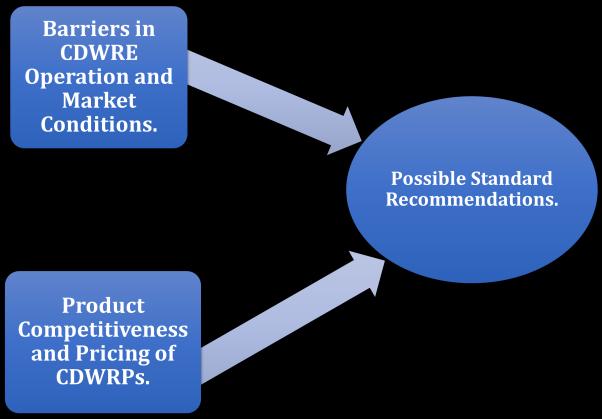
3. Results and Discussions
3.1 Identified Barriers in CDWREs Operations.
Code Barriers
B1 LackOfProductKnowledge
B2 LackOfEffectiveMarketingStrategy
B3 HesitancyToAdoptRecycledProducts
B4 LackofSpaciousStorageandProcessingFacilities forLargeVolumesofWaste
B5 ExorbitantOperatingCostsandStakeholders’ Behaviour
Table 1: BarriersInfluencingCDWREsOperationand MarketConditions.
3.2 B1- Lack of Product Knowledge.
Organizations engaged in marketing and distributing products derived from recycled construction materials occupy downstream positions in the industry chain. The currentdeficiencyinaunifiedplatformprovidingaccessible information about these recycled products contributes to low consumer awareness regarding their availability and benefits. Limited public acceptance and unfavorable perceptionsofrecycledproductspresentsignificantbarriers to sustainable construction. The market for recycled productsisstillemerging,raisingsignificantconcernsabout
International Research Journal of Engineering and Technology (IRJET) e-ISSN: 2395-0056
Volume: 11 Issue: 07 | July 2024 www.irjet.net p-ISSN: 2395-0072
availability, after-sales support, and resale value. Organizations worry that using recycled materials could complicatetheirsupplychainsandimpactproductquality standards,causingreluctancetoadoptthesematerials.This issue is further exacerbated by inadequate consumer awareness of recycled products. Additionally, these challenges are compounded by inefficient information managementamongstakeholders,resourceandtechnology constraints, non-standardized procedures, divergent objectives,anddecentralizedoperations[5]
TheprogressofthecirculareconomyandCDWMishindered by poor coordination of information, resources, and investments.Companiesoftenoverlookcompetition,market dynamics, and business processes. CDWREs rely on ineffective traditional marketing methods, like deploying salesrepresentativeswithbrochurestoconstructionsites. As a result, these organizations encounter challenges in accessing proper distribution channels and establishing partnerships with retailers or wholesalers, mostly due to their limited marketing resources. Not utilizing suitable communication channels or failing to connect with consumersthroughtheirpreferredmediumscanrestrictthe reachandimpactofmarketingcampaigns.Thisstrategyfails to address sluggish sales due to limited product value, flawed marketing, lack of technical guidance, insufficient investment, and poor market insights. Additionally, inadequate understanding of customer needs prevents precisemarketingandthoroughfeedbackresearch[6].
Despite global government policies promoting recycled products,concernsaboutsupplyanddemandhindermarket acceptance. Different capabilities among construction stakeholders and consumer prejudice against recycled products,perceivedasinferiortonewones,furtherimpede acceptance.Enhancingstakeholderunderstandingcanhelp eliminatethesebiases[7].Aspercustomerperceptioneven though there is a growing preference for sustainable products,thispreferencenarrativedoesnotalwaystranslate into purchasing decisions of the recycled products. This entire disconnect emphasizes the need for recycling enterprisestoinvestinstrongmarketingstrategiesthatnot only raise awareness but also effectively persuade consumersofthetangiblebenefitsandcomparablequalityof recycledproducts.
C&Dwastemanagementrequiresspecializedinfrastructure, including sorting, crushing, and screening facilities with loadingcapabilities,demandingsubstantialspace.Inurban areas,CDWREsneedsignificantcapitalinvestmentsforlarge
storage and processing facilities. The CDWM system faces obstaclesduetolimitedinterestandinsufficientinvestment in these essential storage facilities [7]. Insufficient investment in waste management infrastructure by both governments and private entities results in inadequate facilities to effectively handle growing waste volumes. Additionally, outdated waste processing technologies restrict the efficiency and capacity of existing facilities, complicating the management of large amounts of waste. Therearevariouscomplexpermittingprocessesandzoning restrictionswhichdelaytheconstructionofnewfacilitiesor theexpansionofexistingones.Privateinvestorsmayalsobe hesitanttoinvestinwastemanagementinfrastructuredue to perceived risks and uncertainties in the market. Interestingly,integratingpublic-privatepartnerships(PPPs) is a viable solution as PPPs can mobilize private sector resources and proficiency to balance public sector efforts, leading to more efficient and effective C&D waste managementalsolutions.Successfulexamplesfromvarious countrieshavedemonstratedthatwhengovernmentsand private entities collaborate, they develop state-of-the-art facilities that substantially enhance waste processing capabilities.
Maintaining a continuous flow of C&D waste is crucial for long-term recycling. Inconsistent waste sources and significant investments threaten revenue stability and market feasibility. Increased waste volume raises transportationdemandsandcostsalsolimitedgovernment resources hinder regulation enforcement. Contractors' reluctancetobuyrecycledproductsisinfluencedbypolicies, control, efficacy, societal norms, and information [8]. Stakeholdersfrequentlyprioritizeshort-termfinancialgains overlong-termsustainabilitybenefits,decliningtosupport for recycling initiatives. Majorly because the preliminary setup costs for recycling facilities can be formidable, establishinganewrecyclingplantrequiressignificantcapital investment,includinglandacquisition,construction,andthe purchase of specialized equipment. The regulatory environment also plays a role in shaping stakeholders' behavior.Insomeregions,thereareinsufficientgovernment incentivesorsupportforrecyclinginitiatives.Forinstance, subsidies,taxbreaks,orgrantsthatcouldimproveoffsetthe high costs of recycling are often lacking. Additionally, complex, and bureaucratic regulatory requirements can further increase operating costs and delay project implementation, discouraging investment in the recycling sector. Stakeholders are hesitant to adopt new recycling methodsduetotheapparentneedforsubstantialfinancial investments in establishing new recycling facilities. This perception arises from the expected expenses related to procuringandinstallingspecializedequipment,introducing new processes, and possibly providing training for staff members.
International Research Journal of Engineering and Technology (IRJET) e-ISSN: 2395-0056
Volume: 11 Issue: 07 | July 2024 www.irjet.net p-ISSN: 2395-0072
Pricing of CDWRPs (Construction & Demolition waste recycled products)
Code Challenges
C1 WasteAcquisitionandResidueTreatment
C2 LackofTechnicalandOperationalObstacles
C3 DominanceofVirginMaterials
C4 RecycledProductQuality
1: ChallengesinProductCompetitivenessand PricingofCDWRPs.
The growing volume of construction waste challenges urbanization, increasing site accumulation and costs. Effective management requires minimizing waste at its source and efficient sorting, yet landfill exhaustion and resource strain persist. Unsystematic collection, poor transportation,andunderdevelopedrecyclingtechnologies hinder market development [6]. The lack of sufficient equipmentandsiteavailabilityposeschallengesinaccessing limited waste acquisition channels, enabling unregistered CDWREs to bypass government oversight. Intense competitionforhigh-quality,cost-efficientconstructionand demolition waste further complicates the ability of registered enterprises to secure superior raw materials. Significant challenges in recycling construction and demolition (C&D) waste. Collected waste often includes contaminantsandmixedmaterials,complicatingrecycling efforts. Insufficient collection systems result in minimal recyclablewaste.InIndia,upto25%ofC&Dwasteisnonrecyclable, requiring additional sorting or ending up in landfills.Highcostsofcollecting, sorting,andtransporting waste diminish recycling profitability. Fluctuating supply anddemandforconstructionwastecomplicateplanningfor recycling businesses. Proper segregation at the source is crucial, but often lacking, leading to mixed waste streams thatarecostlytoseparateandreducerecyclingefficiency.
Integrating circular economy principles into construction projects is crucial for environmental and technical advantagesofrecycledproducts.Additionally,thereisalow levelofawarenessaboutrecyclingenterprise’spotentialto manufacture products meeting certified quality standards and inadequate training. According to CDWREs, the main operational challenges stem from the inconsistent flow of C&Dwaste,highexpensesassociatedwithitstreatmentand recycling,andthelowdischargefees.CDWREsfacesgeneral financialconstraintswithfixedcosts,suchassiterentalsand
employeewages,persistdespiteextendedrepaymentcycles andensuringfinancialstabilityisasignificanthurdle.Since many CDWREs primarily depend on self-funds, it is challengingtomanagecashflowdisruptions,particularlyas costs rise while sales decline [2]. Redundant equipment oftenrequiresmorefrequentmaintenanceandisproneto breakdowns, resulting in increased downtime and repair costs.Thisnotonlydisruptsoperationsbutalsoaddstothe overall operational expenses. Advanced multi-material recyclingsystemscanprocessawidervarietyofmaterials simultaneously, improving recovery rates and reducing waste sent to landfills. Inadequate training for workforce engaged in recycling enterprises direct to operational barriersandless-than-optimalperformance.Inefficiencies anderrorsresultfrominadequatestafftraining,whichleads tohigheroperationalcosts.Plus,thesecostsincludenotonly thedirectexpensesassociatedwith equipmentrepairand material loss but also the indirect costs related to lower productivityandincreasedwaste.
Without robust research and strategies, recycling enterprises struggle to deliver competitive products, favoring companies producing virgin materials and hindering the circular economy. Recycled products face pricingdisadvantagesduetohighrecyclingcostsandlimited awareness.Theabundanceandcost-effectivenessofvirgin materialsreducedemandforrecycledalternatives,despite their recognized benefits and compatibility with standard constructionpractices[9]. Regulatoryframeworksthatlack incentives for recycled materials may maintain the dominanceofvirginmaterialsbyfailingtoencouragetheir adoptioninindustries.Thisabsenceofprioritizationhinders market demand for recycled alternatives, perpetuating relianceonvirginresources.
Thelackoftechnicalstandardshindersqualitycontroland productperformanceverificationinrecycling.CDWREsface high costs from impurity-laden C&D waste, requiring significant investment in processing. Reuse challenges include lead times, costs, and quality reliability. Contaminants if not segregated properly it can disrupt manufacturing processes, leading to defects or failures in product manufacturing or the final product. At times, recycledmaterialsundergoareductioninquality,knownas downcycling,wheretherecycledproductisoflowerquality andfunctionalitythantheoriginalmaterialthissituationcan developtrustissuesamongstakeholders.Thisdowncycling canlimittheapplicationofrecycledmaterialstolowergrade uses, making them unsuitable for high-performance applications which can disrupt the image of the recycled products. This contamination necessitates additional processing and quality control measures to ensure the productmeetsrequiredstandards.Insufficientreturnsfrom
2024, IRJET | Impact Factor value: 8.226 | ISO 9001:2008 Certified
International Research Journal of Engineering and Technology (IRJET) e-ISSN: 2395-0056
recycled materials, high expenses, and impurity detection issuesleadtonarrowprofitmargins.Advancedtechnology andimprovedstandardsareessentialforfullconstruction waste reutilization [6] Balancing the meager profits from recycled materials against the high costs of rentals, transportation, labor, and the challenge of detecting impurities presents a persistent challenge. This delicate equilibriumoftenleadstoslimprofitmarginsand,insome instances,theclosureofrecyclingenterprises.
5. Recommendations for Possible Standards and Solutions.
3: PossibleStandardsandSolutions
R1 ClosedLoopofWasteAcquisitionandRecycling Framework
R2 StrengtheningTechnologicalInnovation
R3 ExpandingProductTypesandMarket
R4 GovernmentalInterventions
R5 PublicPrivatePartnership
Closed-loop system is crucial as, waste materials are collected, processed, and recycled into new products, adopting an ongoing cycle of material usage. This holistic approach enhances resource efficiency by reducing dependence on virgin materials and minimizing waste generation. Adopting a closed-loop system enables companies to adhere to environmental regulations and achieve sustainability objectives. Governments should establish consumption and recycling zones to facilitate acquisition and cross-domain CDWM, encouraging collaborationandtechnologyexchange.AccurateC&Dwaste assessments and a comprehensive cycle for generation, sorting,transportation,recycling,andpromotionarecrucial forsustainablewastemanagement.Improvedcollaboration between CDWREs and the government can enhance recyclingframeworksandpromoteindustrystandards[10].
Engaging with research institutions supports CDWREs in technology and development, easing market expansion challenges. Advances in waste processing and tracking technologies are vital for effective waste management. Promoting Precast Construction Technologies minimizes pollution and facilitates material recovery without disruptive dismantling. Intensifying research on CDWM technologiesandsustainablepracticesiscrucialforefficient classification, sorting, and quality control, reducing
Volume: 11 Issue: 07 | July 2024 www.irjet.net p-ISSN: 2395-0072 © 2024, IRJET | Impact Factor value: 8.226 |
environmentalimpact[7] Advancedtechnologiesstreamline operations, leading to decreased resource usage and enhancedefficiency.Throughautomation,optimization,and efficientresourceallocation,thesetechnologiesfrequently reducemanufacturingexpenses.Strengtheningtechnological innovationintherecyclingindustry,particularlywithinthe framework of a circular economy, is crucial for enhancing efficiency,productquality,andoverallsustainability.
Establishingaclosed-looprecyclingsystemforC&Dwaste can reduce intermediary profits and promote selfproduction and sales. Partnering with upstream and downstream industries enhances quality control and marketing strategies. CDWREs should leverage industry associationsandexpostoshowcaseproductsandimprove visibility. Forming alliances with state-owned enterprises ensures a steady raw material supply and supports R&D, easing operational pressures [8] CDWREs can develop contingencyplans,establishalternativesupplychains,and maintainfinancialreservestoensuresufficientcashflowand capital to withstand market fluctuations and unexpected costsfromeventslikenaturaldisasters,marketdisruptions, andregulatorychanges.Conductingcomprehensivemarket analysisiscrucialforeffectiveimplementation,asitaidsin understanding current trends, consumer preferences, and potentialdemandforrecycledproducts.Identifyingmarket gaps where recycled materials can be introduced is also essential.Additionally,implementingmandatoryconsumer feedback mechanisms on recycled products helps better understand their needs and preferences, guiding product development and marketing strategies to strengthen recycled product enterprises. Advanced and efficient inventorymanagementsystemsshouldbeimplementedto trackandmanagerecycledproducts,preventingshortages andoverproduction.
Governmental interventions are crucial in providing regulatory frameworks which is the backbone of the enterprise as it helps to promote stability in markets, ensuring rational competition and protecting consumers from exploitation. Converting C&D waste into secondary resourcesiscrucialforadvancingacirculareconomy.Key factorsincludegovernmentsupport,efficientsupplychains, and technology investments. In emerging economies, aligning environmental and economic goals is vital. Policymakers,practitioners,andthepublicmustcollaborate toimproveincentivesandsupportforCDWMenterprises. Effective economic incentives are needed to enhance the viabilityoftherecycledproductsmarket[2].Executingstrict quality standards for recycled materials can help build consumer trust and ensure that recycled products meet industry requirements. Quality certification programs can validatethesafetyandperformanceofrecycledmaterials. Governmentaleffectiveinvolvementscansetstandardsfor
International Research Journal of Engineering and Technology (IRJET) e-ISSN: 2395-0056
Volume: 11 Issue: 07 | July 2024 www.irjet.net p-ISSN: 2395-0072
C&D waste recycling, promoting effective waste managementandenvironmentalprotectionwithfocusingon circular economy. Government support can also boost marketdemandforrecycledC&Dproductsthroughpolicies like procurement mandates, tax incentives, and subsidies, thereby creating economic opportunities for recycling enterprisescommunities.
Public-privateparticipation(PPP)playsafundamentalrole in advancing the circular economy within CDWREs. By combiningthestrengthsofbothsectors,PPPscanenhance resourceefficiency,innovation,andmarketreach.Creating fundingmodelsthatblendpublicandprivateinvestments can boost the financial viability of recycling projects. For instance, combining public grants with private loans can provide a solid financial foundation. Co-financing arrangements where both sectors share the costs and benefits can also make these projects more feasible and sustainable. This collaborative approach ensures that recyclinginitiativeshavethenecessaryresourcestosucceed and grow. Establishing joint systems for monitoring and evaluating the performance of recycling initiatives can ensure continuous improvement. This can involve setting performance indicators, conducting regular assessments, andreportingonprogress.
The research concentrates solely on challenges, practices, andproceduresspecifictoCDWREsindevelopingcountries, potentially limiting its applicability to other regions or countries globally. Additionally, it may not encompass all essential stakeholders, including builders, waste managementcompaniespotentiallyleadingtoanincomplete understandingofconstructionwastemanagementindustry challenges.
CDWREsplayavitalroleinC&Dwastemanagementwithin thecirculareconomy,necessitatingimmediateattentionfor devisinglong-termsolutionsindevelopingcountries.This research's core objective was to investigate impediments hinderingthegrowthof CDWREsin developingcountries. Through exploring the perspectives of researchers and stakeholders,thestudyaimedtoilluminatechallengesinthe recycling enterprise sector. The findings offer valuable insights for stakeholders seeking to enhance recycling enterprises in developing countries. Additionally, the research presents standards and recommendations to address identified issues and promote sustainable waste managementalignedwithcirculareconomyprinciplesand sustainability.CDWREscanemergeaskeydriversofpositive environmental, social, and economic impact, contributing significantlytotheachievementofsustainabledevelopment goalsonbothlocalandglobalscales.
[1] Zhikun,D.,Wang,X.,&Zou,P.X.W.(2023).Barriersand countermeasuresofconstructionanddemolitionwaste recyclingenterprisesundercirculareconomy.Journalof Cleaner Production, 138235. https:/doi.org/10.1016/j.jclepro.2023.138235
[2] Shooshtarian,S.,Maqsood,T.,Khalfan,M.,Yang,R.J.,& Wong, P. (2020b). Landfill Levy Imposition on Construction and Demolition Waste: Australian Stakeholders’Perceptions.Sustainability,12(11).
[3] Zacho, K. O., Mosgaard, M., & Riisgaard, H. (2018). Capturinguncapturedvalues ADanishcasestudyon municipalpreparationforreuseandrecyclingofwaste. Resources,ConservationandRecycling,136,297-305. https://doi.org/10.1016/j.resconrec.2018.04.031
[4] Tennakoon,G.A.,Rameezdeen,R.,&Chileshe,N.(2021). Divertingdemolitionwastetowardsecondarymarkets through integrated reverse logistics supply chains: A systematic literature review. Waste Management & Research, 40(3), 274-293. https://doi.org/10.1177/0734242X211021478
[5] Liu, J., Teng, Y., Wang, D., & Gong, E. (2020). System Dynamic Analysis of Construction Waste Recycling Industry Chain in China. Environmental Science and Pollution Research, 27(30), 37260-37277. https://doi.org/10.1007/s11356-019-06739-x
[6] Ding,Z.,Wang,X.,&Zou,P.X.W.(2023).Barriersand CountermeasuresofConstructionandDemolitionWaste RecyclingEnterprisesUnderCircularEconomy.Journal of Cleaner Production, 420, 138235. https://doi.org/10.1016/j.jclepro.2023.138235
[7] Ma, M., Tam, V. W. Y., Le, K. N., & Li, W. (2020). Challenges in Current Construction and Demolition Waste Recycling: A China study. Waste Management, 118, 610-625. https://doi.org/10.1016/j.wasman.2020.09.030
[8] Huang,B.,Wang,X.,Kua,H.,Geng,Y.,Bleischwitz,R.,& Ren, J. (2018). Construction and Demolition Waste Management in China through the 3R principle. Resources, Conservation and Recycling, 129, 36-44. https://doi.org/10.1016/j.resconrec.2017.09.029
[9] Kumawat,T.,Sharma,V.,Kumawat,V.,Biyani,M.,Pandit, A., & Bhatt, A. (2021). Sustainable Techniques for Building Waste Disposal. In (pp. 489-503). https://doi.org/10.1007/978-3-030-76073-1_26
[10] Wang,Z.,Xie,W.,&Liu,J.(2021).RegionalDifferences and Driving Factors of Construction and Demolition Waste GenerationinChina. Engineering, Construction
International Research Journal of Engineering and Technology (IRJET) e-ISSN: 2395-0056
Volume: 11 Issue: 07 | July 2024 www.irjet.net p-ISSN: 2395-0072
and Architectural Management, ahead-of-print. https://doi.org/10.1108/ECAM-10-2020-0887
BIOGRAPHIES

Author 1: Graduated as an Architect from the KLS Gogte Institute of Technology, Belgaum, IndiaandMaster’sinConstruction Management from Auckland University of Technology, New Zealand. Graduate Certificate in Advanced Public Policy, Takshashila Institute, Bangalore. Having previously worked in multi-disciplinary consultancy practicesandacademia.Asateam member, was involved in various large infrastructural projects in fieldsofoperation–UrbanDesign, Environmental Planning, and LandscapeConservation.
SupervisoroftheResearch
DrDatDoan
SeniorLectureratAuckland UniversityofTechnology, Auckland,NewZealand
© 2024, IRJET | Impact Factor value: 8.226 | ISO 9001:2008