
International Research Journal of Engineering and Technology (IRJET) e-ISSN: 2395-0056
Volume: 11 Issue: 07 | July 2024 www.irjet.net p-ISSN: 2395-0072

International Research Journal of Engineering and Technology (IRJET) e-ISSN: 2395-0056
Volume: 11 Issue: 07 | July 2024 www.irjet.net p-ISSN: 2395-0072
Anjala Sharma1 , Dr. Mamta Awasthi2
1PG Scholar, Center for Energy Studies, N.I.T Hamirpur, Himachal Pradesh, India
2Professor, Center for Energy Studies, N.I.T Hamirpur, Himachal Pradesh, India
Abstract – Small-scale rooftop solar PV systems are convenient forms of energy providers for the household worldwide.HimachalPradeshreceivesabundantsolarenergy with average annual Global Horizontal Irradiations (GHI) above 4.5kWh/m2/day which is adequate for installation of solar PV systems Government of India has launched several schemes to promote the grid-connected roof-top solar PV systems. Objective of this study is to perform the economic analysis of grid-connected roof-top solar PV system for the domestic consumers of Himachal Pradesh (HP). Three different size of solar PV systems are selected (1020Wp, 2040Wpand3400Wp)forcomparativeeconomicassessment for domestic consumers with monthly electrical energy consumption in the range of 60kWh to 600kWh This study provides the comparative financial analysis with expected returns on investment and payback period for solar PV systems for domestic consumers with different energy demands under government policies and subsidies. Results of thisin-depthanalysisdemonstratesthatgrid-connectedrooftop solar PV systems would be economically viable for the domestic consumers of Himachal Pradesh with monthly averageelectricalenergyconsumptionof200kWhandabove, cangenerateanalternatesourceofincomefortheconsumers and contribute to the environmental friendly solution.
Key Words: Solar PV System, Grid-connected, Roof-top, Economicassessment
India’sgeographicalareareceivesabout5000trillionkWhof solarenergyeachyearwithmostsectionsreceiving4-7kWh per m2 per day [1]. The National Institute of Energy estimated the countries solar potential to be at 748 GW, assuming solar photovoltaic modules cover 3% of the geographical surface. India is a perfect location for solar energybecauseofitsgeographicallocation.India receives around250to300daysofsunshineeachyear[1],[2]
UndertheParisAgreementof2015,Indiaiscommittedto generate40%ofelectricity(450GW)fromrenewableenergy sourcesby2030.Solarenergyplaysavitalroleinachieving thetargetwithatargetof280GWfromsolarpowerby2030 whichisaround60%ofthetotalrenewableenergy target [3]
Himachal,hillstateofIndiareceivesannualaverageGlobal Horizontal Irradiations (GHI) above 4.5kWh/m2/day [4] ThisisatinyhillStatewithaheightofbetween300metres in Kangra and Una, and over 7,000 metres in Lahaul and Spiti, central Himalayans. It spans an area of 55,673 km2 , about1.69%ofthetotalsurfaceareaofthenation[5].GHIin theregionareinfluencedbydiversetopographyofthestate. The lower- and middle-elevation zones (<3500m) with tropical to wet-temperate climate receives higher GHI (>5 kWh/m2/day)foramajorpartoftheyearcomparedto thehigherelevationzone(>3500 m)withdry-temperateto alpineclimate(4–4.5 kWh/m2/day)[4]
Himachalhassetatargetofachieving10GWofsolarpower by 2030 [6] Himachal Pradesh, among all States and territories of the Union of the nation, is the state with the greatestproportionofruralpeopletotheoverallpopulation. 89.97% of population of Himachal Pradesh resides in the ruralofstate[7].Small-scaleroof-topsolarPVsystemcan contributetotheHimachal’sambitioustargetofachieving 10GWby2030.
Government of India is promoting the roof-top solar PV systemsandhavelaunched PMSurya- HarGharMuftBijli Yojana. Under this scheme, subsidy is provided for consumers to install roof-top solar PV system. This paper analyzeeconomicaspectsofthesmallsizeofgridconnected roof-topsolarPVsystemforthedomesticsupplyconsumer forHamirpur.Thisstudyalsoevaluatestheelectricitytariffs andnetmeteringapplicablefortheconsumersofHimachal Pradesh. Site selected for study, Hamirpur is one of the districtsofHimachallocatedinthelowerwestcentralouter Himalayasatanaverageelevationof790mabovesealevel [15] Study provides the detailed comparison of three differentsizeofsolarPVsystemaccordingtotheconsumer’s energydemand.
Threegrid-connectedroof-topsolarPVsystemsA,BandC withcapacity1020Wp,2040Wpand3400Wprespectively areusedforthestudy.Domesticconsumercaninstallsolar PVsystembasedontheelectricalenergyneedsoreconomic feasibility therefore objective of selection of different capacity solar PV systems is to provide a comparative analysis of 3 different size solar PV systems for domestic consumers with electrical energy needs in the range of 60kWhto600kWhpermonth
International Research Journal of Engineering and Technology (IRJET) e-ISSN: 2395-0056
Volume: 11 Issue: 07 | July 2024 www.irjet.net p-ISSN: 2395-0072
This study is applicable to the domestic supply for the electrical energy consumers of Himachal Pradesh and is applicabletothefollowingconsumersofenergy[8].
- Consumersusing electricalenergyforlights,fans, heaters, cooking ranges, ovens, refrigerators, air conditioners, stereos, radios, televisions, mixers, grinders,electriciron,sewing/embroidery/knitting machines, domestic pumping sets and other domesticappliancesinasingleprivatehouse/flator anyotherresidentialpremises;
- Religiousplaceswithconnectedloadupto5kW;
- Orphanages, homes for old people and homes for destitute;
- Working Women Hostels, Hostels attached to the educational institutions, if supply is given separatelytoeachhostelandtheelectricitycharges arerecoveredfromthestudents;
- LeprosyHomesrunbycharityandun-aidedbythe Government;
- PanchayatGharswithconnectedloadupto5kW;
- Patwar Khanas and Kanungoo Bhawans (GovernmentBuildingsonly)withconnectedload upto5kW;
- Community gausadans, goshalas and cow sanctuaries not registered with Gow Sewa Ayog withconnectedloadupto20kW;
- MonasteriesandNunneries;
- HeritageHotelsapprovedunderHPGovernment’s HeritageTourismPolicy,2017;
- ResidentialPayingGuests;
- Incredible India Bed-and-breakfast as per GoI, MinistryofTourismguidelines;
- “Home Stay Units” in rural areas duly registered withtheDistrictTourismDevelopmentOfficer;
- Offices of the Himachal Pradesh Senior Citizen Forum;
- PersonalGarageforparkingofpersonallightmotor vehicle;
- ForIndustrialConsumerwhichareunderPDCOdue to non-payment of dues or sick closed units with maximumconnectedloadof20kWforlightingand
security purpose only till regular connection is restored (Pre-paid meter provisionally); and HPSEBL-D Business Plan and MYT Order for 5th Control Period (FY25-29) Himachal Pradesh ElectricityRegulatoryCommission
- MESandothermilitaryestablishment
InHimachalPradesh,theprovisionofelectricityisoverseen by theHimachal Pradesh State Electricity Board Ltd. (HPSEBL).Electricitychargestothedomesticconsumersof the state with the subsidy provided by the government of Himachalareasper[8]
Toeconomicallyanalyzethegrid-connectedroof-topsolar PVsystems,itisimportanttounderstandthegovernment policies and subsidies provided to promote renewable energy.InaccordancewiththeElectricityAct,2003,every stateinIndiahascomeupwitha netmeteringpolicyora rooftop solar policy which dictates the modalities of installing a grid-connected rooftop solar or a small solar power plant in the given state. In the net metering mechanism,theelectricitygeneratedbythesolarPVsystem isconsumedbytheuserandanyexcesselectricityisinjected into the grid. In case the consumer requires more power than what is produced by the solar PV system, they can import the balance from the grid. At the end of the settlementperiod,theconsumerisonlychargedforthe‘net’ energy utilized – the difference between the energy produced through the solar PV system and the energy consumedoverthebillingperiod.Abi-directionalmeteris used to measure the net electricity consumption of the system[9].
HimachalPradeshElectricityRegulatoryCommission,makes theamendmentsin2022intheHimachalPradeshElectricity RegulatoryCommission(RooftopSolarPVGridInteractive System based on Net Metering) Regulations, 2015 [10] as listedbelow:
(a)Therooftopsolarsystemuptocapacityof50kWpmaybe installedundernetmetering.
(b)Undernetmetering,thesolarenergygeneratedfromthe rooftop solar system, installed at premises of the eligible prosumer,isusedbytheprosumerinhispremisesandthe surplusenergy,ifany,isdeliveredtotheGrid.
(c)TheenergyimportedbytheProsumerfromtheGrid,on netbasis,duringabillingperiodisbilledtotheProsumerat applicableretailtariff
International Research Journal of Engineering and Technology (IRJET) e-ISSN: 2395-0056
Volume: 11 Issue: 07 | July 2024 www.irjet.net p-ISSN: 2395-0072
(d)Anet-metertomeasurethenetflowofenergyisinstalled bythedistributionlicenseeatProsumerpremises.Thecost ofnet-meterisbornebytheprosumer.
(e)Thecarryforwardofunadjustedsurplusenergyfromone billingperiodtothesubsequentbillingperiod(s)withinthe same settlement period is done in shape of unit’s kWh or kVAh,asthecasemaybe.
(f)Theunadjustedsurplusenergy,ifany,asperthebillfor the last billing period of the settlement period shall be settledaspertheprovisionsofRegulation.
“Prosumer”meansapersonwhoconsumeselectricityfrom the grid and can also inject electricity into the grid for distributionlicensee,usingsamepointofcommencementof supply.InthispaperProsumerisidentifiedasconsumer.
AlleligibleconsumersofelectricityinHimachalPradeshare eligiblefortheroof-topsolarPVsystem.Maximumsize of roof-topsolarPVsystemisdecidedbasedonthesanctioned connectedloadtotheconsumeraspertheslabsdecidedby the Himachal Pradesh Electricity Regulatory Commission [11] in 2018. Table 1 provides the maximum solar PV systemcapacitybasedonsanctionedloadforconsumers.
Table 1:Capacityofroof-topsolarPVsystem
Sr. No For consumers having sanctioned connected load
1 5kWorless
2 Exceeding5kWbutnot exceeding10kW
Maximum peak capacity of Solar PV Project
100%ofsanctioned connectedload
70%ofsanctioned connectedloador 5kW;whicheveris higher
3 Exceeding10kW
50%ofsanctioned connectedloador 7kW;whicheveris higher
To encourage the domestic households to install roof-top solar PV plants, Government of India launched PM Surya GharMuftBijliYojanaonFebruary15,2024[12].Underthis scheme, subsidy is provided on small-scall roof-top solar plantsperbelow:
4 Rs30,000/-perkWroof-topsolarplantisprovidedby governmentupto2kWplantsize.
5 Rs18000/-perkWadditionalcapacityupto3kWrooftopsolarplantsize.
6 Totalsubsidyforsystemslargerthan3kWcappedatRs 78,000/-
AsperHimachalPradeshElectricityRegulatoryCommission regulations,2015andsubsequentamendments,theratesfor settlementofsurpluspowerexportedtoGridbyPVsystem consumerisRs1.051/kWhfordomesticcategoryconsumers [13]
3.1
The performance of solar PV systems can be different according to their different configurations and locations [14] Inthisstudy,threeconfigurationsofcapacity1020Wp, 2040Wpand3400Wpofgrid-connectedroof-topPVsystem areconsideredfortechno-economicanalysisandsuitability for the domestic consumers of Himachal Pradesh. Three grid-connected roof-top solar PV systems A, B and C with capacity 1020Wp, 2040 Wp and 3400Wp respectively are modelled in the software tool PVsyst. Domestic consumer can install solar PV system based on the electrical energy needsoreconomicfeasibilitythereforeobjectiveofselection of different capacity solar PV systems is to provide a comparativeanalysisof3differentsizesolarPVsystemsfor domestic consumers with electrical energy needs in the range of 60kWh to 600kWh per month.These solar PV systemsareidentifiedbySolarPVSystemA,SystemBand System C respectively in this paper. This present paper considers the Hamirpur district of Himachal for the study purpose. The geographical co-ordinates of Hamirpur is31.68°N 76.52°E [15] Meteorological weather data provided provided by National Solar Radiation Database managed by The National Renewable Energy Laboratory (NREL)isusedforthestudypurpose[16].Electricitytariffs and subsidies provided by the Government of India and GovernmentofHimachalPradeshapplicableinYear2023-24 as defined in section 1 and section 2 are used for the economic analysis of grid-connected roof-top solar PV systems Costofsmall-scalesolarPVcomponentsisreceived fromlocalsuppliers.
Techno-economic analysis is performed for small-scale grid-connectedroof-topsolarPVsystembyusingfollowing calculation methods. Electrical energy consumed by consumers varies and depend upon the no. of family membersinfamilyandtypeofappliancesusedathousehold based on income of the family. Electrical energy consumptionintherangeof60kWhpermonthto600kWh permonthisselectedfortheeconomicassessmentofgridconnectedrooftopsolarPVsystemsA,BandC.
International Research Journal of Engineering and Technology (IRJET) e-ISSN: 2395-0056
Volume: 11 Issue: 07 | July 2024 www.irjet.net p-ISSN: 2395-0072
Electricity bill is calculated based as total cost of the energy units consumed by consumer minus no. of energy units generated by PV system. In case the no. of units generated by PV system is more than the no. of units consumedbyconsumer,surplusenergyunitsareexported to the grid at settlement rate defined by the Himachal Pradesh State Electricity Board for the domestic category consumersaspersection2.4
Monthly Electricity Bill (Rs.) = Noofunitsconsumed by consumer(kWh)xenergycharges+fixedcharges[8]
No. of energy units (kWh) generated by PV system more than,equaltoorlessthanenergyconsumptionbyconsumer. Total cost saving per month with installation of gridconnected roof-top solar PV system is calculated for two casesasdefinedbelowtocalculatenetannualcash-inflow.
Case I: If No. of energy units generated by PV system ≥ monthlyenergyconsumptionofconsumer
Cost Saving on Electricity Bill (Rs.) =Monthlyelectricity bill
Surplus Energy Exported to Grid (kWh) = No. of units generated by PV system - No. of units consumed by consumer
Cost of Surplus Energy Exported to Grid (Rs) = Energy exportedtoGridxsettlementrate
Total Cost Saving (Cash In-flow) / month (Rs) = Cost savingonelectricitybill+costofsurplusenergyexportedto grid
Case II: If No. of energy units generated by PV system < monthlyenergyconsumptionofconsumer
Cost Saving on Electricity Bill (Rs.) =Monthlyelectricity bill–Costofenergyunitsimportedfromgrid
Total Cost Saving (Cash In-flow) / month (Rs) = Cost savingonelectricitybill
Payback Period [PB]: Payback period is defined as the amountoftimeittakestorecoverthecostofaninvestment and can be calculated as ratio of initial investment to net annualcashin-flow.

Levelized Cost of Electricity [LCOE]: Thelevelizedcostof electricity(LCOE)isa measureoftheaveragenet present costofelectricitygenerationforageneratoroveritslifetime. It can be expressed as the ratio of plant cost (capital cost [CC]+presentValueofMaintenanceCosts[MC])tothetotal electricitygenerated[E].

A roof-top solar PV system is defined as unprofitable when Net Present Value (NPV) of the project is less than zero.
ThePVsysttooliscommerciallyavailablesoftwarethatis usedtosimulatesolarPVprojects.ThisstudyusedPVsyst tool for the simulation of solar PV system. The PVsyst software library contains detailed data most common photovoltaic modules and inverters offered by different suppliers,andall thatisneededfora photovoltaicsystem project. Furthermore, it records losses due to the partial shadowing effects, mismatches between connected PV modules,wiringlosses,inverterlosses,andtheeffectofthe ambient temperature variations on its electrical output powercalculation.Thisfunctionalitymakesitaprecisetool toestimatetheamountofelectricalenergyproducedbya designedsystem[17].
Threegrid-connectedroof-topsolarPVsystemsA,BandC withcapacity1020Wp,2040Wpand3400Wprespectively are modelled in the software tool PVsyst. Models are analyzedfordomesticconsumerswithenergydemandinthe rangeof60kWhto600kWhpermonth.Finalresultsdepends on the net metering, energy imported or exported by consumerforsolarPVsystemsA,BandC.Identicaltechnical parametersareselectedforcomparativestudypurpose
Hamirpur experiences short warm summers from late ApriltoJunewhentemperaturemaygoupto40°C,andcool winters from mid-October to April having as low as 7°C. Monsoon season starts in late June and lasts till early September with fair amount of rainfall. The optimum tilt angleforsolarPVis30oatwhichitreceivesanirradiationof 4.96kWh/m2/day.DetailedirradiationdataforHamirpuris providedinTable2.Thepresentstudyhasconsideredthe meteorological weather data provided by National Solar Radiation Database (South Asia 2000-2014) managed by NREL [16] Geographical co-ordinates of Hamirpur are 31.68oN76.52oE.
International Research Journal of Engineering and Technology (IRJET) e-ISSN: 2395-0056
Volume: 11 Issue: 07 | July 2024 www.irjet.net p-ISSN: 2395-0072
Table 2: Monthlysolarirradiationdataforthe investigatedHamirpurdistrictofHP.
Thetiltangleofsolarpanelsissignificantforcapturingsolar radiation that reaches the panel's surface. The azimuth is defined as the angle between the south direction and the directionthepanelsface.Fig.1showstheplanetiltangleand azimuthangles(30o andAzimuth0o respectively).
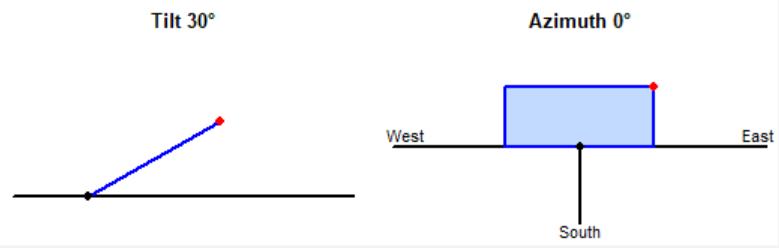
1: OrientationparametersofPVmodules arrangementsystem:tiltangleandazimuthangle
4.2 Technical Specifications
Threesmall-scalePVsystemsA,BandCofdifferentcapacity aremodelledinthePVSystsoftwaretoolfortheassessment. SelectionofPVmoduleandinverterinthePVsystdatabase is based on the most suitable capacity and size for the designingofsolarPVsystemandislistedoutinTable3
Table 3: TechnicalspecificationsofsolarPVsystem
Solar PV System A B C
DCPVarray capacity 1020Wp 2040Wp 3400Wp
PVmodule (AEGASM1203B-H360)
PVmodule connection 1stringof3 modules 1
EstimatedcostofsolarPVsystemsisreceivedfromsystem suppliers in the region as listed in Table 4. Government subsidyonthePVsystemisappliedunderPM–SuryaGhar: MuftBijliYojana[12]
Table 4: Costdetailsofgridconnectedroof-topsolar plant.
Solar PV systems are assessed economically based on the tariffsplansandelectricitygeneratedbyeachPVsystemfor
International Research Journal of Engineering and Technology (IRJET) e-ISSN: 2395-0056
Volume: 11 Issue: 07 | July 2024 www.irjet.net p-ISSN: 2395-0072
theconsumerswithdifferentelectricalenergyneedsinthe range of 60kWh per month to 600kWh per month. In addition,followingfactorsareconsideredfortheeconomic analysis:
- The life expectancy of PV models is over 25 years [18]
- Inverterlifehasbeenconsideredas10years[19]
- TheoverallmaintenancecostofsolarPVplanthas beenconsideredas1%ofthecapitalcost[20]
Solar PV system A with capacity of 1020Wp consists of 3 solarmodulesof340Wpconnectedinseries.Totalelectricity generatedby1020WpPVsystemmodelis1807kWhyearly. Levelizedcostofelectricityis1.39Rs./kWh.
Solar PV system B with capacity 2040Wp generates 3578kWhelectricityyearlywith6solarmodulesof340Wp. 2 strings of 3 modules each are used for solar PV system modeling.Levelizedcostofelectricityfor2040WpPVsystem is1.38Rs./kWh.
SolarPVsystemCwithcapacity3400Wgenerates5967kWh electricityyearlywith10solarmodulesof340Wp.2strings of5moduleseachareused forsolarPVsystemmodeling. Levelizedcostofelectricityfor3040WpPVsystemis1.20 Rs./kWh.
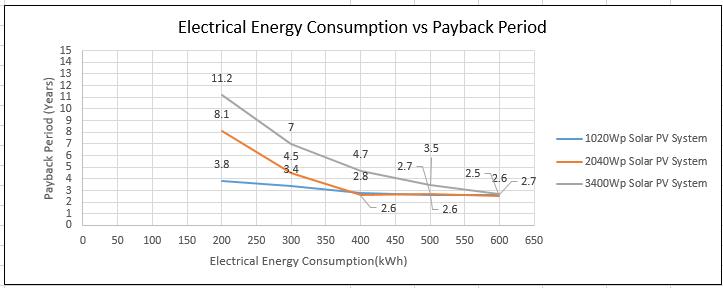
All three solar PV systems are non-profitable for the consumerswithlowelectricitydemand(<200kWh/month). ThisisbecauseofthesubsidiesprovidedbyHPSEBLforlow incomeconsumersonelectricitybill. Howeversystemwill beprofitablefortheconsumerswithmonthlyconsumption ofmore than 200kWh with payback period and return on investments as shown in Chart - 1 and Chart - 2. Payback periodforsystemAisminimumamong3modelsthoughitis notedthatsystemBwithcapacity2040kWhwouldbemost suitable for domestic consumers with monthly average electrical energy consumption of 400kWh. Reason is the tariffratesapplicableinthisrangeofelectricityconsumption [8]
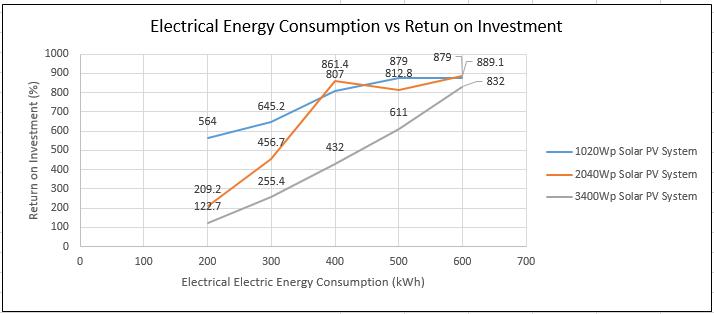
- 2: ElectricalEnergyConsumptionvsReturnon Investment(ROI)forthreesolarPVsystems
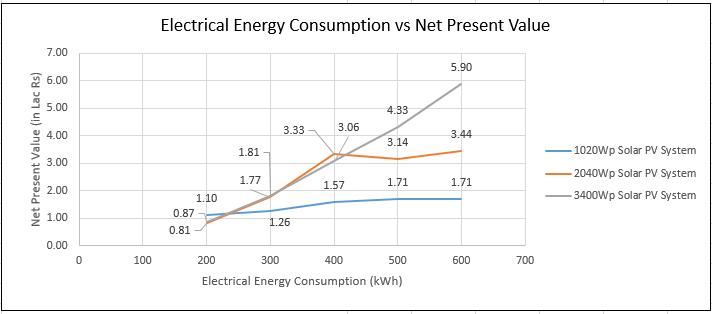
- 3: ElectricalEnergyConsumptionvsNetPresent Value(NPV)forthreesolarPVsystems
Toachieveaglobaltargetofnet-zerocarbonemissionsby 2050 requires substantial scaling up of solar photovoltaic (PV) and other renewable energy production [21]. The globalinstalledcapacityofsolarPVpowerhasincreased30fold from 2009 to 2019, while its cost of generation has declined by 90% [22]. It is important to measure the environmentalbenefitofgrid-connectedroof-topsolarplant overitslife-timecycle.Chart-4showstheamountofCO2 emissionsavedbythedifferentsmall-scalegrid-connected roof-topsolarplants. Thecalculationsdependmajorlyon thevalueofthelifecycleemissions(LCA),whichrepresent CO2 emissions associated with a given component or quantity of energy. This includes the total life cycle of a componentortheamountofenergy,includingproduction, operation,maintenance,disposal,etc.Therationalebehind thecarbonfootprinttoolisthattheelectricitygeneratedby the photovoltaic system will replace the same amount of electricityintheexistinggrid.Ifthecarbonfootprintofthe PVinstallationperkWhissmallerthantheoneforthegrid electricityproduction,therewillbeanetsavingofCarbon Dioxideemissions.Thus,thetotalcarbonbalanceforaPV installationisthe difference betweenproducedandsaved CO2Emissions.FromChart-4,CO2emissionisnegativeuntil thelast10years(orclose)oftheproject;then,itbecomes positive.
Similarly, return on investment for the solar PV system A wouldbehighestamongallasshowninChart-2.However netpresentvalueofsolarPVsystemCishighestasshownin Chart-3
International Research Journal of Engineering and Technology (IRJET) e-ISSN: 2395-0056
Volume: 11 Issue: 07 | July 2024 www.irjet.net p-ISSN: 2395-0072
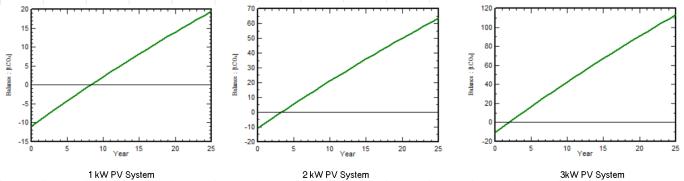
- 4: CO2 emissionreductionvs.timeforPVSystems
Thispaperperformedcomparativeeconomicassessmentof threesmallscalegrid-connectedroof-topsolarPVsystemsof capacity 1020Wp, 2040Wp and 3400Wp for domestic consumers of Himachal Pradesh with average electric consumptionintherangeof60kWhto600kWhpermonth. Under PM – Surya Ghar: Muft Bijli Yojana [12], it is found that grid-connected roof-top solar PV systems would be economicallyviableforthedomesticconsumersofHimachal Pradeshhavingaveragemonthelectricalenergyconsumer morethan200kWh.ThoughsolarPVsystemswouldnotbe economicallyviablefortheconsumerswithmonthlyaverage electricalenergyconsumptionlessthan200kWhbecauseof the tariff rates and subsidies provided to the consumers. Studyalsohighlightstheenvironmentalbenefitsofinstalling grid-connected roof-top solarPV system fordifferent slab consumersofelectricityduringitslifecycle Thisstudycan be used as base for further economic evaluation of gridconnected roof-top solar PV system considering more technicaldetailse.g.addingtheimpactofshadowareaonthe performanceofsolarPVsystem.Fromthestudy,itisevident thatpromotingthegrid-connectedroof-topsolarPVsystem inruralaswellasurbanareasofHimachalPradesh under PM-SuryaGhar:MuftBijliYojana[12]couldhelpdomestic consumerstoinstalleconomicfeasiblegrid-connectedrooftopsolarplantsandcontributetoachievesolarenergytarget of450GWby2030forIndia
REFERENCES
[1] SolarOverview,MinistryofNewandRenewableEnergy, https://mnre.gov.in/solar-overview/
[2] AkritiMasoom,PanagiotisKosmopoulos,AnkitBansal andSteliosKazadzis,“SolarenergyestimationsinIndia usingremotesensingtechnologiesandvalidationwith sunphotometersinurbanareas”,“Remotesensing”,vol. 12,Issue2,Jan.2020,doi:10.3390/rs12020254
[3] Press Information Bureau, Ministry of New and Renewable Energy https://pib.gov.in/PressReleasePage
[4] T V Ramachandra, Gautam Krishnadas,Rishabh Jain, “Solar potential in Himalayan landscape” “ISRN Renewable Energy” 2012(9), doi: 10.5402/2012/203149
[5] R B. Singh, Pankaj Kumar, “Geographic and socioeconomic realities of Himachal Pradesh, Northern Himalaya”,Partofthebookchapter“Livelihoodsecurity inNorthwesternHimalaya,Jan.2014
[6] Energy Policy, Director of Energy [Online] doehimachal.nic.in
[7] National Health Mission, Himachal Pradesh [Online] https://nhm.hp.gov.in/demographic-profile
[8] HimachalPradeshStateElectricityBoard–Scheduleof Tariff,[Online],Tariff(hpseb.in)
[9] DemustifyingIndia’srooftopsolarpolicies,Astate-level analysis, Centre for Energy Finanace, Issue Brief, Nov 2019 demystifying-india-rooftop-solar-policies.pdf (ceew.in)
[10] Himachal Pradesh Electricity Regulatory Commission, Notification,[Online],fsolarpv2-22.pdf(hperc.org)
[11] Central Board of Irrigation and Power Publications; Himachal Pradesh Electricity Regulation Commission notification, [Online], HP_Net_Metering_Order.pdf (cbip.org)
[12] PM – Surya Ghar: Muft Bijli Yojana, [Online], https://pmsuryaghar.gov.in/
[13] HimachalPradeshStateElectricityBoard–Settlement rateofrooftopsolarPVconsumers/prosumers[Online] https://www.hpseb.in/irj/go/km/docs/internet/New_ Website/Pages/solar.html
[14] SatishKumar,UshaBajpai,“Performanceevaluationofa rooftop solar photovoltaic power plant in Northern India”, “Energy for sustainable development”, Vol. 43, Apr.2018
[15] Hamirpur topographic map [Online}, https://enin.topographic-map.com/map-4jkc1h/Hamirpur/
[16] NationalRenewableEnergyLaboratory(NREL)[Online], https://www.nrel.gov/
[17] Alaa A.F.Husain,MaryamHuda AhmadPhesal,Mohd ZainalandUngkuAnisa,“Techno-economicanalysisof commercial size grid-connected rooftop solar PV systemsinMalaysiaundertheNEM3.0scheme”
[18] M. Asif, Mohm A. Hassanain, Kh Md Nahiduzzaman, Haitham Sawalha, “Techno-economic assessment of applicationofsolarPVinbuildingsector:Acasestudy from Saudi Arabia”, “Smart and sustainable built environment”,ISSN:2046-6099,Mar2019
[19] Ken Zweibel, “Should solar photovoltaics be deployed soonerbecauseoflongoperatinglifeatlow,predictable
International Research Journal of Engineering and Technology (IRJET) e-ISSN: 2395-0056
Volume: 11 Issue: 07 | July 2024 www.irjet.net p-ISSN: 2395-0072
cost”, “Energy Policy”, Vol 38, Issue 11, Nov 2010, p 7519-7530,doi:10.1016/j.enpol.2010.07.040
[20] MuyiwaS.Adaramola,“Techno-economicanalysisofa 2.1kWrooftopphotovoltaic-grid-tiedsystembasedon actual performance, Vol 101, Sept 2015, p 85-93, doi: 10.1016/j.enconman.2015.05.038
[21] Shi Chen, Xi Lu, Chris P. Nielsen, Michael B. McElroy, “Deploying solar photovoltaic energy first in carbonintensive regions brings gigatons more carbon mitigations to 2060”, “Communications earth & environment”,Articleno.369,Oct2023
[22] Lu, Xi, Shi Chen, Chris P. Nielsen, “Combined solar power and storage as cost-competitive and gridcompatible supply for China’s future carbon-neutral electricity system”, Oct 2021, doi: 10.1073/pnas.2103471118