
International Research Journal of Engineering and Technology (IRJET) e-ISSN: 2395-0056
Volume: 11 Issue: 07 | July 2024 www.irjet.net p-ISSN: 2395-0072
International Research Journal of Engineering and Technology (IRJET) e-ISSN: 2395-0056
Volume: 11 Issue: 07 | July 2024 www.irjet.net p-ISSN: 2395-0072
Anix Samuel N1 , Ardra P Nair2
1M.Tech Student, Department of Civil Engineering, Vidya Academy of Science and Technology, Thrissur, Kerala 2Assistant Professor, Department of Civil Engineering, Vidya Academy of Science and Technology, Thrissur, Kerala
Abstract - This study focused on end-reinforced steel pipe dampers (ESPDs), specifically the ESPD-70, fabricated from commonly utilized pipes with reinforced ends. These reinforcements, consisting of two inner short pipes connected by welding or mechanically attached steel plates, enhance load-bearing capacity anddurabilityatconnectionpoints.The ESPD-70 employs a tension brace mechanism to dissipate energy and provide resistance. Initially, the study examined the effects of the ESPD-70 in a single chevron braced frame using static non-linear pushover analysis with ANSYS Software. The optimal section was identified and subjected to cyclic loading to evaluate its energy dissipation performance against other models. This optimized section was then incorporated into a two-baymultistoryframeandsubjectedto time history analysis with real-time earthquake data. The results demonstrated that using pipe dampersreducesseismic demand on structures. ESPDs are cost-effective,easytoinstall, and replace.
Key Words: ESPD-70, Cyclic analysis, pushover analysis, chevron Brace Frame, ANSYS, Hysteresis, Time History Analysis
1.INTRODUCTION
Passivedampersplayacrucialroleinstructuralengineering, effectively reducing the impact of dynamic forces on buildings,bridges,andvariousinfrastructures.Unlikeactive dampers that depend on external energy and intricate control systems,passivedampersfunction independently, efficientlyreactingtovibrationsandseismicactivity. Endreinforced steel pipes represent an advanced solution in structuralengineering.Thesepipesfeaturereinforcedends, typicallythroughweldingorthemechanicalattachmentof additional steel plates, to enhance their load-bearing capacity and durability at connection points. The reinforcement mitigates stress concentrations, preventing failure modes such as buckling, deformation, or rupture, especially in high-pressure fluid transportation, underground conduits, or structural support systems. By placing these ESPD dampers on special moment resisting frames, it can reduces the seismic activity acting on the structures.
Thestudyaimstodevelopanewmulti-segmentalvertical energydissipatorwithinatwo-bay,multi-storysteelspecial moment-resistingframe(SMRF)featuringachevron-braced configuration.
AtFirstthe performanceand effectiveness ofa vertical energy dissipator and develop a single-story portal frame withaChevron-bracedconfiguration,bothwithandwithout a damper. Then assessing the hysteresis performance and energy dissipation capacityof an effective steel damperin both braced and unbraced systems by conducting cyclic analysis.Finallytimehistoryanalysisusingrealearthquake groundmotiondataonamulti-storyframetoevaluatestorey displacement, storey drift, base shear, and acceleration is studied.
Todeterminetheoptimalsizeofthedamper,apushover analysisisconducted,wherelateralloadingisappliedatthe top of the frame while keeping the supports fixed. The optimized damper section is then installed on a chevronbracedframetoassessitshysteresisperformance,whichis compared to that of a standard chevron-braced frame. Finally, earthquake data is applied, and a time history analysisisperformedtoevaluatetheseismicperformanceof thestructure.
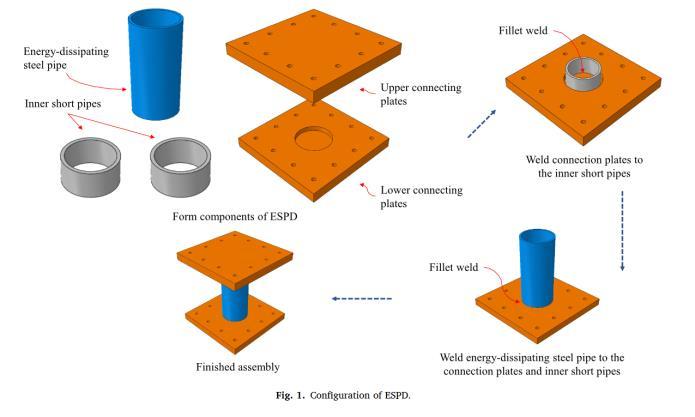
The configuration of ESPD is simple, consisting of two reinforcedsteelpipeslocatedontheupperandlowerend, oneenergy-dissipatingsteelpipe,andtwoconnectingplates, asshowninFigure1.Thereisnogapbetweenthereinforced steel pipe and the energy-dissipating steel pipe, thereby reinforced steel pipe can provide support to the energydissipating steel pipe. This configuration can delay the crackingoftheendoftheenergy-dissipatingsteelpipeand prevent the ESPD from losing its bearing capacity due to prematurecracking.
International Research Journal of Engineering and Technology (IRJET) e-ISSN: 2395-0056
Volume: 11 Issue: 07 | July 2024 www.irjet.net p-ISSN: 2395-0072
2.1 Geometrical and Material Properties of ESPD
The ESPD-70 is given structural steel as the material in ANSYS,asitsyieldstrengthis300MPa,Young’sModulusis 2.06×10⁵andpoisson’sratiois0.3. ESPD-70 Model was modelledusingANSYS2024Software.
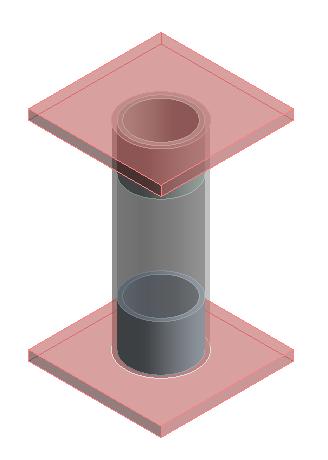

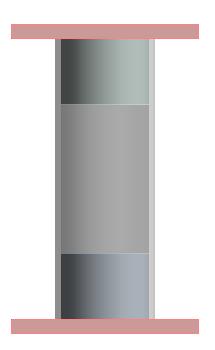
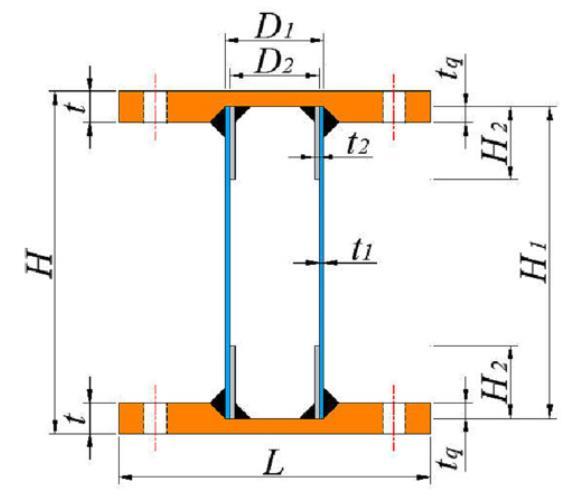
Fig -3:GeometricaldefinitionofESPD-70
Table -1: Geometricparametersoftestspecimens
SpecimenNo: ESPD-70(mm)
-2:DifferentviewsofESPD-70
2.2 Material Properties of Chevron braced frame with damper
Table -2: EngineeringDatasectionsofchevronbrace framewithdamper
Material
1 Beam and Column Isotropic Elasticity
EX 20,2000Mpa
PRXY 0.3
Bilinear Isotropic Hardening
YieldStrength 345Mpa
International Research Journal of Engineering and Technology (IRJET) e-ISSN: 2395-0056
Volume: 11 Issue: 07 | July 2024 www.irjet.net p-ISSN: 2395-0072
Tangent Modulus 0Mpa
2 Brace Isotropic Elasticity
EX 20,2000Mpa
PRXY 0.3
Bilinear Isotropic Hardening
YieldStrength 317Mpa
Tangent Modulus 0Mpa
3 Damper Isotropic Elasticity
EX 20,2000Mpa
PRXY 0.3
Bilinear Isotropic Hardening
YieldStrength 300Mpa
Tangent Modulus 0Mpa
Modelling and analysis of optimised section
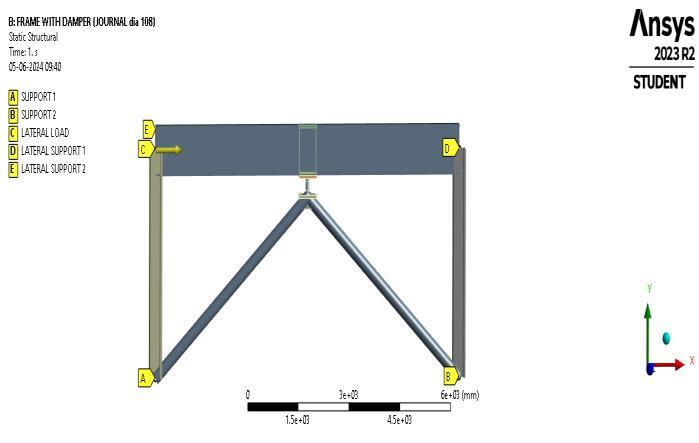
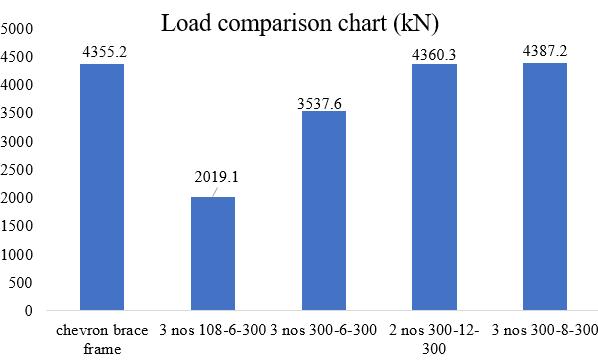
TheESPD-70whenconnectedwithchevronbracedframeit fails considerably and cannot take a load greater than required value. So, the optimization of this damper is required and by changing the different parameters of the section such as diameter,thickness etc we can find more effectiveandoptimizedonefortheseismicperformance.The mostoptimisedESPD-70isfoundtobeESPD-70with30012-3002NOSasitdenotesthediameter-thickness-heightof twodampers.
Table -3: Resultsobtainedfrompushoveranalysis
International Research Journal of Engineering and Technology (IRJET) e-ISSN: 2395-0056
Volume: 11 Issue: 07 | July 2024 www.irjet.net p-ISSN: 2395-0072
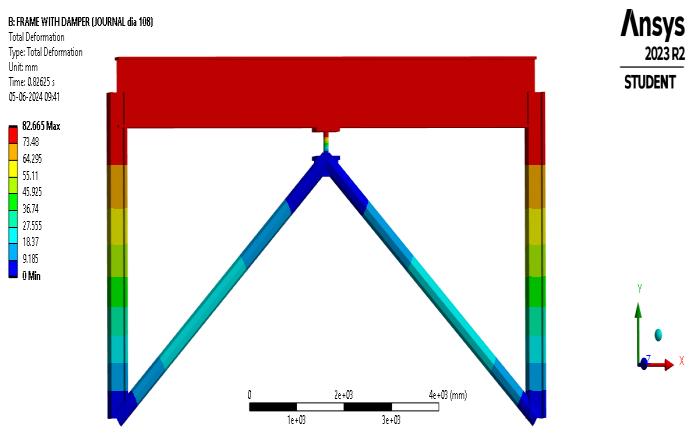
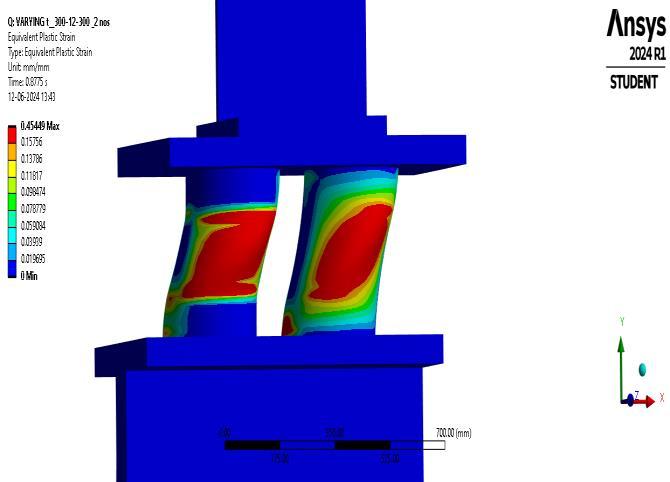
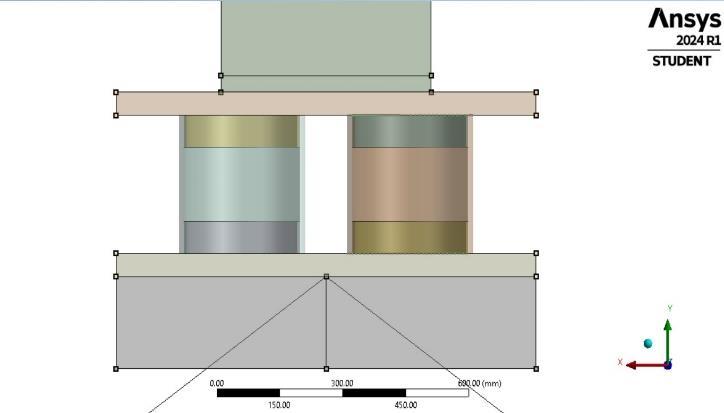
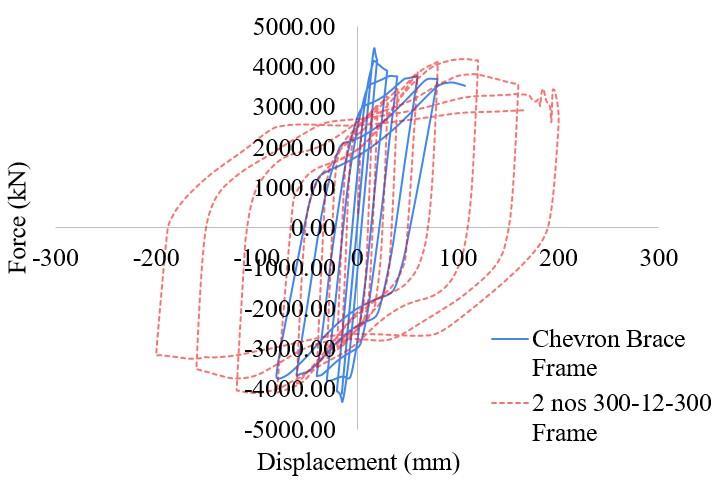
Cyclic analysis of Chevron-braced frames is crucial for evaluating their behaviour under repeated loading conditions, which is essential for understanding their performanceduringseismicevents.FEAiscommonlyused tomodelthecomplexbehaviourofChevron-bracedframes under cyclic loads. It allows for detailed simulation of material properties, geometric nonlinearities, and interactioneffects.
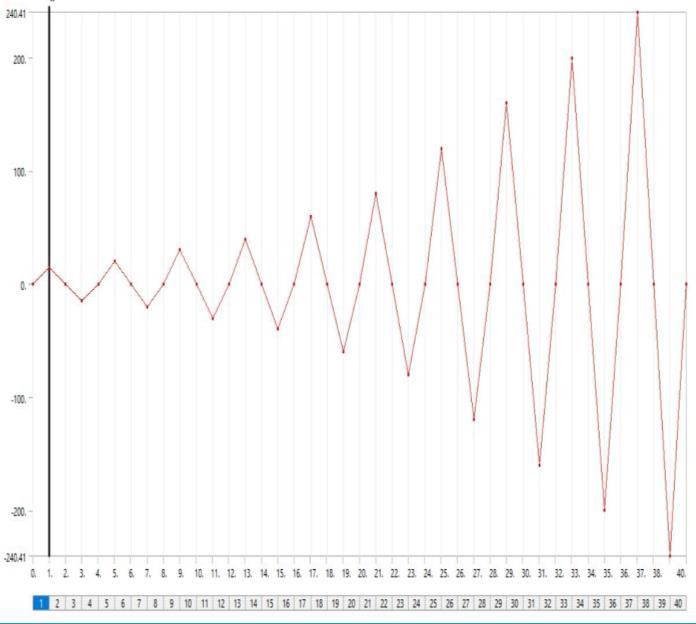
A detailed model of the Chevron-braced frame is created, incorporating the geometry, material properties, and boundaryconditions.Theframeissubjectedtoapredefined cyclic loading protocol, typically involving increasing displacementlevelsasshowninthefigure.
International Research Journal of Engineering and Technology (IRJET) e-ISSN: 2395-0056
Volume: 11 Issue: 07 | July 2024 www.irjet.net p-ISSN: 2395-0072
2.5 Time history analysis
Unlikesimplerstaticanalyses,whichconsideronlysteadystateloadingconditions,timehistoryanalysisaccountsfor the dynamic response of structures to transient or timevarying loads. The El Centro earthquake of 1940, which occurrednearthetownofElCentro,California,isaneventof great significance in the field of structural design for earthquake engineering. With a magnitude of 7.1 on the Richterscale,theearthquakecausedsubstantialdamageto structuresinthesurroundingareas,anditsparametersare now widely used as a reference for seismic analysis of structures. One of the primary reasons why the El Centro earthquakeisusedasareferenceearthquakeisthatitwas one of the first earthquakes for which strong motion data wasrecordedindetail.Thisdatawasusedtodevelopdesign codesandguidelinesforseismic-resistantstructures,suchas ASCE7andNEHRP,whicharestillinusetoday.
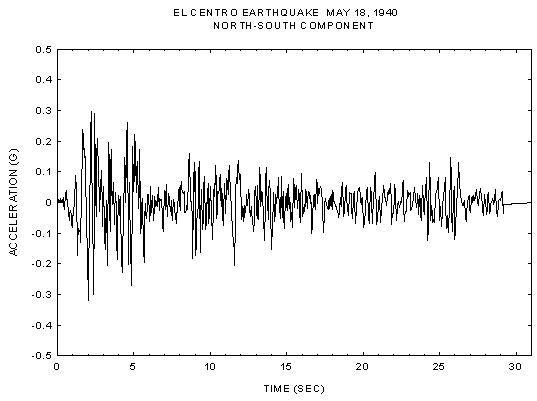
Fig -10:GroundaccelerationData-ElCentroEarthquake
ThelessonslearnedfromtheElCentroearthquakehaveled to the development of design codes and guidelines that ensure that structures remain stable during earthquakes, with the concept of ductility being a key consideration in
earthquake-resistant design. Its ground motion record continuestobeusedtotestandrefineseismicanalysistools and software, ensuring that structures are designed to be safeandresilientduringseismicevents
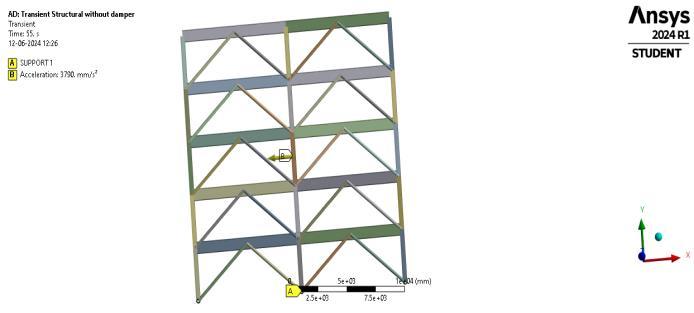
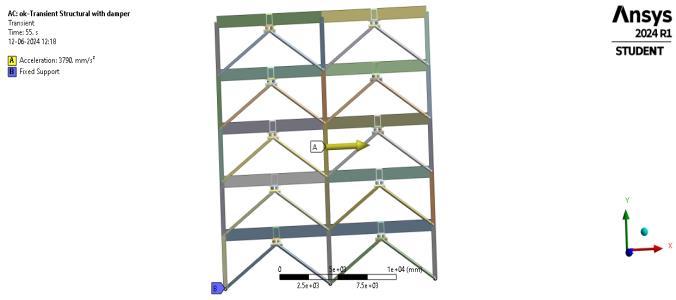
-12:Modellingofmultistoriedframewithoptimized damper
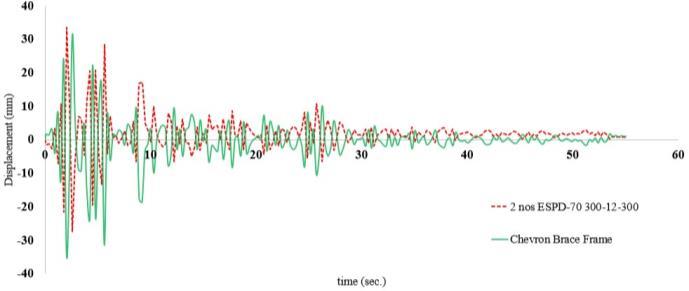
Fig -13:TimehistoryanalysisresultsofDisplacement response
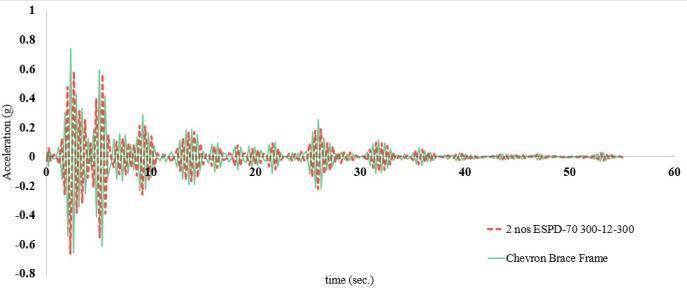
Fig -14:Accelerationtimehistoryresponsecurve
International Research Journal of Engineering and Technology (IRJET) e-ISSN: 2395-0056
Volume: 11 Issue: 07 | July 2024 www.irjet.net p-ISSN: 2395-0072
On the basis of Non-linear Analysis Results, the following conclusionscanbedrawn:
• Failure pattern comparison of ESPD-70 of experimentaldataandtheanalyticaldataisverified andfoundbothsbowsexactfailureplasticpatterns.
• From the hysteresis performance the maximum loadofbothshowsapercentageerrorof6.93%.
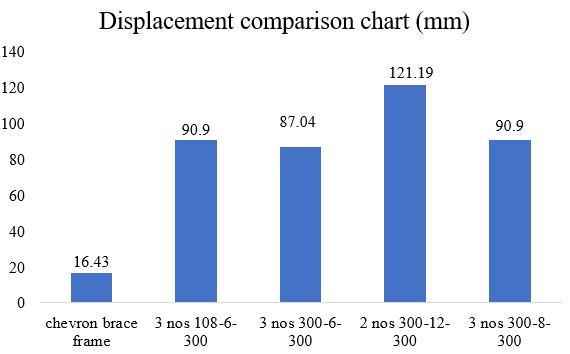
• SingleChevron-bracedframewhensubjectedtoa pushoveranalysisofdisplacement100mmtakea load upto 4355 kN,, then fails and deformed to 16.338mm.
• SinglechevronbraceframewithESPD-70canonly takeloadupto1637kNanddeformedto82mm.
• OptimisedsectionESPD300-12-3002NOS,when placed in a Chevron-braced frame produce better results when compared to the single Chevronbracedframeandcantakealoadof4360kNwhich isgreaterthanchevronframeanddeformedto121 mm.
• Ductilityofthestructure,when placedwithESPD 300-12-300 2 NOS, increased compared to the singlechevronframe.
• Yield stiffness of the structure increased to 47 % from274000N/mmto522000N/mm.
• ByconductingcyclicanalysisitisfoundthatESPD 300-12-300 2 NOS damper failure region can be seeninthecentreofthepipe.
• Leaf-like hysteresis loop of the frame with ESPD 300-12-300 2 NOS shows that the energy dissipationisdoneanditisanonlinearsolution.
• Energy dissipation capacity of the chevron brace framewithESPD300-12-3002NOSincreasedfrom 38kJsto173kJs.
• By modal analysis the frequency of both storied buildings is found to be 10.52 Hz in the chevron brace frame and 11.87 Hz in the ESPD inbuilt building.
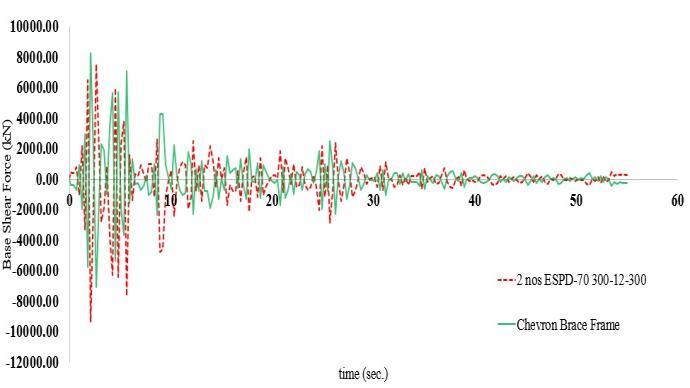
• By Time history analysis it is found out that the storeyaccelerationwasdecreasedto20.85%inthe ESPD frame and storey displacement, Base shear increasedto6.63%and12.74%.
For future research, several potential avenues can be explored:
:
o While this project altered only the diameter and thickness of the steel pipe damper, future studies could expand to includeotherparameterssuchasmaterial properties, length of inner pipes, and placement angles. This can help in understanding the broader performance spectrum of the ESPD under various conditions.
2. Alternative Installation Schemes:
o Thecurrentstudyutilizedchevron-braced frames.Futureresearchcaninvestigatethe effectiveness of ESPDs in other bracing configurations, such as X-bracing, Vbracing,orknee-bracing.Thiswillprovide a comprehensive understanding of the optimalinstallationmethodsfordifferent structuralrequirements.
3. Storey Drift Improvement:
o Additional studies could focus on the impactofESPDsonimprovingstoreydrift inmulti-storeybuildings.Byexperimenting with different damper placements and configurations, researchers can identify strategies to minimize inter-storey displacementsduringseismicevents.
4. Energy Dissipation Capacity:
o Further analysis can be conducted to evaluatetheenergydissipationcapacityof ESPDs under various bracing conditions. This involves testing and comparing the performance of ESPDs in different structural systems to identify the most efficient configurations for energy absorption.
International Research Journal of Engineering and Technology (IRJET) e-ISSN: 2395-0056
Volume: 11 Issue: 07 | July 2024 www.irjet.net p-ISSN: 2395-0072
o Application studies and simulations on real-time multi-storey buildings are essentialforvalidatingtheeffectivenessof ESPDsinpracticalscenarios.Thesestudies canincludetheassessmentofthedamper’s performanceunderactualseismicevents, wind loads, and other dynamic forces experiencedbytallbuildings.
By addressing these future research directions, the understanding of steel pipe dampers can be significantly enhanced,leadingtobetterimplementationstrategiesand moreresilientstructuraldesigns.
[1]Genquan Zhong, Zhiming He, Haobin Chen b, Yun Zhou “Seismicperformanceofend-reinforcedsteelpipedampers: Laboratory test and numerical investigation ” 2023. https://doi.org/10.1016/j.jcsr.2023.107994
[2] P.S Thapasya, Neeraja Nair “Study on Seismic PerformanceofBracedSingleStoreyFramedStructureUsing X-ShapedPipeDamper”2022.pp227–234
[3]RohithKRajan,SajiKP“NumericalInvestigationofCyclic Behaviour of Stainless Steel Ring Damper ” 2021. https://dx.doi.org/10.2139/ssrn.3976356
[4] Yong Li.Ye Liu, Zheheng Chen “Seismic response assessment of a hybrid coupled wall structure with novel self centering steel truss coupling beams” 2020. Volume18,pp2657–2680
[5]WeiGuo,XingyeWang,YujieYu,XueyuanChen,ShuLi, Wenbin Fang , Chen Zeng, Yang Wang , Dan Bu “ExperimentalstudyofasteeldamperwithX-shapedwelded pipe halves” 2020. https://doi.org/10.1016/j.jcsr.2020.106087
[6]ZhipengZhai,WeiGuo,ZhiwuYu,ChongjianHe,Zhefeng Zeng“ExperimentalandnumericalstudyofS-shapedsteel plate damper for seismic resilient application” 2020. https://doi.org/10.1016/j.engstruct.2020.111006
[7] Vandad Garmeh, Abbas Akbarpour, Mohammadreza Adibramezani,AtaHojatKashani,MahdiAdibi“Introducing andnumericalstudyofaninnovativerotationaldamperwith replaceable hourglass steel pins” 2019. https://doi.org/10.1016/j.istruc.2021.05.072
[8] P.C. Ashwin Kumar, Dipti Ranjan Sahoo, Abhay Kumar “Seismic response of concentrically braced frames with staggered braces in split-x configurations” 2018. https://doi.org/10.1016/j.jcsr.2017.12.005
[9]AbdullahCheraghi,SeyedMehdiZahrai“CyclicTestingof Multi-Level Pipe in Pipe Damper” 2017. https://doi.org/10.1080/13632469.2017.1387191
[10] Ahad Javanmardi, Zainah Ibrahim, Khaled Ghaedi, HamedKhatibi“Numericalanalysisofverticalpipedamper” 2017.pp2967-2973.
[11]SaeedMahjoubi,ShervinMaleki“Seismicperformance evaluation and design of steel structures equipped with dual-pipe dampers” 2016. https://doi.org/10.1016/j.jcsr.2016.01.023
[12]AlirezaHeysami“TypesofDampersandtheirSeismic Performance During an Earthquake” 2015. https://doi.org/10.12944/cwe.10.special-issue1.119
[13] Tarek Edrees Saaed,George Nikolakopoulos,Jan-Erik Jonasson,Hans Hedlund “A state-of-the-art review of structural control systems” 2015. https://doi.org/10.1177/1077546313478294
[14]ShervinMalekia,SamanBagheri ”Pipedamper,PartI: Experimental and analytical study ”2010. https://doi.org/10.1016/j.jcsr.2010.03.010
[15] Sang-Hoon Oh,Young-Ju Kim, Hong-SikRyu“Seismic performanceofsteelstructureswithslitdampers”2009. https://doi.org/10.1016/j.engstruct.2009.03.003