
International Research Journal of Engineering and Technology (IRJET) e-ISSN: 2395-0056
Volume: 11 Issue: 07 | July 2024 www.irjet.net p-ISSN: 2395-0072

International Research Journal of Engineering and Technology (IRJET) e-ISSN: 2395-0056
Volume: 11 Issue: 07 | July 2024 www.irjet.net p-ISSN: 2395-0072
Ghefar Alrefai 1 , Yahia Fareed 2 , Mohammad Samir Modabbes 3
1 Postgraduate Student (PhD), Communication Engineering department, Faculty of Electrical and Electronic Engineering, University of Aleppo, Aleppo, Syria
2 Professor, Communication Engineering department, Faculty of Electrical and Electronic Engineering, University of Aleppo, Aleppo, Syria
3 Professor, Communication Engineering department, Faculty of Electrical and Electronic Engineering, University of Aleppo, Aleppo, Syria.
Abstract - Managing wireless infrastructure is very essential and crucial after natural disasters such as earthquakes, hurricanes, landslides or man-made disasters such as wars. Rapid information gathering after a disaster helps in achieving effective communication management, as the pressure of users to maintain constant communication withfamilyandfriendscausesbottlenecksandcommunication failures for other users. Device-to-device (D2D) communicationtechnologyreducesthispressurebyrelyingon the proximity of users, thus increasing the efficiency of spectrum utilization. A many-to-many matching algorithm with an adaptive splitting factor and reuse factor was proposed for two scenarios and the results were evaluated using MATLAB simulation software. The results showed that the proposed algorithm outperforms the recently used GaleShapley matching algorithms in achieving effective managementofradioresourcesinemergencysituations,and it also succeeded in improving productivity and serving a larger number of users effectively.
Key Words: Mobile, D2D, MILEACH, CH, Disasters, 5G
Ensuring continued communications is one of the top priorities after a natural disaster such as an earthquake, hurricane,etc.Governmentstendtogatherinformationas quicklyaspossibleat the disastersite, soit is essential to manage the wireless network infrastructure efficiently to help rescue workers or people in the same disaster area communicatewithpeopleoutside[1].Communicationsmay bedisruptedafteradisastereitherduetodamageordueto thepressurecausedbythelargenumberofcallsusersmake to family and friends. Device-to-Device (D2D) communications technology helps reduce the number of callsbytakingadvantageoftheproximityandcommunicate directlybypassingEvolvedNodeB(eNB)orNext-Generation Node B (gNodeB), and thus enhances the capabilities of
wireless networks, especially in the areas of 5G and subsequentcellularsystems[2].
Emergency communications systems are typically designed to transmit information across multiple types of devices, from light signals to text messages to live video streaming, with the goal of creating a unified communications system that aims to improve communications during emergencies. Unlike emergency notification systems, which generally deliver emergency information in one direction, emergency communications systemsaretypicallyabletoinitiateandreceiveinformation frommultiplepartiesandavarietyofsourcesandlocations, fromwhichthesystemwilldisseminatethisinformationto oneormoretargetaudiences[1].
The post-disaster areas can be classified into coverage areas and out-of-coverage areas. Cellular users can communicatewitheachotherunderthecoverageofthebase station, while users outside the coverage area resort to multi-hopD2Dcommunicationstocommunicateorwithin thesamecoverageareabutdependingontheclosedistance betweenusers[3].
AftertherecentearthquakedisasterinSyriaandTurkey, the cellular communications network in the disaster area collapsed,andwhetherthecollapsewaspartialorcomplete, it caused delays in emergency response and saved many lives. Social media such as Facebook launched the Safety Checkfeature,allowingpeopletoupdatetheirsafetystatus tofamiliesandfriendsduringadisaster[4].Itwasnotedthat ontheground,localsdidnothavethecapacitytocollectand sort through the large amounts of information coming in, leadingtoconfusionduetocellphonelimitations.
D2D communications use millimeter waves (mmWave) frequencybandfrom3GHzto300GHz,complementingthe frequencybandscurrentlyinusefrom300MHzto3GHz.
International Research Journal of Engineering and Technology (IRJET) e-ISSN: 2395-0056
Volume: 11 Issue: 07 | July 2024 www.irjet.net p-ISSN: 2395-0072
Althoughshort-rangeD2Dconnectionscantransmitdataat arateofseveralgigabitspersecond,theysufferfromhigh propagationlossandpoorpenetrationthroughobstacles[5].
Non-orthogonal multiple access (NOMA) has recently beenpromotedasapivotaltechnologyfor5Gnetworksand severalstudieshavedemonstrateditsimportancecompared totraditionalorthogonalmultipleaccess(OMA)models,asit allowssimultaneousaccesstoresourcesbydifferententities, which increases spectral efficiency through advanced decoding strategies, particularly sequential interference cancellation(SIC)[6].Thecomplexityofpowerdistribution within NOMA frameworks increases, especially when combinedwithD2Dcommunications,asthechallengearises in intelligently distributing power among users, given the many variables, such as user density, individual channel dynamics,andoverallsystemtopology[2].
Power distribution among users is also related to fair access to radio resources, and addressing this is also not easyduetotheinherentpowerdisparitiesamongusersand their different locations within the network or channel dynamics, and giving them a balanced share of resources needs special attention when a disaster occurs. Energy Efficiency(EE),whichismeasuredastheratioofrelevant informationtransmittedtothetotalenergyexpended,isalso affected by power distribution strategies and is a very importantparameterinpowerdistributionstrategiesthat aimtoachieveacompromisebetweenenergyconservation andmaximumsystemperformance,ensuringthelongevity ofthenetwork[7].
Basedonthecapabilitiesof D2Dcommunicationsin5G networks, this paper strives to address radio resource allocation and power control to enhance network performanceandensureEE.Ourcontributioninvolvesthe deploymentoftheproposedalgorithmwithinthemulti-cell hybridmultiple-access(MC-HMA)frameworksupposedin [13] for two scenarios in system model. The following sections will elaborate on the proposed algorithm and compare it with other resource allocation algorithms to demonstrateitseffectivenessinemergencysituations,which isthefocusofourresearch.
ThefieldofD2DcommunicationinsynergywithNOMAis an important research area that attracts researchers, especiallywiththeincreasingdemandforhigh-densitydata transmission,theincreasingnumberofusersinthenetwork, and the increasing occurrence of disasters and network congestion. Our research builds on these fundamental studies,extendstheirconcepts,andaddressestheirgaps.
Researchers in [8] proposed a resource allocation algorithm based on Gale algorithm to effectively solve the resourceallocationproblemofD2Dusersinmultiplecellular user channels in heterogeneous cellular network
environments by adjusting the signal-to-interference-tonoiseratio(SINR)threshold.TheyusedKuhn-Munkres(KM) algorithm to achieve the optimal matching between D2D groupsandcellularchanneltomaximizethetotalcapacityof D2Dusers.
HMILA,et.al[9]improvedtheenergyefficiencyofdeviceto-multi device (D2MD) wireless communications. The optimization focused on optimizing both unicast and multicast D2D communications through a multi-objective optimizationframework.ThemodelincludesSICoperations inthedecoders,sothathigherratescanbeachievedwhen multiple sources transmit on the same channel(s). This approachisparticularlyrelevanttoourresearchbecauseit highlightstheimportanceofefficientpowerusageinMD2D networks,akeyconsiderationinouralgorithm’sdesign.
In [10] Logeshwaran et. al proposed an intelligent performance analysis of energy-efficient resource optimization model for D2D communication in fifthgeneration (5G). The proposed energy-efficient resource allocation model (EERAM) helped to reduce energy consumptionandextendthelifespanofdevices.
Elmadina, et.al, focused in [11] on the downlink power allocation of a cognitive radio-based NOMA system in a femtocellwithD2Dcommunications.Theproposedscheme used the Greedy Asynchronous Distributed Interference Avoidance(GADIA)algorithmtomitigateinterferenceand allocatepowerefficientlybasedonthefairnessindex.The analysis results of the proposed Maximum Rate Under Fairness (MRF) algorithm showed an improvement in the systemperformancewhileprovidingfairnessamongusers. Theresultsofthisalgorithmwerespecifictoaspecificcase, non-emergency and did not address the complexity that could arise when the number of users increases and the radiochannelsbecomefewerandmorevariable.
Finally,theresearchersin[12]delvedintoanapproachto enhance power allocation and throughput in 5G cellular systems,withtheaimofconservingresourcesandensuring connectivity through direct end-to-end connections using thedevice-to-deviceprotocolandthemodifiedGale-Shapley algorithm. The robustness of the proposed approach was testedintwoscenarios:thefirstinstandard5Goperations thatfocusesonminimizingpowerusagewhilemaximizing signalreliability,andthesecondindisaster-inducednetwork outages.
Our research is in line with these studies by providing innovative solutions for resource allocation in 5G D2D networks in disaster situations with the aim of improving overallnetworkperformance.Byreviewingandbuildingon these diverse studies, our research will contribute to providing a solution that helps in continuing communicationsinemergencysituationsbysharingradio resources with less interference and more equitably between cellular users (CUs) and D2D users (DUs) in
International Research Journal of Engineering and Technology (IRJET) e-ISSN: 2395-0056
Volume: 11 Issue: 07 | July 2024 www.irjet.net p-ISSN: 2395-0072
disastersituationswithintheMC-HMAframeworksupposed in[13].
5Goffersgreatpotentialbutisabitcomplex,thebiggest challengeisthescarcityofradioresourcesandtheallocation ofpowertotheverymanyuserswithinthecoveragearea. Theallocationofpowerwithintheavailableresourcesisa pivotalfactorthataffectstheefficiencyofdatatransmission. Theaimofourresearchistofocusontheresourceallocation touserslocated ina disaster-prone area that rely on D2D communications.
We have presented the contributions of researchers in this field, but emergencies or disasters have their own circumstancesandchallenges,andtheaffectedareaimposes variableconstraintsdependingonthedisastersituation,so theresourceallocationalgorithmmustbedynamicandthe preferencelistthatresearchershavereliedonmustbemore flexible,otherwisetheattempttocontinuecommunications in these difficult situations will fail. Ensuring optimal distributionofradioresourcesbetweenCUsandDUsisvery difficultindisastersituationsbecausedemandforresources exceedssupply.
Wewilldeploythedynamicandgreedyalgorithmforthis purpose within NOMA framework. Although it does not guaranteeoptimality,itadaptstocurrentstateandwecan relyonittoreachthebestsolutioninourcase.
In this paper, we will adopt the concept of in-band underlayD2Dcommunication,whereD2Dpairsshareradio resourceswithCUs.ThedisasterareawillcontainD2Dpairs thatcommunicatewitheachotherbasedonproximityand transmit data within dedicated radio channels. We will considertwoemergencyscenariosasshowninFig-1:
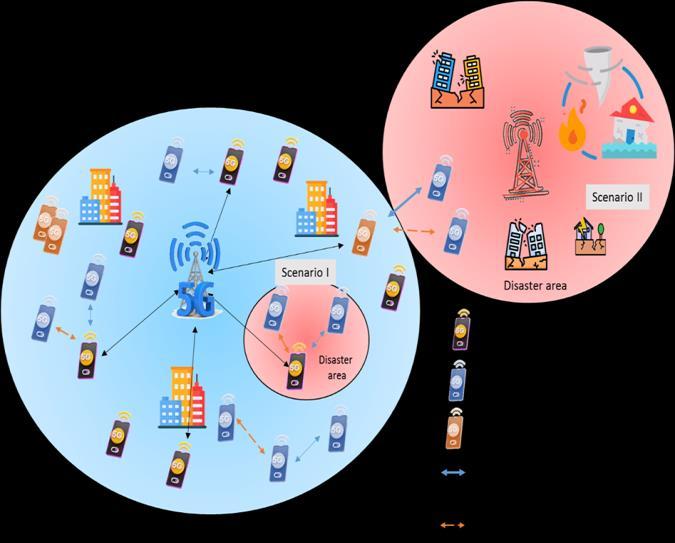
First:Thebasestationisworkingwell,butisunderheavy pressure and there is a very high demand for radio resources.Somecellularusers(especiallydevicesfarfrom the base station that need more transmission power than nearbyusers)willchangethecommunicationmodetoD2D mode in order to relieve the pressure on the cellular networkandrelyonproximity.
Second: Some devices go out of service due to a malfunctionofthebasestationandsomenodeswithgood coverage start working as relays to help devices communicateindisasterareas.
Such emergency situations are not ideal, in these cases basestationsfacetechnicalfailureorenvironmentalfactors, and the number of ongoing communications is required more than ever, and here the possibility of interference between channels increases, in addition to user mobility, which increases the difficulty of service stability, and also maintainingastabledatatransmissionratethroughoutthe disaster.
ThechannelmodelusedinoursystemisRayleigh,which takes into account several factors such as path loss and multipathfading.Thebasestation(gNodeB)isassumedto beawareofthechannelstateinformation(CSI)oftheD2D links,andcontrolchannelsarerequiredtosendCSIfeedback tothegNodeB.D2DusersrelyonSICtocancelinterference from neighboring DUs. This technology is particularly important in a NOMA network, where signals are superimposed with different power levels and decoded sequentiallyatreceivers[12].
When designing an algorithm for radio resource allocation,weviewitasafunctionthattakesintoaccount several parameters, which are DUs, CUs, and downlink or uplinkchannels.NonServedGroup(NSG)isforunmatched DUs.Thepreferredpairingiswhichcausestheleastpossible mutual interference for users according to the proposed many-to-many matching algorithm for the first scenario showninFig-2
International Research Journal of Engineering and Technology (IRJET) e-ISSN: 2395-0056
Volume: 11 Issue: 07 | July 2024 www.irjet.net p-ISSN: 2395-0072
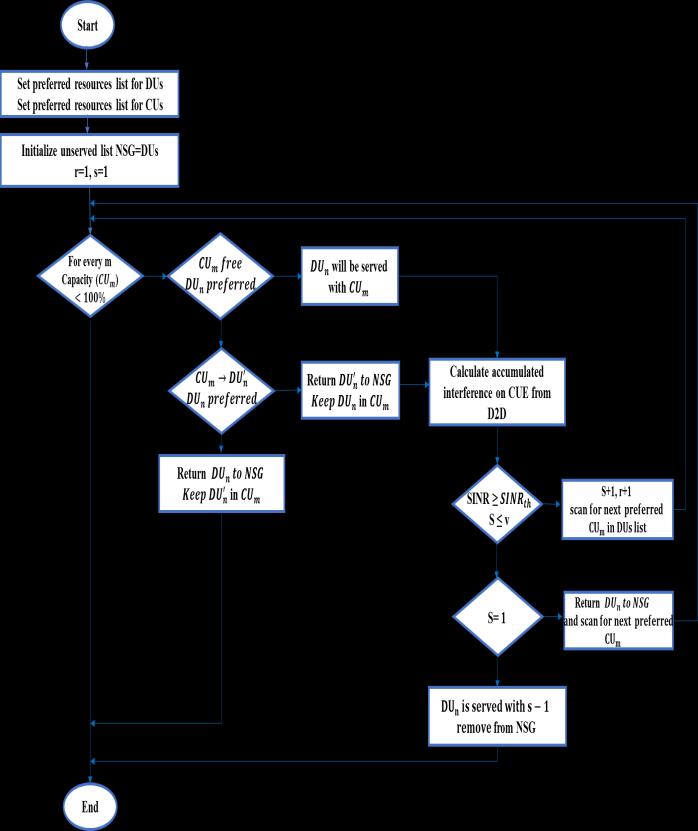
Fig-2: Flowchartoftheproposedpairingalgorithmfor Scenario-I.
Thetrade-offforchoosing thebest channel dependson the total interference received on each DUn group when usingtheCUmchannelwiththefollowingequation[9]:

The of interference for each cellular user CUm is measuredbythefollowingequation[9]:
Thisalgorithmisadopted tomatchrandomsetsofDUs andCUs,andthetrade-offtakesthesameformasthemanyto-one relationship with the addition of a condition regardingthesplittingfactors(whichissharingD2Dpairs withmorethanonechannelforcellularusers)whichis:
For example, if we try to allocate DU2, which has similar preferencestoDU1,butitisclearfromtheCU4groupthat DU2ismorepreferredthanDU1,thefirstDUisremovedand returnedtothelistofmismatchedgroup(NSG).
D2Dcognitivecommunicationshavebecomeincreasingly important with the advancement of wireless communicationsbecausetheyusecognitivestrategiesthat enhance efficiency and adaptability. The integration of cognitive processes into D2D communications allows for more intelligent and efficient use of radio spectrum resources. The cognitive cycle in D2D communications includes several stages, including spectrum discovery, decision-making, and adaptation. Thus, D2D devices can intelligently analyze their environment, make informed decisions about spectrum usage, and adapt their communication strategies accordingly. This is especially important in disaster scenarios where dynamic spectrum access is essential. In emergency situations where D2D communicationsoperateindependentlyofthebasestation, userdevicesundergoseveralkeycontrolfunctions,namely [12]:
Devicediscovery:Theydiscovereachotherthrough specific protocols or technologies, allowing for efficientanddirectcommunicationwithoutcentral coordination.
Mode selection: Devices decide whether to communicatedirectly(D2Dmode)orthroughthe base station (cellular mode) based on various factors, such as signal strength, proximity, and networkconditions.
Resourceandenergyallocation:Withoutacentral coordinating authority, D2D devices allocate resources (such as spectrum and channels) and energy among themselves using algorithms or strategies designed for efficient and fair distribution.
Thisscenarioaimstosimulatethereal-worldchallenges of an earthquake or natural disaster in which urban 5G networks are partially destroyed or damaged. There are somepointsthatgreatlyaffectthestudyofthisscenario:
1. The demand for voice calls increases with the high density of users, not to mention the potentialinterferenceproblems.
2. Usermobilitythataffectsnetworkstabilityand reliabilityofD2Dcommunications.
where refers to the matching function, s is the splitting factorandrisreusefactor.
The allocation remains open to any adaptive update, meaningthatifdifferentDUs wanttousetheRBsandthe second DUpairis more preferred,theswap will be made.
3. Quality of service under difficult urban conditions.
4. Maintaining high data rates and stable connectivity.
International Research Journal of Engineering and Technology (IRJET) e-ISSN: 2395-0056
Volume: 11 Issue: 07 | July 2024 www.irjet.net p-ISSN: 2395-0072
Fig-3 shows flow chart of the proposed algorithm for servingDUsinout-of-coveragedisasterareaforthesecond scenario.
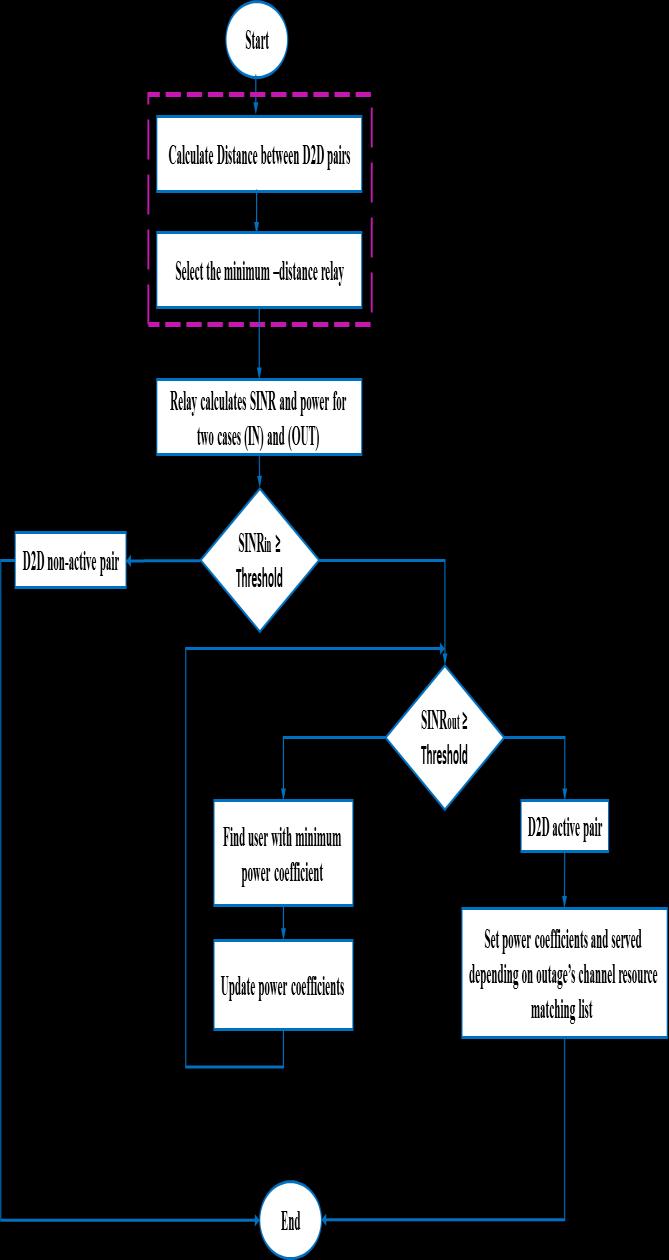
Fig-3: Flowchartoftheproposedpairingalgorithmfor Scenario-II.
In discovering stage, the distance between DUs and the relaysismeasuredtochoosetheshortestdistancebasedon Euclideanequation[12]:
(5)
Next,theSINRiscalculatedusingformula(6)[1],poweris allocated to DUs and CUs based on the expected transmissionrate(theminimumneededtomakeatleasta voicecall).

(6)
whereSisthepoweroftheincomingsignal,Iisthepower oftheothersignals’interferenceinsidethenetwork,andN tobethenoise.ThisSINRmetricisthenusedtocomputethe channelcapacity:
(7)
where W is the bandwidth. When the transmission is basedonarelay,thecommunicationwillbedividedintotwo D2Dstages,whichwewillcallINandOUT,asshowninthe followingFig-4.
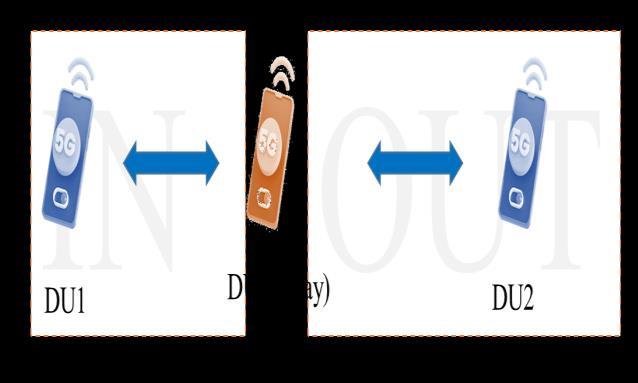
Fig-4: D2DdiscoverywithRelay.
Thepathlossbetweentwodevices,DU1andDU2(relayor anothernearDU),isgivenas[12]: (8)
where d represents the distance between the devices accordingequation(5),andfcdenotesthefrequency.
Thesimulationwillbeforasystemconsistingofmicrocell, withinwhichD2Dcommunicationscontinueinadditionto cellularcommunications,andthebasestationislocatedin themiddleofthiscellasshowninFigure.5.CUsandDUsare spatially distributed following a standard homogeneous Poissonpointprocess(PPP)[14].Theproposedalgorithm aims to improve the overall performance by allocating power resources in two scenarios, and evaluating the performancebasedonthemutualinterferenceratioandthe proximityofthetransmittersandreceivers.Wereliedonthe MATLABsimulationprogramforitsefficientmanagement and excellent computational capabilities. The following Table-1summarizestheparametersusedinthesimulation.
Table -1: SimulationParameters.
Parameter
Value
CellRadius 500meters
gNodeBPosition (500,500)
No.CUs 125
No.DUs 125
Frequencyforpathloss 28GHz
Reusefactor(r) 1~3(adaptive)
Splitfactor(s) 1~3(adaptive)
Pathlossexponent 3(urban)
International Research Journal of Engineering and Technology (IRJET) e-ISSN: 2395-0056
Volume: 11 Issue: 07 | July 2024 www.irjet.net p-ISSN: 2395-0072
Thebasestationislocatedinthemiddleofthestudiedcell and the primary transmission medium is air, which has uniform free space losses. We adopt the mmW band (28 GHz).ThelocationsofcellularandD2Duserschangeineach iterationandduringacertaintimeperiod.
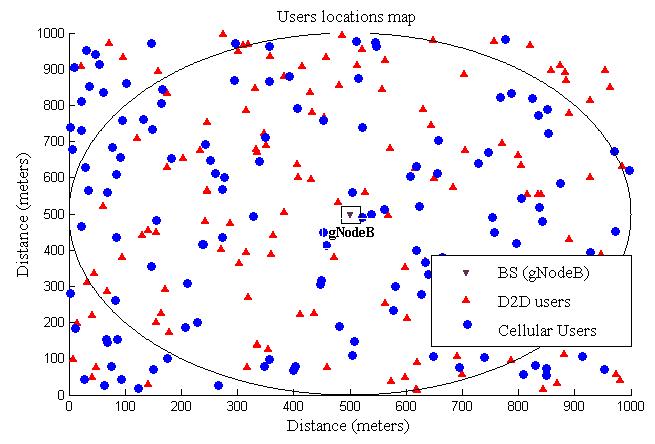
Fig-5: D2DdiscoverywithRelay.
5.1 Results discussion for Scenario-I
As can be seen from the results of the Chart -1, the aggregate rate increases significantly with the proposed algorithm compared to the algorithm proposed in [12], which is based on each cellular user sharing his radio resourceswithonlyoneD2Duser,whereasinourproposed algorithmitisadaptiveandthesplittingandreusefactorcan becontrolledaccordingtothecapacitiesofthesharedradio resources.Channel reusemeansthatreceiverscanexploit SICtodecodeweaksignals.
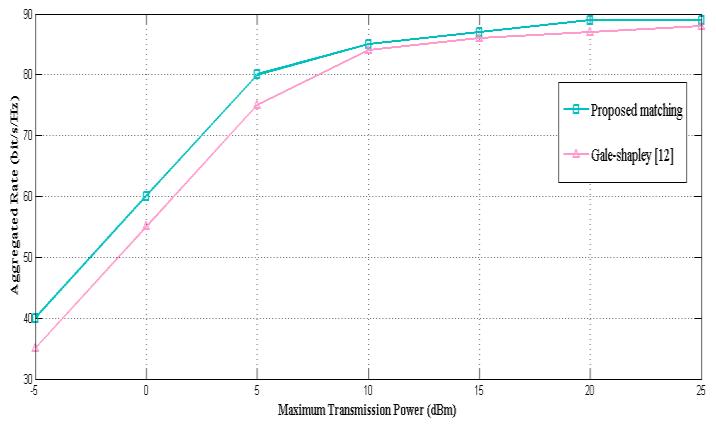
Chart -1: Aggregatedrateusingmany-to-manymatching.
ThefollowingChart-2showsthetotalamountofenergy consumed in the proposed algorithm and [12], which confirms that the proposed algorithm is resistant to the
amount of interference by relying on SIC technology and distributingpowerfairlyamongusersanditsabilitytoserve alargernumberofusers.
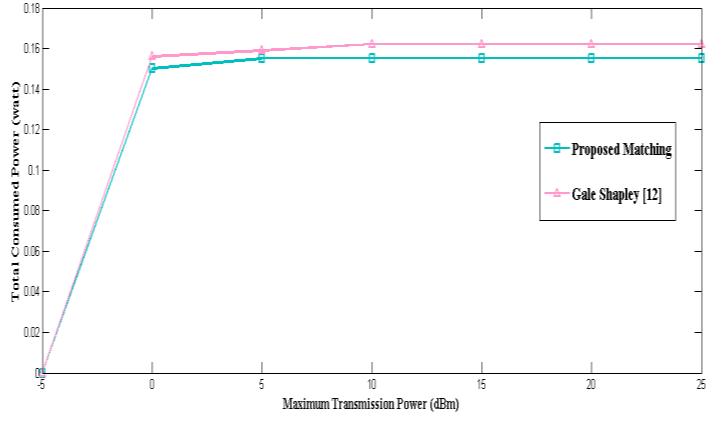
Chart -2: Consumedpowerfordifferenttransmission powerlevels.
The proposed algorithm was able to reduce the power required to serve the users by relying on proximity and reducingtheinterferencebyrelyingontheSICadoptedin the downlink-NOMA system. This is the goal behind the proposed resource allocation algorithm to ensure the continuity of communication for users in emergency situations.
The second scenario is a special case of the first, but it leads to an additional responsibility to increase the total numberofusersbenefitingfromoutsidethecell,andthus additionalburdensandtheexpectedimpactonthequalityof service.Therefore,thissensitiveprocessmustbedynamic, asitisnotrequiredheretosearchforperfectionasmuchas tosecuretheservicefortheremaininguserslocatedwithina disasterareaandwithoutbasestationcoverage.
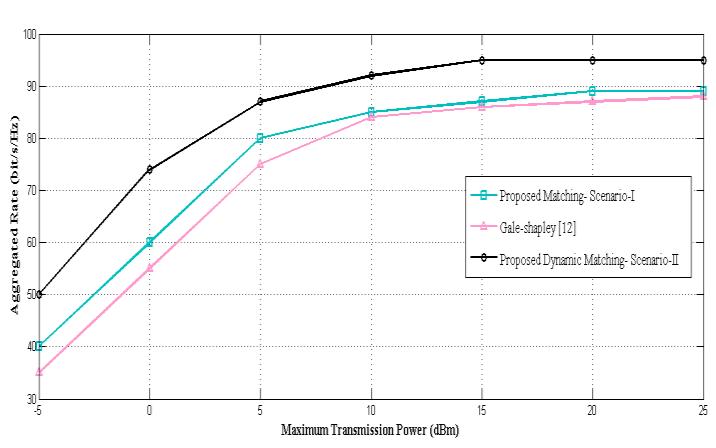
Chart -3: Consumedpowerfordifferenttransmission powerlevels.
International Research Journal of Engineering and Technology (IRJET) e-ISSN: 2395-0056
Volume: 11 Issue: 07 | July 2024 www.irjet.net p-ISSN: 2395-0072
The total data transmission rate will certainly increase whenadditionalusersareserved,andheretheimportance of the NOMA framework becomes more evident in eliminating the interference caused by sharing radio resources with D2D users. According to reference [9], the NOMAsystem'sgaininthedownlinkisclearlygreaterwhen thereusefactorrislargerbecauseitallowsmorefreetouse ofchannels.
Theaimofthisresearchwastomaximizetheefficientuse of radio resources in emergency situations, which we dividedduringourstudyintotwoscenarios,oneofwhichis that the users' devices in the disaster area are under the coverage area of the cell, but there is a pressure on the communications,sosomeuserschangethecommunication modetoD2Dandsharetheresourceswiththecellularusers accordingtoanadaptivemany-to-manymatchingalgorithm with a splitting factor and an adaptive reuse factor to maintain a specific interference level, while the second scenarioismoredifficult,wheretheserviceextendstothe vicinityofthecellandtheuserusestheneighboringdevices asrelaysandconnectstothembasedonD2Dtechnologyto reach the radio resource that guarantees him continued communication with the least possible interference. Our study preserves scarce network resources in emergency situations and enhances D2D communications, leading to morerobustandreliabledatatransmission.Thisisproven bytheresultsshownforourproposedapproachtoimprove theperformanceandreliabilityof5Gsystemsinemergency situations. The proposed algorithm is promising for the futureof5Gnetworks,asitintegratesD2Dcommunications withcellularcommunicationsforthesakeofalargedevice density in a city crowded with devices, which is the most difficultcase.
[1] OmarAA,NadarKP,VivekanandCV,DeviEA,Xavier AJ,InbamalarTM,TheraseLM,VanithaJ,SoniaCA, Rose JB. (2024). Performance evaluation of pair selection algorithms in device to device communication using relay assisted techniques. EURASIPJournalonWirelessCommunicationsand Networking. https://doi.org/10.1186/s13638-024-02336-w
[2] Zhang R, Liu L, Li H, Chen X. (2016). Resource allocation in D2Denabled cellular networks with fractional frequency reuse,’’ IEEE Trans. Veh. Technol.,vol.65,pp.8933–8946.
[3] Chakraborty C, Rodrigues JJCP. (2020). A comprehensive review on device-to-device communication paradigm: trends, challenges and applications.Wirel.Pers.Commun.114,185–207.
[4] (2016). Safety Check. Facebook. https://www.facebook.com/about/safetycheck/
[5] AteyaAA,MuthannaA,VybornovaA,Koucheryavy A.(2017). Multi-level Cluster Based Device-toDevice(D2D)CommunicationProtocolfortheBase Station Failure Situation. Springer International PublishingAG. https://doi.org/10.1007/978-3-319-67380-6_71.
[6] Wu Q, Chen S, Li G. (2017). An iterative power allocationalgorithmforfairnessinnon-orthogonal multipleaccess,’’IEEETrans.Veh.Technol.,vol.66, pp.5685–5697.
[7] Chun YJ, Cotton SL, Dhillon HS, Ghrayeb A, Hasna MO. (2017). A stochastic geometric analysis of device-to-device communications operating over generalizedfadingchannels,’’IEEETrans.Wireless Commun.,vol.16,no.7,pp.4151–4165.
[8] SaraerehOA,MohammedSL,KhanI,RabieK,Affess S.(2019).AnEffcientResourceAllocationAlgorithm for Device-To-Device Communications. Appl. Sci., vol.9,no.18.
[9] Hmila M, Fernández-Veiga M, Rodríguez-Pérez M, Herrería-AlonsoS.(2021).Non-orthogonalmultiple access for unicast and multicast D2D: Channel assignment, power allocation and energy efficiency,’’Sensors,vol.21,no.10,p.3436. https://doi.org/10.3390/s21103436
[10] Logeshwaran J, Shanmugasundaram N, Lloret J. (2023).Energy-efficientresourceallocationmodel fordevice-to-devicecommunicationin5Gwireless personalareanetworks. https://doi.org/10.1002/dac.5524
[11] Elmadina NN, Saeed R, Saeid E, SayedAli E, Abdelhaq M, Alsaqour R, Alharbe N. (2023). Downlink Power Allocation for CR-NOMA-Based Femtocell D2D Using Greedy Asynchronous Distributed Interference Avoidance Algorithm. Computers,vol.12,no.158. https://doi.org/10.3390/computers12080158
[12] ALRUWAILIM,KIMJ,OLUOCHJ.(2024).Optimizing 5G Power Allocation With Device-to-Device Communication: A Gale-Shapley Algorithm Approach.IEEEAccess. https://doi.org/10.1109/ACCESS.2024.3369597
[13] EBRAHIM A, CELIK A, ALSUSA E, BAIDAS MW, ELTAWILA.(2023).HybridMultiple-Access:Mode Selection, User Pairing and Resource Allocation. IEEEAccess. https://doi.org/10.1109/ACCESS.2023.3320640
International Research Journal of Engineering and Technology (IRJET) e-ISSN: 2395-0056
[14] Ak S, Inaltekin H, Poor HV. (2018). A Tractable Framework for the Analysis of Dense Heterogeneous Cellular Networks. IEEE TransactionsonCommunications,vol.12. https://doi.org/10.1109/TCOMM.2018.2808353
BIOGRAPHIES


Volume: 11 Issue: 07 | July 2024 www.irjet.net p-ISSN: 2395-0072 © 2024, IRJET | Impact Factor value: 8.226 | ISO 9001:2008
MissGhefarAlrefai PhDstudent
Communication Engineering department
FacultyofElectricalandElectronic Engineering,UniversityofAleppo.
Mr.YahiaFareed Professor
Communication Engineering department
FacultyofElectricalandElectronic Engineering,UniversityofAleppo
Mr.MohammadSamirModabbes Professor
Communication Engineering department
FacultyofElectricalandElectronic Engineering,UniversityofAleppo.